The recent bust of a worldwide international paedophile ring using Bitcoin payments highlighted one of the key fears surrounding crypto-currencies -- their use by criminals.
Social networking giant Facebook is keen to get in on the act by launching a digital currency called Libra.
But US Treasury Secretary Steven Mnuchin has aired his ongoing opposition to the move, saying many concerns remained unresolved, including "the issue of money laundering".
Despite tighter regulations and increased vigilance by the authorities, illegal activities related to virtual currencies remained "significant", Madeleine Kennedy, from the research firm Chainalysis, told AFP.
- 1% of transactions illegal -
A Chainalysis report published in January said that in 2018, one percent of Bitcoin transactions -- the most widely used cryptocurrency -- involved illegal activities.
The equivalent of $600 million was also spent using Bitcoins on the dark web, a set of hidden networks where a multitude of illicit products, including weapons and drugs, are traded.
In comparison, the global turnover of drug trafficking is estimated at several hundred billion dollars.
Kennedy believes the use of Bitcoins for criminal purposes was partly based on a "misunderstanding".
The confidentiality reputation of the most famous cryptocurrency is unrivalled, with all transactions recorded in an unforgeable public ledger, the blockchain.
But it is "more transparent than some traditional financial systems and certainly more than cash", she added.
The British and US authorities last week announced more than 300 arrests in 38 countries as part of an investigation that led to the dismantling of an unprecedented child pornography ring.
Investigators analysed the blockchain and succeeded in "de-anonymising Bitcoin transactions," according to Ron Fort, the head of criminal investigations in the US tax services.
- Concerns about Monero -
But if Bitcoin is still the reference currency for criminals because of its popularity, they are turning to less transparent alternatives, such as Monero, which began life in in 2014, according to the European law enforcement agency Europol.
Monero's users can remain anonymous until they need to interact with a cryptomarketing platform or invest their funds with a "wallet" -- the equivalent of an account for virtual currencies.
GETTY IMAGES NORTH AMERICA/AFP / WIN MCNAMEE Facebook chief Mark Zuckerberg has tried to shield Libra from the crypto controversy
It is phenomenon that also worries the German finance ministry, which recently published a document warning that anonymous cryptos could become "a real alternative to Bitcoin".
Monero, whose capitalisation is still 160 times lower than Bitcoin, uses a complex architecture that makes transactions "much more difficult to track", said Kennedy.
"But no more than the many shell companies in the many tax havens," said Emilien Bernard-Alzias, a lawyer at Simmons & Simmons, a specialist in financial markets.
"We have always seen both legal and technical arrangements to conceal money transfers from the courts," he told AFP, adding that only cash can be considered "perfectly untraceable".
Also, since Monero does not allow large quantities of money to be bought, criminals are encouraged to convert their funds and must therefore use service providers subject to anti-money laundering regulations.
Unlike currencies that have made anonymity a marketing feature, Facebook has repeatedly said in recent months that Libra will be transparent and comply with the authorities' requirements.
Libra "will clearly not be ideal for laundering dirty money", said Bernard-Alzias, although it will probably need to use blockchain analysts "to satisfy regulators", added Kennedy.
According to a report at Axios, Republican insiders are fearful that Facebook could reverse course and ban political ads before the 2020 elections which would strike a crippling blow to Donald Trump's re-election campaign.
Following in the footsteps of Twitter booting the ads off of its platform, White House insiders are afraid Facebook will follow suit after taking a beating over the past few weeks by saying they would not censor or refuse misleading ads.
According to the report, "Top Republicans are privately worried about a new threat to President Trump’s campaign: the possibility of Facebook pulling a Twitter and banning political ads," adding, "Facebook says it won't, but future regulatory pressure could change that. If Facebook were to ban — or even limit — ads, it could upend Trump’s fundraising and re-election plan, GOP officials tell Axios. "
According to the report, the Trump campaign has been focusing resources on Facebook where they hope to reach the type of people who get their information from the social media platform despite a lack of rigorous fact-checking.
Axios notes, the president's "campaign has mastered the art of using Facebook’s precision-targeting of people to raise money, stir opposition to impeachment, move voters and even sell Trump shirts and hats."
Trump 2020, "often uses highly emotional appeals to get clicks and engagement, which provides valuable data on would-be voters and small-dollar donors," the report states.
According to Kara Swisher of Recode, she believes Mark Zuckerberg will switch course, saying, "He's going to change his mind — 100% ... [H]e's done it before."
Speaking with Axios, Trump campaign communications director Tim Murtaugh attempted the put possible blame on a possible change of policy on Democrats if it happens.
"We’ve always known that President Trump was too successful online and that Democrats would one day seek to wipe him off the Internet," he explained.
Tesla chief Elon Musk fired off a tweet on Friday indicating that he is disconnecting from Twitter, perhaps in favor of popular news and discussion platform Reddit.
Kicking the Twitter habit would be a radical change for the colorful serial entrepreneur who is known for tweeting so freely that he landed in hot water with the US Securities and Exchange Commission which accused him of misleading investors on the platform.
"Not sure about good of Twitter," Musk told his more than 29 million followers in a series of rapid-fire tweets.
"Reddit still seems good."
"Going offline," Musk concluded.
Musk is being sued for defamation in Los Angeles by a man who helped in the dramatic rescue of 12 boys trapped in an underwater cave in Thailand last year.
Musk called the British caver a "pedo guy" on Twitter following a highly public spat between the two after Musk traveled to Thailand and offered to assist in rescue efforts.
Musk said in a court filing last month that he did not mean to accuse the caver of pedophilia when he referred to him as "pedo guy."
In the filing, Musk claimed the term was a common insult used in South Africa when he was growing up, synonymous with "creepy old man."
The case is set to go to trial on December 2.
Musk's trouble with the SEC meanwhile stems from multiple tweets.
In February 2018 he posted that Tesla would make 500,000 cars in 2019 -- up from the 400,000 that the company had estimated until then, an apparent increase on a benchmark tied to profitability, which elicited a rebuke from the SEC.
In a separate Twitter incident the following August, Musk claimed on the platform that he had secured funding to take Tesla private, which was quickly aborted, leading the SEC to accuse him of defrauding investors.
The SEC subsequently required Musk to step down as chairman and pay $20 million to settle charges over the matter.
Musk and the SEC early this year reached a deal to settle their differences over his Twitter use.
The agreement set out clearer guidelines on topics Musk should avoid on Twitter or other social media, including statements about acquisitions, mergers, new products and production numbers.
Musk's Friday farewell tweet was met with thousands of replies, many expressing sadness and urging him to make his next online commentary platform definitively known.
A lawsuit filed on Thursday accuses Facebook of letting ad targeting tools be used to exclude women and older people from offers regarding loans, investments and other financial services.
Two law firms have filed a discrimination suit in San Francisco federal court on behalf of a 54-year-old woman living in Washington and will ask a judge to grant the case class-action status.
"Women and older persons are entitled to full and equal services of businesses such as Facebook, and the financial services companies that advertise on Facebook's platform," attorney Matthew Handley said in a statement.
"Purposeful targeting of advertisements away from these members of our community unlawfully denies them these guarantees."
The suit contends that women and older people were denied the benefits of ads for financial services because Facebook tools allow messages to be targeted at specific age ranges or genders.
Facebook said it is reviewing the complaint.
"We've made significant changes to how housing, employment and credit opportunities are run on Facebook and continue to work on ways to prevent potential misuse," a spokeswoman for the leading social network told AFP.
"Our policies have long prohibited discrimination and we're proud of the strides we're making in this area."
Facebook announced earlier this year that it was revamping how it uses targeted advertising in a settlement with activist groups alleging it discriminated in messages on jobs, housing, credit and other services.
Under those changes, housing, employment or credit ads would no longer be allowed to target by age, gender or zip code -- a practice critics argued had led to discrimination.
In the settlement, Facebook agreed to take "far-reaching measures to stop advertisers from using age, gender, and other protected traits to target job, housing, and credit ads," according to the law firms involved in the new suit.
"Today's lawsuit alleges that Facebook has not taken any action to stop advertisers from excluding older persons and women from getting financial services ads on Facebook, other than in the limited area of credit ads," the law firms said.
Apple moves into new territory Friday with a streaming television service that features a budding library of original shows starring big-name celebrities, aimed at winning over its gadget lovers at home and on the go.
The Apple TV+ on-demand streaming service was set to debut in more than 100 countries at $4.99 per month.
Apple is spending heavily on new content and promises a "powerful and inspiring lineup of original shows, movies and documentaries," in addition to a handful of already familiar titles.
The arrival of Apple TV+ "marks a pivotal new chapter" for the Cupertino, California-based titan, said Wedbush analyst Dan Ives.
"We believe Apple's goal here on this streaming endeavor is to be a major distribution platform for content," Ives said in a note to investors.
Ives said Apple is seeking to attract viewers from a massive worldwide customer base of approximately 1.4 billion active iOS device users.
The trend-setting brand set the smartphone standard with its iPhone more than a decade ago but is moving to diversify into services and digital content as iPhone sales soften.
The first Apple TV box for streaming shows from the internet to its devices or television sets was released some 12 years ago, with the company long downplaying it as "a hobby."
The new streaming service competes with the likes of Netflix and Amazon, among others, and comes as rivals such as Walt Disney Co. and AT&T's Warner Media are set to launch their own on-demand services.
Original Apple TV+ shows have so far been met with lukewarm early reviews, but the low subscription price and an offer of year-long memberships free with purchases of the company's devices was expected to get viewers to tune in.
"We expect Apple will do well initially, especially due to their free offer," said Convergence Research analyst Brahm Eiley.
"However, given the amount of capital Amazon, Disney/Hulu, Netflix, Warner, etc. have spent, spend and are willing to spend on programming, can Apple succeed as a long-term (streaming) provider?" he said.
- Massive movie money -
Apple has budgeted some $6 billion for streaming television content, according to analysts.
The Silicon Valley-based tech giant has a formidable war chest of some $200 billion that can be tapped.
Netflix, meanwhile, has budgeted $15 billion this year for original shows, on top of the billions it has devoted to exclusive productions in recent years.
Amazon, which has deep pockets thanks to its e-commerce and cloud services, has also poured cash into original shows for its Prime Video service.
This sets up a potential spending war among the major streaming players, according to analysts.
"Will Apple double and triple annual spending over the next five to 10 years, to build a significant library and programming flow?" Eiley asked.
- Disney on deck -
Apple TV+ is launching ahead of a Disney+ online streaming service set to debut November 12 in the United States, Canada and the Netherlands, before rolling out worldwide.
Disney chief executive Bob Iger told investors on a recent earnings call that "nothing is more important to us" than the platform.
As well as offering Disney's enormous catalog within its first year, including all animated films and Pixar movies, it will feature a cornucopia of newly commissioned shows playing off famous franchises such as "Star Wars."
It will cost $6.99 a month in the United States.
"It is a crucial time for Cupertino, as it recently launched its trifecta of new smartphones with iPhone 11 strong out of the gates thus far and now looks to convert millions of Apple device users onto its streaming platform," analyst Ives said.
Even more competition looms on the horizon, with AT&T's Warner Media to launch its "HBO Max" in early 2020 after reclaiming the rights from Netflix to stream its popular television comedy "Friends."
NBCUniversal's Peacock service is also launching next year.
Netflix chief executive Reed Hastings said during a recent earnings call that he is unfazed by the new rivals.
"Disney will be a great competitor," he told analysts. "Apple is just beginning but, you know, they will probably have some great shows too."
Apple has put out new gender neutral emojis of most of its people icons -- including punks, clowns and zombies -- as part of an update to its mobile operating system.
The tech giant has offered growing numbers of inclusive emoji designs in recent years, putting out a range of skin tones and occupations, with Google's Android publishing its own non-binary faces in May.
A wheelchair, guide dog and a flexing prosthetic arm are among Apple's latest batch -- put out on Monday with the iOS 13.2 upgrade -- that users can slip into messages to get their points across.
The new gender neutral emojis differ slightly from the male and female ones.
In some, the style and color of their clothes is changed. In others the haircuts are different and a "gender neutral facial structure" is used, says the Emojipedia website.
The attempt at on-screen inclusivity has not pleased everyone however, with some suggesting the icons indicate how gender-nonconforming people should look.
"How do u determine that these emojis are how gender-neutrality should be represented or that these emojis even represent most gnc people," wrote one Twitter user.
"I don't understand why they weren't just all neutral to begin with," wrote another.
"Regular old smileys were neutral. I don't know why we had to go and start gendering everything in the first place."
When it unveiled the designs earlier this year, Apple said they would "bring even more diversity to the keyboard" and "fill a significant gap" in the selection of emojis.
"Users will now be able to select any combination of skin tone, in addition to gender," it said.
Apple also serves up some niche offerings in the new update including a plate of falafel, a skunk and a banjo.
Businesses have paid increasing attention to becoming more inclusive in recent times.
Toy maker Mattel for example released gender-neutral dolls last month with none of the curves or large muscles of the traditional Barbie or GI Joe, while many small fashion brands and make-up companies are marketing non-binary products
The national advocacy group Free Press expressed support Monday for the hundreds of Facebook employees who recently have signed on to an open letter to CEO Mark Zuckerberg criticizing the social media giant's policy of exempting political advertising from its "misinformation" standards.
"Facebook's own employees are rising up against the company's dangerous decision to help politicians lie to U.S. voters," Free Press vice president of strategy and senior counsel Jessica J. González said in a statement. "They know what's increasingly obvious to others across the country: Letting politicians lie on Facebook isn't about free speech at all; it's about politics and profits, not principles."
González's comments came after The New York Timesreported on and published the full text of the employee letter Monday. According to the Times, the letter is aimed at Zuckerberg and "his top lieutenants," has been available on the internal software program Facebook Workplace for the past two weeks, and has been signed by more than 250 employees.
Despite mounting criticism both within and beyond the company, particulary from White House hopeful Sen. Elizabeth Warren (D-Mass.), Zuckerberg has dug in his heels over the recent revision to the company's political ad policy—first reported by journalist Judd Legum in his newsletter Popular Information—which allows politicians to pay Facebook to spread lies on the platform under the guise of "free expression."
"This is our company," reads the employees' open letter to executives. "We want to raise our concerns before it's too late. Free speech and paid speech are not the same thing."
"Misinformation affects us all," the letter continues. "Our current policies on fact checking people in political office, or those running for office, are a threat to what FB stands for. We strongly object to this policy as it stands. It doesn't protect voices, but instead allows politicians to weaponize our platform by targeting people who believe that content posted by political figures is trustworthy."
The letter goes on to detail six "proposals for improvement":
Hold political ads to the same standard as other ads;
Stronger visual design treatment for political ads;
Restrict targeting for political ads;
Broader observance of the election silence periods;
Spend caps for individual politicians, regardless of source; and
Clearer policies for political ads.
González, in her statement Monday, said that "Free Press stands in solidarity with the employees and their thoughtful list of demands."
"The restriction on user targeting is especially needed," she said. "We've seen political operatives and others use Facebook's advanced data tools to exclude certain classes of people from receiving beneficial information, or conversely target them with misinformation designed to keep them from voting in a certain way or turning out at all. Facebook must do more to prevent politicians and others from using its tools to discriminate."
Facebook, for its part, maintained its position on the political ad policy in a statement to the Times.
"Facebook's culture is built on openness, so we appreciate our employees voicing their thoughts on this important topic," said Facebook spokesperson Bertie Thomson. "We remain committed to not censoring political speech, and will continue exploring additional steps we can take to bring increased transparency to political ads."
Movie nights once required driving to the local video store to rent, rewind and return the latest blockbuster. Now on-demand video content providers offer countless binge-worthy options at the touch of a finger.
But experts say the ease of streaming services comes with a hefty environmental price tag.
Watching a half-hour show would lead to emissions of 1.6 kilograms of carbon dioxide equivalent, said Maxime Efoui-Hess of French think tank the Shift Project. That's equivalent to driving 3.9 miles (6.28 kilometres).
Last year, online video streaming produced emissions equivalent to Spain and that amount may double in the next six years, according to the Shift Project.
While most of the online traffic -- 34 percent -- is related to streaming videos, on Netflix, Amazon Prime, and Hulu, for example, the next biggest sector is online porn.
"Digital videos come in very large file sizes and (are) getting bigger with each new generation of higher definition video," said Gary Cook of Greenpeace, which monitors the IT sector's energy footprint.
"More data equals more energy needed to maintain a system that is ready to stream this video to your device at a moment's notice," Cook told AFP.
Much of the energy needed for streaming services is consumed by the data centre, which delivers data to your computer or device, explained Cook.
The centres contribute about 0.3 percent of all carbon emissions, according to an article by Nature.
Experts remain divided on how much that number will grow.
- 'Waste of resources on all levels' -
"For energy consumption to stay flat for the next five to 10 years, significant improvement in IT equipment and data centre energy performance must be made or our appetite for computations must diminish," said Dale Sartor of the Center of Expertise for Data Centers, linked to the US Department of Energy.
Anders Andrae of Huawei Technologies told AFP he estimated they would consume as much as 4.1 percent of global electricity by 2030.
Web-based video traffic is expected to increase four times from 2017 to 2022 and account for 80 percent of all internet traffic by 2022, according to the CISCO Network.
Netflix is continuing to expand globally —- the company reported a 53-percent increase in international revenue for streaming subscriptions between 2017 and 2018. And Disney and Apple are launching their own streaming services this year.
Meanwhile, the equipment used to view videos is getting larger -— the average screen size shot up from 22 inches (55 centimetres) in 1997 to an expected 50 inches by 2021, according to the Consumer Technology Association.
"The changing screen size and related shift to digital video technology has set the stage for higher definition and thus larger file sizes that we are streaming," said Cook.
Screens with 4K resolution use about 30 percent more energy than high-definition screens, according to a report by the Natural Resources Defense Council. Last year, 8K screens made their debut.
The consequence is "a waste of resources at all levels", added Laurent Lefevre of the French Institute for Research in Computer Science and Automation.
Experts suggest that viewers disable autoplay and stream over Wi-Fi in lower-definition formats. The worst-case scenario is watching over a 3G connection on a mobile device, said Lefevre.
The Shift Project offers a browser extension that monitors internet use, displaying the amount of electricty used, the CO2 that electricity produces, and how far the user would have to drive to match those emissions.
Cook emphasizes the most impactful change consumers can make is through their wallets.
"Exercising collective responsibility, with individuals demanding internet giants rapidly transition their data centres to renewable energy, has been the biggest driver thus far," he said.
Fifty years ago, a UCLA computer science professor and his student sent the first message over the predecessor to the internet, a network called ARPANET.
The log page showing the connection from UCLA to Stanford Research Institute on Oct. 29, 1969.
On Oct. 29, 1969, Leonard Kleinrock and Charley Kline sent Stanford University researcher Bill Duval a two-letter message: “lo.” The intended message, the full word “login,” was truncated by a computer crash.
Leonard Kleinrock shows the original document logging the very first ARPANET computer communication.
1978: Encryption failure
Early internet pioneers, in some ways, were remarkably farsighted. In 1973, a group of high school students reportedly gained access to ARPANET, which was supposed to be a closed network managed by the Pentagon.
Computer scientists Vinton Cerf and Robert Kahn suggested building encryption into the internet’s core protocols, which would have made it far more difficult for hackers to compromise the system.
But the U.S. intelligence community objected, though officials didn’t publicly say why. The only reason their intervention is public is because Cerf hinted at it in a 1983 paper he co-authored.
However, computers may not have had enough processing power to effectively encrypt internet communications. That could have slowed the network, making it less attractive to users – delaying, or even preventing, wider use by researchers and the public.
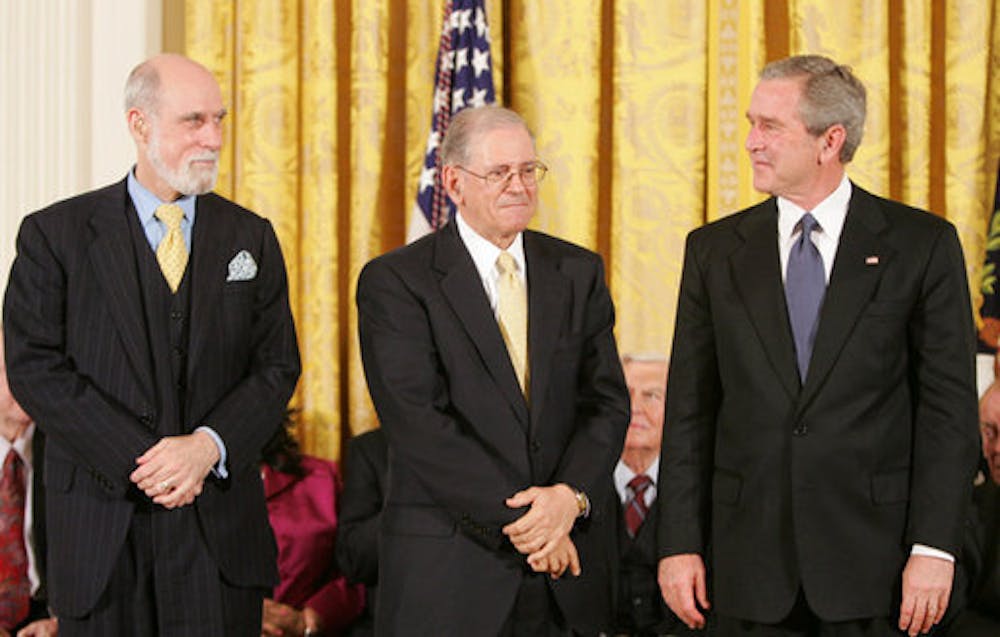
Vinton Cerf and Robert Kahn with President George W. Bush at the ceremony where Cerf and Kahn were given the Presidential Medal of Freedom for their contributions to developing the internet.
For the internet to really be a global entity, all kinds of different computers needed to speak the same language to be able to communicate with each other – directly, if possible, rather than slowing things down by using translators.
Cerf and Kahn, however, proposed another way, called Transmission Control Protocol/Internet Protocol. TCP/IP worked more like the regular mail – wrapping up messages in packages and putting the address on the outside. All the computers on the network had to do was pass the message to its destination, where the receiving computer would figure out what to do with the information. It was free for anyone to copy and use on their own computers.
TCP/IP – given that it both worked and was free – enabled the rapid, global scaling of the internet. A variety of governments, including the United States, eventually came out in support of OSI but too late to make a difference. TCP/IP made the internet cheaper, more innovative and less tied to official government standards.
1996: Online speech regulated
By 1996, the internet boasted more than 73,000 servers, and 22% of surveyed Americans were going online. What they found there, though, worried some members of Congress and their constituents – particularly the rapidly growing amount of pornography.
In response, Congress passed the Communications Decency Act, which sought to regulate indecency and obscenity in cyberspace.
Those 26 words, as various observers have noted, released internet service providers and web-hosting companies from legal responsibility for information their customers posted or shared online. This single sentence provided legal security that allowed the U.S. technology industry to flourish. That protection let companies feel comfortable creating a consumer-focused internet, filled with grassroots media outlets, bloggers, customer reviews and user-generated content.
The TCP/IP addressing scheme required that every computer or device connected to the internet have its own unique address – which, for computational reasons, was a string of numbers like “192.168.2.201.”
But that’s hard for people to remember – it’s much easier to recall something like “indiana.edu.” There had to be a centralized record of which names went with which addresses, so people didn’t get confused, or end up visiting a site they didn’t intend to.
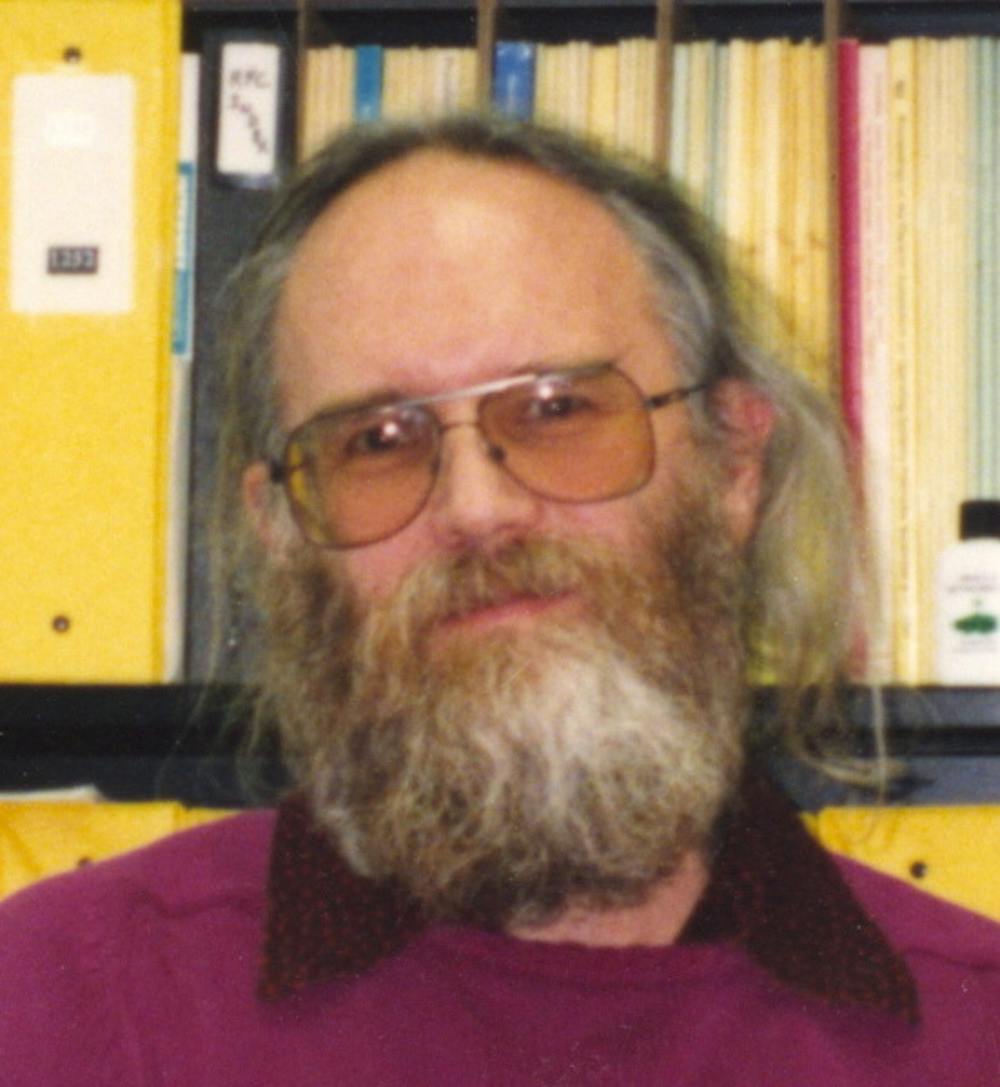
For years, Jon Postel held the reins to the internet’s address system.
Originally, starting in the late 1960s, that record was kept on a floppy disk by a man named Jon Postel. By 1998, though, he and others were pointing out that such a significant amount of power shouldn’t be held by just one person. That year saw the U.S. Department of Commerce lay out a plan to transition control to a new private nonprofit organization, the Internet Corporation for Assigned Names and Numbers – better known as ICANN – that would manage internet addresses around the world.
Other groups that manage key aspects of internet communications have different structures. The Internet Engineering Task Force, for instance, is a voluntary technical organization open to anyone. There are drawbacks to that approach, but it would have lessened both the reality and perception of U.S. control.
This 2007 photo shows an Iranian nuclear enrichment facility in Natanz, which was apparently the target of the first known cyberweapon to cause physical damage.
In June 2010, cybersecurity researchers revealed the discovery of a sophisticated cyber weapon called Stuxnet, which was designed specifically to target equipment used by Iran’s effort to develop nuclear weapons. It was among the first known digital attacks that actually caused physical damage.
Almost a decade later, it’s clear that Stuxnet opened the eyes of governments and other online groups to the possibility of wreaking significant havoc through the internet. These days, nations use cyberattacks with increasing regularity, attacking a range of military and even civilian targets.
There’s certainly cause for hope for online peace and community, but these decisions – along with many others – have shaped cyberspace and with it millions of people’s daily lives. Reflecting on those past choices can help inform upcoming decisions – such as how international law should apply to cyberattacks, or whether and how to regulate artificial intelligence.
Maybe 50 years from now, events in 2019 will be seen as another key turning point in the development of the internet.
Scott Shackelford, Associate Professor of Business Law and Ethics; Director, Ostrom Workshop Program on Cybersecurity and Internet Governance; Cybersecurity Program Chair, IU-Bloomington, Indiana University
Facebook on Friday began rolling out its dedicated "news tab" with professionally produced content -- the latest move by the social network to promote journalism and shed its reputation as a platform for misinformation.
The tab, being tested with some US users, will be separate from a user's normal feed and include articles from partner news organizations -- making a clear distinction between journalism and stories shared by users from a wide range of sources.
"This is going to be the first time ever there will be a dedicated space on the (Facebook) app that is focused on high-quality journalism," chief executive Mark Zuckerberg told an audience in New York in a joint appearance with CEO Robert Thomson of News Corp, one of the partners in the project.
The mix of stories in Facebook News will be determined by algorithmic "personalization" based on a user's preferences and data, with journalists choosing some of the stories.
The company said users would have "more control over the stories they see, and the ability to explore a wider range of their news interests, directly within the Facebook app."
Facebook is expected to pay some of the news organizations -- reportedly millions of dollars in some cases -- but has yet to disclose full details.
Zuckerberg said Facebook would not seek to limit coverage of the company or himself.
- Going global? -
Zuckerberg said he sees the effort as important even if it is used by only a small percentage of Facebook users. And he said the company is in discussions to bring the feature to other countries.
"We want to do something like this across the world as well," he said.
The social network has partnered with some 200 news organizations including The Wall Street Journal, USA Today, The Washington Post, CBS News, BuzzFeed, Fox News, the Boston Globe, Bloomberg and Vanity Fair.
Zuckerberg defended the inclusion of partners some criticize as politically partisan such as the right-wing outlet Breitbart, saying the news tab "needs to have a diversity of views."
Facebook said it would begin an initial test rollout which would "showcase local original reporting" from publications in major cities including New York, Los Angeles, Chicago, Dallas, Philadelphia, Houston, Washington, Miami, Atlanta and Boston.
Topic sections will include business, entertainment, health, science and technology, and sports.
- Rebooting the relationship -
AFP/File / MANDEL NGAN Facebook chairman and CEO Mark Zuckerberg says he wants the recently unveiled news tab to help promote "high quality journalism" on the huge social network
The move represents Facebook's effort to reboot its relationship with news organizations, many of which have been critical of the platform for failing to curb the spread of misinformation and for taking much of the online ad revenue.
The plan notably brings together Facebook and Rupert Murdoch's News Corp.
Thomson, the News Corp CEO who last year denounced what he called a "dysfunctional" online landscape that made it hard for publishers to thrive, welcomed the Facebook initiative in the joint appearance with Zuckerberg.
"It is a powerful precedent that will echo around editorial departments," said Thomson, whose company includes the Wall Street Journal.
"It begins to change the terms of trade for quality journalism."
- Paying for 'good stuff' -
AFP/File / JIM WATSON News Corp CEO Robert Thomson, a longtime critic of online platforms, welcomed Facebook's "news tab" which will feature professionally produced content
Northeastern University professor Dan Kennedy said the tab could help Facebook users distinguish between misinformation and professional news.
"Less savvy news consumers might not be able to tell the difference between exaggerated or fake viral news and real journalism from respected news organizations," Kennedy said.
"So this should help a lot."
But Kennedy said it could be problematic that Facebook may only be paying the richest media organizations, increasing woes for small, local outlets.
Ken Paulson, a former USA Today editor who now heads the Free Speech Center at Middle Tennessee State University, agreed that the initiative will promote better content.
"My long-term hope for the news business is that more consumers will recognize the difference between quality and chaos and be willing to pay for the good stuff," Paulson said.
University of Oregon journalism professor Damian Radcliffe noted that Facebook users currently "bump into" news in their feed, as opposed to actively seeking it out.
He said the project raises "important questions here about how transparent the story selection process will be, and what Facebook is effectively saying about news which sits outside of the tab. Does that means it's deemed less trustworthy?"
I’m an expert on labor markets in the U.S., and I believe that AI will undoubtedly change the future of U.S. labor – but Yang is also exaggerating the impact AI will have on the workforce.
The solution to job loss sparked by automation lies less in Yang’s guaranteed income proposal, and more in reskilling the labor force, a process that would involve educating workers to do the jobs a more automated economy will require.
For example, people process information at work, while computers can only execute instructions. Even jobs that have shrunk because of automation include components that require human judgment.
Predictive models, which lie at the heart of AI, are never right all the time. Incidents that fall outside the boundaries of ordinary or routine decisions – for example, legal cases – have to be handled by people who can make complex decisions.
This means that low-skill jobs, the ones that can truly be replaced because they follow the same routines, are likely to disappear, while middle- and high-skill jobs are likely to grow.
But the results are not always easy to predict. For example, many bank tellers have been replaced by ATMs. But this development has lowered the cost of running a bank branch so profoundly that banks are sprouting on every corner in most major cities.
As a result of these two countervailing forces, the number of tellers has actually stayed roughly constant since the invention of the ATM, mainly because they were needed to service the nonroutine aspects of customer service in a growing number of branches.
Who’s at risk?
Economists who study AI often underplay the gravity of the jobs losses it will create because they tend to look at the big picture.
Positive economic growth across the country – reflected in national trends – does not pay the bills for auto workers on the assembly line who have been replaced by robots. If they haven’t had the opportunity to become an expert in robot repair, they may have a hard time.
Instead, U.S. officials need to build ladders to middle-skill jobs that are growing rapidly. Institutes of higher education need to create certificates for technical courses so that current workers do not become obsolete.
Reskilling the workforce
Education is not an enterprise that should end after school.
Accommodating change in the labor market means continuous training. Educational institutions that complement classroom learning, which creates general skills, with shop floor experience, which generates firm-specific skills, forge a valuable combination.
That’s what the Germans learned decades ago when they created their “dual education” system that combines rigorous classroom training with apprenticeships on the shop floor.
Although the U.S. pursued a similar path during World War II, most companies later abandoned it, mainly because employers were not willing to commit the kind of resources in the form of in-house training that the Germans willingly provide.
But I see it as the only sensible solution to keep workers – whether new to the labor force or experienced and determined to avoid technical obsolescence – ahead of automation, productively employed in the industries of the future and able to take care of themselves.
Facebook founder and CEO is warned that lawmakers have "serious concerns" about Facebook's size and reach.
House Democrats challenged Facebook CEO Mark Zuckerberg on a number of issues Wednesday at a hearing focused primarily on the company's efforts to develop cryptocurrency—putting the social media executive on the defensive regarding Facebook's position on the limits of free speech in political advertising, its labor practices, and critics' claims that the company supports housing discrimination.
Facebook spent more than $12 million in the first nine months of 2019 to lobby the federal government to win approval of Libra, its proposed cryptocurrency, and to fight growing calls that the company should be broken up. Zuckerberg was called to appear before the House Financial Services Committee to explain why lawmakers and the public should trust Facebook.
Committee Chairwoman Maxine Waters (D-Calif.) opened the hearing by accusing Zuckerberg of ruthlessly pursuing more power through Facebook, which is now used by about a third of the world population, at the expense of its users' privacy and other rights.
"Perhaps you believe you're above the law, and its appears that you are aggressively increasing the size of your company and are willing to step on or over anyone—including your competitors, women, people of color, your own users, and even our democracy to get what you want," said Waters. "Given the company's size and reach it should be clear why we have serious concerns about your plans to establish a global digital currency."
Part of the company's threat to democracy, Waters said, comes from allowing factually incorrect political advertising to appear on the platform. Earlier this month, Facebook came under fire for allowing an ad on the site for President Donald Trump's re-election campaign which included falsehoods.
Zuckerberg told the committee that, rather than fact-checking political advertisements before they're able to appear on the platform, independent fact-checkers review content after it is distributed widely.
CNN notably refused to allow the same video to air on its network, citing falsehoods about the whistleblower complaint which led to the House's impeachment inquiry including the use of the word 'coup' "to describe a constitutionally prescribed legal process."
Rep. Alexandria Ocasio-Cortez (D-N.Y.) pointedly asked Zuckerberg whether the company has determined the limits of free political speech.
"Would I be able to run advertisements on Facebook targeting Republicans in primaries saying that they voted for the Green New Deal?" she asked. "I mean, if you're not fact checking political advertisements, I'm just trying to understand the bounds here. What's fair game?"
Zuckerberg replied that he wasn't sure whether such an ad would be permitted to appear on Facebook.
Critics of Facebook say the company should acknowledge that it's used by many as a news publisher and hold itself accountable for the content that appears on the platform.
Zuckerberg also came under fire at Wednesday's hearing for Facebook's algorithm and the company's practice of optimizing ads by sending them to specific demographics—a policy which critics say exacerbates housing discrimination and is reminiscent of the redlining which segregated neighborhoods in the 20th century.
"Technological innovations have created new opportunities for discrimination in U.S. housing markets that may be harder to spot, investigate, and attribute to any particular individual when proprietary algorithms are making decisions that have systemic impacts," wrote the committee ahead of the hearing.
"You have even enabled the practice of this dreaded redlining of certain communities, restricting them from housing and employment opportunities," said Rep. David Scott (D-Ga.). "We in Congress have worked hard for the past 50 years to eliminate the very racial discrimination practices that your platform is guilty of."
Rep. Ayanna Pressley (D-Mass.) drove the discussion back to Libra and Zuckerberg's claim that the cryptocurrency would help the 1.7 billion people around the world who cannot afford to use banks for their financial needs.
"I know you understand the tech and business case for Libra, you have the stats, but I'm not sure you understand the source of the pain that millions are experiencing, that are experiencing underbanking and credit invisibility," Pressley said.
"This is not about banking costs," she added. "This is about a tsunami of hurt that millions are experiencing because of a $1.6 trillion student debt crisis, because of rising healthcare costs and people having to use GoFundMe pages to pay medical bills."
"You represent the power," the congresswoman said, "but I don't think you understand the pain."
Scientists claimed Wednesday to have achieved a near-mythical state of computing in which a new generation of machine vastly outperforms the world's fastest super-computer, known as "quantum supremacy".
A team of experts working on Google's Sycamore machine said their quantum system had executed a calculation in 200 seconds that would have taken a classic computer 10,000 years to complete.
A rival team at IBM has already expressed scepticism about their claim.
But if verified and harnessed, the Google device could make even the world's most powerful supercomputers -- capable of performing thousands of trillions of calculations per second -- look like an early 2000s flip-phone.
Regular computers, even the fastest, function in binary fashion: they carry out tasks using tiny fragments of data known as bits that are only ever either 1 or 0.
But fragments of data on a quantum computer, known as qubits, can be both 1 and 0 at the same time.
This property, known as superposition, means a quantum computer, made up of several qubits, can crunch an enormous number of potential outcomes simultaneously.
The computer harnesses some of the most mind-boggling aspects of quantum mechanics, including a phenomenon known as "entanglement" -- in which two members of a pair of bits can exist in a single state, even if far apart.
Adding extra qubits therefore leads to an exponential boost in processing power.
In a study published in Nature, the international team designed the Sycamore quantum processer, made up of 54 qubits interconnected in a lattice pattern.
They used the machine to perform a task related to random-number generation, identifying patterns amid seemingly random spools of figures.
The Sycamore, just a few millimetres across, solved the task within 200 seconds, a process that on a regular machine would take 10,000 years -- several hundreds of millions of times faster, in other words.
Google's CEO Sundar Pichai hailed the result as a sea change in computing.
"For those of us working in science and technology, it's the 'hello world' moment we've been waiting for -- the most meaningful milestone to date in the quest to make quantum computing a reality," he wrote in a blog post.
John Martinis, from Google AI and a study author, told journalists his colleagues were "excited we can start talking" about their discovery.
"The physics was right... Physicists thought this would work, they had faith in quantum physics... and tech companies now will see that this technology is much closer than they thought," he said.
- Not so fast? -
Colleague Sergio Boixo described the discovery as "mind-blowing".
The quest for quantum supremacy is still far from over, however. The authors themselves acknowledge the need for better hardware and more sophisticated monitoring techniques in order to truly harness the power of quantum.
Some immediate applications of quantum computing could be in encryption software and AI, but its calculations could eventually lead to more efficient solar panels, drug design and even smarter and better financial transactions.
Wednesday's announcement was not without controversy.
After a leaked draft of the Google lab's paper appeared online last month, chip-maker IBM, which runs its own quantum computing programme, said the boasts of the Sycamore computer's feats were exaggerated.
Instead of 10,000 years for an ordinary supercomputer to match Sycamore's performance, IBM scientists claimed it would be more like two-and-a-half years using the most sophisticated traditional processors.
"Because the original meaning of the term 'quantum supremacy'... was to describe the point where quantum computers can do things that classical computers can't, this threshold has not been met," they wrote on their blog.




 GETTY IMAGES NORTH AMERICA/AFP / WIN MCNAMEE Facebook chief Mark Zuckerberg has tried to shield Libra from the crypto controversy


 AFP/File / MANDEL NGAN
  AFP/File / JIM WATSON

