On Tuesday, Secretary of Homeland Security Kirstjen Nielsen joined a long list of government officials to confirm Russian interference in the 2016 election and denounce the Kremlin's meddling.
"Let me be clear: our intelligence community has it right. It was the Russians. We know that. They know that. It was directed from the highest levels. And we cannot and will not allow that to happen again," Nielsen said at a cybersecurity summit in New York.
President Donald Trump has yet to admit that Russia tried to sway the election in favor of a Trump presidency—even after Russian President Vladimir Putinadmitted he had hoped Trump would beat Hillary Clinton.
United States President Donald Trump has a preoccupation with Twitter. Since his account @realDonaldTrump became active in March 2009, it has amassed 53.2 million followers, making it the 18th most popular account on the social media site.
While Trump has tweeted more than 38,000 times, his tweets during and after the 2016 presidential election made his Twitter account a lightning rod for the media and the public. Major news outlets like CNN, CBC, and BBC routinely embed tweets from @realDonaldTrump in their online stories. The Daily Show even turned Trump’s tweets into a mock presidential museum.
In a controversial and unparalleled fashion, Trump uses Twitter as a vehicle for his political announcements. On high-impact issues such as the U.S. travel ban, transgender military recruits and immigration, to name a few, Trump used Twitter to communicate policy decisions.
Given the volume of Trump’s tweets and their potential political relevance, we thought it would be revealing and novel to use mathematical methods to analyze the web of interactions formed by his most frequently used keywords.
Network analysis
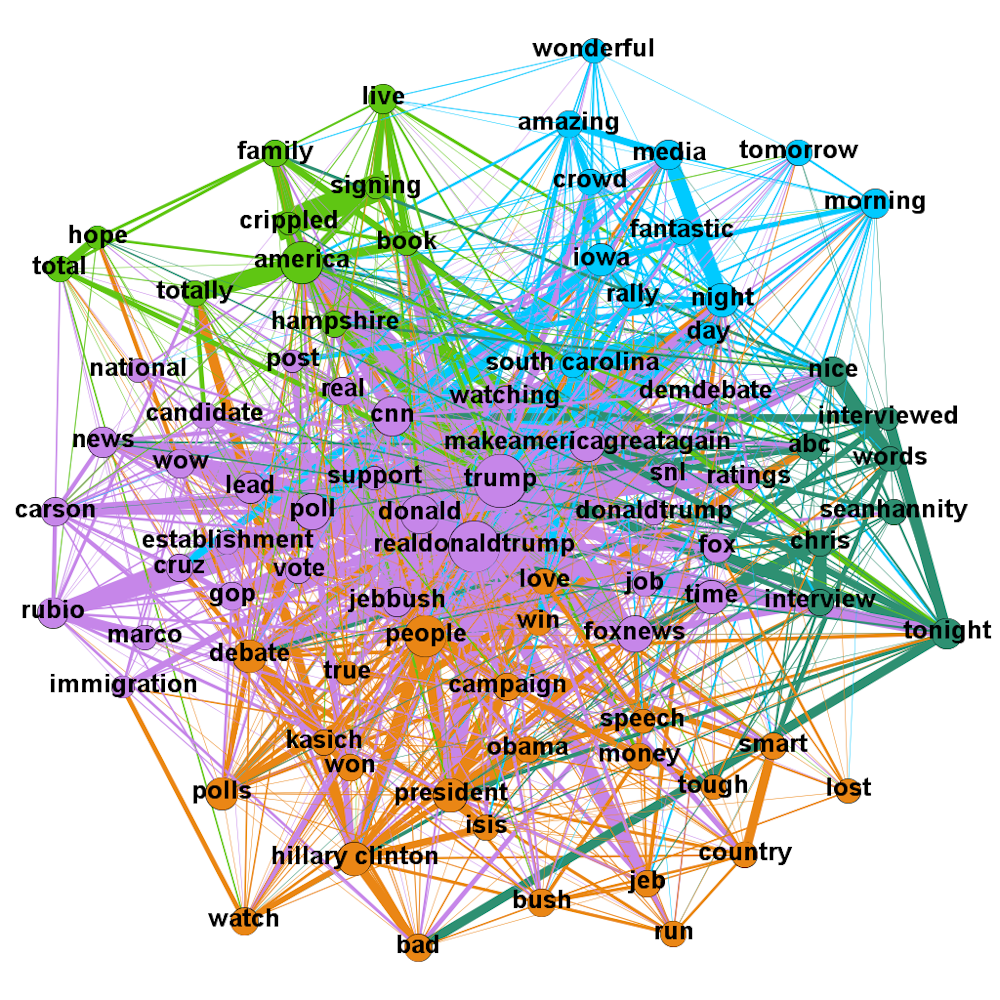
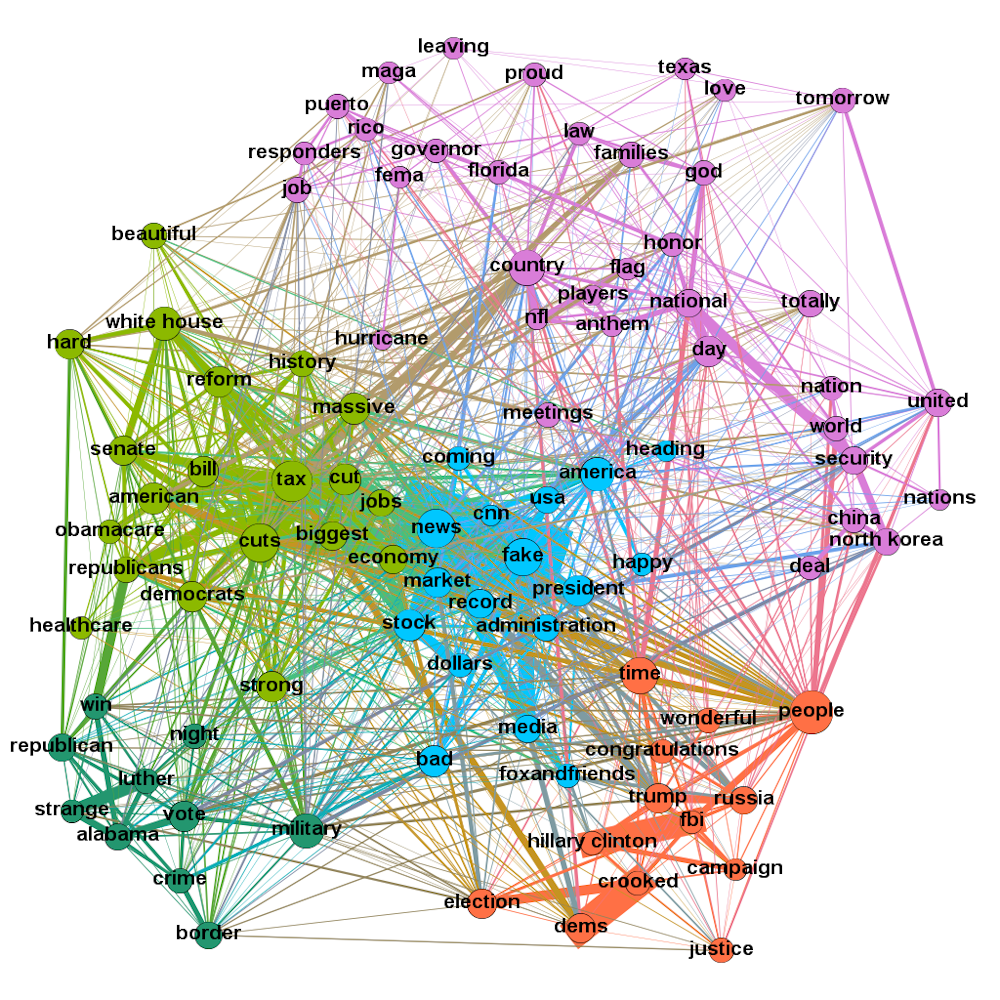
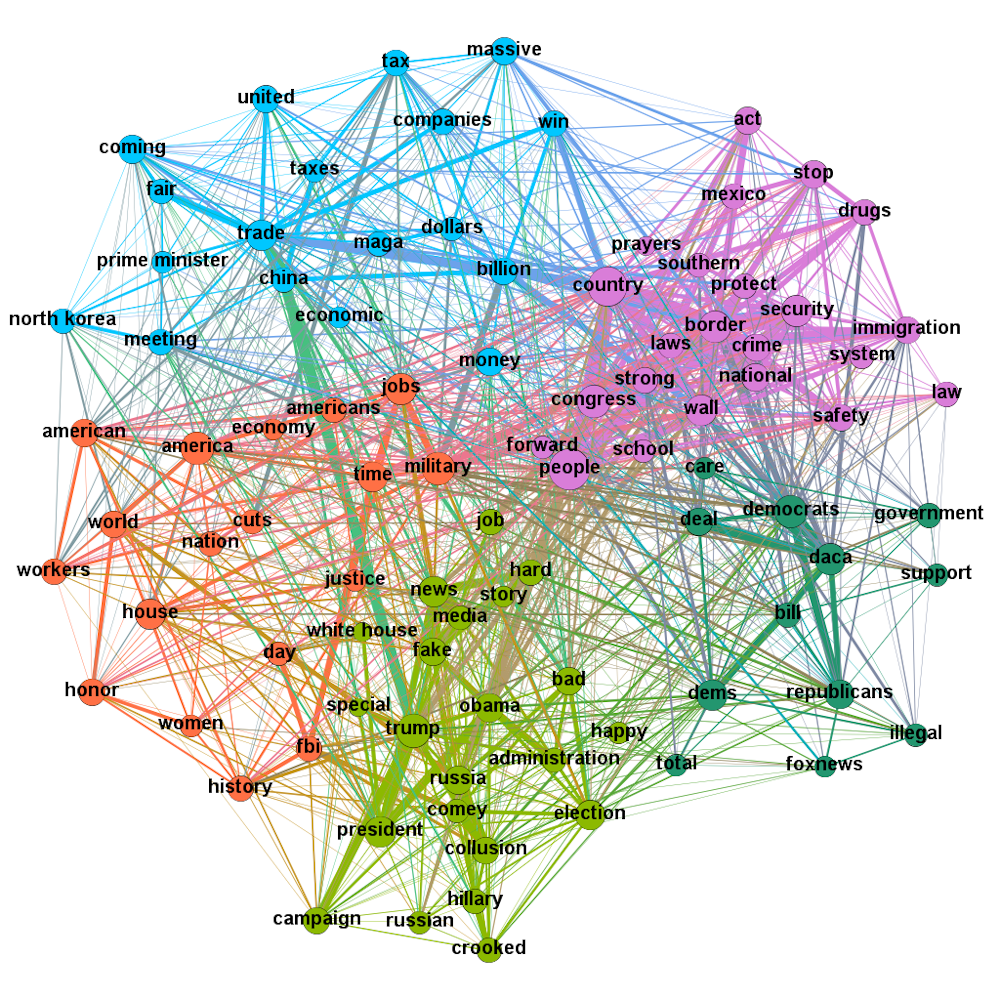
One of our primary goals was to uncover communities, which represent groupings of thematically related keywords. We formed co-occurrence networks based on Trump’s tweets, where nodes are keywords, and form links between two keywords if they appear in the same tweet. For example, if the keywords “bad” and “media” appear in the same tweet, they receive a link.
Using an online archive of the president’s tweets on GitHub, we extracted the top 100 keywords from Trump’s Twitter account from each of the last four years. We removed retweets and common words like “it” and “the.”
Some nodes were combined if the keyword was made up of two words; for example, “white” and “house” became “white house;” others such as “e-mail” and “e-mails” were kept separate because Trump used them in different contexts. Labels containing more than one word without spaces are hashtags that frequently appear in the tweets.
We visualized networks of keywords in @realDonaldTrump using the open source software Gephi with the ForceAtlas2 layout algorithm. Communities are groups of nodes that are more likely linked to each other than to other nodes in the network. Gephi uses the Louvain method on network modularity to identify communities, where modularity measures the strength of the division into communities. The Louvain method is an algorithm that optimizes the modularity of a network, so the higher the modularity, the better the division into communities.
The communities were uncovered as a byproduct of the overall network structure, and not by any manual manipulation on our parts. The Gephi software randomly assigned colours to each community: keywords with the same colour are thematically related.
Visualizations
The following network visualizations represent keywords from Trump’s Twitter account taken in 2015 and 2016, leading up to the 2016 U.S. presidential election. Links and nodes were resized based on their relative frequency.
The keyword network from Trump’s 2015 tweets.
In the 2015 network, the two nodes with the most links are “trump” and “realdonaldtrump,” which both appear in the purple community. The likely reason why Trump’s name came up so often as a keyword in 2015 was that he was campaigning for the Republican primary, and his tweets often included compliments made about or by him.
The purple community containing “cruz,” “rubio,” and “carson,” and the green community containing “kasich” and “bush” correspond to his Republican primary opponents.
In the 2016 network, the communities reflect his race against the Democratic nominee Hillary Clinton. The purple community appears to focus on Clinton and the Democratic Party, containing “crooked,” “fbi,” “emails,” and his hashtag “draintheswamp.”
The keyword network from Trump’s 2016 tweets.
In the orange community, there are keywords “rally,” “new hampshire” and “michigan,” along with his hashtag “makeamericagreatagain.” In the blue community, we observe the swing states “ohio” and “florida,” and his shortened hashtag “maga” that stands for “Make America Great Again.”
Next we looked at the 2017 and 2018 networks which correspond to the first and second years of Trump’s presidency.
In the 2017 network, the blue community corresponds to Trump’s dislike of the media, and it contains “fake,” “news,” “cnn,” “bad” and “media.” The orange community contains “hillary clinton,” “fbi” and “crooked.”
The keyword network from Trump’s 2017 tweets.
The green community corresponds to domestic policy issues such as “healthcare,” “economy,” “jobs,” “tax,” “reform,” and “cut,” while the purple community has a cluster related to foreign policy issues such as “security,” “china,” and “north korea.”
The keyword network from Trump’s 2018 tweets.
In the 2018 network, communities emerged related to trade (in orange) and borders and immigration (in purple). Trump’s focus on the media and Clinton continues unabated and moves into the blue community. He frequently tweeted about “tax,” “cuts,” and “jobs” in the green community.
Five communities revealed
While’s Trump’s words spoken in the traditional media may at times appear unpredictable, our analysis suggests a long-term trend with his tweets.
Considering that Trump tweets on average ten times a day and on a range of issues, it is remarkable that in each of the four years, his Twitter networks consistently split up into precisely five communities. In other words, by accident or design, his tweets tend to focus on five broad topics each year since 2015. Some of the issues morph over time, and this is evident from before and after his presidency.
The content in the communities sometimes beg further questions. For example, in the 2018 network, the green community contains the keywords “russia,” “comey,” and “collusion.” These refer to the ongoing Russiainvestigation. The green community, however, also includes “crooked” and “hillary,” and we leave it to pundits to explain how all these keywords are related.
Our take is that by repeating keywords together, his sizable Twitter audience will view them as more likely linked in real life.
Trump is unlikely to stop or even reduce his tweeting anytime soon. Twitter represents a vital aspect of Trump’s media engagement.
Our analysis used network science to map out Trump’s keywords on Twitter and their interactions over the timescale of years. From this approach, we obtain a historical view of the topics that matter to him. A potential future research plan would be to map Trump’s Twitter networks over shorter time periods such as months, weeks or even days.
Every politician and public figure on Twitter have associated with them an evolving web of keywords. These networks are not always evident in our break-neck 24-hour news cycle, and our approach holds the potential to make these hidden networks more visible. We need only to look to network science to uncover them.
The Soviet Union and now Russia under Vladimir Putin have waged a political power struggle against the West for nearly a century. Spreading false and distorted information – called “dezinformatsiya” after the Russian word for “disinformation” – is an age-old strategy for coordinated and sustained influence campaigns that have interrupted the possibility of level-headed political discourse. Emerging reports that Russian hackers targeted a Democratic senator’s 2018 reelection campaign suggest that what happened in the lead-up to the 2016 presidential election may be set to recur.
Two sets of federal indictments – one in February and another in July – allege in detail how a private company linked to Putin and the Russian military itself worked to polarize American political discourse and sway the 2016 U.S. presidential election.
Cybersecurity experts in the U.S. knew that the Russian intelligence agencies were conducting these acts of information warfare and cyberwarfare, but I doubt they had any idea how comprehensive and integrated they were – until now.
Russia’s propaganda machine duped American voters
The operation was complex. What is publicly known now is perhaps most easily understood in two pieces, the subjects of separate federal indictments.
First, a billionaire Russian businessman and Putin associate allegedly assembled a network of troll factories: private Russian companies engaging in a massive disinformation campaign. Their employees posed as Americans, created racially and politically divisive social media groups and pages, and developed fake news articles and commentary to build political animosity within the American public.
The people involved did not fit the stereotypical picture of internet trolls. One leading Russian troll factory was a company called the Internet Research Agency, reportedly with all the trappings of a real corporation, including a graphics department to create incendiary images, a foreign department dedicated to following political discourse in other countries and an IT department to make sure trolls had reliable computers and internet connections. Employees, mostly 18 to 20 years old, were paid as much as US$2,100 a month for creating fake social media accounts and blogs to distribute disinformation to Americans.
One ex-troll told a Russian independent TV network that his job included writing incendiary comments and creating fake posts on political forums: “The way you chose to stir up the situation, whether it was commenting [on] the news section or on political forums, it didn’t really matter.” In 2015, well before the 2016 election, the troll-factory network had more than 800 people doing this kind of work, producing propaganda videos, infographics, memes, reports, news, interviews and various analytical materials to persuade the public.
America never stood a chance.
An interview with an ex-Russian troll.
Focusing on social media
It’s no surprise that these Russian trolls spent most of their time on Facebook and Instagram: Two-thirds of Americans get at least some news on social media. The trolls spread out across both platforms, seeking to encourage conflict on any topic that was getting a lot of attention: immigration, religion, the Black Lives Matter movement and other hot-button issues.
When describing how he managed all of the fake social media accounts, the ex-troll said: “First, you gotta be a redneck from Kentucky, then you need to be a white guy from Minnesota, you’ve slaved away all your life and paid your taxes, and then 15 minutes later you are from New York posting in some Black slang.”
Then, the indictments reveal, the GRU entered this increasingly fraught online political discourse.
The GRU joins in
Like another significant political scandal, the GRU effort allegedly started with a break-in to Democratic National Committee records – but this time it was a digital burglary. It wasn’t particularly sophisticated, either, using two common hacking techniques, spearphishing and malicious software.
As the July indictment details, starting in March 2016, Russian military operatives sent a series of fake emails, disguised to look real, to more than 300 people associated with Democratic National Committee, the Democratic Congressional Campaign Committee and Hillary Clinton’s presidential campaign. One of the targets was Clinton campaign chairman John Podesta, who fell for the scheme and unwittingly handed over more than 50,000 emails to the Russians.
Around the same time, the Russian hackers allegedly began searching for technical vulnerabilities in the Democratic organizations’ computer networks. They used techniques and specialized malicious software that Russians had used in other hacking efforts, including against the German Parliament and the French television network TV5 Monde. By April 2016, the hackers had gained access to the Democratic Congressional Campaign Committee systems, exploring servers and secretly extracting sensitive data. They located a Democratic Congressional Campaign Committee staffer who also had privileges in the Democratic National Committee systems, and thereby got into the Democratic National Committee networks too, extracting more information.
When the Democratic National Committee realized there was unusual data traffic in its systems, the group hired a private cybersecurity firm, which in June 2016 publicly announced that its investigation had concluded that Russia was behind the hacking. At that point, the Russians allegedly tried to delete traces of their presence on the networks. But they kept all the data they had stolen.
Opposing Hillary Clinton
As early as April 2016, the GRU was allegedly trying to use the Democrats’ confidential documents and email messages to stir up political trouble in the U.S. There is evidence that the Russian government, or people acting on its behalf, offered key people in the Trump campaign damaging information on Clinton.
In July 2016, the indictments say, the GRU began releasing many of the Democrats’ documents and email messages, mainly through WikiLeaks, an internet site dedicated to anonymous publishing of secret information.
All of this effort was, according to the indictments, set up to undermine Hillary Clinton in the eyes of the American public. Putin definitely wanted Trump to win – as the Russian president himself acknowledged while standing next to Trump in Helsinki in July. And the trolls were instructed to go after her savagely: A former Russian troll said, “Everything about Hillary Clinton had to be negative and you really had to tear into her. It was all about the leaked email, the corruption scandals, and the fact that she is super rich.”
The indictments describe in detail how information warfare and cyberwarfare were used as political tools to advance the interests of people in Russia. Something similar may be set to happen in 2018, too.
Even before the revelation on July 23 that Russian government hackers had penetrated the computer systems of U.S. electric utilities and could have caused blackouts, government agencies and electricity industry leaders were working to protect U.S. customers and society as a whole. These developments, alarming as they might seem, are not new. But they highlight an important distinction of conflict in cyberspace: between probing and attacking.
The U.S. and its allies have substantial capabilities, too, some of which have reportedly been directed against foreign powers. Stuxnet, for instance, was a cyberattack often attributed to the U.S. and Israel that disrupted Iran’s nuclear weapons development efforts.
The distinction between exploiting weaknesses to gather information – also known as “intelligence preparation of the battlefield” – and using those vulnerabilities to actually do damage is impossibly thin and depends on the intent of the people doing it. Intentions are notoriously difficult to figure out. In global cyberspace they may change depending on world events and international relations. The dangers – to the people of the U.S. and other countries both allied and opposed – underscore the importance of international agreement on what constitutes an act of war in cyberspace and the need for clear rules of engagement.
Advanced adversaries
In July the Center for Cyber and Homeland Security at George Washington University, where we serve, hosted a forum on protecting energy infrastructure. At that event, a Duke Energy Corporation executive reported that in 2017, the company experienced over 650 million attempts to intrude into their system. That number is startling, though hard to contextualize. More generally, however, some efforts directed against the U.S. are extremely sophisticated.
Federal officials have said that starting in 2016, continuing in 2017 and likely still ongoing, Russian government attacks took advantage of trusting relationships between key vendors of services related to equipment and operations for utility companies. Compromising the vendors’ computers was the first step toward breaching the security of systems not directly connected to the internet.
It’s not just electric utilities – crucial though they are to almost every aspect of modern society. The Russian intrusion targeted computerized industrial control systems that are at the beating hearts of every part of critical public and private infrastructure, including water, energy, telecommunications and manufacturing. In the U.S., more than 85 percent of those critical potential targets are owned and operated by private companies. Once considered safely on home soil far from conflict, these firms are now at the center of the international cyberspace battleground.
Setting up defenses
The energy industry has invested heavily in protecting itself, and is leveraging a sector-wide collaboration called the Electricity Information Sharing and Analysis Center to communicate between companies about warnings and threats to grid operations. But the task is too great – and the consequences to public health and safety too severe – for private companies to handle the burden on their own. As a result, the U.S. Department of Homeland Security has been investigating breaches like the Russian intrusions, and briefing industry leaders about what it finds.
For instance, the Wall Street Journal reported that DHS cybersecurity experts are “looking for evidence that the Russians are automating their attacks, which … could presage a large increase in hacking efforts.” That possibility, taken together with the energy-sector focus of the utility-hacking effort and the perpetrators’ interest in industrial control systems, could be a signal that Russia may be considering shifting from exploring U.S. utility systems to actually attacking them.
An upcoming meeting may deepen federal-corporate collaboration: On July 31, the Department of Homeland Security is hosting a National Cybersecurity Summit to bring together government, industry and academic experts in protecting the country’s most important infrastructure. It will take all their efforts to keep up with the threats, particularly as the underlying techniques and technologies continue to evolve. The “internet of things,” for instance, connects physical devices in ways that merge the virtual world with the real one – making people only as safe as the weakest link in the network or supply chain.
Those statements, and the inexorable march of research and development, mean that machine learning – and ultimately quantum computing too – will play an increasing role in cyberespionage and cyberwarfare, as well as cybersecurity. The line between probing and attacking – and between defensive readiness and offensive preparation – may get even thinner.
This hacking is similar to the 2015 and 2016 attacks on Ukraine’s grid. While DHS has raised the number of the Russian utility-hacking incidents it detected from dozens to hundreds, it still maintains that this infiltration has not risen beyond scouting mode. Russia denies having any role in the hacking, yet the specter of Russian sabotage in the U.S. now seems more realistic than it used to.
Clearly, there’s no time to waste in shoring up the grid’s security. Yet getting that done is not easy, as I’ve learned through my research regarding efforts in to stave off outages in hurricane-prone Florida.
A catch-22
There is no way to completely protect the grid. Even if that were possible, utilities tend to adopt new and better security procedures after mishaps, boosting the chance that some attacks will succeed.
Regulation at the state and federal levels makes it hard for utilities and regulators to work together to get this job done.
Say, for example, a power company is building a substation. The utility would disclose what it spent on construction, prove that it picked its contractors responsibly and explain how this new capacity is enhancing its service. The regulator then must decide what rate hikes, if any, would be reasonable – after hearing out everyone with something at stake.
Following this routine is harder with cyberdefense spending. Security concerns make it tough if not impossible for utilities to say what they’re doing with that money. Regulators, therefore, have a hard time figuring out whether utilities are spending too much or too little or maybe even wasting money on an unnecessary expense.
If regulators blindly approve these rate hikes, it can be an abdication of their duties. If they reject them, utilities get penalized for shoring up their security and then lose an incentive to keep doing the right thing.
To err is human
Even though the idiosyncrasies of utility regulation make cyberdefense a more complicated issue than it might otherwise be, tools to manage this risk are available.
Mitigating the damage that human error can cause in response to malicious attacks, for example, may not demand any spending beyond what it costs to teach workers at utilities and their contractors to refrain from blindly opening perilous email attachments, the avenue into the electricity system used by hackers in the 2015 Ukraine attacks and in the system breaches the government recently disclosed.
They also need to guard against so-called watering-hole attacks. According to the new DHS revelations, Russian hackers set traps in websites that utility vendors were known to frequent – many of which had insufficient cybersecurity measures in place. They then leveraged that access to steal the credentials they needed to worm their way into utilities’ systems.
Indeed, hackers delivered almost 94 percent of all malware in 2016 through email systems. Clearly, more widespread awareness of the need to keep an eye out for phishing attacks will help secure infrastructure.
Preventative measures can include states adopting new regulations that protect utilities’ confidential information and doing more to train utility workers to spot and confront cybersecurity threats.
It’s also important that regulators recognize that securing systems is an ongoing process. It can never really end because as system security measures change, hackers devise new ways to circumvent them.
Grid resilience
Grid resilience strategies can help to maintain service regardless of the source of the outage. For example, many utilities have invested in “self-healing” systems that isolate glitches in the grid and quickly restore service amid outages.
Here’s an example of how that works. During Hurricane Matthew in Florida, in 2016, Florida Power and Light identified a threatened substation and isolated it from the rest of the grid. This measure protected its customers by ensuring that outages at that substation would not spread.
Utilities can also create microgrids, or portions of the grid that can be isolated from the rest of the system in the event of an attack. Most of these systems have been designed to improve resilience in the event of natural disasters and storm events. But they can help defend the grid against cyberattacks as well.
Public concerns over grid security are more justified than ever. But I believe that minimizing the risk of a catastrophic infrastructure attack is within reach. All it will take is for utilities to educate their workers on system security while the government updates its rules and practices – and for everyone involved to keep doing what they can to avert outages of all kinds and to restore power as quickly as possible when outages occur despite those efforts.
Editor’s note: This article was updated on July 24, 2018 to add news regarding the scale of the hacking and the discovery that hackers used watering-hole attacks.
While much of the world's attention is currently centered on efforts by Russian operatives to sow discord among the American electorate with fake social media postsand "troll farms" during the 2016 presidential election, an Oxford Internet Institute study published Friday found that use of social media by governments looking to "spread junk information and propaganda to voters" has become a global phenomenon.
"Social media manipulation is big business," the researchers found. "We estimate that tens of millions of dollars are being spent on social media manipulation campaigns, involving tens of thousands of professional staff."
While there is nothing new about political parties and governments using disinformation to manipulate elections at home and abroad, the Oxford researchers note that the massive, easily accessible, and lightly regulated platforms offered by Facebook and Twitter have become enormously powerful tools in the hands of political actors, who have used social media to kick their propaganda campaigns into overdrive and cast doubt on science and public institutions.
"Although closely related to some of the dirty tricks and negative campaigning we might expect in close races (and which have always played a part in political campaigning ), what makes this phenomenon unique is the deliberate use of computational propaganda to manipulate voters and shape the outcome of elections," the study notes.
In 30 of the 48 countries examined, Oxford researchers discovered "evidence of political parties using computational propaganda during elections or referenda. In emerging and Western democracies, sophisticated data analytics and political bots are being used to poison the information environment, promote skepticism and distrust, polarize voting constituencies, and undermine the integrity of democratic processes."
Despite recent efforts by Facebook, Twitter, and governments to rein in the proliferation of fake stories on social media, Oxford researchers found that the use of bots to quickly spread disinformation is growing exponentially.
"We actually found 38 countries used bots last year, compared with 17 in the year before," Philip Howard, director of the Oxford Internet Institute and co-author of the new study, toldMcClatchy.
"Social media have gone from being the natural infrastructure for sharing collective grievances and coordinating civic engagement, to being a computational tool for social control, manipulated by canny political consultants, and available to politicians in democracies and dictatorships alike," the study concludes. "We cannot wait for national courts to sort out the technicalities of infractions after running an election or referendum. Protecting our democracies now means setting the rules of fair play before voting day, not after."
The social media staffer at Fox News seems to be having a hard time telling the difference between a real Brett Kavanaugh Twitter account and fake ones.
It all began Monday night when @FoxNewsOpinion retweeted a few tweets from an account claiming to belong to President Donald Trump's Supreme Court nominee, Law & Crime found. The account has since been suspended, but not before Fox fumbled.
Prior to it being deleted Law & Crime explained that the account only began tweeting as of 9 p.m. when Trump was announcing the nominee.
"I am grateful to President Trump and I am humbled by his confidence in me. Thank you President. No president has ever consulted more widely or talked with more people from more backgrounds to seek input about a Supreme Court nomination. #SCOTUS" the account tweeted.
It was obvious that no one double-checked to ensure the account was authentic, though the only previous tweets were bizarre replies like the one below:
The other tweets that were retweeted by Fox seemed to be nothing more than recycled versions of Kavanaugh's statement he read from the White House podium.
“The tweets have since been deleted on our FOX News Opinion Twitter account and we regret the error," Fox said in a statement.
The Trump administration’s tariffs on China have so far targeted mostly industrial goods like aircraft engines and gas compressors. But the administration has also threatened to slap tariffs on US$200 billion in other goods if the dispute continues.
No list of all the goods that might be subject to tariffs has been released, but it would have to include consumer electronics, such as smartphones, which is the largest single product category in China’s exports to the U.S.
One well-known product that might be affected is Apple’s iPhone, which is assembled in China. When an iPhone arrives in the U.S., it is recorded as an import at its factory cost of about $240, which is added to the massive U.S.-China bilateral trade deficit.
IPhone imports look like a big loss to the U.S., at least to the president, who argues that “China has been taking out $500 billion a year out of our country and rebuilding China.” One estimate suggests that imports of the iPhone 7 and 7 Plus contributed $15.7 billion to last year’s trade deficit with China.
But, as our research on the breakdown of an iPhone’s costs show, this number does not reflect the reality of how much value China actually gets from its iPhone exports – or from many of the brand-name electronics goods it ships to the U.S. and elsewhere. Thanks to the globe-spanning supply chains that run through China, trade deficits in the modern economy are not always what they seem.
Who really makes the iPhone?
Let’s examine an iPhone 7 a little more closely to see how much value China is actually getting.
Start with the most valuable components that make up an iPhone: the touch screen display, memory chips, microprocessors and so on. They come from a mix of U.S., Japanese, Korean and Taiwanese companies, such as Intel, Sony, Samsung and Foxconn. Almost none of them are manufactured in China. Apple buys the components and has them shipped to China; then they leave China inside an iPhone.
So what about all of those famous factories in China with millions of workers making iPhones? The companies that own those factories, including Foxconn, are all based in Taiwan. Of the factory-cost estimate of $237.45 from IHS Markit at the time the iPhone 7 was released in late 2016, we calculate that all that’s earned in China is about $8.46, or 3.6 percent of the total. That includes a battery supplied by a Chinese company and the labor used for assembly.
The other $228.99 goes elsewhere. The U.S. and Japan each take a roughly $68 cut, Taiwan gets about $48, and a little under $17 goes to South Korea. And we estimate that about $283 of gross profit from the retail price – about $649 for a 32GB model when the phone debuted – goes straight to Apple’s coffers.
In short, China gets a lot of (low-paid) jobs, while the profits flow to other countries.
The trade balance in perspective
A better way of thinking about the U.S.-China trade deficit associated with one iPhone would be to only count the value added in China, $8.50, rather than the $240 that shows up as a Chinese import to the U.S.
Scholars have found similar results for the broader U.S.-China trade balance, although the disparity is less extreme than in the iPhone example. Of the 2017 trade deficit of $375 billion, probably one-third actually involves inputs that came from elsewhere – including the U.S.
The use of China as a giant assembly floor has been good for the U.S. economy, if not for U.S. factory workers. By taking advantage of a vast, highly efficient global supply chain, Apple can bring new products to market at prices comparable to its competitors, most notably the Korean giant Samsung.
Consumers benefit from innovative products, and thousands of companies and individuals have built businesses around creating apps to sell in the App Store. Apple uses its profits to pay its armies of hardware and software engineers, marketers, executives, lawyers and Apple Store employees. And most of these jobs are in the U.S.
If the next round of tariffs makes the iPhone more expensive, demand will fall. Meanwhile Samsung, which makes over half its phones in Korea and Vietnam, with a lower share of U.S. parts, will not be affected as much by a tariff on goods from China and will be able to gain market share from Apple, shifting profits and high wage jobs from the U.S. to South Korea.
Put another way, research has shown globalization hurt some Americans while it made life better for many others. Putting globalization in reverse with tariffs will also create winners and losers – and there could be far more of the latter.
Why not make the iPhone in America?
When we discuss these topics with policymakers and the media, we’re often asked, “Why can’t Apple just make iPhones in the U.S.?”
The main problem is that the manufacturing side of the global electronics industry was moved to Asia in the 1980s and 1990s. Companies like Apple have to deal with this reality.
As the numbers we’ve cited make clear, there’s not much value to be gained for the U.S. economy or its workers from simply assembling iPhones here from parts made in Asia.
While it’s possible to do so, it would take at least a few years to set it up, cost more per unit than production in Asia, and require a lot of carrots and sticks from policymakers to get the many companies involved to do so – for example, like the potential $3 billion in subsidies Wisconsin gave to Foxconn to build an LCD factory there.
A flawed response to the challenge from China
There is, of course, plenty for the U.S. to complain about when it comes to China’s high-tech industry and policies, whether it’s the lack of intellectual property protection or non-tariff barriers that keep major tech companies such as Google and Facebook out of the huge Chinese market. There is room for much tougher and more sophisticated bargaining to address these issues.
But where trade is concerned, policies should reflect that manufacturing is now a global network. The World Trade Organization has already developed an alternate set of trade numbers that shows each country’s trade in value added terms, but the administration seems to have missed the memo.
Trump’s trade war is based on a simplistic understanding of the trade balance. Expanding tariffs to more and more goods will weigh on U.S. consumers, workers and businesses. And there’s no guarantee that the final outcome will be good when the dispute ends.
This is a war that should never have been started.
Conservative and Russian media outlets -- amplified by sketchy Twitter accounts -- are pushing a social media campaign intended to drive Democratic voters away from the party.
A surge of tweets with the hashtag #WalkAway began June 23 after White House press secretary Sarah Huckabee Sanders was asked to leave a Virginia restaurant the night before, and the campaign took off after Rep. Maxine Waters (D-CA) called for the public shaming of Trump administration officials, reported the blogger Caroline O. for Medium.
The remarkable similar tweets claimed to be from former Democrats who got fed up with the "hate" and "intolerance" of "the left," and piggybacked off the "civility" debate going on at the time on opinion pages and cable news shows.
Brandon Straka officially started the "#WalkAway Campaign" in May to encourage Democrats to abandon their party, but the hashtag got an artificial boost into the public sphere by automated Twitter accounts identified as linked to Russian influence operations.
“Once upon a time, I was a liberal,” says Straka, a nearly broke New York hairstylist, in his first video.
The video was initially promoted by Fox News host Charles Payne, Trump superfan Bill Mitchell, Turning Point USA head Charlie Kirk and conservative activist Candace Owens, who helped introduce Kanye West to right-wing politics.
Then, after the civility debate kicked off, something weird happened.
The hashtag became one of the most popular topics among suspected Russian bots, which skewed algorithms to push the campaign into suggested search terms on Google products and other social media, and gained popularity among actual Twitter users.
The Russian media outlets Sputnik and RT featured segments and videos on the campaign starting last week, and Straka did an interview with RT this week.
Straka also appeared Tuesday on Laura Ingraham's Fox News program, and the campaign got coverage on conservative websites such as Breitbart, The Patriot Post, Epoch Times and Legal Insurrection.
Hashtag clouds also revealed #WalkAway was frequently associated with the bizarre #QAnon conspiracy theory to push the narrative that the Democratic Party was "sick" and corrupt.
The campaign targeted racial division and so-called "identity politics," and Trump himself amplified the movement's claims that Democrats wanted to abolish ICE and open U.S. borders to criminals.
The Medium blogger said she'd seen similar overlap between Russian influence campaigns and conservative U.S. media, and she warned that more would be coming as November's midterm elections approached.
"There is reason to believe that this psychological operation — and to be clear, that’s what this is — represents a trial run for future social media manipulation efforts," Caroline O. wrote.
She suspects the #WalkAway movement could be intended to map out social networks, test messaging and conduct surveillance to study patterns of behavior.
"If you want to cause chaos or just generally stir up trouble, figuring out how to provoke other users -- and determining which users are most receptive to provocation -- would be extremely helpful," she wrote. "This is a great reason to heed the advice, 'Don’t engage the trolls.'"
Megaupload founder Kim Dotcom suffered a major setback in his epic legal battle against online piracy charges Thursday when New Zealand's Court of Appeal ruled he was eligible for extradition to the United States.
The German national, who is accused of netting millions from his file sharing Megaupload empire, faces charges of racketeering, fraud and money laundering in the US, carrying jail terms of up to 20 years.
Dotcom had asked the court to overturn two previous rulings that the Internet mogul and his three co-accused be sent to America to face charges.
Instead, a panel of three judges backed the FBI-led case, which began with a raid on Dotcom's Auckland mansion in January 2012 and has dragged on for more than six years.
The court said US authorities had "a clear prima facie case to support the allegations that the appellants conspired to, and did, breach copyright wilfully and on a massive scale for commercial gain".
Dotcom is accused of industrial-scale online piracy via Megaupload, which US authorities shut down when the raid took place.
They allege Megaupload netted more than US$175 million in criminal proceeds and cost copyright owners US$500 million-plus by offering pirated content including films and music.
"We are disappointed with today's judgment by the NZ Court of Appeal in the Kim Dotcom case," his lawyer Ira Rothken tweeted, indicating there would be an appeal to the Supreme Court.
"We have now been to three courts each with a different legal analysis -- one of which thought that there was no copyright infringement at all."
AFP / Gal ROMAKim Dotcom
Dotcom and his co-accused -- Finn Batato, Mathias Ortmann, Bram van der Kolk -- have denied any wrongdoing and say Megaupload was simply a case of established interests being threatened by online innovation.
The website was an early example of cloud computing, allowing users to upload large files onto a server so others could easily download them without clogging up their email systems.
At its height in 2011, Megaupload claimed to have 50 million daily users and account for four percent of the world's internet traffic.
- 'Bond villain' or businessman? -
Dotcom's lengthy legal battle has previously seen the District and High Courts find against him.
In its 120-page judgement, the Court of Appeal indicated it wanted the matter resolved swiftly.
AFP/File / MICHAEL BRADLEYThe internet mogul used the wealth generated from his website to fund a lavish lifestyle, including his "Dotcom Mansion" in New Zealand
"We direct that the District Court should now proceed without further delay to complete its duties under section 26 of the Extradition Act in accordance with the determination," it said.
Under the Extradition Act, Justice Minister Andrew Little can now sign an order to extradite Dotcom to the United States.
Dotcom can take his appeal to the Supreme Court, New Zealand's final avenue of appeal, but will need compelling new evidence that he was facing a miscarriage of justice.
Rothken confirmed his client was not giving up.
"We will seek review with the NZ Supreme Court," he tweeted.
Born Kim Schmitz in Kiel, northern Germany in 1974, Dotcom changed his name in 2005, around the same time he established Megaupload.
He used the wealth generated from his website to fund a lavish lifestyle of racing cars and luxury yachts before moving to New Zealand in 2010.
AFP/File / MICHAEL BRADLEYDotcom had asked the court to overturn two previous rulings that the Megaupload founder and his three co-accused be sent to the United States to face charges
With his penchant for black clothing and Teutonic accent, Dotcom has likened himself to a James Bond villain, arguing that is why he has been pursued so vigorously.
"I'm an easy target, they needed a villain who's rich, flamboyant and over-the-top like me," he said in 2013, claiming US prosecutors were chasing him at the behest of Hollywood studios.
Dotcom enjoyed early successes in his legal battle, extracting an apology from then prime minister John Key when it emerged New Zealand intelligence services illegally spied on him.
But he has suffered a number of reversals since the District Court ruled in 2015 that he could be extradited, with Dotcom vowing to fight every step of the way.
He launched a multi-billion dollar damages claim against the New Zealand government this year, saying it had destroyed his business and damaged his reputation.
A science fiction-inspired robot hardwired to assist astronauts will launch from Florida early Friday morning to become the first personal, artificial intelligence-powered companion in space.
The Crew Interactive Mobile Companion, or CIMON, is an English-speaking droid roughly the size of a basketball that will help German astronaut Alexander Gerst conduct experiments on the International Space Station.
“What we’re trying to do with CIMON is to increase the efficiency of the astronaut,” Matthias Biniok, an engineer for chip maker IBM and one of the lead architects behind CIMON’s artificial intelligence, told Reuters.
CIMON will verbally communicate step-by-step instructions to Gerst during three planned science experiments on the space station’s European module. Currently, astronauts read these instructions from a laptop, which Biniok says is an arduous process that a responsive, hands-free companion like CIMON can replace.
“Right now our main mission is to support the astronauts with their daily tasks to save time, because time is the most valuable and most expensive thing on the ISS,” Biniok said.
SCIENCE FICTION COMIC
The German Aerospace Center plans for CIMON to undergo three one-hour sessions to demonstrate how well the robot can help with experiments, like a crystal growth study, a test for its eight on-board cameras and an exercise to help Gerst solve a Rubik’s cube.
CIMON will return to Earth on Dec. 13.
Biniok said the concept of CIMON was inspired by a 1940s science fiction comic series set in space, where a sentient, brain-shaped robot named Professor Simon mentors an astronaut named Captain Future.
Philipp Schulien, a German engineer for CIMON’s hardware contractor, Airbus, said extending astronauts’ abilities in space is imperative for future space exploration journeys, like the crewed missions to Mars that are scheduled to take off as early as 2020.
“There are certain effects that might appear during long-term missions like the so-called groupthink effect,” Schulien said, citing a behavioral phenomenon in which humans that spend lengthy periods of time in isolation are driven to make irrational decisions. “Long, isolated groups tend to stop communicating with the ground,” he said.
A robot like CIMON with human-like personalities could help mitigate the disorientation astronauts may feel in space, Schulien said.
CIMON is among 5,900 pounds of cargo launching to the International Space Station on Friday, atop a SpaceX Falcon 9 rocket.
Reporting by Joey Roulette; editing by Bill Tarrant and Leslie Adler
California state lawmakers on Thursday unanimously passed a data privacy bill aimed at giving consumers more control over how companies collect and manage their personal information, a bill that Google parent Alphabet Inc and other big companies have opposed.
Governor Jerry Brown has 12 days to sign the measure into law or veto it, though the legislature can override a veto with two-thirds support. Under the proposal, large companies, such as those with data on more than 50,000 people, would be required starting in 2020 to let consumers view the data they have collected on them, request deletion of data and opt out of having the data sold to third parties.
Each violation would carry a $7,500 fine. The law would apply only in California.
Google executives have warned that the measure could have unintended consequences but have not said what those might be. The Internet Association, which also represents Facebook Inc and Amazon.com Inc has also opposed the bill, as have the California Chamber of Commerce and the Association of National Advertisers.
CTIA, a wireless industry trade group, called on Congress to pass legislation instead.
“State-specific laws will stifle American innovation and confuse consumers,” CTIA said.
Ali Bay, the governor’s deputy press secretary, declined to comment. (Reporting by Paresh Dave; Editing by David Gregorio)
States have broad authority to force online retailers to collect potentially billions of dollars worth of sales taxes, the U.S. Supreme Court ruled on Thursday, siding against e-commerce companies in their high-profile fight with South Dakota.
The justices, in a 5-4 ruling against Wayfair Inc, Overstock.com Inc and Newegg Inc, overturned a 1992 Supreme Court precedent that had barred states from requiring businesses with no “physical presence” in that state, like out-of-state online retailers, to collect sales taxes.
The ruling opens the door to a new revenue stream to fill state coffers - up to $13 billion annually, according to a federal report - while imperiling a competitive advantage that e-commerce companies had over brick-and-mortar rivals that already must collect sales tax.
Shares of online retailers fell sharply following the ruling, with Wayfair down 3.8 percent, Overstock off 2.1 percent and Etsy Inc shares off 4.4 percent. Amazon.com Inc shares fell as much as 1.9 percent before paring losses. Amazon was among the biggest drags on the benchmark S&P 500 stock index.
The court, in a ruling authored by conservative Justice Anthony Kennedy, revived a 2016 South Dakota law that required larger out-of-state e-commerce companies to collect sales tax, a mandate that the online retailers fought in court.
“Rejecting the physical presence rule is necessary to ensure that artificial competitive advantages are not created by this court’s precedents,” Kennedy said.
The win was welcomed by groups representing brick-and-mortar retailers and decried by e-commerce advocates.
The ruling puts an end to a legal regime that “distorts free markets and puts local brick and mortar stores at a competitive disadvantage with their online-only counterparts,” said Deborah White, general counsel of the Retail Industry Leaders’ Association.
Small online businesses will be the hardest hit, said Chris Cox, a lawyer for e-commerce industry group NetChoice.
“Consumers will quickly feel the negative effects as those businesses dry up or are forced into the arms of Internet giants,” he added.
South Dakota was backed by President Donald Trump’s administration in the case. The law could yet face legal challenges on other grounds, Kennedy noted.
The ruling is likely to lead other states to try to collect sales tax on purchases from out-of-state online businesses more aggressively. It also likely will lead to many consumers paying more at the online checkout. Forty-five of the 50 states impose sales taxes.
Most states would need to pass legislation before seeking to collect the additional taxes, although some have already enacted laws or regulations similar to South Dakota’s.
South Dakota has estimated that it could take in up to $50 million a year in additional revenue with these taxes being collected.
States like South Dakota that depend heavily on sales taxes for their revenue are likely to benefit most, with a predicted maximum revenue increase of around 3 percent, according to a Barclays research note.
The states that are likely to see the biggest percentage increase in revenue are Louisiana, Tennessee, South Dakota, Oklahoma and Alabama, according to the Barclays research.
Kennedy wrote that the 1992 precedent that affirmed that a physical presence is required - a case called Quill v. North Dakota - was “flawed on its own terms” and was especially problematic due to the rise of internet retail.
In the digital era, the costs of complying with different tax regimes “are largely unrelated to whether a company happens to have a physical presence in a state,” Kennedy wrote.
The ruling comes against a backdrop of Trump’s criticism of Amazon, the leading player in online retail, on the issue of taxes and other matters.
Amazon, which was not involved in the Supreme Court case, collects sales taxes on direct purchases on its site but does not typically collect taxes for merchandise sold on its platform by third-party venders, representing about half of total sales.





 The indictments describe in detail how information warfare and cyberwarfare were used as political tools to advance the interests of people in Russia. Something similar may be
  Those statements, and the inexorable march of research and development, mean that
  Editor’s note: This article was updated on July 24, 2018 to add news regarding the scale of the hacking and the discovery that hackers used watering-hole attacks.


 This is a war that should never have been started.
 AFP / Gal ROMA
 AFP/File / MICHAEL BRADLEY
 AFP/File / MICHAEL BRADLEY