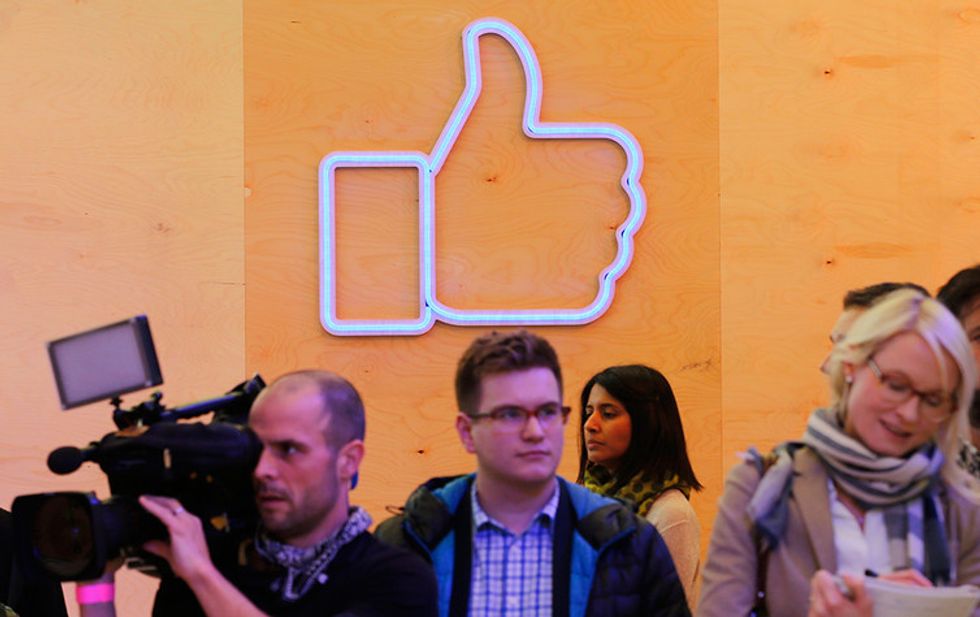
Facebook Inc will learn from a mistake it made by deleting a historic Vietnam War photo of a naked girl fleeing a napalm attack, the company's chief operating officer said.
The photograph was removed from several accounts on Friday, including that of Norwegian Prime Minister Erna Solberg, on the grounds it violated Facebook's restrictions on nudity. It was reinstated after Solberg accused Facebook of censorship and of editing history.
"These are difficult decisions and we don't always get it right," Facebook COO Sheryl Sandberg wrote in a letter to the prime minister, obtained by Reuters on Monday under Norway's freedom of information rules.
"Even with clear standards, screening millions of posts on a case-by-case basis every week is challenging," Sandberg wrote.
"Nonetheless, we intend to do better. We are committed to listening to our community and evolving. Thank you for helping us get this right," she wrote. She said the letter was a sign of "how seriously we take this matter and how we are handling it".
The 1972 photograph, by Pulitzer Prize-winner Nick Ut of the Associated Press, shows screaming children running from a napalm attack. A naked nine-year-old girl, Phan Thị Kim Phúc, is at its center.
Sandberg wrote that "sometimes ... the global and historical importance of a photo like 'Terror of War' outweighs the importance of keeping nudity off Facebook."
Facebook bars nudity with some exemptions, such as photographs of nudes in art. It is unclear exactly how disputes over its "Community Standards" reach top management.
Solberg posted the photograph on her Facebook page after the company had deleted it from the sites of Norwegian authors and the newspaper Aftenposten, which mounted a front-page campaign on Friday urging Facebook to permit publication.
Solberg welcomed Facebook's about-turn. "It shows that it helps to use your voice to say 'we want a change'. I'm very pleased with that," she told NRK public broadcasting on Friday.
Sandberg suggested that Solberg's staff could meet two Facebook officials visiting Norway on Friday. "I hope to see you soon - and am always available if you have further concerns," she wrote.
Norway is a big investor in Facebook. Its $891 billion sovereign wealth fund, the world's biggest, had a stake of 0.52 percent in Facebook, worth $1.54 billion at the start of 2016.
Solar panel installer SolarCity Corp , which is being bought by Tesla Motors Inc for $2.6 billion, said on Monday it had raised $305 million to fund its projects.
A private investment fund affiliated with Quantum Strategic Partners Ltd provided the equity investment, the company said.
The fund was advised by Soros Fund Management LLC.
The deal included an 18-year-loan syndicated to five institutional investors, SolarCity said.
The solar company said last month it faced greater-than-usual delays in closing new project financing commitments due to its takeover talks with Tesla.
(Reporting by Arathy S Nair in Bengaluru:; Editing by Sriraj Kalluvila)
A U.S. government safety agency on Friday urged all consumers to stop using Samsung Galaxy Note 7 phones, which are prone to catch fire, and top airlines globally banned their use during flights.
Following reports that the phones' batteries have combusted during charging and normal use, the U.S. Consumer Product Safety Commission said it was working on an official recall of the devices and that users should turn them off in the meantime.
Samsung Electronics Co Ltd <005930.KS> said it was working with the agency and asked customers to immediately turn in their Note 7 phones. It voluntarily issued a recall last week for 10 markets, including South Korea and the United States, and it said it was expediting shipments of replacement phones to customers in the United States.
The U.S. government action heralds more fallout for the South Korean manufacturer, which may take a financial hit from the recall and lose customers who are concerned about the quality of its flagship phones.
Some analysts say the recall could cost Samsung nearly $5 billion in revenue, after accounting for expenses from the recall process.
For Samsung, which prides itself on manufacturing prowess, the scale of the recall is expected to be unprecedented. Some 2.5 million of the premium devices have been sold worldwide, the company has said. Its shares closed down 3.9 percent on Friday.
Samsung said users in the United States can exchange their phones for one of several models and receive a $25 gift card.
In a separate statement on Saturday, Samsung asked consumers in South Korea to discontinue the use of their Galaxy Note 7 phones and visit one of the company's service centers for the recall process.
"The cost of the recall is going to be astronomical," said product liability expert and chief executive officer of Real-World Forensic Engineering, Jahan Rasty.
"They have to compensate people, fix the problem and give them a revised version of the product that doesn't have the same manufacturing or design defect.
"The longer this story lingers, the more it will etch itself in people's minds," he said.
AIRLINE BANS
One pain point is that the devices are now off limits in a typically high-use setting: aboard planes.
Aviation authorities and airlines from North America to Europe and Asia have issued bans or guidance on the phones. On Thursday, the U.S. Federal Aviation Administration (FAA) said travelers should not use or charge them while in the air, or stow them in checked luggage.
South Korea made similar recommendations on Saturday.
The FAA's action prompted the world's three largest airlines by passenger traffic - American , Delta and United - to start telling passengers at the gate and on board aircraft to keep the phones switched off until they deplane.
While experts say the bans may be tough for airlines to enforce, they nonetheless may deter would-be customers of the Note 7 in addition to annoying existing customers.
That's because airlines have increasingly made movies and TV shows available free for streaming on smart devices in flight, to avoid the cost of installing new screens on seat-backs. For now, Note 7 customers are cut off from this entertainment.
This is "a huge black eye for Samsung", TECHnalysis Research President Bob O'Donnell said.
Companies ranging from Singapore Airlines Ltd and Qantas Airways Ltd to Air France KLM SA have instituted similar bans on the device.
They are the latest in ongoing efforts in the airline industry to manage the use of lithium-ion batteries, which are known to combust and are used in many devices, from phones and laptops to toys.
Top airlines banned hoverboards during the Christmas holiday season in 2015. Earlier this year, the U.N.'s aviation agency prohibited shipments of lithium-ion batteries as cargo on passenger planes.
A January report from the FAA said at least 171 incidents of smoke, fire, extreme heat or explosion involving batteries have occurred since 1991.
In some instances, they have caused emergency landings, as when a camera short-circuited and started a small fire in the overhead bin of an American Airlines flight in September 2013. Injuries were rare, the report said.
(Reporting by Se Young Lee in Seoul and Jeffrey Dastin in New York; Additional reporting by Victoria Bryan and Deborah Todd; Editing by Tiffany Wu, Cynthia Osterman and Himani Sarkar)
A U.S. government safety agency on Friday urged all consumers to stop using Samsung Galaxy Note 7 phones, which are prone to catch fire, and top airlines globally banned their use during flights.
Following reports that the phones' batteries have combusted during charging and normal use, the U.S. Consumer Product Safety Commission said it was working on an official recall of the devices and that users should turn them off in the meantime.
Samsung Electronics Co Ltd said it was working with the agency. It voluntarily issued a recall last week for 10 markets including the United States, and it was expediting shipments of replacement phones to customers.
The U.S. government action heralds more fallout for the South Korean manufacturer, which may take a financial hit from the recall and lose customers who are concerned about the quality of its flagship phones.
For Samsung, which prides itself on manufacturing prowess, the scale of the recall is expected to be unprecedented. Some 2.5 million of the premium devices have been sold worldwide, the company has said. Its shares closed down 3.9 percent on Friday.
Samsung said users in the United States can exchange their phones for one of several models and receive a $25 gift card.
"The cost of the recall is going to be astronomical," said product liability expert and chief executive officer of Real-World Forensic Engineering, Jahan Rasty. "They have to compensate people, fix the problem and give them a revised version of the product that doesn't have the same manufacturing or design defect.
"The longer this story lingers, the more it will etch itself in people's minds," he said.
AIRLINE BANS
One pain point is that the devices are now off limits in a typically high-use setting: aboard planes.
Aviation authorities and airlines from North America to Europe and Asia have issued bans or guidance on the phones. On Thursday, the U.S. Federal Aviation Administration said travelers should not use or charge them while in the air, or stow them in checked luggage.
That prompted the world's three largest airlines by passenger traffic - American, Delta and United - to start telling passengers at the gate and on board aircraft to keep the phones switched off until they deplane.
While experts say the bans may be tough for airlines to enforce, they nonetheless may deter would-be customers of the Note 7 in addition to annoying existing customers.
That's because airlines have increasingly made movies and TV shows available free for streaming on smart devices in flight, to avoid the cost of installing new screens on seat-backs. For now, Note 7 customers are cut off from this entertainment.
This is "a huge black eye for Samsung," TECHnalysis Research President Bob O’Donnell said.
Companies ranging from Singapore Airlines Ltd and Qantas Airways Ltd to Air France KLM SA have instituted similar bans on the device.
They are the latest in ongoing efforts in the airline industry to manage the use of lithium-ion batteries, which are known to combust and are used in many devices, from phones and laptops to toys.
Top airlines banned hoverboards during the Christmas holiday season in 2015. Earlier this year, the U.N.'s aviation agency prohibited shipments of lithium-ion batteries as cargo on passenger planes.
A January report from the FAA said at least 171 incidents of smoke, fire, extreme heat or explosion involving batteries have occurred since 1991.
In some instances, they have caused emergency landings, as when a camera short-circuited and started a small fire in the overhead bin of an American Airlines flight in September 2013. Injuries were rare, the report said.
(Reporting by Se Young Lee in Seoul and Jeffrey Dastin in New York; Additional reporting by Victoria Bryan and Deborah Todd; Editing by Tiffany Wu and Cynthia Osterman)
It’s difficult to browse the internet without being inundated with requests to like a company’s Facebook page or with contests and offers dependent on doing so.
From the company’s perspective, a like on Facebook offers a chance to stay “top of mind,” a marketing concept that means a consumer thinks of a specific brand first for a certain product or service by having its promotional messages show up in that user’s Facebook newsfeed. Being liked can also be used as a metric to determine the performance of social media campaigns and other promotional activities. The more a company is liked, the more successful the promotion is thought to be.
But is this really the case? To find out, we surveyed hundreds of Facebook users to dig into the meaning and value of the Facebook like. We wanted to understand the motivations behind liking certain types of brands and discover how that affects interactions between the user and the business. We also sought to understand how this varies depending on brand type (i.e., product makers versus service providers).
Findings from two studies we undertook reveal that what likes say about consumers and what they think about the brands they like is surprisingly varied.
Does Facebook’s ‘like’ button create brand loyalty?
Fabrizio Bensch/Reuters
The loyalty of liking
For the first study, we asked 150 Facebook users to tell us about a brand that they currently like on Facebook. We then asked them to describe their motivation behind clicking the like button the first time, their interactions with the brand since liking them and any changes that have occurred in their relationship with the brand since then.
From our results, it seems that the primary reason that consumers choose to like a brand on Facebook is a sense of existing loyalty or obligation to support a brand. The largest percentage of respondents said they liked a brand simply because they felt that’s what a loyal fan should do. The next biggest share seemed to be more focused on getting something in return for their like, such as information, social recognition or entries into contests.
Interestingly, only a relatively small percentage of respondents reported that they “liked” the brand on Facebook because they simply liked (had a positive attitude toward) the brand. This differs from loyalty in subtle ways.
For example, I may have a positive attitude toward the Rolls Royce brand after seeing its products in advertisements, product placements, etc., but I have never owned one of its cars; therefore, I do not feel loyalty or obligation to the brand. This finding shows that some users who may not have purchased products from the brand may still like the brand on Facebook for various reasons.
As for levels of interaction since first liking a brand, over half of users said that while they may have read the brand’s posts or viewed its images in their Facebook newsfeed, they haven’t given any information whatsoever back to the brand. Just one-fifth said they reposted or shared content from the brand, while only 17 percent reported actually commenting on brand posts.
Finally, there was an interesting and contradictory set of instances in which respondents reported no change in the brand relationship but at the same time went on to actually detail positive brand-related consequences.
For example, a respondent initially noted that his relationship with Ford did not change after liking the Ford page, but later noted that he did look at more photos of new Ford trucks posted by the company on Facebook. This could be interpreted as a change in their relationship, because they are interacting more with the brand.
This suggests that generating Facebook likes can indeed have positive outcomes for a company, including having more interaction with its fans.
Are all likes created equal?
While the first study provided interesting results, we wanted to see if there was a statistically significant difference in the way that Facebook users reported interacting with product versus service brands.
While varying types of businesses may all be trying to gain the same outcome, there is evidence that differences exist between how product- and service-based brands interact with potential customers, ones that require distinct engagement strategies.
Just as all brands are not the same, all likes are not equal. It may seem more natural to like a brand that makes an actual product such as a favorite car manufacturer or clothing brand than a service like a plumber, cable provider or pet groomer. That’s because, due to their intangible nature, services can be much more difficult for consumers to evaluate. As a result, service companies need to initiate social interactions with their customers in order to communicate value and set appropriate expectations.
So in our second study, we surveyed 300 Facebook users to explore these differences and discovered some interesting similarities and differences in the way they interact with brands selling products and those offering services.
For example, we found that “fans” of product brands were more likely to report engaging in passive interactions with the company such as by reading or liking posts compared with those of service brands. They also reported a greater intention to make future purchases.
We found no differences between the groups, however, in their intentions to engage in more active Facebook interactions such as sharing or commenting on posts.
Parsing the results
So what does this all mean?
First, it tells us that simply adding up Facebook likes does not necessarily tell us how engaged a customer is with a company’s brand. Many of our respondents liked their respective brands for reasons other than wanting to engage in an interactive relationship. In other words, quantity of likes does not equal quality of relationships.
In addition, brand and social media managers should not automatically assume that new Facebook followers are new to the company. Many of our respondents felt that it was their obligation to a favorite or oft-purchased brand to like that brand on Facebook.
Although passive engagement with followers is perhaps not what gets the most attention when pundits discuss the benefits of Facebook engagement, it still offers benefits, such as becoming more “top of mind.” Brand managers should not always assume that their loudest and most active Facebook followers are the only ones getting the message.
Finally, our research offers different lessons for service- and product-based brands. For the former, feelings of brand connectedness were a strong outcome of Facebook interaction. These companies should perhaps focus more on personalizing their Facebook messages in an attempt to further stimulate and enhance this elevated sense of connectedness.
For product-based brands, although brand connectedness was lower, purchase intention and brand attitude – the positive or negative associations one has with the brand – were higher. To leverage this, these companies should perhaps include more calls to action on Facebook and showcase their latest and greatest product offerings.
So next time you “like” a brand on Facebook, think about what you are telling the company. And whether that’s the message you want to send.
The White House on Thursday named a retired U.S. Air Force brigadier general as the government’s first federal cyber security chief, a position announced eight months ago that is intended to improve defenses against hackers.
Gregory Touhill's job will be to protect government networks and critical infrastructure from cyber threats as federal chief information security officer, according to a statement.
The administration of President Barack Obama has made bolstering federal cyber security a top priority in his last year in office. The issue has gained more attention because of high-profile breaches in recent years of government and private sector computers.
U.S. intelligence officials suspect Russia was responsible for breaches of Democratic political organizations and state election systems to exert influence on the Nov. 8 presidential election. Russia has dismissed the allegations as absurd.
Obama announced the new position in February alongside a budget proposal to Congress asking for $19 billion for cyber security across the U.S. government. The job is a political appointment, meaning Obama's successor can choose to replace Touhill after being sworn in next January.
Touhill is currently a deputy assistant secretary for cyber security and communications at the Department of Homeland Security.
He will begin his new role later this month, a source familiar with the matter said. Touhill's responsibilities will include creating and implementing policy for best security practices across federal agencies and conducting periodic audits to test for weaknesses, according to the announcement.
Grant Schneider, who is the director of cyber security policy at the White House’s National Security Council, will be acting deputy to Touhill, according to the announcement.
(Reporting by Dustin Volz; editing by Cynthia Osterman and Grant McCool)
For the past year or so, Comcast has been experimenting in select markets with a new data cap scheme where users get charged overage fees if they use more than an allotted amount of data each month.
And that's not the worst part of it, as a detailed report from Ars Technica shows that Comcast isn't correctly measuring data usage for many customers, and is thus sending them monthly bills with wrongfully inflated charges and fees.
Ars Technica's investigation started when one customer told the publication that he received a bill that tacked on a whopping $570 in charges over the span of just one month for data overage fees. The customer and his girlfriend both work long hours and couldn't possibly use all the data that Comcast claimed, simply because they weren't in their apartment long enough to rack up such big charges.
Comcast tried to blame the customer's Apple TV set-top box for eating up data while he was outside the house, but an investigation into the box by Apple showed that it was not running unauthorized downloads 24 hours a day.
So what's really going on here? Ars Technica tried to get Comcast to give detailed breakdowns of how it monitors customers' data but the company refused to do so, while at the same time insisting that its data measurement tools worked perfectly.
Comcast uses a consulting firm called NetForecast to help it confirm the accuracy of its data measurements, but the company only monitors 55 different accounts. It would be too expensive for the company to put monitoring equipment in the homes of its 23 million other customers, so it's simply relying on a tiny sample to show that its measurements are correct.
In the end, Comcast has still offered no explanation for why customers are getting hit with higher bills and it won't give them detailed breakdowns showing exactly what is purportedly causing their accounts to use up so much data.
So if you receive a shockingly high bill from Comcast on a given month and you want to challenge it, don't expect that the company will go out of its way to help you figure out what's going on.
Gurbaksh Chahal -- the 33-year-old tech CEO who stepped down in July after violating his probation for a vicious assault on his girlfriend -- is back at the helm of his startup, the ad tech company Gravity4, in spite of the fact that he still faces jail time.
TechCrunch reported that Chahal turned over control of the company to his sister Kamal Kaur two months ago, but on Gravity4's corporate website this week, Kaur's profile has disappeared and Chahal is once again listed as CEO and described as a “diehard entrepreneur." The website makes no mention of his legal issues.
In August of 2013, Chahal assaulted his then-girlfriend in his penthouse apartment in San Francisco. The incident was caught on video by surveillance cameras.
Police determined that during the attack, Chahal punched and kicked the woman he was dating 117 times, then tried to smother her with a pillow for 20 seconds. Court papers say that Chahal told the victim "I'm going to kill you" four times as he beat her.
Chahal -- who sold his first company for $40 million when he was 18 and his second company for $300 million when he was 22 -- struck a plea deal with the court, pleading guilty to misdemeanor assault charges. He was placed on probation for three years.
In July, a California judge found that Chahal violated the terms of his probation when he attacked a different woman in the same apartment as before and threatened to have her deported to her native South Korea if she turned him in.
Chahal pleaded guilty in court, but posted a series of ranting blog posts proclaiming his innocence and calling the charges "bullsh*t." The 2014 attack -- which included more kicking -- was just him losing his temper, Chahal said, not committing domestic abuse.
"(T)here is a difference between temper and domestic violence,” he fumed.
He has since deleted the posts.
TechCrunch's Kate Conger wrote, "Chahal has fought to maintain control over his companies through all his legal battles, which have included lawsuits from employees in addition to the criminal charges. At the time of the initial charges against him, he was the CEO of another company, RadiumOne. However, the board forced him out after his guilty plea and he went on to found Gravity4. It looks like he’s planning to fight for this company, too, although he’s still facing jail time."
Technology, media, pharmaceutical and other companies, along with major corporate lobbying groups, filed legal briefs on Friday in support of a Microsoft Corp lawsuit that aims to strike down a law preventing companies from telling customers the government is seeking their data.
Friday was the deadline for filing of friend-of-the-court briefs by nonparticipants in the case. The filings show broad support for Microsoft and the technology industry in its latest high-profile clash with the U.S. Justice Department over digital privacy and surveillance.
Microsoft's backers included the U.S. Chamber of Commerce, the National Association of Manufacturers, Delta Air Lines Inc, Eli Lilly and Co, BP America, the Washington Post, Fox News, the National Newspaper Association, Apple Inc, Alphabet Inc's Google, Amazon.com Inc, the Electronic Frontier Foundation and many others.
Microsoft filed its lawsuit in Seattle federal court in April, arguing that a law allowing the government to seize computer data located on third-party computers and often barring companies from telling their customers that they are targets is unconstitutional.
The Justice Department argues that Microsoft has no standing to bring the case and the public has a "compelling interest in keeping criminal investigations confidential." Procedural safeguards also protect constitutional rights, it contends. A Justice Department spokesman declined comment on Friday's filings.
Microsoft says the government is violating the Fourth Amendment, which establishes the right for people and businesses to know if the government searches or seizes their property, in addition to Microsoft's First Amendment right to free speech.
In the suit, which focuses on the storage of data on remote servers that are often referred to as "cloud" computers, Microsoft said it had been subjected to 2,600 federal court orders within the past 18 months prohibiting the company from informing customers their data was given to authorities pursuing criminal investigations.
Under the authority of the 30-year-old Electronic Communications Privacy Act (ECPA), the government is increasingly directing investigations at parties that store data in the cloud, Microsoft argued in its suit.
Five former law enforcement officials who worked for the FBI or Justice Department in Washington state also submitted a brief supporting Microsoft.
In July, a federal appeals court sided 3-0 with Microsoft in a separate case against the Justice Department, ruling the government could not force the tech company to hand over customer emails stored on servers outside the United States.
The Justice Department has not decided whether to appeal that decision, a spokesman said.
The case is Microsoft Corp v United States Department of Justice et al in the United States District Court, Western District of Washington, No. 2:16-cv-00537.
(Reporting by Dustin Volz; Editing by Jonathan Weber and Cynthia Osterman)
A Romanian hacker nicknamed "Guccifer" who helped expose the existence of a private email domain Hillary Clinton used when she was U.S. secretary of state was sentenced on Thursday to 52 months in prison by a federal court in Alexandria, Virginia.
Marcel Lazar, 44, who used the alias online, had pleaded guilty in May to charges including unauthorized access to a protected computer and aggravated identity theft after being extradited from Romania.
Lazar's public defender, Shannon Quill, was not immediately available for comment.
Lazar has said in interviews he breached Clinton's private server at her home in Chappaqua, New York, but law enforcement and national security officials say that claim is meritless.
Lazar is believed to have hacked into email accounts of about 100 victims between 2012 and 2014.
They include prominent political figures such as former Secretary of State Colin Powell, a relative of former President George W. Bush and Sidney Blumenthal, a former Clinton White House aide and an unofficial adviser to Clinton. Clinton is now the Democratic nominee for president.
Lazar leaked online memos Blumenthal sent Clinton that were addressed to her private email account, which was used during her time as secretary of state to conduct both personal and work business in lieu of a government account.
Clinton's email arrangement, which became the subject of an FBI investigation, has drawn intense scrutiny from Republicans attempting to sow doubt about her honesty ahead of the Nov. 8 presidential election.
An entity calling itself "Guccifer 2.0" and claiming to be a Romanian hacker emerged in June and began taking credit for data breaches at the Democratic National Committee and Democratic Congressional Campaign Committee.
U.S. intelligence officials and cyber security experts believe Guccifer 2.0 is a front for Russian intelligence services intended to spread confusion about the hacks against the Democratic Party.
(Reporting by Dustin Volz; Editing by James Dalgleish)
White nationalists and self-identified Nazi sympathizers located mostly in the United States use Twitter with “relative impunity” and often have far more followers than militant Islamists, a study being released on Thursday found.
Eighteen prominent white nationalist accounts examined in the study, including the American Nazi Party, have seen a sharp increase in Twitter followers to a total of more than 25,000, up from about 3,500 in 2012, according to the study by George Washington University’s Program on Extremism that was seen by Reuters.
The study's findings contrast with declining influence on Twitter Inc's service for Islamic State, also known as ISIS, amid crackdowns that have targeted the militant group, according to earlier research by report author J.M. Berger and the findings of other counter-extremism experts and government officials.
“White nationalists and Nazis outperformed ISIS in average friend and follower counts by a substantial margin," the report said. "Nazis had a median follower count almost eight times greater than ISIS supporters, and a mean count more than 22 times greater.”
While Twitter has waged an aggressive campaign to suspend Islamic State users - the company said in an August blog post it had shut down 360,000 accounts for threatening or promoting what it defined as terrorist acts since the middle of 2015 - Berger said in his report that "white nationalists and Nazis operate with relative impunity."
Reuters was unable to independently verify the findings.
Asked about the study, a Twitter spokesman referred to the company's terms of service, which prohibit promoting terrorism, threatening abuse and "hateful conduct" such as attacking or threatening a person on the basis of race or ethnicity.
The company relies heavily on users to report terms of service violations.
The report comes as Twitter faces scrutiny of its content removal policies. It has long been under pressure to crack down on Islamist fighters and their supporters, and the problem of harassment gained renewed attention in July after actress Leslie Jones briefly quit Twitter in the face of abusive comments.
Berger said in an interview that Twitter and other companies such as Facebook Inc faced added difficulties in enforcing standards against white nationalist groups because they are less cohesive than Islamic State networks and present greater free speech complications.
The data collected, which included analysis of tweets of selected accounts and their followers, represents a fraction of the white nationalist presence on Twitter and was insufficient to estimate the overall online size of the groups, the report said.
Accounts examined in the study possessed a strong affinity for U.S. Republican presidential nominee Donald Trump, a prolific Twitter user who has been accused of retweeting accounts associated with white nationalism dozens of times.
Three of the top 10 hashtags used most frequently by the data set of users studied were related to Trump, according to the report, entitled "Nazis vs. ISIS on Twitter." Only #whitegenocide was more popular than Trump-related hashtags, the report said.
The Trump campaign did not respond to a request for comment.
(Reporting by Dustin Volz; Editing by Jonathan Weber, Peter Cooney and Bill Rigby)
Facebook Inc. will not become a media company, its founder and CEO Mark Zuckerberg said on Monday, telling students the firm would remain a technology platform.
An increasing number of users are turning to social media networks, such as Facebook and Twitter, to find their news, but Zuckerberg said his firm had no ambitions to become a content provider.
"No, we are a tech company, not a media company," said Zuckerberg, after a young Italian asked him whether Facebook intended to become a news editor.
While acknowledging the role Facebook has in supplying users with news through their connections and stressing the advantages of obtaining information from different parts of the world, Zuckerberg said Facebook was "a technology company, we build the tools, we do not produce any content".
"The world needs news companies, but also technology platforms, like what we do, and we take our role in this very seriously," he said, speaking from Rome's Luiss university.
Earlier on Monday, Zuckerberg and his wife Priscilla Chan had a private audience with Pope Francis. It was the latest in a string of meetings the pontiff has held with Silicon Valley leaders, including Apple CEO Tim Cook and Alphabet's boss Eric Schmidt.
Zuckerberg said he gave the Argentine pontiff a model of Aquila, Facebook's lightweight solar-powered drone aimed at beaming lasers to extend internet access to places that have yet to be connected.
"We ... discussed the importance of connecting people, especially in parts of the world without internet access," Zuckerberg posted on his personal Facebook profile after the meeting.
Zuckerberg also on Monday met Italian Prime Minister Matteo Renzi, who is pushing to upgrade Italy's limited internet infrastructure.
Thousands of user accounts at the conservative site InfoWars have been hacked.
According to Motherboard, the Alex Jones-founded site gives paying subscribers access to extra stories, media and information. The accounts for those paid subscribers were hacked and the email addresses, usernames and their passwords are being offered on the digital underground.
An administrator at Databases.Land gave a copy of over 50,000 unique records to prove the hack was real and Vigilante.PW also lists a data dump of the InfoWars information.
Motherboard verified that the email addresses and usernames were real and the users of the emails admitted they were signed up to Infowars/PrisonPlanet.
The passwords were masked by a cryptographic algorithm known as MD5, which is notoriously weak and easy for hackers to break. It's still unclear how much information beyond email, username and passwords have been obtained by the hackers.
The news comes on the same day that the FBI released information that election databases were also hacked in Arizona and Illinois.
"We have cross referenced the current dump versus our current db and it is data from an old breach that happened in 2012 and was dealt with at that time," Buckley Hamman from Infowars told Motherboard in a statement.
(Note: This article has been updated with a statement from InfoWars)