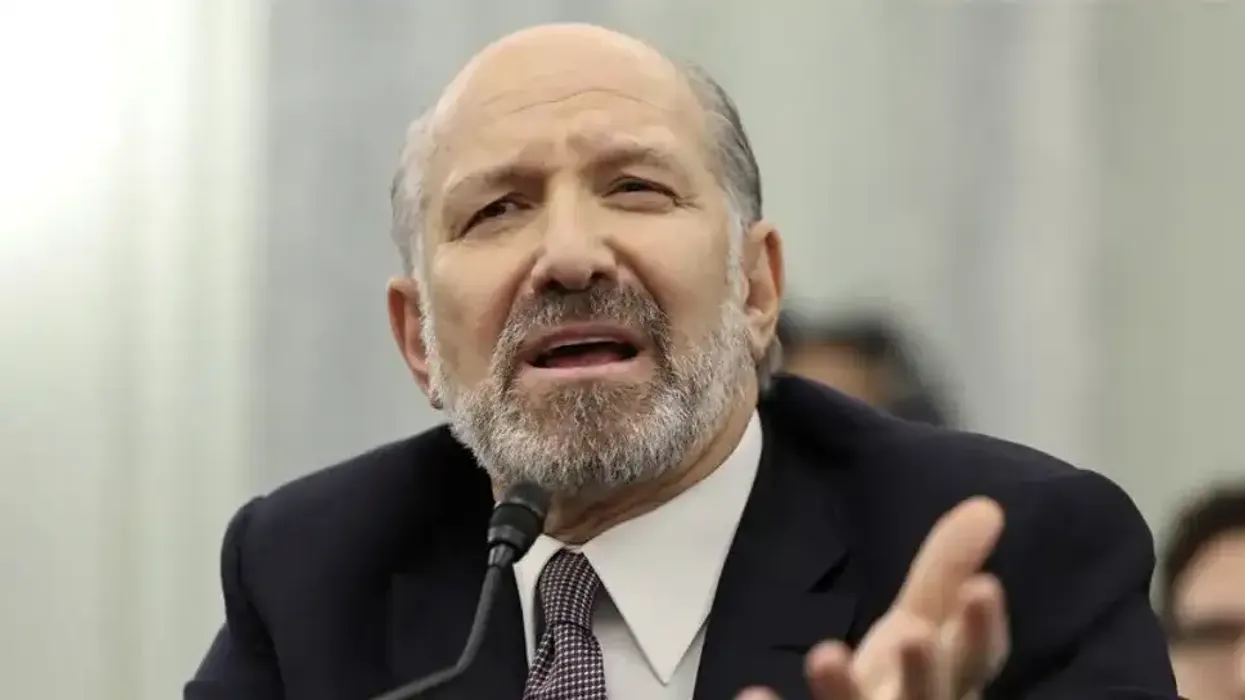
Supreme Court Justice Clarence Thomas attends a swearing-in ceremony for a new Federal Reserve Chair Kevin Warsh at the White House on May 22. REUTERS/Evelyn Hockstein

Justice Clarence Thomas tore into his own Supreme Court colleagues and two lower courts after the justices refused to hear a challenge to California’s implicit bias training rule for doctors.
Thomas, joined by Justice Samuel Alito, laid out his objections Monday in a nine-page dissent. Justice Neil Gorsuch also wanted to take the case, leaving the challengers one vote short of the four needed and California’s rule in place.
The challenge came from California ophthalmologist Azadeh Khatibi and Do No Harm, a group that opposes diversity initiatives in medicine. A 2019 state law requires nearly all continuing education courses that doctors take to keep their licenses to include lessons on implicit bias, the unconscious attitudes that can affect how patients are treated.
Thomas’ dissent called the topic “so-called implicit bias.” Khatibi, though, believes implicit bias can unintentionally lead to substandard care, KFF Health News reported in 2024.
The lower courts ruled that the courses count as California itself speaking, because the state decides what they must cover to earn credit. Free-speech protections shield private people from the government, but they do not cover the government’s own message.
“That logic fundamentally misunderstands this Court’s precedents and the Constitution,” Thomas wrote. “First Amendment protections do not give way simply because a State heavily regulates speech.”
Thomas also went after the Court’s 2022 ruling in Shurtleff v. Boston, which tells judges how to decide when the government is the one doing the talking.
“More fundamentally, however, Shurtleff is leading courts astray,” he wrote.
In that case, every justice agreed Boston was wrong to bar a Christian flag outside City Hall. Justice Stephen Breyer’s opinion setting out the test was joined by five justices still on the court, including Chief Justice John Roberts and Justices Brett Kavanaugh and Amy Coney Barrett.
Thomas signed a separate opinion by Alito warning that the test could lead courts to treat heavily regulated private speech as the government’s.
“As the Ninth Circuit’s decision shows, those concerns were prescient,” Thomas wrote, adding that “we should reconsider Shurtleff.”
Thomas is asking five sitting colleagues to abandon reasoning they signed, and none of them sided with him when the case was heard.
The questions at the heart of that test trace back to a 2015 ruling in which Thomas cast the deciding vote.
In that case, Thomas joined the court’s four liberal justices in a 5-4 decision letting Texas refuse a Confederate flag license plate. The court ruled that specialty plates, many designed by private groups, were the state’s own message after weighing their history, who people think is speaking, and how much control Texas has.
The Ninth Circuit leaned heavily on that ruling, including its finding that private groups helping design a message do not make it any less the government’s.
Thomas said the lower courts got an easy question wrong, but the appeals judges had named the same danger he raises about heavy regulation.
“It should have been easy, then, for the courts below to conclude that California’s implicit-bias-training requirement regulates private speech,” Thomas wrote. He called the Ninth Circuit’s analysis “blinkered.”
The appeals panel called the question of whether students see the instructor or the state as the speaker a close one, and said its ruling would stand either way. The judges also warned that letting a long history of regulation alone shield a state from free-speech claims “would be a serious affront to the Constitution.”
Only three of the Ninth Circuit’s judges dissented when the full court refused to rehear the case.
“If Khatibi wins in the Supreme Court, or at any level, then chaos reigns,” UC Davis law professor Ashutosh Bhagwat told KFF Health News, warning that every continuing education requirement for licensed professionals would be open to challenge.
Report typos and corrections to corrections@rawstory.com.
For customer support contact support@rawstory.com.