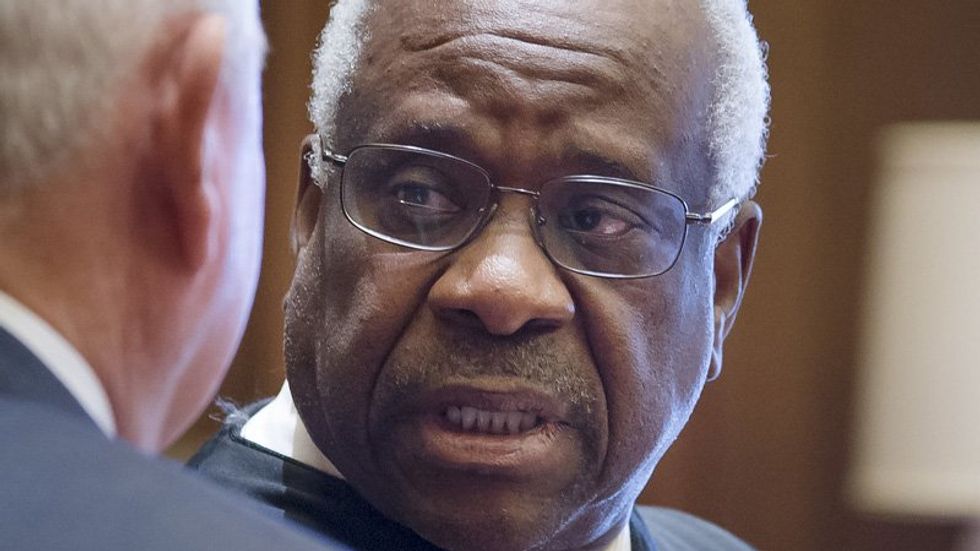
U.S. Supreme Court Justice Clarence Thomas. (Photo by Preston Keres/USDA)

Justice Clarence Thomas was the single dissent in a case where a domestic abuser demanded access to his gun after it was taken away due to a victim's protection order.
Former federal prosecutor Harry Litman said that the U.S. Supreme Court "painted itself into a corner" in a previous gun case. So, they had to fix it in the United States v. Rahimi ruling.
Speaking to MSNBC's Nicolle Wallace, Litman joked that at least Thomas has some consistency.
ALSO READ: Inside the 'irregular warfare' campaign fascists are conducting against America
"This opinion was cleaning up a self-inflicted error by the court two years ago in the Bruen case," he said.
The Bruen case was a suit against the State of New York, which requires a person to show a special need for protection before they can obtain an unrestricted license to get a concealed weapon.
What was different in this case, Litman explained, is that there is no originalism argument because when the law was written, it was legal to beat your wife.
"There wasn't any history for understandable and irrelevant reasons, sad reasons, really, of regulating domestic offenders at the time," said Litman. In fact, it wasn't until 1920 that it became illegal in all 20 states not to beat your wife.
But the case on Friday had to turn out the way that it did, said Litman, "and Thomas' adherence to what they said in Bruen really just shows the rigidity of the way he approaches the Constitution."
He predicted that the "originalism" argument would play out in the coming years, but in Friday's case, it was clear that the majority of the court agreed a domestic abuser shouldn't have a gun.
"You can come up with relevantly similar regulations that we used to do, and he's saying society would do. But now take that question and think about, for example, gay marriage. Is that relevantly similar as to marriage as it used to be or abortion?" he asked.
See the full comments in the video below or click here.
Part 1 youtu.be
Report typos and corrections to corrections@rawstory.com.
For customer support contact support@rawstory.com.