



This fix will stop Trump's wave of destruction — by obliterating him
I was reading a story about how Donald Trump had so thoroughly destroyed the Kennedy Center, a once-great arts institution reduced to a pathetic shell by one man’s seemingly deep-seated enmity at John F. Kennedy’s ongoing, and entirely justified, veneration. It was clear that Trump’s goal all along has been to raze the venue and rebuild it as the Trump Center, so egomaniacal is he.
The thing is, this sort of pitiful move is entirely on brand for this president. He is at war with America’s history, the goal being to erase it and install himself as at once the demolisher and self-appointed savior of everything that has been and will be. He is all about marking his territory with toxic urine. If it doesn’t bear his name and/or likeness, he believes it carries no value and must be wiped from the face of the earth.
Indeed, to catalog the institutions, ideals, norms and shared assumptions of American life that Trump has sought to destroy during both his first and (especially) second administrations is to perceive an impossibly voluminous obliteration of things and standards that once seemed permanent and invulnerable.
What follows here, in no particular order, is a list of what Trump has ruined through either his hideous taste, inept decision-making or purposeful hostility. It is by no means a complete list, as that would require a multi-book encyclopedia.
- He’s destroyed the Kennedy Center.
- He’s destroyed the East Wing.
- He’s destroyed the Reflecting Pool.
- He’s destroyed our alliances.
- He’s destroyed the U.S. Postal Service.
- He’s destroyed the free press.
- He’s destroyed the military.
- He’s destroyed the rule of law.
- He’s destroyed the U.S. Congress.
- He’s destroyed the FCC.
- He’s destroyed the independence of public broadcasting.
- He’s destroyed the EPA.
- He’s destroyed the FBI.
- He’s destroyed the IRS.
- He’s destroyed the State Department.
- He’s destroyed the Department of Education.
- He’s destroyed the Department of Homeland Security.
- He’s destroyed the Federal Trade Commission.
- He’s destroyed the National Institutions of Health.
- He’s destroyed USAID.
- He’s destroyed the Electoral College.
- He’s destroyed the Office of Government Ethics.
- He’s destroyed the concept of ethics in government.
- He’s destroyed the expectation that a president and his family won’t be hopelessly corrupt.
- He’s destroyed the National Science Foundation and public confidence in science as a method for establishing facts.
- He’s destroyed the credibility of facts and the veracity of truth itself.
- He’s destroyed the stability of the research funding upon which laboratories, universities and scientists depend.
- He’s destroyed the expectation that public-health guidance should be grounded in evidence.
- He’s destroyed our trust in vaccines to prevent disease.
- He’s destroyed the understanding that universities must be allowed to operate independently of executive branch interference and government shakedown.
- He’s destroyed academic freedom itself along the assumption that colleges should be institutions of intellectual inquiry rather than ideological conformity.
- He’s destroyed the construct that knowledge itself is an essential boon to humankind.
- He’s destroyed the FDA.
- He’s destroyed the CDC.
- He’s destroyed the Supreme Court.
- He’s destroyed the concept that judicial rulings are sacrosanct rather than partisan.
- He’s destroyed the Justice Department and the assumption that it exists to serve justice rather than the president.
- He’s destroyed the Health Department.
- He’s destroyed the National Endowment for the Humanities.
- He’s destroyed the National Endowment for the Arts.
- He’s destroyed the lives of America’s immigrants.
- He’s destroyed the harmonious co-existence of trans citizens.
- He’s destroying our national parks and protected lands.
- He’s destroyed generations of civil rights and equal opportunity/gender equality gains for women and people of color in particular.
- He’s destroyed trust in our elections.
- He’s destroyed the peaceful transfer of power.
- He’s destroyed the idea that losing an election is a simple disappointment rather than an injustice compelling litigation.
- He’s destroyed the concept of live and let live.
- He’s destroyed the expectation that a president serves the Constitution rather than the demand that the Constitution serve him.
- He’s destroyed the notion that a president should serve the people rather than his bulging bottom line.
- He’s destroyed the expectation that career criminals shouldn’t be placed in positions of authority.
- He’s destroyed the belief that government servants should serve the people rather than themselves.
- He’s destroyed the understanding that the FBI should operate independent of political vendettas.
- He’s destroyed the distinction between law enforcement and personal retaliation.
- He’s destroyed the principle that the law applies equally to the powerful and the powerless.
- He’s destroyed the understanding that climate change must be viewed as a legitimate threat to the planet.
- He’s destroyed trust in American history itself — in the independence of the historians who study it, the museums that preserve it, and the public institutions entrusted with telling the nation’s story.
- He’s destroyed the dignity of the presidency and the belief that character matters in public office.
- He’s destroyed the expectation that presidents should avoid even the appearance of conflicts of interest.
- He’s destroyed America’s word and the nation’s honor in dealing with what were once our allies.
- He’s destroyed our standing in NATO.
- He’s destroyed the expectation that American foreign policy will consistently defend democratic institutions abroad.
- He’s destroyed any expectation of diplomacy or of bargaining in good faith.
- He’s destroyed the belief that public figures should apologize rather than double-down when proven wrong.
- Finally, he’s destroyed the sense of assurance that our democracy will always survive.
The deeper argument here is not simply that Trump is singlehandedly destroying American democracy, science, education, journalism and the rule of law. They remain essentially intact despite the enormous and continuing pressures placed on them to completely implode.
What seems the larger point is how his two presidencies have exposed how much of our lives depends on voluntary restraint, institutional independence, public trust and a willingness to accept limits on power, the kind of limits that Trump will never believe apply to him.
As we sit less than six weeks from the midterms, it’s instructive to remember that a constitution cannot enforce itself and a democracy can’t survive indefinitely without a vigorous defense. We must start to reverse his purposeful destruction of everything we hold dear.
November can’t come soon enough.
(Ray Richmond is a longtime journalist/author and an adjunct professor at Chapman University in Orange, CA.)
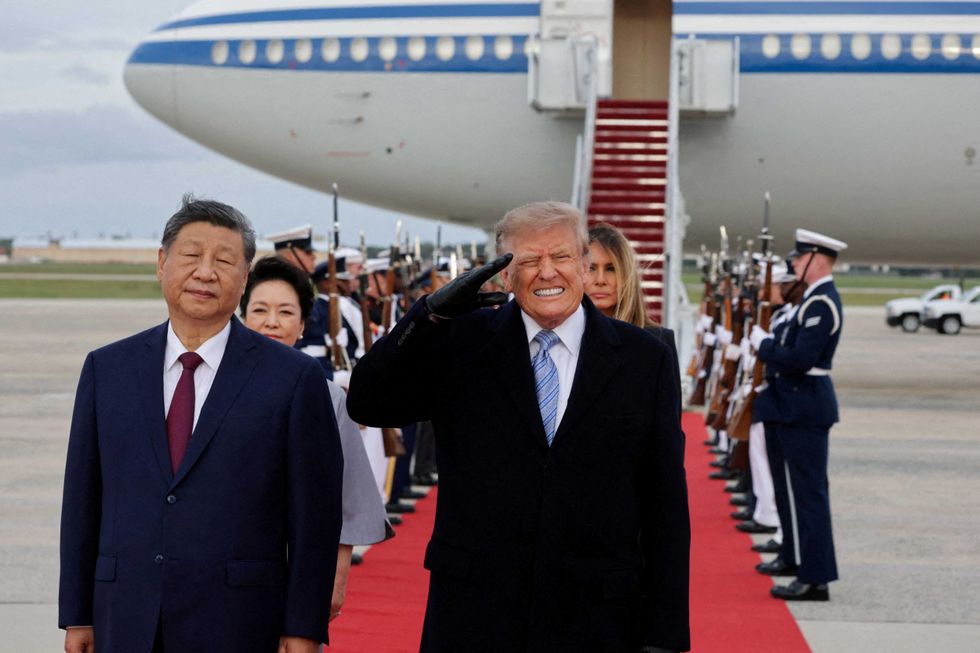 US President Donald Trump reacts to the roar of B-1 bomber flyover during the U.S. national anthem as Trump salutes next to Chinese President Xi Jinping during an arrival ceremony ahead of a state visit at Joint Base Andrews, Maryland, US, September 23, 2026. REUTERS/Jonathan Ernst
 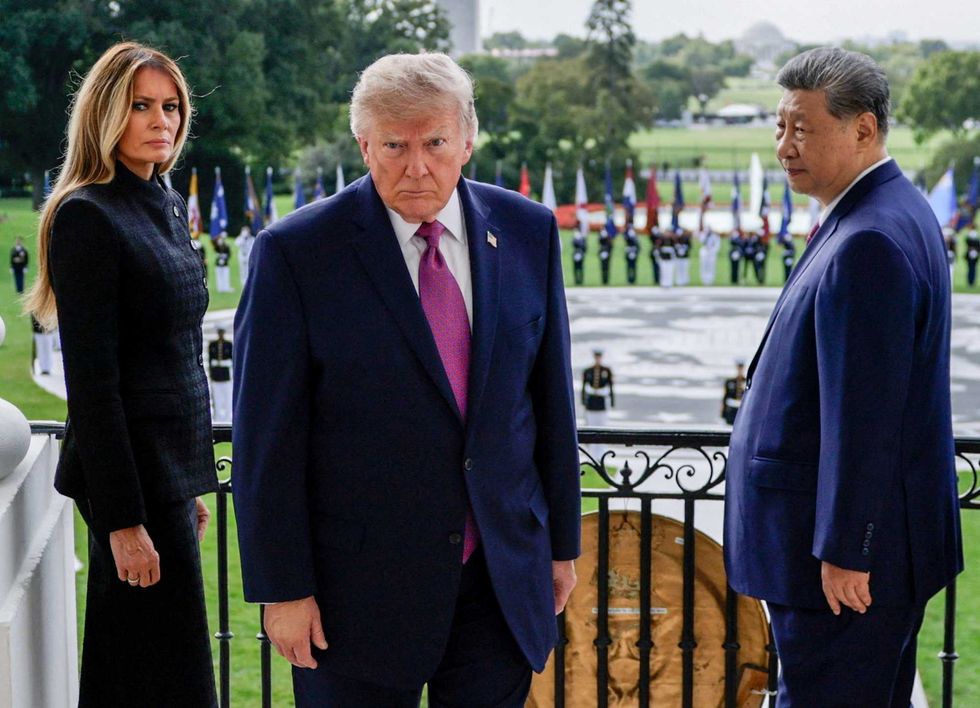 US President Donald Trump, first lady Melania Trump and Chinese President Xi Jinping after watching a military demonstration from a balcony of the White House in Washington, D.C., US, September 24, 2026. REUTERS/Evan Vucci