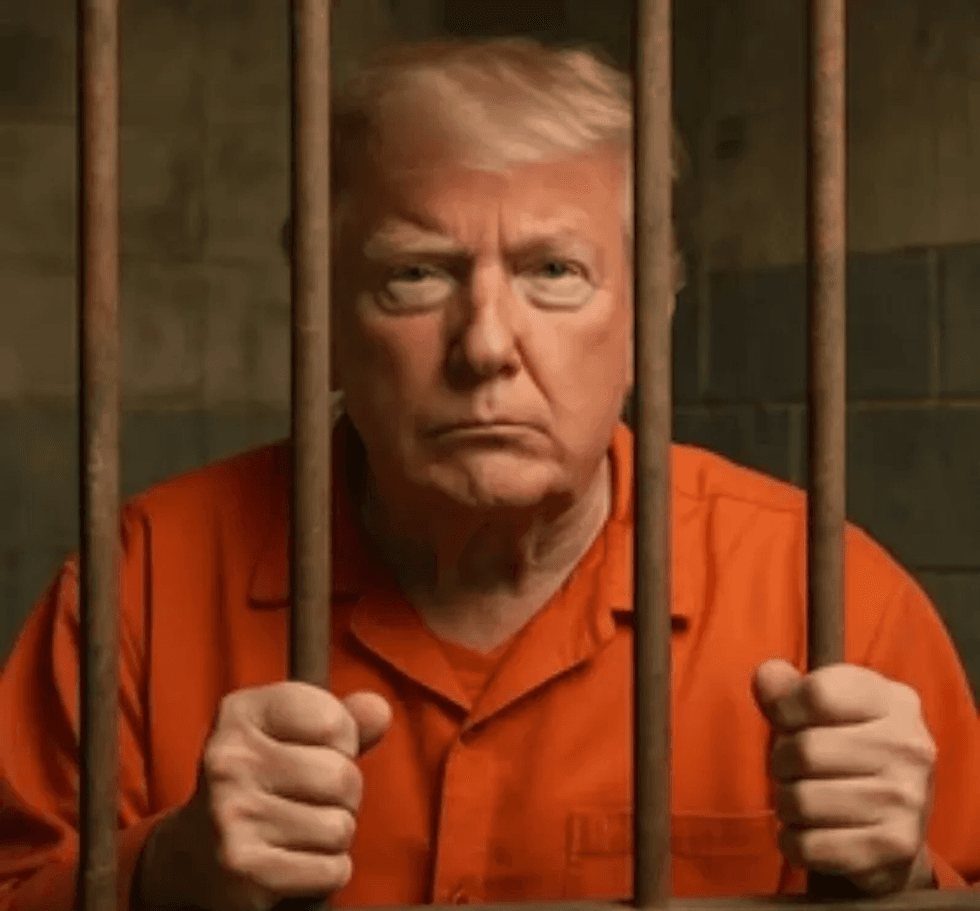
Mad as hell Dems will incinerate their party before they accept this betrayal
There is a question Democrats should be asking themselves before the November midterm elections, and it is more uncomfortable than simply asking whether they can win.
What happens if they do?
More specifically: What will Democrats do if voters hand them control of Congress?
The fact that this question even needs to be asked — especially amid what many regard as the most corrupt and lawless administration in history — should tell Democrats something about the depth of voter frustration.
We sat through nearly eight years of Barack Obama trying to play Kumbaya with Republicans whose only goal was opposing everything he stood for. We watched the Justice Department's burying of the Mueller investigation and its aftermath. We endured nearly two years of an attorney general who seemed determined to move on. After an insurrection.
And we're now faced with Democratic leaders who, at least on the surface, still appear to be failing to read the room.
Americans aren't simply angry at Republicans. Many are also deeply frustrated with Democrats who, in their view, have repeatedly failed to meet the moment: funding ICE when resistance was demanded, responding with “strong letters” when action was required, engaging in private meetings with members of Trump's inner circle, and appearing remarkably passive when voters expected action — Mitch McConnell's months-long vanishing act being just one example.
These are not minor complaints.
They reflect a larger problem: the perception that Democrats are unwilling to use the power they have — or the power voters might give them — to demand accountability.
A Republican victory in November would be deeply consequential. A continued Republican majority could mean another two years in which congressional oversight of the current administration remains about as likely as the Trump EPA protecting the environment.
But there is another possibility:
Democrats win control of Congress — and then decide that the country needs to “move on.”
That could be almost as damaging.
To some, “moving on” may sound like national healing. To angry voters who believe they have watched institutions and their leaders fail and want accountability, it may sound like something else entirely:
Surrender.
Americans are exhausted by political warfare. They want lower prices, better jobs, functioning government and safer communities.
But there is a fundamental difference between moving forward and moving on.
Moving forward means establishing what happened, determining whether laws were broken, exposing abuses of power and putting safeguards in place so they cannot happen again.
Moving on means deciding that accountability is too politically inconvenient.
Winning Congress Is Not the Same as Restoring Accountability
If Democrats regain the House, they will have subpoena power, committee gavels and the ability to conduct serious investigations.
Reports indicate Democratic leaders are preparing investigations into the Trump administration, its business interests and its political network should they win the House.
But preparation is one thing. Follow-through is another.
That is where Democratic candidates need to be pressed.
Consider Iowa Senate candidate Josh Turek, who recently appeared on The Briefing with Jen Psaki. Turek is the Democratic nominee challenging Republican Ashley Hinson. When asked whether, should he win, he would hold members of the Trump administration accountable, Turek responded with familiar, complacent Democratic talking points: the desire to “move on,” establish “guardrails,” and “prevent this from happening again.”
Not exactly the “mad as hell and we're not going to take it anymore” candidate many voters are looking for.
When Psaki pressed him again, he again avoided the simple answer many voters wanted: “Yes.”
That kind of timid response does not sit well with voters who want accountability.
We are furious.
We are enraged.
Many Americans believe the country has been profoundly damaged by political corruption, institutional dysfunction and stentorian abuses of power.
Any Democrat who fails to understand that anger — or assumes voters will be satisfied with another round of carefully worded statements about “norms” — is profoundly out of touch with reality.
Congressional oversight is not revenge.
It is one of Congress's fundamental responsibilities.
So what if it looks political?
It only looks that way to those being investigated.
At some point, caution becomes complicity.
Fence-sitting becomes normalization.
I have friends who say, should the Democrats win in November and then fall back into their old, cautious ways, they will never vote for a Democrat again. Imagine how frustrated one has to be to pull the trigger for corruption over compassion and ethics? It’s the last act of a voter who feels betrayed by both parties. It’s our way of saying, you won’t do what we’re begging you to do? When we need you the most? We’d rather see it burn.
That should concern Democratic leaders more than a little.
So which is worse?
A Republican victory in November would certainly carry enormous consequences.
But a Democratic victory followed by political timidity could create a different — and perhaps more profound — result:
Resignation.
Imagine millions of voters turning out because they believe Congress should serve as a check on executive power, then seeing their elected officials spending their political capital explaining why they shouldn't investigate. Imagine, in Chuck Schumer's voice, hearing that “taxpayer dollars should be spent helping Americans get the things they need.”
What if the thing taxpayers need most is accountability?
We've lived with armed agents patrolling our streets, the doubling of gas prices, pardons for criminals, and bacteria in our food. We can endure a bit longer if it means those responsible are held accountable.
What we can’t endure another minute are those in power being let off the hook by the people we elected to do just that.
Imagine hearings that produce headlines but no subpoenas.
Investigations that produce reports but no consequences.
Evidence that produces outrage for a week and disappears the next.
And eventually, the inevitable Washington conclusion:
“It's time to move on.”
Move on to what?
The next election? If there is one?
The next scandal? We can’t keep track.
The next administration? President Vance?
If credible evidence shows that laws were broken, public trust abused or government institutions corrupted, the answer cannot simply be:
“Forget it.”
It must be:
Investigate it.
Establish the facts.
Hold accountable those who deserve accountability.
Then fix the system.
That is not partisan warfare.
That is democracy protecting itself.
So, Democrats, in the immortal words of Sean Connery:
“What are you prepared to do about it?”