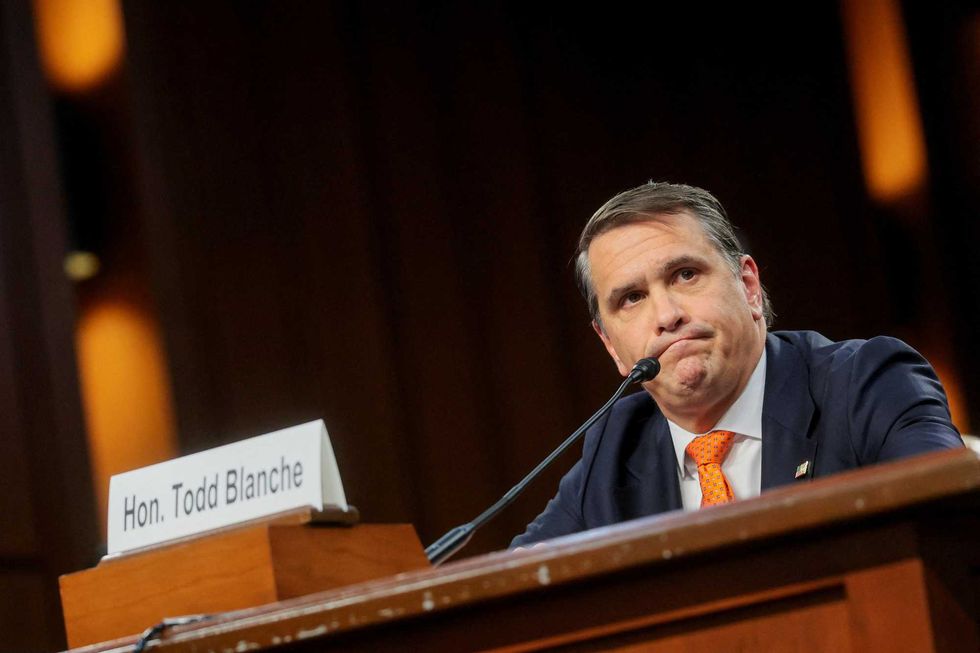
Acting U.S. Attorney General Todd Blanche testifies before a Senate Judiciary Committee confirmation hearing on his nomination to be attorney general, on Capitol Hill in Washington, D.C., U.S., July 15, 2026. REUTERS/Jonathan Ernst

A federal judge rejected the Justice Department’s bid to limit or cancel a hearing on whether Chicago’s top federal prosecutor and three of his assistants misled her in a case arising from President Donald Trump's Chicago immigration crackdown.
U.S. District Judge April Perry denied the department’s “motion for clarification” Wednesday, according to court records.
U.S. Attorney Andrew Boutros and Assistant U.S. Attorneys William Hogan, Matthew Skiba and Andres Almendarez must testify under oath on Nov. 16 about statements made to her in the collapsed case against the “Broadview Six” protesters.
Perry reminded Woodward of her "inherent authority," the power courts have to police the lawyers who appear before them.
“Ultimately, the Government’s professed lack of clarity about the Court’s inherent authority to ask lawyers who have made misstatements to or misled the Court to explain their actions is immaterial,” Perry wrote.
The motion, filed Tuesday by the office of Associate Attorney General Stanley Woodward, asked Perry to explain what law authorizes the hearing and to consider “limiting or forgoing entirely this inquiry.”
“In sum, the Court has presented the United States Attorney and his subordinates with a Catch-22. They can testify and risk prosecution, or they can assert their rights under the Fifth Amendment and risk antagonizing the Court,” the motion said.
“The Government does not represent at least 3/4 of the individuals who have been asked to testify, two of whom have expressed their willingness to do so,” Perry replied.
Almendarez’s lawyer wrote that he “is ready to testify truthfully,” and Skiba’s lawyer wrote that he “stands ready” to testify fully. Perry also wrote that there is “no indication on the docket” that the department represents Boutros.
So the witnesses the department said faced a Catch-22 are mostly not its clients, and two of them have chosen to testify anyway.
The hearing will also test the department’s changing account of whether anyone outside Chicago, including the White House, weighed in on the case.
In a March 30 filing, Hogan called the former defendants’ suspicion of “external political influence” on the charges “completely false” and said there were “no communications of any nature” with anyone outside the Chicago office about investigatory or charging decisions, apart from local FBI agents.
“To be crystal clear, this specifically includes anyone in the White House and all components and offices of Main Justice,” Hogan wrote, referring to department headquarters.
A September correction from the government acknowledged contacts with department headquarters after the charging decision but said there were none with the White House about the case.
Perry wrote in her Nov. 2 order that the government has since called Hogan’s statement “true as it relates to pre-charging decisions” while also arguing that “if any such communications did exist, they would be privileged.”
The department’s privilege log, its list of withheld records, names no author or recipient, Perry wrote Tuesday, calling it “noncompliant.”
The department has moved from denying any outside contact, including the White House, to claiming privilege over outside communications without saying who took part.
The Broadview Six case is one of many to fall apart from Operation Midway Blitz, Trump’s immigration crackdown in Chicago, and its fallout now reaches Boutros himself.
About 30 protesters faced federal charges during the operation, and many of those cases have since been dropped or dismissed, the Associated Press reported.
Of 33 known Midway Blitz defendants, grand jurors declined to indict at least three, the Chicago Sun-Times reported. U.S. Magistrate Judge Gabriel Fuentes wrote last year that such refusals were “virtually unheard of in this district until Operation Midway Blitz.”
Perry has said the inquiry could lead to sanctions or criminal contempt, a charge for obstructing a court. The department wrote Tuesday that it does not view any criminal referral as “necessary or proper.”
Report typos and corrections to corrections@rawstory.com.
For customer support contact support@rawstory.com.