



Why does your hair curl in the summer? A chemist explains the science behind hair structure
Hair structure
Hair begins growing under the skin’s surface, but it’s what happens after it pokes through the skin that determines whether you have a good hair day or a bad one.
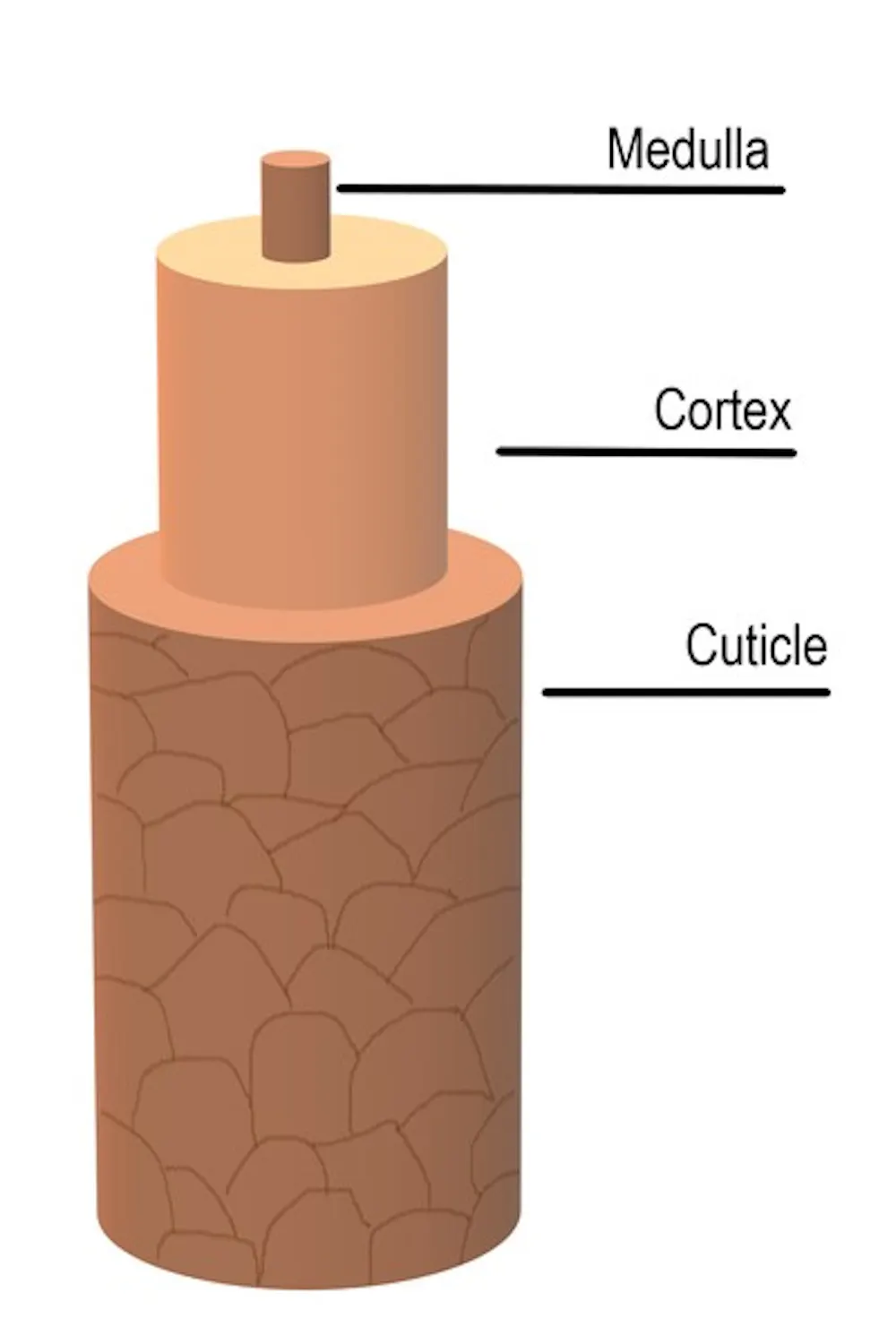
The three layers of hair. Christinelmiller/Wikimedia Commons, CC BY-SA

Each hair can have three layers – the medulla, the cortex and the cuticle. You can think of each hair like a tiny tree trunk.
The innermost, or core layer, is the medulla. This layer holds moisture, much like the pith in the center of a tree trunk. This layer is also very fragile, but only thick or coarse hairs contain this part – so those with thin or blond hair typically don’t have the medulla layer in their hairs.
Next is the cortex, which makes up most of a hair and is analogous to the wood of a tree. The cortex is made up of spring-shaped protein molecules that lie in parallel rows in a cylindrical bundle. The exact shape of that bundle is determined by the hair follicle, which is a pore on the skin from where the hair grows.
How the hair grows out of the follicle influences the distribution of its proteins. So a straight follicle produces straight hair and a curved follicle produces curly hair. The less evenly distributed the squiggly proteins are, the curlier the hair. Your genetic code also plays a role in the shape of the cortex and, therefore, the shape and thickness of your hair.
Lastly, the outermost layer of a hair is called the cuticle. The cuticle is like the bark of a tree – and it even looks like bark under a microscope.

A hair’s cuticle under a microscope. Lauren Holden, CC BY-SA
It’s the cuticle’s job to protect the cortex, but the cuticle is very easily damaged. Imagine lifting or removing the bark from a tree. Doing so would leave the wood inside susceptible to moisture loss, exposure to the environment and damage.
The same is true for each hair. When the cuticle is damaged from brushing, chemicals, wind or heat, the proteins of the cortex have a much more difficult time lying smoothly together. This means they can lose moisture, gain moisture, fray like a rope – this causes split ends – and even break. All these factors can influence how your hair looks at any given moment.
Hair in the summer
So what does all of this have to do with humidity? Well, hair proteins contain many permanent chemical bonds. Only chemical treatments like perms or straightening can change these bonds. But there’s another natural phenomenon that keeps the protein molecules in the cortex in line – something called hydrogen bonding.
The long, stringy protein molecules in the cortex contain tiny positive and negative charges throughout their structure. Because opposite charges attract each other, entire rows of proteins can be attracted to each other like tiny, weak magnets.
Heating or wetting your hair breaks the magnetlike attraction between these rows of proteins. So, heat and water can rearrange the proteins in your hair by breaking the hydrogen bonds that keep their structure together.
How hydrogen bonds form.
Water is one of the best molecules at hydrogen bonding. So when a molecule of water has the opportunity to hydrogen bond with something, it will.
In your hair, water can form hydrogen bonds between the rows of proteins in your hair’s cortex. It is the extent to which this happens that determines your hair’s fate.
When just a little water enters the hair, like it might in lower humidity conditions or when the cuticle is healthy and able to keep too much water out of the cortex, your hair may curl. When humidity is high, or the cuticle is damaged, more water enters the hair. Too much water can swell and crack the cuticle, making hair look frizzy.
Many people consider high humidity to be the problem behind frizzy hair, but styling your hair under high humidity and then entering a less humid environment can also be an issue. Water molecules leaving the hair’s cortex can also lead to a change in hair behavior.
Treating summer hair
A damaged cuticle layer leaves the cortex more susceptible to water molecules creeping in or out and wreaking havoc on your hair. Anytime water molecules travel in or out, your hair’s structure suffers and your hairstyle may be ruined. When the cuticle is healthy, it can protect the cortex, making your hair less susceptible to changes in the weather or environment. The bottom line is that a healthy hair cuticle helps keep proper moisture in the cortex.
Heat from styling tools is the most common culprit behind damaged cuticles, but chemical treatments, brushing, sun and wind can also cause damage. Avoiding these activities can help, but some things, such as exposure to the sun, can’t be avoided.
You can also take care of your scalp – a clean, healthy scalp leads to healthy hair cuticles. Using moisturizing products on your hair can help maintain cuticle health as well. Oils and moisturizing treatments can even restore damaged cuticles. The good news is that by understanding your hair and treating it well, you can help prevent the undesired effects of humidity.
Tara S. Carpenter, Principle Lecturer, University of Maryland, Baltimore County
This article is republished from The Conversation under a Creative Commons license. Read the original article.