The long-awaited, first civilian space tourism flight by Virgin Galactic was set for takeoff Thursday, carrying an 80-year-old ex-Olympian and a mother and daughter who won their tickets in a sweepstakes.
The three passengers -- Jon Goodwin, 80; Keisha Schahaff, 46; and her daughter Anastatia Mayers, 18 -- will spend a few minutes in space, where they can admire the curvature of the Earth and briefly float in weightlessness.
The flight will be the culmination of a nearly two-decade-old promise by British billionaire Richard Branson, Virgin Galactic's founder, to bring tourists into space, giving them the chance to experience weightlessness and see the earth.
This mission, named Galactic 02, is the company's second commercial flight.
The first at the end of June carried a group of senior Italian Air Force officers who had carried out several experiments on board, rather than civilians making the trip purely for pleasure.
Schahaff, a health coach from Antigua and Barbuda, won a contest for the tickets that raised $1.7 million for the non-profit Space for Humanity, which aims to widen space access.
Mayers is a student at the University of Aberdeen in Scotland, studying philosophy and physics.
"I always was interested in space as a little girl," Schahaff told AFP in an interview in 2021. "This is a great opportunity for me to feel alive and to just make the greatest adventure ever."
Goodwin is an adventurer who competed in the 1972 Olympic games as a canoeist for Britain.
He was diagnosed with Parkinson's in 2014 and will be the second person with the condition to travel to space.
Virgin Galactic's spaceflights involve a giant, twin-fuselage carrier aircraft that takes off from a runway, gains altitude, then drops a rocket-powered spaceplane that soars into space.
The passengers experience a few minutes of weightlessness at around 53 miles (85 kilometers) above sea level, before the spacecraft glides back to Earth.
Founded in 2004, Virgin Galactic has sold around 800 tickets for seats on future commercial flights -- 600 between 2005 and 2014 for $200,000 to $250,000, and 200 since then for $450,000 each.
Virgin Galactic competes in the "suborbital" space tourism sector with billionaire Jeff Bezos's company Blue Origin, which has already sent 31 people into space using a vertical lift-off rocket.
But since an accident in September 2022 during an unmanned flight, Blue Origin's rocket has been grounded. The company promised in March to resume spaceflight soon.
Research published in Psychological Reports suggests that labeling oneself as a “highly sensitive person” can sometimes be a manipulative tactic used by individuals with dark personality traits, particularly narcissism and psychopathy, to sway others’ behavior and gain advantages. The researchers conducted this study to better understand the construct known as sensory processing sensitivity, which refers to individual differences in sensitivity to internal and external stimuli. This trait is popularly known as being a “highly sensitive person” in public discourse, and some individuals identify...
Russia's plan to launch its lunar lander on Friday is the latest in an international push to return to the Moon that includes the world's top powers but also new players.
Technology, science and politics are all essential factors in the Moon race.
Here is the latest:
- China's great leap -
China is pursuing plans to send a crewed mission to the Moon by 2030 and plans to build a base there.
The world's second-largest economy has invested billions of dollars in its military-run space program in a push to catch up with the United States and Russia.
China was the third country to put humans in orbit in 2003 and Tiangong is the crown jewel of its space program, which has also landed rovers on Mars and the Moon.
The unmanned Chang'e-4 rocket landed on the far side of the Moon in 2019, with another robot mission to the near side raising the Chinese flag there in 2020.
That moonshot brought rock and soil samples back to Earth, the first time that has been done in more than four decades.
- NASA's Artemis -
NASA's Artemis 3 mission is set to return humans to the Moon in 2025 including its first woman and first non-white astronaut.
Under the Artemis program, NASA is planning a series of missions of increasing complexity to return to the Moon and build a sustained presence in order to develop and test technologies for an eventual journey to Mars.
The first, Artemis 1, flew an uncrewed spacecraft around the Moon in 2022. Artemis 2, planned for November 2024, will do the same with crew on board.
NASA sees the Moon as a pit stop for missions to Mars and has done a deal with Finnish mobile firm Nokia to set up a 4G network there.
However, NASA said this week that the Artemis 3 mission may not land humans on the Moon, depending on whether certain key elements, including the landing system developed by SpaceX, were ready.
Elon Musk's firm won the contract for a landing system based on a version of its prototype Starship rocket, which remains far from ready.
An orbital test flight of the uncrewed Starship ended in a dramatic explosion in April.
- Russia's Luna -
Russia's launch of Luna-25 on Friday will be its first to the Moon since 1976 and marks the beginning of Moscow's new lunar project.
President Vladimir Putin is looking to strengthen space cooperation with China after ties with the West broke down following the start of Moscow's invasion of Ukraine in 2022.
- New players -
Recent technological progress has reduced the cost of missions and opened the way for new players in the public and private sector to get involved.
India's latest space mission Chandrayaan-3 entered the Moon's orbit in August ahead of the country's second attempted lunar landing later this month.
But getting to the Moon is not an easy task. Israeli non-profit SpaceIL launched its Beresheet lunar lander in 2019, but it crashed.
And in April this year Japan's ispace was the latest company to try, and fail, at the historic bid to put a private lunar lander on the Moon.
Two other US companies, Astrobotic and Intuitive Machines, are set to try later in the year.
Air pollution, especially its tiniest particles, has contributed to a 30% global rise in heart-related disabilities and death since 1990, a new study has found. The pollution connection affected men more than women, while poorer regions of the world were hit harder that wealthier areas, researchers said in the study published Wednesday in the Journal of the American Heart Association. The most notable culprit, particulate matter pollution, shows up outside in dirt, dust, soot or smoke from coal- and gas-fueled power plants, vehicle emissions, agriculture, dust, pollen and wildfire smoke, while...
Mindfulness-Based Programs lead to small to moderate reductions in psychological distress among adults, with effects lasting up to six months, according to new research published in Nature Mental Health. The findings shed light on the general effectiveness of these programs and clarify that this effectiveness is not significantly influenced by individual factors such as baseline distress, gender, age, education, or dispositional mindfulness. The researchers conducted this study to better understand the effectiveness of Mindfulness-Based Programs (MBPs) in preventing mental health issues among ...
NASA's Curiosity rover has discovered the first evidence that Mars once had a climate which alternated between wet and dry seasons similar to Earth, a study said on Wednesday, suggesting the red planet may have once had the right conditions to support life.
Though the surface of Mars is now an arid desert, billions of years ago rivers and vast lakes are thought to have stretched across its surface.
Since 2012, the Curiosity rover has been exploring the huge Gale crater, which is believed to be home of a former lake and has a massive mountain of sediment nearly six kilometers (four miles) high in its centre.
"We quickly realized that we were working in lakes and rivers deposits, but did not know what type of climate they were linked to," William Rapin, a researcher at France's CNRS scientific research centre and the study's lead author, told AFP.
While climbing the slope of the sediment mountain in 2021, Curiosity found salt deposits forming a hexagonal pattern in soil dated to nearly four billion years ago.
The rover's instruments identified the patterns as cracks in dried mud, according to the study published in the journal Nature.
"When a lake dries up the mud cracks, and when it fills back up, the cracks heal," Rapin explained.
Repeat this process enough times, and the cracks arrange themselves in hexagons.
Therefore, this is "the first tangible proof that Mars had a cyclical climate," Rapin said.
Regularly occurring wet and dry seasons, as on Earth, could have provided the conditions needed for life to form, the researchers said.
- 'Pretty lucky' -
Curiosity has already detected the presence of organic compounds considered the building blocks of life on Mars, which could be another piece of the puzzle.
But these building blocks need the right conditions to become the precursors of life.
"In a world that's too dry, these molecules never have the opportunity to form -- nor do they in a world that's too wet," Rapin said.
But banish thoughts of big-headed green men -- if Mars did support life, it was likely primitive single-celled microorganisms.
"Over 11 years, we've found ample evidence that ancient Mars could have supported microbial life" due to the Curiosity rover, said Ashwin Vasavada of NASA's Jet Propulsion Laboratory.
"Now, the mission has found evidence of conditions that may have promoted the origin of life, too," he said in a statement.
The discovery of such ancient terrain could never have been possible on Earth, where tectonic plates constantly reshuffle the surface, sifting away such lingering traces of the past.
That means that studying Mars -- which lacks tectonic plates -- could help scientists solve the mystery of how life began on our home planet.
"It's pretty lucky of us to have a planet like Mars nearby that still holds a memory of the natural processes which may have led to life," Rapin said.
A new study offers a glimmer of hope in efforts to save the world's coral reefs, which play a vital role in underwater life but have been put under threat by rising ocean temperatures.
The study published Wednesday, which is based on 20 years of data from the US island of Hawaii, says that combining local efforts to limit the impact of humans on both the land and sea give coral reefs a greater chance at bouncing back.
"We found that both land-based (for example wastewater pollution) and sea-based human impacts (for example fishing) must be reduced together to ensure coral reef persistence," the study's co-lead author Gareth Williams, a marine ecologist at the UK's Bangor University, told AFP.
Using high-resolution data and thousands of hours of underwater surveys, the researchers looked at connections between human impacts and the recovery of the reef.
They found that not all coral reefs suffer equally during heatwaves.
In 18 percent of the reefs surveyed during an unprecedented marine heatwave in Hawaii in 2015, coral cover remained unchanged -- and in some cases, increased -- despite the heat.
Their ability to recover was dependent on how strained they were by various human pollutants and how many algae-eating fish were around to pave the way for regrowth, the study said.
The more negative impacts that were remedied, the better the reefs recovered, offering a potential path ahead for conservation efforts.
The researchers carried out modeling which indicated that simultaneously reducing these problems on land and sea gave reefs an up to six times higher chance of regrowing after a heatwave than if the efforts were carried out separately.
They called for more cooperation.
"Resource managers have aspired to manage land and sea together, but because governance tends to be centralized, most terrestrial- and ocean-management efforts remain siloed," said the study's co-lead author Jamison Grove of the US National Oceanic and Atmospheric Administration.
But the researchers warned that the frequency and severity of coral bleaching as ocean temperatures rise due to human-caused climate change could "simply overwhelm the positive effects of local management actions".
The study, published in the journal Nature, came just days after it was revealed that the temperature of the world's oceans rose to their hottest level ever recorded on July 30.
Last year most nations committed to protecting 30 percent of the planet's land and ocean by 2030 to safeguard biodiversity.
(Reuters) - The World Health Organization is currently tracking several coronavirus variants, including the EG.5 variant that is spreading in the U.S. and U.K., Director General Tedros Adhanom Ghebreyesus said on Wednesday.
"The risk remains of a more dangerous variant emerging that could cause a sudden increase in cases and deaths," Tedros said, adding that the agency is publishing a risk evaluation report on it today.
New research sheds light on biased perceptions of sexist attitudes in intimate heterosexual relationships. The study, published in the Journal of Social and Personal Relationships, found that women tend to overestimate their partners’ hostile sexism while underestimating benevolent sexism. Conversely, men tend to underestimate their partners’ hostile sexism and overestimate benevolent sexism. Prior research has mainly focused on individuals’ own sexist attitudes or perceptions of strangers’ sexist attitudes. However, understanding how individuals perceive their intimate partners’ sexist attitu...
Scientists have identified the maximum mix of heat and humidity a human body can survive.
Even a healthy young person will die after enduring six hours of 35-degree Celsius (95 Fahrenheit) warmth when coupled with 100 percent humidity, but new research shows that threshold could be significantly lower.
At this point sweat -- the body's main tool for bringing down its core temperature -- no longer evaporates off the skin, eventually leading to heatstroke, organ failure and death.
This critical limit, which occurs at 35 degrees of what is known "wet bulb temperature", has only been breached around a dozen times, mostly in South Asia and the Persian Gulf, Colin Raymond of NASA's Jet Propulsion Laboratory told AFP.
None of those instances lasted more than two hours, meaning there have never been any "mass mortality events" linked to this limit of human survival, said Raymond, who led a major study on the subject.
But extreme heat does not need to be anywhere near that level to kill people, and everyone has a different threshold depending on their age, health and other social and economic factors, experts say.
For example, more than 61,000 people are estimated to have died due to the heat last summer in Europe, where there is rarely enough humidity to create dangerous wet bulb temperatures.
But as global temperatures rise -- last month was confirmed on Tuesday as the hottest in recorded history -- scientists warn that dangerous wet bulb events will also become more common.
The frequency of such events has at least doubled over the last 40 years, Raymond said, calling the increase a serious hazard of human-caused climate change.
Raymond's research projected that wet bulb temperatures will "regularly exceed" 35C at several points around the world in the coming decades if the world warms 2.5C degrees above preindustrial levels.
- 'Really, really dangerous' -
Though now mostly calculated using heat and humidity readings, wet bulb temperature was originally measured by putting a wet cloth over a thermometer and exposing it to the air.
This allowed it to measure how quickly the water evaporated off the cloth, representing sweat off of skin.
The theorized human survival limit of 35C wet bulb temperature represents 35C of dry heat as well as 100 percent humidity -- or 46C at 50 percent humidity.
To test this limit, researchers at Pennsylvania State University in the United States measured the core temperatures of young, healthy people inside a heat chamber.
They found that participants reached their "critical environmental limit" -- when their body could not stop their core temperature from continuing to rise -- at 30.6C wet bulb temperature, well below the previously theorised 35C.
The team estimated that it would take between five to seven hours before such conditions would reach "really, really dangerous core temperatures," Daniel Vecellio, who worked on the research, told AFP.
- The most vulnerable -
Joy Monteiro, a researcher in India who last month published a study in Nature looking at wet bulb temperatures in South Asia, said that most deadly heatwaves in the region were well below the 35C wet bulb threshold.
Any such limits on human endurance are "wildly different for different people," he told AFP.
"We don't live in a vacuum -- especially children," said Ayesha Kadir, a pediatrician in the UK and health advisor at Save the Children.
Small children are less able to regulate their body temperature, putting them at greater risk, she said.
Older people, who have fewer sweat glands, are the most vulnerable. Nearly 90 percent of the heat-related deaths in Europe last summer were among people aged over 65.
People who have to work outside in soaring temperatures are also more at risk.
Whether or not people can occasionally cool their bodies down -- for example in air conditioned spaces -- is also a major factor.
Monteiro pointed out that people without access to toilets often drink less water, leading to dehydration.
"Like a lot of impacts of climate change, it is the people who are least able to insulate themselves from these extremes who will be suffering the most," Raymond said.
His research has shown that El Nino weather phenomena have pushed up wet bulb temperatures in the past. The first El Nino event in four years is expected to peak towards the end of this year.
Wet bulb temperatures are also closely linked to ocean surface temperatures, Raymond said.
The world's oceans hit an all-time high temperature last month, beating the previous 2016 record, according to the European Union's climate observatory.
(This Aug 8 story has been corrected to clarify that the quote was from Anna Hogg, not Caroline Holmes, in paragraphs 3 and 4) By David Stanway SINGAPORE (Reuters) - Sea ice in the Antarctic region has fallen to a record low this year as a result of rising global temperatures and there is no quick fix to reverse the damage done, scientists said on Tuesday in a new study of the impact of climate change on the continent. The continent's minimum summer ice cover, which last year dipped below 2 million square kilometres (772,000 square miles) for the first time since satellite monitoring began in ...
CAPE CANAVERAL, Fla. — There were no tires to kick, but the quartet of astronauts on the Artemis II mission that aims to fly around the moon next year got their first look Tuesday at the spacecraft that will take them there. NASA astronauts Reid Wiseman, Victor Glover and Christina Koch along with Canadian astronaut Jeremy Hansen flew into Kennedy Space Center to view the Orion capsule that will take them on the roughly nine-day mission. It’s still on track to fly in late November 2024. “That’s real. That’s it,” Hansen said Tuesday, pointing over his shoulder to the capsule set up at the end o...
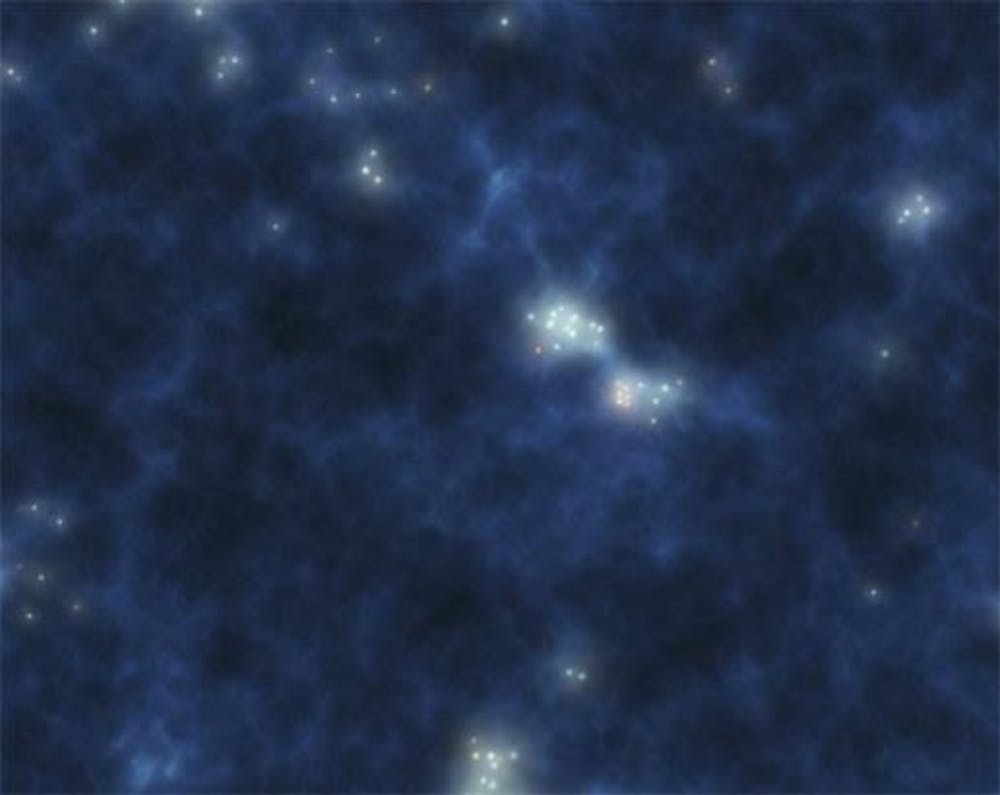
The universe we live in is a transparent one, where light from stars and galaxies shines bright against a clear, dark backdrop. But this wasn’t always the case – in its early years, the universe was filled with a fog of hydrogen atoms that obscured light from the earliest stars and galaxies.
The early universe was filled with a fog made up of hydrogen atoms until the first stars and galaxies burned it away. NASA/JPL-Caltech, CC BY
The intense ultraviolet light from the first generations of stars and galaxies is thought to have burned through the hydrogen fog, transforming the universe into what we see today. While previous generations of telescopes lacked the ability to study those early cosmic objects, astronomers are now using the James Webb Space Telescope’s superior technology to study the stars and galaxies that formed in the immediate aftermath of the Big Bang.
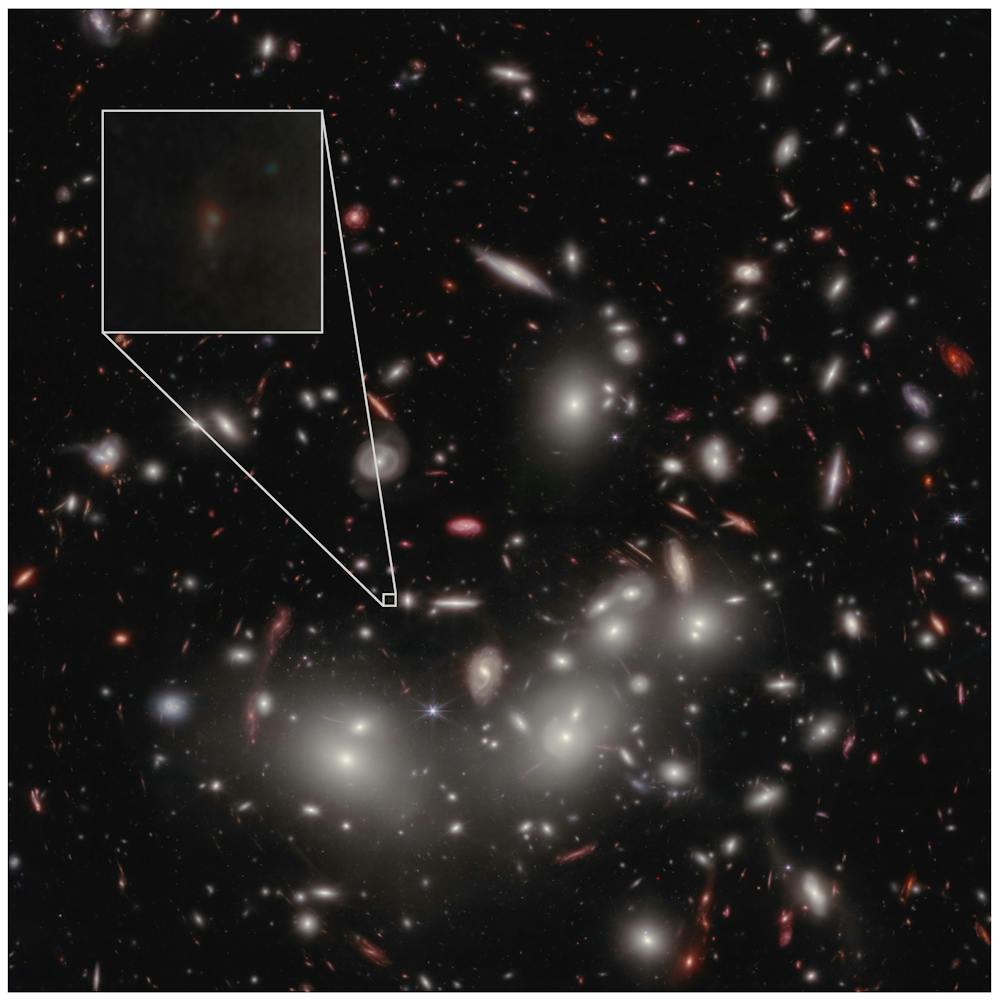
I’m an astronomer who studies the farthest galaxies in the universe using the world’s foremost ground- and space-based telescopes. Using new observations from the Webb telescope and a phenomenon called gravitational lensing, my team confirmed the existence of the faintest galaxy currently known in the early universe. The galaxy, called JD1, is seen as it was when the universe was only 480 million years old, or 4% of its present age.
A brief history of the early universe
The first billion years of the universe’s life were a crucial period in its evolution. In the first moments after the Big Bang, matter and light were bound to each other in a hot, dense “soup” of fundamental particles.
However, a fraction of a second after the Big Bang, the universe expanded extremely rapidly. This expansion eventually allowed the universe to cool enough for light and matter to separate out of their “soup” and – some 380,000 years later – form hydrogen atoms. The hydrogen atoms appeared as an intergalactic fog, and with no light from stars and galaxies, the universe was dark. This period is known as the cosmic dark ages.
The arrival of the first generations of stars and galaxies several hundred million years after the Big Bang bathed the universe in extremely hot UV light, which burned – or ionized – the hydrogen fog. This process yielded the transparent, complex and beautiful universe we see today.
Astronomers like me call the first billion years of the universe – when this hydrogen fog was burning away – the epoch of reionization. To fully understand this time period, we study when the first stars and galaxies formed, what their main properties were and whether they were able to produce enough UV light to burn through all the hydrogen.
A visual model showing the burning of hydrogen fog by UV light in the ‘reionization’ era. Ionized, or burned, regions are blue and translucent. Ionization fronts are red and white, and neutral regions are dark and opaque. Via djxatlanta on Youtube.
The search for faint galaxies in the early universe
The first step toward understanding the epoch of reionization is finding and confirming the distances to galaxies that astronomers think might be responsible for this process. Since light travels at a finite speed, it takes time to arrive to our telescopes, so astronomers see objects as they were in the past.
For example, light from the center of our galaxy, the Milky Way, takes about 27,000 years to reach us on Earth, so we see it as it was 27,000 years in the past. That means that if we want to see back to the very first instants after the Big Bang (the universe is 13.8 billion years old), we have to look for objects at extreme distances.
Because galaxies residing in this time period are so far away, they appear extremely faint and small to our telescopes and emit most of their light in the infrared. This means astronomers need powerful infrared telescopes like Webb to find them. Prior to Webb, virtually all of the distant galaxies found by astronomers were exceptionally bright and large, simply because our telescopes weren’t sensitive enough to see the fainter, smaller galaxies.
However, it’s the latter population that are far more numerous, representative and likely to be the main drivers to the reionization process, not the bright ones. So, these faint galaxies are the ones astronomers need to study in greater detail. It’s like trying to understand the evolution of humans by studying entire populations rather than a few very tall people. By allowing us to see faint galaxies, Webb is opening a new window into studying the early universe.
A typical early galaxy
JD1 is one such “typical” faint galaxy. It was discovered in 2014 with the Hubble Space Telescope as a suspect distant galaxy. But Hubble didn’t have the capabilities or sensitivity to confirm its distance – it could make only an educated guess.
Small and faint nearby galaxies can sometimes be mistaken as distant ones, so astronomers need to be sure of their distances before we can make claims about their properties. Distant galaxies therefore remain “candidates” until they are confirmed. The Webb telescope finally has the capabilities to confirm these, and JD1 was one of the first major confirmations by Webb of an extremely distant galaxy candidate found by Hubble. This confirmation ranks it as the faintest galaxy yet seen in the early universe.
To confirm JD1, an international team of astronomers and I used Webb’s near-infrared spectrograph, NIRSpec, to obtain an infrared spectrum of the galaxy. The spectrum allowed us to pinpoint the distance from Earth and determine its age, the number of young stars it formed and the amount of dust and heavy elements that it produced.
A sky full of galaxies and a few stars. JD1, pictured in a zoomed-in box, is the faintest galaxy yet found in the early universe. Guido Roberts-Borsani/UCLA; original images: NASA, ESA, CSA, Swinburne University of Technology, University of Pittsburgh, STScI
Gravitational lensing, nature’s magnifying glass
Even for Webb, JD1 would be impossible to see without a helping hand from nature. JD1 is located behind a large cluster of nearby galaxies, called Abell 2744, whose combined gravitational strength bends and amplifies the light from JD1. This effect, known as gravitational lensing, makes JD1 appear larger and 13 times brighter than it ordinarily would.
Large galaxies can warp and distort light traveling around them. This video shows how this process, called gravitational lensing, works.
Without gravitational lensing, astronomers would not have seen JD1, even with Webb. The combination of JD1’s gravitational magnification and new images from another one of Webb’s near-infrared instruments, NIRCam, made it possible for our team to study the galaxy’s structure in unprecedented detail and resolution.
Not only does this mean we as astronomers can study the inner regions of early galaxies, it also means we can start determining whether such early galaxies were small, compact and isolated sources, or if they were merging and interacting with nearby galaxies. By studying these galaxies, we are tracing back to the building blocks that shaped the universe and gave rise to our cosmic home.