Major new research claims smaller-brained Homo naledi made rock art and buried the dead. But the evidence is lacking
Rising Star Cave is an exceptional resource for exploring the origins of our species. However, archaeological work at the site has been some of the most controversial in the discipline.
Three new studies made available today (as pre-prints awaiting peer review) claim to have found evidence Homo naledi intentionally buried their dead (a sophisticated practice we usually associate with Homo sapiens) and made rock art, which suggests advanced cognitive abilities.
However, as archaeologists who investigate early humans in Africa, we’re not convinced the new research stacks up.
Did Homo naledi bury their dead?
The research purports to have evidence Homo naledi undertook deliberate burial of their dead – a major claim.
So far, the earliest secure evidence for burial in Africa comes from the Panga ya Saidi cave site in eastern Kenya, excavated by our team and dated to 78,000 years ago. This burial of a Homo sapiens child meets rigorous criteria agreed upon by the scientific community for identifying intentional human burial.
The aim of the criteria is to help differentiate burial from other practices and phenomena that could lead to the depositing of human remains. These include, for example, the natural accumulation of skeletal parts in a predator’s cavern, or the kind of carrying and protecting of dead bodies observed among cognitively advanced non-human species such as gorillas and chimpanzees.
The claimed Homo naledi burials precede the Panga ya Saidi burial evidence by as much as 160,000 years. If the claim is correct, it significantly pushes back evidence for advanced mortuary behavior in Africa. It also implies intentional burial wasn’t limited to our species or other big-brained hominins.
Such a finding would force us to rethink the role of brain size in advanced “meaning-making” cognition, as well as what distinguishes our species from our ancestors.
But is there actually evidence for funerary behaviour at Rising Star Cave? According to standards set by the palaeoanthropology community, the evidence presented so far indicates no.
Insufficient evidence
The site’s researchers claim to have evidence for three intentional burials.
However, not one of the burials provides compelling evidence of a deliberately excavated pit. Indeed, the shallow cavities may not be dug pits at all, but natural depressions where the bodies accumulated and were later disturbed by trampling, or partial cave collapse.
The alleged burials also fail to meet another fundamental criteria for deliberate burials: anatomical alignment of the body and articulation of skeletal remains.
In a deliberate burial, the body is generally intact and any minimal displacement can be explained by decomposition. That’s because burial involves immediately covering the body with soil, which protects the anatomical integrity of the skeleton.
Rising Star Cave so far hasn’t produced evidence for anything other than the general spatial association of some skeletal elements. At most, it provides evidence for the in-situ decomposition of particular body parts, such as an ankle, and partial hand and foot articulations.
Moreover, confirming intentional burial in the past has required the presentation of human remains in an arrangement that can’t have been achieved by chance. However, the scattered distribution of the remains at Rising Star prevents reconstruction of their original positions.
Other claimed evidence for funerary behavior is equally uncompelling. A stone artifact supposedly included in the burial as a “grave good” is said to have scratches and edge serrations from use. But this so-called artefact’s shape suggests it may be natural. It’s still encased in sediment and has only been studied through synchrotron X-ray.
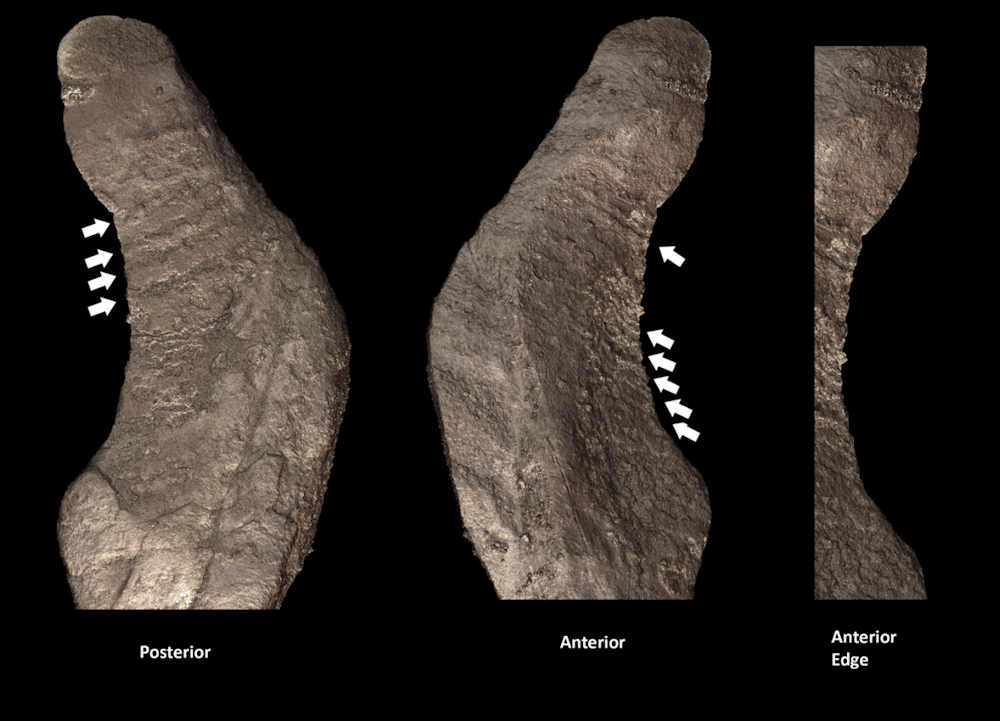
The purported stone artefact (from synchrotron X-ray) showing so-called scratches and edge serrations may actually be a natural rock and not culturally modified. Lee Berger et al, CC BY-SA
But perhaps the biggest barrier to confirming the status of the findings is that so far none of the alleged burials have been fully excavated. It’s therefore impossible to assess the completeness of the bodies, their original position, and the limits of the purported pits.
Did Homo naledi make rock art?
An equally splashy claim made in one of the publications is that Homo naledi left rock art on the walls of Rising Star Cave.
The report describes engravings in the form of deeply impressed cross-hatchings and geometric shapes such as squares, triangles, crosses and X’s. Further claims are made about the preparation of and potential repeated handling or rubbing of the associated rock surface, and the use of a similar “tool” to the one they claim was found with the alleged burial.
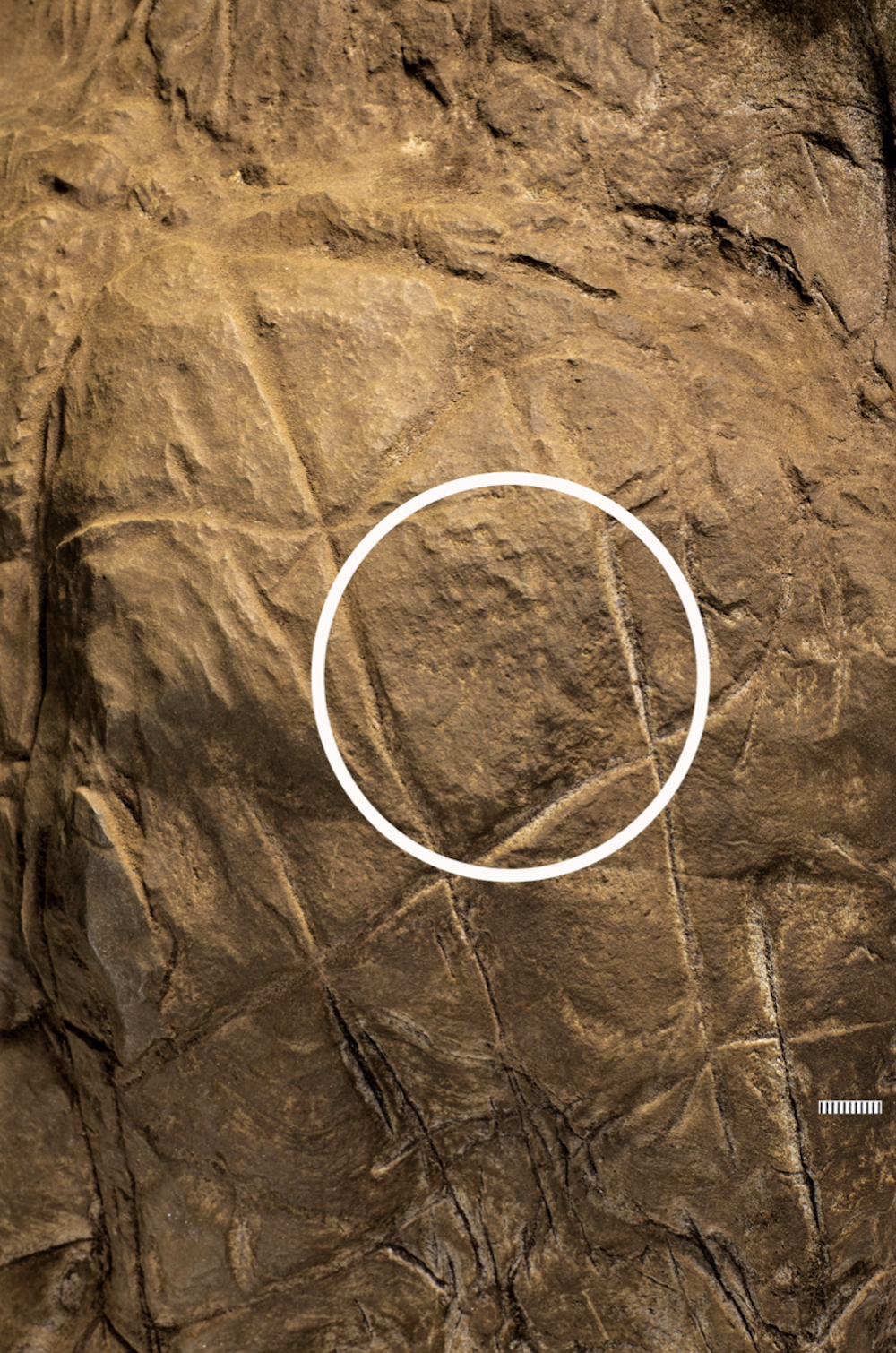
The researchers point to engravings in the wall as evidence of Homo naledi’s capability to create art and symbols. But these etchings haven’t been dated, and some of the lines look relatively recently etched. Lee Berger et al, CC BY
This claim has major implications. To date, rock art has only reliably been linked to Homo sapiens and, in rarer cases, some of our large-brained ancestors. Similar to deliberate burial, producing rock art has major implications for the cognitive abilities of a species. It denotes a capacity for representation, and the creation and communication of meaning via abstract symbols.
The problem with the rock art at Rising Star Cave is that it’s undated. To imply any link with Homo naledi requires firm dates. This could be achieved through using dating techniques on associated residues or natural deposits covering the art, or by studying materials from excavated and dated archaeological layers that can be linked to the art (for instance, if they contain engraving tools or engraved rock fall fragments).
In the absence of dating, it’s simply spurious to claim the engravings were made by Homo naledi, rather than by another species (and potentially at a much later date).
Did Homo naledi light up Rising Star Cave?
The researchers also claim the mortuary and engraving activities in Rising Star Cave involved strategic use of fire for illumination.
In public lectures and on social media they clarify they have found new evidence for hearths, including charcoal, ash, discoloured clay and burned animal bones. Yet none of the scientific research needed to confirm the use of fire has been carried out. Or if it has, it hasn’t been published.
Previously acquired radiocarbon dates obtained by the site investigators on the apparent hearth material provided very late dates that distanced the hearths from the remains of Homo naledi by several hundred thousand years.
We’re not opposed to the idea that the Rising Star Cave witnessed precocious mortuary behavior involving the intentional disposal of bodies by Homo naledi. But it’s clear the latest inferences require further investigation before they’re accepted by the broader scientific community.
Michael Petraglia, Director, Australian Research Centre for Human Evolution, Griffith University; Emmanuel K. Ndiema, Senior Research Scientist, National Museums of Kenya; María Martinón-Torres, CENIEH Director, Atapuerca Research Team and author of "Homo imperfectus" (Ed. Destino), Centro Nacional de Investigación sobre la Evolución Humana (CENIEH), and Nicole Boivin, Professor, Max Planck Institute of Geoanthropology
This article is republished from The Conversation under a Creative Commons license. Read the original article.