Media coverage was chaotic. Outlets reported that physicists had created a theoretical wormhole, a holographic wormhole or perhaps a small, crummy wormhole, and that Google’s quantum computer suggests wormholes are real. Other outlets soberly offered the news that no, physicists didn’t make a wormhole at all.
If this has you confused, you’re not alone! What’s going on?
Wormholes and entanglement
The Universe is vast. It’s so big that traveling from one side to the other by conventional means is impractical.
Wormholes are a kind of loophole: shortcuts between two regions of the Universe that might allow one to traverse vast distances in a much shorter time. Wormholes are permitted by Einstein’s theory of relativity, but none have ever been found in nature.
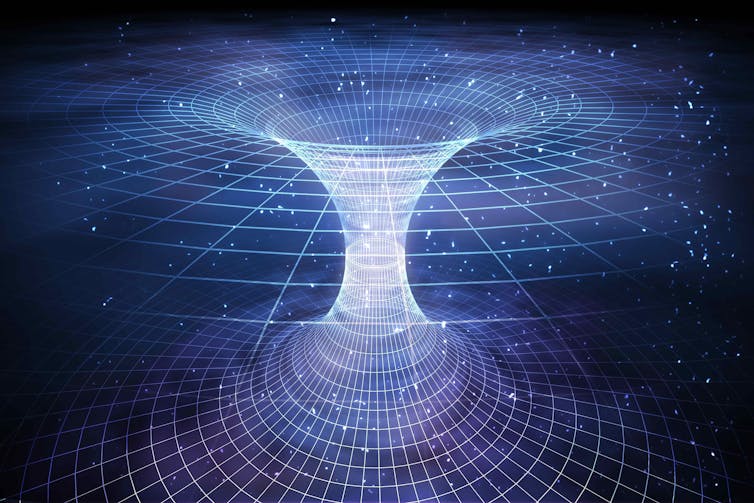
A wormhole is a hypothetical ‘shortcut’ between two regions of space.Shutterstock
Recently, physicists have been toying with the idea that wormholes are related to another phenomenon, known as entanglement.
Entanglement is a peculiar, quantum phenomenon involving particles. When particles are put into an entangled state, measurement of one particle seems to affect the other particle immediately. This is the case even when the two particles are too far apart for causation to be possible.
Some physicists have suggested that a wormhole may just be a way of describing a certain kind of quantum entanglement. If correct, this would forge a link between two prominent theories of physics: quantum mechanics and general relativity.
General relativity explains how gravity works, and describes the Universe on large scales. Quantum mechanics explains the other fundamental forces, and describes the Universe on very small scales.
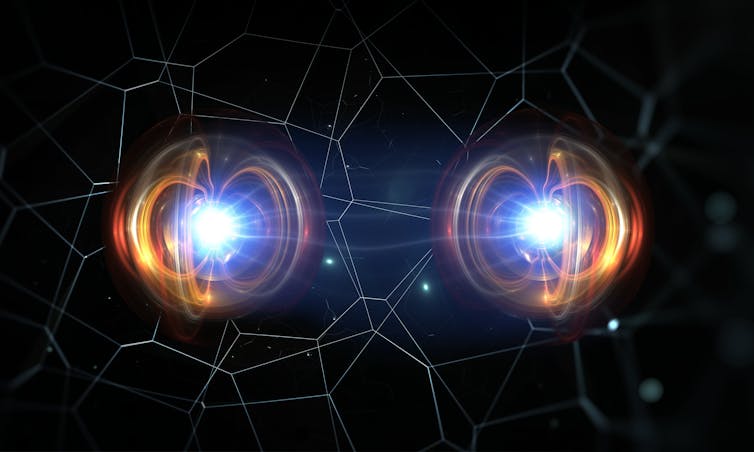
In quantum mechanics, ‘entanglement’ is a kind of link between particles that may be quite distant from one another.Shutterstock
Both are extremely successful theories. However, they are yet to be reconciled into a single, unified theory.
A unified theory would preserve the insights of both quantum mechanics and general relativity, while at the same time providing an account of how gravity works in the quantum domain, something we don’t currently understand.
Because wormholes are distinctive of general relativity, and entanglement is distinctive of quantum mechanics, the potential similarity between them is exciting. It suggests the two theories may, at some level, be describing the very same thing.
Quantum gravity on a chip?
How would we look for this potential similarity between wormholes and entanglement?
Well, we know how to entangle particles experimentally. We’ve been doing that for some time.
So we can try to build a particular kind of quantum system: one that can be described using the same physics we use for wormholes. If we can build such a system in the lab and it behaves like a wormhole, it would support the idea that entanglement and wormholes are two sides of the same coin.
In quantum computers, the basic components can be put into various quantum states that can be used to run quantum experiments. So, it seems they present an opportunity to test the relationship between wormholes and entanglement.
This is perhaps why it was reported that physicists had used a quantum computer to generate a wormhole. But that does not seem to be what actually happened, though understanding why is not straightforward.
Not a wormhole
What physicists did was organize the basic components of a quantum computer into a specific quantum state. They were then able to transfer information from one part of the computer to another through the quantum system.
The quantum system, and the way the information was transferred, can be described using a particular model in physics. According to this model, the kind of information transfer that occurred within the computer is descriptively similar to the way that something passes through a wormhole.
However, the model being used has at least two limitations.
First, it appears to make unrealistic assumptions about the physics of our world. It assumes, in particular, that spacetime – the fabric of the Universe – has certain properties that it may not have.
Second, the model has been simplified to describe a simple system that can be implemented with a quantum computer. Such a simplified model may be physically inaccurate.
So while we can describe what happened within the computer as though it were a wormhole, using a specific kind of model, it is unclear whether the model represents the world as we know it.
Experiment and simulation
Some commentators have offered a different reason to be skeptical that a wormhole was created: it was just a simulation. As one critic put it, taking the system to be a wormhole “is like claiming that playing the video game Portal involves creating an actual wormhole because it depicts something akin to the theoretical concept onscreen”.
We must indeed be careful about drawing inferences about reality from simulations. However, the quantum aspect of this simulation makes it more like an experiment than the ordinary simulation you might run on an everyday computer.
So it seems the simulation may legitimately tell us something about the quantum system it is simulating. However, the problem remains that we can only interpret the system as a wormhole in a specific, potentially unrealistic model of physics.
No wormholes, but still impressive
So we should perhaps be skeptical that any wormholes were created. Still, there is reason to be impressed.
For one thing, the team used machine-learning techniques to simplify the model they were using to simulate it in a useful way.
The use of machine learning to produce the simplified model is neat, and we should expect to see more uses of machine learning like this in the future.
It’s also important that a quantum computer was used to run the type of quantum experiment at issue. That this can be done at all opens the way toward running further experiments. This may open up an experimental paradigm that can be used to make progress in physics.
There is also the possibility – albeit rather distant – that some aspect of the model that was used to describe the quantum system will be vindicated. This may lead to the discovery of a relationship between quantum entanglement and wormholes in the future.
But this remains very speculative.
Sam Baron, Associate Professor, Philosophy of Science, Australian Catholic University
This article is republished from The Conversation under a Creative Commons license. Read the original article.