Scientists and activists expressed shock and the need for urgent climate action Wednesday as the United Nations' World Meteorological Organization revealed that atmospheric levels of the three main greenhouse gases fueling catastrophic global heating all hit record highs in 2021.
"You can say goodbye to 1.5°C and 2°C too."
The WMO's annual Greenhouse Gas Bulletin warns that atmospheric carbon dioxide, methane, and nitrous oxide reached unprecedented levels last year. According to the report, carbon dioxide concentrations in 2021 were 415.7 parts per million (ppm), methane was 1908 parts per billion (ppb), and nitrous oxide was 334.5 ppb. These levels are, respectively, 149%, 262%, and 124% above pre-industrial levels.
The report notes that methane concentrations saw their biggest single-year increase since systematic measurements began nearly 40 years ago, while CO2 levels rose at a higher-than-usual rate.
"The brutal truth is here for everyone to see," climate scientist Bill McGuire tweeted in response to the new figures. "Far from emissions being brought under control, they are actually accelerating. This is the worst possible news."
"You can say goodbye to 1.5°C and 2°C too," he added, referring to the Paris agreement's targets for avoiding projected worst-case climate scenarios.
The new report came on the same day that the United Nations warned ahead of next month's COP27 climate summit that nations are falling far short of their commitments to reduce greenhouse gas emissions, and that global heating could hit a catastrophic 2.9°C by century's end absent immediate, meaningful action by major polluters to dramatically slash carbon emissions and transition from fossil fuels to renewable energy.
WMO Secretary-General Petteri Taalas said in a statement that this year's Greenhouse Gas Bulletin "has underlined, once again, the enormous challenge—and the vital necessity—of urgent action to cut greenhouse gas emissions and prevent global temperatures rising even further in the future."
"The continuing rise in concentrations of the main heat-trapping gases, including the record acceleration in methane levels, shows that we are heading in the wrong direction," he added.
Scientists fear soaring concentrations of methane—which is up to 87 times more potent than CO2 over a 20-year period—may have triggered a potentially irreversible climate feedback loop.
As the WMO bulletin notes, scientists still do not fully understand all causes of the sharp rise in methane levels in recent years. Methane is emitted during fossil fuel production and transport, as well as from agriculture and biogenic sources like wetlands.
Last September, the European Union and the United States pledged to voluntarily reduce methane emissions by 30% from 2020 levels by the end of the decade. More than 100 nations have signed on to their Global Methane Pledge.
The world's three leading methane emitters—China, Russia, and India—have not signed the pledge, nor have other major methane polluters like Australia and Iran.
In the U.S., efforts to slash methane emissions have been stymied by opposition from the fossil fuel industry and the politicians it influences through campaign contributions. For example, Sen. Joe Manchin (D-W.Va.), whose family owns a coal brokerage and who is currently by far the largest congressional recipient of oil and gas industry contributions, has been a staunch opponent of bold climate action.
Critics call the 30% target a step in the right direction but insufficient to adequately address the emissions crisis. The International Energy Agency said last October that a 75% reduction in methane emissions by 2030 is "essential" to combating the climate emergency.
"There are cost-effective strategies available to tackle methane emissions, especially from the fossil fuel sector, and we should implement these without delay," Taalas argued.
"However, methane has a relatively short lifetime of less than 10 years and so its impact on climate is reversible," he added. "As the top and most urgent priority, we have to slash carbon dioxide emissions, which are the main driver of climate change and associated extreme weather, and which will affect climate for thousands of years through polar ice loss, ocean warming, and sea level rise."
ALBANY, NY — The scientific research nonprofit UAPx is like a 21st-century A-Team composed of two highly regarded astrophysicists and a computational astrophysicist, two Navy veterans who are radar experts, a mechanical engineer and a former Air Force pilot who can MacGyver a vehicle into a mobile lab. They research a controversial but critical field of UAPs — or Unidentified Aerial Phenomena.
Last summer, they had an amazing stroke of luck. A documentary film producer funded a full week of research for UAPx in Laguna Beach and nearby Catalina Island, a hotspot for UAP sightings. It's where the famous UAP shaped like a gigantic TicTac was filmed and tracked on radar by Navy pilots from the USS Princeton pilots in 2004.
Just this month, The War Zone published U.S. Navy reports the publication obtained via the Freedom of Information Act (FOIA) about a 2019 encounter near Catalina Island when a Navy destroyer was swarmed by UFOs. The USS Paul Hamilton encountered several "Unmanned Aircraft System/Non-Traditional Aviation Technology," the term the U.S. Department of Homeland Security prefers to UFOs. The objects glowed red or white — although one remained dark. They came within 200 yards of the destroyer and drenched its bridge in light a few times.
Apparently, the area is a hotbed. In one week, the UAPx team captured several extraordinary and dramatic UAPs.
"We use the term UAP instead of the term UFO because UFO has a sci-fi stigma," University at Albany astrophysicist and former NASA research scientist Kevin Knuth told Raw Story, with a brief sigh. "There are academics who consider it a taboo field of study."
The data and video UAPx collected seems likely to command respect, especially given the reputations of Knuth and his teammates. It will take years to analyze completely all that UAPx collected in one week.
How they caught UFOs in action
A Hollywood celebrity and astronomy buff loaned the team a luxurious Laguna Beach villa perched on a mountainside overlooking the ocean. They set up infrared cameras, sound sensors, an oscilloscope to measure electric signals and radiation detectors on the flat roof. The team had eight thermal cameras that can measure a UAP's outer temperature -20 F to -80 F. They also used long-wavelength infrared cameras like those on U.S. fighter jets. They set up more equipment across the water on a Catalina Island rooftop. An OSIRIS vehicle loaded with similar equipment was ready to follow any UAPs detected from the ground.
On July 14 at 4 a.m. an elliptical hole appeared in the cloud cover above and expanded to one-quarter of a mile. Meanwhile, the instruments recorded a huge spike in radiation at 43.37 MeV. (The average was 2 MeV). Inside the egg-shaped hole, 53 white UAPs glowed, each between 35 to 50 feet wide. Then the hole closed with such abnormal swiftness, Knuth calculated that clouds would be moving 750 mph.
The team checked with NASA and NOAA who had no record of solar flares or gamma ray anomalies that could cause such phenomena. No aircraft were flying in the area at that time. The documentary director, Caroline Cory, was so dazzled by the phenomenon's appearance, she named the film "A Tear in the Sky."
Beloved "Star Trek" icon William Shatner appears in the film to chat with Cory. She tells him the tear in the sky might be a "wormhole," a phenomenon mathematically predicted by Albert Einstein and his Princeton colleague back in the 1930s. They called the entity an "Einstein Rosen Bridge". Theoretically, it's a shortcut through time and space. Enter one end and emerge in a different world.
But no one knows what a wormhole will look like. No one has ever seen one. The UAPx scientists gave Cory's enthusiastic assessment a tactful reality check.
"It's an unidentified unclassified phenomenon; we don't know what it is," University at Albany physics professor Matthew Szydagis told Raw Story. "It could take years of tests and study before we know what it is, or what the other phenomena are that we filmed."
That's the norm for scientists investigating UAPs. When astronomers first detected a black hole in the Milky Way in 1964, they weren't sure what they were looking at. No one had yet seen a black hole. What they could see was a mysterious way gas was sucked away from a blue, supergiant star. It wasn't until 1971 that the phenomenon was identified as a black hole through independent work by several researchers.
Another night, the Laguna equipment documented two UAPs. Szydagis said they were flying too high to be planes, even international flights, and too low to be satellites. The objects were very cold.
"Cold is significant because there should be a heat signature from whatever propulsion system the object has," Szydagis explained. In the documentary, Cory describes an additional UAP documented that week; a pink, luminous object that flies across the sky, makes a quick U-turn then flies out of frame. There is a spike in radiation when the object appears.
Another event as dramatic as the tear in the sky was captured that week when dozens of TicTac-shaped UAPs rained from the sky falling from 28,000 feet from the air to sea level. Each UAP was around 4 feet to 69 feet wide and fell at 5,000 mph to 84,000 mph.
There were no sonic booms, no air disturbances. Knuth says that in the video, splashes are visible when the objects hit water.
Even if UAPs have nothing to do with alien life, they could be exciting phenomena worth studying because they may help unlock secrets of how the universe works. For example, Szydagis says that the tear in the sky could be: a distant supernova. It may reflect the impact of a black hole. It may be an atmospheric event so rare, it's still a mystery to scientists.
Want to help study celestial phenomena?
Szydagis is an expert on dark matter WIMPs (Weakly Interacting Massive Particles). He and Knuth are in demand for research projects across the globe. And they have university classes to teach, students to guide. They were recruited to UAPx by the two Navy vets who founded it, both of whom were serving on the USS Princeton and eyewitnesses to the 2004 TicTac UAP. Knuth and Szydagis make time for UAPx because they believe UAPs are a crucial field of study. They are painfully aware other academics disagree.
Ironically, the scientific research that ignites public interest and pop cultural passion is often dissed by academics who are embarrassed by all that pop enthusiasm. Those exuberant UFO enthusiasts, the self-proclaimed alien abductees, Roswell conspiracy theorists, TV series and movie blockbusters that make annoying mistakes about evolution, warp travel and wormholes dismay and exhaust some scientists.
Knuth and Szydagis see that pop cultural engagement as a boon to a field of study. They wish there was a famous, popular scientist like TV star astronomer Carl Sagan (who championed UAP research) to be a liaison between the public and scientists. The astrophysicist who comes closest to Sagan's popularity is Neil deGrasse Tyson "and he pooh-poohs UAPs," Szydagis said.
Tyson complains frequently that UAP evidence is limited to grainy videos. It would be more accurate to say that's the only publicly accessible evidence. Congress wasn't able until 2020 to get the Department of Defense to declassify materials on UAPs and issue a report.
The UAPx team's dream is to maintain equipment permanently at UAP hotspots including Laguna Beach, Uintah County in Utah, and Northwestern Puerto Rico's shoreline. The UAPx scientists asked a U.S. military base on Puerto Rico if its scientists would like to team up on research.
"The military's answer was, no, everything the military researches about UAPs is classified. Go away," Szydagis said.
UAPx teammates Gary Voorhis and Kevin Day were on the USS Princeton when the TicTac was documented. Voorhis remembers the next day, a team arrived on the ship to carry away the radar equipment Voorhis used to monitor the UAP. Day believes being cited as a witness to the famous UAP undermined his career. The military did not encourage either of them to share their experiences with civilian scientists.
UAPx vows to take the opposite, transparent approach, sharing all its data and video with other scientists and the public. And it welcomes volunteers.
Two retired engineers volunteered to pore through the Laguna video frame by frame. It can be tedious. But one engineer spotted an additional UAP. The discovery is the reward. A volunteer may even be credited and have a phenomenon named after him or her.
UAPx also welcomes volunteer software coders, hardware wizards, and mechanics. It has a $10,000 GoFundMe for the team's beloved OSIRIS (Off-road Scientific Investigation & Response Informatics System.) vehicle. Volunteer Jeremy McGowan had transformed an SUV into a mobile lab that can collect data on UAPs as it follows their path from the road. Right now, it needs a complete overhaul.
Meanwhile, the Laguna/ Catalina data must be triple-checked, tested, and examined to make sure the phenomena aren't equipment glitches or other snafus. The team embraces the Carl Sagan Standard: "extraordinary claims require extraordinary proof."
But Carl Sagan also said, "Somewhere, something incredible is waiting to be known."
Rheumatoid arthritis affects 1 in 100 people worldwide. It causes inflamed, painful and swollen joints, often in the hands and wrists, and can lead to loss of joint function as well as chronic pain and joint deformities and damage. What causes this condition has been unknown.
In our recently published study, my colleagues and I found an important clue to a potential culprit behind this disease: the bacteria in your gut.
What causes rheumatoid arthritis?
Rheumatoid arthritis is an autoimmune condition, meaning it develops when the body’s immune system starts to attack itself. Proteins called antibodies, which usually help fight off viruses and bacteria, begin to attack the joints instead.
The origins of the antibodies that cause rheumatoid arthritis have been an area of study for many years. Some research has shown that these antibodies can start forming at sites like the mouth, lung and intestines over 10 years before symptoms arise. But until now, it was unclear why researchers were finding these antibodies in these particular areas.
Rheumatoid arthritis can develop at any age.
We wanted to investigate what could trigger the formation of these antibodies. Specifically, we wondered if bacteria in the microbiome, a community of microorganisms that live in the intestines, might be the ones activating the immune response that leads to rheumatoid arthritis. Since microbes commonly live at the same sites as the antibodies driving rheumatoid arthritis, we hypothesized that these bacteria could be triggering the production of these antibodies. We reasoned that though these antibodies were meant to attack the bacteria, rheumatoid arthritis develops when they spread beyond the intestines to attack the joints.
First, we sought to identify the intestinal bacteria targeted by these antibodies. To do this, we exposed the bacteria in the feces of a subset of people at risk for developing rheumatoid arthritis to these antibodies, allowing us to isolate just the bacterial species that reacted and bound to the antibodies.
We found that one previously unknown species of bacteria was present in the intestines of around 20% of people who were either diagnosed with rheumatoid arthritis or produce the antibodies that cause the disease. As a member of the Cherokee Nation of Oklahoma, I suggested we name this species Subdoligranulum didolesgii (“didolesgii” means arthritis or rheumatism in Cherokee) as a nod to the contributions that other Indigenous scholars have made to science as well as the fact that rheumatoid arthritis affects Indigenous people at a higher rate than other populations.
Subdoligranulum didolesgii has not been detected in the feces of healthy people before, and it is currently unknown how prevalent this bacteria is in the general population.
We also found that these bacteria can activate specialized immune cells called T cells in people with rheumatoid arthritis. T cells drive inflammatory responses in the body, and have been linked to the development of different autoimmune diseases.
These findings suggest that these gut bacteria may be activating the immune systems of people with rheumatoid arthritis. But instead of attacking the bacteria, their immune system attacks the joints.
Most of your immune system is located in your gut.
Why this bacteria?
It is still unknown why people with rheumatoid arthritis develop an immune response to Subdoligranulum didolesgii. But we think it may be the culprit when it comes to rheumatoid arthritis because this bacteria is found only in the intestines of people with rheumatoid arthritis, and not in the intestines of healthy people.
While many immune responses happen in the intestines, they are usually self-contained and do not spread to other areas of the body. However, we believe that a particularly strong intestinal immune response against Subdoligranulum didolesgii could allow antibodies to bypass the intestinal “firewall” and spread to the joints.
To confirm our hypothesis, we gave mice an oral dose of Subdoligranulum didolesgii and monitored their reaction. Within 14 days, the mice began to develop joint swelling and antibodies that attacked their joints.
The future of rheumatoid arthritis treatment
My colleagues and I hope this research can shed light on the origins of rheumatoid arthritis. Our next goal is to discover how common these bacteria are in the general population and test whether the presence of these bacteria in the gut may lead to the development of rheumatoid arthritis in people.
It’s important to note that antibiotics are unlikely to be helpful treatment for the microbiomes of patients with rheumatoid arthritis. Although Subdoligranulum didolesgii may be triggering an autoimmune response for some people with rheumatoid arthritis, antibiotics eliminate both helpful and harmful bacteria in the gut. Additionally, removing the bacteria won’t necessarily stop the immune system from attacking the joints once it has started.
Nevertheless, we believe that these bacteria can be used as tools to develop treatments for rheumatoid arthritis and hopefully ways to prevent disease from happening in the first place.
(Reuters) - U.S. doctors are warning that a surge in cases of respiratory syncytial virus (RSV) is coinciding with an increase in COVID transmission and an earlier-than-normal flu season, raising the specter of a "tripledemic" of respiratory illness this winter.
In particular, RSV infections among young children are reportedly filling some U.S. hospitals to capacity.
"We are already seeing patients testing positive for more than one virus," said pediatrician Dr. Ira Wardono of Providence Cedars-Sinai Tarzana Medical Center in Tarzana, California, in a statement.
WHO IS AT RISK?
Infants are most at risk from RSV because they often cannot cough up the secretions caused by the virus and may need airway suctioning or intravenous fluids. Some may need extra oxygen. Older children and most adults typically experience mild, cold-like symptoms.
On average, RSV leads to 58,000 hospitalizations among children under age 5 and 177,000 hospitalizations among adults age 65 and older each year, according to the U.S. Centers for Disease Control and Prevention.
RSV deaths are rare in U.S. children, but 14,000 adults die annually from the virus, with older or immunocompromised individuals at greatest risk, the CDC said.
WHAT CAN PREVENT RSV?
Infection with RSV can be prevented in the same way one would ward off any virus: staying away from people who are sick, ensuring the best possible ventilation when you are indoors, wearing a high quality mask, and keeping your hands as clean as possible, said Dr. Jay Varma, Chief Medical Adviser at Kroll.com and Director of the Weill Cornell Center for Pandemic Prevention and Response.
High-risk infants can receive preventive treatment with monthly doses of Synagis (palivizumab) from Swedish drugmaker Orphan Biovitrum. AstraZeneca Plc and Sanofi SA are hoping for U.S. and European approval of Beyfortus (nirsevimab) for preventing RSV infections in newborns and infants.
There is no vaccine against RSV, although Pfizer Inc is developing RSVpreF for adults. In the meantime, it is important "for everyone to get up to date on their COVID and flu vaccines," Varma said.
WHAT IS CAUSING THIS SURGE?
Part of the increase in RSV cases is due to the relaxation of COVID-precautions, such as masking and social distancing, which reduced rates of both RSV and flu during the pandemic, Varma said.
RSV rates were unusually low in the fall/winter of 2020-2021 but increased dramatically starting in Spring 2021 and have spiked since late August.
The CDC says it cannot yet predict when the previous seasonal patterns will return.
(Reporting by Nancy Lapid; Editing by Michele Gershberg and Richard Pullin)
Bees order numbers in increasing size from left to right, a study has shown for the first time, supporting the much-debated theory that this direction is inherent in all animals including humans.
Western research has found that even before children learn to count, they start organising growing quantities from left to right in what has been called the "mental number line".
However the opposite direction has been found in people from cultures that use an Arabic script which reads from right to left.
"The subject is still being debated between those who think the mental number line has an innate character and those who say it is cultural," said Martin Giurfa, a professor at the Research Centre on Animal Cognition at Paul Sabatier University in Toulouse, France.
There has been recent evidence that newborn babies and some vertebrate animals, including primates, organise numbers from left to right.
Giurfa led a study, published last week in the journal Proceedings of the National Academy of Sciences (PNAS), aiming to find out if the same holds true for insects, via an experiment on bees.
"It has already been shown that bees are able to count -- at least up to five," Giurfa told AFP.
They also process information differently in the two hemispheres of their brains, he added. This trait they seem to share with humans, and is thought to be a potential reason for the "the existence of the mental number line," Giurfa said.
A numbers game
For the experiment, the researchers had individual honeybees fly into the first of two compartments of a wooden box.
Sugar-water was then used to entice the bees to select a number affixed to the middle of the back of the second compartment.
The number stayed the same for each individual bee, but varied randomly across the group from between one, three or five, in shapes of circles, squares or triangles.
Once the bees were trained to fly towards their set number, the researchers removed it and put another number on both sides of the second compartment, leaving the middle blank.
They then removed the sugar-water reward and observed which way the bees went.
For example, if the bee was trained to select the number three, and was now faced with two number ones on either side and nothing in the middle, which way did they fly?
Around 80 percent of the time the bees chose the option on the left -- the "correct choice" if brains order numbers from left to right, Giurfa said.
But if those same bees were given two number fives to choose from, they went right, again supporting the mental number line.
And bees trained to go for number one went to the right for a number three, while bees targeting a five went left for their three.
So if animals do in fact think of numbers from left to right, why is this not true for all humans?
Giurfa said it was more complicated than directly choosing between nature and nurture.
Even if the mental number line "is innate, culture can still modify it, even reverse it -- or on the contrary accentuate it," he said.
Bees, on the other hand, have to stick to what nature dictates.
In searching for planets and studying their stars, I’ve had the privilege to use some of the world’s great telescopes. However, our team has recently turned to an even larger system to study the cosmos: Earth’s forests.
We analyzed radioactive signatures left in tree rings around the world to study mysterious “radiation storms” that have swept over Earth half a dozen times in the past 10,000 years or so.
Our results, published today in Proceedings of the Royal Society A, rule out “solar superflares” as the culprit – but the true cause remains unknown.
A history written in tree rings
When high-energy radiation strikes the upper atmosphere it turns nitrogen atoms into radioactive carbon-14, or radiocarbon. The radiocarbon then filters through the air and the oceans, into sediments and bogs, into you and me, into animals and plants - including hardwoods with their yearly tree rings.
To archaeologists, radiocarbon is a godsend. After it is created, carbon-14 slowly and steadily decays back into nitrogen – which means it can be used as a clock to measure the age of organic samples, in what is called radiocarbon dating.
To astronomers, this is equally valuable. Tree rings give a year-by-year record of high-energy particles called “cosmic rays” going back millennia.
The magnetic fields of Earth and the Sun shield us from cosmic rays shooting through the Galaxy. More cosmic rays reach Earth when these magnetic fields are weaker, and fewer when the fields are stronger.
But tree rings also record events we cannot presently explain. In 2012, Japanese physicist Fusa Miyake discovered a spike in the radiocarbon content of tree rings from 774 AD. It was so big that several ordinary years’ worth of cosmic rays must have arrived all at once.
As more teams have joined the search, tree ring evidence has been uncovered of further “Miyake events”: from 993 AD and 663 BC, and prehistoric events in 5259 BC, 5410 BC, and 7176 BC.
These have already led to a revolution in archaeology. Finding one of these short, sharp spikes in an ancient sample pins its date down to a single year, instead of the decades or centuries of uncertainty from ordinary radiocarbon dating.
Among other things, our colleagues have used the 993 AD event to reveal the exact year of the first European settlement in the Americas, the Viking village at L'Anse aux Meadows in Newfoundland: 1021 AD.
Could huge radiation pulses happen again?
In physics and astronomy, these Miyake events remain a mystery.
However, the most widely accepted explanation is that Miyake events are “solar superflares”. These hypothetical eruptions from the Sun would be perhaps 50–100 times more energetic than the biggest recorded in the modern era, the Carrington Event of 1859.
Our team at UQ set out to sift through all the available tree ring data and pull out the intensity, timing, and duration of Miyake events.
To do this we had to develop software to solve a system of equations that model how radiocarbon filters through the entire global carbon cycle, to work out what fraction ends up in trees in what years, as opposed to the oceans, bogs, or you and me.
Our results confirm each event delivers between one and four ordinary years’ worth of radiation in one go. Earlier research suggested trees closer to Earth’s poles recorded a bigger spike – which is what we would expect if solar superflares are responsible – but our work, looking at a larger sample of trees, shows this is not the case.
We also found these events can arrive at any point in the Sun’s 11-year activity cycle. Solar flares, on the other hand, tend to happen around the peak of the cycle.
Most puzzling, a couple of the spikes seem to take longer than can be explained by the slow creep of new radiocarbon through the carbon cycle. This suggests that either the events can sometimes take longer than a year, which is not expected for a giant solar flare, or the growing seasons of the trees are not as even as previously thought.
For my money, the Sun is still the most likely culprit for Miyake events. However, our results suggest we’re seeing something more like a storm of solar flares rather than one huge superflare.
To pin down what exactly happens in these events, we will need more data to give us a better picture of the events we already know about. To obtain this data, we will need more tree rings – and also other sources such as ice cores from the Arctic and Antarctic.
This is truly interdisciplinary science. Normally I think about beautifully clean, precise telescopes: it is much harder to understand the complex, interconnected Earth.
Pandemics and disease outbreaks put a spotlight on the hurdles researchers face to get a drug on the shelves. From finding prospective drug candidates to balancing time and financial pressures with ensuring safety and efficacy, there are many aspects of drug development that determine whether a treatment ever makes it out of the lab.
Broadening the definition of “medicine” and where it can be found, however, could help expand the therapeutic options available for both researchers and patients.
Here are four facets of how drugs are developed and how they work in the body, drawn from stories in The Conversation’s archive.
1. Matching drug to target
The most effective drugs are, in a sense, the product of good matchmaking – they bind to a specific disease-causing receptor in the body, elicit a desired effect and ideally ignore healthy parts of the body.
Factors such as your age, genetics and diet can affect how well your body processes a drug.
Drugs travel through the bloodstream to reach their targets. Because of this, most drugs circulate throughout the body and can bind to unintended sites, potentially causing undesired side effects.
Researchers can increase the precision and effectiveness of a drug by designing different ways to take it. An inhaler, for example, delivers a drug directly to the lungs without its having to travel through the rest of the body to get there.
Whether patients take drugs as prescribed is also essential to ensuring the right dose gets to where it needs to be often enough to have a desired effect. “Even with all the science that goes into understanding a disease well enough to develop an effective drug, it is often up to the patient to make it all work as designed,” writes pharmaceutical scientist Tom Anchordoquy of the University of Colorado Anschutz.
2. Searching for drug candidates
Researchers have discovered a number of drugs by chance, including penicillin for bacterial infections, vaccines for smallpox and warfarin for blood clots. While serendipity still plays a role in modern drug discovery, most drug developers take a systematic approach.
Scientists typically start by identifying a particular molecular target, usually receptors that trigger a specific response in the body. Then, they look for chemical compounds that react with that target. Technology called high-throughput screening allows researchers to quickly test thousands of potential drug candidates at once. Compounds that match screening criteria advance to further development and refinement. Once optimized for their intended use, compounds go on to safety and efficacy testing in animals and people.
Scientists have been isolating medicinal compounds from natural products for centuries.
One way to ease the search for optimal drug candidates is to work with compounds that are already optimized to work in living beings. Natural products, derived from organisms like microbes, fungi, plants and animals, share similar structures and functions across species. Though not without their own development challenges, they could aid the search for related compounds that work in people.
“There are thousands of microorganisms in the ocean left to explore as potential sources of drug candidates, not to mention all the ones on land,” writes medical chemist Ashu Tripathi of the University of Michigan. “In the search for new drugs to combat antibiotic resistance, natural products may still be the way to go.”
3. A drug by any other name may be just as effective
Existing drugs can find a second (or third, fourth and fifth) life through repurposing.
Most drugs have many functions beyond what researchers originally designed them to do. While this multifunctionality is often the cause of unwanted side effects, sometimes these results are exactly what’s needed to treat a completely unrelated condition.
Sildenafil, for example, failed to treat severe chest pain from coronary artery disease, but proved to be potent at inducing erections as Viagra. Similarly, thalidomide, a compound that caused birth defects in thousands of infants around the world as a morning sickness drug, found redemption as a cancer treatment.
While thalidomide was disastrous for morning sickness, it has proved effective for other diseases.
Because drugs inherently have more than one function in the body, repurposing existing drugs can help fill a gap where pharmaceutical companies and other developers cannot or will not. Gregory Way, a researcher at the University of Colorado Anschutz, uses artificial intelligence to predict the various effects a drug can have and believes that this lack of specificity is something to explore rather than eliminate. Instead of trying to home in on one specific target, he suggests that scientists “embrace the complexity of biology and try to leverage the multifaceted effects drugs can offer.”
4. Poison as medicine
If so many drugs can have toxic effects in the body, be it through side effects or taking the wrong dose or for the wrong condition, what determines whether a drug is a “medicine” or a “poison”?
Biomedical scientists evaluate drugs based on their active ingredient, or a specific compound that has a specific effect in the body. But reducing medicines to just a single molecule ignores another important factor that determines whether a drug is therapeutic – the context in which it is used. Opioids treat intractable pain but can lead to debilitating and lethal addiction when improperly administered. Chemotherapy kills tumors but causes collateral damage to healthy tissues in the process.
Aconite is a poisonous herb that was used to treat cold symptoms in ancient Chinese medical practice.
Another pharmaceutical paradigm, traditional Chinese medicine, has historically acknowledged the malleability of drugs through the use of poisons as therapeutics.
Yan Liu, a medical historian at University of Buffalo who studies this practice, notes that ancient texts did not distinguish between poisons and nonpoisons – rather, Chinese doctors examined drugs based on a continuum of potency, or ability to harm and heal. They used different processing and administration techniques to adjust the potency of poisons. They also took a personalized approach to treatment, aware that each drug works differently based on a number of different individual factors.
“The paradox of healing with poisons in traditional Chinese medicine reveals a key message: There is no essential, absolute or unchanging core that characterizes a medicine,” Liu writes. “Instead, the effect of any given drug is always relational – it is contingent on how the drug is used, how it interacts with a particular body and its intended effects.”
Editor’s note: This story is a roundup of articles from The Conversation’s archives.
Dr. Josie Tenore and Paul Hinds were introduced by a mutual friend in 2017 and hadn’t been going out long when she laid down the law: He had to get a physical.
“I don’t date people who don’t take care of their health,” said Tenore, who practices cosmetic dermatology and functional medicine in suburban Chicago.
One of Hinds’ blood tests that summer came back with an alarming result: His prostate-specific antigen, or PSA, level was very high. A biopsy confirmed he had advanced prostate cancer.
There aren’t a lot of comfortable alternatives for treating prostate cancer, which generally progresses as long as testosterone levels remain high. Marijuana appears to lower testosterone levels, so after his diagnosis, Paul dosed a liquid form of cannabis for several weeks. That cut his PSA in half, but Hinds, a cybersecurity expert who likes yoga and bicycling, “was stoned out of his mind and couldn’t function,” Tenore recalled.
With Tenore guiding his decisions, Hinds next tried a procedure called high-frequency ultrasound treatment, but it failed. And in summer 2019 doctors removed his prostate gland. Still, the PSA levels climbed again, and doctors assessed that the cancer had metastasized. The only alternative was to drastically lower Hinds’ testosterone levels — either via surgery or drugs that block all testosterone. In May 2021, Paul got his first intramuscular shot of Lupron Depot, a brand name for leuprolide, designed to suppress the prostate gland’s release of the hormone for three months. That August, he got his second shot.
And then the bills came.
The Patient: Paul Hinds, now 60, is covered by United Healthcare through a COBRA plan from his former employer.
Medical Service: Two three-month Lupron Depot injections for metastatic prostate cancer.
Service Provider: University of Chicago Medicine, a 900-physician nonprofit system that includes an 811-bed medical center, a suburban hospital, the Pritzker School of Medicine, and outpatient clinics and physician offices throughout the Chicago area.
Total Bill: $73,812 for the two shots ($35,414 for the first, $38,398 for the second), including lab work and physician charges. United Healthcare’s negotiated rate for the two shots plus associated fees was $27,568, of which the insurer paid $19,567. After Hinds haggled with the hospital and insurer for more than a year, his share of the bills was determined to be nearly $7,000.
What Gives: The first issue is unrelenting price increases on old drugs that have remained branded as manufacturers find ways to extend patents for decades and maintain sales through marketing.
Though Lupron was invented in 1973, its manufacturer got patent extensions in 1989 by offering a slow-release version. Drugmakers commonly use this tactic to extend their exclusive rights to sell a product.
The development of Lupron Depot as an intramuscular shot that suppressed testosterone for months at a time improved patient compliance and also enabled its maker, Abbott Laboratories, and its Japanese partner, Takeda, to extend their patents on the drug into the 2000s, said Dr. Gerald Weisberg, a former Abbott scientist who has been critical of the company’s pricing policies.
In subsequent years, Abbott and Takeda, in a joint venture called TAP Pharmaceuticals, steadily marked up the price of their slow-release product. In 2000, the average wholesale U.S. price for a three-month shot was $1,245; currently that figure is $5,866. (It is manufactured in the U.S. by AbbVie now.)
In the United Kingdom, where health care is generally free and Takeda sells the drug under the name Prostap, all physicians can purchase a three-month dose for about $260.
It’s likely that Chicago Medicine, where Hinds got his shots, paid something close to the British price. That’s because the health system’s hospital on Chicago’s South Side participates in a federal program called 340B, which allows hospitals that serve low-income populations to purchase drugs at deep discounts.
Lupron Depot is given as a simple injection into the muscle. It takes minutes for a nurse or doctor to administer. Yet hospital systems like Chicago Medicine can and typically do charge lavishly for such services, to enhance revenue, said Morgan Henderson, principal data scientist at the Hilltop Institute at the University of Maryland-Baltimore County. Chicago Medicine declined to say what it paid for the drug.
While U.S. drugmakers can price their drugs however they please, TAP has gotten into trouble for its Lupron sales policies in the past. In 2001, after a Justice Department probe, it paid an $875 million settlement for illegally stimulating sales by giving urologists free and discounted vials of the drug while enabling them to charge Medicare full price.
Since then, many other drugs aimed at lowering testosterone levels have entered the market, including a pill, relugolix (Orgovyx). So why wouldn’t a patient use them?
Lupron Depot is long-acting, is easy to prepare and store, and employs a small needle, which some patients prefer, said Dr. Brian McNeil, chief of urology at University Hospital of Brooklyn. Orgovyx is convenient, but “a patient has to be very compliant. They have to take it every day around the same time,” he said. “Some people just forget.”
But there is another important factor that may well explain Lupron Depot’s ongoing popularity among medical providers: Doctors and hospitals can earn tens of thousands of dollars each visit by marking up its price and administration fees — as they did with Hinds. If they merely write a prescription for a drug that can be taken at home, they earn nothing.
Asked about this high patient charge and the possibility of using alternatives, United spokesperson Maria Gordon Shydlo said payment was “appropriately based on the hospital’s contract and the member’s benefit plan,” adding that the insurer encourages customers to shop around for the best quality and price.
Resolution: In addition to leaving Hinds listless, the Lupron Depot shots were, literally, a pain in the rear end. “Each time he was miserable for two weeks,” Tenore said. After looking over his first bill for the Lupron shot, Tenore told Hinds he should ask his doctor whether there was a less expensive drug that was easier to take.
After the second shot, in August 2021, a pharmacist told him he could instead receive the pill. His doctor prescribed Hinds three months’ worth of Orgovyx last November, for which he paid $216 and the insurer paid over $6,000. The drug’s list price is about $2,700 a month. There is evidence that Orgovyx works a little better than leuprolide.
Orgovyx was a “no-brainer,” Hinds said. “Why would you want a sore ass for two weeks when you can take a pill that kicks in sooner, functions the same way, and clears your body of testosterone faster?”
While Orgovyx is increasingly used for prostate cancer, Lupron and other injections usually remain the standard of care, hospital spokesperson Ashley Heher said. Clinicians “work with patients to determine what treatments are the most medically effective and, when necessary, to find reasonable alternatives that may be less financially burdensome due to insurance coverage limitations,” she said.
Hinds was baffled by the size of the charges. During months of phone calls and emails, the hospital reversed and then reapplied part of the charge, and then in July agreed to a $666.34 monthly payment plan. After Hinds had made two payments, however, the hospital announced Aug. 29 it was canceling the agreement and sending the remainder of his bill to a collection agency. Two weeks later, the hospital reinstated the payment plan — after KHN asked about the cancellation.
As for Hinds, he remains active, though his bike rides have been shortened from 50 or 60 miles to about 30, he said.
He’s grateful to have Tenore as a free consultant and empathizes with those who lack a knowledgeable guide through their disease and health care’s financial maze.
“I’ve got Dr. Josie as an advocate who knows the system,” Hinds said.
The Takeaway: First tip: If you are prescribed an infusion or injection, ask your physician if there are cheaper oral medications to treat your condition. Also, many drugs that are given by injection — ones that are given “subcutaneously,” rather than into a muscle — can be administered by a patient at home, avoiding hefty administration fees. Drugs like Dupixent for eczema fall into this category.
Keep in mind that where you get treatment could make a big difference in your charges: A study found that leading U.S. cancer centers charge enormous markups to private insurers for drug injections or infusions. Another study found that hospital systems charge an average of 86% more than private clinics for cancer drug infusions. And the percentage of cancer infusions done in hospital-operated clinics increased from 6% in 2004 to 43% in 2014, and has grown since.
Under a law that took effect in 2021, hospitals are required to list their charges, though they currently do so in a way that is not user friendly. But it’s worth taking a look at the price list — the hospital chargemaster — to try to decipher the pricing and markup for your medicine. If you’re about to get an injection, infusion, or procedure done in a hospital system, ask ahead of time for an estimate of what you will owe.
Dan Weissmann contributed the audio portrait with this story.
Bill of the Month is a crowdsourced investigation by KHN and NPR that dissects and explains medical bills. Do you have an interesting medical bill you want to share with us? Tell us about it!
KHN (Kaiser Health News) is a national newsroom that produces in-depth journalism about health issues. Together with Policy Analysis and Polling, KHN is one of the three major operating programs at KFF (Kaiser Family Foundation). KFF is an endowed nonprofit organization providing information on health issues to the nation.
More than a decade after campaigners first warned U.S. officials that the emperor penguin of Antarctica must be federally protected as the species faces threats to its habitat due to the climate crisis, the U.S. Fish and Wildlife Service on Tuesday announced that the penguin is being listed as endangered.
"It finally happened," tweeted the Center for Biological Diversity (CBD), which filed a petition in 2011 calling for the emperor penguin to be listed under the Endangered Species Act (ESA).
But while CBD's climate science director, Shaye Wolf, said the decision is "a big win for these beloved, iconic penguins and all of us who want them to thrive," the group warned that the listing should set off alarm bells for the planet.
"This decision is a warning that emperor penguins need urgent climate action if they're going to survive," said Wolf. "The penguin's very existence depends on whether our government takes strong action now to cut climate-heating fossil fuels and prevent irreversible damage to life on Earth."
An estimated 625,000-650,000 emperor penguins live in Antarctica, where they rely on sea ice to provide their habitat and breeding grounds.
As Common Dreams reported earlier this year, glaciers in Antarctica are now melting at a rate that hasn't been seen in more than 5,000 years, with fossil fuel extraction by humans and the warming planet fueling what scientists at the University of Maine called "runaway ice loss."
In recent years, the early melting of sea ice at Halley Bay and Cape Crozier resulted in the drowning deaths of thousands of penguin chicks, who were not yet able to swim when the ice began breaking up.
Melting sea ice and ocean acidification—which happens when water absorbs high volumes of the atmosphere's carbon dioxide—have also led to diminished supplies of krill, which emperor penguins rely on for sustenance.
In 2021, researchers at the CBD, the National Center for Atmospheric Research, and the British Antarctic Survey were among those who published a study showing that the emperor penguin "will be in danger of extinction throughout a significant portion of its range regardless of emission scenario" by 2050.
"According to the best available science, by 2050 their global population size will likely decrease by 26% (to approximately 185,000 breeding pairs) to 47% (to approximately 132,500 breeding pairs) under low and high carbon emissions scenarios, respectively," the USFWS said.
USFWS Director Martha Williams said the listing "reflects the growing extinction crisis and highlights the importance of the ESA and efforts to conserve species before population declines become irreversible."
CBD said the decision to list the emperor penguin as protected under the ESA will help to boost conservation funding and promote "international cooperation on saving them," but the Fish and Wildlife Service did not outline specific steps the U.S. plans to take to protect the species.
Stephanie Jenouvrier, a seabird ecologist at Woods Hole Oceanographic Institution, called the listing "an important step for raising awareness about the impact of climate change."
"Emperor penguins, like many species on Earth, face a very uncertain future, which is dependent on people working together to reduce carbon pollution," said Jenouvrier. "We should draw inspiration from the penguins themselves; only together can penguins brave the harshest climate on Earth, and only together can we face a difficult climate future."
Although halting and reversing deforestation by 2030 is key to averting the worst consequences of the climate and biodiversity crises, the world is off course to achieve these critical targets and urgent international action is needed, an analysis warned Monday.
"Funding for forests will need to increase by up to 200 times to meet 2030 goals."
During the United Nations' COP26 climate summit last November, 145 nations signed the Glasgow Leaders' Declaration "to halt and reverse forest loss and land degradation" by the end of the decade.
One year later, "not a single global indicator is on track to meet these 2030 goals of stopping forest loss and degradation and restoring 350 million hectares of forest landscape," according to the annual Forest Declaration Assessment.
"To be on course to halt deforestation completely by 2030, a 10% annual reduction is needed," the report notes. "However, deforestation rates around the world declined only modestly, in 2021, by 6.3% compared to the 2018-20 baseline. In the humid tropics, loss of irreplaceable primary forest decreased by only 3.1%."
"Tropical Asia is the only region currently on track to halt deforestation by 2030," thanks to the "exceptional progress" made by Indonesia and Malaysia, which reduced clear-cutting by 25% in 2021, states the report. "While deforestation rates in tropical Latin America and Africa decreased in 2021 relative to the 2018-20 baseline, those reductions are still insufficient to meet the 2030 goal."
Globally, 26,000 square miles of forest—an area roughly equivalent to the Republic of Ireland—were destroyed in 2021. This deforestation decimated biodiverse ecosystems and released 3.8 billion tons of greenhouse gas emissions into the atmosphere, about as much as the European Union.
Experts have long warned that it will be virtually impossible to maintain a habitable planet unless the world stops felling trees to make space for cattle ranching, monocropping, and other harmful practices.
Even though "notable progress in afforestation and reforestation efforts over the last two decades have resulted in new forest new forest areas the size of Peru, with net gains of forest cover in 36 countries... overall losses exceeded gains over the same period, resulting in a net loss of 100 million hectares globally," according to the report.
Furthermore, "forest cover gains, through reforestation and afforestation activities, do not compensate for forest loss in terms of carbon storage, biodiversity, or ecosystem services," the report explains. "Therefore, highest priority efforts should be directed towards safeguarding primary forests from losses in the first place."
Fran Price, global forest practice lead at World Wildlife Fund, one the groups involved in the report, called the Forest Declaration Assessment "another warning signal that efforts to halt deforestation are not enough and we're not on track to achieve our 2030 goals."
"There is no pathway to meeting the 1.5°C target set out in the Paris agreement or reversing biodiversity loss without halting deforestation and conversion," said Price. "It's time for bold leadership and for daring solutions to reverse this alarming trend."
Key findings from the report's section on sustainable production and development include:
We are not on track to achieve the private sector goal to eliminate deforestation from agricultural supply chains by 2025, and corporate action in the extractives sector also remains limited;
REDD+ (reducing emissions from deforestation and forest degradation) programs have not yet yielded a reduction in deforestation, and only a handful of countries have received payments for forest emission reductions;
In most countries, governments have yet to make the bold sectoral reforms needed to protect forests;
There are very few examples of government-led poverty reduction programs that both prioritize forest impacts and are implemented at scale; and
200 land and environmental defenders were killed in 2021, and the mining and extractives sector is consistently ranked as one of the deadliest for defenders.
"To ensure that 2025 and 2030 do not pass as 2020 did—with limited progress toward global forest goals—governments, companies, and civil society must collaborate to accelerate forest action," states the report.
The authors recommend that governments adopt and enforce much stronger regulations to prevent deforestation and human rights abuses while also calling on corporations to "increase the scope and stringency" of efforts to remove deforestation from their supply chains and reduce the negative forest impacts of extraction.
According to the section on forest finance, "It will cost up to $460 billion per year to protect, restore, and enhance forests on a global scale. Currently, domestic and international mitigation finance for forests averages $2.3 billion per year—less than 1% of the necessary total."
"Funding for forests will need to increase by up to 200 times to meet 2030 goals," notes the report. "Finance pledges made in 2021 demonstrate a substantial increase in ambition to meet 2030 forest goals. If they are fully delivered, they would quadruple annual finance for forests from 2021-25 to $9.5 billion. Yet, funding would still need to increase by up to 50 times to meet investment needs."
"It's time for bold leadership and for daring solutions to reverse this alarming trend."
"IPs [Indigenous peoples] and LCs [local communities], who are the most effective stewards and guardians of their forest territories, receive far less funding than their estimated finance needs for securing tenure rights and preserving forest ecosystems," the report finds. "Only 1.4% of total public climate finance in 2019-20 was targeted toward IPs and LC's needs, and only 3% of the financial need for transformational tenure reform is being met annually."
Moreover, "most financial institutions still fail to have any deforestation safeguards for their investments," the assessment points out. "Almost two-thirds of the 150 major financial players most exposed to deforestation do not yet have a single deforestation policy covering their forest-risk investments, leaving $2.6 trillion in investments in high deforestation-risk commodities without appropriate safeguards."
Spending $460 billion per year on global forest protection and restoration—substantially less than the United States' annual military budget—"is an investment that we cannot afford not to make," the authors emphasize. "Achieving the 2030 forest goals is essential for ensuring a livable world in line with the Paris agreement."
To that end, the report implores "governments, companies, and financial institutions to utilize all tools at hand to substantially increase their investments in forests, while also shifting finance away from harmful activities."
A final section on forest governance argues that more robust policy and legal frameworks are required to curb deforestation, land degradation, and human rights violations.
Tools such as "moratoria, strengthened enforcement capacity, smart conservation policies, and improved transparency and accountability are effective in protecting forests—as evidenced by remarkable reductions in deforestation in various periods since 2004 when these tools have been employed in Indonesia, Ghana, Côte d’Ivoire, Gabon, Guyana, and Brazil," the report notes.
However, the report points out, "some of these achievements have been reversed—notably in Brazil—or are at risk of being reversed as countries phase out or roll back policy gains through recent or proposed amendments."
Since assuming office in 2019, far-right Brazilian President Jair Bolsonaro has accelerated the destruction of the Amazon rainforest, endangering the future of human beings and other species. Luiz Inácio Lula da Silva, his popular leftist opponent who was president from 2003 to 2010 when Brazil made progress toward halting deforestation, currently has a six percentage point lead in the polls ahead of Sunday's runoff election.
"The Brazilian elections are not just about the future of Brazil, the result will have an impact on all of humanity," Paul Morozzo, senior food and forests campaigner at Greenpeace U.K., said earlier this month. "If we lose the Amazon, we lose the fight against the climate crisis."
While the report is focused on forest ecosystems, the authors stress that "globally, terrestrial and coastal ecosystems including savannas, grasslands, scrublands, and wetlands are all under threat of conversion and degradation."
"Countering this threat for all ecosystems is essential to meeting global climate and biodiversity goals" and "will require a drastic reduction in the conversion and degradation of all natural ecosystems and a very large increase in restoration and reforestation activities, which must be pursued through equitable and inclusive measures," they continue.
The report adds that "nothing less than a radical transformation of development pathways, finance flows, and governance effectiveness and enforcement will be required to shift the world's forest trajectory to attain the 2030 goals."
More than 50 animal species previously thought to be mute actually communicate vocally, according to a study published on Tuesday which suggested the trait may have evolved in a common ancestor over 400 million years ago.
The lead author of the study, evolutionary biologist Gabriel Jorgewich-Cohen, told AFP he first had the idea of recording apparently mute species while researching turtles in Brazil's Amazon rainforest.
"When I went back home, I decided to start recording my own pets," Jorgewich-Cohen said. That included Homer, a turtle he has had since childhood.
To his great excitement, he discovered that Homer and his other pet turtles were making vocal sounds.
So he started recording other turtle species, sometimes using a hydrophone, a microphone for recording underwater.
"Every single species I recorded was producing sounds," said Jorgewich-Cohen, a researcher at Zurich University in Switzerland.
"Then we started questioning how many more animals that are normally considered mute produce sounds."
As well as 50 species of turtle, the study published in the journal Nature Communications also included recordings from three "very strange animals" considered mute, he said.
They include a type of lungfish, which has gills as well as lungs that allow it to survive on land, and a species of caecilian -- a group of amphibians resembling a cross between a snake and a worm.
The research team also recorded a rare type of reptile only found in New Zealand called a tuatara, the only surviving member of an order called Rhynchocephalia which once spanned the globe.
All the animals made vocal sounds such as clicks and chirps or tonal noises, even if they were not very loud or only made them a few times a day.
Common vocal ancestor
The research team combined their findings with data on the evolutionary history of acoustic communication for 1,800 other species.
They then used an analysis called "ancestral state reconstruction", which calculates the probability of a shared link back through time.
It had previously been thought that tetrapods -- four-limbed animals -- and lungfishes had evolved vocal communication separately.
"But now we show the opposite," Jorgewich-Cohen said. "They come from the same place".
"What we found is that the common ancestor of this group was already producing sounds, and communicating using those sounds intentionally," Jorgewich-Cohen.
The common ancestor lived at least 407 million years ago during the Palaeozoic era, the study said.
John Wiens -- an evolutionary biology professor at Arizona University in the United States who was not involved in the research -- said the suggestion that "acoustic communication arose in the common ancestor of lungfish and tetrapods is interesting and surprising".
Wiens, who published a 2020 paper called "the origins of acoustic communication in vertebrates", welcomed the new data for the additional species.
But he suggested the study might not "necessarily distinguish between animals making sounds and actual acoustic communication".
Jorgewich-Cohen said the researchers had indeed set out to identify sounds animals made specifically for communicating, by comparing video and audio recordings to find matches for particular behavior.
They also recorded the animals in different groups "so we could tell if there are sounds that are only produced in specific situations", he said.
He acknowledged that some species were hard to study as they do not vocalize frequently and "tend to be shy", adding that further research was needed.
Most Americans – 81% – think government investments in scientific research are “worthwhile investments for society over time,” according to the Pew Research Center’s latest survey on public perceptions of science.
A similar proportion said they have at least “a fair amount” of confidence that scientists act in the public’s best interests: 77% for all scientists, and 80% for medical scientists. As with previous surveys, this puts confidence in scientists at about the same level as in the military – 77%. It’s also much higher than for any other group pollsters asked about and, unlike most groups, fairly stable over time, despite recent increasing political polarization.
Science supporters want researchers to share their insights to help address societal problems. Scientists themselves want their research to have an impact. So public judgments like those identified in the Pew report matter because of what they suggest about how Americans might see evidence-based guidance on issues such as climate change and public health.
Don’t fixate on the negatives
It would be easy for the scientific community to look at this data and lament the 1 in 5 Americans who said they don’t think government investments in science are important or who said they do not have confidence in scientists.
Same with the fact that confidence in scientists has retreated from a small surge that Pew surveys previously identified starting in late 2018, or the reality that Republicans appear to have increasingly more negative views about scientists and scientific investments than Democrats do.
But I suspect there are more shades of gray behind the black and white numbers themselves.
For instance, while two-thirds of Democrat-oriented respondents said they supported scientists’ involvement in policy debates, less than a third of Republican-oriented respondents said they share this perspective, a further decrease from the proportion of Republicans who expressed this view in both 2019 and 2020.
But consider that this specific question only gave people two choices. Respondents could say they want scientists to take an “active role” in policy or “focus on establishing sound scientific facts.”
Given the choice, I suspect many respondents from across the political spectrum would have given a more nuanced answer. Even the biggest science boosters likely want scientists to devote most of their time to research and teaching.
Within this new survey, in fact, only about a third of Republicans said scientists currently have “too much” influence in public policy debates and about a quarter said scientists have “not enough” influence. The plurality – 39% – said they have “about the right amount.”
From my perspective, yes, it is disheartening that about 2 in 10 Republicans think scientists are “usually worse” at “making good policy decisions about scientific issues” than “other people” and that this proportion has doubled since 2019.
But about a quarter of Republicans still said scientists’ decisions are “usually better” than others, with about half saying scientists’ decisions are “neither better nor worse.”
And it seems possible that while current Republicans responded to the survey they were thinking about issues such as abortion or COVID-19 policies that involve medicine, but also ethics and economics and personal values. Additionally, many Republicans presumably recognize that most scientists oppose current directions in the party and may be using their poll answers to communicate their sense of alienation.
What could improve overall perceptions
Data such as those provided by the Pew Research Center point to potential problems; they don’t suggest a fix. Taking a positive view, though, puts the focus on potential solutions.
As Anthony Dudoand I argue in our new book on science communication strategy, anyone who wants to be trusted – including scientists – should consider social science research about what enhances trust and perceptions of trustworthiness.
Key among these findings: people perceive others as trustworthy if they appear to be caring, honest and competent.
Looking back at the Pew Research Center’s 2019 surveys on trust in science, which are consistent with other research, it seems that Americans largely perceive scientists as fairly competent. However, Americans tend to be less likely to believe scientists “care about people’s best interests,” are “transparent about conflicts of interest” or willing to take “responsibility for mistakes.”
These perceived characteristics help explain the chunk of the American population who don’t feel confident about scientists’ motivations. They are also perceptions that scientists, like others, can take responsibility for through their choices about how they behave and communicate.
Further, Americans tend to see “research scientists” less positively than science-focused practitioners such as doctors, suggesting that they feel more distant from academic researchers.
Looking on the bright side for better results
Focusing too heavily on the minority of people with negative perceptions is dangerous for those of us who want science to play a strong role in society because attacking one’s critics may exacerbate the problem.
Unlike politicians, science supporters probably can’t win by making others look bad. Just like the press, members of the scientific community want to ensure their field’s long-term place in society. Research suggests that for scientists, building real relationships with other members of the public will depend on communicating and behaving in ways that demonstrate caring, honesty and expertise.
Loud griping by scientists and their supporters about how too many people just don’t appreciate science’s place in society, or insults toward those who don’t see its value, are bound to be counterproductive.
The stakes are high as humanity confronts a number of science-related challenges, including climate change, infectious diseases and habitat destruction. Anyone who wants scientific evidence to have a seat at the table where solutions are being discussed may need to follow the evidence on how to make that happen.
Cats are great companions, but for some people their company comes at a cost. Up to 1 in 5 people have an allergic response to cats, and this figure is increasing.
There are many myths about allergies to cats, but what is fact and what is fiction? And can you still have a cat if you’re allergic?
Myth #1: People are allergic to cat hair
There is an element of truth to this myth. However, rather than the hair itself, substances on the hair are the source of the allergy. Most people allergic to cats react to a protein called Fel d 1. This main cat allergen is produced in the glands of the cat, including the sebaceous (oil-producing skin glands) and salivary glands.
While Fel d1 is the main culprit, domestic cats have eight different potential allergens. The second most common is Fel d 4, also produced in salivary glands.
Another type, Fel d 2, is similar to a protein found in other animals, and the reason a person might be allergic, for example, to both cats and horses. This similarity can also result in a child with milk allergy having an increased risk of being allergic to animals like cats.
When cats groom themselves, they deposit the allergen in their saliva onto their hair. Sebaceous glands are close to the skin and can secrete onto the hair follicles. When you pet a cat’s fur, a reaction is set off, especially if you then rub your nose or eyes.
But you don’t need to pet a cat to have an allergic reaction to them. Simply being around dander can be enough. Dander might sound like a dating app for pets, but it’s actually more akin to animal dandruff, and contains tiny scales from hair or skin. As dander particles are so small, they float in the air and we often breathe them in.
When cats groom themselves, the allergen is transferred from their saliva onto their fur. Eric Han/Unsplash
Myth #2: There are hypoallergenic cats
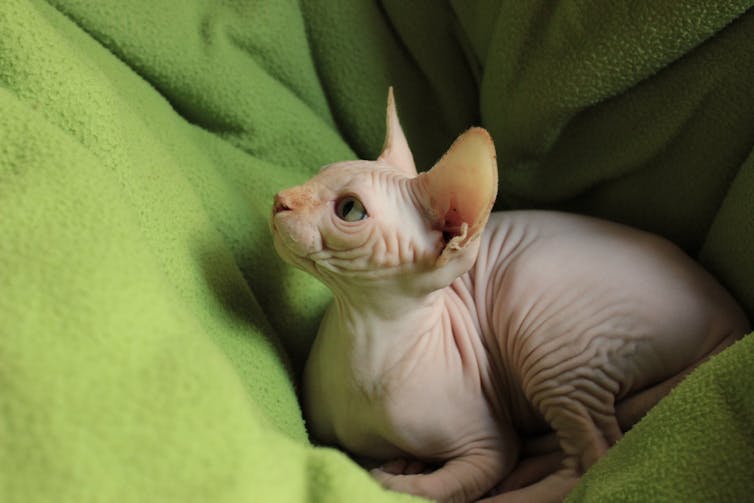
There is no evidence that specific cat breeds do not cause allergies. However, if some breeds have less hair, or shed less hair, this may reduce exposure to allergens in the environment.
All cats produce Fel d 1, but the levels can differ by as much as 100-fold between individual cats. This may explain why people with cat allergies notice they react more to some cats than others.
Sphynx cats have little to no hair, but they still produce allergens. Jesus Vivas Alacid/Shutterstock
Myth #3: You have to re-home your cat if you have an allergy
If you have a life-threatening allergy to cats, your only alternative might be to find them a new home. However, most people have less severe reactions and can manage symptoms successfully.
Some things you can do to limit reactions include:
always wash your hands and avoid touching your face and eyes after handling your cat
regularly clean surfaces and change litter to reduce dander
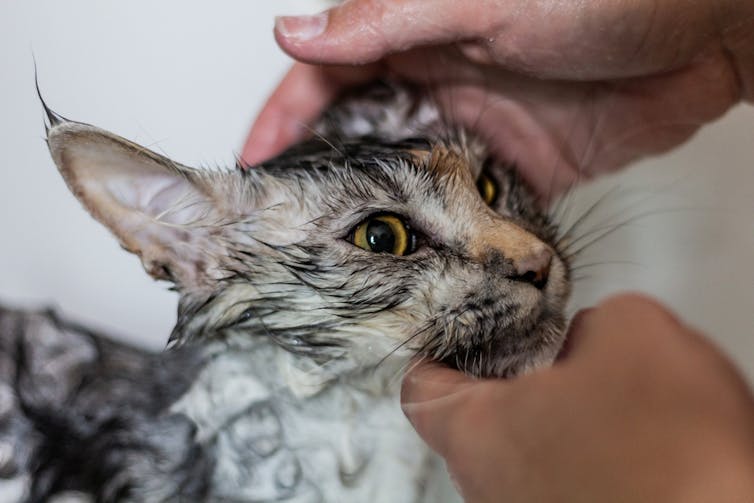
If the cat is amenable to baths, it can be a good method to reduce the level of allergens. Matyas Rehak/Shutterstock
restrict cats’ access to rooms you want to keep allergy-free, such as the bedroom
get a vacuum specifically designed for reducing allergens, such as ones with a HEPA filter
use air purifiers with HEPA filters.
Adopting a cat when allergic
If you’re allergic and want to adopt a cat, make sure to spend some time with them first to assess your reaction. Ideally, pick a cat that doesn’t make you sneeze.
If cats need to be re-homed, this does negatively affect their welfare. A large study of RSPCA shelters in Australia reported allergy as the reason for relinquishment in roughly 3% of cats out of 61,755 total relinquished between 2006 and 2010.
You can also see your doctor about options for managing symptoms such as over-the-counter medications (such as antihistamines) and longer term solutions.
For those with allergies who want to have their cat and their ability to breathe too, another option is immunotherapy, although there is limited evidence to support this treatment for cat allergies.
Immunotherapy involves first identifying which specific allergen is causing the reactions, and then systematically delivering increasing levels of this allergen over several months in an effort to retrain the immune system to tolerate the allergen without a reaction. This may be especially beneficial for those with moderate to severe reactions.
What we do know is that pet cats provide companionship and joy to many, and understanding the causes and treatment of pet allergy can only help both cats and humans.