Veterinarians and researchers at the University of California, Davis have developed a new way to detect leptospirosis, a life-threatening bacterial disease, in dogs using artificial intelligence. Leptospirosis is caused by the Leptospira bacteria, according to American Veterinary Medical Association, and it is typically found in soil and water. Infection in dogs can result in kidney failure, liver disease and bleeding in the lungs, with early detection being a matter of life or death, UC Davis said in a news release. “Traditional testing for Leptospira lacks sensitivity early in the disease pr...
Voyager 1 is the farthest human-made object from Earth. After sweeping by Jupiter, Saturn, Uranus and Neptune, it is now almost 15 billion miles (24 billion kilometers) from Earth in interstellar space. Both Voyager 1 and its twin, Voyager 2, carry little pieces of humanity in the form of their Golden Records. These messages in a bottle include spoken greetings in 55 languages, sounds and images from nature, an album of recordings and images from numerous cultures, and a written message of welcome from Jimmy Carter, who was U.S. president when the spacecraft left Earth in 1977.
Each Voyager spacecraft carries a Golden Record containing two hours of sounds, music and greetings from around the world. Carl Sagan and other scientists assumed that any civilization advanced enough to detect and capture the record in space could figure out how to play it.
The Golden Records were built to last a billion years in the environment of space, but in a recent analysis of the paths and perils these explorers may face, astronomers calculated that they could exist for trillions of years without coming remotely close to any stars.
Having spent my career in the field of religion and science, I’ve thought a lot about how spiritual ideas intersect with technological achievements. The incredible longevity of the Voyager spacecraft presents a uniquely tangible entry point into exploring ideas of immortality.
For many people, immortality is the everlasting existence of a soul or spirit that follows death. It can also mean the continuation of one’s legacy in memory and records. With its Golden Record, each Voyager provides such a legacy, but only if it is discovered and appreciated by an alien civilization in the distant future.
Many religions espouse some form of life after death.
Religious beliefs about immortality are numerous and diverse. Most religions foresee a postmortem career for a personal soul or spirit, and these range from everlasting residence among the stars to reincarnation.
The ideal eternal life for many Christians and Muslims is to abide forever in God’s presence in heaven or paradise. Judaism’s teachings about what happens after death are less clear. In the Hebrew Bible, the dead are mere “shades” in a darkened place called Sheol. Some rabbinical authorities give credence to the resurrection of the righteous and even to the eternal status of souls.
Jimmy Carter, whose message and autograph are immortalized in the Golden Records, is a progressive Southern Baptist and a living example of religious hope for immortality. Now battling brain cancer and approaching centenarian status, he has thought about dying. Following his diagnosis, Carter concluded in a sermon: “It didn’t matter to me whether I died or lived. … My Christian faith includes complete confidence in life after death. So I’m going to live again after I die.”
It is plausible to conclude that the potential of an alien witnessing the Golden Record and becoming aware of Carter’s identity billions of years in the future would offer only marginal additional consolation for him. Carter’s knowledge in his ultimate destiny is a measure of his deep faith in the immortality of his soul. In this sense, he likely represents people of numerous faiths.
Secular immortality
For people who are secular or nonreligious there is little solace to be found in an appeal to the continuing existence of a soul or spirit following one’s death. Carl Sagan, who came up with the idea for the Golden Records and led their development, wrote of the afterlife: “I know of nothing to suggest that it is more than just wishful thinking.” He was more saddened by thoughts of missing important life experiences – like seeing his children grow up – than fearful about the expected annihilation of his conscious self with the death of his brain.
With Voyagers 1 and 2 estimated to exist for more than a trillion years, they are about as immortal as it gets for human artifacts. Even before the Sun’s expected demise when it runs out of fuel in about 5 billion years, all living species, mountains, seas and forests will have long been obliterated. It will be as if we and all the marvelous and extravagant beauty of planet Earth never existed – a devastating thought to me.
Voyager 1’s path, in white, has taken the craft well past the orbits of the outer planets into interstellar space, where aliens may someday come across the relic of humanity.
But in the distant future, the two Voyager spacecraft will still be floating in space, awaiting discovery by an advanced alien civilization for whom the messages on the Golden Records were intended. Only those records will likely remain as testimony and legacy of Earth, a kind of objective immortality.
Religious and spiritual people can find solace in the belief that God or an afterlife waits for them after death. For the secular, hoping that someone or something will remember humanity, any wakeful and appreciative aliens will have to do.
Boeing's Starliner capsule is readying to return to Earth on Wednesday in the final step of a key test flight to prove itself worthy of providing rides for NASA astronauts to the International Space Station.
The spaceship is scheduled to autonomously undock at 2:36 pm Eastern Time (1836 GMT) and touch down in New Mexico just over four hours later, at 2249 GMT, wrapping up a six-day mission crucial to restoring Boeing's reputation after past failures.
Orbital Flight Test-2 (OFT-2) is the last hurdle for Starliner to clear before it carries humans in another test flight that could take place by the end of this year.
Starliner rendezvoused with the ISS on Friday, a day after blasting off from the Kennedy Space Center in Florida.
Over the weekend, astronauts living aboard the research platform opened the hatch and "greeted" the capsule's sole passenger: Rosie the Rocketeer, a mannequin equipped with sensors to understand what human crew would have experienced in the journey.
The mission hasn't been without its hiccups. These include propulsion problems early on Starliner's journey that saw two thrusters responsible for placing it in a stable orbit failing, though officials insisted there was plenty of redundancy built into the system.
On the day of docking, the vessel missed its scheduled contact time by more than an hour, after a ring responsible for latching on to the station failed to deploy correctly. Engineers had to retract the ring then pop it out again before it worked the second time.
Still, the glitches are little compared to the troubles Starliner saw during its first test launch, back in 2019, when one software bug caused it to burn too much fuel to reach its destination, and another almost meant that the vehicle was destroyed during re-entry.
The second error was caught in time to upload a patch, and the vessel was able to achieve a gentle landing, slowed by its enormous parachutes, at White Sands Space Harbor -- the same spaceport where Space Shuttles once launched, and where Starliner is once more expected for touchdown.
Boeing and NASA also tried to launch Starliner in August 2021, but the capsule was rolled back from the launchpad to address sticky valves that weren't opening as they should and the ship was eventually sent back to the factory for fixes.
NASA is looking to certify Starliner as a second "taxi" service for its astronauts to the space station -- a role that Elon Musk's SpaceX has provided since succeeding in a test mission for its Dragon capsule in 2020.
CHICAGO — People with long COVID-19 who visited a Northwestern Medicine clinic were still experiencing symptoms such as headaches, dizziness, fatigue and brain fog for a median of 15 months after first falling ill, despite never needing hospitalization, according to a new Northwestern study. The study looked at 52 patients who were seen at Northwestern’s Neuro COVID-19 clinic between May 2020 and November 2020, who initially had mild COVID-19 symptoms. Study senior author Dr. Igor Koralnik said the study is the first to look, over such a long time period, at neurological symptoms in people who...
In 1921, he was studying radioactivity at the Kaiser Wilhelm Institute for Chemistry in Berlin, Germany, when he noticed something he could not explain. One of the elements he was working with wasn’t behaving as it should have. Hahn had unknowingly discovered the first nuclear isomer, an atomic nucleus whose protons and neutrons are arranged differently from the common form of the element, causing it to have unusual properties. It took another 15 years of discoveries in nuclear physics to be able to explain Hahn’s observations.
We are two professors of nuclear physics who study rare nuclei including nuclear isomers.
The most common place to find isomers is inside stars, where they play a role in the nuclear reactions that create new elements. In recent years, researchers have begun to explore how isomers can be put to use for the benefit of humanity. They are already used in medicine and could one day offer powerful options for energy storage in the form of nuclear batteries.
This video shows radioactive uranium-238 in a chamber full of mist. The streaks are created as particles are emitted from the radioactive sample and pass through water vapor.
On the hunt for radioactive isotopes
In the early 1900s, scientists were on the hunt for new radioactive elements. An element is considered radioactive if it spontaneously releases particles in a process called radioactive decay. When this happens, the element is transformed over time into a different element.
At that time, scientists relied on three criteria to discover and describe a new radioactive element. One was to look at chemical properties – how the new element reacts with other substances. They also measured the type and energy of the particles released during the radioactive decay. Finally, they would measure how fast an element decayed. Decay speeds are described using the term half-life, which is the amount of time it takes for half of the initial radioactive element to decay into something else.
By the 1920s, physicists had discovered some radioactive substances with identical chemical properties but different half-lives. These are called isotopes. Isotopes are different versions of the same element that have the same number of protons in their nucleus, but different numbers of neutrons.
Uranium is a radioactive element with many isotopes, two of which occur naturally on Earth. These natural uranium isotopes decay into the element thorium, which in turn decays into protactinium, and each has its own isotopes. Hahn and his colleague Lise Meitner were the first to discover and identify many different isotopes originating from the decay of the element uranium.
All the isotopes they studied behaved as expected, except for one. This isotope appeared to have the same properties as one of the others, but its half-life was longer. This made no sense, as Hahn and Meitner had placed all the known isotopes of uranium in a neat classification, and there were no empty spaces to accommodate a new isotope. They called this substance “uranium Z.”
The radioactive signal of uranium Z was about 500 times weaker than the radioactivity of the other isotopes in the sample, so Hahn decided to confirm his observations by using more material. He purchased and chemically separated uranium from 220 pounds (100 kilograms) of highly toxic and rare uranium salt. The surprising result of this second, more precise experiment suggested that the mysterious uranium Z, now known as protactinium-234, was an already known isotope, but with a very different half-life. This was the first case of an isotope with two different half-lives. Hahn published his discovery of the first nuclear isomer, even though he could not fully explain it.
The discovery that the nucleus of an atom is made of both protons and neutrons allowed physicists to explain isotopes as well as uranium Z.
At the time of Hahn’s experiments in the 1920s, scientists still thought of atoms as a clump of protons surrounded by an equal number of electrons. It wasn’t until 1932 that James Chadwick suggested a third particle – neutrons – were also part of the nucleus.
With this new information, physicists were immediately able to explain isotopes – they are nuclei with the same number of protons and different numbers of neutrons. With this knowledge, the scientific community finally had the tools to understand uranium Z.
In 1936 Carl Friedrich von Weizsäcker proposed that two different substances could have the same number of protons and neutrons in their nuclei but in different arrangements and with different half-lives. The arrangement of protons and neutrons that results in the lowest energy is the most stable material and is called ground state. Arrangements resulting in less stable, higher energies of an isotope are called isomeric states.
At first nuclear isomers were useful in the scientific community only as a means to understand how nuclei behave. But once you understand the properties of an isomer, it’s possible to start asking how they can be used.
Technetium-99m is an isomer that is commonly used for diagnosing many diseases, as doctors can easily track its movement through the human body. This photo shows a medical professional injecting technetium-99m into a patient.
Isomers have important applications in medicine and are used in tens of millions of diagnostic procedures annually. Since isomers undergo radioactive decay, special cameras can track them as they move through the body.
For example, technetium-99m is an isomer of technetium-99. As the isomer decays, it emits photons. Using photon detectors, doctors can track how technetium-99m moves throughout the body and create images of the heart, brain, lungs and other critical organs to help diagnose diseases including cancer. Radioactive elements and isotopes are normally dangerous because they emit charged particles that damage bodily tissues. Isomers like technetium are safe for medical use because they emit only a single, harmless photon at a time and nothing else as they decay.
Isomers are also important in astronomy and astrophysics. Stars are fueled by the energy released during nuclear reactions. Since isomers are present in stars, nuclear reactions are different than if a material were in its ground state. This makes the study of isomers critical for understanding how stars produce all the elements in the universe.
Scientists are also investigating whether nuclear isomers could be used to build the world’s most accurate clock or whether isomers may one day be the basis for the next generation of batteries. More than 100 years after the detection of a small anomaly in uranium salt, scientists are still on the hunt for new isomers and have just begun to reveal the full potential of these fascinating pieces of physics.
The risk of monkeypox spreading widely among the general population is very low and transmission can be stopped outside endemic countries in Central and West Africa, health officials said Monday, after cases exploded this month in Europe and North America.Fewer than 200 confirmed and suspected cases had been recorded since early May in Australia, Europe and North America, the World Health Organization (WHO) said, sparking fears over the spread of the disease.
Although monkeypox has been known for 40 years, WHO said it was the first time there had been several cases across many countries simultaneously and among people who had not travelled to the endemic regions in Africa.
But the UN agency said the outbreaks in non-endemic countries could be brought under control and human-to-human transmission of monkeypox stopped.
The EU's European Centre for Disease Prevention and Control (ECDC) also played down fears of a spread among the wider public.
Monkeypox, which is not usually fatal, can cause a fever, muscle aches, swollen lymph nodes, chills, exhaustion and a chickenpox-like rash on the hands and face.
The virus can be transmitted through contact with skin lesions or droplets of bodily fluid from an infected person.
No treatment exists, but the symptoms usually clear up after two to four weeks. The disease is considered endemic in 11 African nations.
US President Joe Biden insisted Monday "extra efforts" would not be needed to prevent the spread.
'Remain vigilant'
"This is a containable situation, particularly in the countries where we are seeing these outbreaks that are happening across Europe, in North America as well," the WHO's emerging disease lead Maria Van Kerkhove said Monday via the UN health agency's social media channels.
"We want to stop human-to-human transmission. We can do this in the non-endemic countries," she said.
Meanwhile, the European Centre for Disease Prevention and Control (ECDC) director, Andrea Ammon, said most of the cases had mild symptoms.
"For the broader population, the likelihood of spread is very low," Ammon added in a statement.
"However, the likelihood of further spread of the virus through close contact, for example during sexual activities among persons with multiple sexual partners, is considered to be high," she said.
Stella Kyriakides, European Commissioner for Health and Food Safety, said it was important to "remain vigilant" despite the low risk, ensuring contact tracing and adequate diagnostics capacity.
The agency also pointed to the risk of "human-to-animal transmission", and said if the virus is spread to animals "there is a risk that the disease could become endemic in Europe".
Japan and the United States said Monday they want to put the first Japanese astronaut on the Moon as the allies deepen cooperation on space projects.
No non-American has ever touched down on the lunar surface, and Japan has previously said it hopes to achieve a Moon landing by the end of this decade.
President Joe Biden, after his first face-to-face meeting with Japan's Prime Minister Fumio Kishida in Tokyo, said the nations will work together in the US-led Artemis program to send humans to the Moon, and later to Mars.
Biden said he was "excited" about the collaboration, including on the Gateway facility, which will orbit the Moon and provide support for future missions.
"I'm excited (about) the work we'll do together on the Gateway Station around the Moon, and look forward to the first Japanese astronaut joining us on the mission to the lunar surface under the Artemis program," he said at a joint press conference.
Japan's domestic space program focuses on satellites and probes, so Japanese astronauts have turned to the US and Russia to travel to the International Space Station.
But space agency JAXA is looking to revitalize its ranks, last year launching its first recruitment of new astronauts in 13 years.
It lifted the requirement that applicants have a science degree and urged women to apply, because all seven of the nation's current astronauts are men.
When the pandemic forced schools into remote learning, Washington-area science teacher Rebecca Bushway set her students an ambitious task: design and build a low-cost lead filter that fixes to faucets and removes the toxic metal.
Using 3D printing and high-school level chemistry, the team now has a working prototype -- a three-inch (7.5 centimeter) tall filter housing made of biodegradable plastic, which they hope to eventually bring to market for $1 apiece.
"The science is straightforward," Bushway told AFP on a recent visit to the Barrie Middle and Upper School in suburban Maryland, where she demonstrated the filter in action.
"I thought, 'We have these 3D printers. What if we make something like this?'"
Bushway has presented the prototype at four conferences, including the prestigious spring meeting of the American Chemistry Society, and plans to move forward with a paper in a peer-reviewed journal.
Up to 10 million US homes still receive water through lead pipes, with exposure particularly harmful during childhood.
The metal, which evades a key defense of the body known as the blood-brain-barrier, can cause permanent loss of cognitive abilities and contribute to psychological problems that aggravate enduring cycles of poverty.
A serious contamination problem uncovered in Flint, Michigan in 2014 is perhaps the most famous recent disaster -- but lead poisoning is widespread and disproportionately impacts African Americans and other minorities, explained Barrie team member Nia Frederick.
"And I think that's something we can help with," she said.
The harms of lead poisoning have been known for decades, but lobbying by the lead industry prevented meaningful action until recent decades.
President Joe Biden’s administration has pledged billions of dollars from an infrastructure law to fund the removal of all the nation’s lead pipes over the coming years -- but until that happens, people need solutions now.
A clever trick -
Bushway's idea was to use the same chemical reaction used to restore contaminated soil: the exposure of dissolved lead to calcium phosphate powder produces a solid lead phosphate that stays inside the filter, along with harmless free calcium.
The filter has a clever trick up its sleeve: under the calcium phosphate, there's a reservoir of a chemical called potassium iodide.
When the calcium phosphate is used up, dissolved lead will react with potassium iodide, turning the water yellow - a sign it is time to replace the filter.
Student Wathon Maung spent months designing the housing on 3D printing software, going through many prototypes.
"What's great about it was that it's kind of this little puzzle that I had to figure out," he said.
Calcium phosphate was clumping inside the filter, slowing the reaction. But Maung found that by incorporating hexagonal bevels he could ensure the flow of water and prevent clumping.
The result is a flow rate of two gallons (nine liters) per minute, the normal rate at which water flows out a tap.
Next, the Barrie team would like to incorporate an instrument called a spectrophotometer that will detect the yellowing of the water even before it is visible to the human eye and then turn on a little LED warning light.
Paul Frail, a chemical engineer who was not involved in the work, said the group "deserves an incredible amount of credit" for its work, combining general chemistry concepts with 3D printing to design a novel product.
He added, however, that the filter would need further testing with ion chromatography instruments that are generally available in universities or research labs -- as well as market research to determine the demand.
Bushway is confident there is a niche. Reverse osmosis systems that fulfill the same role cost hundreds to thousands of dollars, while carbon block filters available for around $20 have to be replaced every few months, which is more often than her group's filter.
"I am over-the-Moon proud of these students," Bushway said, adding that the group hoped to work with partners to finalize the design and produce it at scale.
CHICAGO — Contrary to what his profession might lead you to believe, Joe Weber hasn’t always been obsessed with mushrooms. It’s not that he hated them either. Rather, while growing up in Hoffman Estates, Illinois, he didn’t think about mushrooms at all, beyond the rare occasion they would make an appearance at his family’s dinner table. When they did, he wasn’t impressed. These days, as founder and CEO of Chicago’s Four Star Mushrooms, an indoor mushroom farm, it’s pretty much all the 26-year-old thinks about. For the past 2 1/2 years, Four Star Mushrooms has been supplying high-quality fungi ...
The current popularity bump is thanks to an email newsletter called “Dracula Daily.” The original 1897 version of “Dracula” was told in epistolary format, meaning the novel’s plot is presented through journal entries, letters, newspaper articles and the like. Matt Kirkland hit on a simple idea: Release the novel “Dracula” by entry, by date. Subscribers to his Substack newsletter receive messages in their inboxes day by day as the vampire tale unfolds in real time. If there’s no action on that date, there’s no message sent.
Stoker’s “Dracula” is not unique in using an epistolary style; it’s not even the first work of vampire fiction to do so. But by including the new technologies of his time – such as the phonograph and the typewriter – Stoker gave his tale a modern feel, much as if it were written today using Reddit entries composed on a smartphone.
The novel starts on May 3, with Jonathan Harker, a young English solicitor, describing his travels to visit a mysterious client in Transylvania. “Dracula Daily” readers received this particular entry on the same date, with a flippant summary stating “Meet Jonathan Harker, on a fun road trip for work, as he collects some new recipes.” With that intro, the opening Stoker wrote in the 19th century to set the scene comes off like a naïve travel blog to 21st-century readers scrolling on their phones.
The only difference between the original novel and the emailed content is that Kirkland opts to release the material in chronological order. For instance, Jonathan Harker witnesses Count Dracula scaling the wall of his castle in “lizard fashion” for the third and final time on June 29. His fiancee, Mina Murray, writes a letter to her friend Lucy Westenra on May 9. In the novel, the description of Dracula’s uncanny exit is presented before Lucy’s chatty letter. In “Dracula Daily,” it’s the reverse. Subsequent sections are published in the same way.
Newsletter subscribers are thus consuming the novel not just in a different format, but in a different order. While faithful to the original text, “Dracula Daily” is, in a sense, a partial retelling of the book.
Protectively mocking ‘my buddy Harker’
Upon initial publication, “Dracula” was dismissed by some influential critics. One comment was that “the early part goes best.” And it’s these first entries that have grabbed the “Dracula Daily” audience’s attention in 2022. They follow Jonathan Harker’s journey to meet Count Dracula to assist with his purchasing of properties in England. It hardly sounds like the sinister scheming of a centuries-old undead vampire lord. To audiences in 1897, the novel was quite similar to previous vampire literature, and such details were largely overlooked as par for the course.
But today’s audience meets Harker’s descriptions with more critical scrutiny. Readers laugh as Harker marches past what are obviously red flags. When locals stare at him and talk among themselves of Satan, hell, werewolves and vampires after hearing his travel plans, Harker simply adds a parenthetical note to himself: “(Mem., I must ask the Count about these superstitions).” For Harker, who does not believe in vampires, this would hardly seem a nonsensical idea.
Modern readers, even if tackling Stoker’s writing for the first time, however, are well aware that Count Dracula is a bloodthirsty vampire who has much more than British real estate on his mind. Trained by social media to mockingly scrutinize online content, “Dracula Daily” readers revel in minor details that are easily mocked. For instance, the fact that Dracula, maintaining the pretense that there are servants in this remote vampire’s lair, secretly makes Jonathan Harker’s bed himself, is viewed in a new and humorous light. “I appreciate Dracula’s efforts in running a one man hotel,” commented Tumblr user ashtry.
In Stoker’s time, one critic called the book’s descriptions “probably quite uncanny enough to please those for whom they are designed” – meaning, essentially, trash written for trash. Tumblr audiences in particular seem to have picked up on this quality, approaching the material with plenty of snark. It’s the mocking analysis of the novel by modern readers that sent “Dracula Daily” trending.
Consuming the story as a social experience
Readers always interpret a book’s style and meaning through the lens of their own knowledge and experiences. But the majority of previous “Dracula” interpretation I’ve seen has been at the hands of scholars and devoted fans. The social media response to “Dracula Daily” is different, with a primarily younger audience riffing on the novel in a new way.
As audiences analyze the novel piece by piece, they are engaging one another with memes and artistic interpretations of the plot as it unfolds. For instance, Harker’s description of Dracula climbing down the walls of his castle in “lizard fashion” has elicited visual art of fashion looksinspired by lizards.
Because “Dracula Daily” reveals the plot day by day, readers follow the story together and are all at the same place in the narrative at the same time. As in the heyday of radio or network series television, the audience can gather around the (now virtual) water cooler to discuss the latest revelation and speculate about what’s to come. Anyone could easily read ahead in the novel. But people are waiting with bated breath for the next installment to hit their inboxes.
It’s like a chapter-by-chapter book club. The forced slow pace leaves plenty of time for the ecosystem of memes and posts to flourish as the delicious dread builds about just what Dracula will do. As the plot further unfolds, I look forward to continuing to be entertained by the “Dracula Daily” audience – at least until Nov. 6, when the story will draw to a close for this year.
Humans behave in strange ways. We readily reveal our inner feelings during moments of weakness, which doesn’t seem like the smart thing to do.
Just by observing someone’s behaviour, we can tell when they are in pain, frustrated or upset. Surely the best strategy is to try and conceal weakness? Why run the risk of being taken advantage of?
Many other animals rarely show visible behaviour changes when they are struggling. Vets and animal carers have to rely on cues such as changes in blood pressure, heart rate or hormone levels to get an idea of pain or stress. But could there be an advantage to broadcasting your vulnerability?
Our research (funded by the ERC) investigates the reasons we communicate using our bodies, faces and hands. We found these signals play a key role in how we build and maintain social networks. Specifically, our experiment showed the more stressed you seem, the more others find you likeable.
Evolution and stress
We’ve long understood the experience of stress and behaviour is linked. When someone is stressed, they are more likely to show what we call self-directed behaviour. We touch our face, we bite our nails, we fumble with objects and play with our hair. Very similar forms of stress behaviour are well documented in monkeys and apes, which adds to the evidence they emerged over evolutionary time from a common ancestor.
However, the way others see these stress-related behaviours has been a mystery to researchers. Do people even notice these behaviours in others? Can we detect when others are feeling stressed? How does that change our impression of them?
To investigate, we needed to induce mild stress in volunteers to study their behaviour. They had three minutes to prepare for a presentation and mock job interview, followed immediately by a challenging maths test.
It won’t shock you to learn most participants became stressed.
We showed footage of these stressed volunteers to a new group of people, who rated their behaviour on sliding scales such as “How stressed is this person?” The results told us what people looked like when they were stressed and what people thought of them.
It turns out, humans are quite good at recognising when someone is feeling stressed. The more stressed a person reported being, the more stressed others thought they were – a clear linear relationship. As expected, self-directed behaviour seems to play an important role. The more of these behaviours a person produced, the more stressed they were judged to be.
It’s also worth noting that these were not subtle signals detectable only by close friends, as we asked complete strangers to make the judgments about our participants.
New findings
The fact that other people can so clearly detect when we’re stressed is evidence these behaviours function like other types of non-verbal communication (such as facial expressions, gestures) – a fact that has been unsupported until now. This is the first study which found a demonstrable link between stress behaviour and stress perception.
The fact that those judged as more stressed were also considered the most likeable people could explain why we produce these signals of weakness in the first place (and why they evolved). People’s first impressions towards “stress signallers” are not negative, but in fact very positive. We expect people to take advantage of weakness but showing your vulnerable side encourages support and social bonding.
We are a highly cooperative species, more so than any other animal, and we are attracted to those who are honest about their intentions and state of mind. There is nothing more honest than communicating when you are weak.
Other research shows stress may be a good thing and should be embraced. Our brains evolved to tackle challenges in the environment, and mild stress gives a healthy challenge to keep your mind stimulated.
Stress communication is telling a similar story. Show your feelings, good or bad. Don’t try too hard to conceal your stress levels during that big presentation or interview. Communicating honestly and naturally through your behaviour may in fact leave a positive impression on others.
Up to 30% of people with depression don’t respond to treatment with antidepressants. This may be down to differences in biology between patients and the fact that it often takes a long time to respond to the drugs – with some people giving up after a while. So there is an urgent need to expand the repertoire of drugs available to people with depression.
In recent years, attention has turned to psychedelics such as psilocybin, the active compound in “magic mushrooms”. Despite a number of clinical trials showing that psilocybin can rapidly treat depression, including for cancer-related anxiety and depression, little is known about how psilocybin actually works to relieve depression in the brain.
Now two recent studies, published in The New England Journal of Medicine and Nature Medicine, have shed some light on this mysterious process.
Psilocybin is a hallucinogen that changes the brain’s response to a chemical called serotonin. When broken down by the liver (into “psilocin”), it causes an altered state of consciousness and perception in users.
Previous studies, using functional MRI (fMRI) brain scanning, have shown that psilocybin seems to reduce activity in the medial prefrontal cortex, an area of the brain that helps regulate a number of cognitive functions, including attention, inhibitory control, habits and memory. The compound also decreases connections between this area and the posterior cingulate cortex, an area that may play a role in regulating memory and emotions.
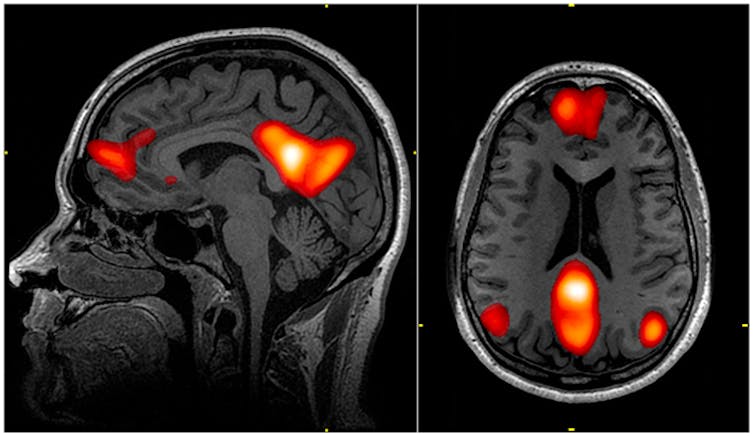
An active connection between these two brain areas is normally a feature of the brain’s “default mode network”. This network is active when we rest and focus internally, perhaps reminiscing about the past, envisioning the future or thinking about ourselves or others. By reducing the activity of the network, psilocybin may well be removing the constraints of the internal “self” – with users reporting an “opened mind” with increased perception of the world around them.
Interestingly, rumination, a state of being “stuck” in negative thoughts, particularly about oneself, is a hallmark of depression. And we know that patients with higher levels of negative rumination tend to show increased activity of the default mode network compared with other networks at rest – literally becoming less responsive to the world around them. It remains to be seen, however, if the symptoms of depression cause this altered activity, or if those with a more active default mode network are more prone to depression.
New results
The most compelling evidence of how psilocybin works comes from a double-blind randomised controlled trial (the gold-standard of clinical studies) that compared a group of depressed people taking psilocybin with those taking the existing antidepressant drug escitalopram – something that’s never been done before. The trial was further analysed using fMRI brain scans, and the results were compared with other fMRI findings from another recent clinical trial.
Just one day after the first dose of psilocybin, fMRI measures revealed an overall increase in connectivity between the brain’s various networks, which are typically reduced in those with severe depression. The default mode network was simultaneously reduced, while connectivity between it and other networks was increased – backing up previous, smaller studies.
The dose increased connectivity more in some people than others. But the studies showed that the people who had the biggest boost in connection between networks also had the greatest improvement in their symptoms six months later.
MRI scan showing the default mode network.
wikipedia
The brains of people taking escitalopram, on the other hand, showed no change in connectivity between the default mode and other brain networks six weeks after treatment started. It is possible that escitalopram may bring about changes at a later time point. But the rapid onset of psilocybin’s antidepressant effect means it may be ideal for people who don’t respond to existing antidepressants.
The study proposes that the observed effect may be due to psilocybin having more concentrated action on receptors in the brain called “serotonergic 5-HT2A receptors” than escitalopram. These receptors are activated by serotonin and are active throughout network brain areas, including the default mode network. We already know that the level of binding by psilocybin to these receptors leads to psychedelic effects. Exactly how their activation leads to changes in network connectivity is still to be explored though.
The end of traditional antidepressants?
This does raise the question of whether altered activity of the brain’s networks is required for treating depression. Many people taking traditional antidepressants still report an improvement in their symptoms without it. In fact, the study showed that, six weeks after commencing treatment, both groups reported improvement in their symptoms.
According to some depression rating scales, however, psilocybin had the greatest effect on overall mental wellbeing. And a greater proportion of patients treated with psilocybin showed a clinical response compared with those treated with escitalopram (70% versus 48%). More patients in the psilocybin group were also still in remission at six weeks (57% versus 28%). The fact that some patients still do not respond to psilocybin, or relapse after treatment, shows just how difficult it can be to treat depression.
What’s more, mental health professionals supported both treatment groups during and after the trial. The success of psilocybin is heavily dependent on the environment in which it is taken. This means it is a bad idea to use it for self-medicating. Also, patients were carefully selected for psilocybin-assisted therapy based on their history to avoid the risk of psychosis and other adverse effects.
Regardless of the caveats, these studies are incredibly promising and move us closer to expanding the available treatment options for patients with depression. What’s more, internalised negative thought processes are not specific to depression. In due course, other disorders, such as addiction or anxiety, may also benefit from psilocybin-assisted therapy.
In early March, a manipulated video of Ukrainian President Volodymyr Zelenskyy was ciruclated. In it, a digitally generated Zelenskyy told the Ukrainian national army to surrender. The video was circulated online but was quickly debunked as a deepfake — a hyper-realistic yet fake and manipulated video produced using artificial intelligence.
While Russian disinformation seems to be having a limited impact, this alarming example illustrated the potential consequences of deepfakes.
Therefore, the same voice-cloning technology could be used for phishing, defamation and blackmailing. When deepfakes are deliberately deployed to reshape public opinion, incite social conflicts and manipulate elections, they have the potential to undermine democracy.
Researchers at the University of Washington produced a deepfake of Barack Obama.
Causing chaos
Deepfakes are based on technology known as generative adversarial networks in which two algorithms train each other to produce images.
While the technology behind deep fakes may sound complicated, it is a simple matter to produce one. There are numerous online applications such as Faceswap and ZAO Deepswap that can produce deepfakes within minutes.
Google Colaboratory — an online repository for code in several programming languages — includes examples of code that can be used to generate fake images and videos. With software this accessible, it’s easy to see how average users could wreak havoc with deepfakes without realizing the potential security risks.
Deepfakes are the perfect tool for disinformation campaigns because they produce believable fake news that takes time to debunk. Meanwhile, the damages caused by deepfakes — especially those that affect people’s reputations — are often long-lasting and irreversible.
Is seeing believing?
Perhaps the most dangerous ramification of deepfakes is how they lend themselves to disinformation in political campaigns.
We saw this when Donald Trump designated any unflattering media coverage as “fake news.” By accusing his critics of circulating fake news, Trump was able to use misinformation in defence of his wrongdoings and as a propaganda tool.
Credibility in authorities and the media is being undermined, creating a climate of distrust. And with the rising proliferation of deepfakes, politicians could easily deny culpability in any emerging scandals. How can someone’s identity in a video be confirmed if they deny it?
Combating disinformation, however, has always been a challenge for democracies as they try to uphold freedom of speech. Human-AI partnerships can help deal with the rising risk of deepfakes by having people verify information. Introducing new legislation or applying existing laws to penalize producers of deepfakes for falsifying information and impersonating people could also be considered.
Multidisciplinary approaches by international and national governments, private companies and other organizations are all vital to protect democratic societies from false information.