Bees have irrational biases when choosing which flowers to feed on
When confronted with these choices, you’d think bees would always pick the flowers with the most accessible, highest-quality nectar and pollen. But they don’t. Instead, just like human grocery shoppers, their decisions about which flowers to visit depend on their recent experience with similar flowers and what other flowers are available.
I find these behaviors fascinating. My research looks at how animals make daily choices – especially when looking for food. It turns out that bees and other pollinators make the same kinds of irrational “shopping” decisions humans make.
Predictably irrational
Humans are sometimes illogical. For instance, someone who wins $5 on a scratch ticket immediately after winning $1 on one will be thrilled – whereas that same person winning $5 on a ticket might be disappointed if they’re coming off a $10 win. Even though the outcome is the same, perception changes depending on what came before.
Perceptions are also at play when people assess product labels. For instance, a person may expect an expensive bottle of wine with a fancy French label to be better than a cheap, generic-looking one. But if there’s a mismatch between how good something is and how good someone expects it to be, they may feel disproportionately disappointed or delighted.
Humans are also very sensitive to the context of their choice. For example, people are more likely to pay a higher price for a television when a smaller, more expensive one is also available.
These irrational behaviors are so predictable, companies have devised clever ways to exploit these tendencies when pricing and packaging goods, creating commercials, stocking shelves, and designing websites and apps. Even outside of a consumer setting, these behaviors are so common that they influence how politicians design public policy and attempt to influence voting behavior.
Like minds
Research shows bumblebees and humans share many of these behaviors. A 2005 study found bees evaluate the quality of nectar relative to their most recent feeding experience: Bees trained to visit a feeder with medium-quality nectar accepted it readily, whereas bees trained to visit a feeder with high-quality nectar often rejected medium-quality nectar.
My team and I wanted to explore whether floral traits such as scents, colors and patterns might serve as product labels for bees. In the lab, we trained groups of bees to associate certain artificial flower colors with high-quality “nectar” – actually a sugar solution we could manipulate.

The bumblebee colony, right, is attached by tunnel to the foraging arena, left, where colored discs serve as artificial flowers. Claire Hemingway, CC BY-SA
For example, we trained one group to associate blue flowers with high-quality nectar. We then offered that group medium-quality nectar in either blue or yellow flowers.
We found the bees were more willing to accept the medium-quality nectar from yellow flowers than they were from blue. Their expectations mattered.
In another recent experiment, we gave bumblebees a choice between two equally attractive flowers – one high in sugar concentration but slower to refill and one quick to refill but containing less sugar. We measured their preference between the two, which was similar.
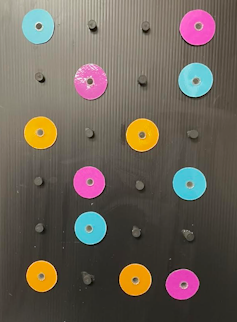
At the center of each artificial flower is a tube the bee enters to access the sugar solution. Claire Hemingway, CC BY-SA
We then expanded the choice by including a third flower that was even lower in sugar concentration or even slower to refill. We found that the presence of the new low-reward flower made the intermediate one appear relatively better.
These results are intriguing and suggest, for both bees and other animals, available choices may guide foraging decisions.
Potential uses
Understanding these behaviors in bumblebees and other pollinators may have important consequences for people. Honeybees and bumblebees are used commercially to support billions of dollars of crop production annually.
If bees visit certain flowers more in the presence of other flowers, farmers could use this tendency strategically. Just as stores stock shelves to present unattractive options alongside attractive ones, farmers could plant certain flower species in or near crop plants to increase visitation to the target crops.
Claire Therese Hemingway, Assistant Professor of Ecology & Evolutionary Biology, University of Tennessee
This article is republished from The Conversation under a Creative Commons license. Read the original article.


 The floods were caused by record rainfall © Attila KISBENEDEK / AFP
 When Storm Boris hit Austria, the Liesing creek's water rose up to the level where project manager Marlies Greussing stands © Alex HALADA / AFP



 © Handout / Yamagata University Institute of Nasca/AFP
 A combination made on September 24, 2024 of undated handout picture released by the Yamagata University Institute of Nasca shows 9 of 303 new geoglyphs discovered by scientists at Yamagata University in Japan, where a team of researchers applied AI-assisted image analysis of aerial photographs, which accelerated the pace of geoglyph discovery during a 6-month fieldwork in the Nazca Pampas. The famous Nazca Lines, recognized as a World Heritage Site by UNESCO, are geoglyphs more than 2,000 years old with geometric and animal figures that can only be seen from the sky. © Handout / Yamagata University Institute of Nasca/AFP