EPA Administrator Scott Pruitt faced a grilling from Fox News host Chris Wallace on Sunday over his climate change denials and plans to do away with scores of environmental regulations.
"You think that rewriting and, in fact, doing away with the clean power plan is going to improve air quality, which you say is a major goal?" Wallace asked Pruitt on Fox News Sunday.
According to the EPA head, President Barack Obama had put clean power regulations in place "through executive fiat" and President Donald Trump has vowed to return to the "rule of law."
Wallace pointed out that the Trump administration's deregulation of the environment meant that China was now pushing the U.S. to decrease greenhouse gas emissions instead of the other way around.
"We have nothing to be apologetic about with respect to the leadership we've show as a country," Pruitt insisted.
The Fox News host also noted that Pruitt was in the minority when it came to acknowledging that humans play a role in climate change.
"Mr. Pruitt, there are all kinds of studies that contradict you," Wallace explained. "The UN panel on climate change says it's 95 percent likely that at least half of the temperature increase since the mid-20th century is due to human activities."
"Mr. Pruitt, are we supposed to believe that's all a coincidence?" the host pressed.
Pruitt, however, declared that "the real issue" was that the EPA should not have the power to regulate greenhouse gasses.
"Sir, you're sugar coating what you have said," Wallace shot back. "You said that you would not agree that carbon CO2 is a primary contributor to global warming. And the question I have is, what if you're wrong? What if, in fact, the Earth is warming, what if it is causing dramatic climate change and that we as humans through carbon emissions are contributing to it?"
"Simple question," Wallace continued, "what if you're wrong?"
"The issue is how much we contribute to it from a human activity perspective and what can be done about it from a process perspective," Pruitt replied.
"But don't you think the fact that we have these coal power plants belching carbon emissions into the air, you don't think that plays a role?" Wallace wondered.
"I think that we've done better than anybody in the world at burning coal cleanly," Pruitt stated. "We have nothing to be apologetic about."
Watch the video below from Fox News, broadcast April 2, 2017.
Famed anthropologist Jane Goodall took to Facebook on Friday to push back at the anti-science policies of the Trump administration, calling it disturbing that there are those who "belittle" scientists at their own peril.
With President Donald Trump appointing an EPA secretary who wants to roll back environmental protections -- including the Clean Air Act -- Goodall encouraged concerned voters to take part in the “March for Science” scheduled for Earth Day — April 22.
“Many scientists have spent years collecting information about the effect of human actions on the climate,” explained Goodall. “There’s no question that the climate is changing, I’ve seen it all over the world. And the fact that people can deny that humans have influenced this change in climate is quite frankly absurd.”
"I really hope that everybody that can, take part in this march," Goodall explained."I hope you'll help by sharing information about it."
In an interview with the Huffington Post, the anthropologist bemoaned Trump's environmental policies, calling them, "Immensely disappointing.“
"Many of us, not just my institute but many, we’ve been working really hard to create the Paris [climate] agreement and global efforts to cut emissions. Thinking that the USA isn’t going to play its part, such an industrial country, is really very, very sad. And it means we’re going to have to work harder,” she explained.
Addressing Trump, Goodall said, “There is definitely a feeling of gloom and doom among all the people I know. If we allow this feeling of doom and gloom to continue, then it will be very, very bad. But my job is to give people hope.”
A new study bodes well for human organ transplants Levin, Blackiston A tadpole with an eyeball grafted to its tail Transplanting a whole eyeball is tough. So tough, in fact, that it's never been done. For an eye to work properly inside the sockets of a new host, it needs to be connected to the central…
Could new drugs be found in its unique venom? Richard Smith/OceanRealmImages A venomous fang blenny, Meiacanthus nigrolineatus swimming in the Red Sea. At first glance, a fang blenny looks completely unthreatening. It’s small, brightly colored, and looks like it would be an adorable backup character in a Finding Nemo film. Then, it opens its mouth. Anthony…
The Science Guy joins the March for Science Popular Science Bill Nye, star of the megahit "Science Guy" television show of the 90s, announced his public support of the March for Science in a blog post on Thursday. The April 22 march is billed as a call for the world to support and safeguard science in…
A five-foot (1.5-meter) debris shield being installed on the International Space Station floated away on Thursday during a spacewalk by two veteran U.S. astronauts, a NASA TV broadcast showed.
Peggy Whitson, who became the world's most experienced female spacewalker during the outing, told ground control teams that a bag containing the debris shield floated away at about 10 a.m. EDT/1400 GMT.
At the time, Whitson, 57, and station commander Shane Kimbrough, 49, were about midway through a planned 6.5-hour spacewalk to prepare a docking port for upcoming commercial space taxis and to tackle other maintenance tasks.
It was the eighth spacewalk for Whitson, who surpassed the 50-hour, 40-minute record total cumulative spacewalk time by a female astronaut previously held by NASA astronaut Sunita Williams.
Cameras on the station tracked the debris shield bag as it sailed into the distance. NASA said engineers determined it posed no safety threat to the astronauts or to the facility, a $100 billion research laboratory that flies about 250 miles (402 km) above Earth.
No other details were immediately available about how the shield, which weighs 18 pounds (8 kg) and measures 63.6-by-23.4- by-2.6 inches (162-by-59-by-7 cm), was lost.
"Teams are focused on completing the (spacewalk) and will review the events as they unfolded after it is completed," NASA spokesman Dan Huot wrote in an email.
Whitson and Kimbrough were working on a docking port that will eventually be used by space taxis being developed by Boeing and privately owned Space Exploration Technologies.
The pair installed three other debris shields during their spacewalk and fitted a temporary cover over the docking port where the lost shield would have gone.
While not a perfect fit, the cover will help protect the station from impacts and provide thermal shielding, NASA said.
Spacewalkers occasionally lose small items like nuts and screws, but rarely do large objects slip away. The last such occasion was in 2008 when an astronaut lost hold of her tool bag while struggling with a jammed solar panel.
The lost debris shield will eventually be pulled back into Earth's atmosphere and burn up. Until then, it joins more than 21,000 other pieces of orbiting trash and debris that are big enough to be tracked by radar and cameras on Earth.
(Reporting by Irene Klotz; Editing by Daniel Wallis and Leslie Adler)
A Republican Pennsylvania gubernatorial candidate said this week that global warming is caused by the Earth moving closer to the sun.
NPR reports that Pennsylvania State Senator Scott Wagner on Tuesday gave a talk in favor of conducting natural gas drilling in state forests -- and he justified his position by using a scientifically incorrect analysis of climate change.
Specifically, Wagner said he wasn't worried about carbon emissions leading to a warming planet because the change in the planet's temperature was more likely caused by the Earth getting closer to the sun every year.
"I haven’t been in a science class in a long time, but the earth moves closer to the sun every year–you know the rotation of the earth," Wagner said. "We’re moving closer to the sun."
Wagner also suggested that climate change could be caused by the heat emitted from human bodies.
"We have more people," he said. "You know, humans have warm bodies. So is heat coming off? Things are changing, but I think we are, as a society, doing the best we can."
When it comes to dinosaur sex, don’t jump to conclusions. That’s the message of one paleontologist, who says there isn’t enough evidence to tell between male and female dinos based on the shape of their bones alone, differences between the genders that are known as sexual dimorphism. According to his analysis in the journal Paleobiology, many…
A paralyzed man in Cleveland fed himself mashed potatoes for the first time in eight years, aided by a computer-brain interface that reads his thoughts and sends signals to move muscles in his arm, U.S. researchers said on Tuesday.
The research, published in the journal Lancet, is the latest from BrainGate, a consortium of researchers testing brain-computer interface technology designed to give paralyzed individuals more mobility. Prior tests of the technology allowed paralyzed people to move a robotic arm or a cursor on a keyboard just by using their thoughts.
The team at Case Western Reserve University and the Cleveland Functional Electrical Stimulation Center used the brain-computer interface and an electrical stimulation system that allowed Bill Kochevar, 56, to control his own arm.
To achieve this, the team implanted two sensors, each about the size of a baby aspirin, loaded with 96 electrodes designed to pick up nerve activity in the movement centers of the brain.
The sensors record brain signals created when Kochevar imagines moving his arm, and relay them to a computer. The computer sends the signals to the electrical stimulation system, which directs impulses through about 30 wires implanted in muscles in Kochevar's arm and hand to produce specific movements.
Kochevar, who was paralyzed below his shoulders in a cycling accident eight years ago, first learned to use the system to move a virtual reality arm on a computer screen. He accomplished that on the first day he tried it, said Case Western's Robert Kirsch, the study's senior author.
For the movement phase of the trial, Kochevar had to go through 45 weeks of rehabilitation to restore muscle tone that had atrophied over the years of inactivity.
Using the brain interface system, he can now move each joint in his right arm individually, just by thinking about it. To accomplish tasks like drinking through a straw, or scratching his face with a dry sponge, Kochevar is aided by an arm support, a device he also controls with his thoughts.
Kochevar said the chance to do simple things for himself has been "better than I thought it would be."
For the moment, the system is experimental only, but the study shows such a system is feasible, Kirsch said.
BrainGate is funded by the National Institutes of Health and the Department of Veterans Affairs.
(Reporting by Julie Steenhuysen; Editing by Dan Grebler)
Many of the technological advances predicted in Star Trek’s fictional universe have become reality, such as the mobile communicator and hand-held tablet computers.
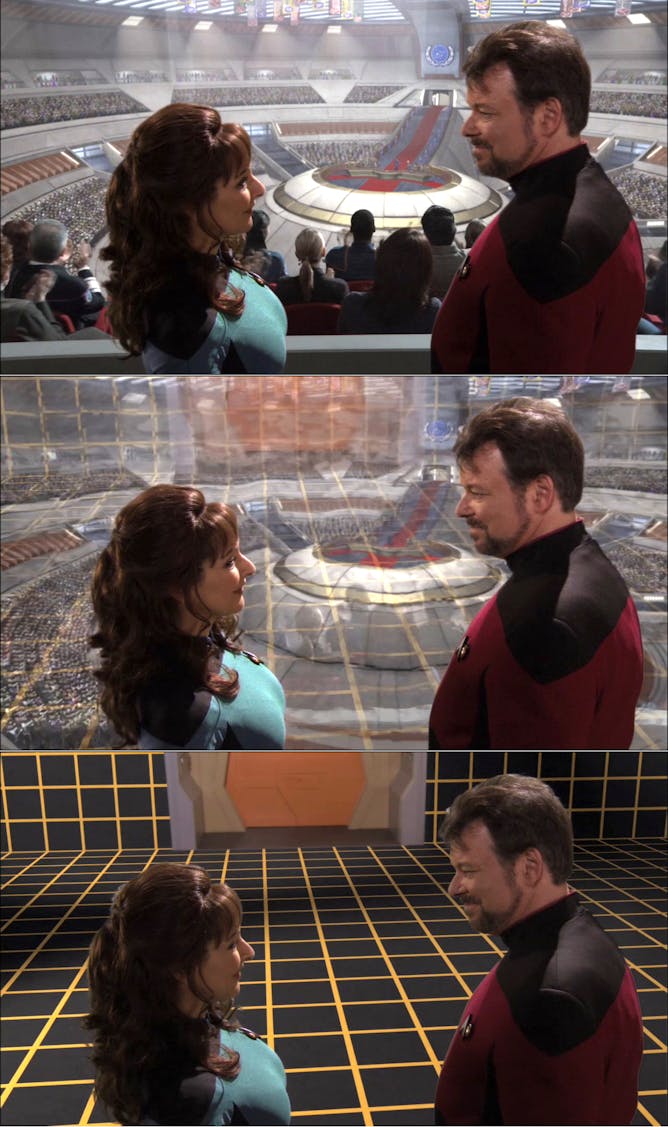
The Holodeck first appeared in The Practical Joker, a 1974 episode of the Star Trek animated series. It was depicted as a recreation room containing a simulated, alternative version of reality. It featured heavily in The Next Generation series and in the 1996 film First Contact.
Anyone entering the Holodeck could interact with “solid” props and characters in any scenario based on whatever parameters they programmed.
The Holodeck was a narrative device that allowed Star Trek’s writers to experiment with philosophical questions in settings not available in a typical sci-fi context.
From Holodeck ‘reality’ to just an empty room with Counselor Deanna Troi (Marina Sirtis, left) and William Riker (Jonathan Frakes, right).
It inspired several generations of computer scientists who spearheaded research in artificial intelligence, computer graphics and human-computer interaction.
The convergence of these research areas has given rise to other forms of reality on the path to the construction of a real Holodeck.
A real Holodeck?
In virtual reality (VR) we are fully immersed in a synthetic, “virtual” version of reality, experienced through dedicated VR headsets such as the Oculus Rift or the HTC Vive.
A typical example of VR is an immersive war game that puts a user in charge of a Roman army as Caesar, battling Vercingetorix’s Gaul troops at Alesia.
But VR has a major drawback for some applications. Being isolated from the real world, it’s not easy to engage in social interaction or physical movement in a way that feels natural to most people.
Augmented reality (AR) blends synthetic, virtual objects with the view of our physical reality. In AR, we can interact with virtual humans inhabiting our physical space or we can work with our children, for example, to build virtual LEGO houses on real tables in our own living rooms.
Headsets are available that allow us to create AR in our office or lounge rooms, such as the Microsoft Hololens or the Meta.
But AR headsets still suffer from several technical limitations, such as a reduced field of view. The software that lets the virtual and real worlds interact believably and naturally still needs work.
Sensing humans
Real-world Holodeck programs would also need the technology to sense human actions. This would provide useful information that the virtual personas inhabiting the Holodeck programs would use to anticipate our human intentions.
Progress here has been fast and constant, with great improvements in speech recognition and language translation, such as Apple’s Siri, Google’s Assistant and Microsoft’s Cortana.
We now take almost for granted the ability to search for information with speech or to command our mobiles to schedule meetings and appointments. Other devices, originally conceived for entertainment applications, can track human gestures or even their full body posture.
For example, Microsoft Kinect can track a human body, and the technology is now included in the Hololens as its gesture-recognition component.
Lots of other sensing devices are now commonplace in mobile devices, such as accelerometers, gyroscopes, magnetometers, and temperature and pressure sensors.
The general trend is towards giving humans the ability to communicate using a combination of their body and their voice via hands-free or wearable user interfaces.
Enter the artificial intelligence
The key ingredient for Holodeck programs in the real world is the ability to equip virtual characters with sophisticated forms of artificial intelligence (AI).
Attacking the Borg on the Holodeck in Star Trek: First Contact with Lily (Alfre Woodard, left) and Captain Picard(Patrick Stewart, right).
These advances, while noteworthy, do not necessarily show strong progress towards general forms of artificial intelligence (AGI) exhibited by humans.
It has been argued that defining or providing general human intelligence may prove a very elusive problem for a long time, or indeed forever.
Fortunately, a restricted version of a Holodeck program may only require a slightly weaker, not fully general form of intelligence. This was exemplified by androids in the popular TV series reboot of Westworld.
Almost human? Close enough
The good news is that this may shorten the time needed to realise the hypothetical Holodeck programs. The bad news is that such a feat is still beyond us at this stage, although recent progress in machine learning will likely help us close the gap faster.
The question is then whether we shall ever be able to reach the level of sophistication in AR and AI needed to build a Holodeck? And if so, when?
Making predictions on such matters is not trivial, but I am inclined to think that current advances in VR and AR technologies will provide us with the required sophisticated headsets within the next five to ten years.
The question then is also whether we shall ever be able to achieve AR using alternative forms of projections that remove the need for a headset altogether.
This may be possible, eventually, but it would be irrelevant if headsets could be miniaturised and potentially implanted into human eyes, similar to what was suggested in other sci-fi classics such as Neuromancer or Snow Crash, and recently advocated by transhumanists.
The recent predictions about breakthroughs in general artificial intelligence by experts seem to converge around a date around 2040. This would put the sort of AI required for Holodeck characters somewhat earlier than that.
So I believe that one day humans will be able to experience some form of Holodeck similar to what was envisaged in Star Trek.
To paraphrase Star Teek’s infamous Borg alien race, I will say that resistance to this technological progress is futile and it will be assimilated, one day.
Congress has only approved funding through 2024. What happens then? Wikimedia Commons In 2024 the clock will run out on the International Space Station. Maybe. That’s the arbitrary deadline that Congress imposed back in 2014, at which point they'll have to decide whether or not to keep funding the ISS. And yeah, that’s a whole seven…
How does a galaxy like our own Milky Way form? Until now there’s been a lot of inferring involved in answering that question.
The basic story is that gas collects toward the center of roughly spherical “halos” of matter. The gas then cools, condenses, fragments and eventually collapses to form stars. Generations of stars build up the galaxy and with it the production of heavy elements – such as carbon, oxygen and so on – that populate our periodic table and comprise our familiar physical world.
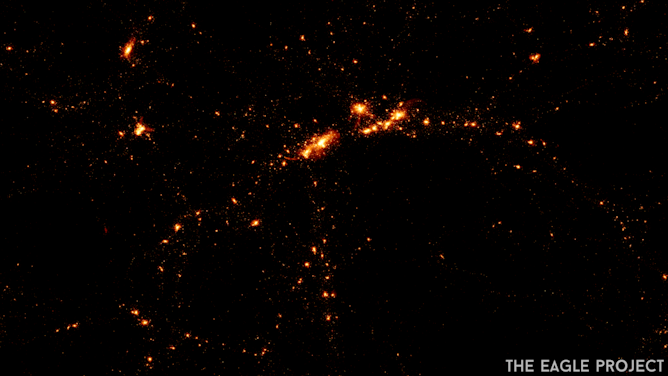
Numerical visualizations of the stars in galaxies forming in the early universe.
Astrophysicists like me have pieced together this picture thanks largely to theoretical research. We run numerical simulations on the world’s largest supercomputers to capture the processes that govern galaxy formation – gravitational collapse, heating, radiative cooling – at high fidelity.
Numerical simulation of gas corresponding to the same region as the previous figure. Young galaxies are dominated by gas and not stars.
To study many of these processes, we were largely restricted to this kind of theoretical inquiry because we didn’t have the technical capacity to observe them. But things have changed as we’ve witnessed the rise of what we consider the “Great Observatories”: NASA’s Hubble Space Telescope, the twin 10m Keck Telescopes on Manua Kea, Hawaii, and, most recently, the Atacama Large Millimeter/submillimeter Array (ALMA) in northern Chile. With these facilities, astronomers have sought to test and refine the tenets of galaxy formation theory, especially the processes governing galaxy assembly and star formation.
The new data our group is publishing based on observations from ALMA are truly transformative relative to previous observations. They allow us to directly image the gas in nascent galaxies – something that was impossible before – and thereby test our fundamental predictions of galaxy formation.
The physical challenge
When we try to directly observe distant galaxies, the principal challenge is the very faint signal that reaches Earth from such great distances. The light from the two galaxies studied in our publication, for example, has traveled 12 billion light years to get here. This also means the light was emitted 12 billion years ago, when the universe was only 1.5 billion years old and galaxies were mere adolescents. And I’m especially interested in studying the gas that fuels star formation, which is particularly difficult to detect.
To address this challenge, starting in 1986 our group – led by the late Arthur M. Wolfe – relied on an indirect way to study distant galaxies. Rather than focusing on the galaxies themselves, we recorded the light from quasars that are even farther away from us. This allows us to probe gas in foreground galaxies.
Quasars are exceedingly bright objects that are powered by supermassive black holes. As a quasar’s light travels through the galactic gas we’re actually interested in, the atoms in the gas scatter a small portion of the light at well-defined wavelengths. It’s these so-called absorption signatures in the quasar’s spectrum that we focus on. The gas is imprinting its signature on the light we can collect with our telescopes.
Light from a distant quasar passes through intervening gas clouds in galaxies and in intergalactic space. These clouds of primeval hydrogen subtract specific colors from the beam. The resulting ‘absorption spectrum’ can help determine the distances and chemical composition of the invisible clouds.
We pass the light our telescope gathers through a spectrometer, an instrument that allows us to study the brightness as a function of wavelength. Then we can infer that there is in fact gas present between us and the quasar and we can quantitatively measure various properties of the gas.
Arthur used spectrometers at the primary observing suite of the University of California Observatories, first instruments on the Shane 3m telescope of the Lick Observatory and then, upon being commissioned, led research on the powerful Keck telescopes. These data provide estimates on the gas surface density, heavy element enrichment, molecular content and dynamical motions of the galaxy.
This observational experiment, however, is limited. It offers little information on the galaxy’s mass, size or star formation – all things that are fundamental to a galaxy’s makeup. It is critical that we measure these properties to understand the formation history of galaxies like our Milky Way.
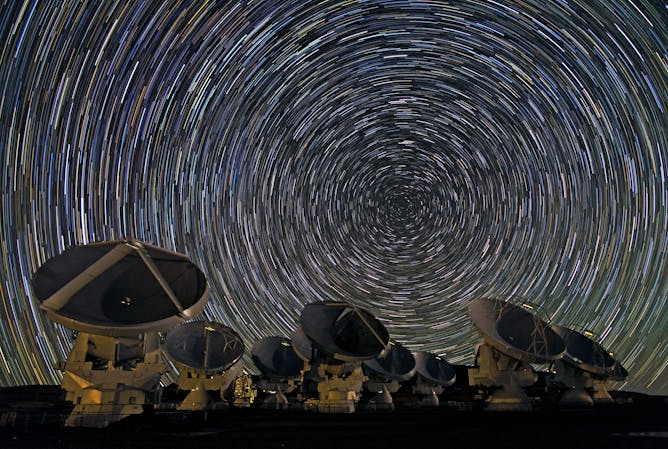
The Atacama Large Millimeter/submillimeter Array is made up of 66 antennas, all pointed at the sky collecting data 24 hours a day.
In 2003, we reported that the then-future ALMA telescope would be a true game-changer by enabling us to directly image the gas within nascent galaxies. We would have to wait over a decade to begin while the telescope was built – so we had plenty of time to carefully identify the optimal targets and refine our observing strategies.
All the waiting and planning have now paid off. Arthur’s last Ph.D. student, Marcel Neeleman, just published our first results with ALMA and the data are spectacular. Here, in contrast to our previous work, we measure light from the gas in the galaxy itself, which reveals the size and shape of the star-forming regions. And what we saw was not what we expected.
Map of one galaxy’s emission from ionized carbon, taken with the ALMA telescope. These data reveal and resolve the star-forming regions within young, forming galaxies.
Neeleman et al doi: 10.1126/science.aal1737, CC BY-ND
ALMA collects light at wavelengths not visible to the human eye. We focused on two sources in our target galaxies: ionized carbon and warm dust, both of which surround the birthplace of new stars. We were able to create maps based on the light emitted by ionized carbon within a galaxy that we first detected in absorption, via our old technique.
Remarkably, the dense, star-forming gas of the galaxy is greatly offset from the hydrogen gas originally revealed by the quasar spectrum (by approximately 100,000 light years or 30 kiloparsecs). This distance shows that young galaxies are surrounded by a massive reservoir of un-ionized, neutral gas. We further suggest that the gas detected in absorption is likely to accrete back onto the galaxy and fuel future generations of stars.
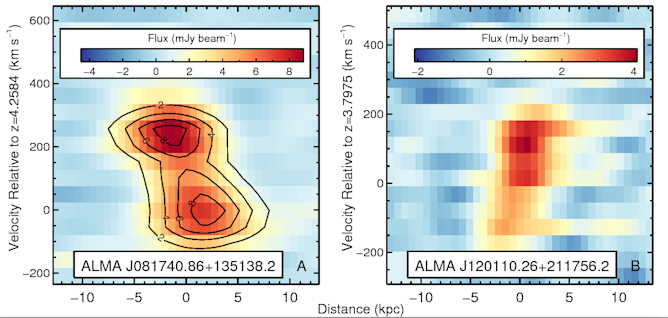
Spectral image of one galaxy’s light. Horizontal axis describes the size of the galaxy and the vertical axis describes the motion of the gas. Analysis of the image reveals the gas is rotating in a disk, like our own spiral galaxy.
Neeleman et al doi: 10.1126/science.aal1737, CC BY-ND
The ALMA data also uniquely resolve the internal motions of the galaxy’s gas. Our analysis of the dynamics indicates the gas is configured in a large disk – similar to our Milky Way – and rotating with a speed of approximately 120 km/s. This speed is characteristic of what theory predicts for the progenitors of this sort of galaxy.
Lastly, we detected emission from “warm” dust in the galaxy. (Of course, warm is relative – in this case only about 30 degrees Celsius above absolute zero.) We believe the dust is heated by young massive stars; we estimate that the galaxy is forming stars at a rate of over 100 suns per year, a prodigious and precocious rate.
These data demonstrate the power and potential of ALMA to discover and dissect the progenitors of galaxies like our own. They will be invaluable to refine our understanding – in space and time – of the build-up of galaxies.
Milky Way-like galaxies in the early universe.
While many of us in the community held some reservations about ALMA (given its great cost), it is now clear to me the payoff will be extraordinary. ALMA research has already paid off in the discovery of protoplanetary disks from which planets form and unlocked hidden secrets of the process of star formation. And ALMA will continue to greatly advance our understanding of how galaxies like the Milky Way form.
Celebrate with some amazing photos of the fluffy stuff. Claudia Hinz | International Cloud Atlas The iridescence is caused by diffraction of sunlight in all the tiny, uniform clouds. Clouds are a lot like Baskin-Robbins. They’re timeless, can be found all over America, and come in 31 flavors. And induce nostalgia. Yes, there are 31 species…