Donald A. Henderson, who headed the World Health Organization vaccination effort that wiped out smallpox in 1977 and later became a U.S. bioterrorism expert, has died from complications following a hip fracture, officials said on Sunday. He was 87.
The 1966-1977 smallpox program at first was given little chance of succeeding. It required the development of labs around the world to produce vaccines, a constant scramble for funding, arm-twisting of governments to join in, and halting outbreaks as soon as they emerged by focusing on vaccinating people who came in contact with those infected, Henderson told the WHO.
"The most important legacy of smallpox eradication was its demonstration of how many people could be protected through vaccination, so rapidly and inexpensively with a well planned program and quality-control monitoring," the man known as "D.A.," said in an interview published by the World Health Organization a few years ago.
Smallpox is a highly infectious virus that kills 30 percent of its victims and scars the rest for life.
In 1972, he flew to Belgrade in the former Yugoslavia to help stamp out the last smallpox outbreak in Europe, the WHO said.
After the campaign to wipe out the disease, Henderson became dean of the Johns Hopkins University Bloomberg School of Public Health from 1977 to 1990, expanding the school's reach and making it a national leader in addressing HIV/AIDS, said Michael Klag, dean of the school.
"D.A. was a force of nature who, until relatively recently, seemed invulnerable. Public health has lost a hero," Klag wrote adding, smallpox is the only human disease ever to have been eradicated.
In 2001, Henderson was named by then U.S. President George W. Bush to head a newly formed Office of Public Health Preparedness, set up to coordinate the national response to public health emergencies, including a spate of anthrax attacks that took place at the end of that year.
In 2002, he received the nation's highest civilian honor when he was awarded the Presidential Medal of Freedom.
Henderson died on Friday at a Baltimore-area hospice, officials said.
(Reporting by Jon Herskovitz; Editing by Sandra Maler)
Speculating about what aliens look like has kept children, film producers and scientists amused for decades. If they exist, will extra terrestrials turn out to look similar to us, or might they take a form beyond our wildest imaginings? The answer to this question really depends on how we think evolution works at the deepest level.
Hollywood has given us its fair share of humanoid aliens over the years. Initially this was through necessity, as special effects required someone to clamber into a rubber suit. Ironically, now that CGI makes anything possible, aliens sometimes look even more human in order to help the cinema goer make an emotional connection with them – such as in James Cameron’s Avatar.
At present, the only life forms we can study are here on Earth. These had a single origin around 3.5 billion years ago, but this common ancestor gave rise to perhaps 20m living species of animals alone. These have bodies organised according to about 30 different body plans in major groups called phyla.
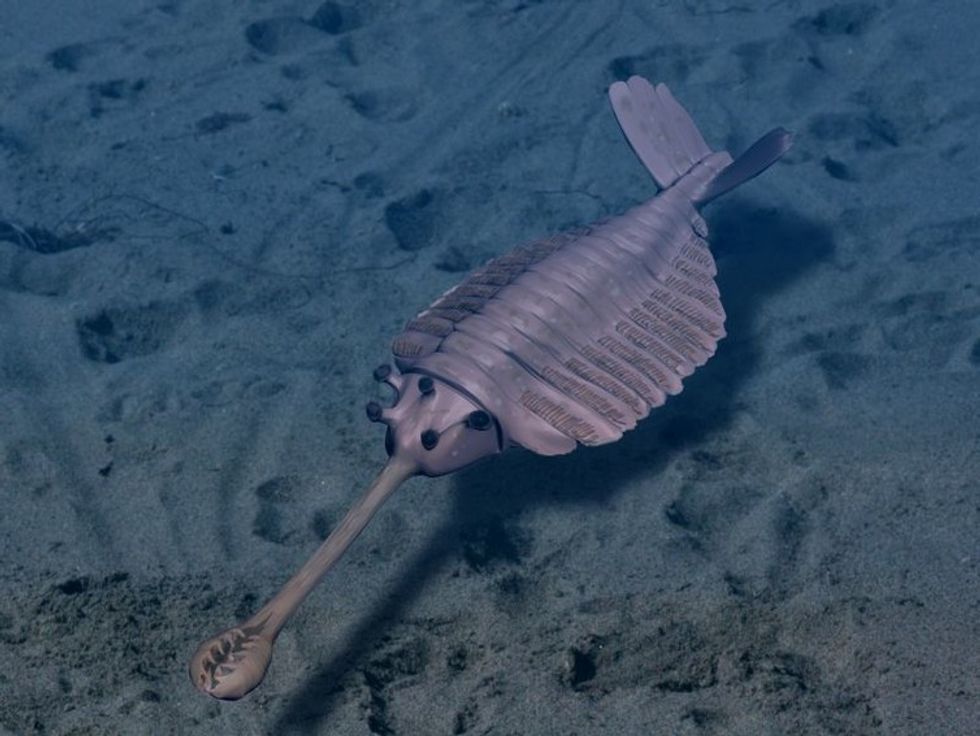
The five-eyed fossil Opabinia could have given rise to five-eyed animals today.
But when animals first diversified some 542m or more years ago in the Cambrian “explosion”, there may have been an even greater diversity of fundamental body plans. Consider the five-eyed and trunked Opabina in the image above, or the stalked and almost flower-like Dinomischus alongside our own distant relative, the chordate Pikaia.
Rerunning the tape of life
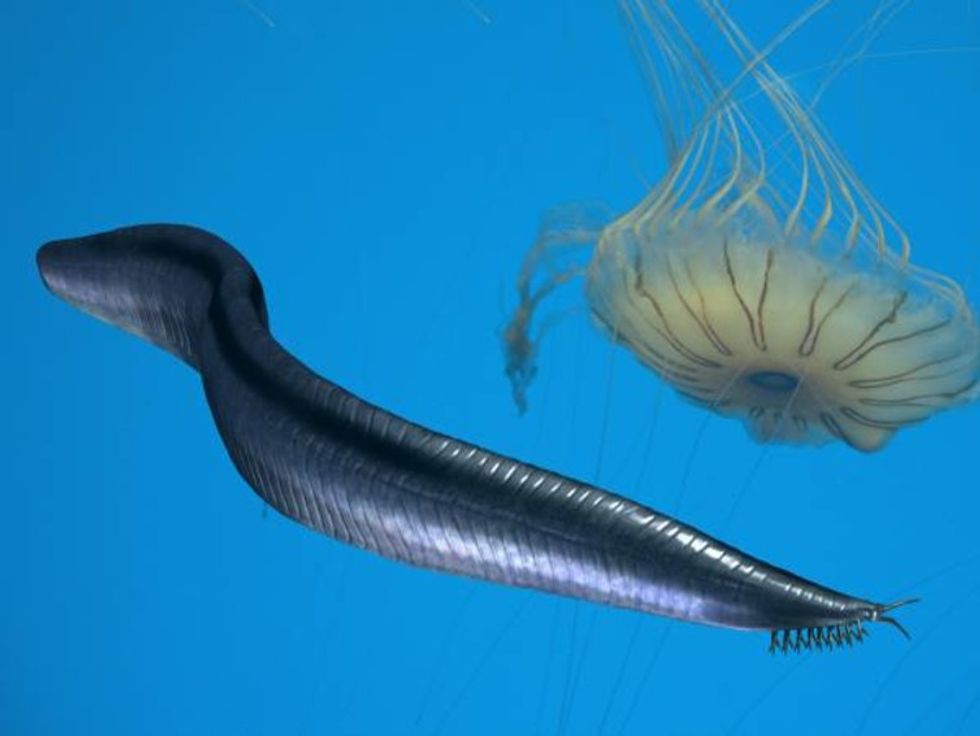
In a famous thought experiment, biologist Stephen Jay Gould asked what might happen if we were to rewind the “tape of life” and rerun it. Gould argued for the importance of chance in evolution: change one small thing early on, and the consequences magnify through time. In the version of history we know, Pikaia (imaged below) or something very like it survived and ultimately gave rise to fishes, amphibians, reptiles, mammals and ultimately ourselves. But what if it had perished? Might some other group have given rise to intelligent beings, and might you now be reading this with five eyes rather than the customary two? If our own origins on Earth really turned on such fine hinges, why should aliens – evolving on different planets – even remotely resemble us?
Pikaia – an early chordate, the group to which humans belong.
The answer, according to evolutionary biologist Simon Conway Morris, lies in the phenomenon of evolutionary convergence: the process by which distantly related animals come to closely resemble each other. For example, the similar streamlined shape of dolphins, tuna fish and the extinct ichthyosaurs all evolved independently in response to the same selective pressures for moving efficiently through water at speed.
But what aspects of alien biology might we expect? Carbon-based biochemistry is likely given that carbon forms stable backbone chains, and makes stable but readily breakable bonds with other elements. Other elements, notably silicon and sulphur, make less stable bonds at Earth-like temperatures. Water or some other solvent also seems necessary. For evolution to occur there needs to be some mechanism for storing and replicating information with moderate fidelity, such as DNA, RNA or some analogue. Although the first cells appeared on Earth quite early, multicellular animals took nearly 3 billion more years to evolve. So it may well be that life on other planets could get stuck at the single-celled stage.
On an Earth-like planet it is also likely that radiation from the alien sun or suns would be used in biochemical pathways as a source of energy. For moderately large multicellular primary producers, harnessing light efficiently probably necessitates a light gathering system of leaves and branches. Similar shapes and habits have evolved convergently on Earth, so we might expect “plants” with broadly familiar forms on Earth-like planets.
With few exceptions, animals either eat the primary producers or each other, and there are only so many ways of doing this. Pursuing food often necessitates moving with the mouth first, so the animal has a head and tail end. Teeth and probably jaws evolve to hold and tackle food items. Moving against a hard surface requires specialised structures (such as cilia, a muscular foot or legs) at the interface, so that there is a back and front side. Typically, this also imparts bilateral (left/right) symmetry: indeed, most animals belong to a “super-group” called the Bilateria.
Why not giant intelligent “insects”?
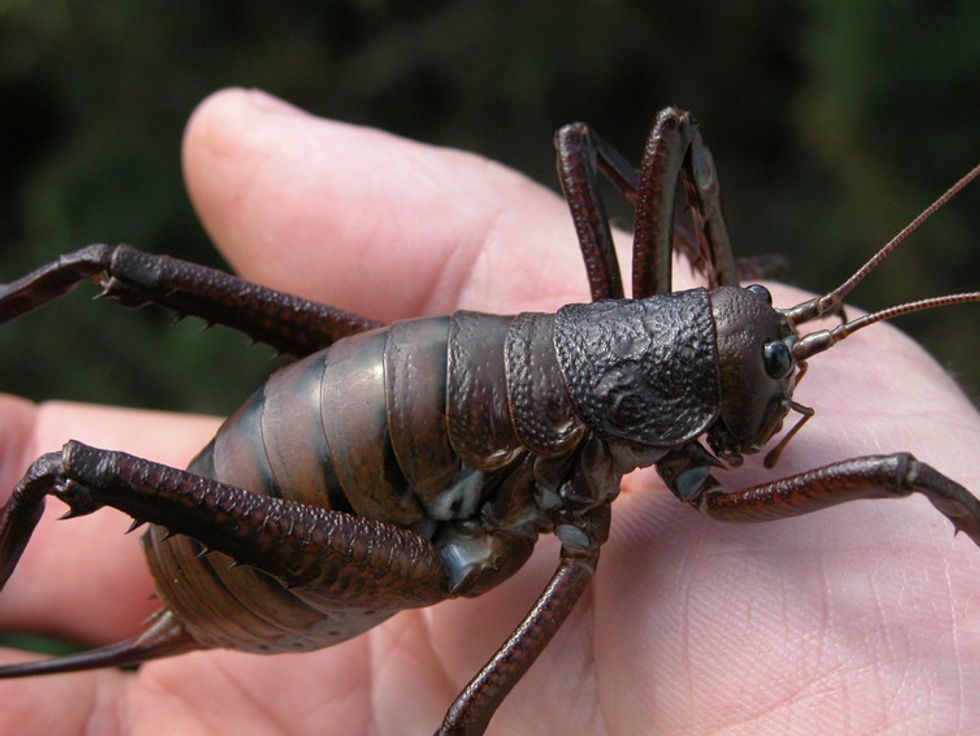
But what about the large brained and intelligent creatures that might be capable of crossing interstellar distances? Insects are by far the most species rich group on Earth: why shouldn’t aliens look more like them? Unfortunately, having your skeleton on the outside makes growth difficult, and entails periodic shedding and regrowth. On Earth-like planets, all but relatively small terrestrial animals with external skeletons would collapse under their own weight during moulting, and some critical size may be necessary for suitably complex brains.
Relatively large brains, some degree of tool use and problem-solving abilities appear to be correlated on Earth, and have evolved multiple times: in apes, whales, dolphins, dogs, parrots, crows and octopuses. However, the apes have developed tool use to a vastly greater degree. This is at least partly the result of walking on two legs, which frees up the front limbs, and because of the dexterity of our fingers (which may also be a key to the origins of written language).
Ultimately, the jury is out on the extent to which intelligent aliens – if they exist – would resemble us. It may or may not be significant that humans have just two eyes and ears (just enough for stereo vision and hearing), and just two legs (reduced from the initially more stable four). Many other organs also come in pairs as a consequence of our evolutionarily deep-seated – and perhaps inevitable – bilateral symmetry. Still other elements of our body plan are probably nothing more than chance. The fact that we have hands and feet with five digits is a consequence of the fixation on five in our early tetrapod ancestors – close relatives experimented with seven or eight.
Indeed, most species have been subject to an accidental “locking down” during development – making body plans become stereotyped and inflexible with evolutionary time. Untangling the functional from the accidental is one of the big outstanding challenges in evolutionary biology – and may help us better understand how alien lifeforms could differ from us.
The main way we now search for intelligent life in space is by listening for radio or gamma transmissions. These efforts are increasingly being concentrated on star systems with Earth-like planets, as these are believed to be the most likely to harbour life. After all, it is easier to search for “life as we know it” than life as we don’t.
The 5,300-year-old Alpine mummy known as the Tyrolean Iceman died wearing leather clothes and accessories harvested from no less than five wild or domesticated species, a DNA analysis published Thursday revealed.
Frozen solid after being fatally wounded by an arrow in the back, the brown-eyed, Copper Age nomad, nicknamed "Otzi", was discovered in 1991 in the Otztal Alps between Italy and Austria.
Details about his ancestry, what he snacked on, and his sundry diseases and ailments have all been dissected with scientific precision over the last two decades, but no one had taken a close look at the origin or his attire. Until now.
A team led by Niall O'Sullivan, a researcher at the Institute for Mummies and the Iceman in Italy (and University College Dublin), put nine samples from Otzi's leather accoutrements under the microscope to determine their origin.
These included a fur hat, an archery quiver, a composite leather coat, a loin-cloth, grass-lined shoes, and tight-fighting leggings.
What they found, to their surprise, was a medley of fauna, both domesticated and wild.
The fur from the hat came from the ferocious brown bear, a species that can easily top 300 kilos (660 pounds).
Otzi, who was about 45 when mortally wounded, would have to have been an ace shot to take one down with his slender arrows.
The quiver sheathing those arrows came from another wild species -- a roe deer, while his jacket was stitched together from domesticated goats and sheep.
"The coat alone was a combination of at least four hides and two species," the study concluded.
But the piece de resistence of the Iceman's wardrobe was the glove-like leggings, made of the same kind of goat's skin favoured by haute couture houses in Paris.
He may even have started a trend: similar leather was used to make 4,500-year-old leggings found in Schnidejoch, Switzerland, the researchers point out.
Conclusion? Our pre-historic fashionista "made considered choices when manufacturing clothes, and used everything that was available to him," O'Sullivan told AFP.
The findings, published in the peer-reviewed journal Scientific Reports, were made by sequencing mitochondrial genomes from each of the leather samples.
Unlike nuclear DNA, which is transferred to offspring by the mother and father combined, mitochondrial DNA is inherited from the mother alone.
Speculating about what aliens look like has kept children, film producers and scientists amused for decades. If they exist, will extra terrestrials turn out to look similar to us, or might they take a form beyond our wildest imaginings? The answer to this question really depends on how we think evolution works at the deepest level.
Hollywood has given us its fair share of humanoid aliens over the years. Initially this was through necessity, as special effects required someone to clamber into a rubber suit. Ironically, now that CGI makes anything possible, aliens sometimes look even more human in order to help the cinema goer make an emotional connection with them – such as in James Cameron’s Avatar.
At present, the only life forms we can study are here on Earth. These had a single origin around 3.5 billion years ago, but this common ancestor gave rise to perhaps 20m living species of animals alone. These have bodies organised according to about 30 different body plans in major groups called phyla.
The five-eyed fossil Opabinia could have given rise to five-eyed animals today.
But when animals first diversified some 542m or more years ago in the Cambrian “explosion”, there may have been an even greater diversity of fundamental body plans. Consider the five-eyed and trunked Opabina in the image above, or the stalked and almost flower-like Dinomischus alongside our own distant relative, the chordate Pikaia.
Rerunning the tape of life
In a famous thought experiment, biologist Stephen Jay Gould asked what might happen if we were to rewind the “tape of life” and rerun it. Gould argued for the importance of chance in evolution: change one small thing early on, and the consequences magnify through time. In the version of history we know, Pikaia (imaged below) or something very like it survived and ultimately gave rise to fishes, amphibians, reptiles, mammals and ultimately ourselves. But what if it had perished? Might some other group have given rise to intelligent beings, and might you now be reading this with five eyes rather than the customary two? If our own origins on Earth really turned on such fine hinges, why should aliens – evolving on different planets – even remotely resemble us?
Pikaia – an early chordate, the group to which humans belong.
The answer, according to evolutionary biologist Simon Conway Morris, lies in the phenomenon of evolutionary convergence: the process by which distantly related animals come to closely resemble each other. For example, the similar streamlined shape of dolphins, tuna fish and the extinct ichthyosaurs all evolved independently in response to the same selective pressures for moving efficiently through water at speed.
But what aspects of alien biology might we expect? Carbon-based biochemistry is likely given that carbon forms stable backbone chains, and makes stable but readily breakable bonds with other elements. Other elements, notably silicon and sulphur, make less stable bonds at Earth-like temperatures. Water or some other solvent also seems necessary. For evolution to occur there needs to be some mechanism for storing and replicating information with moderate fidelity, such as DNA, RNA or some analogue. Although the first cells appeared on Earth quite early, multicellular animals took nearly 3 billion more years to evolve. So it may well be that life on other planets could get stuck at the single-celled stage.
On an Earth-like planet it is also likely that radiation from the alien sun or suns would be used in biochemical pathways as a source of energy. For moderately large multicellular primary producers, harnessing light efficiently probably necessitates a light gathering system of leaves and branches. Similar shapes and habits have evolved convergently on Earth, so we might expect “plants” with broadly familiar forms on Earth-like planets.
With few exceptions, animals either eat the primary producers or each other, and there are only so many ways of doing this. Pursuing food often necessitates moving with the mouth first, so the animal has a head and tail end. Teeth and probably jaws evolve to hold and tackle food items. Moving against a hard surface requires specialised structures (such as cilia, a muscular foot or legs) at the interface, so that there is a back and front side. Typically, this also imparts bilateral (left/right) symmetry: indeed, most animals belong to a “super-group” called the Bilateria.
Why not giant intelligent “insects”?
But what about the large brained and intelligent creatures that might be capable of crossing interstellar distances? Insects are by far the most species rich group on Earth: why shouldn’t aliens look more like them? Unfortunately, having your skeleton on the outside makes growth difficult, and entails periodic shedding and regrowth. On Earth-like planets, all but relatively small terrestrial animals with external skeletons would collapse under their own weight during moulting, and some critical size may be necessary for suitably complex brains.
Relatively large brains, some degree of tool use and problem-solving abilities appear to be correlated on Earth, and have evolved multiple times: in apes, whales, dolphins, dogs, parrots, crows and octopuses. However, the apes have developed tool use to a vastly greater degree. This is at least partly the result of walking on two legs, which frees up the front limbs, and because of the dexterity of our fingers (which may also be a key to the origins of written language).
Ultimately, the jury is out on the extent to which intelligent aliens – if they exist – would resemble us. It may or may not be significant that humans have just two eyes and ears (just enough for stereo vision and hearing), and just two legs (reduced from the initially more stable four). Many other organs also come in pairs as a consequence of our evolutionarily deep-seated – and perhaps inevitable – bilateral symmetry. Still other elements of our body plan are probably nothing more than chance. The fact that we have hands and feet with five digits is a consequence of the fixation on five in our early tetrapod ancestors – close relatives experimented with seven or eight.
Indeed, most species have been subject to an accidental “locking down” during development – making body plans become stereotyped and inflexible with evolutionary time. Untangling the functional from the accidental is one of the big outstanding challenges in evolutionary biology – and may help us better understand how alien lifeforms could differ from us.
The main way we now search for intelligent life in space is by listening for radio or gamma transmissions. These efforts are increasingly being concentrated on star systems with Earth-like planets, as these are believed to be the most likely to harbour life. After all, it is easier to search for “life as we know it” than life as we don’t.
Two NASA astronauts left the International Space Station on Friday for a 6-1/2-hour spacewalk to install a parking spot for upcoming commercial space taxis, which will end U.S. reliance on Russia for rides to the orbiting outpost.
Station commander Jeff Williams and flight engineer Kate Rubins floated outside the station's airlock at about 8:15 a.m. EDT (1215 GMT) and headed toward the berthing slip once used by NASA's now-retired space shuttles, a NASA TV broadcast showed.
"Great view," said Rubins, who is making her first spacewalk.
Since grounding the shuttle fleet in 2011, the United States has been dependent on Russia to ferry astronauts to and from the space station, at a cost of more than $70 million per person.
During Friday's spacewalk, Williams and Rubins plan to attach an adapter onto the shuttle's docking port that will allow commercial space taxis under development by Space Exploration Technologies and Boeing to park at the station, a $100 billion research laboratory that flies about 250 miles (400 km) above Earth.
California-based SpaceX, owned and operated by technology entrepreneur Elon Musk, plans to begin test flights of its new passenger Dragon capsule to the station in 2017.
Boeing's debut flight of its CST-100 Starliner capsule is expected in 2018.
NASA had hoped to have the first of two new docking ports installed last year, but the equipment was destroyed during a SpaceX cargo ship launch accident in June 2015.
A replacement docking port is under construction and expected to be delivered to the station in early 2018.
(Reporting by Irene Klotz in Cairns, Australia; Editing by Colleen Jenkins and Paul Simao)
Pauline Hanson’s concern about the Australian Tax Office installing squat toilets to cater for its increasingly diverse workforce has prompted debate about the best way to go to the toilet: sitting or squatting.
While nobody is claiming you climb up and plant your feet on a regular toilet seat, there is some evidence to suggest squatting makes it easier to empty your bowels.
The flush toilet was first invented in the late 16th century by Sir John Harington. But it was only during the 19th century that seated toilets became available for mass use. Most of the Western world still sits to defaecate, while squatting is favoured in the developing world.
The process of passing bowel motions or defaecation is a lot more complicated than you might imagine. First, the rectum contracts as it fills up with stools. This causes the smooth muscle of the anal canal to relax.
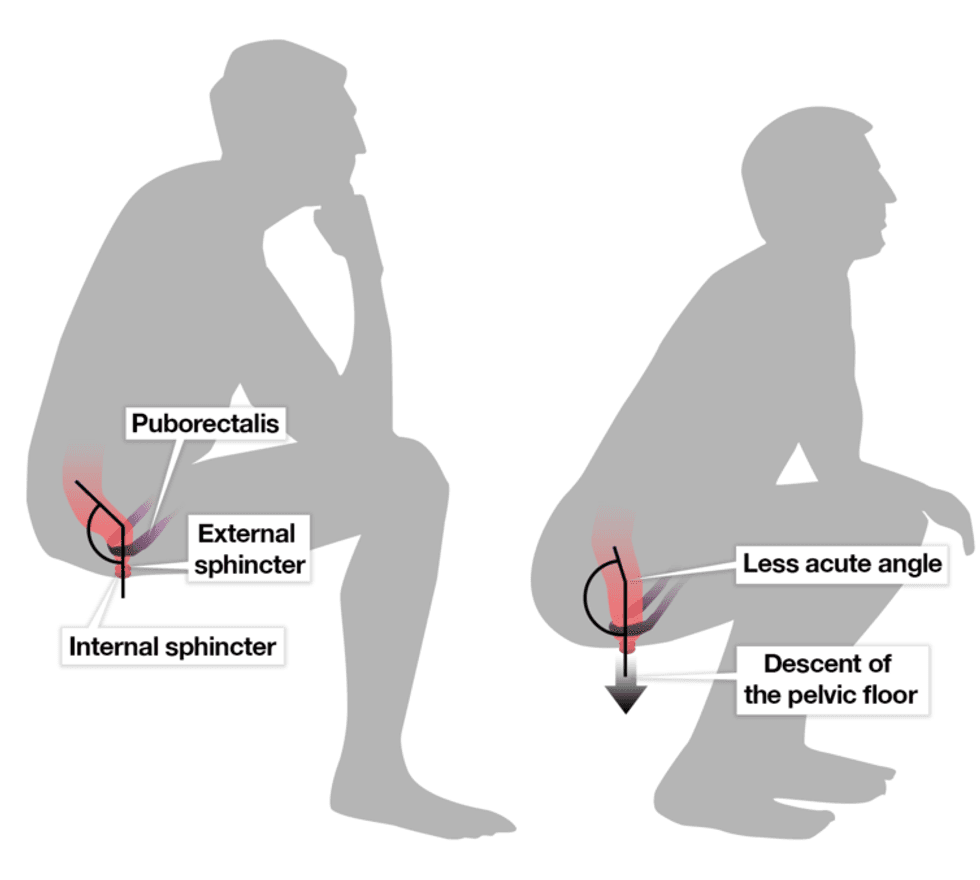
The puborectalis muscle, which loops around the rectum like a sling, normally pulls the rectum forward to create a tight angle (known as the anorectal angle). During defaecation, the puborectalis muscle will relax and the anorectal angle will widen.
Squatting widens the anorectal angle even more to allow a clearer and straighter passage for stools to pass through the anal canal.
Experiments have been carried out on the differences between squatting and sitting. Israeli researcher Dov Sikirov studied 28 healthy volunteers who were asked to record how long their bowel motions took and how difficult their efforts were.
The volunteers sat on toilets of different heights (42cm and 32cm high) and also squatted over a plastic container. They recorded data for six consecutive bowel motions in each posture.
The average time for passing a bowel motion during squatting was 51 seconds, compared to the average times for the lower and higher toilet seats: 114 and 130 seconds respectively. Participants found defaecation easier while squatting than when seated.
A Japanese study looked at six volunteers who had their rectums filled with contrast solution and were asked to release the fluid from a sitting and squatting position. They were filmed with live radiography from behind a screen.
The researchers found the anorectal angle had greater widening in the squatting position. Participants also had less abdominal straining while squatting.
People who strain excessively are more prone to developing tears of the anal lining, known as a fissure. One study in Pakistan looked at participants who had chronic anal fissures with symptoms such as painful defecation, passage of blood from the rectum and difficulty sitting.
Participants adopted a squatting posture on a modified toilet seat (with their hips flexed and feet resting on an elevated stool) to help mimic a squatting position. They were found to have significantly reduced symptoms compared to the sitting position.
Although squatting may be helpful for people with chronic constipation, it’s no panacea. Other factors, such as diet, exercise, medications and fluid intake, can affect the frequency and consistency of bowel motions.
The benefits of squatting – and harms of sitting – are at times overstated. There’s no firm evidence to suggest, for instance, that squatting can prevent or cure haemorrhoids.
And although it’s an intriguing concept, there is no firm data that the sitting position causes colonic diverticulosis (pouches in the wall of the colon).
Nor is there evidence to suggest that the sitting position leads to a greater risk of developing colon cancer.
Squatting to go to the toilet isn’t free from risks. It has been shown to induce a small rise in blood pressure in both healthy and hypertensive patients.
Some strokes have been found to occur during squatting and defaecation. But whether the squatting posture during defaecation puts patients at a significantly greater risk of heart disease or stroke remains debatable.
While it’s difficult to draw definitive conclusions given the lack of long term-studies, squatting has clear benefits. If you have a regular toilet and would like to obtain some of the benefits of squatting, you can use a modified toilet seat and foot stool, which allows you to flex your hips and elevate your feet.
Lola Gayle, STEAM Register High-fructose corn syrup and sugar have gotten a pretty bad rap in recent years, and for good reason. For starters, these sweeteners can do a number on your liver, and they have been linked to obesity, heart disease and diabetes. What's more, they can even interfere with our metabolism and fool our…
Evidence of ancient surgery found in Siberia is causing feverish speculation about the nature of Bronze Age painkillers.
This article was originally published by The Influence, a news site that covers the full spectrum of human relationships with drugs. Follow The Influence on Facebook or Twitter.
A 3,000-year-old skull—found in the “Nefteprovod 2” burial ground at the Anzhevsky archeological site near the city of Kansk in Siberia’s Krasnoyarsk region—shows markings that indicate some form of brain surgery. The individual was aged between 30 and 40, a fairly decent age by Bronze Age standards, when he died.
What makes the skull remarkable is that though the man probably died from eventual complications of surgery, he did live long enough afterwards for the bone to start healing and for skin to cover the hole.
“The key to successful surgery was the patient’s complete trust and confidence,” deadpans Dr. Sergey Slepchenko, a researcher at the Institute of Archeology and Ethnography in Novosibirsk.
Given the absence from Siberia of certain plants known to have been used by other ancient cultures as painkillers, researchers speculate about some other candidates to achieve the “altered” state of mind necessary for such surgery. These include juniper and thyme, wild rosemary sticks, hallucinogenic fly agaric mushrooms, and cannabis—a plant that may have played a key role in the birth of Eurasian civilization.
Based on known shamanistic practices, they also speculate that “ecstatic dancing” may have been involved.
The problems around modern pharmaceutical drugs are well known, but we’ll take ’em over the ancient alternatives any time.
This article was originally published by The Influence, a news site that covers the full spectrum of human relationships with drugs. Follow The Influence on Facebook or Twitter.
Over the past several years, the sports media have presented several stories of youth athletes who have become addicted to prescription painkillers and eventually turned to heroin. If fact, one of these reports in Sports Illustrated was ominously titled “How painkillers are turning young athletes into heroin addicts."
The narratives in these reports typically revolved around a young male athlete who sustained an injury, was prescribed painkillers to manage pain after surgery and eventually developed a dependence on these medications. This dependence then subsequently escalated into a heroin addiction, as heroin is a cheaper and more available alternative to prescription painkillers.
These stories resonate among many Americans, given the attention on both the rise of prescription painkiller misuse and the uptick in heroin overdoses over the past several years.
While these trends suggest some dangerous overlap between prescription painkiller and heroin use, very little research has been done to see if this is an emerging pattern among youth athletes in the United States. In particular, young athletes who play one sport are at greater risk for injuries that may require some form of opioid pain management.
As someone who studies how youth sport influences the healthy development of children and adolescents, I wanted to see if these news reports were capturing an unintended consequence of sport participation that could have tragic consequences for a substantial number of youth in the U.S. population.
A closer look suggests a minor increase
I began researching the association between adolescent sport participation and nonmedical use of prescription opioids (i.e., using prescription painkillers without a doctor’s orders) among high school students in 2013.
Using both national and regional data, I found several modest patterns that suggested young athletes involved in high-contact sports, like football and wrestling, were more likely to misuse prescription painkillers.
These findings made sense to me given that these high-contact sports, particularly for males, have some of the highest injury rates at the interscholastic level. Injuries are bound to happen, and these athletes may be self-medicating to recover from injuries in order to get back on the playing field as soon as possible.
As someone who used to be involved in both wrestling and football as a youth, I understood the anxiety and fear of losing my spot on the team. Unfortunately, substance use became a normative feature to help cope with both the injuries and the intense anxiety associated with my involvement in these activities.
Of course, this problem was not unique to me. Many young athletes feel this way and sometimes use illicit drugs to cope with injuries associated with their involvement in sport.
But is prescription painkiller use and heroin use on the rise among young athletes?
Trends in prescription painkiller and heroin use
In order to determine if youth athletes were at greater risk of misusing prescription pain killers and heroin, in 2016 I drew upon a secondary data source, Monitoring the Future, to examine trends among eighth and tenth graders between 1997 and 2014. This was a period in the U.S. that experienced an increase in both the prescribing and misuse of prescription pain killers.
The analyses revealed that athletes either highly or moderately involved in sports and exercise had the lowest prevalence of lifetime and past-year nonmedical use of prescription pain killers and heroin use when compared to their peers who were not involved in these activities.
Roughly 8.8 percent of highly involved athletes indicated nonmedically using prescription pain killers in 1997, while only 4.4 percent of highly involved athletes indicated nonmedically using prescription pain killers in 2014. Similar declines were also found with respect to heroin use among highly involved athletes (i.e., 1.8 percent in 1997 and 0.8 percent in 2014).
In fact, the percentage of youngsters who are not athletes engaging in nonmedical use of prescription opioids was 13.9 percent in 1997 – higher than their athlete counterparts. This decreased to 6.2 percent in 2014. Further, 4.4 percent of nonathletes used heroin in 1997. This, too, decreased in 2014, to 1.6 percent.
Interestingly, the analysis also found that among lifetime heroin users in the sample, athletes were not more likely to have initiated nonmedical use of opioids prior to using heroin when compared to their peers who did not participate in sport or exercise. In other words, the unfortunate pattern of prescription painkiller misuse to heroin use was not something that was more likely to occur among athletes either moderately or highly involved in sports.
Should we continue to worry about misuse?
While this study suggests the population of young athletes, as a whole, are at a lower risk to engage in painkiller or heroin use, other patterns in the Monitoring the Future study may suggest a cause for concern with specific sports.
Preliminary studies assessing the associations with painkiller and heroin use across different types of youth sports based on level of contact show that certain high-contact sports like football, ice hockey, lacrosse and wrestling are modestly associated with these types of drug use, with much higher rates among these athletes in these sports when compared to nonathletes.
Interestingly, this modest association has only begun to appear after 2012. This change may have occurred due to changes in the availability of certain drugs, but it is hard to say for certain.
Taking these results as a whole, the data suggest that coaches, parents and physicians need to monitor young athletes' use of prescription painkillers. In particular, students who play sports with higher injury rates and are motivated to hide pain are those most at risk.
The Smithsonian isn't merely a museum, it also serves as a research institute. Boxes and boxes of remains, archives of artwork and libraries of rare books are stacked in warehouses and line shelves in the research centers. The teams of scientists and other experts comb their way through the inventory of history, cataloguing as they go.
This is inevitably how a new species of dolphin was discovered. According to the Washington Post, Alexandra Boersma and Nicholas D. Pyenson were making their way through dusty old boxes when they discovered a 25 million-year-old river dolphin.
"There's all this stuff that no one has ever had time to go through," Boersma explained. "Some of it has been sitting there for decades. No one has gotten around to describing it."
The two named the species Arktocara yakataga. "The name Arktocara derives from the combination of arktos from Greek and cara from Latin, which together signify 'the face of the North,' reads their published findings in PeerJ. Boersma told the Post that the creature has a "beautiful, cute little skull."
There are currently only three or four species of river dolphin, one of which might be extinct already. Three of the species are close relatives of each other. While, the fourth has always remained largely different. But the new discovery of Arktocara yakataga shows remarkably similar characteristics of the South Asian river dolphin Platanist, the lone species that is not like the others. They remain the two species that are the most like ocean based dolphins. These river species are more likely to swim on their sides and use sound waves to "see" through dark, muddy waters in rivers. The new species is the oldest known member of the Platanistoidea family and existed around the time whales were beginning to split into the ancestral groups that led to what we see today. That helps scientists prove that Platanista is an ancient lineage.
Due to pollution, fishing nets and development, the rivers where the Platanista live in Nepal, India, Bangladesh and Pakistan are becoming hostile homes. As a result, the Platanista is endangered.
The remains were discovered in 1951 by United States Geological Survey (USGS) geologist Donald J. Miller. The dolphin was found while he was mapping what was then the Yakataga District of Alaska, according to the study.
"It was striking and really kind of bizarre that this huge group of marine dolphins that were up in the arctic and all over the world has dwindled to this one species that’s stuck in freshwater systems in Asia," said Boersma.
Some whales live in the arctic today and are thought to be descended from whales that lived during the time the time Arktocara yakataga was around.
"It would be interesting to know what whales started out in the arctic," Boersma told the Post. "It would give us a better sense of how whales first adapted to those new climates, and maybe give us a sense of how well they might adapt in the future, now that climate is changing so rapidly."
It turns out, no actual scientist (even the lone dissenter) agreed that “the government, the military, airlines and others are colluding in a widespread, nefarious program to poison the planet from the skies,” according to the study.
Chemtrails just ain’t a thing.
Despite absolutely no evidence supporting the conspiracies, a 2011 international survey found that nearly 17 percent of respondents believe or partly believe in chemtrails.
So why do so many of us believe?
“The chemtrails conspiracy theory maps pretty closely to the origin and growth of the internet,” said study co-author Steven Davis.
And, hey, is it really that much of a stretch that so many people think the feds are administering anthrax vaccines through the clouds? A U.S. presidential candidate tells us Obama founded ISIS and Chinamanufactured global warming, after all.
The reign of record hot months in 2016 continues, with last month claiming the title of hottest July on record globally, according to data released by NASA on Monday. This July was also the hottest month on record for the world.
The streak means that 2016 is still well on its way to upsetting last year as the hottest year on record. Or as Gavin Schmidt, director of NASA’s Goddard Institute of Space Studies, said on Twitter, there is still a 99 percent chance 2016 will take the top slot.
How temperatures across the globe differed from average in July 2016. (Credit: NASA)
Every month so far this year has been record hot. In NASA’s data, that streak goes back to October 2015, which was the first month in its data set that was more than 1˚C hotter than average.
In NOAA’s records, the streak of hottest months goes back to May 2015. If July is record warm in its data (which will be released Wednesday, July will be the 15th record-warm month in a row.
By NASA’s reckoning, July 2016 was 1.27˚F (0.84˚C) hotter than the 1951-1980 average. It was 0.2˚F (0.11˚C) above July 2015, the next warmest July in records that go back to 1880. The record July heat also means this was the hottest month the planet has seen over the course of NASA's records. That's because July is also generally the hottest month of the year due the fact that it's summer in the northern hemisphere where there's more land.
While El Niño provided a boost to global temperatures this year, the bulk of the heat is what has been trapped by accumulating greenhouse gases in the atmosphere.
Nations have agreed to keep the rise of global temperatures below 2˚C (3.6˚F) by the end of this century, and are discussing aiming for an even more ambitious 1.5˚C (2.7˚F). But temperatures for the year-to-date have been hovering close to 1.5˚C above preindustrial times all year.
If 2016 does end up the hottest year on record, it will be the third such year in a row. But just as the streak of record-hot months will come to an end, so too may the streak of record-hot years. Forecasters expect a La Niña to form, which tends to mean a relative cooling of global temperatures.
These are only small blips on the overall long-term trend of warming, which tips the odds toward record heat and away from record cold. Of the 15 hottest years on record, 14 have occurred in the 21st century, but the last record-cold year was in 1911.
NASA is weighing a Moscow proposal to cut the number of Russian cosmonauts at the International Space Station from three to two, particularly its potential risk to the crew, an official said Monday.
Typically, six crew members live at the orbiting outpost, a hallmark of global cooperation that is meant to stay in operation until at least 2024.
Asked during a news conference about media reports that Russia was considering reducing its staff there to two, NASA's Kenneth Todd said the ISS partners -- which include Canada, Japan and the European Space Agency -- are aware of the proposal.
"They are exploring the option of going down to two crew on the Russian segment," said Todd, International Space Station Operations Integration manager.
"They have made that known to the partnership."
Russian media reports have quoted a Roscosmos official as saying the proposal comes as Russia is sending fewer cargo ships to the ISS, and could be a cost-cutting measure.
Meanwhile, the United States is ramping up its supply missions to the orbiting lab, with US astronauts preparing a spacewalk Friday to install a commercial docking adaptor at the ISS so that more private spaceships can park at the research lab in the years to come.
Todd said the ISS partners are aware that Russia has committed to the ISS program at least through 2024.
"There is no doubt they are keeping that in mind as they work through whatever challenges they have with their system," Todd said.
"We will look at it, as we do with all these kinds of things. We will trade it against whatever risk that might put into the program," he said.
"First and foremost, the risk to our crew on board and the station itself."
Next, Todd said the international partners will see "what we can do as a partnership to try to either accommodate it, or help them realize why that is a bad thing."
For now, he cautioned that "it is strictly a proposal they have put on the table and we will look at it."
The first section of the ISS station, called Zarya, or Dawn in Russian, was launched into space on November 20, 1998.
From two modules, the space station has grown to 15 modules, occupying a space the size of an American football field and representing around $100 billion in investment.
Since 2000, the station has been continuously occupied by a rotating staff of astronauts who typically stay for six months at a time before returning to Earth.