Its fangs are not what makes the newly identified Indonesian frog species Limnonectes larvaepartus unique on Earth. The way it makes babies does.
This little amphibian from the rain forests of Indonesia's island of Sulawesi is the only one of the world's 6,455 frog species to give direct birth to tadpoles, eschewing the common froggy practice of laying eggs, scientists said on Wednesday.
"Reproduction in most frogs could not be more different from human reproduction. In this case, what is most interesting, ironically, is that the reproductive mode is more similar to our own," said herpetologist Jimmy McGuire of the University of California, Berkeley, whose research appears in the scientific journal PLOS ONE.
This frog, usually gray or brown, measures about 1-1/2 inches long (40 mm), weighs less than two-tenths of an ounce (5 grams) and belongs to the Asian group of fanged frogs. Males possess two fang-like projections from the lower jaw that are used in fighting.
The frog lives along small streams and puddles in rainforest habitats, doing its best to avoid being eaten by larger fanged frog species as well as snakes and frog-munching birds.
Its mode of reproduction sets this frog apart.
"The vast, vast majority of frogs have external fertilization. For mating, the male grips the female around the waist and releases sperm as she releases her eggs," McGuire said.
Those eggs mature through stages including the aquatic tadpole larval phase, typically limbless with a tail that propels it through the water.
About a dozen frog species rely on internal fertilization, McGuire said. All but the newly identified one either deposit fertilized eggs or give birth to froglets, essentially miniature versions of an adult that already passed through a modified tadpole stage while still in an egg capsule inside the female.
The female Limnonectes larvaepartus (meaning "marsh swimmer that gives birth to larvae") instead gives birth to tadpoles.
"It's totally unclear why this mode of reproduction has not evolved more frequently," McGuire said.
"My favorite topic when it comes to frog evolution and diversification is the bewildering variation in reproductive modes that occur. Frogs exhibit all sorts of interesting twists."
There have been frogs that swallowed their eggs and brooded them in the stomach, a species in which the male broods the eggs in his vocal sac, and many species that carry eggs and tadpoles in pouches on their backs and sides, he said.
(Reporting by Will Dunham; Editing by Mohammad Zargham)
(Reuters) - The U.S. Centers for Disease Control and Prevention plans to hire a chief of laboratory safety, a new post that has taken on more urgency after a CDC scientist was possibly exposed to Ebola in a laboratory last week.
Creating a new high-level safety position was a key recommendation of a months-long internal investigation into the mishandling of anthrax and bird flu in CDC labs this past summer, according to an internal CDC memo obtained by Reuters.
Those incidents called into question safety practices at more than 1,000 laboratory and support facilities across the CDC's sprawling network of scientists.
CDC spokeswoman Barbara Reynolds confirmed that a search for an agencywide chief of laboratory science and safety was under way. The search, which has not been previously reported, is being led by Dr. Rima Khabbaz, director of CDC's Office of Infectious Diseases.
"The person selected will be empowered to identify problems, establish plans to solve them, and hold programs throughout CDC accountable for follow-up," Reynolds said in an email.
Private laboratories that work closely with the CDC welcomed the move.
"This is going to bring a focus to lab science and safety that has been really needed for two decades," said Scott Becker, executive director of the Association of Public Health Laboratories, a national group representing state and municipal public health laboratories.
Filling the new position, though, may seem too little, too late for at least one lab worker, who last week may have been exposed to live Ebola while working in a CDC laboratory in Atlanta.
The unidentified scientist, who was working with Ebola specimens that were supposed to have been inactivated, wore gloves and a gown but not a protective face mask or other gear recommended for working with live Ebola, the CDC said. The staffer is being monitored for signs of infection for 21 days, the disease's incubation period.
The CDC said on Tuesday the scientist was not showing symptoms and had a "low, but not zero, risk" of contracting Ebola, which has killed nearly 8,000 people in the three countries worst hit by the virus - Sierra Leone, Liberia and Guinea.
"SAME CHAIN OF ERRORS"
Critics say the Ebola mishap is similar to several others in recent years and highlights the need for the agency to elevate lab safety across all CDC labs.
"The incident involves exactly the same chain of errors,” said Richard Ebright, a molecular biologist and biosafety expert at Rutgers University.
Ebright laid out an all-too-common chain of events. First, he said, a CDC lab prepares a sample that is supposed to be "inactivated" but is not. Then the lab sends the sample to another facility without verifying that it is sterile. The receiving lab also does not verify that the sample is inactive, so staff at the receiving lab work on the sample without wearing the proper protective gear.
Becker said CDC's lab safety woes have grown over the years as the agency's role in biodefense has expanded. According to a 2012 report by CDC scientists, there were 269 incidents of lost or escaped microbes from CDC labs in 2010, compared to 16 in 2004.
In a congressional hearing last summer, angry U.S. lawmakers faulted a "dangerous pattern" of safety lapses at government laboratories handling deadly pathogens and called for an overhaul of controls at the CDC. Lawmakers were openly critical of Frieden but stopped short of calling for his resignation.
In July, Frieden closed the two labs responsible for the release of pathogens over the summer and named CDC scientist Dr. Michael Bell to review lab protocols before they could reopen. Bell has since completed the review and returned to his former post, according to the memo obtained by Reuters.
Frieden has tapped Dr. Leslie Dauphin, a CDC microbiologist, to oversee lab safety until the position is permanently filled.
Frieden, in the memo, said Dauphin would expand biosafety training for lab scientists, explore technologies to improve safety and work with an external group of safety experts appointed by the CDC. Agency watchers said Dauphin's successor would likely expand on those duties, overseeing the development of an agency-wide safety and quality management program.
(Reporting by Julie Steenhuysen; additional reporting by Michele Gershberg; Editing by Eric Effron and Ross Colvin)
In the depths of an Indonesian rainforest, scientists have identified the first known frog that gives birth to tadpoles instead of laying eggs, according to research published Wednesday.
Known as Limnonectes larvaepartus, this member of the Asian group of fanged frogs was first discovered decades ago by Indonesian researcher Djoko Iskandar.
Scientists have long thought these particular frogs likely gave birth to tadpoles, but they had never seen the creatures mate or spawn firsthand.
But they found new evidence of the frogs' reproductive behavior recently when University of California, Berkeley herpetologist Jim McGuire, who was exploring the Sulawesi Island rain forests one night, grabbed one that he thought was a male and found instead it was a female that had about a dozen slippery, newborn tadpoles with her.
"Almost all frogs in the world -- more than 6,000 species -- have external fertilization, where the male grips the female in amplexus (the frog mating embrace) and releases sperm as the eggs are released by the female," said McGuire, whose study appears in the journal PLOS ONE.
"This new frog is one of only 10 or 12 species that has evolved internal fertilization, and of those, it is the only one that gives birth to tadpoles as opposed to froglets or laying fertilized eggs."
There is plenty of other unusual behavior in the frog world when it comes to creating offspring.
Some frogs in Africa that also engage in internal fertilization are known to give birth to froglets that never go through the tadpole stage.
Others "carry eggs in pouches on their back, brood tadpoles in their vocal sac or mouth, or transport tadpoles in pits on their back," according to a statement from UC Berkeley.
Two known species of female gastric brooding frogs, both of which are now extinct, were "famous for swallowing their fertilized eggs, brooding them in their stomach, and giving birth out of their mouths to froglets," it added
Road tripping used to feel like it broke the bank, with gasoline prices in many places hovering above $3.50 per gallon or higher. Today, filling up for more than $2 per gallon in some places feels jarring.
Crude oil prices tumbled into an unexpected free fall in 2014, pushing gasoline prices down with them. Solar power prices continued their dive, too, helping usher in a new gold rush in renewables worldwide and predictions that rooftop solar could assist in a major transformation of the U.S. electric power grids in just a few short years.
2014 set the scene for a major turning point in energy in 2015. We’ll see how those free-falling oil prices affect how people drive and if that, in turn, will stunt use of public transportation and development of vehicles running on alternative fuels. The future of coal may be determined, just as solar power may start to spread outside California and Arizona and more deeply into places where the sun doesn’t shine every day, thanks to falling prices and new technology.
The world is pinning its hopes on renewables to help cap CO2 emissions at a level that will prevent the globe from warming 2°C (3.6°F) above pre-industrial levels, the point at which the effects of climate change could spiral out of control, scientists warn. 2015 could also be the year energy policies aimed at curbing those emissions could show if they have teeth, including the Obama administration’s Clean Power Plan.
Scheduled to be finalized in June barring legal challenges, the Clean Power Plan is likely to see its approval complicated by unfolding political theaterthat could define U.S. climate policies next year, and for many years thereafter. Aiming to slash emissions from existing coal-fired power plants, the plan sends a strong signal to utilities that natural gas and renewables are the federal government’s answer for how electric power companies should tackle climate change.
The natural gas that utilities will use to replace coal was itself the subject of a climate controversy that is likely to a major part of any ongoing energy conversation. Most natural gas is produced using fracking, the same method energy companies use to extract the crude oil that ignited the shale oil boom of the past five years. Public health concerns associated with fracking prompted a ban in New York State, and study after study produced mounting evidence that large amounts of climate change-driving methane is leaking from both fracking operations and the natural gas distribution system leading to homes and power plants.
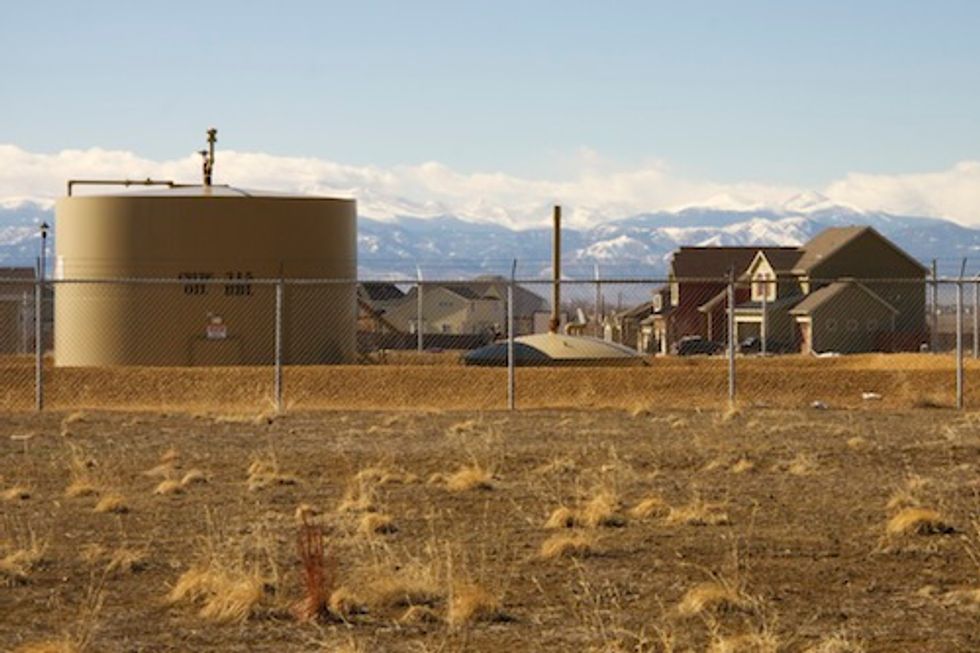
Shale oil and gas development near Denver, Colo.
Credit: Bobby Magill/ClimateCentral
How those studies and low oil and gas prices will affect renewables will soon be readily apparent. Electricity generation from renewables was expected to grow by nearly 2 percent and power generation from wind, solar and biomass alone was expected tosurpass hydropower productionfor the first time in history by the end of 2014. That growth is likely to continue.
New wind farm power generating capacity is set to double in 2015, contributing nearly 5 percent of all U.S. power generation. Though solar power is expected to account for only a tiny fraction of power generation in the New Year — about 0.6 percent — growth is nearly inevitable as prices, which have fallen about 7 percent each year since 1998, continue to decline.
The future of carbon capture and storage technology may also become more clear, with the first large-scale coal-fired power plant fitted with carbon-capture technology completing its first year of operation in Canada and research continuing on new ways to make that carbon capture economical and effective.
If all those scenarios play out over the next year, one of the big stories next December will be how U.S. CO2 emissions from burning energy didn’t increase at all in 2015 — good news for the climate at a possible turning point in American energy.
On New Year’s Eve fireworks manufacturers the world over will finally be able to relax after their biggest sale of the year. But this day has been a fireworks staple for a surprisingly long time, although the fireworks themselves have changed quite a bit.
Fireworks, as everyone knows, were invented in ancient China. The details of their actual origin are lost to history, but they were probably developed as a way to keep mountain men and spirits at bay using loud bangs. Dried bamboo stalks would emit a noisy crack when thrown on a fire, and gunpowder, another Chinese invention, rammed into bamboo may have first been used to magnify this startling effect.
An illustration of a fireworks, 1628-1643 edition of the Ming Dynasty book.
By the 11th century there were gunpowder weapons in China and in the early 12th century, the Chinese used firecrackers and fireworks (yen huo) to celebrate a visit of the Chinese emperor. Chinese fireworks included rockets (or “earth rats” because they were fired over the ground) and wheels, coloured smoke-balls, crackers and fireworks attached to kites. They all made a “glorious noise”.
Fireworks in Europe
Gunpowder and fireworks might have been invented independently in Europe, but they probably reached Europe via the Mongols, who spread west from China as far as central Europe by the mid-13th century. In 1267, the English monk Roger Bacon recorded seeing what were very likely firecrackers, which he compared with the flash of lightning and growl of thunder.
Fireworks on the River Thames, Monday May 15 1749.
In 1377 fireworks accompanied a religious mystery play by the bishop’s palace in Vicenza, and were soon used to add sparks to figures of doves, representing the Holy Spirit, or angels, made to ascend and descend from the heavens on ropes.
By the 15th century, rockets were being used in Europe for military and peaceful purposes. Italian and Spanish cities in particular began to use fireworks for outdoor celebrations. The Italian metallurgist Vannoccio Biringuccio described festivities in Florence and Siena for feast days. These included “girandoles” or whirling decorated wheels packed with fireworks which were suspended from a rope hung across a street or square.
Flaming castles and artichokes.
UCLA Digital Library
Fireworks were also used in the German lands. An elaborate colour-painted book commemorates the Schembart carnival of Nuremberg, which saw men dressed in brightly-coloured costumes parading through the town. Often these included some kind of pyrotechnics. One image shows a man wearing a hat in the form of a castle with fireworks and smoke shooting up from the towers, and interestingly, what looks like a smoking artichoke.
Stars falling from heaven
But the greatest of early European fireworks was surely the Girandola (not to be confused with Biringuccio’s girandoles) staged for the election of a new pope at the Castel Sant’Angelo in Rome. This imposing castle on the banks of the river Tiber was originally constructed by the emperor Hadrian as a mausoleum for his family, before being converted into a fortress and later a papal residence.
Fireworks were set off from the building from the late 15th century, and continue to be shown there to this day. The performance consisted first of an illumination of the castle using tallow candles and illuminated figures of stars and coats of arms placed around the outside of the building. On a gun signal, artificers then shot up fireballs that appeared “like stars, finally bursting”. The finale was a great volley of rockets. Biringuccio tells us they were:
Constructed so that after they have moved upwards with a long tail and seem to be finished they burst and each one sends forth anew six or eight rockets.
The effect was a huge explosion of fire and noise and smoke, which spectators compared to the heavens falling to the earth or the fires of hell – a truly apocalyptic experience.
Jacob Hackert, Fireworks over Castel Sant'Angelo in Rome, 1775.
By the 16th century, firework festivals similar to the Girandola had spread to northern Europe. Styles of display proliferated and diversified. Most fireworks in this period were court spectacles, staged to celebrate princes and their actions, and often involved elaborate scenery, artificial castles, figures of monsters, and an array of exotic pyrotechnics.
In 1533, the English celebrated the coronation of Anne Boleyn with barges on the river Thames carrying “wild men” wielding fire-clubs and a “great red Dragon continually moving and casting forth wild-fire". Queen Elizabeth I also enjoyed fireworks displays in the 1570s.
German princes staged mock battles and pyrotechnic pantomimes featuring contests between giant dragons and fire-spouting whales. French kings saw astrological fireworks, featuring lions (Leo) and fireworks made to resemble suns and stars. Audiences marvelled at these events, which could cost a small fortune to produce, and they also found fireworks terrifying. These were, after all, a rare and novel experience for many people.
In that regard, the earliest fireworks were quite different to the ones we enjoy today. We’re very familiar with fireworks now, so it takes a grand display to impress us. The courtly politics and elaborate decorations of the past are long since gone thanks to economising tendencies in pyrotechnics in the 19th century. In the 20th century fireworks became simple displays of coloured light, dropping the dragons and castles, to the point where one critic claimed that fireworks were the purest form of abstract art.
But the basic vocabulary of fireworks – using gunpowder tightly packed into containers to make an array of explosions, flashes, bangs, sparks, and noises, together with the tremendous scale and drama which these effects create – has remained a constant source of astonishment to audiences for many hundreds of years. Fireworks, re-imagined in creative ways, will no doubt continue to amaze and impress us for many centuries to come.
December 31, 2014 marks the 500th anniversary of the birth of one of the most important figures in the history of medicine. He authored one of the most elegant and influential books in scientific history. His investigations revolutionized our understanding of the interior of the human body and the methods physicians use to study and teach about it, reverberating throughout medicine down to the present day.
Andreas Vesalius.
Everett Historical/Shutterstock
His name was Andreas Vesalius. He was born into a medical family in what is now Belgium. As a boy he showed a great interest in the dissection of animals, a predilection that disgusted his contemporaries. Yet he persevered, going on to study medicine at both Paris and Padua, then two of the great centers for anatomic research. When he graduated, he was immediately offered a teaching position. Unlike those who taught him, he insisted on performing the dissections himself and encouraged his students to do likewise.
Comparing what his dissections revealed with what he read in the textbooks of the day, Vesalius asserted that the flesh itself is a more reliable guide than the written word. He contradicted more than 200 of the teachings of perhaps the most towering figure in the history of anatomy, the 2nd century Roman physician and anatomist Galen. For example, Vesalius pointed out that Galen erred in asserting that the human jaw consists of two bones.
How could a man whose teachings withstood the scrutiny of 1,300 years make such a seemingly elementary mistake? Some of the authorities of Vesalius’s day defended Galen by suggesting that the anatomy of the human body itself must have changed over the generations since. But Vesalius knew the real answer: Roman custom had prevented Galen from dissecting the bodies of humans, forcing him to rely on those of other creatures, such as pigs, apes and dogs. And when it came to the jaw of a dog, Galen was right.
Vesalius insisted teachers and students learn anatomy directly. Image of brain from On the Fabric of the Human Body.
Of course, Vesalius himself knew that Galen was far more often right than he was wrong, and he frequently marveled at the depth of his ancient predecessor’s knowledge. For example, Galen had experimented on the spinal cords of pigs, demonstrating that when he cut the cord near the tail end, the animal first lost the use of its hind limbs. When another cut was made closer to the head, the forelimbs ceased moving. And when he cut still higher, the animal would cease breathing – a truly extraordinary experimental linkage of neurological structure and function.
In insisting that teachers and students study anatomy directly instead of memorizing what they found in the textbooks, Vesalius was in a sense rekindling the flames of Galen’s own passion for direct
observation. But he was also elevating them to levels not equaled for well over a millennium. In the process, he was creating truly remarkable anatomic specimens. His 1543 public dissection of a famous criminal’s body produced the world’s oldest surviving complete anatomic skeleton. It’s still on display today in Basel, Switzerland.
Perhaps Vesalius’s most remarkable achievement of all was his publication, On the Fabric of the Human Body. It consists of seven volumes describing the bones, muscles, blood vessels, nerves, digestive system, heart, and brain. The works contains over 200 illustrations, many of which are recognized today as among the most exquisite anatomic images ever produced. Produced by artists he retained, the drawings were engraved on wood blocks for reproduction, and they represent a quantum leap beyond their predecessors in anatomic detail and sophistication.
Vesalius’ masterpiece stands as one of the greatest books ever produced. It is simply beautiful, reflecting an unparalleled degree of both scientific erudition and aesthetic sensitivity. It showed the body not as inert flesh but enlivened and in motion, emphasizing the correlation of form and function. It also established vastly higher standards for anatomical research and teaching, setting biology and medicine on new paths of discovery. And finally, it is one of the greatest marriages of science, art, and humanism ever achieved.
Equally impressive is the fact that Vesalius published his magnum opus at the incredibly young age of 28, in an era when most authorities in medicine were a generation or two his senior. But he was no enfant terrible. In presenting this new anatomic vision to the world, he was not so much tearing down idols as reestablishing the primacy of the human form itself as medicine’s most important text. Those who would know the human form, he said, must devote themselves to studying it for themselves, rather than delegating the responsibility to others.
Our understanding of human anatomy has advanced quite far since Vesalius. The introduction of the microscope opened up a world of cells that Vesalius could scarcely have dreamt of, and the invention of CT and MRI scanners has made it possible to inspect the interior of the human form in life and without the use of a scalpel. Yet even these more recent innovations bear the spirit of Vesalius, who insisted that those who wish to understand the body must see it for themselves.
A colorful "Lovejoy" comet will be visible from Earth for the next few days, offering stargazers their best chance to observe it for thousands of years.
But, Plait said, he was able to get a good look at it as recently as Sunday with a good pair of binoculars. The comet's greenish hue, which is caused by diatomic gas fluorescing in sunlight, can be spotted in long-exposure photographs.
"With my larger 15x70s (Celestron's SkyMaster binocs, before you ask) I could see the tail, too, despite looking through city lights in that direction, plus having a first quarter Moon illuminating the sky," Plait wrote. "I'm kicking myself that I didn't take any pictures, but the temperature was hovering near -15° C, so I'm willing to forgive myself."
WRAL-TV reported that Q2's last trip near Earth was around 11,500 years ago. But its path should be altered enough during this pass to bring it back toward the planet in about 8,000 years.
Plait wrote that an Italian facility, the Bellatrix Astronomical Observatory, will offer live online viewings of the comet on Jan. 6 and 11, as part of its "Virtual Telescope" project.
A new trend has seen companies springing up to intravenously inject the stricken with an IV bag packed with vitamins and medications. The Guardian’s Adam Gabbatt tested out the service after a night on the town
Some people swear by the hair of the dog to cure a hangover. Some turn to greasy food. Others just throw up and get on with it.
A new trend could put all these dubious traditions to bed, however, as companies have sprung up offering IV drips to the stricken.
The IV Doc , which offers its intravenous fluids in New York, Chicago, Los Angeles and San Francisco, is perhaps becoming the best known.
Launched in December 2013, it has treated “thousands” of people in its first year, according to CEO Adam Nadelson, who said the idea is based on “something that residents have been doing since the dawn of ages”.
Nadelson said that trainee physicians would often be on call at a hospital round-the-clock when completing their residency. They might only get a small, say six-hour, window to go and let off steam.
“For those six hours you didn’t sleep you went out and had fun with your friends. The next morning you were back on point 100%. A nurse would stick a small IV, get you hydrated back up and you were good to go.”
Now, however, one needs not commit to seven years medical training to feel that kind of sweet relief.
For between $199 and $250 anyone – that is, anyone who can afford to spend between $199 and $250 curing a hangover – can have the company send round medical personnel with their bulging bags of fluid.
Although the IV Doc website is keen to stress that they offer their drips for other things too – like general dehydration and food poisoning – Nadelson says most people call them for hangover treatment. The majority of customers, he says, are “affluent”.
“They’re hard-working individuals,” Nadelson explained. “They don’t have even a moment to step away from their busy schedules, have a few glasses of water and allow themselves to recuperate.”
“They’re literally flying from California to Texas to New York and in-between them flying back to California they’re stopping off with us because they just feel horrible.”
“They’re picking up clients at night, they’re trying to sell to them the next morning,” Nadelson continued.
“They’re busy. Busy, busy, busy. It’s time-sensitive to get to these meetings. And the service we provide, hopefully we can get to them within two hours’ notice.”
Unable to quite recreate this high-flying, fast-paced dynamic, this reporter instead drank a large quantity of alcohol over a short space of time, then summoned the IV Doc the next morning.
For $250, I received two bags of fluid – the ‘Revive’ package , which is billed as “for deathbed relief”. The solution contains:
Famotidine, a histamine H2-receptor antagonist that inhibits stomach acid production.
Odansetron, a serotonin 5-HT3 receptor antagonist used to prevent nausea
Ketorolac, a nonsteroidal anti-inflammatory drug
“Alcohol inhibits the body’s anti-diuretic hormones, which help you absorb water from fluids. When those ADH levels drop, instead of taking water in, the body wants to push it out via a bodily function you should be familiar with,” Nadelson said.
“But after drinking a beer, not only does that full fluid volume pass right through the body, existing H20 gets drawn out along with it. One drink = twice the urine. That’s why an IV drip rehydrates on a level way beyond downing a before-bed desperation glass of water.”
Insect-eating bats that inhabited a hollow tree in a remote village in Guinea may have been the source of the world's biggest Ebola epidemic, scientists said on Tuesday.
More than 20,000 cases of Ebola, with at least 7,800 deaths, have been recorded by the World Health Organization (WHO) since a two-year-old boy died in the village of Meliandou in December 2013.
Reporting in the journal EMBO Molecular Medicine, scientists led by Fabian Leendertz at Berlin's Robert Koch Institute delved into the circumstances surrounding this first fatality.
The finger of suspicion points at insectivorous free-tailed bats -- Mops condylurus in Latin -- that lived in a hollow tree 50 metres (yards) from the boy's home, they said.
"The close proximity of a large colony of free-tailed bats... provided opportunity for infection. Children regularly caught and played with bats in this tree," the team said after an exhaustive four-week probe carried out in April.
The Ebola virus holes up in a natural haven, also called a reservoir, among wild animals which are not affected by it.
The virus can infect humans who come into contact with this source directly, or indirectly through contact with animals that have fallen sick from it.
Highly contagious, the virus is then passed among humans through contact with body fluids.
A known reservoir is the fruit bat (Epomophorus wahlbergi), a widespread tropical African species that in some countries is killed for food, offering a infection pathway to hunters and butchers of the mammal.
But the role of fruit bats in the current outbreak has never been confirmed, the scientists said.
In contrast, free-tailed bats, a cousin species, have been found in lab tests to be able to carry the virus but not fall sick with it.
That, too, would make them a "reservoir," but no evidence of this has ever been found in the wild.
The German team said evidence that this species helped unleash the present epidemic was strong but not 100 percent.
Local children not only played with the bats at the tree, they also hunted bats that roosted at village homes and grilled them for food, they found.
In addition, they saw no evidence of any local die-off among larger mammals, which would have been a secondary route of infection for humans.
On the other hand, no trace of Ebola virus was found in any of the bats the scientists captured and whose blood was analysed.
- 'Rare' virus -
When the researchers came to Meliandou, they found the bat colony had fled, for most of the tree had burned and only the stump and branches remained.
Traces of DNA found in surrounding ash and soil pointed to the previous presence of the insect-eating bats. But again, there was no presence of Ebola virus.
"The virus must be very rare in the reservoir," Leendertz said in an email exchange with AFP.
"That is also obvious when you think about how many tonnes of bat meat is consumed every year.
"If more bats carried the virus, we would see outbreaks all the time. That's one of the challenges: the virus is rare and (in) a large multi-species reservoir."
The possibility that this species of bat could be an Ebola vector is a worry, said Leendertz.
Very little is known about how these bats live -- when they migrate and reproduce, where and why they cluster, their sources of food, and so on -- and only understanding this will quantify the risk for humans.
Africa's population explosion has destroyed more and more of the bats' habitat and brought more people into proximity with them.
Leendertz said an early priority should be to encourage co-existence between villagers and bats.
Culling the insect-eating animals could encourage the spread of insect-borne disease.
"It is no solution to start killing bats or disrupting their habitat. That may backfire very badly," he warned.
A deep crater in the ocean floor is providing scientists with evidence to support the theory that the sprawling, highly advanced Mayan empire collapsed around the year 900 A.D. because of climate change and devastating droughts.
The Washington Post reported Tuesday that a Rice University team extracted sediment samples from the great Blue Hole crater, a bucket-shaped hole in the ocean floor off the coast of Belize.
The Blue Hole is about 1,000 feet deep and, scientist Andre Droxler told LiveScience.com, acts as a "sediment trap."
Sediments washed into the ocean in rivers or dropped into the water in rain settle to the sea floor over time. In a crater like the Blue Hole, the sediments settle in layers that are undisturbed by ocean currents, making a perfect historical record of centuries of topsoil which was washed into the sea.
The once-mighty Mayan Empire was centered in what is now the nation of Guatemala and stretched from what is now the southern tip of Mexico to what is now the shared border of Honduras and El Salvador. The Mayans communicated via written language, performed advanced math, mapped the stars, built pyramids and practiced agriculture on a scale adequate to feed its teeming cities.
Then, abruptly, some time between 800 and 1000 A.D., the civilization collapsed. Its great cities and temples were abandoned and its farmlands went fallow.
Droxler said that his team is able to determine rainfall amounts during prehistoric epochs by studying the chemical composition of silt layers in the Blue Hole. When rainfall is plentiful, the soil that washes into the ocean is rich in titanium, a mineral found in volcanic rocks. In years with less rain, the ratio of titanium falls and levels of aluminum rise.
During the era when the Mayan empire declined, Droxler said, the region underwent significantly fewer major tropical typhoons -- only one or two every 20 years instead of the usual five or six. While typhoons can bring devastating winds and flooding, they also bring much-needed water inland in the form of heavy rains.
These heavy rains were an integral part of growing enough food to sustain the sprawling empire. The first great blow to the civilization came in the form of a 100-year drought between 800 A.D. and 900. When the rains stopped, food because scarce and a period of violent unrest ensued.
According to LiveScience, "After the rains returned, the Mayans moved north -- but they disappeared again a few centuries later, and that disappearance occurred at the same time as another dry spell, the sediments reveal."
This is not the first evidence scientists have unearthed that indicates that droughts brought about the collapse of the Mayan civilization. Pennsylvania State University archaeologist Douglas Kennett said in 2013 that changes in climate patters were a major factor in the collapse of the once-mighty civilization.
European researchers said Monday they have devised the first tiny motion detector that could help find microscopic life forms on distant planets.
Until now, scientists have tried to find signs of extraterrestrial life by listening for sounds that might be emitted from an alien world, by scanning the skies with potent telescopes and by sending robotic probes and rovers to analyze the chemical fingerprint of samples from comets and planets.
But researchers in Switzerland and Belgium were interested in a new method. Taking advantage of movement, which they call "a universal signature of life," they would aim to sense on a nanolevel the tiny motions that all life forms make.
They began to explore the possibility of searching for life with a sensor attuned to those nanoscale vibrations in microscopic organisms such as bacteria and yeast.
"The nanomotion detector allows studying life from a new perspective: life is movement," said Giovanni Longo, lead author of the paper in the Proceedings of the National Academy of Sciences, a peer-reviewed US journal.
"This means that the nanomotion detector can detect any small movement of living systems and deliver a complementary point of view in the search for life," he told AFP via email from Switzerland.
- Inexpensive 'life detector' -
Longo, a scientist at the Ecole Polytechnique Federale de Lausanne, and colleagues at Vlaams Instituut voor Biotechnologie in Belgium devised an instrument that is smaller than a millimeter -- just a few hundred microns in length -- that can sense the smallest nanoscale movements.
They tested it on a variety of living things, including E coli, yeast, as well as human, plant and mice cells in the lab.
In all cases, when living organisms were placed near the sensor, they "produced an increase in the amplitude of the measured fluctuations," said the study.
Longo and colleagues also scooped up soil and water from the grounds near their Swiss lab and found that the sensor could detect tiny life there, too.
Researchers found they could manipulate the movements of the life forms by adding nutrients which the cells would consume, or adding chemicals that would kill them, making the motion stop.
"The detection system can be used as a simple, extremely sensitive, and weight-efficient 'life detector,'" the study said.
Longo said a prototype would cost less than $10,000, would use very little battery power and could be contained in a 20 by 20 centimeter (eight inch) box.
- New way to look for life -
The device has not been presented yet to NASA or the European Space Agency, but efforts are under way to write a proposal and make a prototype that could travel to space on a robotic vessel or orbiter that is hunting for extraterrestrial life, Longo said.
If it had been available to the ESA's Rosetta mission, which recently sent its Philae lander onto a comet for the first time and detected water and possible signatures of life in the form of complex carbon, it could have propelled the science one step further, "determining if these conditions are still harboring life, in any form," Longo said.
If the world's space agencies find a way to use it, the detector could be used to search for life on the moons of Jupiter or Saturn, or on Mars, where it might help scientists recognize life exists in a form that they had not previously expected or understood.
The sensor could also be used to detect extreme life forms in areas that are hard to measure on Earth, such as volcanoes and the ocean floor, he said.
However, it could be years before the sensor is actually tested in space.
"It is rare that anything is 'simple' in the context of space exploration," said Ariel Anbar, a professor in the School of Earth and Space Exploration and the department of chemistry and biochemistry at Arizona State University.
Nonetheless, Anbar, who was not involved in the study, described the work as "refreshing" and a "fundamentally new idea."
"Motion-detection on such a scale has never been attempted before as an extraterrestrial life detection approach," he told AFP.
"If it is as technologically simple to implement as the authors claim, then it could be worth integrating into future mission concepts."
One of the world's most spectacular historical sites could now have a future full of remarkable wildlife too, as conservationists try to restore the forests around Cambodia's Angkor Wat to the teeming levels of animal life that they once had. The areas surrounding the ancient temple complex of…
Chuck Bednar for redOrbit.com – Your Universe Online Lung cancer cells can spread more easily than other types of cells because the protein ties that tether them together are severed, allowing them to break loose, a team of researchers from the Cancer Research UK Manchester Institute report in a new study. In research published Wednesday in…