




A deep crater in the ocean floor is providing scientists with evidence to support the theory that the sprawling, highly advanced Mayan empire collapsed around the year 900 A.D. because of climate change and devastating droughts.
The Washington Post reported Tuesday that a Rice University team extracted sediment samples from the great Blue Hole crater, a bucket-shaped hole in the ocean floor off the coast of Belize.
The Blue Hole is about 1,000 feet deep and, scientist Andre Droxler told LiveScience.com, acts as a "sediment trap."
Sediments washed into the ocean in rivers or dropped into the water in rain settle to the sea floor over time. In a crater like the Blue Hole, the sediments settle in layers that are undisturbed by ocean currents, making a perfect historical record of centuries of topsoil which was washed into the sea.
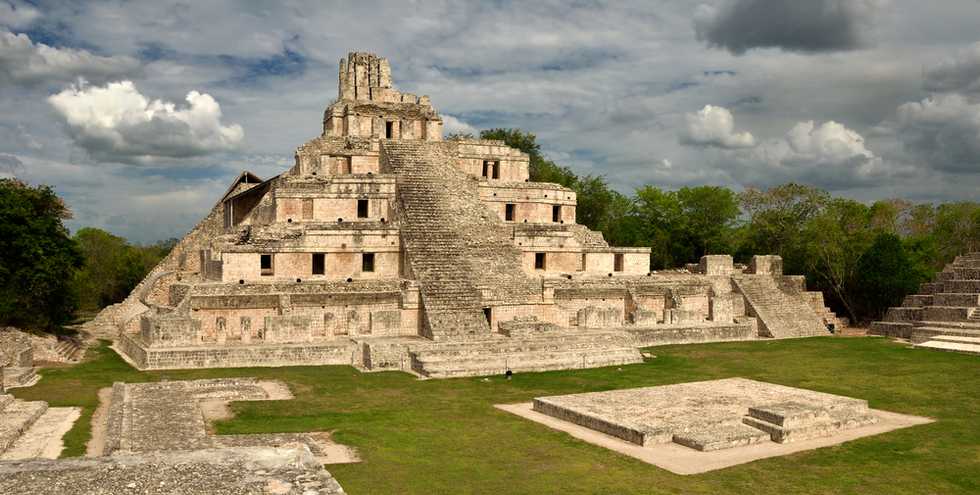
The once-mighty Mayan Empire was centered in what is now the nation of Guatemala and stretched from what is now the southern tip of Mexico to what is now the shared border of Honduras and El Salvador. The Mayans communicated via written language, performed advanced math, mapped the stars, built pyramids and practiced agriculture on a scale adequate to feed its teeming cities.
Then, abruptly, some time between 800 and 1000 A.D., the civilization collapsed. Its great cities and temples were abandoned and its farmlands went fallow.
Droxler said that his team is able to determine rainfall amounts during prehistoric epochs by studying the chemical composition of silt layers in the Blue Hole. When rainfall is plentiful, the soil that washes into the ocean is rich in titanium, a mineral found in volcanic rocks. In years with less rain, the ratio of titanium falls and levels of aluminum rise.
During the era when the Mayan empire declined, Droxler said, the region underwent significantly fewer major tropical typhoons -- only one or two every 20 years instead of the usual five or six. While typhoons can bring devastating winds and flooding, they also bring much-needed water inland in the form of heavy rains.
These heavy rains were an integral part of growing enough food to sustain the sprawling empire. The first great blow to the civilization came in the form of a 100-year drought between 800 A.D. and 900. When the rains stopped, food because scarce and a period of violent unrest ensued.
According to LiveScience, "After the rains returned, the Mayans moved north -- but they disappeared again a few centuries later, and that disappearance occurred at the same time as another dry spell, the sediments reveal."
This is not the first evidence scientists have unearthed that indicates that droughts brought about the collapse of the Mayan civilization. Pennsylvania State University archaeologist Douglas Kennett said in 2013 that changes in climate patters were a major factor in the collapse of the once-mighty civilization.
