Australia's plans to protect the Great Barrier Reef are inadequate, short-sighted and will not prevent its decline, the country's pre-eminent grouping of natural scientists said Tuesday.
The draft plan, released for consultation last month, was supposed to allay concerns by the United Nations about the reef's health after UNESCO threatened to put it on the World Heritage "in danger" list.
Environment Minister Greg Hunt has said the proposal reflects an effort to balance the priorities of protecting the reef, which is teeming with marine life, and long-term sustainable development.
But the Australian Academy of Science warned that the plan ignored the impact of climate change and failed to address problems with poor water quality, coastal development and fishing.
"The science is clear, the reef is degraded and its condition is worsening. This is a plan that won't restore the reef, it won't even maintain it in its already diminished state," academy fellow Terry Hughes said.
"The plan also seems overly focused on the short-term task of addressing UNESCO's concerns about the reef's World Heritage Listing, rather than the longer-term challenges of restoring the values of the reef."
Hughes said while the plan identified targets for reducing harmful agricultural run-off, any improvements would likely be lost in the unprecedented amount of dredging for coal ports and the Queensland state government's plans to double agricultural production by 2040.
The survival of the reef depended on a reduction in pollution from run-off and dredging, less fishing and a decrease in carbon emissions from fossil fuels, he said.
A vision for the reef
A spokesman for Minister Hunt said the "Reef 2050 Long-Term Sustainability Plan" states the government's vision to improve the health of the reef over successive decades.
"We note the Academy is calling for such a vision, and it is front and centre of what we are working to achieve," he said.
He said the plan acknowledged that climate change was a global problem requiring global action, and was being addressed by the government through other policies.
The draft, prepared by the Australian and Queensland governments, calls for greater coordination between authorities in relation to the reef, a proposal welcomed by environmentalists.
It also urges a 10-year ban on dredging to develop new ports or to expand existing ones both inside and next to the World Heritage site -- apart from in priority port development areas.
And it bans future port developments in the Fitzroy Delta, Keppel Bay and North Curtis Island near Rockhampton -- areas of the reef described by environmentalists as key incubators of marine life.
But environmentalists have criticized the draft as not setting high enough targets for cutting agricultural pollution or providing the billions of dollars required to restore the health of the reef.
With the government's final reef plan due in December, WWF-Australia and the Australian Marine Conservation Society called for stronger action to protect the major tourist attraction.
"The reef is one of the world's great natural wonders and we cannot allow it to be turned into an industrial park and a shipping super-highway," campaigner Felicity Wishart said.
The colorful coral faces a number of pressures including climate change, poor water quality from land-based runoff, the crown-of-thorns starfish, which eat coral, and the impacts of coastal development and fishing.
Researchers said that over a dozen infant deaths in one Utah basin over the last year may be related to a recent increase in oil drilling.
In a Sunday report, the Denver Post talked to scientists about the possibilities that the dead babies were "victims of air pollution fed by the nearly 12,000 oil and gas wells in one of the most energy-rich areas in the country."
"I suspect it is real — that there is a relationship," University of Missouri School of Medicine researcher Susan Nagel, Ph.D, told the Post.
"Scads of medical studies have concluded that air pollution can harm embryos. Drilling is a documented contributor to that pollution. It is a given that some of the harmful chemicals released in drilling, like benzene, toluene and xylenes, can cross the placental barrier and cause heart, brain and spinal defects," the paper points out.
"Suffice it to say that air pollution from drilling is a part of it," Salt Lake City-based anesthesiologist and activist Dr. Brian Moench insisted. "But I think there is a low probability (that) air quality is bad enough to impact infant mortality."
Utah State University in Vernal air-quality researcher Seth Lyman said that it was obvious that the area had an air-quality problem, "but we try not to freak out."
To complicate things, there was a large explosion at a business that handles fracking equipment last year that scattered debris over a half-mile area.
Nagel said that she takes the possible connection to infant mortality so seriously that she has begun studying the effects of fracking chemicals on pregnant mice.
"Mechanistically, from what we know about endocrine-disrupting chemicals, it is highly plausible" that the chemicals could cause fetal problems, she observed.
But high wages provided by the oil industry in the area -- $3,963 per month for non-farm workers on average -- mean that there is little desire to place the blame on drilling.
"People like to blame stuff on that all the time, but I don't feel like it has anything to do with oil and gas. I just feel like it's a trial I was given," Heather Jensen, who had infant sons die in 2011 and 2013, argued.
Ben and Caren Moon recently gave birth after previously losing a pre-term baby. They don't buy the idea that drilling is increasing the infant mortality rate.
"Oil-field drilling has been here forever," Ben Moon remarked. "I don't believe it all had anything to do with that."
Bioactive ingredients found in cocoa sharply reversed age-related memory decline in a group of volunteers, scientists reported on Sunday.
The compounds, called flavanols, were taken in a specially-prepared cocoa drink, according to an experiment published by the journal Nature Neuroscience.
Over three months, 37 healthy volunteers aged 50-69 had a daily drink containing either a high dose of flavanols -- 900 milligrammes -- or a low dose, 10mg.
The scientists carried out brain imaging, measuring blood volume in a key part of the hippocampus called the dentate gyrus, a region of memory formation whose performance typically declines as one ages.
They also carried out memory tests before and after the volunteers started with the drink.
The tests entailed a 20-minute pattern-recognition exercise designed to assess a type of memory controlled by the dentate gyrus.
The high-flavanol group notched up major memory improvements and an increase in blood flow to the dentate gyrus.
"If a participant had the memory of a typical 60-year-old at the beginning of the study, after three months that person on average had the memory of a typical 30- or 40-year-old," said Scott Small, a professor of neurology at Columbia University Medical Center in New York.
More work, in a bigger group, is needed to verify these early findings, he cautioned.
Flavanols have excited great interest. They dangle the possibility of tackling age-related memory loss in the world's fast-growing population of the elderly, but without using drugs.
The compounds exist in grapes, blueberries and other fruit, as well as in some vegetables and teas, but the type of flavanol and the amount vary widely.
Previous studies in mice showed that the class of flavanols found in cocoa boosts the performance of the dentate gyrus.
"The dentate gyrus in humans and mice are very similar," Small said in an e-mail exchange with AFP.
"I suppose that our study does show, for the first time, that flavanols improves the function of humans' dentate gyrus, particularly in ageing humans."
-- Age-related decline --
The findings apply to normal memory loss -- things such as forgetting names of new acquaintances or where one has left one's glasses -- which usually becomes noticeable when people reach their fifties or sixties.
They do not apply to memory loss caused by disease, such as Alzheimer's.
The cocoa drink was prepared by a large US food corporation, which also partly supported the research. The study is published in a peer-reviewed journal.
The firm used a proprietary process to extract flavanols from cocoa beans. Under conventional processing, most of the flavanols are lost from the raw plant.
Small said it was still too early to make dietary recommendations for flavanols, but "certainly I would NOT suggest that people consume more chocolate."
"That would be a mistake," he said.
"Very simply, the amount of flavanols that are found in chocolate is minuscule compared to the very high amount of extracted flavanols that our subjects consumed. The same is true for most other foods or teas," said Smith.
"Hopefully, in the future a food source or a specific diet will be identified that contains very high amounts of the specific flavanols we studied."
SpaceX's unmanned Dragon spacecraft splashed down in the Pacific Ocean on Saturday carrying a heavy load of NASA cargo and scientific samples from the International Space Station that experts hope could yield significant results.
A boat was ferrying the spacecraft to a port near Los Angeles, where NASA said the haul of 1.5 tonnes of experiment results and other materials will be removed and returned to the space agency by late Monday for scientists to pick apart.
Dragon also carried crew supplies, hardware and computer resources.
The investigations in the cargo could help develop more efficient solar cells and semiconductor-based electronics, as well as grow plants better suited for space and improve sustainable agriculture, according to NASA.
"This mission enabled research critical to achieving NASA's goal of long-duration human spaceflight in deep space," said Sam Scimemi, director of the International Space Station division at NASA headquarters.
Dragon, which spent a month at the space station, will later travel back for processing to SpaceX's test facility in McGregor, Texas.
Astronauts at the ISS had manipulated the orbiting lab's robotic arm to detach Dragon on time, at 1357 GMT, in what NASA called a "very clean release."
The capsule splashed down five-and-a-half-hours later, at 1939 GMT, near the Mexican coast, slowed by three enormous parachutes.
- Space traffic -
The SpaceX vessel is the only spacecraft currently capable of returning from the ISS with cargo. Its last mission to the space station was in April.
Then it delivered cargo including freeze-dried meals, 20 live lab mice and a 3D printer, in its fourth contracted mission to the ISS.
The lab mice were the first live mammals to hitch a ride aboard a commercial cargo ship, and they are enclosed in a NASA-made research cage for studying the effects of weightlessness on their bodies.
The 3D printer is the first of its kind to demonstrate how the technology can be used in space, even without gravity to assist the process.
The Dragon return kicks off a week of heavy traffic to and from the orbiting science lab.
Late Monday, Orbital Sciences is scheduled to launch its unmanned Cygnus capsule from the Wallops Island space center, on the coast of Virginia, and should arrive November 2 at ISS at the same dock that held Dragon.
And on Wednesday, the Russian cargo ship Progress is set to take off for the ISS, replacing a sister vessel due to break away from the orbiting station and return to Earth on Monday.
Three of the six ISS crew members are also preparing to leave the lab after 165 days in orbit. They are set to ride in a Russian Soyuz craft on November 9.
Their three replacements, a Russian and two Americans, should arrive on November 23.
NASA lost its ability to reach the space station alone when the shuttle program ended in 2011 after 30 years.
The US space agency has helped fund private companies in the race to restore US access to the ISS.
In 2010, SpaceX became the first private company to send a spacecraft to the ISS.
The company is run by Internet mogul Elon Musk, who built his fortune by co-founding PayPal. He also heads Tesla Motors.
Creationists will gather Saturday at Michigan State University to explore the links between Nazism and the theory of evolution.
The Origins Summit will also discuss why “the Big Bang is fake” and “natural selection is NOT evolution,” according to ScienceInsider.
The creationist group will also examine the work of Michigan State biologist Richard Lenski, who conducted an influential study on evolution within bacterial populations.
Michigan State is home to several other prominent evolutionary biologists, including Robert Pennock, who testified in a 2005 federal case that prohibited the teaching of intelligent design in public schools.
The university is also the lead partner in The BEACON Center for the Study of Evolution in Action, which is funded by the National Science Foundation and promotes evolution-related research and education.
The Oklahoma-based Creation Summit group reserved a room at the university’s business school through a religious student group – which did not know about specific topics for discussion until later.
The creationist group said the event was planned at the university in East Lansing because four of its board members live in Michigan, but members plan to organize additional conferences at other universities.
Mike Smith, the group’s executive director, said Creation Summit was “not overtly evangelistic,” but members hope to promote evangelism by campus ministries through its promotion of “intelligent design.”
"Once students realize they're created beings, and not the product of natural selection, they're much more open to the Gospel, to the message of God's love & forgiveness,” Smith told ScienceInsider in an email.
The group invited Lenski and Pennock to participate, but the biologists have not responded.
“In my opinion, this event will be just another forgettable blip in the long history of anti-science, anti-evolution screeds,” Lenski said. “I suppose the speakers chose to target our research … because their event is being held here, and maybe because they find it confusing to their world view that evolution isn’t supposed to happen.”
How is it that Earth developed an atmosphere that made the development of life possible? A study published in the journal Nature Geoscience links the origins of Earth’s nitrogen-rich atmosphere to the same tectonic forces that drive mountain-building and volcanism on our planet. It goes some way to explaining why, compared to our nearest neighbors, Venus and Mars, Earth’s air is richer in nitrogen.
The chemistry of the air we breathe is, at least partly, the result of billions of years of photosynthesis. Plant life has transformed our world from one cloaked in a carbon dioxide-rich atmosphere – as seen on Mars or Venus – to one with significant oxygen. About a fifth of the air is made up of oxygen, and almost all the rest is nitrogen. But the origins of the relatively high nitrogen content of Earth’s air have been something of a mystery.
Geoscientists Sami Mikhail and Dimitri Sverjensky of the Carnegie Institution of Washington have calculated what nitrogen is expected to do when it is cycled through the rocks of the deep Earth by the churning cycle of plate tectonics. Active volcanoes not only shower volcanic rock and superheated ash as they erupt molten rock into the air, they also vent huge amounts of gas from Earth’s depths. The latest eruptions in Iceland, for example, have been noted for the amounts of sulphurous fumes that they have emitted.
Alongside sulphur, steam and carbon dioxide, volcanoes next to active tectonic plate boundaries pump massive quantities of nitrogen into the air. Mikhail and Sverjensky explain this through the chemistry of what goes on beneath those volcanic roots.
Nitrogen bubbles up
As oceanic crust is subducted (that is, dragged down beneath continental crust) down into the depths of the Earth by the cycle of plate tectonics, it releases “volatile” elements into the rock above. These volatile elements contain nitrogen – and its fate could be to either end up locked in minerals or be released as gas into the atmosphere. The chemical composition of the overlying rocks decide the fate of the volatiles.
The volcanic eruption at Holuhraun, Iceland, active since last month is releasing immense clouds of steam, carbon dioxide and sulphur dioxide every day.
Simon Redfern/University of Cambridge
Nitrogen deep in the Earth’s crust will tend to form ammonium ions (NH4+) which get incorporated into solid silicate minerals easily. Silicate minerals are among the most abundant kind of minerals in Earth’s crust. This is presumed to occur to much of the nitrogen on Earth and pretty much all of the nitrogen on Venus and Mars. But when those silicate minerals react under certain conditions, such as in the presence of oxygen or oxygen-containing compounds, the ammonium molecules break down to a mixture of water (H2O) and nitrogen (N2). The latter then finds its way to the surface and the atmosphere through volcanic vents.
Mars and Venus have no plate tectonics and relatively little nitrogen. The nitrogen-rich atmosphere that made Earth a home for life thousands of millions of years ago appears to have its origin in the fact that the planet itself is a geologically active beast. Subduction, a driving force for plate tectonics, also creates the chemical reactor to make deep nitrogen. The same forces that drive the formation of mountains and continents, oceans and islands, are also responsible for our atmosphere and biosphere.
The findings suggest that nitrogen first started building in the atmosphere more than three billion years or so ago, and implies that plate tectonics was already active on Earth at that time. This fits in with other estimates for how long Earth has been an active planet, and it contrast starkly with the geologically stagnant picture we have of Mars and Venus. The results provide new insights into the pre-conditions guiding the likely character of life-hosting planets around distant stars, elsewhere in the universe.
Simon Redfern does not work for, consult to, own shares in or receive funding from any company or organization that would benefit from this article, and has no relevant affiliations.
Reef historian Iain McCalman, in Sydney, and reef scientist Stephen Palumbi, in California, are monitoring reef degradation from opposite sides of the planet. They compared notes.
Are the problems you are finding in the US old ones that have mounted up and intensified? Or are they new challenges coming from human-stimulated climate change?
Steve Palumbi: All coral reefs in the world suffer from the same problems – they’re smothered by sediment, choked by weedy algae, blasted, dug up and stripped of most of their fish. Then there’s climate change making the oceans hot, sour and stormy.
Worst off are the reefs of the Caribbean, suffering from more than 500 years of incremental impact from western civilization, mostly in the form of poor stewardship. But even the far-flung reefs of the Pacific that the US manages have some combination of local stresses.
It seems to me that what the Great Barrier Reef has – that US reefs do not – is a central place in the hearts and minds of the public. Sure, most people in the US like corals and fish, but our reefs have not reached celebrity status. What kind of extra oomph does celebrity give the Great Barrier Reef? Has it been important in keeping it healthy?
Iain McCalman: The Great Barrier Reef’s popularity has helped control some things such as tourist pollution and the overfishing of parrot fish that graze on algae and keep corals clean.
Yet we haven’t been able to deter our governments from building massive new Reef ports and there are more and bigger coal ports on the way.
What worries me, too, is that waters warmed by greenhouse gases will cause big outbreaks of coral bleaching this coming summer, with stressed corals turning white as they expel the symbiotic algae that normally live within them. Another one degree or so will hurt corals that have been hit before: this time they may not recover.
Bleaching coral, losing its symbiotic protozoan inhabitants.
Steve Palumbi: I’m also worried about coral bleaching. This week along the US Pacific coast we have had record temperatures on land and in Monterey Bay – well, it is still very cold by Great Barrier Reef standards, about 60F (16C), but it is warm for us! And a look at the latest map of ocean temperatures shows a lot of red – these are places where the ocean is 1-2 degrees warmer than the usual annual maximum.
The temperature’s rising….
NOAA, Author provided
Iain McCalman: We are predicting something similar, especially because we seem to be entering an El Niño weather phase when the Pacific is generally warmer anyway, though Charlie Veron, one of our great coral scientists, says that every year is becoming an El Niño year in Australia as far as corals are concerned.
Steve Palumbi: Every year is a hot one … that seems to be what the world is seeing across the continents and the seas. Way back when people first stumbled on the fact that corals bleached when the temperature rose too much, they found something else: corals in warmer climates near the equator bleached at a higher temperature than corals living in cooler waters.
We have seen this on a small scale in American Samoa where we work, and have shown that individual coral colonies living in warm water acclimate to the heat by changing their physiology. And whole populations of corals adapt to heat by having the right genetic makeup across about 100 genes.
Can we use this discovery? Turns out we can in two ways. We can locate and protect these heat-resistant corals. And we can try transplanting them to see if they in fact retain their heat resistance. We expect them to lose a little ground. How much is the question.
I’d love to think this will give us a leg up in replanting future reefs. I am not sure yet, because reef restoration has been so difficult. Does the Great Barrier Reef have any successful restored, replanted reefs?
Iain McCalman: Not that I know of. Moreover, with a government skeptical about climate change, a good deal of the work of this kind on adaptation is being shelved. Five of the Directors of the Great Barrier Reef Marine Park Authority recently resigned in protest against the cutting of programs concerned with responding to climate change.
But I also wanted to ask you about acidification. As the amount of CO2 in the atmosphere rises, oceans absorb more and it turns into carbonic acid in seawater. How do you rate the mounting acidification of the oceans from absorption of CO2 as a threat to corals?
It seems to be the elephant in the room: its consequences go beyond endangering corals to threaten other marine species as well. Some scientists seem to think it will deliver the death blow to coral reefs, if other things don’t get them first. What’s your feeling?
Steve Palumbi: Acidification is not the elephant in the room yet, it’s the elephant on the bus … due to get here any time now. The best data suggest that acidification has huge effects, from slowing down coral growth to changing the behavior of coral reef fish so that they get eaten more easily. Those effects are not strong yet, but they are coming quickly as CO2 builds up in the atmosphere.
CO2 and acidification takes 50 years to reverse. Think of stopping distance – a speeding car takes a long time to stop. So too with acidification.
And that is what I worry about. Because by the time the effect of that CO2 is killing corals, it will be too late to do anything about it. It’s like cancer treatment. If you’re lucky, they find a tumor when it is small and maybe isn’t even bothering you. But that tiny tumor is a huge threat, and we jump on it to fix it.
But I want to circle back to something you brought up at the beginning. Australia is selling coal to China, I hear. What is going on?
Shipping coal through the delicate GBR threatens its health.
Nguyen Huy Kham/Reuters
Iain McCalman: This issue of coal lies at the heart of current threats to the Great Barrier Reef, and symbolizes an economic mindset that reef lovers everywhere are up against. Our government has decided that Australia’s economic future lies in selling cheap coal to China and India. To do this the Federal and Queensland state governments need to expand existing coal ports on the Reef because these provide the cheapest and quickest shipping routes to Asia.
Quite apart from discouraging investment in renewable energy by backing fossil fuels, this decision has fraught implications for the health of the Reef and its waters.
Because the reef is too shallow for massive container ships, the new coal ports all entail extensive dredging of the seafloor. Thankfully public agitation has temporarily deflected the government’s original plan to dump three million cubic meters of dredged silt from Abbot Point into the reef channel, where it would choke corals and swamp sea grasses. Even so, dredging will stir up immense amounts of sediment as well as coral-threatening bacteria.
The vastly increased tonnage of container ships churning up and down the tricky reef channel represents a further threat from reef accidents and oil spillages, both of which have occurred a number of times in the recent past. There are plans, too, for several new mega-sized coal mines to be opened nearby, requiring similar access to the Great Barrier coastline and lagoon.
To call this policy short-sighted is an understatement. It sacrifices one of the wonders of the world and a substantial economic asset for Australian tourism; and this at a time when even China is trying to wean itself from using polluting coal.
The Great Barrier Reef might be an icon for us in Australia, as you said, Steve, but we seem to have governments that are proud to be icon bashers.
Steve Palumbi: I am thinking about a wonderful passage in your book, about Captain Cook navigating the Great Barrier Reef’s intricate tributaries, straining his considerable navigational skills to delicately thread his small ship up coral-filled canals. Now blast a modern coal ship through there, and what would you expect to happen? Cook’s ship was threatened by the Great Barrier Reef. Now the tables have turned.
Crown of thorns starfish was the last existential threat to the GBR.
Steve Doo, Author provided
I can’t help also to think about one of the last major threats to the whole Great Barrier Reef - the crown of thorns starfish. It wasn’t too long ago that this voracious predator was wasting reefs all along Australia. The way you describe the dangers of mining and ports makes me want to call this new threat the Coal of Thorns.
The Coal of Thorns may prove to be an even bigger threat - because it is something the reef has never seen and it is on an industrial scale that could threaten even this biggest biological structure on Earth. And all to help China pollute their own air! What happens after you build all these ports, you export the coal and China turns to their vast supplies of natural gas? Dead reef and a dead exporting business.
When the coral-eating Crown of Thorns began devastating the Reef in the 1960s, people tried everything to stop it. Folks picked them up by the thousands and burned them. They poisoned them. They fought them up and down the length of Australia. They would have loved to have the problem solved by simply passing a law.
This threat from coal is a problem created specifically by people. And it could be solved by people in a way that was never available for the starfish scourge – a simple sign of a pen could do away with this major threat.
Iain McCalman receives funding from Australian Research Council.
Stephen Palumbi receives funding from the U.S. National Science Foundation, the Gordon and Betty Moore Foundation and the David and Lucile Packard Foundation.
Americans consume 75 pounds of sugar per year -- much of it hidden in packaged goods the food and beverage industry doesn't want you to know about. So, after a short bit about ridiculous "sexy" Halloween costumes, including a "sexy John Oliver costume" featured by Playboy, Last Week Tonight host John Oliver turned his attention Sunday night to the $5 billion sugar industry.
"This Halloween, Americans will spend $2.2 billion on candy ...But, is it really fair to consider candy a treat considering how much we eat it all year round?," Oliver asked.
"Sugar activates our brains like cocaine," he said. "With sugar being so viscerally appealing to us, it's no wonder that food manufacturers put it in everything -- and I do mean everything."
As Oliver then noted, the food and beverage industry is fighting a new FDA proposal to require packages to include the amount of added sugars on labels.
"We are proposing, in the spirit of Halloween, that product manufacturers express their sugar content in the form of candy," Oliver said. "Specifically, circus peanuts, the most disgusting of all the candies. They taste like an elephant ejaculated into a packet of Splenda."
Oliver called on viewers to support this idea by tweeting food makers with the hashtag #ShowUsYourPeanuts.
It’s hard to get a bad coffee these days. Plenty of baristas have fine-tuned the process of making espresso, but really there are only a handful of variables they can control:
coarseness of the grind
temperature of the extraction
extraction time
the all-important coffee-to-water ratio.
Coffee roasters and barista schools have produced many impressively complex charts plotting grams of coffee against volume of water overlaid with concentration and yield. In the middle is the ideal weight/ volume/ concentration yield target for the perfect cup of coffee.
(Of course, if you prefer a latte, cappuccino or flat white, the milk is a whole other story.)
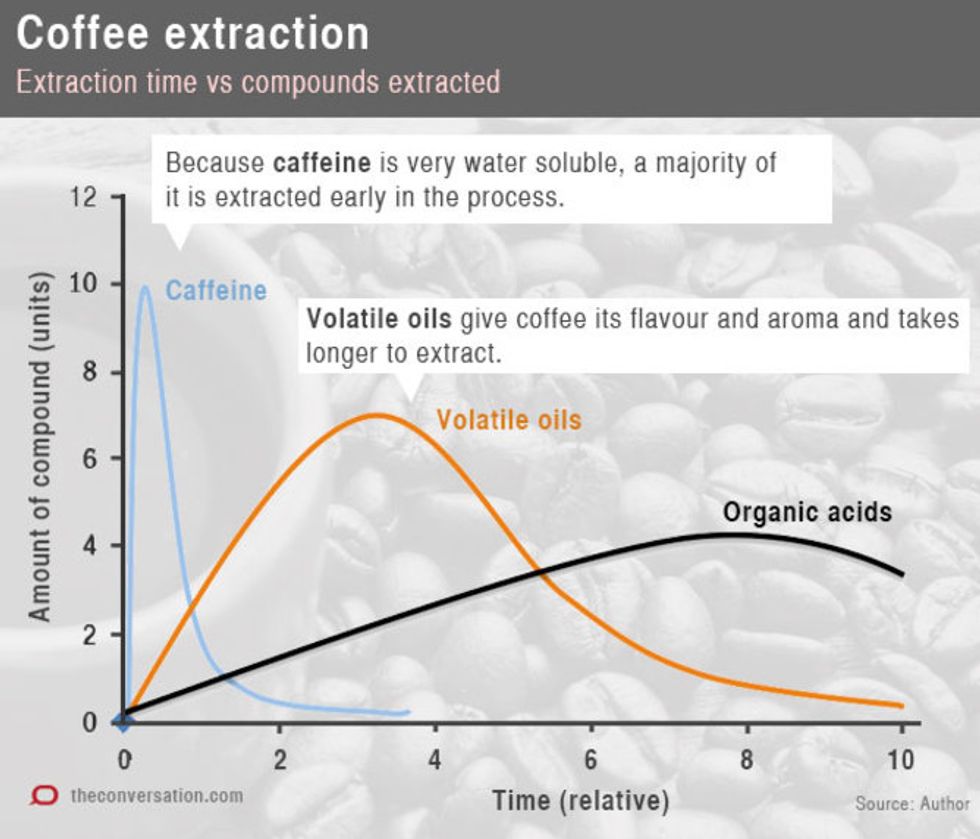
Here is a little graphic of my own that I will use to describe what happens when we change our four variables.
On the horizontal axis we have relative time, on the vertical axis the numbers represent amount. The curves are extraction profiles.
Caffeine is very water soluble and the vast majority of the caffeine is extracted early. The volatile oils, which give coffee its complex flavour and aroma, extract more slowly. The organic acids, which make coffee taste bitter, are extracted the most slowly of all.
So let’s go through each of our four variables in turn.
1. Grind
The coarseness of the grind and the extraction time are inextricably linked. The finer a coffee is ground, the more surface area there is. Conversely, the larger the grind, the smaller the surface area.
Let’s consider the two ends of the extreme. If we grind coffee as fine as talcum powder we have maximised the surface area available for extraction. Therefore, we can very quickly extract the target compounds – but perhaps too quickly for some people’s tastes.
Turkish coffee is very finely ground and boiled. This produces a coffee which is very strong and bitter and because of the fineness of the grind often contains a lot of suspended solids (muddy). The finely ground material may block filters too, causing the extraction to go on for too long – or not allow the water to pass through at all.
At the other end of the spectrum, let’s consider whole coffee beans. Of course, given enough time, we can extract unground coffee. This is quite wasteful of the coffee beans because the hot water may not penetrate all the way to the interior of the bean, so we throw away unextracted material.
Obviously, the optimum grind (coarseness) is somewhere between these two extremes, where we match the residence time of the hot water (flow rate) across the ground coffee beans with our ideal caffeine/ volatile oil/ organic acid ratio.
If you get a cup of coffee produced from a quality bean but it is too weak and insipid, the coffee may have been ground too coarsely. If the coffee is unacceptably bitter, perhaps the grind is too fine, with too-high levels of organic acids being extracted.
2. Temperature
Let’s hold all of our variables except temperature constant and see what happens. As with our coarseness experiment let’s consider the two ends of the extremes.
Temperature strongly influences solubility and rates of extraction. Yes, you can extract coffee with ice water. The three curves on our graph above get pulled to the right, so given enough time we can extract a decent cup of coffee. Cold brew coffee is made this way – ground beans are placed in cold water and allowed to “brew” in the fridge for up to a day.
The solubility of caffeine is moderately affected by temperature and the solubility of the organic acids is strongly affected by temperature. We would expect that a coffee brewed using this method would be lower in caffeine and much lower in bitterness than a coffee brewed using hot water.
Now, let’s extract our coffee using boiling water. The curves on our graph get scrunched up on the left-hand side. Everything gets extracted much quicker and the margin for error becomes much smaller if we try to limit bitter organic acid content.
Another complicating factor is that our volatile oils are just that – volatile. If we boil coffee, our flavour and aroma compounds get carried away in the steam. This can produce a coffee that is weak in taste, yet high in caffeine and organic acids.
3. Time
Let us keep our coarseness, temperature and water-to-coffee ratio variables constant and only consider the time variable. If we consider the ideal cup of coffee is one that has maximum caffeine and maximum volatile oils while limiting the bitter organic acids, we would consider 4 on our arbitrary timescale to be just about perfect.
If we only extract to 2 on the timescale we will have a coffee high in caffeine but weak, or underdeveloped, in flavour, aroma and bitterness. If we extract for too long, say to 8 on our timescale, our coffee will contain high amounts of organic acids, which can make it unacceptably bitter.
This brings us to our coffee-to-water ratio – perhaps the most subjective of all our tests. Too little coffee and even with all our variables optimised the coffee will taste weak. Too much coffee and the resulting brew will be too strong and overpowering.
This ratio depends on choice of extraction method:
for a French press, or plunger, where the temperature of the water drops quickly, we need to have more coffee per unit of water
if using a drip filter, the water temperature is higher than that in a plunger so a lower ratio is needed
in modern espresso machines the volume of water can be changed to taste.
Generally, the water temperature is maintained within the machine at around 97C. Too little water and the coffee is weak and underdeveloped; too much water and the coffee is bitter.
The generally accepted rule of thumb for the coffee-to-water ratio is approximately 10g of coffee to 200mL of hot water. One heaping tablespoon is about 15g, give or take a gram or two.
So there you have it. Optimise the coarseness of the grind, match this with the water temperature and the extraction time and make sure your coffee-to-water ratio is in the right ballpark. Or you can go down and visit your friendly local barista, have a chat, and let them do the thinking for you.
Don Brushett does not work for, consult to, own shares in or receive funding from any company or organisation that would benefit from this article, and has no relevant affiliations.
The UK’s largest medical charity, the Wellcome Trust, has made its vast database of images freely available to all. The collection holds photos of hundreds of years worth of medicine, instruments and scientific culture.
For me, the progress of science best described by advances in medicine and the instruments used to practice it. Here is a list of a few of my favorites.
Nothing quite says medicine like a syringe. And this collection has plenty, from the 17th century brass or 18th century ivory enema syringes, to the 20th century’s glass and stainless steel ones, all clearly made to last much longer than our modern disposable versions.
17th century French brass syringe
Science Museum, London
18th century Sri Lankan Ivory enema syringe
Science Museum, London
19th century Japanese self-administering enema syringe with a piston and reservoir
Science Museum, London
Then there are the surgical instruments, like the 16th century tools below. Those on the right include a double-bladed knife, a forceps for extracting arrow head and a bullet extractor.
Wellcome Library
Others like the Belgian Iron “scolds bridle” mask from the 1550s that was used to publicly humiliate and punish, mainly women, speaking out against authority, nagging, brawling with neighbours, blaspheming or lying, are just horrible inventions.
Wellcome Library London
More preferable are the “Jedi” helmets from the 1980s, used in conjunction with MRI scanners to investigate the brain without having to crack open the cranium. The word “Jedi” was used to ensure that children put it on without too much fuss.
Science Museum, London
There is also this steampunk steel hand and forearm with brass wrist mountings from 1890.
Wellcome Library, London
And finally how about the slightly disturbing model eye…
Model eye by W. and S. Jones, London, 1840-1900
Wellcome Library, London
…to go alongside the original eye pad
Box of eyeballs from 1900
Wellcome Library, London
By Mark Lorch, University of Hull
Mark Lorch does not work for, consult to, own shares in or receive funding from any company or organisation that would benefit from this article, and has no relevant affiliations.
Autumn is awash with alcohol, and not just because of the new vintage. Oktoberfest plays a part, too, the 16-day festival in Munich that we associate with massive beer mugs and plenty of debauchery. Its success has prompted copycat events around the world, from London to Ontario, Glasgow to Cincinnati. Such indulgence adds further fuel to the fear that we’re getting drunker than ever. But are we?
Recent statistics seem to bear this out. There are many worrying examples – like the million drink-related UK hospital admissions in 2013 alone. Similar figures can be found the world over. But if you look at European drinking habits in a historic perspective, other evidence suggests that our levels of intake are not unprecedented.
Let’s face it: while the roots of the Oktoberfest stretch to the early 19th century, Europeans have a much longer tradition of periodic alcohol excess: carnivals, church dedication feasts and numerous rites of passage have existed from as early as our records begin.
More generally still, drinking has always been an integral feature of European culture, be it as an indispensable part of people’s diets or a facilitator of countless forms of social exchange.
Steeped in tradition.
Kzenon/Shutterstock
Booze today
Let’s start with the present. 6.3m visitors downed 6.5m litres of beer at this year’s Oktoberfest, a little over one litre per person on average. Widening the perspective from the local to the global, the Kirin Beer University Report, based on returns from brewers’ associations and the latest industry statistics, sees China as the largest beer-consuming country in the world for the tenth consecutive year, with a remarkable 23.6% of the world market.
But the picture is different when measuring in a unit that adjusts for the varying strengths of beer, wine and spirits – in terms of pure ethyl alcohol. According to the World Health Organization’s Global Status Report on Alcohol 2004, the biggest drinkers are actually the Czechs, with 9.43 litres of ethyl alcohol per head. This is equivalent to roughly 232 pints or 132 litres of lager per year (or 0.3 l. per day). Germany ranks 4th and the UK 9th, with 5.97 litres. The corresponding list for wine is headed by Luxembourg with 9.43 litres, followed by France, Portugal and Italy; the spirits chart by the Republic of Moldova (10.94 litres), with Reunion and Russia in 2nd and 3rd place. Over the years, trends can go up as well as down.
Unweighted means of global per capita consumption 1961 to 2001.
Meaningful longer-term comparisons are, of course, very challenging. Producing accurate figures for societies of the past is riddled with problems. As with all statistics, there are issues of interpretation and contextualisation, but this is magnified for periods with patchy sources and unknown variables (such as beverage strengths). But it is possible to extrapolate from information surviving in disparate records such as household accounts, diaries, travel reports, customs books, inventories and similar genres.
Thirsty Tudors to baby boomers
A House of Commons Health Committee Memorandum sheds valuable light on the case study of England, illuminating fluctuating drinking habits since Tudor times. Between 1550-1650, the earliest period covered, consumption increased due to the commercialisation of the brewing industry and rising wine imports facilitated by Dutch traders.
Over the next century, the evidence becomes more ambivalent given that the “Gin craze” in the mid-1700s captured so memorably by Hogarth coincided with a rise in non-alcoholic alternatives (like coffee, tea and chocolate).
William Hogarth, Beer Street and Gin Lane (1751).
The years of the Industrial Revolution between 1750-1850 then brought a marked decrease in alcohol consumption, followed by a renewed upturn towards the end of the 19th century and another decline continuing into the second half of the 20th.
It’s from the 1950s that England witnessed its latest upsurge, most spectacularly in per-capita wine consumption (which rose from four pints in the 1950s to 25.5 pints today). In their explanatory framework for this roller-coaster ride, the authors of the survey place less emphasis on issues of deprivation and escape drinking than on socio-political and cultural factors such as varying taxation burdens, shifting codes of behaviour, the relatively recent phenomenon of excess drinking by women and proportional increases in wealth for key sections of the population.
Venturing even further back in time (and yet more speculative ground), it seems probable that the late Middle Ages (circa 1350 to 1500) formed a previous peak of alcohol (and meat) consumption. These centuries represented a “golden age” for lower social groups, which benefited from relatively high wages and low rents in the wake of the Black Death. The country was flooded with amateur brewers and “alewives” engaged in small-scale household production. It’s unlikely to be a coincidence that rural parish communities, in a period nostalgically referred to as “Merry England”, derived most of their supplementary income from the sale of church ales.
Drunk on the Continent
If we widen the perspective to the Continent, further peaks and troughs of historical imbibing reveal themselves. Typical estimates of per-capita intakes for 16th-century Central Europe cluster around 1 to 1.5 litres per day (well above even the Czech figure for 2013). This decreased – as in the case of England – to around 1 litre by the late 18th century, albeit with huge social, regional and situational variations.
A recent analysis of the contested relationship between alcohol and violence came to equally intriguing conclusions: while consumption for present-day Italy reaches some 0.2 litre of wine per person per day, the figure for documented Renaissance individuals could easily exceed 1 litre. In “Puritan” England, where we find the loudest protests against drinking excess, the levels of intake were actually much lower.
Turning to more indirect evidence, in German-speaking Europe during the 18th century (a relatively sober point) some public houses clocked up sales many present-day successors can only dream about: In 1787-88, the keeper of the Sun Inn at Herzogenbuchsee, a Swiss village on an important highway with three fairs, accounted for a massive 38,700 litres of wine retailed on the premises (on average 106 litres a day). Yet far from stable and proportionate, local drinking landscapes could be very dynamic. As this graph shows, the three inns in the nearby village of Münsingen saw very diverging trends in their turnovers over a hundred-year period:
Fluctuating average daily sales of wine (in litres) in the three inns of Münsingen near Bern (Switzerland), based on taxation returns for 1687-88 and 1787-88.
The author
By the second quarter of 2014, by comparison, UK pubs recorded 3,633,000 barrels (circa 595,000,000 litres) of annual on-trade beer sales. Dividing this by the roughly 48,000 outlets operating in 2013 yields a daily figure of just under 34 litres and, once again, by no means historically unprecedented levels.
All these calculations only re-emphasise the problems of approaching the issue of drink through statistics alone, especially in a wider historical context. Of course we have grounds for concern, but let’s keep things in perspective.
Looking back over the centuries, we find no linear increase or decrease of alcohol consumption. Every so often societies tend to slip into moral panics about drinking excess, at times on rather questionable grounds. And throughout European history, alcohol has been viewed as a socio-cultural resource as well as a “problem”. Worth remembering perhaps the next time we see a tabloid headline about our ever-worsening drink problem.
Beat Kümin received funding from the Swiss National Science Foundation, the Arts and Humanities Research Council and the European Science Foundation to conduct research on early modern public houses. He is a co-founder of the 'Warwick Drinking Studies Network' (https://go.warwick.ac.uk/wdsn).
Scientists in Denmark said Sunday they had found genetic clues to explain why a small number of children have febrile seizures -- brief convulsions -- after receiving the measles, mumps and rubella (MMR) vaccine.
They stressed there was no need to scrap the MMR vaccine -- caught in a health scare in 1998 that watchdogs later declared groundless -- and described its use as a "great achievement" in saving lives.
Reporting in the journal Nature Genetics, the team found that febrile seizures occurred in roughly one in every 1,000 children who were given the MMR vaccine.
Two genetic variants came to light that pointed to a higher risk of a febrile seizure in the second week following MMR vaccination, they said.
They lie on genes that play an important role in how the immune system reacts to viral intruders.
Febrile seizures are the term for when a child develops a high temperature, loses consciousness and spasms.
The episode usually lasts for a minute or two, but apart from causing alarm for parents and the need for a checkup afterwards, is typically not dangerous.
A known but rare side effect of vaccination or viral infection, febrile seizures are different from epileptic seizures, which occur without fever.
In addition, four other variants were found that link to febrile seizures in general, and have no connection with the MMR vaccine.
These four lie on genes that help to govern ion channels, an essential communications link between nerve cells.
Children who had the highest tally of the four variants were almost four times likelier to have febrile seizures than counterparts with the least number.
The six variants are unlikely to account for more than just a small proportion of the genetic causes for seizures, the researchers said.
Further work should tease out other genetic culprits, hopefully leading to a diagnostic test to show which children could be at greater risk of a febrile seizure after a jab.
The study was unable to say whether children who had seizures did so as a result of getting a triple immunisation, as opposed to getting single shots to protect against the three diseases. The triple vaccine is the only available in Denmark.
In addition, the gene trawl was only carried out in Denmark, and it is unknown whether the same risk exists, or exists to the same degree, in children elsewhere.
-- Vaccine improvement --
Lead scientist Bjarke Feenstra at the Statens Serum Institute in Copenhagen said the research should throw up new pathways for exploring febrile seizures.
As far as the MMR vaccine is concerned, it could improve an already good and safe vaccine, he said in an email exchange with AFP.
"The MMR vaccine is a great public health success, estimated to prevent the death of more than one million children worldwide per year," he said.
"The knowledge gained from studies like ours may ultimately lead to even safer vaccines."
In 1998, a study published in the British journal The Lancet unleashed a scare that the triple vaccine caused autism.
Even though the allegation was scientifically debunked and the study was later withdrawn, fears about the MMR vaccine persisted, prompting some parents to refuse immunisation for their child.
That in turn reduced "herd immunity" -- the protection that comes when everyone is vaccinated -- and placed non-immunised children at risk.
The row over genetically modified crops should be a thing of the past because they have failed to live up to their promise, according to Greenpeace, which will publish a report this week highlighting the successes of biotechnology projects it claims are outstripping GM in improving food production around the world.
The environmental campaign group – which has long been against GM foods – claims that a “silent revolution” in agriculture is showing a stronger track record than the GM process, which it labels as having shown disappointing results.
“Whilst the debate between GM and non-GM has used up most of the political oxygen, this report shows it is not the only – or indeed, the best – show in town. There is a growing range of non-GM biotechnologies which show how a growing world population can be fed at a time when natural environments are increasingly stressed,” said Greenpeace chief scientist Dr Doug Parr.
“It’s a silent revolution, making huge strides on the ground for the world’s farmers without the novel risks of GM,” he said. “The debate is not about GM any more; things have moved on.”
However, the group has been accused of “bizarre” hypocrisy by several leading geneticists who point out that the same science is behind both GM and the biotechnologies Greenpeace are backing. Known as MAS – Marker Assisted Selection – they combine genetics and molecular biology to pick out and control the best traits of an individual plant. Essentially, it is using gene technology to improve what is already there rather than introducing new elements as GM does, for example in the “golden rice” project which added vitamin A to rice.
“This is bizarre. What they are talking about is essentially the suite of technologies that spearhead the ‘green revolution’, which eco groups such as Greenpeace have steadfastly rubbished for decades. Now they see it as agriculture’s saviour,” said Johnjoe McFadden, professor of molecular genetics at the University of Surrey.
“If GM is not up to much then why has it been so successful that crops such as soya are now nearly all GM worldwide. Who knows best how to grow their own crops – farmers or Greenpeace?
“Genetic-assisted breeding is certainly very important and will help to generate new crops but it can’t, for example, replace golden rice. Vitamin A-rich rice cannot be bred because it isn’t a trait which already occurs in rice. This places strict limitations on this form of breeding.”
But Greenpeace insisted Vitamin A rice was still “years away” from being ready for use and pointed to MAS successes with rice, wheat and in increasing resistence to disease to crops that are of key importance in their own small geographical areas – such as Indian millet and sorghum in Sudan.
“Our report shows how MAS has a much stronger track record of delivery than GM technologies on properties that genuinely help poorer families globally, yet currently receives little attention,” the group said.
The Greenpeace report on biotechnology will be launched at the International Rice Congress in Bangkok later this week.








 By
By 


_with_signs_of_bleaching_or_crown-of-thorns_starfish_damage.jpg)