Elon Musk says the first human patient with a brain implant from his Neuralink startup is able to move a computer mouse with thought.
Last month, Musk's neurotechnology company installed a brain implant in its first human patient and on Monday Musk reported the experiment had been a success.
"The patient seems to have made a full recovery with no ill effects," Musk said in an interview streamed on X, formerly Twitter.
The patient is able to "move the mouse around the screen just by thinking," Musk said.
"We're trying to get as many button presses as possible from thinking," Musk added. "You want to have, obviously, more than just two buttons."
Neuralink's technology works through a device about the size of five stacked coins that is placed inside the human brain through invasive surgery.
The startup, cofounded by Musk in 2016, aims to build direct communication channels between the brain and computers.
The ambition is to supercharge human capabilities, treat neurological disorders like ALS or Parkinson's, and maybe one day achieve a symbiotic relationship between humans and artificial intelligence.
Musk is hardly alone in trying to make advances in the field, which is officially known as brain-machine or brain-computer interface research.
Hit with delays, the tycoon had reportedly reached out to join forces with implant developer Synchron.
The Australia-based Synchron implanted its first device in a US patient in July 2022.
The year 2024 promises to be a busy one for American Moon landings, all under a new partnership between NASA and the space industry.
A first attempt under the Commercial Lunar Payload Services (CLPS) initiative ended in disappointing failure last month, but a second, led by Houston-based Intuitive Machines, will attempt on Thursday to return the United States to Moon for the first time in five decades.
NASA's thinking behind CLPS is to delegate the delivery of its science hardware to the private sector, reducing costs to taxpayers as it prepares to return astronauts to the surface under the flagship Artemis program later this decade.
- Purchasing services -
Established in 2018, CLPS operates on the principle of purchasing services from commercial partners, rather than buying their hardware.
Joel Kearns, a senior NASA official involved with CLPS, said it would allow the agency to be more cost effective and do more frequent trips, even if "we don't know how many of the early attempts will be successful."
But the space agency is offsetting that risk by contracting with multiple companies offering different technical solutions.
It also hopes those companies will in turn build up their own clientele, for example research institutions and others wanting to ship gear to the Moon, creating a wider lunar economy in which NASA is just one of many customers.
The approach is completely different from that used during the Apollo era, when NASA dictated its industrial contracts down to the last bolt.
"When you have unlimited funds, like in the Apollo days, yes, you can do incredible things," said Trent Martin of Intuitive Machines. "Now, can we find a way to do it for a lower cost? Can we find a way to do it, where there's a marketplace that is not driven solely by government funds?"
- Fledgling companies -
Fourteen companies have been pre-selected to be in the running for contracts, with eight firm missions so far planned.
Many of the companies involved are considered fledging, rather than legacy aerospace giants, reflecting the initiative's experimental nature.
The first attempt, led by Pittsburgh-based Astrobotic, failed to reach the Moon in January after developing an in-flight fuel leak shortly after separating from its rocket.
It could get another shot later this year, to carry an important water-seeking NASA rover to the south pole, but the green light will depend on the outcome of a detailed review of its first mission.
Intuitive Machines, founded in 2013, is also targeting a region near the south pole. It has two more missions set for this year.
Another Texas company, Firefly Aerospace, has two missions, including one in 2024, with its Blue Ghost lander.
Finally, Massachusetts-based Draper, which built the computer that ran the Apollo spaceships, will attempt to land on the far side of the Moon in 2025.
NASA paid both Astrobotic and Intuitive Machines around $100 million each for their respective first missions.
- Lasting presence -
CLPS deliveries serve the bigger goal of better understanding the environmental risks -- from radiation to lunar dust -- that face American astronauts when they touch down on the surface no sooner than 2026.
Unlike during Apollo, when the United States was driven by the Cold War to act fast and chose near the equator for five short trips, NASA is now taking its time to build a "sustained presence," involving habitats, on the south pole.
Here, it hopes to harvest ice for drinking water and rocket fuel, with an eye on using our cosmic neighbor as a waypoint for crewed missions to Mars.
The United States is knee-deep in what some experts call the opioid epidemic’s “fourth wave,” which is not only placing drug users at greater risk but is also complicating efforts to address the nation’s drug problem.
These waves, according to a report out today from Millennium Health, began with the crisis in prescription opioid use, followed by a significant jump in heroin use, then an increase in the use of synthetic opioids like fentanyl.
The latest wave involves using multiple substances at the same time, combining fentanyl mainly with either methamphetamine or cocaine, the report found.
The leading contenders in the 2024 presidential election are two of the three oldest people ever to serve as president. President Joe Biden is 81. Former President Donald Trump is 77. Ronald Reagan took office at 69 and left it at age 77.
Scholars writing for The Conversation U.S. have discussed various aspects of how aging affects people’s brains. Here we spotlight four articles that collectively explain why there is cause for concern, why there is no clear statement to be made about any specific person’s cognitive power as they age, and ways people can preserve their brain power into their golden years.
1. Decline in thinking can come with age
Brandeis psychology professor Angela Gutchess, who studies brain activity to understand human thought, said there is a body of work documenting a cognitive decline in aging people:
“Past behavioral data largely pointed to loss in cognitive – that is, thinking – abilities with age, including poorer memory and greater distractibility.”
But her work has also found that “aging brains can reorganize and change, and not necessarily for the worse.”
2. Some people age faster than others
Aging is an individual experience, explained Aditi Gurkar, a geriatric medicine scholar at the University of Pittsburgh:
“Although age is the principal risk factor for several chronic diseases, it is an unreliable indicator of how quickly your body will decline or how susceptible you are to age-related disease. This is because there is a difference between your chronological age, or the number of years you’ve been alive, and your biological age – your physical and functional ability.”
Gurkar’s work has been focused on the latter, noting that some people with the same chronological ages can have very different cognitive and physical abilities. Key factors include the strength of a person’s social connections, as well as their sleeping habits, water consumption, exercise and diet.
As University of Pittsburgh geriatric scholar Aditi Gurkar notes in her TED Talk, aging is not just a number.
3. Even cells age differently inside the body
Ellen Quarles, who teaches cellular and molecular biology of aging at the University of Michigan, explained that aging is so individualized that it varies even at the cellular level:
“There is no single cause of aging. No two people age the same way, and indeed, neither do any two cells. There are countless ways for your basic biology to go wrong over time, and these add up to create a unique network of aging-related factors for each person that make finding a one-size-fits-all anti-aging treatment extremely challenging.”
4. There is a way to preserve abilities
Brian Ho and
Ronald Cohen, University of Florida scholars who study brain health in aging people, have found that physical activity makes a real difference in cognition:
“People in the oldest stage of life who regularly engage in aerobic activities and strength training exercises perform better on cognitive tests than those who are either sedentary or participate only in aerobic exercise.”
Specifically, they found:
“(T)hose who incorporated both aerobic exercises, such as swimming and cycling, and strength exercises like weightlifting into their routines – regardless of intensity and duration – had better mental agility, quicker thinking and greater ability to shift or adapt their thinking.”
Whether it’s for Biden and Trump or anyone else, these scholars advise staying active, deepening connections with family and friends and recognizing that not everyone ages the same way.
This story is a roundup of articles from The Conversation’s archives.
A "quite radical" report suggests governments and communities, not the private sector, should be leading the carbon removal industry.
To get to the Super Bowl on time, Taylor Swift took a private jet from Tokyo to Los Angeles and then hustled to Las Vegas. The carbon removal company Spiritus estimated that her journey of roughly 5,500 miles produced about 40 tons of carbon dioxide — about what is generated by charging nearly 5 million cell phones. But don’t worry, the company assured her critics: It would take those emissions right back out of the sky.
“Spiritus wants to help Taylor and her Swifties ‘Breathe’ without any CO2 ‘Bad Blood,’” it said in a pun-laden pitch to reporters. “It’s a touchdown for everyone.”
The startup is among dozens, if not hundreds, of businesses trying to permanently remove climate-warming gases from the atmosphere. Its approach involves drawing carbon directly from the air and burying it, but others sink it in the ocean. Last week, Graphyte, a venture backed by Bill Gates, began compacting sawdust and other woody waste that are rich in carbon into bricks that it will bury deep underground.
Spiritus says “sponsoring carbon offsets is a step toward environmental responsibility, not an endorsement of luxury flights” and added that “celebrities are going to take private jets regardless of what Spiritus does.” Even before the company stepped in, Swift reportedly planned to purchase offsets that more than covered her travel. But some climate experts say moves like Spiritus’ illustrate the dangerous direction the rapidly growing carbon dioxide removal, or CDR, industry is headed.
“The worry is that carbon removal will be something we do so that business-as-usual can continue,” said Sara Nawaz, director of research at American University’s Institute for Carbon Removal Law and Policy. “We need a really big conversation reframe.”
“It’s very market-oriented: doing carbon removals for profit,” Nawaz said. That reliance on the market, she elaborated, won’t necessarily lead to the just, equitable, and scalable outcomes that she hopes CDR can achieve. “We need to take a step back.”
Nawaz co-wrote a report released today titled “Agenda for a Progressive Political Economy of Carbon Removal.” In it, she and her co-authors lay out a vision for carbon removal that shifts away from market-centric approaches to ones that are government-, community-, and worker-led.
“What they suggest is quite radical,” said Lauren Gifford, associate director of the Soil Carbon Solutions Center at Colorado State University who was not involved in the research. She supports the direction the authors advocate, adding, “They actually give us a roadmap on how to get there, and that in itself is progressive.”
Nawaz compared carbon removal’s current trajectory to the bumpy path that carbon offsets has followed. That industry, in which organizations sell credits to offset greenhouse gas emissions, has been plagued by misleading claims and perverse incentives. It has also raised environmental justice concerns where offsets are disproportionately impacting frontline communities and developing nations. For example, Blue Carbon, a company backed by the United Arab Emirates, has been buying enormous swaths of land in Africa to fuel its offsets program.
“We don’t want to do that again with carbon removal,” she said.
Philanthropy is one possible alternative to corporate carbon removal. The report cites a nonprofit organization called Terraset that puts tax-deductible donations toward CDR projects (including Spiritus’). But, Nawaz says, that approach won’t grow quickly or sustainably enough to remove the many gigatons of emissions needed to meaningfully address climate change.
“That’s not a scalable approach,” she said. “We’re going to need so much more money.”
The report argues that communities and governments must play a central role in the industry. Nawaz cites community-driven carbon removal efforts out West, such as the 4 Corners Carbon Coalition, as examples of what might be possible on the local level. Nationally, she points to Germany’s transition away from coal as a way that governments can not only fund but fundamentally drive clean energy policy that puts workers at the fore.
A suspected bat bite turned into a $6,000 hospital bill for a Seminole County, Florida, woman.
Worried she may have been exposed to rabies, Caroline Ford sought treatment from AdventHealth Altamonte Springs.
She called her insurance company, Anthem Blue Cross, and expected she’d need to pay about $600 based on her conversation over the phone.
Rabies is fatal if left untreated. A regimen of immune globulin and four vaccination shots over two weeks is lifesaving if administered quickly after exposure to the deadly disease.
“With rabies, there are no second chances,” she said.
Whether it’s part of a New Year’s resolution or just following doctor’s orders, ditching cigarettes is easier said than done. And while nicotine gum has long been available to help soothe the withdrawal cravings, a quitter could be better off vaping instead as a stop-gap, according to the results of a clinical trial published by the American Medical Association. Smokers who turned to e-cigarettes to help them stop smoking were more likely to have stayed quit after 6 months than those who chewed gum, according to the research team, which included Queen Mary University in London and Peking Unive...
Micellar water, a product found in supermarkets, chemists and bathroom cabinets around the world, is commonly used to remove make-up. It’s a very effective cleanser and many people swear by it as part of their skincare routine.
So, what is micellar water and why is it so good at getting makeup and sunscreen off? Here’s the science.
What are micelles?
Oil and water generally don’t mix, which is why you’ll struggle to remove makeup and sunscreen (which both contain oils) with just plain water.
But micellar water products contain something called micelles – clusters of molecules that are very effective at removing oily substances. To understand why, you need to first know two chemistry terms: hydrophilic and hydrophobic.
A hydrophilic substance “loves” water and mixes easily with it. Salt and sugar are examples.
A hydrophobic substance “hates” water and generally refuses to mix with it. Examples include oil and wax.
Hydrophilic materials will happily mix with other hydrophilic materials. The same goes for hydrophobic substances. But if you try to combine hydrophilic and hydrophobic materials, they won’t mix.
How are micelles formed? It’s all about surfactants
The micelles in micellar water are formed by special molecules known as surfactants.
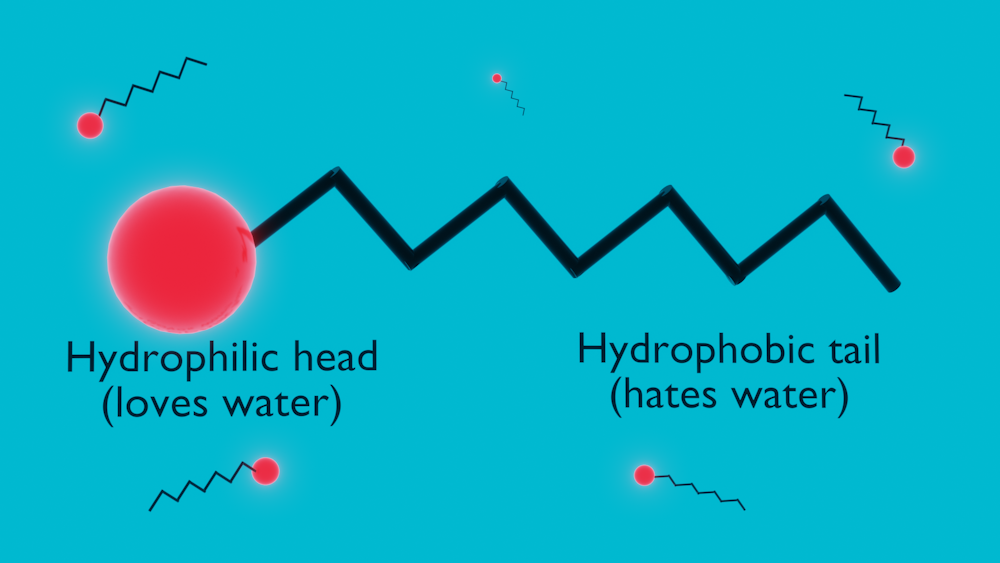
Surfactant stands for surface active agent. These molecules looked at their hydrophilic and hydrophobic brethren and said, why not both? They are typically comprised of two ends: a head group that is hydrophilic and a tail that is hydrophobic.
A surfactant has a head that is hydrophilic and a tail that is hydrophobic. Daniel Eldridge
When a small amount of surfactant is added to water, the two ends of the molecule have competing interests. The hydrophilic head wants to be in the water, but the hydrophobic tail can’t stand water.
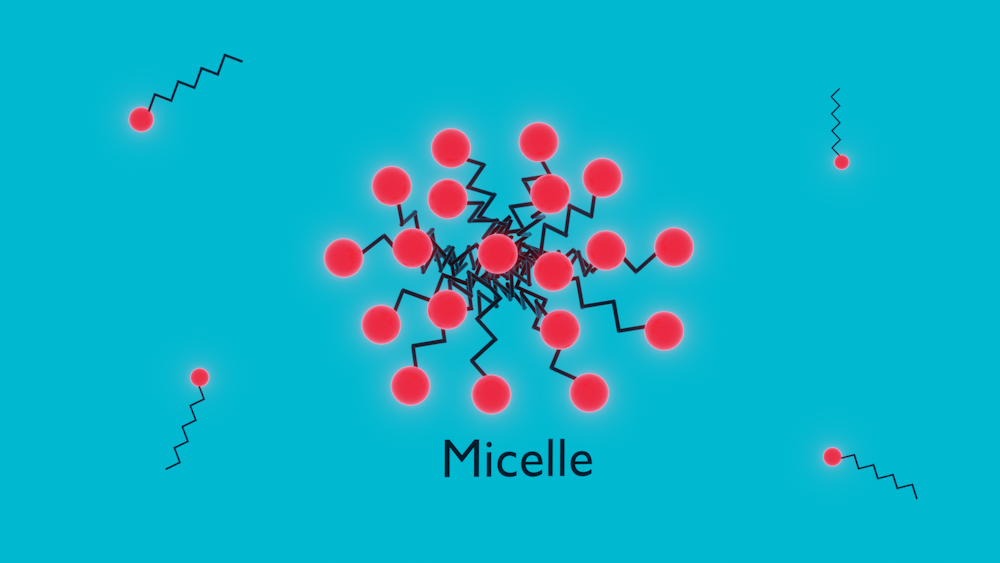
Add enough surfactant and, eventually, we will pass a critical micelle concentration and the surfactants will self-assemble into clusters of approximately 20 to 100 surfactant molecules.
All the hydrophilic heads will be pointing outwards, while the hydrophobic tails remain “hidden” at the centre. These clusters are micelles.
Surfactant molecules arrange themselves into a micelle, with the hydrophilic heads pointing outwards and the hydrophobic tails pointing inwards. Daniel Eldridge
These micelles have a hydrophilic exterior, meaning that they are very happy to remain mixed throughout water. However, in the centre remains a hydrophobic pocket that’s very good at attracting oils.
This is very handy, and helps explain why adding some detergent (a surfactant) to water will allow you to wash an oily saucepan. The surfactant first helps lift of the oil, and then the oil can remained mixed into the water, finding a new home in the hydrophobic centre of the micelle.
Micellar water in action
Surfactants are in your dishwashing detergent, your body wash, your shampoo, your toothpaste and even many foods. In all of these cases, they are there to help the water interact with the dirt and oils, and micellar water is no different.
When you apply some micellar water to a cotton pad, another convenient interaction occurs. The wet cotton is hydrophilic (loves water). Consequently, some of the micelles will unravel, with the hydrophilic heads being attracted to the wet cotton pad.
Now, sticking out from the surface will be a layer of hydrophobic tail groups. These hydrophobic tails cannot wait to attract themselves to makeup, sunscreen, oils, dirt, grease and other contaminants on your face.
As you sweep the cotton pad across your skin, these contaminants bind to the hydrophobic tails and are removed from the skin.
Some contaminants will also find themselves encapsulated in the hydrophobic centres of the micelle.
Either way, a cleaner surface is left behind.
Look at how a cotton wipe soaked in micellar water cleans up a small oil spill, in comparison to water alone.
So why shouldn’t I just use dishwashing detergent to wash my face?
Technically, that would work as detergent does indeed contain lots of micelle-forming surfactants.
But these particular surfactants would probably cause a lot of skin and eye irritation, while also damaging and drying out your skin. Not nice.
The surfactants in micellar water are chosen to be mild and well tolerated by most people’s skin. But micellar water isn’t the only skincare product to contain micelles. There are many other face-cleaning products that also make great use of surfactant molecules and work very well too.
Now, it’s not perfect. While it is effective at removing a wide range of contaminants, thick or heavy makeup might not come off easily with micellar water (you might need to do a more vigorous clean).
Some products say there is “zero residue”, although the fine print clearly states this refers to visible residue.
Many products also state there is no rinse off required. Surfactants will remain on your skin after product use, but for many people they don’t cause irritation. If your skin is feeling irritated after using a micellar water product, you can try rinsing afterwards or discontinuing use.
And as is the case with many cosmetic products, you should test it first on a small patch of skin before using it all over your face.
It’s an all too common situation – you’re busy cooking or baking to a recipe when you open the cupboard and suddenly realise you are missing an ingredient.
Unless you can immediately run to the shops, this can leave you scrambling for a substitute that can perform a similar function. Thankfully, such substitutes can be more successful than you’d expect.
There are a few reasons why certain ingredient substitutions work so well. This is usually to do with the chemistry and the physical features having enough similarity to the original ingredient to still do the job appropriately.
Let’s delve into some common ingredient substitutions and why they work – or need to be tweaked.
Oils versus butter
Both butter and oils belong to a chemical class called lipids. It encompasses solid, semi-solid and liquid fats.
In a baked product the “job” of these ingredients is to provide flavour and influence the structure and texture of the finished item. In cake batters, lipids contribute to creating an emulsion structure – this means combining two liquids that wouldn’t usually mix. In the baking process, this helps to create a light, fluffy crumb.
One of the primary differences between butter and oil is that butter is only about 80% lipid (the rest being water), while oil is almost 100% lipid. Oil creates a softer crumb but is still a great fat to bake with.
You can use a wide range of oils from different sources, such as olive oil, rice bran, avocado, peanut, coconut, macadamia and many more. Each of these may impart different flavours.
Other “butters”, such as peanut and cashew butter, aren’t strictly butters but pastes. They impart different characteristics and can’t easily replace dairy butter, unless you also add extra oil.
Nut ‘butters’ can’t replace dairy butter because their composition is too different. congerdesign/Pixabay
Aquafaba or flaxseed versus eggs
Aquafaba is the liquid you drain from a can of legumes – such as chickpeas or lentils. It contains proteins, kind of how egg white also contains proteins.
The proteins in egg white include albumins, and aquafaba also contains albumins. This is why it is possible to make meringue from egg whites, or from aquafaba if you’re after a vegan version.
The proteins act as a foam stabiliser – they hold the light, airy texture in the product. The concentration of protein in egg white is a bit higher, so it doesn’t take long to create a stable foam. Aquafaba requires more whipping to create a meringue-like foam, but it will bake in a similar way.
Another albumin-containing alternative for eggs is flaxseed. These seeds form a thick gel texture when mixed with a little water. The texture is similar to raw egg and can provide structure and emulsification in baked recipes that call for a small amount of egg white.
Lemon plus dairy versus buttermilk
Buttermilk is the liquid left over after churning butter – it can be made from sweet cream, cultured/sour cream or whey-based cream. Buttermilk mostly contains proteins and fats.
Cultured buttermilk has a somewhat tangy flavour. Slightly soured milk can be a good substitute as it contains similar components and isn’t too different from “real” buttermilk, chemically speaking.
One way to achieve slightly soured milk is by adding some lemon juice or cream of tartar to milk. Buttermilk is used in pancakes and baked goods to give extra height or volume. This is because the acidic (sour) components of buttermilk interact with baking soda, producing a light and airy texture.
Buttermilk can also influence flavour, imparting a slightly tangy taste to pancakes and baked goods. It can also be used in sauces and dressings if you’re looking for a lightly acidic touch.
Honey is a complex sugar-based syrup that includes floral or botanical flavours and aromas. Honey can be used in cooking and baking, adding both flavour and texture (viscosity, softness) to a wide range of products.
If you add honey instead of regular sugar in baked goods, keep in mind that honey imparts a softer, moister texture. This is because it contains more moisture and is a humectant (that is, it likes to hold on to water). It is also less crystalline than sugar, unless you leave it to crystallise.
The intensity of sweetness can also be different – some people find honey is sweeter than its granular counterpart, so you will want to adjust your recipes accordingly.
Honey has a complex flavour and can taste sweeter than regular sugar. estelheitz/Pixabay
Gluten-free versus regular flour
Sometimes you need to make substitutions to avoid allergens, such as gluten – the protein found in cereal grains such as wheat, rye, barley and others.
Unfortunately, gluten is also the component that gives a nice, stretchy, squishy quality to bread.
To build this characteristic in a gluten-free product, it’s necessary to have a mixture of ingredients that work together to mimic this texture. Common ingredients used are corn or rice flour, xanthan gum, which acts as a binder and moisture holder, and tapioca starch, which is a good water absorbent and can aid with binding the dough.
When the first cane toads were brought from South America to Queensland in 1935, many of the parasites that troubled them were left behind. But deep inside the lungs of at least one of those pioneer toads lurked small nematode lungworms.
Almost a century later, the toads are evolving and spreading across the Australian continent. In new research published in Proceedings of the Royal Society B, we show that the lungworms too are evolving: for reasons we do not yet understand, worms taken from the toad invasion front in Western Australia are better at infecting toads than their Queensland cousins.
An eternal arms race
Nematode lungworms are tiny threadlike creatures that live in the lining of a toad’s lung, suck its blood, and release their eggs through the host’s digestive tract. The larva that hatch in the toad’s droppings lie in wait for a new host to pass by, then penetrate through its skin and migrate through the amphibian’s body to find the lungs and settle into a comfortable life, and begin the cycle anew.
Parasites and their hosts are locked into an eternal arms race. Any characteristic that makes a parasite better at finding a new host, setting up an infection, and defeating the host’s attempts to destroy it, will be favoured by natural selection.
Over generations, parasites get better and better at infecting their hosts. But at the same time, any new trick that enables a host to detect, avoid or repel the parasites is favored as well.
So it’s a case of parasites evolving to infect, and hosts evolving to defeat that new tactic. Mostly, parasites win because they have so many offspring and each generation is very short. As a result, they can evolve new tricks faster than the host can evolve to fight them.
The march of the toads
The co-evolution between hosts and parasites is most in sync among the ones in the same location, because they encounter each other most regularly. A parasite is usually better able to infect hosts from the local population it encounters regularly than those from a distant population.
But when hosts invade new territory, it can play havoc with the evolutionary matching between local hosts and parasites.
Since cane toads were released into the fields around Cairns in 1935, the toxic amphibians have hopped some 2,500 kilometres westwards and are currently on the doorstep of Broome. And they have changed dramatically along the way.
The Queensland toads are homebodies and spend their lives in a small area, often reusing the same shelter night after night. As a result, their populations can build up to high densities.
For a lungworm larva, having lots of toads in a small area, reusing and sharing shelter sites, makes it simple to find a new host. But at the invasion front (currently in Western Australia), toads are highly mobile, moving over a kilometre per night when conditions permit, and rarely spending two nights in the same place.
At the forefront of the invasion, toads are few and far between. A lungworm larva at the invasion front, waiting in the soil for a toad to pass by, will have few opportunities to encounter and infect a new host.
Lungworms from the invasion front
When hosts are rare, we expect the parasite will evolve to get better at infecting the ones it does encounter, because it is unlikely to get a second chance.
To understand how this co-evolution is playing out between cane toads and their lungworms, we did some experiments pairing hosts and parasites from different locations in Australia. What would happen when toad and lungworm strains that had been separated by 90 years of invasion were reintroduced to each other?
To study this we collected toads from different locations, bred them in captivity and reared the offspring in the lab under common conditions. We then exposed them to 50 lungworm larvae from a different area of the range, waited four months for infections to develop, then killed the toads and counted how many adult worms had successfully established in their lungs.
As expected, worms from the invasion front were best at infecting toads, not just their local ones. Behind the invasion front, in intermediate and old populations we found that hosts were able to fight their local parasites better than those from distant populations.
While we saw dramatic differences in infection outcomes, we have yet to determine what biochemical mechanisms caused the differences and how changes in genetic variation of host and parasite populations might have shaped them.
ABOARD THE SOUNDGUARDIAN, Lake Washington — The region's cold, watery heart is nestled between Seattle and the Eastside.
It uniquely supports two major roadways atop floating bridges, has offered beachgoers a summertime respite for decades and is central to the identity of the Seattle area's culture.
But Lake Washington is changing — by over half a degree Fahrenheit each recent decade.
In fact, since 1963, the lake's surface from June to September has warmed about 4.3 degrees, according to data collected and analyzed by King County and the University of Washington.
ORLANDO, Fla. — NASA was riding a high after the overall success of Artemis I when the uncrewed rocket made a test run to the moon and back in 2022, so the message remained full steam ahead to push for a crewed Artemis II flight in 2024 and the return of humans to the moon in 2025.
But under the surface were issues, and the sheen of success hit reality, prompting NASA to delay Artemis’ first human spaceflight until no earlier than September 2025, and then pushing the moon landing until at least one year later.
Nurse midwife Beverly Maldonado recalls a pregnant woman arriving at Ascension Saint Agnes Hospital in Maryland after her water broke.
It was weeks before the baby would have any chance of survival, and the patient’s wishes were clear, she recalled: “Why am I staying pregnant then? What’s the point?” the patient pleaded.
But the doctors couldn’t intervene, she said.
The fetus still had a heartbeat and it was a Catholic hospital, subject to the “Ethical and Religious Directives for Catholic Health Care Services” that prohibit or limit procedures like abortion that the church deems “immoral."