Whether it’s part of a New Year’s resolution or just following doctor’s orders, ditching cigarettes is easier said than done. And while nicotine gum has long been available to help soothe the withdrawal cravings, a quitter could be better off vaping instead as a stop-gap, according to the results of a clinical trial published by the American Medical Association. Smokers who turned to e-cigarettes to help them stop smoking were more likely to have stayed quit after 6 months than those who chewed gum, according to the research team, which included Queen Mary University in London and Peking Unive...
Micellar water, a product found in supermarkets, chemists and bathroom cabinets around the world, is commonly used to remove make-up. It’s a very effective cleanser and many people swear by it as part of their skincare routine.
So, what is micellar water and why is it so good at getting makeup and sunscreen off? Here’s the science.
What are micelles?
Oil and water generally don’t mix, which is why you’ll struggle to remove makeup and sunscreen (which both contain oils) with just plain water.
But micellar water products contain something called micelles – clusters of molecules that are very effective at removing oily substances. To understand why, you need to first know two chemistry terms: hydrophilic and hydrophobic.
A hydrophilic substance “loves” water and mixes easily with it. Salt and sugar are examples.
A hydrophobic substance “hates” water and generally refuses to mix with it. Examples include oil and wax.
Hydrophilic materials will happily mix with other hydrophilic materials. The same goes for hydrophobic substances. But if you try to combine hydrophilic and hydrophobic materials, they won’t mix.
How are micelles formed? It’s all about surfactants
The micelles in micellar water are formed by special molecules known as surfactants.
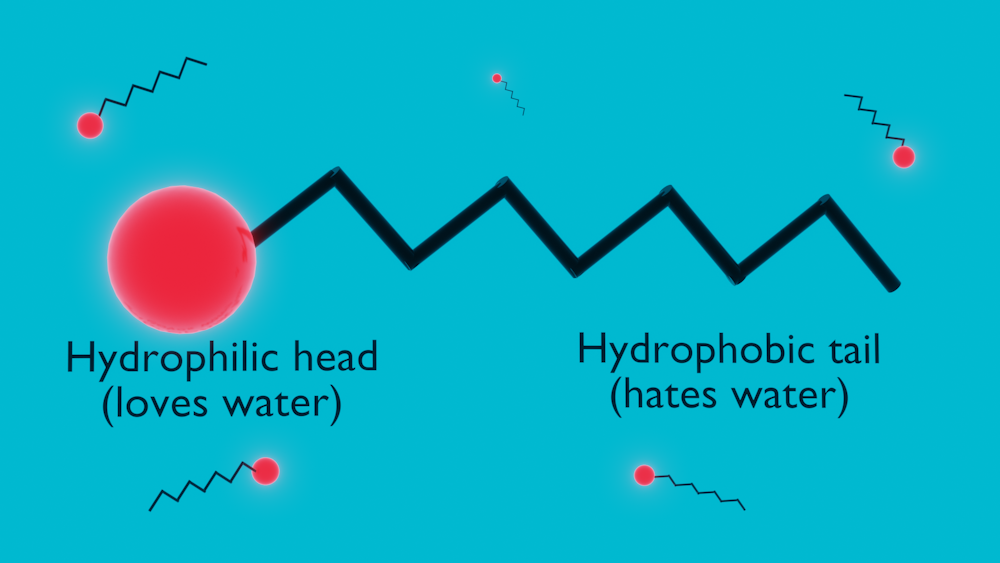
Surfactant stands for surface active agent. These molecules looked at their hydrophilic and hydrophobic brethren and said, why not both? They are typically comprised of two ends: a head group that is hydrophilic and a tail that is hydrophobic.
A surfactant has a head that is hydrophilic and a tail that is hydrophobic. Daniel Eldridge
When a small amount of surfactant is added to water, the two ends of the molecule have competing interests. The hydrophilic head wants to be in the water, but the hydrophobic tail can’t stand water.
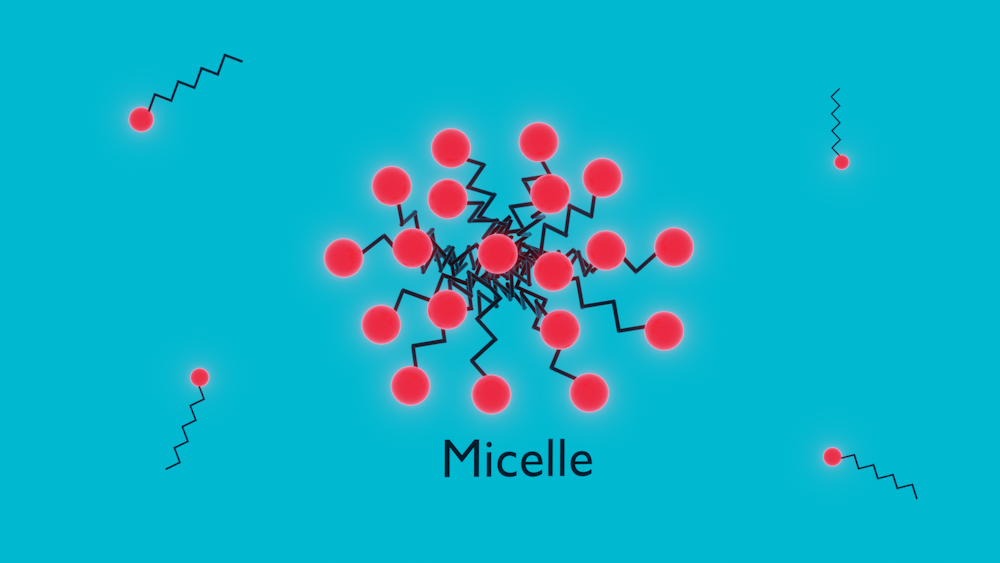
Add enough surfactant and, eventually, we will pass a critical micelle concentration and the surfactants will self-assemble into clusters of approximately 20 to 100 surfactant molecules.
All the hydrophilic heads will be pointing outwards, while the hydrophobic tails remain “hidden” at the centre. These clusters are micelles.
Surfactant molecules arrange themselves into a micelle, with the hydrophilic heads pointing outwards and the hydrophobic tails pointing inwards. Daniel Eldridge
These micelles have a hydrophilic exterior, meaning that they are very happy to remain mixed throughout water. However, in the centre remains a hydrophobic pocket that’s very good at attracting oils.
This is very handy, and helps explain why adding some detergent (a surfactant) to water will allow you to wash an oily saucepan. The surfactant first helps lift of the oil, and then the oil can remained mixed into the water, finding a new home in the hydrophobic centre of the micelle.
Micellar water in action
Surfactants are in your dishwashing detergent, your body wash, your shampoo, your toothpaste and even many foods. In all of these cases, they are there to help the water interact with the dirt and oils, and micellar water is no different.
When you apply some micellar water to a cotton pad, another convenient interaction occurs. The wet cotton is hydrophilic (loves water). Consequently, some of the micelles will unravel, with the hydrophilic heads being attracted to the wet cotton pad.
Now, sticking out from the surface will be a layer of hydrophobic tail groups. These hydrophobic tails cannot wait to attract themselves to makeup, sunscreen, oils, dirt, grease and other contaminants on your face.
As you sweep the cotton pad across your skin, these contaminants bind to the hydrophobic tails and are removed from the skin.
Some contaminants will also find themselves encapsulated in the hydrophobic centres of the micelle.
Either way, a cleaner surface is left behind.
Look at how a cotton wipe soaked in micellar water cleans up a small oil spill, in comparison to water alone.
So why shouldn’t I just use dishwashing detergent to wash my face?
Technically, that would work as detergent does indeed contain lots of micelle-forming surfactants.
But these particular surfactants would probably cause a lot of skin and eye irritation, while also damaging and drying out your skin. Not nice.
The surfactants in micellar water are chosen to be mild and well tolerated by most people’s skin. But micellar water isn’t the only skincare product to contain micelles. There are many other face-cleaning products that also make great use of surfactant molecules and work very well too.
Now, it’s not perfect. While it is effective at removing a wide range of contaminants, thick or heavy makeup might not come off easily with micellar water (you might need to do a more vigorous clean).
Some products say there is “zero residue”, although the fine print clearly states this refers to visible residue.
Many products also state there is no rinse off required. Surfactants will remain on your skin after product use, but for many people they don’t cause irritation. If your skin is feeling irritated after using a micellar water product, you can try rinsing afterwards or discontinuing use.
And as is the case with many cosmetic products, you should test it first on a small patch of skin before using it all over your face.
It’s an all too common situation – you’re busy cooking or baking to a recipe when you open the cupboard and suddenly realise you are missing an ingredient.
Unless you can immediately run to the shops, this can leave you scrambling for a substitute that can perform a similar function. Thankfully, such substitutes can be more successful than you’d expect.
There are a few reasons why certain ingredient substitutions work so well. This is usually to do with the chemistry and the physical features having enough similarity to the original ingredient to still do the job appropriately.
Let’s delve into some common ingredient substitutions and why they work – or need to be tweaked.
Oils versus butter
Both butter and oils belong to a chemical class called lipids. It encompasses solid, semi-solid and liquid fats.
In a baked product the “job” of these ingredients is to provide flavour and influence the structure and texture of the finished item. In cake batters, lipids contribute to creating an emulsion structure – this means combining two liquids that wouldn’t usually mix. In the baking process, this helps to create a light, fluffy crumb.
One of the primary differences between butter and oil is that butter is only about 80% lipid (the rest being water), while oil is almost 100% lipid. Oil creates a softer crumb but is still a great fat to bake with.
You can use a wide range of oils from different sources, such as olive oil, rice bran, avocado, peanut, coconut, macadamia and many more. Each of these may impart different flavours.
Other “butters”, such as peanut and cashew butter, aren’t strictly butters but pastes. They impart different characteristics and can’t easily replace dairy butter, unless you also add extra oil.
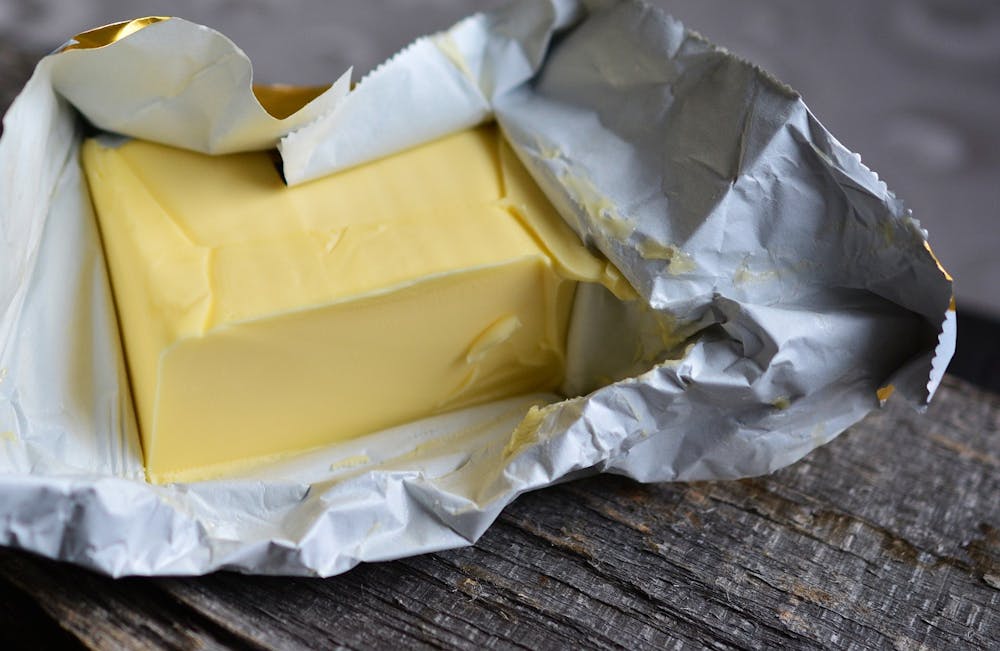
Nut ‘butters’ can’t replace dairy butter because their composition is too different. congerdesign/Pixabay
Aquafaba or flaxseed versus eggs
Aquafaba is the liquid you drain from a can of legumes – such as chickpeas or lentils. It contains proteins, kind of how egg white also contains proteins.
The proteins in egg white include albumins, and aquafaba also contains albumins. This is why it is possible to make meringue from egg whites, or from aquafaba if you’re after a vegan version.
The proteins act as a foam stabiliser – they hold the light, airy texture in the product. The concentration of protein in egg white is a bit higher, so it doesn’t take long to create a stable foam. Aquafaba requires more whipping to create a meringue-like foam, but it will bake in a similar way.
Another albumin-containing alternative for eggs is flaxseed. These seeds form a thick gel texture when mixed with a little water. The texture is similar to raw egg and can provide structure and emulsification in baked recipes that call for a small amount of egg white.
Lemon plus dairy versus buttermilk
Buttermilk is the liquid left over after churning butter – it can be made from sweet cream, cultured/sour cream or whey-based cream. Buttermilk mostly contains proteins and fats.
Cultured buttermilk has a somewhat tangy flavour. Slightly soured milk can be a good substitute as it contains similar components and isn’t too different from “real” buttermilk, chemically speaking.
One way to achieve slightly soured milk is by adding some lemon juice or cream of tartar to milk. Buttermilk is used in pancakes and baked goods to give extra height or volume. This is because the acidic (sour) components of buttermilk interact with baking soda, producing a light and airy texture.
Buttermilk can also influence flavour, imparting a slightly tangy taste to pancakes and baked goods. It can also be used in sauces and dressings if you’re looking for a lightly acidic touch.
Honey is a complex sugar-based syrup that includes floral or botanical flavours and aromas. Honey can be used in cooking and baking, adding both flavour and texture (viscosity, softness) to a wide range of products.
If you add honey instead of regular sugar in baked goods, keep in mind that honey imparts a softer, moister texture. This is because it contains more moisture and is a humectant (that is, it likes to hold on to water). It is also less crystalline than sugar, unless you leave it to crystallise.
The intensity of sweetness can also be different – some people find honey is sweeter than its granular counterpart, so you will want to adjust your recipes accordingly.
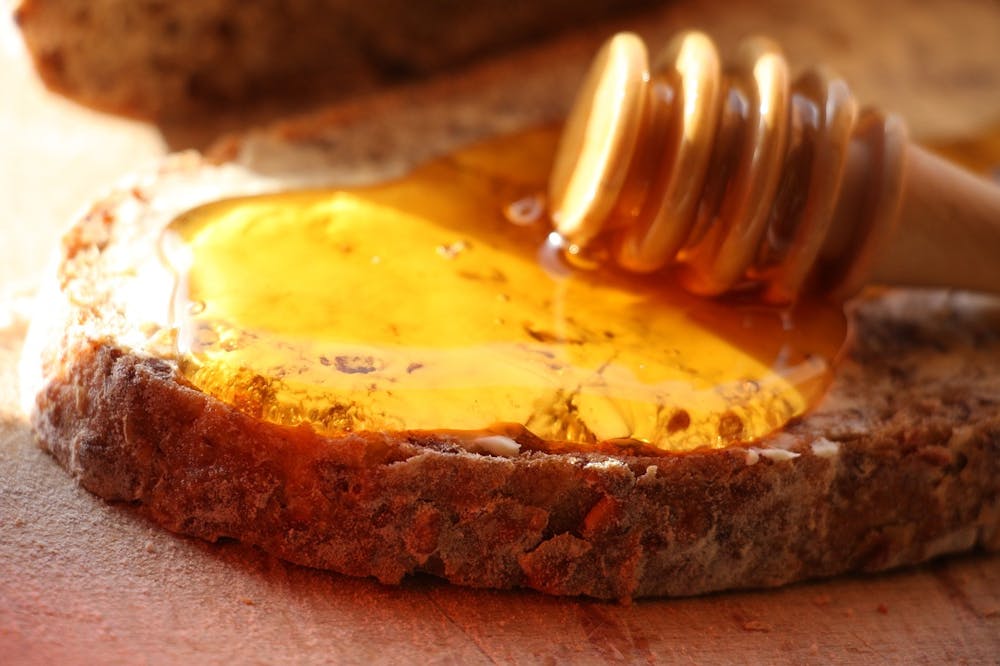
Honey has a complex flavour and can taste sweeter than regular sugar. estelheitz/Pixabay
Gluten-free versus regular flour
Sometimes you need to make substitutions to avoid allergens, such as gluten – the protein found in cereal grains such as wheat, rye, barley and others.
Unfortunately, gluten is also the component that gives a nice, stretchy, squishy quality to bread.
To build this characteristic in a gluten-free product, it’s necessary to have a mixture of ingredients that work together to mimic this texture. Common ingredients used are corn or rice flour, xanthan gum, which acts as a binder and moisture holder, and tapioca starch, which is a good water absorbent and can aid with binding the dough.
When the first cane toads were brought from South America to Queensland in 1935, many of the parasites that troubled them were left behind. But deep inside the lungs of at least one of those pioneer toads lurked small nematode lungworms.
Almost a century later, the toads are evolving and spreading across the Australian continent. In new research published in Proceedings of the Royal Society B, we show that the lungworms too are evolving: for reasons we do not yet understand, worms taken from the toad invasion front in Western Australia are better at infecting toads than their Queensland cousins.
An eternal arms race
Nematode lungworms are tiny threadlike creatures that live in the lining of a toad’s lung, suck its blood, and release their eggs through the host’s digestive tract. The larva that hatch in the toad’s droppings lie in wait for a new host to pass by, then penetrate through its skin and migrate through the amphibian’s body to find the lungs and settle into a comfortable life, and begin the cycle anew.
Parasites and their hosts are locked into an eternal arms race. Any characteristic that makes a parasite better at finding a new host, setting up an infection, and defeating the host’s attempts to destroy it, will be favoured by natural selection.
Over generations, parasites get better and better at infecting their hosts. But at the same time, any new trick that enables a host to detect, avoid or repel the parasites is favored as well.
So it’s a case of parasites evolving to infect, and hosts evolving to defeat that new tactic. Mostly, parasites win because they have so many offspring and each generation is very short. As a result, they can evolve new tricks faster than the host can evolve to fight them.
The march of the toads
The co-evolution between hosts and parasites is most in sync among the ones in the same location, because they encounter each other most regularly. A parasite is usually better able to infect hosts from the local population it encounters regularly than those from a distant population.
But when hosts invade new territory, it can play havoc with the evolutionary matching between local hosts and parasites.
Since cane toads were released into the fields around Cairns in 1935, the toxic amphibians have hopped some 2,500 kilometres westwards and are currently on the doorstep of Broome. And they have changed dramatically along the way.
The Queensland toads are homebodies and spend their lives in a small area, often reusing the same shelter night after night. As a result, their populations can build up to high densities.
For a lungworm larva, having lots of toads in a small area, reusing and sharing shelter sites, makes it simple to find a new host. But at the invasion front (currently in Western Australia), toads are highly mobile, moving over a kilometre per night when conditions permit, and rarely spending two nights in the same place.
At the forefront of the invasion, toads are few and far between. A lungworm larva at the invasion front, waiting in the soil for a toad to pass by, will have few opportunities to encounter and infect a new host.
Lungworms from the invasion front
When hosts are rare, we expect the parasite will evolve to get better at infecting the ones it does encounter, because it is unlikely to get a second chance.
To understand how this co-evolution is playing out between cane toads and their lungworms, we did some experiments pairing hosts and parasites from different locations in Australia. What would happen when toad and lungworm strains that had been separated by 90 years of invasion were reintroduced to each other?
To study this we collected toads from different locations, bred them in captivity and reared the offspring in the lab under common conditions. We then exposed them to 50 lungworm larvae from a different area of the range, waited four months for infections to develop, then killed the toads and counted how many adult worms had successfully established in their lungs.
As expected, worms from the invasion front were best at infecting toads, not just their local ones. Behind the invasion front, in intermediate and old populations we found that hosts were able to fight their local parasites better than those from distant populations.
While we saw dramatic differences in infection outcomes, we have yet to determine what biochemical mechanisms caused the differences and how changes in genetic variation of host and parasite populations might have shaped them.
ABOARD THE SOUNDGUARDIAN, Lake Washington — The region's cold, watery heart is nestled between Seattle and the Eastside.
It uniquely supports two major roadways atop floating bridges, has offered beachgoers a summertime respite for decades and is central to the identity of the Seattle area's culture.
But Lake Washington is changing — by over half a degree Fahrenheit each recent decade.
In fact, since 1963, the lake's surface from June to September has warmed about 4.3 degrees, according to data collected and analyzed by King County and the University of Washington.
ORLANDO, Fla. — NASA was riding a high after the overall success of Artemis I when the uncrewed rocket made a test run to the moon and back in 2022, so the message remained full steam ahead to push for a crewed Artemis II flight in 2024 and the return of humans to the moon in 2025.
But under the surface were issues, and the sheen of success hit reality, prompting NASA to delay Artemis’ first human spaceflight until no earlier than September 2025, and then pushing the moon landing until at least one year later.
Nurse midwife Beverly Maldonado recalls a pregnant woman arriving at Ascension Saint Agnes Hospital in Maryland after her water broke.
It was weeks before the baby would have any chance of survival, and the patient’s wishes were clear, she recalled: “Why am I staying pregnant then? What’s the point?” the patient pleaded.
But the doctors couldn’t intervene, she said.
The fetus still had a heartbeat and it was a Catholic hospital, subject to the “Ethical and Religious Directives for Catholic Health Care Services” that prohibit or limit procedures like abortion that the church deems “immoral."
A stingray housed in a small-town aquarium in the United States is expecting offspring without ever having shared a tank with a male of her kind, making her not just a local sensation but a scientific curiosity.
Charlotte, who has been at the Aquarium & Shark Lab in Hendersonville, North Carolina for more than eight years, started showing an unusual growth on her body around late November. Staff were initially worried she might have a tumor.
"Her hump just started growing and growing, and we thought that it could be potentially cancer," Kinsley Boyette, the aquarium's assistant director and Charlotte's longtime caregiver, told AFP. Such cysts are known to sometimes form in the reproductive organs of rays when they don't mate.
The team performed an ultrasound and sent the results to scientists, who confirmed that Charlotte was carrying eggs. Subsequent scans even revealed tiny flapping tails.
Charlotte, a California round stingray thought to be 12- to 14-years-old, could give birth to her "pups" any day now (such virgin births being exceedingly rare, the gestation period might vary from the normal three to four months).
In any case, anticipation has been building in the local community.
After lengthy renovations, the aquarium reopened on Thursday, "and just about everybody coming through our door wanted to see Miss Charlotte -- it's very, very exciting," said Boyette.
- 'Loves the attention' -
Beyond her unusual pregnancy, Charlotte, who's around the size of a dinner plate and lives alongside five small sharks, charms members of the public with her winsome personality.
"I got in the tank with her this morning and she was just doing laps -- she was doing circles because we had a class here of kiddos and she absolutely loves the attention," said Boyette.
She said Charlotte would come up to the glass if approached and, when her favorite people enter the tank, enjoys cuddles.
She also loves crawfish -- an occasional treat -- along with her regular diet of shrimp, oysters and scallops.
"She's just a silly girl, she's very sweet," Boyette said.
Round stingrays hatch their eggs internally before giving birth to anywhere from one to four pups.
The odds of health issues and death rise in virgin births, experts say.
Charlotte now lives in a 2,200-gallon tank (8,300 liters) -- roughly the size of a small dumpster -- but since she is thought to be carrying up to four offspring, the aquarium hopes to be able to double the size of her tank if all goes well.
- Asexual reproduction -
The ability of breeding species to reproduce without male genetic contributions was long considered exceedingly rare, but in recent years has been documented in many vertebrates including birds, reptiles and fish -- though not mammals.
"To quote Jurassic Park, life finds a way," Bryan Legare, manager of the shark ecology program at the Center for Coastal Studies in Provincetown, Massachusetts told AFP.
Reproductively viable animals prevented from mating in captivity will sometimes undergo a process called parthenogenesis, he explained.
This means that small cells called "polar bodies," formed at the same time as eggs that normally disintegrate, instead go on to re-merge with the egg, providing the genetic material needed to create a viable embryo.
It's not clear how often it happens, Legare added: a case involving sharks or rays in aquariums gets reported every year or two. It may also happen in the wild, though this could not be confirmed without genetic testing.
Scientists note that while sexual reproduction is beneficial for evolution, it comes at the cost of first having to find a mate.
"With parthenogenesis, you see the advantage, you can be single on Valentine's Day," said Legare.
Coral reefs off the Florida Keys islands are struggling to recover from last summer's record-breaking heat wave, new data showed Thursday, in another sign of the devastating impacts of human-caused climate change.
The state's southern waters experienced hot tub-like conditions with temperatures in July briefly topping 100 degrees Fahrenheit (37.8C) in Manatee Bay.
Coral, marine invertebrates made up of individual animals called polyps, have a symbiotic relationship with the algae that live inside their tissue and provide their primary source of food.
When the water is too warm, coral expel their algae and turn white, an effect called "bleaching" that leaves them exposed to disease and at risk of dying off.
A team of National Oceanic and Atmospheric Administration (NOAA) researchers carried out a scientific mission to assess the heat wave's impacts, surveying 64 locations at five of the major reefs that make up most of the state's 255-mile- (410 kilometer-) long barrier reef, which is home to sea turtles, stingrays, sharks, dolphins, grouper and many more species of fish.
They found less than 22 percent of approximately 1,500 staghorn coral (Acropora cervicornis) -- a species that is listed as a candidate for endangered species protections -- remained alive.
Among the five reefs surveyed, living elkhorn coral (Acropora palmata), which is listed as threatened throughout its range, was found only at three sites.
"The findings from this assessment are critical to understanding the impacts to corals throughout the Florida Keys following the unprecedented marine heat wave," said NOAA's Sarah Fangman.
"They also offer a glimpse into coral's future in a warming world," she continued, adding the work would inform ongoing restoration efforts.
NOAA is leading an initiative to restore nearly 3 million square feet (280,000 square meters) of coral reef, the equivalent of more than 50 American football fields -- through growing and transplanating corals.
Florida's coral reefs are vital not just to their wider ecosystem but also for the state's tourism and recreation industries. But their health has been declining since the 1970s due to the impact of human activities, hurricanes, heat-induced bleaching and disease.
New research has discovered ultrasound waves can be used to improve the motility of sperm, with the breakthrough offering new hope for families around the world struggling to conceive. According to the study, out of Melbourne’s Monash University, using high-frequency ultrasound waves on sperm can boost their ability to swim by up to 266%. The university says about 30% of infertility comes down to low sperm motility, which means the sperm are not strong enough swimmers to make it through to the woman’s reproductive tract. Engineering researchers at Monash University have shown that 20 seconds o...
Rep. Marjorie Taylor Greene (R-GA) went on the warpath on Thursday against a medical professional who said COVID-19 vaccines saved millions of lives.
During a hearing on vaccine safety in the House of Representatives, Rep. Jamie Raskin (D-MD) asked Food and Drug Administration official Dr. Peter Marks to comment on the impact that the vaccines had on Americans' health after they began to be administered on a widespread basis in 2021 during the COVID-19 pandemic.
"It's estimated in the United States about 3.2 million lives [were saved] and it's estimated, globally, that COVID-19 vaccines saved over 14 million lives, conservatively," Marks testified.
Marks also noted the horrific toll that COVID-19 took on America, as the virus killed around 1.1 million Americans and, at its peak, was killing over 3,000 per day.
Shortly after this, however, Greene jumped in to accuse Marks of peddling false information.
"I'm not a doctor but I have a PhD in recognizing bulls--t when I hear it," the Georgia congresswoman declared.
"I'd like to point out to everyone that we knew early on ... that the people that were at risk of hospitalization and dying of COVID were those that were obese, had diabetes, were over the age of 65. We also knew the children were at no risk, practically zero risk, of being hospitalized or of death from COVID-19. We knew the young people, healthy young people, were not at risk. However, Dr. Marks, you rushed through this process of authorizing these vaccines even though you knew the side effects."
Ancient viruses that infected vertebrates hundreds of millions of years ago played a pivotal role in the evolution of our advanced brains and large bodies, a study said Thursday.
The research, published in the journal Cell, examined the origins of myelin, an insulating layer of fatty tissue that forms around nerves and allows electrical impulses to travel faster.
According to the authors, a gene sequence acquired from retroviruses -- viruses that invade their host's DNA -- is crucial for myelin production, and that code is now found in modern mammals, amphibians and fish.
"The thing I find the most remarkable is that all of the diversity of modern vertebrates that we know of, and the size they've achieved: elephants, giraffes, anacondas, bullfrogs, condors wouldn't have happened," senior author and neuroscientist Robin Franklin of Altos Labs-Cambridge Institute of Science told AFP.
In new research led by Tanay Ghosh, a computational biologist and geneticist in Franklin's lab, analysts trawled through genome databases to try to discover the genetics that were likely associated with the cells that produce myelin.
Specifically, he was interested in exploring mysterious "noncoding regions" of the genome that have no obvious function and were once dismissed as junk, but are now recognized as having evolutionary importance.
Ghosh's search landed upon a particular sequence derived from an endogenous retrovirus, long lurking in our genes, which the team dubbed "RetroMyelin."
To test their finding, researchers carried out experiments in which they knocked down the RetroMyelin sequence in rat cells, and found they no longer produced a basic protein required for myelin formation.
- Faster reactions, bigger bodies -
Next, they searched for RetroMyelin-like sequences in the genomes of other species, finding similar code in jawed vertebrates -- fellow mammals, birds, fish, reptiles and amphibians -- but not in jawless vertebrates or invertebrates.
This led them to believe the sequence appeared in the tree of life around the same time as jaws, which first evolved around 360 million years ago in the Devonian period, called the Age of Fishes.
"There's always been an evolutionary pressure to make nerve fibers conduct electrical impulses quicker," said Franklin. "If they do that quicker, then you can act quicker," he added, which is useful for both predators trying to catch things, and prey trying to flee.
Myelin enables rapid impulse conduction without widening the diameter of nerve cells, allowing them to be packed closer together.
It also provides structural support, meaning nerves can grow longer, allowing for longer limbs.
In myelin's absence, invertebrates have found other ways to transmit signals faster -- giant squids for example have evolved wider nerve cells.
Finally, the team wanted to learn whether the retroviral infection happened once, to a single ancestor species, or whether it happened more than once.
- More discoveries await? -
To answer this, they used computational methods to analyze the RetroMyelin sequences of 22 jawed vertebrate species, finding the sequences were more similar within than between species.
The finding suggested multiple waves of infection led to the diversity of vertebrate species we see today, the team said.
"One tends to think of viruses as pathogens, or disease causing agents," said Franklin.
But the reality is more complicated, he said: at various points in history retroviruses have entered the genome and integrated themselves into a species' reproductive cells, allowing them to be passed down to future generations.
One of the most well known examples is the placenta -- one of the defining characteristics of most mammals -- which we acquired from a pathogen embedded in our genome in the deep past.
Ghosh said the myelin finding could be just another step in an emerging field. "There are still a lot of things to understand still in terms of biology about how these sequences are driving different processes of evolution," he said.
A US spaceship attempting a lunar landing lifted off early Thursday from the Kennedy Space Center in Florida, the second such private-led effort this year after the first ended in failure.
Intuitive Machines, the Houston company leading mission "IM-1," hopes to become the first non-government entity to achieve a soft touchdown on the Moon, and to land the first US robot on the surface since the Apollo missions more than five decades ago.
Its hexagonal-shaped Nova-C lander named "Odysseus" blasted off on top of a SpaceX Falcon 9 rocket shortly after 1:00 am local time (0600 GMT).
IM-1 was supposed to blast off on Wednesday, but the launch was postponed after SpaceX discovered abnormal temperatures as it attempted to fuel up the lander.
Space agency NASA confirmed the lander had successfully lifted off.
"Confirmed: The Nova-C lander has separated and continues its trip to the Moon," NASA wrote on social media platform X.
The lander has a new type of supercooled liquid methane and oxygen engine giving it the power to reach its destination quickly, avoiding prolonged exposure to a region of high radiation surrounding the Earth known as the Van Allen belt.
Intuitive Machine's Trent Martin told reporters this week that the "opportunity to return the United States to the Moon for the first time since 1972 is a feat of engineering that demands a hunger to explore."
Despite the postponement, the craft is still due to reach its landing site Malapert A on February 22, an impact crater 300 kilometers (180 miles) from the south pole.
NASA hopes to eventually build a long-term presence and harvest ice there for both drinking water and rocket fuel under Artemis, its flagship Moon-to-Mars program.
NASA paid Intuitive Machines $118 million to ship science hardware to better understand and mitigate environmental risks for astronauts, the first of whom are scheduled to land no sooner than 2026.
There is more colorful cargo aboard as well, including a digital archive of human knowledge and 125 mini-sculptures of the Moon by the artist Jeff Koons.
After touchdown, the payloads are expected to run for roughly seven days before lunar night sets in on the south pole, rendering Odysseus inoperable.
- Treacherous terrain -
IM-1 is the second mission under a NASA initiative called Commercial Lunar Payload Services (CLPS), which the space agency created to delegate cargo services to the private sector to achieve savings and to stimulate a wider lunar economy.
The first, by Pittsburgh-based Astrobotic, launched in January, but its Peregrine spacecraft experienced an engine anomaly that caused a fuel leak and it was eventually brought back to burn up in Earth's atmosphere.
Soft landing a robot on the Moon is challenging because it has to navigate treacherous terrain with communications subject to a lag of several seconds, and use its thrusters for a controlled descent in the absence of an atmosphere that would support parachutes.
Apart from Astrobotic's failed attempt, two other private initiatives got close: Beresheet, operated by an Israeli nonprofit, crash-landed in 2019; while Japanese company ispace also had a "hard landing" last year.
Only five nations have succeeded: the Soviet Union was first, then the United States, which is still the only country to also put people on the surface.
In the United States's long absence, China has landed three times since 2013, India in 2023, and Japan was the latest, last month -- though its robot has struggled to stay powered on after a wonky touchdown left its solar panels pointing the wrong way.
Intuitive Machines has two additional launches scheduled for this year, while another Texas company, Firefly Aerospace has one too. Astrobotic will get another shot in late 2024, carrying a NASA rover to the Moon's south pole.
NASA is increasingly purchasing services rather than hardware from commercial partners, unlike during the Cold War when it had a nearly unlimited budget and dictated contracts down to the last bolt.