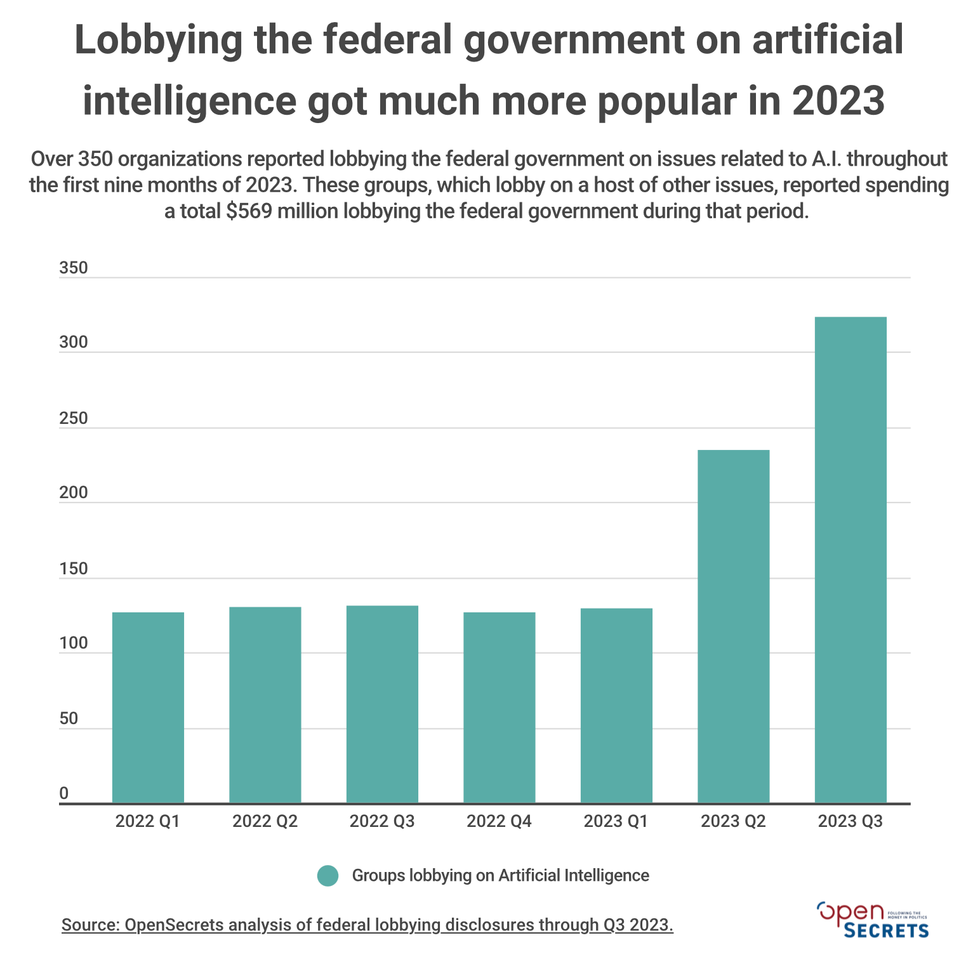
During the first nine months of 2023, lobbyists working for over 350 companies, nonprofits, universities, trade groups and other organizations have reported lobbying on issues related to AI – more than double the number of groups lobbying on AI issues over the entire prior year.
The tranche of lobbyists working on AI issues has grown throughout 2023 as well. From the first quarter of 2023 to the second quarter, the number of groups lobbying the federal government on AI jumped from 129 to 235, an 82% increase. The third quarter saw 323 groups doing the same, a 37% increase.
The year saw an explosion of competing consumer generative AI products, and significant advancements in the field have prompted attempts at regulation.
ALSO READ: Republican congressman violates federal law with botched cryptocurrency disclosures
In March, AI startup and industry leader OpenAI released its latest large language model GPT-4 to the public, which included a host of new features. The company says it performs better than its predecessors GPT-3.5 and GPT-3 on a multitude of tests, and its AI chatbot ChatGPT can use it to read images. The company also integrated web browsing, allowing ChatGPT to browse the internet instead of relying on a dataset frozen in time.
OpenAI did not report lobbying in the first nine months of 2023 and only recently registered as a lobbying client. Details of its lobbying activity will become available later this month.
Anthropic, an AI startup founded in 2021 by former employees of OpenAI, began lobbying the federal government in 2023. It spent $210,000 in the first nine months of 2023, lobbying for increased funding to the National Institute of Standards and Technology and for the CREATE AI Act, which would create a national AI research infrastructure including public tools and datasets.
The bipartisan legislation has prompted lobbying from academic institutions like Harvard, Princetonand Stanford. Stanford’s Institute for Human-Centered AI called the bill “necessary to America’s AI future” because it would help balance the concentration of AI resources and research, which is currently “dominated” by big tech.
Tech giants have thrown large sums of money toward AI investments as well as lobbying last year.
Microsoft invested $10 billion into OpenAI at the beginning of 2023, according to Bloomberg. The company released its own chatbot, Bing Chat, just a month later, which ran on OpenAI’s GPT-4.
Google, which released its chatbot Bard in 2023, invested $2 billion into Anthropic in October. Amazon invested $4 billion.
Bloomberg reports Apple will spend $1 billion on generative AI, and AI is reportedly Meta’s primary investment focus.
In total, the “big five” titans of the tech industry spent $55.5 million lobbying in the first nine months of 2023 on a host of different issues, including AI.
And there’s a lot to lobby on. Congress introduced at least 48 distinct bills regulating AI in 2023 alone, according to the Brennan Center for Justice, a nonprofit law and policy institute. None of the bills have been voted on by either chamber, and they can still be considered this year.
Microsoft cast the widest net, lobbying on at least 12 distinct bills related to AI. Google reported lobbying on four, and Meta and Amazon reported lobbying on three. Apple didn’t report lobbying on any specific AI bills, but lobbied on “Issues related to artificial intelligence and safety.”
Google, Microsoft and Meta lobbied on the AI Labeling Act of 2023. Introduced by Sens. Brian Schatz(D-Hawaii) and John Kennedy (R-La.), it would require AI-generated media to have “a clear and conspicuous” disclosure that the content is AI-generated, and the disclosure must be “permanent or unable to be easily removed by subsequent users.”
The companies have not publicly weighed in on the bill. However, they have individually taken private measures to regulate labeling or create tools to verify the source of content.
Google announced in a blog post ahead of releasing its image-generating AI that every photo created by it will contain information noting it was created by AI. Meta announced in November that any political ads on Instagram or Facebook must disclose if they were made using AI.
Microsoft is a founding partner of the Coalition for Content Provenance and Authenticity, or C2PA. The group’s goal is to create a way for content creators to disclose verified information about how the content was created. The open-source mechanism uses cryptography to encode and preserve metadata.
The AI Labeling bill was also lobbied on by the American Federation of Teachers, International Alliance Theatrical Stage Employees and U.S. Chamber of Commerce. Rep. Thomas Kean (R-NJ) introduced a version of the bill in the House last month.
Microsoft and Google also lobbied on the National AI Commission Act. The bipartisan bill was introduced by Reps. Ted Lieu (D-Calif.), Ken Buck (R-Colo.) and Anna Eshoo (D-Calif.) in June and would create a 20-person commission that advises the federal government on AI issues.
While tech giants have seldom commented on specific legislation, Google and Microsoft have published recommendations for how they want to see AI regulated.
Nonprofit and advocacy groups have also lobbied on legislation related to AI. The ACLU, for example, spent $760,000 lobbying in the first three quarters of 2023, which included lobbying on six bills that would regulate AI, like the Algorithmic Accountability Act of 2023.
Introduced with support from 11 Democratic Senators, the bill would direct the Federal Trade Commission to require impact assessments of algorithms that make decisions in areas like housing, credit and education. Microsoft and the U.S. Chamber of Commerce also lobbied on it.
While the ACLU has not publicly commented on the bill specifically, it has written about the importance of “establishing laws and regulations that mandate robust auditing [of algorithmic systems] for equity, transparency, and accountability.” The AARP and National Fair Housing Alliance also reported lobbying on anti-discrimination AI policy.
The ACLU reportedly met with the White House to discuss how to hold companies in charge of AI accountable. While there haven’t been federal legislative strides in regulating AI, the executive branch has recently made moves to regulate AI.
In September, the White House secured voluntary agreements from big tech companies to a host of practices and principles aimed at managing the risks associated with AI.
In late October, President Joe Biden issued an executive order tackling many of the issues brought up in pending legislation. It directs the Department of Commerce to “develop guidance for content authentication and watermarking to clearly label AI generated content.” It also provides clear guidance on how “to keep AI algorithms from being used to exacerbate discrimination.”
Politico reported last week that the RAND Corporation, a prominent think tank, had a significant role in drafting parts of the executive order related to reporting and security requirements.
Multiple federal agencies are also considering if and how to regulate AI. The Department of Health and Human Services announced rules last week that regulate new AI tools in healthcare, which will go into effect in 2024.
The Federal Election Commission solicited public comments earlier in 2023 on whether some deceptive political uses of AI should be illegal. The U.S. Copyright Office is conducting a study regarding generative artificial intelligence and recently concluded its own public comment period.
States have also been introducing their own AI legislation. Axios reported that as of late September, about 200 AI-related bills were introduced in state legislatures in 2023, with at least 14 becoming law. Most were in Democratic states and focused on tackling deepfakes and regulating how state governments themselves can use AI. Politico reported that tech lobbyists have been active at influencing bills in state legislatures as a way to “stave off more serious restrictions nationwide.”
OpenSecrets is a nonpartisan, independent and nonprofit research and news organization tracking money in U.S. politics and its effect on elections and public policy.