A House Republican-sponsored bill to force the sale to a U.S. company passed by a wide, bipartisan margin on Wednesday. If it passes in the Senate, and President Joe Biden signs it, Mnuchin, like Elon Musk and Donald Trump, could be in charge of a company whose algorithms affect what information Americans see, how that information is framed, and by whom. Mnuchin just last week said he would be open to working in a second Trump administration.
The House bill, which passed in a 352-65 vote, was sponsored by U.S. Rep. Mike Gallagher (R-WI). Explaining what he said was the need for the legislation, which would ban TikTok in the U.S. if it is not sold to an American company, is its strong impact on younger Americans.
Sky News reported Gallagher "insists there is a need to ban the app because it's 'becoming the dominant news platform for Americans under 30'."
"Mnuchin was in the admin[istration] when Trump initially sought to ban TikTok from U.S. app stores. He argued back then that it should be sold to a U.S. company, while others advocated for an outright ban," noted CNN's Kaitlin Collins.
Critics are expressing great concern.
"If you're worried about what the Chinese might do with that video of your puppy wait until you see what a Trump Administration would do with the intel community, law enforcement, your privacy rights, to anyone who spoke out against him, in coordination w/right wing tech moguls," warned foreign policy, national security, and political affairs analyst and commentator David Rothkopf.
Media Matters' Andrew Lawrence sarcastically wrote on X, "rest easy everyone, instead of china exploiting your info itll just be a bunch of former trump admin goblins doing it instead." He added, "i dont think congress should force an influential social media app to be sold to their political cronies."
BBC political political analyst Mary Anne Marsh wrote, also sarcastically, "Oh, so the Saudis and China can control @tiktok_us. No national security concerns whatsoever…I mean the Saudis only gave Mnuchin $1 billion then gave @jaredkushner $2 billion when they walked out of the @WhiteHouse…"
Attorney Luppe B. Luppen, co-author of a book on the future of the Democratic Party, observed: "Having seen what happens when a Trump-aligned rich guy buys a social media network, I would not want my government to have a hand in bringing that about again."
Harvard Law Cyberlaw Clinic Instructor Alejandra Caraballo posited, "Ask yourself why Republicans keep lining up to try and buy Tiktok. Larry Ellison at Oracle, Bobby Kotick, and now Trump treasury secretary Steve Mnuchin. They want to weaponize it to push conservative views like Elon and Dems are complicit in it."
Democratic strategist and senior advisor to former Obama cabinet secretary Julian Castro said, "Democrats shouldn’t help Republicans force the sale of another major media platform to right-wing billionaires."
The bill’s fate in the Senate is unclear. It’s also unclear whether any resulting legislation would survive a court challenge.
On May 17, 2023, Montana Gov. Greg Gianforte signed legislation banning TikTok in the state, the first total ban by a U.S. state government. The law would impose fines of US$10,000 per day on any app store that offers TikTok and on the app-maker itself if it operates in the state. Individual users would not be subject to penalties. The law was scheduled to go into effect Jan. 1, 2024, but a federal judge blocked it pending a trial to determine whether the state overstepped its authority and whether the law violates the First Amendment.
The federal government, along with many state and foreign governments and some companies, has already banned TikTok on work-provided phones. This type of ban can be effective for protecting data related to government work.
But a full national ban of the app is another matter, which raises a number of questions: What data privacy risk does TikTok pose? What could the Chinese government do with data collected by the app? Is its content recommendation algorithm dangerous? Is it legal for a government to impose a total ban on the app? And is it even possible to ban an app?
Governments around the world have been banning TikTok on government-issued phones.
Vacuuming up data
As a cybersecurity researcher, I’ve noted that every few years, a newly popular mobile app raises issues of security, privacy and data access.
Apps collect data for several reasons. Sometimes the data is used to improve the app for users. However, most apps collect data that the companies use in part to fund their operations. This revenue typically comes from targeting users with ads based on the data they collect. The questions this use of data raises are: Does the app need all this data? What does it do with the data? And how does it protect the data from others?
So what makes TikTok different from the likes of Pokemon-GO, Facebook or even your phone itself? TikTok’s privacy policy, which few people read, is a good place to start. Overall, the company is not particularly transparent about its practices. The document is too long to list here all the data it collects, which should be a warning.
There are a few items of interest in TikTok’s privacy policy besides the information you give them when you create an account – name, age, username, password, language, email, phone number, social media account information and profile image – that are concerning. This information includes location data, data from your clipboard, contact information, website tracking, plus all data you post and messages you send through the app. The company claims that current versions of the app do not collect GPS information from U.S. users.
If the data does end up in the hands of the Chinese government, the question is how could it use the data to its benefit. The government could share it with other companies in China to help them profit, which is no different than U.S. companies sharing marketing data. The Chinese government is known for playing the long game, and data is power, so if it is collecting data, it could take years to learn how it benefits China.
One potential threat is the Chinese government using the data to spy on people, particularly people who have access to valuable information. The Justice Department is investigating TikTok’s parent company, ByteDance, for using the app to monitor U.S. journalists. The Chinese government has an extensive history of hacking U.S. government agencies and corporations, and much of that hacking has been facilitated by social engineering – the practice of using data about people to trick them into revealing more information.
The second issue that the U.S. government has raised is algorithm bias or algorithm manipulation. TikTok and most social media apps have algorithms designed to learn a user’s interests and then try to adjust the content so the user will continue to use the app. TikTok has not shared its algorithm, so it’s not clear how the app chooses a user’s content.
The algorithm could be biased in a way that influences a population to believe certain things. There are numerous allegations that TiKTok’s algorithm is biased and can reinforce negative thoughts among younger users, and be used to affect public opinion. It could be that the algorithm’s manipulative behavior is unintentional, but there is concern that the Chinese government has been using or could use the algorithm to influence people.
TikTok’s algorithm for serving you videos has also become a source of concern.
Can a government ban an app?
The pending Montana law aims to use fines to coerce companies into enforcing its ban. It’s not clear if companies will comply, and it’s unlikely that this would deter users from finding workarounds.
Meanwhile, if the federal government comes to the conclusion that TikTok should be banned, is it even possible to ban it for all of its 149 million existing U.S. users? Any such ban would likely start with blocking the distribution of the app through Apple’s and Google’s app stores. This might keep many users off the platform, but there are other ways to download and install apps for people who are determined to use them.
A more drastic method would be to force Apple and Google to change their phones to prevent TikTok from running. While I’m not a lawyer, I think this effort would fail due to legal challenges, which include First Amendment concerns. The bottom line is that an absolute ban will be tough to enforce.
There are also questions about how effective a ban would be even if it were possible. By some estimates, the Chinese government has already collected personal information on at least 80% of the U.S. population via various means. So a ban might limit the damage going forward to some degree, but the Chinese government has already collected a significant amount of data. The Chinese government – along with anyone else with money – also has access to the large market for personal data, which fuels calls for stronger data privacy rules.
Are you at risk?
So as an average user, should you worry? Again, it is unclear what data ByteDance is collecting and if it can harm an individual. I believe the most significant risks are to people in power, whether it is political power or within a company. Their data and information could be used to gain access to other data or potentially compromise the organizations they are associated with.
The aspect of TikTok I find most concerning is the algorithm that decides what videos users see and how it can affect vulnerable groups, particularly young people. Independent of a ban, families should have conversations about TikTok and other social media platforms and how they can be detrimental to mental health. These conversations should focus on how to determine if the app is leading you down an unhealthy path.
This is an updated version of an article originally published on March 23, 2023, and updated on May 18, 2023.
An American company that paid an indicted FBI informant who testified in the Joe Bidenimpeachment inquiry has ties to a British company owned by associates of Donald Trump in Dubai, according to a new report.
The Guardian reported that business filings and court documents show Smirnov, who has been accused of lying to investigators about the president and his son Hunter Biden, was paid $600,000 in 2020 by a company called Economic Transformation Technologies (ETT), and the indictment shows that same year he started lying to the FBI about the Bidens.
ETT's chief executive is Christopher Condon, an American who is also one of three shareholders in ETT Investment Holding Limited in London.
The other two shareholders are Pakistani American investor Shahal Khan and Farooq Arjomand, a former chairman and current board member of Damac Properties in Dubai.
Arjomand and Khan have ties to Trump through some of his associates and Damac, a Middle Eastern developer who has partnered with the former president for a decade, and Trump describes Damac's former chairman Hussain Sajwani as a "friend” and a “great man," and their families have attended weddings, Mar-a-Lago parties and ribbon-cutting ceremonies together.
Sajwani attended the former president's 2016 inauguration, and Trump reported making up to $5 million in 2017 from a Damac licensing deal for the Trump International golf club in Dubai, and multiple reports show he and Sajwani continued discussing business into his presidency.
Khan is CEO of the "blank check company" BurTech Acquisition Group, while Patrick Orlando, a special adviser and shareholder for that public shell company, served as chief executive of another blank-check company, Digital World, when it began the process of merging with Trump Media & Technology Group – which could yield $4 billion in shares for Trump once it's finalized.
A former business associate told the Wall Street Journal last month that the $600,000 payment from ETT to Smirnov was for a stake in an Israel-based crypto trading platform, Bitoftrade, that Smirnov was involved in launching.
The Guardian reported that calls and emails to Condon, Arjomand, Sajwani, Smirnov’s lawyer and Trump's team were not returned, which Khan said he was "on the board for a very short period" but had no connection to the payment.
Smirnov is currently being held without bond after prosecutors argued that his contacts with officials associated with Russian intelligence and easy access to money made him a flight risk.
Dr. Gina Loudon, a television host who supports Donald Trump, said that women are at fault for the gender pay gap.
Axios reported this week that female White House workers made less than men on average.
The Axios report noted that, "White House women last year earned 80 cents per every dollar a White House man made," while citing "public White House employee salary data."
However, Loudon defended President Joe Biden's administration despite the pay gap.
"Yeah, I don't really particularly care if men are paid more than women," the Real America's Voice host said. "I think people should be paid based on their value, contribution, and merit to an organization."
"So I've said it before, I am a bona fide sexist," she continued. "I think I want to be valuable enough in my work environment that my boss wants to pay me what I'm worth."
Loudon insisted that the modern pay scales were fairer than they were "a long time ago."
"I still think that women should stop whining and just start spending time making their contributions even greater," she opined. "You know, it doesn't matter what industry you are in, there's some ism."
"Television is famous for being very sexist. And still I chose to do this work in television. So that's on me, in my personal opinion, that's on me."
The entire panel on MSNBC's "Morning Joe" pounced on Sen. Katie Britt (R-AL) for blowing off accusations she has been repeatedly lying about a sexual assault victim in an effort to malign President Joe Biden long before she brought it up in last week's State of the Union response.
After sharing a clip of Britt appearing on Sen Ted Cruz's podcast laughing it up about Saturday Night Live spoofing her "scary mom" act, co-host Joe Scarborough wondered why it is Republican lawmakers can't admit it when they are wrong.
"I don't think to this degree, but politicians will do this," the former GOP lawmaker explained. "They will tell stories, they will exaggerate."
"She blurred a lot of things together after she's caught red-handed trying to make something that happened during the [George W.] Bush administration; trying to attach that to Joe Biden and to say how could this happen in America. Basically in Joe Biden's America. It's cut and dried," he continued. "I'm a big believer, in this case, say, 'I screwed up. Forgive me, I won't do it again. But we do have a much bigger problem in the U.S.' People would be fine with that. I don't think she can do that, though."
"Now the news that is coming out that she's used that story several times," contributor Katty Kay interjected, "It's hard to believe she didn't know is a story that she has used multiple times and has become kind of part of her stump speech — it's hard to believe that she and her team didn't know was a story from back in the [Georg W.] Bush administration."
"Misleading is an understatement, guys," co-host Mika Brzezinski later offered. "The woman lied flat out, now she's doubling down."
House Republicans, frustrated with their inability to get any of their accusations of corruption aimed at President Joe Biden to stick, are now making plans to try to get the Justice Department to intercede on their behalf and file criminal charges against him.
After a series of public hearings held by House Oversight Committee Chair James Comer (R-KY) and House Judiciary Committee Chair Jim Jordan (R-OH) went nowhere and one of their key witnesses was arrested by the FBI for lying, House Republicans are regrouping and looking to "save face" according to the New York Times' Luke Broadwater.
According to the Times report, making criminal referrals aimed at Biden and his son Hunter Biden to the DOJ "would be largely symbolic" and would appear to be a bid to keep Donald Trump happy as he seeks a return to the Oval Office.
The report also added that "it would avoid a repeat of the humiliating process House Republicans, who have a tiny and dwindling majority, went through last month with the impeachment of Alejandro N. Mayorkas, the homeland security secretary."
Furthermore, Rep. Kelly Armstrong (R-ND) admitted there is little reason to believe a Biden impeachment is likely.
"There’s nothing that I’ve heard in the last couple of weeks that says that we are anywhere close to having the votes," he admitted.
Speaking on Fox News, Comer hinted the criminal referrals could sit and wait for a new administration — possibly headed by Trump.
“At the end of the day, what does accountability look like? It looks like criminal referrals. It looks like referring people to the Department of Justice,” Comer explained. “If Merrick Garland’s Department of Justice won’t take any potential criminal referrals seriously, then maybe the next president, with a new attorney general, will.”
The report added, "The potential change in strategy also comes as Republicans have lost seats in the House, making impeachment all the more unlikely. With the departure next week of Representative Ken Buck, Republican of Colorado, the party will be down to 218 votes in the House, a bare majority of the 435-member body."
MSNBC's Joe Scarborough ripped federal judge Aileen Cannon for even considering whether to dismiss the Mar-a-Lago classified documents case against Donald Trump.
The U.S. District Court judge will hear arguments Thursday morning on whether Trump had the authority under the Presidential Records Act to declassify and retain any government documents he wanted after leaving the White House, and the "Morning Joe" host cast doubt on Cannon's ethics.
"We'll see if the judge, who I guess desperately wants to be appointed something else by Donald Trump, will make the mistake she did before and then get absolutely excoriated by the 11th Circuit," Scarborough said.
That appeals court reversed a Cannon order in December 2022 to appoint a special master in the review of those classified documents seized by the FBI from the former president's private residence, finding that she had “improperly exercised equitable jurisdiction” in hearing the case, and Scarborough predicted that a dismissal would prompt a similar response.
"She can rule what she rules, but no court will uphold a preposterous argument," Scarborough said.
Trump's lawyers argue the main statute Trump has been charged with violating is unconstitutionally vague, and Trump told a friendly Newsmax host in an interview that he and his attorneys agreed he had the right to take anything he wanted from the White House.
"That's just not true, what he said," Scarborough said. "So let's just say that Donald Trump accidentally packed his shirts, golf shoes, and some classified documents and took it down, discovered it, and then said, 'Hey, I've got these things, you guys need to have them back.' No harm, no foul. They would have come to get them. In fact, that's exactly what happened in Joe Biden's case."
"Here, doesn't matter what he says on Newsmax or Fox," Scarborough added. "Here, he had the documents, he knew he had the documents. He lied to the FBI about the documents. They tried negotiating to get the documents back, he gave some of them back. In fact, he had his lawyers actually sign affidavits swearing the documents were back. Ended up, they were lying. He kept more documents, he then tried to get his IT guy to destroy the evidence, the IT guy refused. He then asked someone else to flood the IT room with water from the swimming pool. That guy refused, as well. They are now testifying against Donald Trump."
Wayward Republican pollster Sarah Longwell said on Thursday that former President Donald Trump is essentially waging psychological warfare against American voters by overloading their capacity to process outrage.
During an appearance on CNN, Longwell was asked about a recent column by the Financial Times' Edward Luce that argued about a dangerous acceptance and resignation among Americans about Trump's nonstop falsehoods.
"First of all, I think that's 100 percent right," Longwell began. "The psychology of people are just not built to take this."
She then made the point that, whether he knows it or not, Trump is employing tactics that have been used throughout history by leaders of authoritarian governments.
"One of the main tactics of autocrats and authoritarians is to exhaust people, right?" she said. "That's what they want you to be: They want you to be too exhausted to fight back. They want you to be too exhausted to parse through all the noise to figure out what's going on."
She then said that Trump's chaotic behavior gives President Joe Biden a key opportunity to make a focused case against the former president, who was impeached on two separate occasions and who faces criminal indictments in four separate jurisdictions.
"This is the time for Joe Biden and his campaign to roll out a thousand surrogates to go on offense against Donald Trump and say, 'You do not want this guy,'" she said. "You don't have to talk about each individual case. You've to say, 'This guy's running for president to stay out of jail, he's got [$500 million] plus in legal fees that he's going to raise from you.' Those are the kinds of things you do to sort of paint an overall picture."
President Joe Biden needled "loser" Donald Trump Wednesday, in his first battleground campaign stop since the two rivals secured their parties' nominations for what promises to be one of the most rancorous elections in US history.
Speaking to supporters in Milwaukee in the crucial swing state of Wisconsin, the Democrat also blasted his hard-right Republican nemesis for describing immigrants as "vermin."
The return to the campaign trail came a day after incumbent Biden, 81, and Trump, 77, both won enough delegates to clinch their parties' nominations for a rematch in November.
"A lot of you helped me in 2020 and we made sure he was a loser. And we're going to make sure that happens again, right?" Biden told local supporters and volunteers in Milwaukee -- the same city where Trump and his party will hold the Republican National Convention in July.
Biden has taken to repeatedly calling Trump a loser, knowing it rankles the defeated former president, who still refuses to acknowledge he lost four years ago.
Wisconsin and Michigan, which Biden will visit on Thursday, were among the crucial states he flipped from Trump in their 2020 showdown and needs to win again to secure a second term.
Biden took on Trump over immigration, a key issue in the election with the Republican resorting to increasingly hardline rhetoric as he bashes the Democrat over record numbers of people crossing the border from Mexico into the United States.
"We are a country of immigrants. They're not vermin," Biden said, referring to comments Trump made last year. Trump has also referred to immigrants "poisoning the blood of our country."
Biden also addressed the issue of marijuana reform, which he called a priority in his State of the Union speech last week and which Democrats identify as important as they seek crucial young and ethnic minority voters.
- 'Retribution' -
Earlier in Milwaukee, Biden unveiled over $3 billion in infrastructure investment to help "left behind" areas as he seeks to tout what he calls an "American comeback" for the economy.
Biden embarked late last week on a tour of battlegrounds states, buoyed by the fiery and well-received State of the Union address in which he again took aim at Trump.
The attacks underscored how bitter the next eight months of US politics promise to be, with the country's oldest ever pair of election candidates making no secret of the personal bitterness between them.
Both men lashed out at each other after their nomination wins on Tuesday.
Trump called Biden the "Worst, Most Incompetent, Corrupt and Destructive President in the History of the United States."
Biden assailed Trump's "campaign of resentment, revenge, and retribution" and branded him a threat to democracy.
If reelected, Trump has pledged to be a "dictator" for his first day in power, when he says he will shut the border, order oil drilling and release supporters jailed for the January 6, 2021 US Capitol attack.
He has also promised the biggest ever mass deportation of millions of undocumented immigrants.
The political divisions in Washington have meanwhile paralyzed US foreign policy, alarming allies around the world.
Trump's Republican allies in Congress are blocking Biden's request for $60 billion in vital military aid for Ukraine to fight Russia's invasion.
Trump has said he will not give a "penny" in military aid to support Ukraine and has encouraged Russian President Vladimir Putin to attack NATO allies that don't meet financial pledges.
Exactly three months ago, Republican Speaker of the House Mike Johnson moved his predecessor's impeachment inquiry of President Joe Biden into a full-blown, authorized impeachment investigation. He's not quite sure yet if there's enough evidence to actually impeach the President.
Democrats have repeatedly made the case President Joe Biden has committed no impeachable offenses, which was reinforced when Republicans' latest star witness was indicted for lying to the FBI about the very evidence he provided, evidence Republicans based their impeachment investigation 0n.
At least two Republican House committees have been planning the investigation into President Biden, his son Hunter, and other family members since November of 2022. When Republicans officially took control of the House in January of 2023, they began their work. Then-Speaker of the House Kevin McCarthy announced an impeachment inquiry, without a House vote, later that year, on September 12. On December 13, 2023, under Speaker Johnson, the House officially voted to formally authorize the current three-committee impeachment inquiry, "despite lack of evidence," as Reuters reported.
So after 15 months of investigations, is there enough evidence to impeach President Biden?
That is the question PBS NewsHour's Lisa Desjardins asked Speaker Johnson directly, on Wednesday.
Specifically, Desjardins reports, she asked Johnson if he "thinks there is enough evidence to impeach" President Biden.
Johnson says he hasn't had the time to figure it out.
“'I have not been able to take the time to do a deep dive' into the evidence," Johnson replied.
Punchbowl News' Max Cohen adds: "Amid confusion over the path forward for the Biden impeachment inquiry, Johnson won’t commit to me whether the House will vote on impeachment this Congress."
The Speaker "says [committees] still waiting on some documents," Cohen reports, noting Johnson said: “You've seen a very, very slow, deliberative investigative process.”
"Johnson," Cohen continues, "in a transparent impeachment admission, says 'because I've been so busy with all my other responsibilities, I haven’t been able to take the time to do the deep dive in the evidence.'"
Punchbowl News called it, "a pretty startling revelation from the top House Republican,” according to a report from Political Wire.
Democrats pounced on Johnson's remarks.
"Republicans' sham impeachment has uncovered an extensive body of exculpatory evidence that definitively disproves their lies about the President," wrote Joseph Costello, press secretary for the House Democrats on Chairman Jim Comer's Oversight Committee. "So it is indeed 'alarming' that House Republicans would spend millions and millions of taxpayer dollars to promote debunked lies."
Ian Mariani, communications director to U.S. Rep. Salud Carbajal (D-CA), said, "Mike Johnson breaking up with his party’s own sham impeachment with the classic 'I’m just…like…really busy right now.'"
He was impeached twice, found liable in fraud and sexual abuse lawsuits, charged with dozens of felonies and declared politically dead again and again -- but count Donald Trump out at your peril.
Eight months ahead of the US presidential election, and days before he is due to stand trial for alleged 2016 campaign finance violations, the Republican tycoon looks as strong politically as he ever has.
After winning his party's primary contest without really breaking a sweat, the scandal-prone 77-year-old is on course to contest a third straight election, and his second showdown with Democratic President Joe Biden.
Confident of avenging his defeat in 2020, Trump boasts polling leads in almost all of the swing states against Biden, who is only four years older but has struggled to allay concerns over his age.
Trump's detractors have watched with a mix of frustration, disbelief and awe over the years as the man whose downfall has been prognosticated ad nauseam has turned every scandal into campaign speech punchlines and fundraising dollars.
For Princeton University political scientist Julian Zelizer, the fact that Trump remains the only politician Republicans have thought worthy of leading them in the past decade is nothing short of "stunning."
"This is a unique moment where the party has embraced someone who has been in political trouble as president, legal trouble as post-president and who was a one-term president," he told AFP.
- 'Witch hunt' -
Deluged by lawsuits and buried under indictments from four different jurisdictions, Trump is frequently called "Teflon Don" -- a nickname first used for mobster John Gotti -- by US headline writers.
Through it all, the onetime real-estate magnate has been able to keep his supporters onside by playing the part of the heroic outsider -- targeted, in his words, by corrupt elites for his insurgent campaign to shake up politics on behalf of the forgotten millions.
The potency of Trump's victim narrative has been clear since his 2016 presidential campaign, when an old tape resurfaced capturing the ex-reality TV star boasting about using his celebrity status to get away with groping women.
Opinion leaders penned his political obituary, concluding that he had killed off any hope of winning the White House -- only to see him ascend, phoenix-like, from the embers of scandal to defeat Hillary Clinton.
It is a playbook to which he has returned amid the legal woes overshadowing his 2024 campaign, with the now-familiar denunciations of a "witch hunt" orchestrated by Biden and his cabal of "Marxists and fascists."
"They're not coming after me, they're coming after you -- and I'm just standing in their way," is a regular applause line at Trump rallies, where the crowds who pack arenas to see the former president are as large and loud as ever.
- Cracks in the Teflon? -
Yet for critics, it is still too early for Trump to be picking out new curtains for the Oval Office.
The tycoon may have sprung one of the biggest surprises in modern politics in 2016, but his "America First" movement has been blamed for Republican underachievement in almost every election since.
Nikki Haley -- Trump's last standing opponent before he bagged the Republican nomination -- repeatedly warned her party about his inability to broaden his appeal beyond his hard right, nativist base.
Bucking tradition, the 52-year-old withheld her endorsement when she bowed out after getting trounced in last week's multistate "Super Tuesday" voting.
Zelizer points out that come November, the man who has bragged that his supporters would eventually get "tired of winning" will face one of the few political foes he has never managed to beat.
And while Trump's legal troubles may not have impeded his march to the nomination, there is plenty of evidence in the polling that wavering voters would view a conviction in any of his criminal cases as disqualifying.
His trial for covering up alleged hush money payments to a porn star in 2016 begins on March 25 in New York, and -- if prosecutors get their way -- Trump will face further court dates in Florida, Georgia and Washington.
The ex-president -- whose career-long stock-in-trade in legal disputes has been to force delays -- is pinning his hopes on putting off some of these cases until an election victory that would greatly improve his chances of avoiding trial altogether.
But his chances of punting a verdict in New York into the post-election period are vanishingly small -- meaning that, one way or another, his famous Teflon coating will be put through its paces this year.
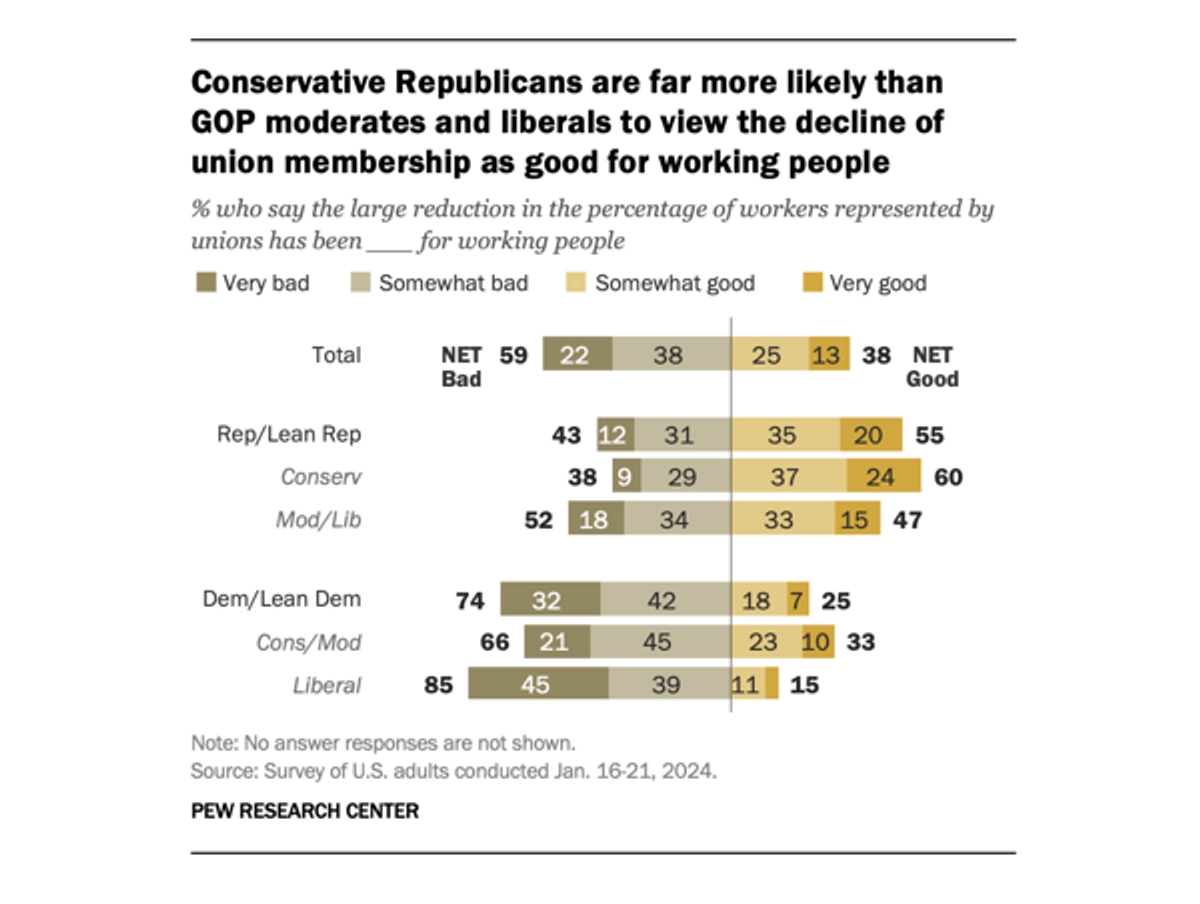
Most Americans think the declining number of unionized workers over the past few decades has been bad for the country, according to a poll released Tuesday from the Pew Research Center.
Pew found 54% of U.S. adults say the decline has been bad for the country, and 59% say it has been bad for working people. The center found 69% of Democrats think the decline has been bad for the country, and 40% of Republicans felt that way.
"A majority of conservative Republicans (60%) say the decline in organized labor membership has been at least somewhat good for working people, including 24% who say this has been very good," the report states. "Across ideological groups, large majorities of Democrats say the decline in the percentage of workers represented by unions has been bad for working people. But liberal Democrats (85%) are more likely than conservative and moderate Democrats (66%) to say this."
Union membership dropped to a record low last year—partially thanks to some red states limiting or banning the unionization of government workers. While recent reporting has tracked many stories of people fighting to unionize, only 10% of American adults belong to a union.
Unions have been shown to help reduce income inequality, they help raise the wages of nonunion members, and they can even improve life outside the workplace.
President Joe Biden and Republican presidential nominee Donald Trump have both been vying for the support of union workers to some degree, but Trump hasn't been received quite as welcomely as Biden.
"Donald Trump is a scab," United Auto Workers president Shawn Fain said in January when the union endorsed Biden. "Donald Trump is a billionaire, and that's who he represents. If Donald Trump ever worked in an auto plant, he wouldn't be a UAW member. He'd be a company man."
Polls have consistently shown in recent years that Americans support labor unions, so running as a supporter of unions could benefit a presidential nominee. Some Republicans, though, have urged Trump to stay as far away from unions as possible.
U.S. Sen. Bernie Sanders on Wednesday led a letter to Postmaster General Louis DeJoy about the potential impacts of mail processing facility reviews that are underway as part of the United States Postal Service leader's controversial decadelong Delivering for America plan.
Sanders (I-Vt.), Sen. Angus King (I-Maine), and 19 Democrats explained that the process is underway at 59 locations across 35 states, and while the USPS claims "there will be no career layoffs or slowed service, we are concerned these facility reviews will functionally result in both."
"In many instances, outgoing mail processing will move hundreds of miles to a regional facility, outside reasonable commuting distance and, in some cases, to another state entirely," they noted. "In Vermont, mail processing at the Burlington and White River Junction facilities will likely transfer to a facility in Hartford, Connecticut, distances of around 230 and 145 miles, respectively."
"Wyoming, Vermont, and New Hampshire are set to lose all outgoing mail processing from within the state," the letter highlights. Along with offering more examples from Colorado, Illinois, Nevada, and Oregon, it warns that possible reassignments and layoffs come "at a time when the Postal Service is struggling with both turnover and ensuring consistent service across the network."
"While the Postal Service continues to work toward financial stability, it cannot come at the expense of the many small businesses, seniors, and other Americans who rely on the Postal Service for their daily life."
The letter says that "for communities near facilities under review, it is unclear how local first-class mail will meet its two-day standard while traveling hundreds of miles for sorting. This is especially concerning for Americans who need reliable and expedient mail service to conduct business, pay their bills, receive medications, and stay in touch with loved ones."
"It is also highly troubling for many of the Postal Service's most loyal customers, such as home delivery medication companies and newspaper publishers," the letter continues, stressing that the USPS "competes with private services for market share."
"For rural communities across the impacted states, the loss of local jobs—at the Postal Service and nearby businesses that serve postal workers—and even slower mail service represent further setbacks to the revitalization of rural life," the senators warned. "While the Postal Service continues to work toward financial stability, it cannot come at the expense of the many small businesses, seniors, and other Americans who rely on the Postal Service for their daily life."
They concluded that "the Postal Service is at its best when it treats its workers right and delivers mail in a timely fashion. We therefore urge you to prevent facility changes or outright closures that will result in any job losses and slower mail."
Their letter was also sent to the USPS Board of Governors, which has two vacancies. Under pressure from critics of DeJoy and his austerity plan, U.S. President Joe Biden last month nominated former Labor Secretary Marty Walsh to fill one of them.
The former secretary's confirmation would give Biden his sixth nominee to sit on the board that has nine presidentially appointed, Senate-confirmed slots. Lee Moak and Bill Zollars both saw their terms expire in December and their seats have been vacant ever since. Walsh would be the fourth Democrat to sit on the board, joining three Republicans and one Independent. Federal statute requires no more than five members of the board be of the same party, meaning Biden could choose another Democrat to fill the remaining vacancy.
The Board of Governors selects the postmaster-general and appointed DeJoy, a former businessman and GOP donor, in 2020 under former Republican President Donald Trump—the presumptive nominee to face Biden in the November election. Throughout DeJoy's tenure, opponents of his policies to slow mail and hike prices have demanded his ouster.
Axiosreported Wednesday that "a growing number of metro Atlantans say important mail ranging from wedding invitations to legal documents is missing or arriving days late," due to delays at a facility in Palmetto. The outlet noted that "this past December, 13 Democratic and Republican members of Georgia's congressional delegation demanded answers from... DeJoy about breakdowns in mail service delivery leading up to the holiday season."