The U.S. Supreme Court will hear oral arguments to determine whether Donald Trump should be disqualified from the Colorado ballot, and a legal expert identified the strongest argument against the former president remaining eligible.
The Colorado Supreme Court ruled him ineligible in December under the U.S. Constitution's insurrection clause, but Trump has appealed to the high court as other states watch and wait for the final decision, and MSNBC legal analyst Barbara McQuade told "Morning Joe" that the law was fairly clear on this political issue.
"If you look at the language of Section 3 of the 14th Amendment, it says not only that someone 'engaged in insurrection,' it also says, 'or provided aid or comfort' to those who did," said McQuade, a former U.S attorney. "I think there are a number of ways, just as the Colorado Supreme Court did, to find that Donald Trump did, indeed, engage in insurrection, which would bar him under this clause. For example, the speech he gave at the Ellipse and the tweets he sent even after the attack was under way could be a basis for engaging in insurrection."
"However, if there is a worry that that violates any First Amendment rights that he may have, I think a stronger argument is that he provided aid and comfort to the same," McQuade added. "As president, unlike the rest of us, he has affirmative duties to take care that the laws be faithfully executed. His failure to call off that insurrection after 187 minutes, I think, is maybe the strongest argument that he provided aid and comfort to those who were engaged in insurrection. That would bar him, as well."
The case puts the court squarely in the middle of the 2024 presidential election, no matter what the justices decide, but McQuade said they should base their decision on the law and not political considerations.
"Chief justice [John] Roberts has his hands full here," she said. "I think we are at a moment in our nation's history when public confidence in the Supreme Court is very low. I think it has to be at the back of his mind that he doesn't want to do anything that makes that worse. If anything, he wants to bolster confidence. It's difficult to know which way that cuts. Removing Donald Trump from the ballot, I suppose, would be putting the court at the center of American life. Perhaps he would like to avoid being the decision maker that removes a presidential candidate who is leading his party for the nomination."
"On the other hand, [justice] Clarence Thomas himself has said it is not the job of the Supreme Court to render extinct language from the Constitution," McQuade added. "To say that, well, he is popular, so we should just forget about worrying about the 14th Amendment, it is the job of the court to interpret the law. So I think that they're a little damned if they do, damned if they don't here. If they say, you know, no, the voters should decide, that would really abdicate their role as the court to interpret the law."
Now, there’s a legitimate chance Donald Trump could be running for president, or even serving as commander in chief, from behind bars.
Two overriding factors contribute to this bizarre reality.
Firstly, there’s very little — legally speaking — preventing Trump from doing so.
Secondly, Trump himself has offered no indication he’ll step away. To the contrary, he’s as emboldened as ever to run for and win the presidency he lost in 2020.
Thus far, juries have found Trump civilly liable for the sexual abuse and defamation of writer E. Jean Carroll. He’s been ordered to pay more than $88 million combined in damages.
New York Judge Arthur Engoron also found Trump and associates of his business empire liable for fraudulently inflating the value of the Trump Organization’s assets. Determination of damages in the civil fraud trial are expected this month — and could be well into the hundreds of millions of dollars.
And then there's the felony charges: 91 in total across four cases. If convicted, Trump could face significant prison time — totaling more than 700 years combined.
His trials are scheduled in the midst of the Republican presidential primary.
The indictments:
For the first time in U.S. history, a grand jury on June 8, 2023, federally indicted a former president — Trump — on 37 felony counts related to the alleged willful retention of classified documents and conspiracy to conceal them. District Judge Aileen Cannon set trial to begin May 20, but in February, special counsel questioned whether the FBI missed searching some rooms at Trump’s Mar-a-Lago residence, ABC reported.
Then it happened again on Aug. 1 when Trump was indicted on four separate federal counts related to his alleged efforts to overturn the 2020 election. He was set to be tried starting March 4, but U.S. District Judge Tanya Chutkan delayed the trial's start as Trump — unsuccessfully, so far — petitioned a federal appeals court to rule that he enjoys presidential immunity from such prosecution.
Trump also faces a criminal trial in Georgia related to election interference in the state, with trial requested for Aug. 5. Fulton County District Attorney Fani Willis admitted in February to having a romantic relationship with a special prosecutor overseeing the case but denied any tainting of the case, Raw Story reported.
Separately, Trump is charged in New York with 34 felony counts of falsifying business records in relation to payments the Trump Organization made to adult film actress Stormy Daniels. His trial is slated for March 25.
Such a laundry list of legal woes would seemingly sabotage any politician’s campaign efforts. But the cases haven’t slowed Trump down in his pursuit of a second term as president or slashed his chances — now as good as ever — of winning the 2024 Republican nomination.
Trump, who has handily won in the Republican primaries thus far, is almost certain to become the Republican nominee — and has made it clear he has no intention of dropping out of the race no matter how severe his legal battles become.
“I see no case in which I would do that,” Trump said in June during an appearance on a radio show hosted by political strategist Roger Stone, a longtime confidant. “I just wouldn't do it. I wouldn't do it. I had opportunities in 2016 to do it, and I didn't do it.”
But Allan Lichtman, a professor of history at American University, said campaigning for president and defending himself against criminal charges are two very different endeavors.
“He thinks he can win this case in the court of public opinion, but the truth is, Trump can huff, and Trump can puff, but he can't blow the courthouse down,” Lichtman said. “It’s a very, very different game once you enter a federal courthouse or a state courthouse. You can't just bluster. Anything that you present has to be proven, and you're subject to perjury.”
Still, Trump can continue to run his campaign while facing these charges — and he could even do so from prison in the event he were to be tried, convicted and sentenced before the 2024 election.
“Trump’s legal problems shouldn’t affect his campaign. Many of his supporters believe that he is being treated unfairly, and there is no prohibition against a defendant under indictment or even a convicted felon from serving as president,” said Neama Rahmani, a former assistant U.S. attorney and president of West Coast Trial Lawyers. “Theoretically, Trump could even be president while in prison.”
Indeed, the U.S. Constitution stipulates only that a presidential candidate be a natural-born citizen of the United States, be at least 35 years old and a U.S. resident for 14 years. Trump easily checks all those boxes. And congressional Democrats’ strongest efforts to potentially disqualify Trump from ever again seeking the presidency — convicting him following impeachment trials — failed.
So, what would it take for Trump to run a presidential campaign — or govern the nation — from prison?
Raw Story interviewed historians, legal experts, political operatives and former government leaders who pieced together a playbook for how he could do it — and the peril that he’d face along the way as he stands to secure the GOP nomination ahead of a general election rematch with President Joe Biden in November.
Campaigning from a cell
Each of the charges Trump faces in the classified documents federal indictment carries maximum prison sentences between five and 20 years. Across all four indictments, potential prison time could span hundreds of years.
Being behind bars would, of course, prevent Trump from campaigning in his signature fashion: at big, rowdy MAGA rallies.
But Amani Wells-Onyioha, operations director at Democratic political firm Sole Strategies, envisions Trump still figuring out ways to communicate with potential voters.
“There's no doubt in my mind that he would have some recorded press from the little prison phone. There's no doubt in my mind that he would set up press opportunities whenever he's out on the yard getting his recreational use in, that there would be cameras there,” Wells-Onyioha said. “He would be using every opportunity to campaign. I don't see him stopping at all, and I only see him using this as fuel to make him go harder.”
Keeping up his Truth Social posts from prison might not be such a challenge for Trump, Wells-Onyioha said, as some jails and prisons might allow internet access.
“I do see him using the internet because that's all that he has, and he's great at that already,” Wells-Onyioha said. “He's a huge internet, TV personality type of guy, so it really would just force him to be in a position to do something that he's the best at, which is unfortunate for the country, but as far as he's concerned, I think he thinks that this is political gold for himself.”
Plus, Trump isn’t building a campaign from scratch. His 2024 presidential campaign is flush with staffers. He enjoys the support of super PACs, which may raise and spend unlimited amounts of money on his behalf to promote the former president and attack his opponents.
He also has a roster of high-profile MAGA acolytes — from Reps. Marjorie Taylor Greene (R-GA) and Elise Stefanik (R-NY) to Sen. J.D. Vance (R-OH) and South Dakota Gov. Kristi Noem — who gladly serve as Trump surrogates.
And save for former South Carolina Gov. Nikki Haley, who remains in the race despite losses in the Iowa caucuses and New Hampshire primary, with dim prospects going forward, Trump has already vanquished his other main GOP challengers, including Florida Gov. Ron DeSantis, Sen. Tim Scott (R-SC), former New Jersey Gov. Chris Christie, former Vice President Mike Pence and businessman Vivek Ramaswamy.
Meanwhile, few politicians are as good as Trump at presenting himself as a victim — he’s single-handedly vaulted the terms “witch hunt,” “deep state,” “hoax” and “fake news” into the contemporary political lexicon. As an inmate, Trump could become a martyr to the MAGA cause.
“You’re obviously handicapped to campaign, but in this electronic age, you can certainly campaign virtually, plus Trump's pretty well known. It’s not like he has to introduce himself to the American people,” Lichtman said.
If not prison, maybe jail
Former President Donald Trump arrives for his arraignment at Manhattan Criminal Court on April 04 in New York City. Michael M. Santiago/Getty Images
Although it seems unlikely Trump will be serving an active prison sentence before the November election, it’s conceivable he could wind up in pretrial confinement of some sort while campaigning.
This, several legal experts said, will depend on Trump himself.
“He has to behave himself during a trial, and that's not beyond the realm of possibility that he'll act up, thinking that somehow he can win over the jury, but that would be a mistake,” said Kevin O’Brien, a former assistant U.S. attorney and partner at Ford O’Brien Landy LLP who specializes in white-collar criminal defense.
His social media antics stand to put him in potential violation of pretrial instructions and release terms, raising the question of whether a judge would dare throw the former president in jail. So far, he’s been fined thousands for violating gag orders.
Brazenly defying a judge’s order or attempting to intimidate witnesses are among the more common ways a defendant can get himself thrown in jail or home confinement before or during his trial.
This isn’t merely conceptual, said Mike Lawlor, a criminal justice professor at the University of New Haven and former member of the Connecticut House of Representatives, who helped lead impeachment hearings against then-Gov. John Rowland, who ultimately pleaded guilty in federal court to political corruption.
Knowing Trump’s penchant for cutting outbursts, Lawlor can envision a judge sanctioning Trump for defying directives. Trump not only has one judge with whom to contend, but several, given the multiple legal actions against him.
“The opportunity to engage in contempt of court or witness tampering or obstruction of justice is fraught at this point. I’m not sure he has the self-control to keep himself from doing something that would get him confined pre-trial,” Lawlor said.
The U.S. House Jan. 6 select committee accused Trump of potential witness tampering, and Lawlor says he’s monitoring similar allegations here, especially because so many of the witnesses are GOP staffers of the former president.
“It’s so easy to imagine a situation where someone could be contacted and intimidated,” Lawlor said. “I think the temptation to do that for a guy like Trump is probably irresistible. I’m not sure his attorneys or the advisors he listens to can stop him from doing so. I don’t rule it out. As I said, it’s unlikely, but I can definitely see it happening.”
Using legal danger to fuel fundraising
The Trump campaign wasted no time in exploiting the indictments to raise money, leaning into a familiar claim that the candidate is a victim of a Democratic witch hunt.
Only one day after news broke about Trump’s first federal indictment, a fundraising appeal built around the charges appeared on the campaign website prominently displayed in a column on the left-hand side of the page, suggesting contribution amounts ranging from $24 to $3,300. The message lays out a bill of particulars with the former president at the center of the persecution narrative, beginning with the apocalyptic opener: “We are watching our Republic DIE before our very eyes.”
Trump Save America, the beneficiary, is a joint fundraising committee for Donald J. Trump for President 2024 and the Save America PAC, which supports Trump.
The fundraising appeal contends that a “witch hunt began when the FBI RAIDED my home and then staged it to look like a made-for-TV crime scene with police sirens and flashing red and blue lights.”
Alluding to his previous indictment in New York state, the appeals continued: “So, after a state prosecutor failed to break us, the Deep State sharpened their attacks and unleashed a FEDERAL prosecutor to TRY and take us down.”
Notwithstanding Trump’s claim, the charges in New York state remain pending, and Jack Smith, the special prosecutor appointed by U.S. Attorney General Merrick Garland, was investigating Trump for allegedly mishandling classified documents four months before a grand jury in New Manhattan returned an indictment on the state charges related to the Stormy Daniels affair.
Minutes after the Aug. 1 indictment dropped, Trump started fundraising again, selling "I Stand With Trump" T-shirts featuring the indictment date, and Trump's mugshot from his booking at the Fulton County Jail helped him bring in more than $7 million after the Georgia indictment as he quickly took to selling mugs, shirts and other merchandise with the photo.
At least one prominent surrogate helped retail the fundraising push.
Kari Lake, a fellow election denier who lost her race for governor of Arizona in 2022, joined a Twitter Spaces co-hosted by Dustin Stockton and Jennifer Lynn Lawrence on the night news broke about Trump’s indictment on charges of mishandling classified documents.
Stockton and Lawrence helped organize the rally that provided the springboard for the Jan. 6 insurrection. During her appearance on Stockton and Lawrence’s Twitter Space, Lake, who is now running for U.S. Senate, told more than 1,300 listeners she had just gotten off the phone with Trump shortly after news broke about the indictment on June 8. Lake said it wasn’t enough for Republican voters to just say they stand with Trump or condemn the indictment.
“And if we really stand with him, we need to go to DonaldTrump.com and make a donation tonight,” said Lake, who is herselfpreparing a 2024 U.S. Senate run in Arizona. “Everybody, whether it’s $5, $10, $500 — whatever you can afford. Because if we’re gonna stand with him, we need to put our money where our mouth is tonight.”
The political monetization of Trump’s legal woes grows deeper by the month. Go to Trump’s campaign website and you’ll find several items on sale — a black-and-white ceramic coffee mug is $24 — featuring a fake mugshot of Trump above the words “NOT GUILTY”. Of late, Trump hassuggested that he would “end” his campaign in a deceptive bid to squeeze money from supporters.
The Federal Election Commission, which enforces federal campaign finance laws, would have no grounds to intervene in Trump’s fundraising efforts while facing criminal charges or even time in jail or prison, said Ann Ravel, who served as an FEC commissioner from 2013 to 2017, including one year as the commission’s chairwoman.
Trump's campaign is selling these black-and-white ceramic coffee mugs for $24. (Screen grab)
Trump’s campaign could easily continue sending supporters incessant fundraising emails and text messages in Trump’s name.
“The only problems for him would be if there's failure to disclose, or if people are giving more than the limits, all of the things that are traditional FEC issues, but they don't have the authority to do anything with regard to a person who's been indicted and is still fundraising,” Ravel said. “That in and of itself is not sufficient for the FEC to take any action.”
Lessons of Eugene Debs, incarcerated presidential candidate
Trump wouldn’t be the first candidate to run for president from prison if he were convicted.
In the weeks before the 1920 election, Eugene V. Debs, the Socialist Party candidate for president of the United States and an inmate in federal prison, touched on the significance of the moment.
“Has there ever been anything like it in American history before?” Debs said, as reported by the socialist newspaper Appeal to Reason. “Will there ever be anything like it in American history again? We must impress it upon the people that this scene is symbolic of what has befallen this country.”
There has been one other. Lyndon LaRouche, whom The New Republiccalled “The Godfather of Political Paranoia,” ran from prison in 1992 after being convicted of tax evasion and mail fraud.
His vice presidential running mate, the Rev. James Bevel, did most of the campaigning. This suggests that a jailed Trump could lean heavily on the presence of a charismatic vice presidential candidate — be it someone such as Lake of Arizona, Rep. Marjorie Taylor Greene of Georgia or even banished Fox News host Tucker Carlson.
LaRouche received .02% of the popular vote — 26,334.
Debs, who was serving a 10-year sentence for decrying the United States’ involvement in World War I, received 3.4% of the popular vote — 919,799.
He received 6% of the vote as a candidate eight years earlier, in 1912.
While emphasizing that she’s speaking as an individual, Allison Duerk, director of the Eugene V. Debs Museum, located in Debs’ home in Terre Haute, Ind., said she cringes at comparisons between Debs and Trump. In material ways, the two men are polar opposites.
“I bristle at recent casual references to the 1920 campaign — not because they are inaccurate on the surface, but because these two men and their respective projects are diametrically opposed,” she told Raw Story.
Duerk does believe Debs predicted the emergence of American political leaders such as Trump.
Illustration of Eugene Debs while running for president in prison. Indiana State University archives
“Take this quote from the speech that got him locked up,” she said, quoting Debs: “‘In every age it has been the tyrant, the oppressor and the exploiter who has wrapped himself in the cloak of patriotism, or religion, or both to deceive and overawe the people.’"
In an Appeal to Reason article, Debs said he believed in change “but by perfectly peaceful and orderly means.” He added, “Never in my life have I broken a law or advised others to do so.”
Unlike Trump, who nurses grievances daily, the article said of Debs, “Nothing embitters him. Injustice, oppression, persecution, savagery do not embitter him. It is a stirring, an uplifting thing to find a man who has suffered so much and remains so ardent and so pure.”
The U.S. government and the prison warden made small accommodations to Debs’ candidacy. He was, for one, allowed a single written message per week to voters.
“Where Debs had once stormed the country in a verbal torrent,” wrote Ernest Freeberg, author of Democracy’s Prisoner, “he would now have five hundred words a week.”
Debs still had some of the trappings of a political campaign, including a button that had his photo from prison with the words, “For President - Convict No. 9653.” He had printed material that said, “From Atlanta to the White House, 1920,” a reference to his residency inside the Atlanta Federal Penitentiary.
On election night, Debs received the results in the warden’s office and soon conceded the election to President-elect Warren Harding.
In his book Walls and Bars, Debs wrote that the question came up in the room about his potential ability to pardon himself as president — an action over which Trump has reportedly mused.
“We all found some mirth in debating it,” Debs wrote.
Serving as president from prison
If Trump ran a successful campaign from jail or prison, is there anything stopping him from assuming the Oval Office if he were elected president?
“There is nothing in our traditions or the Constitution that prevents someone who is indicted or convicted or, in fact, serving in jail, from also serving as the president,” said Harold Krent, law professor at the Chicago-Kent College of Law, who formerly worked for the Department of Justice. “Does it make any sense? No. But there is no Constitutional disablement from that happening. So, you could think of a scenario in which the case goes to trial, maybe after the primary and results in a prison time with President Trump and then he is inaugurated, and he gets to serve as president from some prison farm somewhere.”
Lichtman said “of course” Trump would just pardon himself of any federal crimes were he reelected president. There’s also the possibility of Trump attempting to preemptively pardon himself, with then-President Gerald Ford’s pardoning of Richard Nixon serving as an imperfect template.
But if Trump is convicted on any state-level charges, where federal pardons do not apply, that’s a different story.
“That's unprecedented, but the pardon power is pretty absolute,” Lichtman. “He can’t pardon himself for the New York case because that’s a state case. If he's convicted in New York, he's stuck. If ... he's convicted in Georgia, he can’t pardon himself from that either, because that's also a state case.”
Trump’s ability to pardon himself is widely debated in the academic community, Krent said.Federal document listing indictment counts against former President Donald Trump. U.S. District Court, Southern District of Florida
“There's no law on the books that says you can't. You just have to reason from the idea of separation of powers and the Constitution or to think that it doesn't make any sense to have one person aggregate or accumulate so much power,” Krent said. “As a constitutional matter, I think that that would be too much of a conflict of interest to be able to pardon yourself.”
Interestingly, the classified documents federal indictment didn’t include counts related to 18 U.S.Code 2071, which deals with the concealment, removal or destruction of government documents. This would disqualify anyone found in violation of the code from running for office, Rahmani said.
“That particular provision was passed after Nixon as a disqualification provision that prevents anyone convicted of it from holding public office,” Rahmani said. “Trump's lawyers would have said that it's unconstitutional because only the Constitution can place limits on who could be president. You can be a felon. You can be in prison and still theoretically be president of the United States.”
The Constitution could be interpreted — ostensibly by the U.S. Supreme Court — that an imprisoned president wouldn’t qualify as capable of carrying out his duties, preventing him from taking the office, Ravel said.
“There's nothing to stop him from becoming president either because the provisions in the Constitution about the presidency and the requirements for presidency don't reflect any concern if a president has been indicted or is in jail,” Ravel said. “Although if he goes to jail, it would create a problem for him because the Constitution does have concerns about the inability to carry out the obligations of the office, which he certainly wouldn't be able to do in jail.”
Specifically, Section 4 of the Constitution’s 25th Amendment potentially empowers Congress to determine — via a two-thirds vote of both chambers — that a president is “unable to discharge the powers and duties of his office” and thereby transfer presidential powers to the vice president.
But if Trump is elected in November, and trials end up taking place after the general election, some of his legal peril could subside — at least at the federal level.
“There's clear Department of Justice memos and policies. It's pretty clear that a sitting president cannot be prosecuted,” Rahmani said.
If Trump won and was convicted but on appeal, he would “probably” still be able to get inaugurated, Krent said.
“The question is whether they would stop the appeal and let him serve out the presidency before it would continue,” Krent said. “Uncharted waters in terms of how this would go. It's gonna affect the primary. It would affect the general election, and it certainly would affect his ability to conduct a presidency.”
Editor’s note: A version of this article was originally published on June 13, 2023, and has been updated to reflect numerous legal and political developments involving Trump.
Six Supreme Court justices will be contorting their arguments like Olympic gymnasts when they convene on Thursday, The Nation's legal correspondent Elie Mystal predicted this week during an appearance on CNN's "Newsnight" with Abby Phillip.
"What we'll see tomorrow... is a level of intellectual gymnastics from the Conservatives that I swear, Simone Biles will copy in Paris this summer," he explained. 'That's how much twisting and turning they're going to have to do to keep Trump on the ballot."
Tomorrow's special session will have the Supreme Court hear oral arguments in order to determine if former President Donald Trump should be disqualified to appear on the GOP presidential primary ballot.
The case against Trump is based on Section 3 of the 14th Amendment that bars officeholders who “engaged in insurrection” from pursuing elected office.
The Colorado Supreme Court ruled that Trump should be booted from the GOP primary ballot, where he remains the frontrunner ahead of former UN Ambassador Nikki Haley, because of his efforts to flip his 2020 election loss to then candidate Joe Biden and fomenting a massive crowd of supporters descending in D.C. on
Jan. 6, 2021, to attend the "Stop the Steal" rally that exploded into an attack on the U.S. Capitol.
Mystal believes that the Court should be true to the "original meaning" of the 14th Amendment "when it was written". And he believes if they do, then Trump is deemed an insurrectionist and "ineligible for the ballot."
"If the Republicans were honest with their own philosophy, they will kick Trump off the ballot," he said.
Instead, Mystal suspects while there may be some circus legal knots that are displayed, nobody will likely break from their respective political tribes.
"What I think will happen, what I think should happen, are two different things," he explained. "What I think will happen is the Republican justices, all six of them, will defend their boy and keep Trump on the ballot. But that's going to require them to abandon their own principles."
After getting cut down to size as "citizen Trump" by the three-judge appeals panel denying him absolute immunity from committing crimes — former President Donald Trump is pushing false narratives that the ruling weakens the presidency.
During an appearance on MSNBC's "The Last Word" with Lawrence O'Donnell, former federal prosecutor Barbara McQuade explained that nothing that came out to the D.C. Court of Appeals was a "surprise" because they were "simply restating a law, as we have always known it."
Earlier today, Trump beat the innocence drum on Truth Social that the decision (which he has vowed to appeal) does indelible harm to the office.
"If a President does not have Immunity, the Opposing Party, during his/her term in Office, can extort and blackmail the President by saying that, 'if you don’t give us everything we want, we will Indict you for things you did while in Office,' even if everything done was totally Legal and Appropriate," Trump said. "That would be the end of the Presidency, and our Country, as we know it, and is just one of the many Traps there would be for a President without Presidential Immunity."
He then plays judge and jury to decide former presidents Obama, Bush, and "Crooked Joe Biden" are all guilty of something and "would all be in PRISON."
McQuade calls this out as another con by the Don.
"What Donald Trump is doing is engaging in disinformation," she said. "He is suggesting to the public that what the court has done is something very radical, that is now eroding a power that existed before yesterday, and that now, presidents have lost the power to be able to govern in this country without the fear and the chilling effect that it would have to now face some sort of accountability that they did not face before."
Last month, Trump declared on social media that even presidential acts that “CROSS THE LINE” must be given “TOTAL IMMUNITY” from prosecution.
In fact, McQuade points out the obvious that only one person appears to be unable to grasp: that a "president was not above the law, and that they could be charged with crimes."
"Donald Trump is the only one suggesting that this was different, and that this is something new; but for people who don't know better. they will read that, and they will fall for that con."
President Joe Biden is probably smiling on Wednesday after one of his few challengers for the 2024 Democratic nomination reportedly dropped out of the race.
Self-help and spirituality author Marianne Williamson, who has been challenging Biden for the Democratic presidential nomination, on Thursday reportedly notified her supporters that she was dropping out of the race.
Williamson, who denied similar reports after they surfaced last week, was polling in the single digits in the primaries against the president.
Las Vegas (AFP) - Anger over rising prices and wages that don't stretch far enough brought thousands of casino workers onto the streets of Las Vegas in recent months, part of a wave of labor discontent in the United States. Yet President Joe Biden is gambling that if he keeps explaining how well the economy is doing, voters will reward him in November's election. In America's gaming capital, that seems like a risky bet. "The economy is horrible. Inflation has hurt everyone," Jennine Minervini of the Culinary Workers Union told AFP at a protest outside the Golden Nugget casino. The union, whic...
NEW YORK — President Joe Biden on Wednesday made a quick fundraising trip to New York City as he ramps up efforts to fill his already bulging campaign war chest for the fall campaign.
The commander-in-chief and presumptive Democratic presidential nominee was scheduled to attend three separate fundraisers during the afternoon before returning to Washington, D.C. No public appearances were planned.
The White House didn’t announce locations or times of the events, raising the specter of traffic-snarling delays as his motorcade zigzags across town.
Sen. Tommy Tuberville (R-AL) had an awkward moment to forget something: in the middle of trashing someone else's memory.
Tuberville has been after President Joe Biden saying that he can't "remember names." It has been part of the Republican Party's campaign to attack Biden, purportedly for having some kind of degenerative brain disease.
While going after Biden's memory, the former coach seemed to forget which teams were going to the Super Bowl. The name he struggled to remember is the Kansas City Chiefs. The team has become the latest foe for the right wing after tight end Travis Kelce began dating pop star Taylor Swift, who is a target of conservatives. The Fox network, along with other conservative outlets, has been talking about Swift for the past several weeks.
The ongoing rage about Kelce and Swift has put conservatives in the difficult position of being forced to cheer on a San Francisco team instead.
Senate Republicans have shot down the bipartisan border security bill after days of walkbacks and rejection prompted by former President Donald Trump's opposition to the deal. But that may not be the end of the story.
According to Punchbowl News' Andrew Desiderio, there is a growing sense in the GOP caucus that they will have to pass the bill in order to get aid to Israel and Ukraine passed, and there is no other option.
Per Desiderio, National Republican Senatorial Committee chair Steve Daines (R-MT), one of the first members of Congress to travel to Ukraine to witness the effects of Russia's invasion, "told Republican senators that passing the foreign aid portion without a border component would kneecap GOP candidates in key races who have been calling for no foreign aid w/o border, per two attendees." In response, Sens. Mitt Romney (R-UT) and Ted Cruz (R-TX) "got heated" over the matter.
"I’m told that Sen. Thune, the GOP whip, told Republicans that the vote on this package is going to happen at some point, so 'we need to stop being pu-sies & just vote,'" Desiderio continued, saying that according to those privy to the discussions, "point was made that R's should just get this over with because it's not going away."
The border bill is far more conservative than prior failed bipartisan immigration deals that Democrats participated in, in that it doesn't do anything to protect "Dreamers," or young immigrants brought to the country as children. Under the agreement, the border would be automatically closed to migrants once encounters reach a certain level, new conditions would be added to asylum, and hearings and removal would be expedited. In return, visa caps would be lifted, unaccompanied migrant children would receive legal aid, and migrants who pass initial asylum screenings will more easily be able to get work permits.
Former President Donald Trump has been whipping Republican members against the bill even before the text was released, fearful that President Joe Biden signing a deal to reform border policy would strip him of his main campaign issue.
A Republican lawmaker Wednesday accused an unnamed "popular commentator" of threatening to destroy him if he pushed bipartisan border control legislation before the 2024 presidential election.
Sen. James Lankford (R-OK) made this accusation in a Senate session to vote on his bipartisan $118 billion border security-foreign aid to Israel and Ukraine bill that political analysts believe could be dead on arrival.
“If you try to move a bill that solves the border crisis during the presidential year, I will do whatever I can to destroy you,” Lankford said he was told. “Because I do not want you to solve this during the presidential election.”
Lankford added, “They have been faithful to their promise.”
The Republican lawmaker did not name the commentator who purportedly threatened him, but said the conversation happened about four weeks ago.
Lankford noted the conversation happened “before they knew any of the contents of the bill.”
“Nothing was out at that point,” Lankford said.
He went on to complain of “the Facebook post” and “the Twitter post” he said misstated facts about the policy.
“A lie gets halfway around the world before the truth gets its boots on,” Lankford said. “It’s been hard to overcome.”
The bill has faced a deluge of criticism since its Sunday night release, with perhaps the most powerful voice against belonging to former President Donald Trump.
Politico reports Trump and his allies are desperate to scuttle a bill that would be seen as a political victory for his opponent in the upcoming election, President Joe Biden.
“As the leader of our party, there is zero chance I will support this horrible, open borders betrayal of America,” Trump said about two weeks ago. “It’s not going to happen, and I’ll fight it all the way.”
Video of Lankford’s comment spurred outrage when it X, both at the unnamed commentator and the Republican's senator not calling him out by name.
“It is hard to believe this is actually happening,” replied
Karen Hunter. “Right before our eyes.”
“I’m glad the senator said this but I wish he said it 4 weeks ago when it happened,” added
Anne Zigalis. “And he should name the commentator! This is wrong and it has to stop.”
“This is disgusting!” wrote Tommy Lavin. “The Republicans need to take their party back. MAGA is out of control.”
Forcing a showdown with Republicans, Senate Majority Leader Chuck Schumer will try Wednesday to salvage the wartime funding from a collapsed deal that had included border enforcement, pushing ahead on a crucial test vote for tens of billions of dollars for Kyiv, Israel and other U.S. allies.
With the border deal off, the New York Democrat planned to force Republicans to take two tough procedural votes. First, on the long-negotiated $118 billion package with border enforcement measures that collapsed this week after Republicans rejected it; then, for a modified package with the border portion stripped out. If either passes it would still take the Senate days to reach a final vote.
As some Republicans have grown skeptical of sending money to Ukraine in its war with Russia, Schumer said that “history will cast a permanent and shameful shadow” on those who attempt to block it.
“Will the Senate stand up to brutish thugs like Vladimir Putin and reassure our friends abroad that America will never abandon them in the hour of need?” Schumer asked as he opened the Senate.
The roughly $60 billion in Ukraine aid has been stalled in Congress for months because of growing opposition from hardline conservatives in the House and Senate who criticize it as wasteful and demand an exit strategy for the war.
“We still need to secure America’s borders before sending another dime overseas,” Republican Sen. Mike Lee of Utah wrote in a post on X.
The impasse means that the U.S. has halted arms shipments to Kyiv at a crucial point in the nearly two-year-old conflict, leaving Ukrainian soldiers without ample ammunition and missiles as Russian President Putin has mounted relentless attacks.
Ukraine's cause still enjoys support from many Senate Republicans, including GOP leader Mitch McConnell, but the question vexing lawmakers has always been how to craft a package that could clear the Republican-controlled House.
A pairing of border policies and aid for allies — first proposed by Republicans — was intended to help squeeze the package through the House where archconservatives hold control. But GOP senators — some within minutes of the bill's release Sunday — rejected the compromise as election-year politics.
The wartime funding also includes $14 billion for Israel. It would invest in domestic defense manufacturing, send funding to allies in Asia, and provide $10 billion for humanitarian efforts in Ukraine, Israel, Gaza and other places.
Schumer said the revamped package would include legislation to authorize sanctions and anti-money laundering tools against criminal enterprises that traffic fentanyl into the U.S.
It was not clear whether the new plan, even if it passed the Senate, would gain support from House Speaker Mike Johnson. House Republicans are still insisting on a border plan, even though they rejected the deal negotiated in the Senate as insufficient.
“We'll see what the Senate does,” Johnson told reporters Wednesday morning. “We're going to allow the process to play out.”
Some were skeptical that a standalone aid package would be viable in the House.
“I don’t see how that moves in this chamber. I don’t know how the speaker puts that on the floor,” House Armed Services Committee Chairman Mike Rogers, R-Ala., said, adding that he still wanted tougher border policies attached.
After Donald Trump, the likely Republican presidential nominee, eviscerated the Senate's bipartisan border proposal, Johnson quickly rejected it. Trump has also led many Republicans to question supporting Ukraine, suggesting he could negotiate an end to the war and lavishing praise on Russian President Vladimir Putin, including after Moscow’s February 2022 invasion of Ukraine.
Johnson said this week he wanted to handle wartime aid for Israel and Ukraine in separate packages, but a bill he advanced that only included funds for Israel failed on the House floor Tuesday night.
House Democratic Leader Hakeem Jeffries said Wednesday that the “only path forward” is a comprehensive approach that includes funding for U.S. allies around the world, as well as humanitarian support for civilians caught in conflicts in Gaza and Ukraine.
The White House said that President Joe Biden believes there should be new border policy but would also support moving the aid for Ukraine and Israel alone, as he has from the start.
“We support this bill which would protect America’s national security interests by stopping Putin’s onslaught in Ukraine before he turns to other countries, helping Israel defend itself against Hamas terrorists and delivering live-saving humanitarian aid to innocent Palestinian civilians," said White House spokesman Andrew Bates.
“Even if some congressional Republicans’ commitment to border security hinges on politics, President Biden’s does not.”
An appeals court rejected Trump's claims of immunity in the federal election subversion case in the District of Columbia, although he intends to press the same argument in Florida, where he also faces federal charges for mishandling classified documents, and the ex-president issued what appeared to be a "blackmail" threat against his Democratic rival.
"If a President does not have Immunity, the Opposing Party, during his/her term in Office, can extort and blackmail the President by saying that, 'if you don’t give us everything we want, we will Indict you for things you did while in Office,' even if everything done was totally Legal and Appropriate," Trump posted on Truth Social.
Trump has made clear that he would use the Department of Justice to target his enemies if re-elected, and he listed some of them by name.
"That would be the end of the Presidency, and our Country, as we know it, and is just one of the many Traps there would be for a President without Presidential Immunity," Trump posted. "Obama, Bush, and soon, Crooked Joe Biden, would all be in PRISON. Protect Presidential Immunity. MAKE AMERICA GREAT AGAIN!"
In an op-ed published at the National Review this Wednesday, Jim Geraghty contends that Democrats will never be as good at beating Republicans than Republicans are at beating themselves.
Geraghty then rattled off a list of recent Republican "self owns," starting out with their killing of a bipartisan border security package, putting everything "back to square one." Also mentioned was the failed Republican effort to impeach Department of Homeland Security Secretary Alejandro Mayorkas.
The Republican effort to impeach President Joe Biden, which seems to be going nowhere, was also mentioned, as well as recent reports of the RNC's spending woes.
"I don’t know about you, but I find all this 'winning' exhausting," Geraghty writes. "Will Rogers famously said, 'I’m not a member of any organized political party, I’m a Democrat.' Lately, the Republican Party is demonstrating all the organization of Bogota rush-hour traffic."
According to Geraghty, in the midst of all this, House Speaker Mike Johnson "is attempting to placate the erratic political desires" of Donald Trump "instead of living with the reality of the extremely limited consensus among the 218 other guys in his caucus."
Geraghty writes that Republicans are squandering the fact that there's a huge contingent of the county who are tired of President Joe Biden and have no faith in Kamala Harris.
"Large swaths of America’s independents are begging Republicans to give them an option beyond Donald Trump. But the GOP just won’t do it."




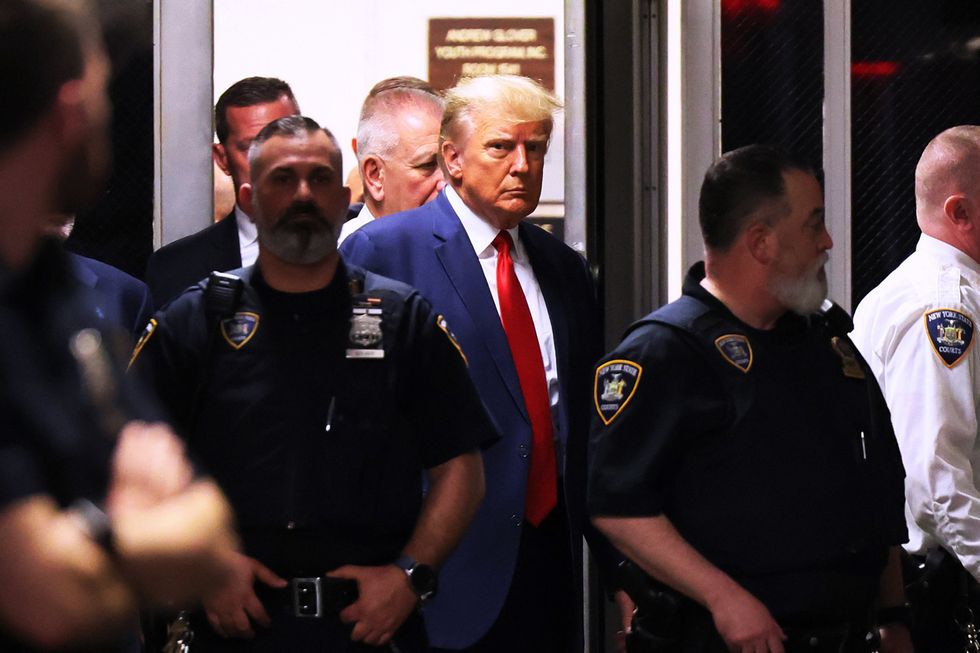 Former President Donald Trump arrives for his arraignment at Manhattan Criminal Court on April 04 in New York City. Michael M. Santiago/Getty Images
 Trump's campaign is selling these black-and-white ceramic coffee mugs for $24. (Screen grab)
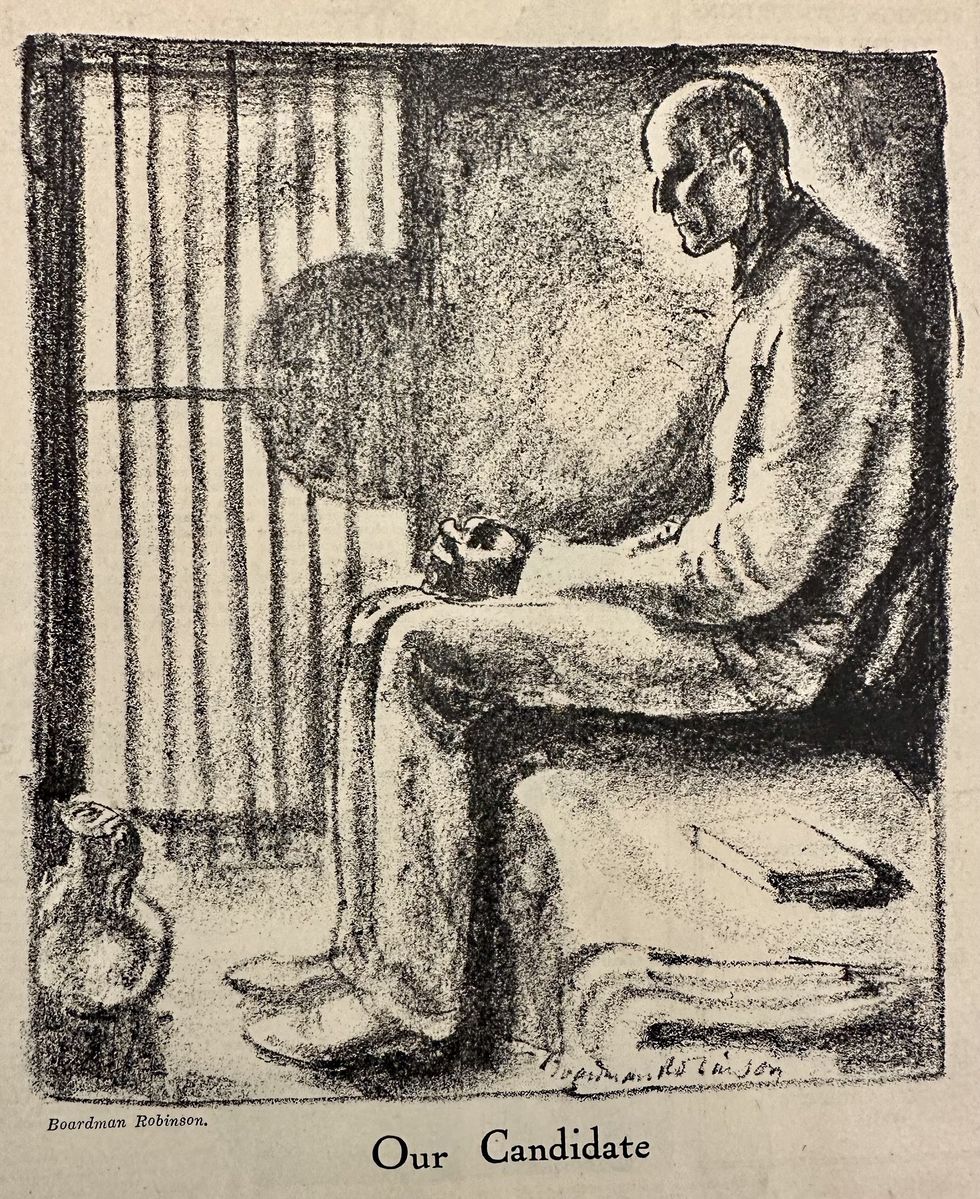 Illustration of Eugene Debs while running for president in prison. Indiana State University archives
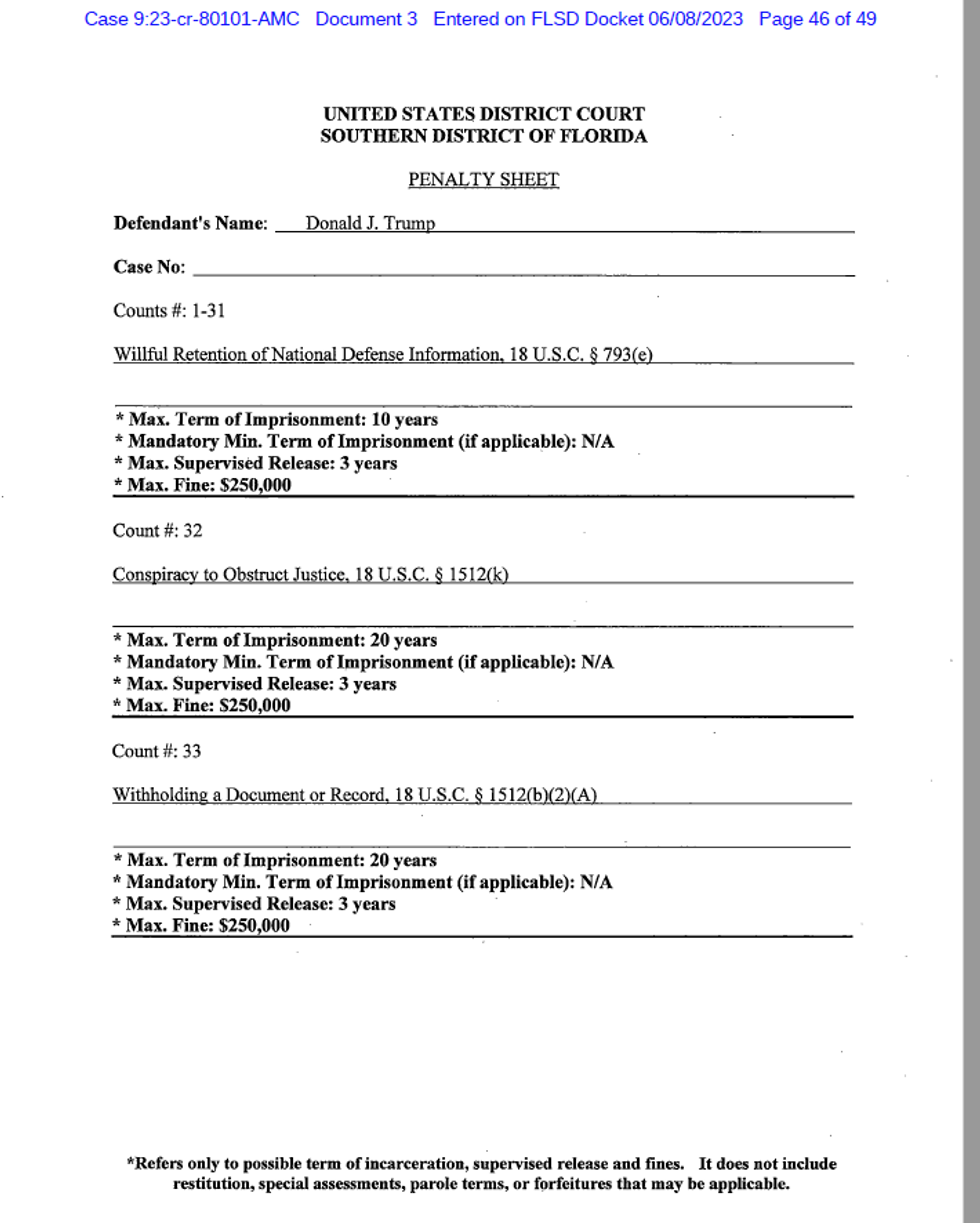 Federal document listing indictment counts against former President Donald Trump. U.S. District Court, Southern District of Florida