A Florida man says he has no plans to take down a large "Trump Won" banner despite facing daily fines of $50 beginning Monday after it was found to be in violation of local signage regulations.
"Fifty dollars a day ain't a damn thing to me. ... I'm not going to take it down," Marvin Peavy told the Northwest Florida Daily News. "I've already had people call me and tell me they'd pay the $50 fines."
Peavy is a Georgia-based real estate professional who lives four days a week in the 6,770-square-foot home in Seagrove Beach, Florida, according to the newspaper. Peavy said he put up the banner in an attempt to troll "Seaside liberals" and "the 1% leftists."
"I'm going to sue the county because they're stepping into my First Amendment rights," Peavy said.
Peavy donated more than $9,000 to Trump and other Republican causes in 2020, and he's now reportedly working to help elect Georgia GOP Senate candidate Herschel Walker.
"Our elections have been rigged for at least 20 years," Peavy told the newspaper. "That's proven facts."
Peavy previously had a "Trump 2020" banner at his Florida home, but he took it down on Jan. 21 — a day after President Joe Biden's inauguration — after being contacted by code enforcement officials.
Both banners reportedly violate a prohibition against "(s)treamers, feather flags, pennants, ribbons, spinners and other similar devices" on Walton County's Road 30A.
Dave Rauschkolb, a local restaurateur, reportedly brought Peavy's "Trump Won" banner to a county commissioner's attention back in May.
"Political signs, banners, information of any kind has no place outside of the election season anywhere," Rauschkolb told the newspaper. "It's my opinion, regardless of political affiliation, it's visual pollution during the political season and it certainly is after the political season. 30A is a scenic corridor, and there's nothing scenic about that."
A GOP state senator on Friday asked his Facebook followers to donate to the legal defense fund of a family facing felony charges in connection with the Jan. 6 attack on the U.S. Capitol.
State Sen. Mark Koran, R-North Branch, shared the link to an online fundraiser organized by Rosemarie Westbury, whose husband and son, Robert Westbury and Isaac Westbury, were charged earlier this month with several counts of civil disorder and assaulting a police officer with a deadly weapon, among other charges. Another family member, Jonah Westbury, was also charged in connection with the storming of the Capitol.
“Here's a local family in Lindstrom who can use some help," Koran wrote. “They attended the Jan 6th Rally and have been accused and charged with a variety of crimes. Some very serious and some which seem to be just to punish opposing views."
He added: “They are a good family!"
Koran did not immediately respond to messages seeking comment on his fundraising plea.
A spokeswoman for Senate Majority Leader Jeremy Miller, R-Winona, also did not immediately respond to a request seeking comment.
Koran's defense of the alleged Lindstrom rioters stands in stark contrast to Minnesota Republicans' frequent law-and-order message, as well as their condemnations of people who destroyed property during the demonstrations and rioting that followed the police murder of George Floyd in May 2020.
Koran, who ran unsuccessfully earlier this year for chair of the Minnesota Republican Party, has not dispelled false assertions that the 2020 election was fraudulent. Pressed by the Reformer last summer on whether President Joe Biden was duly elected, he said: “He's been inserted as the president."
Rosemarie Westbury wrote that her family “is being targeted by this illigitimate (sic), tyrannical government."
So far, she has raised $200 of her $50,000 goal. “We have an attorney who is willing to stand up for us, but this isn't going to be an inexpensive endeavor."
According to the charging documents, Isaac Westbury and Aaron James, another person charged in the case, used a police shield to “forcibly assault, resist, oppose, impede, intimidate and interfere" with an officer. They are also charged with carrying a dangerous weapon into the U.S. Capitol as they allegedly tried to “impede the orderly conduct of government business and official functions."
Robert Westbury faces misdemeanor charges of illegally and knowingly entering the Capitol and trying to disrupt government business and functions.
To date, eight Minnesotans have been charged in connection with the Jan. 6 attack on the Capitol.
Minnesota Reformer is part of States Newsroom, a network of news bureaus supported by grants and a coalition of donors as a 501c(3) public charity. Minnesota Reformer maintains editorial independence. Contact Editor Patrick Coolican for questions: info@minnesotareformer.com. Follow Minnesota Reformer on Facebook and Twitter.
Lev Parnas, a former henchman to Trump lawyer Rudy Giuliani, was found guilty on all six criminal counts leveled against him on Friday.
In a quickly rendered verdict, a jury found Parnas guilty of the most serious charge leveled against him, conspiracy to make foreign contributions to political campaigns.
Parnas was also found guilty of making false statements, falsifying records, and other crimes.
Parnas was arrested along with fellow Giuliani henchman Igor Fruman back in 2019 for allegedly setting up a shell company to funnel hundreds of thousands in Russian donations to Republican candidates.
Parnas and Fruman were also key figures in Giuliani's attempts to shake down the Ukrainian government to publicly announce an investigation into President Joe Biden, who at the time was seen as former President Donald Trump's biggest potential rival for the 2020 presidential election.
Trump ordered military aid to the Ukraine to be withheld shortly after asking the Ukrainian president to do him a "favor" by investigating Biden.
Trump's actions would result in his first impeachment in late 2019. He would be impeached again just over a year later for inciting a deadly riot at the United States Capitol building.
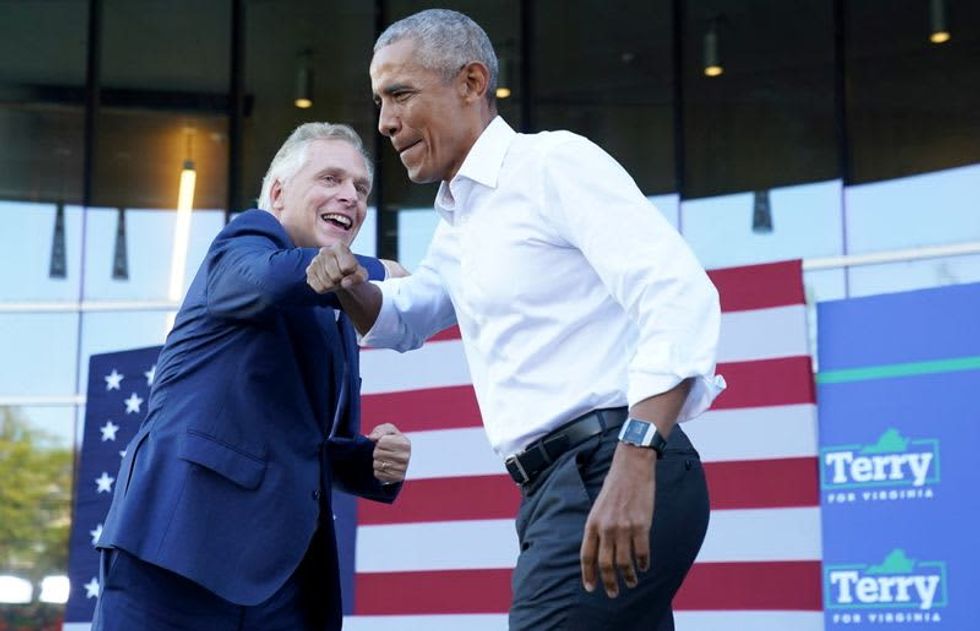
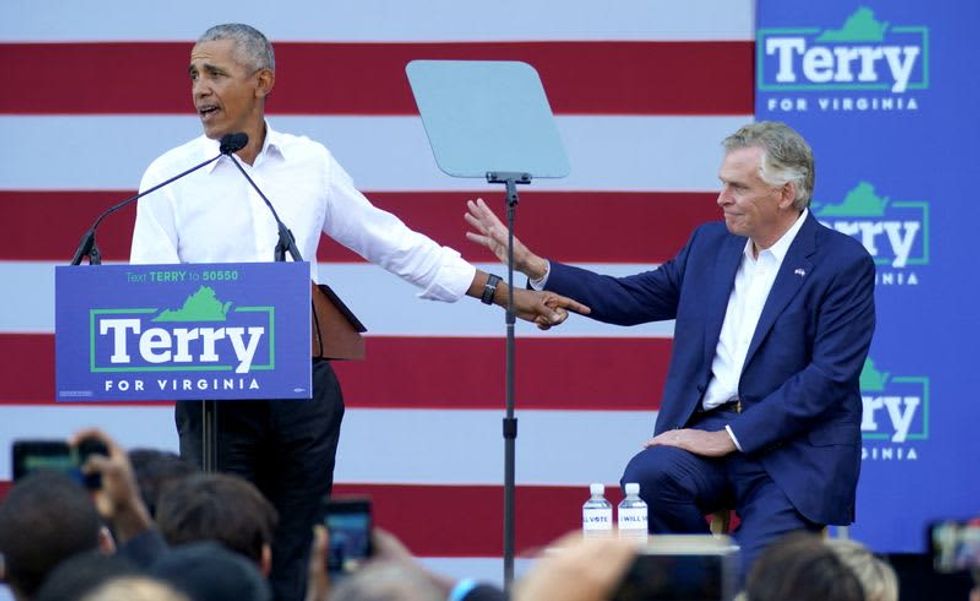
Democrats may control both chambers of Congress, but there are multiple reasons why the party should be concerned about the upcoming statewide election in the state of Virginia.
Bronner pointed out that available early voting data suggests Democrats aren't turning out as enthusiastically for the race as they did in 2020. This implies, he argues, that the Democratic candidate can't expect to win by as much as Biden did — and may not win at all:
Although Virginia does not have party voter registration — meaning we don't necessarily know how many registered Democrats have voted vs. registered Republicans — we can get a sense for the partisanship of the electorate by looking at past primary participation.
When doing so, we can see that the number of votes coming from voters that voted in the Democratic primary outnumber those cast by voters who participated in the Republican primary by around 2 to 1.
This sounds encouraging to Democrats, but it's actually slightly worse than they had been doing at this point before the 2020 election, when the ratio of Democratic primary voters to Republican primary voters was closer to three to one.
Overall, turnout is far lower than in 2020, though that shouldn't be much of a surprise, as he explained:
"When looking at absentee and early in-person voting this year, it's important to remember that last year's Presidential election was unusual — in that it was held during the peak of the pandemic, with more than 100 million Americans deciding to vote early because of that and the expanded access to mail balloting that came along with it. In Virginia, 2.7 million voters chose that option instead of going to the polls on election day."
Yet Bronner pointed to other indications that Democrats might be in trouble:
"There's both some tough history and some warnings signs for Democrats involved. In the past, the party that won the presidency has often lost the Virginia governor's election (though importantly, this didn't happen the last time the Democrats won the White House in 2013). This is particularly worrisome for Democrats because President Biden's approval rating has been falling significantly, including in Virginia. Also, while former governor Terry McAuliffe (D) is leading in the pollingaverages, the numbers have been too close for Democrats' comfort — including the most recent Monmouth University poll, which put McAuliffe and Republican Glenn Youngkin dead-even."
Virginia Democrats may be faced with some concerns, but the silver lining is that most voters have not cast ballots yet. So the election could still swing in Democratic favor. What the result means for the national political scene will undoubtedly be hotly debated.
Former President Donald Trump on Friday put out a statement attacking Meghan McCain, the former co-host of "The View" who wrote disparaging things about him in her new tell-all book.
The former president began by calling her "a bully and basically a lowlife" and then implied that she was not sufficiently grateful for everything he did for her late father, Sen. John McCain (R-AZ).
"I made it possible for her father to have the world's longest funeral, designed and orchestrated by him, even though I was never, to put it mildly, a fan," Trump wrote. In his own very special way, he was a RINO's RINO."
Trump then boasted about winning McCain's home state of Arizona in 2016, before falsely claiming to have won it in 2020, where President Joe Biden defeated him.
Trump also slammed John McCain for handing over the Steele dossier to the FBI.
Trump concluded his statement by recommending that Meghan McCain "fight back against the Losers of The View the way she fights against very good and well-meaning Republicans."
The US Supreme Court agreed on Friday to hear legal challenges on November 1 to an abortion law passed in Texas, but declined to block the restrictive legislation in the meantime.
President Joe Biden's administration and abortion providers are asking the court to overturn the Texas law which bans abortions after six weeks of pregnancy, before most women know they are pregnant.
The Justice Department and other parties to the case were given until October 27 to file their briefs with oral arguments scheduled for November 1.
Abortion providers and the Justice Department say the Texas law violates the landmark 1973 Supreme Court ruling in Roe v. Wade, which enshrined a woman's legal right to an abortion.
U.S. President Joe Biden has sounded increasingly open over the past month to changing the Senate's filibuster tradition to bypass a Republican roadblock that has imperiled key aspects of the Democratic agenda.
After long opposing change, Biden, who spent 36 years in the Senate, said on Thursday the chamber should "fundamentally alter" the long-standing process requiring 60 of the 100 senators to agree on most legislation, which Republicans have used to block voting-rights bills and which brought the country perilously close to a crippling debt default earlier this month.
Democrats could use their razor-thin Senate majority to eliminate or change the rule, though it would require the agreement of all of their members, including moderates Joe Manchin and Kyrsten Sinema, who have voiced objections.
WHAT IS THE FILIBUSTER?
To "filibuster" means to delay action on a bill or other issue by talking.
The Senate filibuster first captured the American imagination in Frank Capra's 1939 movie "Mr. Smith Goes to Washington," when Jimmy Stewart's character spoke for more than a day, and more recently in 2013 when Texas state Senator Wendy Davis spoke for 13 hours to try to block a bill imposing new restrictions on abortion.
The popular image of a lone lawmaker mounting an impassioned hours-long argument belies the reality in today's Senate, where a mere threat is enough to initiate a filibuster and hold up a bill.
A filibuster can only be stopped if a supermajority of 60 senators votes to end debate in a process called cloture.
WHY IS THE RULE A PROBLEM FOR DEMOCRATS?
With just 50 senators in their caucus, Democrats currently can't overcome filibusters unless at least 10 Republicans vote with them.
Democrats were able to pass Biden's $1.9 trillion COVID-19 stimulus plan without a supermajority through another Senate maneuver called "reconciliation," with the help of Vice President Kamala Harris's tie-breaking 51st vote. But the rules limit the use of that process.
Though they did get 19 Republican votes for a $1 trillion package to revamp the nation's roads, bridges and other infrastructure, Republicans have blocked many other Democratic priorities, including a voting-rights measure.
Senate Republicans this year have used the filibuster to block voting rights legislation that Democrats want to counter new restrictions passed in Republican-led states by supporters of Donald Trump's false claims that his November 2020 election defeat was due to widespread fraud.
They are also warning that they could filibuster a vote later this year to avoid a catastrophic debt default. A prior roadblock on that measure prompted Biden earlier this month to say he was open to changing the filibuster.
But he went further at a CNN town hall on Thursday, saying he would support changing the rule to pass the voting rights measure "and maybe more," though he said he would not make any moves until after Congress passes a pair of bills that contain the bulk of his domestic agenda.
WHEN DID THE SENATE ADOPT THE FILIBUSTER RULE?
Although the Constitution makes no mention of filibusters, long-winded Senate speeches became an increasingly common tactic in the 19th century.
By 1917, most senators had had enough, agreeing that a vote by a two-thirds majority could end debate.
But getting two-thirds of the Senate was hard, so filibusters continued. Notoriously, they were used by Southern senators who sought to block civil rights laws.
In 1975, the Senate reduced the requirement for limiting debate to three-fifths of the Senate - currently 60 senators.
In that decade, Senate leadership began agreeing to allow measures that were facing a filibuster to be put aside while the chamber acted on other bills.
The move was intended to prevent opposition to a single bill from bringing all work in the chamber to halt, but it also meant that the filibuster changed from an energy-draining maneuver involving lengthy speeches to a mere objection, or threat to object.
Over time the number of filibusters skyrocketed. A count of votes to try to overcome a filibuster, the nearest reliable proxy, shows 298 such votes in the 2019-2020 legislative session. That's up from 168 such votes in the previous two years. From 1969 to 1970 there were six.
CAN THE FILIBUSTER BE CHANGED?
There have already been changes.
In 2013, Democrats removed the 60-vote threshold for voting on most nominees for administration jobs, apart from the Supreme Court, allowing them to advance on a simple majority vote.
In 2017, Republicans did the same thing for Supreme Court nominees. Both the 2013 and 2017 changes were made by simple majority votes.
Several filibuster reform ideas have been floated that could stop short of ending it. They include an exemption just for voting rights bills, limiting the number of filibusters against any one bill or forcing those waging a filibuster to remain standing and speaking on the Senate floor until one side relents.
WHO OPPOSES CHANGE?
Senate Minority Leader Mitch McConnell, for one. At the start of this year he tried but failed to get an explicit promise from Democratic Majority Leader Chuck Schumer to protect the filibuster.
"Nobody serving in this chamber can even begin ... to imagine what a completely scorched-earth-Senate would look like," McConnell said in March, adding that Republicans would require votes on all parliamentary moves, drastically slowing the pace of business.
His move earlier this month to allow a vote temporarily raising the debt ceiling was in part motivated by a desire to protect the filibuster, according to aides and lawmakers.
(Reporting by Susan Cornwell; Editing by Scott Malone, Aurora Ellis and Jonathan Oatis)
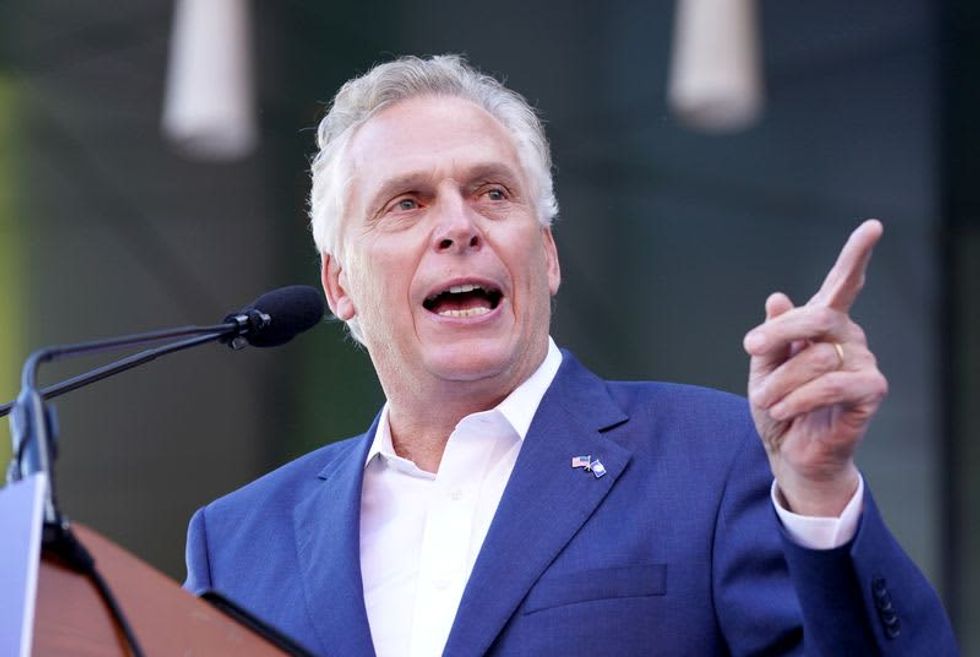
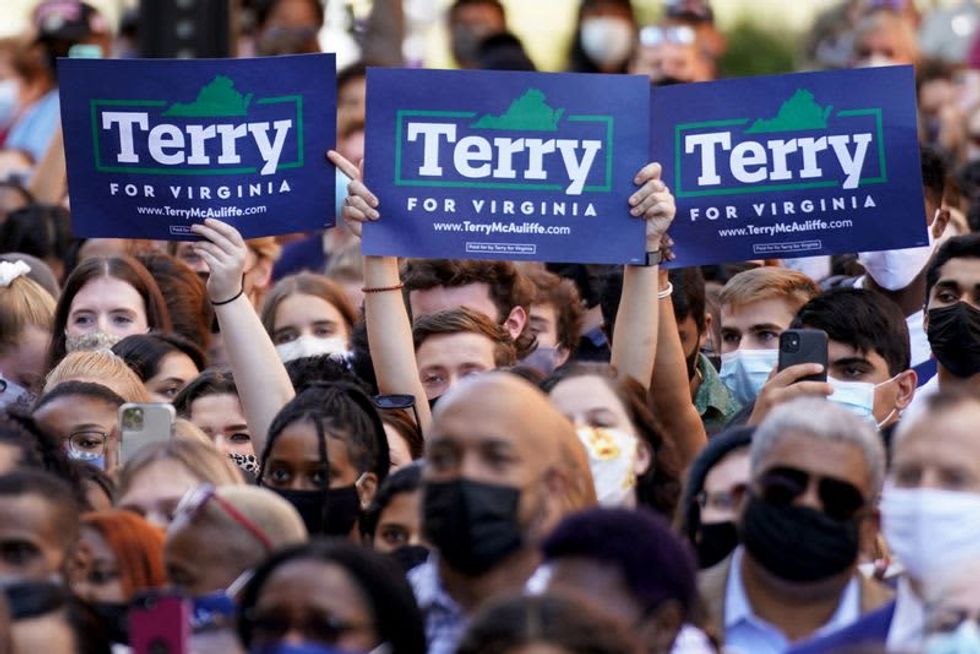
As part of his analysis of the upcoming gubernatorial race in Virginia between Democrat Terry McAuliffe and Republican Glenn Youngkin, CNN pollster Harry Enten suggested the Democrat will likely prevail -- in no small part over voters distaste for Donald Trump -- and that it should serve as a warning to the Republican Party.
As Enten notes -- in the case of Virginia -- President Joe Biden's approval numbers are "underwater," which should be bad news for the Democratic candidate, but Trump is widely reviled in the state and is dragging Youngkin down with him after plugging his run.
Writing, "In Virginia, and even nationally on the generic congressional ballot, Democrats are holding onto slim within-the-margin-of-error advantages. Why? It could be in part because former President Donald Trump is unusually present for a politician not in office, and he's as -- if not more -- unpopular than Biden," Enten added that the Democrats should thank their lucky stars that Trump is an anchor around Youngkin's neck.
With that in mind, Enten suggested that no one really has a handle on how Trump will impact elections beyond Virginia's November 15 turn at the polls.
"A CBS News/YouGov poll from Virginia shows just how motivating a factor Trump is in whether voters cast a ballot. A majority of likely voters (51%) said feelings about Trump were very motivating. That's basically the same as the 48% who said the same thing about their feelings toward Biden," he wrote. "Separate polling from a Monmouth University poll in August showed that about the same share of Virginia voters indicated that Trump was a major factor in their 2021 vote as they did in 2017.
"This is something we're seeing nationally as well. Trump continues to cast a shadow in a way I'm not sure we fully appreciate."
"Trump being this much in the spotlight probably hurts Republicans more than it helps. Trump had a -13 point net favorability rating in a Quinnipiac University poll this week. Biden's was -12 points in the same poll. Other polls have Biden's net popularity ratings in a somewhat better, though still negative, position<" he explained before adding, "...right now, Democrats maintain a low single-digit lead on the generic congressional ballot. That's not much different than their 3-point win in the House popular vote in 2020."
According to the CNN analyst, Republican Party leaders should take a hard look at what happens in Virginia.
"If, on the other hand, McAuliffe is the victor, it will likely lead to plenty of discussion about whether it's good for Republicans to continue to have Trump this present on the political scene," he warned.
On Friday, CBS reported that U.S. intelligence agencies are outlining the threat that failure to meet global CO2 target limits will have on national security.
"We assess that climate change will increasingly exacerbate risks to US national security interests as the physical impacts increase and geopolitical tensions mount about how to respond to the challenge," said a document released by the Office of the Director of National Intelligence, the umbrella office that oversees all U.S. intelligence agencies. "Intensifying physical effects will exacerbate geopolitical flashpoints, particularly after 2030, and key countries and regions will face increasing risks of instability and need for humanitarian assistance."
Among the risks noted by the report are disasters in particularly vulnerable countries, as well as the scramble by higher-latitude countries to control new shipping lanes and extractive resources exposed by retreating ice sheets.
"While wealthier, more developed countries, including the U.S., are in a 'relatively better position' to deal with the costs and risks associated with climate change, the report says that 'impacts will be massive even if the worst human costs can be avoided,"" reported Olivia Gazis. "The assessment says some unforeseen events could alter its projections, including a significant technological breakthrough or, conversely, a global climate disaster that would mobilize countries to take action."
Worldwide, countries have committed in the Paris agreement to limiting the growth of global temperatures to no more than 1.5 degrees Celsius.
A major part of President Joe Biden's infrastructure agenda is climate change investments, and several subsidy programs for renewable investments and grid modernization are being considered in the Build Back Better Act, although the originally envisioned Clean Electricity Performance Program may lack the votes to clear the Senate.
Conservative attorney John Eastman is backing away from the so-called "coup memo" he drafted for former president Donald Trump crafting a legal argument for overturning the results of the 2020 presidential election.
The Claremont Institute fellow and Federalist Society member now claims the infamous two-page memo does not accurately reflect his own views or provide legal advice to Trump or former vice president Mike Pence, but instead was something of a thought exercise gaming out possible scenarios for undoing Trump's election loss to Joe Biden, reported the National Review.
"They were internal discussion memos for the legal team," Eastman told John McCormack. "I had been asked to put together a memo of all the available scenarios that had been floated. I was asked to kind of outline how each of those scenarios would work and then orally present my views on whether I thought they were valid or not, so that's what those memos did."
Eastman claims he doesn't remember who tasked him with drafting the memo, which he wrote on Christmas Eve and then expanded into a six-page version on Jan. 3, but admitted that would be possible to determine by looking at his phone records.
"It was somebody in the legal team, I just don't recall," Eastman said. "It was by a phone conversation, and I've gone back in my phone records, and I have so many calls, I can't tell, you know, which call it was. I was asked, if this was the view of the law that were adopted by the court, how would it play out?"
Eastman presented the final six-page memo Jan. 4 in a private White House meeting with the president and vice president, Pence's legal counsel Greg Jacob, and Pence's chief of staff Marc Short, but he claims he told Trump that he did not believe the plan -- which involved the vice president rejecting some slates of electors and sending it back to Republican-led state legislatures, which would then allow the election to be determined by the House of Representatives.
"Republicans currently control 26 of the state delegations, the bare majority needed to win that vote," the two-page memo states. "President Trump is reelected there as well."
Eastman said he didn't believe the plan would work because Reps. Liz Cheney (R-WY) and Mike Gallagher (R-WI) strongly opposed overturning the election results, and no Democrats would have voted to undo Trump's loss.
"Anybody who thinks that that's a viable strategy is crazy," Eastman said.
The attorney also disagrees with his own argument that the vice president is the only person with the authority to count electoral votes, saying that makes no sense because the vice president is likely to be a contender in the election.
"It's certainly not been definitively resolved one way or the other," Eastman said. "There's historical foundation for the argument that the vice president is the final say and the argument that he is not. I think the argument that he is the final say is the weaker argument."
Eastman broadcast the claims he laid out in the memo during the Jan. 6 "Stop the Steal" rally that preceded the U.S. Capitol riot, which prosecutors say was intended to disrupt the certification process to enact the scenario Eastman had described, but he now insists those arguments were never meant to be taken literally.
"The memo was not being provided to Trump or Pence as my advice," Eastman said. "The memo was designed to outline every single possible scenario that had been floated, so that we could talk about it."
An Indiana Republican who was rejected from the House select committee is apparently conducting a shadow investigation of the Jan. 6 insurrection.
Rep. Jim Banks (R-IN) was one of two GOP congressman rejected by House speaker Nancy Pelosi for the select committee, but he has been sending letters to federal agencies and social media companies identifying himself as the "ranking member" on the panel, and The Daily Beast has obtained one of those letters.
"You are receiving this letter because the House of Representatives Select Committee to Investigate the events of January 6th may have sent you a request for information," Banks wrote in the letter to Interior Department secretary Deb Haaland, dated Sept. 16. "The House Republican Leader Kevin McCarthy appointed me to serve as the Ranking Member of the Select Committee. Yet, House Speaker Nancy Pelosi refused to allow me to fulfill my duties as Ranking Member."
Banks argued that the minority party, under House rules, enjoys the same access to information as the majority party.
"For those reasons, I ask that you provide me any information that is submitted to the Select Committee," he wrote. "Additionally, please include me on any update or briefing that you provide."
The D.C. Circuit of Appeals ruled last year that minority members of a congressional committee can sue to obtain information from executive agencies, but that doesn't guarantee that lawmakers would win those lawsuits, and it's not even clear whether Banks has standing to make such a claim because he's not on the committee -- which already has two Republicans, Reps. Liz Cheney (R-WY) and Adam Kinzinger (R-IL).
Banks' shadow investigation came to light as the select committee voted to hold Donald Trump adviser Steve Bannon in contempt of Congress for ignoring the panel's subpoena, which the House approved in a subsequent vote, and Cheney cited the letters in a floor speech.
He was nominated to the select committee by House minority leader Kevin McCarthy (R-CA), along with Rep. Jim Jordan (R-OH), but Pelosi rejected both GOP lawmakers because they had voted against certifying President Joe Biden's election win on the day of the insurrection.
SCRANTON, Pa. — President Joe Biden took the stage Wednesday in his childhood hometown surrounded by striking images of America's infrastructure.
A retired Southeastern Pennsylvania Transportation Authority railcar sitting to his far right offered an example of how neglected the country's infrastructure has been. Its letters were barely visible. The door's paint was scuffed and faded.
Next to it, however, stood a refurbished trolley car, decked out in patriotic pennants and “Build Back Better" signs.
Biden used his speech at Electric City Trolley Museum in downtown Scranton to argue his signature domestic agenda will make the nation's infrastructure resemble the tricked-out trolley instead of the rusted-out railcar.
That change will improve the nation's economy and environment, he said.
“Did you realize the Chinese are now building a train that will go up to 300 miles per hour?" Biden asked. “You say, 'What difference does that make, Biden?' Well, guess what? If you can take a train from here to Washington much faster than you can go in an automobile, you take a train. We will take literally millions of automobiles off the road, saving tens of millions of barrels of oil."
After spending the first few months of his administration dealing with the coronavirus pandemic and getting the nation vaccinated, the president has moved on to expansive infrastructure and economic plans.
They would include massive investments in transportation, broadband, early childhood education, and other areas. However, the razor-thin majority Democrats hold in Congress has meant a protracted and frustrating legislative fight for the president.
He's not giving up.
“This has been declared dead on arrival from the moment I introduced it," Biden said. “But I think we're going to surprise them because I think people are beginning to figure out what's at stake."
Earlier in the afternoon, Sen. Bob Casey, D-Pa., and U.S. Rep. Matt Cartwright, D-8th District, sounded confident the bills would eventually pass.
Roadblocks remain.
Just hours before Biden took the stage, NPR reported that the administration was dropping its plan for two years of tuition-free community college.
The goals Biden set out to accomplish are important ones, State Rep. Maureen Madden, D-Monroe, said. They're going to take care of people's basic needs, she said.
State Sen. Marty Flynn, D-Lackawanna, brought up the child tax credit, saying that was public policy that people could see immediately affect their finances. Biden wants to extend the program.
“I think that's huge," Flynn said.
Madden also said the possibility of a passenger train running from Scranton to New York City would make a huge difference to the region.
“I feel like we're closer than ever," she told The Capital Star.
Larry Malski, the president of the Pennsylvania Northeast Regional Railroad Authority, has been advocating for rail's return to the region for decades and knows what it feels like to face empty promises.
Is he optimistic?
“More so than I have been in 40 years," he said.
Everyone talks about the possible line. That Amtrak's CEO and president attended Biden's speech didn't go unnoticed.
The president bragged about his connections to the rail line, pointing out he has 2 million Amtrak miles under his belt. That comes from decades of commuting between his home in Delaware and Washington D.C.
He also spent the first 10 years of his life in Scranton, and has recently returned to the narrative of pitting Scranton values against Wall Street interests as he struggles to get his legislation passed.
This time, he didn't just talk about the values he learned as a child in 1940s Scranton, but how the city's growth in the late 1800s and early 20th century can be repeated with different resources.
It's a parallel to the nation for Biden.
“Coal built this town," he said, “but we have to provide other avenues."
Biden argued the nation has to go back to the values of promoting and investing in education.
Scranton would benefit from the green energy jobs in the region and several of the programs in his infrastructure and spending bills, he said.
Wilkes-Barre Mayor George Brown agrees.
Before the speech, he talked to the Capital-Star about how his city is still grappling with issues from the pandemic. Businesses like Guard Insurance employ thousands, but are still operating on a work-from-home system. That has starved downtown restaurants and businesses of much-needed revenue.
Meanwhile, the region is grappling with more and more damage from strong storms.
So, the funds Biden is advocating for would take a lot of pressure off the city government, Brown said.
Brown advocated for the region, pointing out that if this region is successful, it will be a boon for the state, and be a building block for the nation's economic return.
Pennsylvania Capital-Star is part of States Newsroom, a network of news bureaus supported by grants and a coalition of donors as a 501c(3) public charity. Pennsylvania Capital-Star maintains editorial independence. Contact Editor John Micek for questions: info@penncapital-star.com. Follow Pennsylvania Capital-Star on Facebook and Twitter.
Wisconsin Examiner is part of States Newsroom, a network of news bureaus supported by grants and a coalition of donors as a 501c(3) public charity. Wisconsin Examiner maintains editorial independence. Contact Editor Ruth Conniff for questions: info@wisconsinexaminer.com. Follow Wisconsin Examiner on Facebook and Twitter.
Former president Donald Trump Trump has spent years battling tech giants that he argues have wrongfully censored him
Washington (AFP) - Donald Trump may have lost last year's US presidential election but within his own dominion he remains the undisputed leader of the free world.
The entirely false notion that Democrats stole the presidency from Trump is likely to be a hot topic on "TRUTH Social," a conservative platform he is adding to the already hyper-polarized US media ecosystem.
Wednesday's announcement of the launch planned for early next year is noteworthy because it bolsters speculation that Trump -- who is banned from Twitter -- is gearing up for another presidential run in 2024.
More profoundly, it demonstrates how the former reality TV star is able to capitalize on deep fractures in American society that are being intensified like never before through the echo chambers of social and traditional media.
Where once Americans could agree on a shared set of facts, now two implacable tribes eye each other suspiciously from their respective siloes, each armed with their own version of reality served up by their favorite media outlet or smartphone app.
Investigative journalist Carl Bernstein, whose reporting on the Watergate affair alongside Bob Woodward helped bring down Richard Nixon, has called for media and politicians to pay more attention to countering misinformation splitting the country.
"The division that is separating and polarizing us in this country is vicious. It is deep," he said. "It is full of hate and anger. And most of that hate and anger is resting on big lies."
Watch conservative Fox News on any given evening, and you could almost be convinced that it is reporting on an entirely different country from the one covered by left-leaning MSNBC, often with almost no overlap in the news agenda.
'Owning the libs'
Depending on whether Americans hone their opinions on Parler or Twitter, Trump is either the last bulwark against a woke cultural tide presaging a socialist takeover -- or the biggest threat to democracy since the Civil War.
The inhabitants of these two competing bubbles rarely encounter information that might challenge their world view or show them what their opponents are thinking. Put more simply, no one talks to the other side anymore.
It's not just last year's election that gets completely contradictory coverage from right-wing and progressive media sources.
Reporting on the nationwide demonstrations that followed the murder by police of African American George Floyd offered the same dichotomy, with the left being fed images of noble protest for racial justice and the right told the country was on the verge of a violent takeover by communist thugs.
This bifurcation has reached the point where someone's views on a range of hot-button issues -- from abortion, LGBT rights and immigration to gun control and health care -- can be reliably inferred from their choice of cable news channel.
Division has been a hallmark of the Trump era. A record 81 million people voted for Joe Biden in 2020, but the 74 million that voted for Trump marked the second-highest figure ever posted by a candidate.
On the right, figures like the former president's son Donald Trump Jr prioritize "owning the libs" -- sparking outrage and hand-wringing among progressives -- over serious debates about ideology.
Parallel Americas
And in the more militant recesses of the left, every disagreement over race and sexuality is attributed to the supposed innate bigotry of conservatives.
Fox News maintains a loyal viewership but many Trumpists have decamped since the election to further-right conspiracy-mongering outlets such as Newsmax, One America News and the Parler and Gettr social networks.
Newsmax's prime time shows attract up to a million viewers while former White House press secretary Sean Spicer's program on AON is not far behind.
The polarization of the media is a symptom of wider fissures that have seen much of America's wealth concentrated on the liberal-leaning coasts, seen by the more conservative so-called "flyover states" as elite and out-of-touch.
Parler, which offers a home for right-wingers kicked off mainstream social media, was downloaded around a million times in the five days following the election and its user count subsequently hit almost nine million.
There, consumers are fed a daily diet of "culture wars" over the removal of historic statues, athletes who take the knee during the national anthem and the teaching of America's racial history in classrooms.
People who don't use the platform would not likely know what "Laptopgate" means, or be aware of the narrative characterizing Trump as fighting an epic battle against a horde of Satanic pedophiles from Hollywood and the Democratic Party.
"When I'm channel surfing at night, I see two Americas that exist in parallel right now, on side-by-side tracks, "CNN media analyst Brian Stelter wrote after the election.
"Two Americas with completely different assumptions and expectations and information sources."