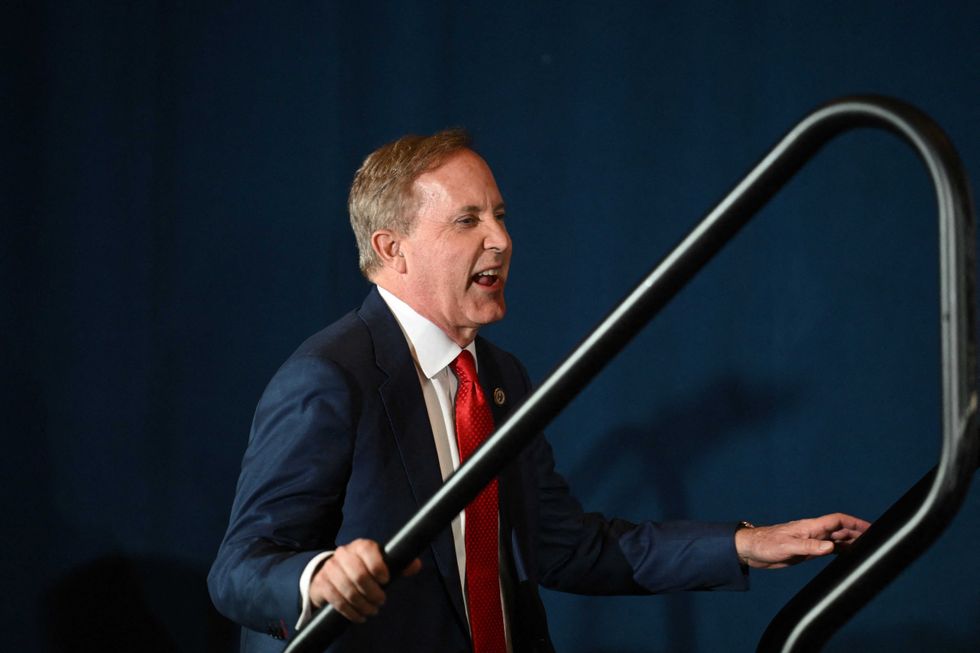
Republican US Senate candidate and Texas Attorney General Ken Paxton attends a watch party during US midterm elections in Dallas, Texas, US, November 3, 2026. REUTERS/Callaghan O'Hare

Less than 24 hours after a historic sweep of Texas’ statewide elected offices by Democrats, the state’s attorney general-elect Nathan Johnson said Tuesday he will not continue Ken Paxton’s practice of suing doctors in other states for sending abortion medication to patients here.
It’s the first big salvo against the state’s four-year-old near abortion ban which makes the procedure virtually impossible to access in this state and is likely to be the first of many tweaks to make the ban less rigid. The attorney general’s office under Ken Paxton, who gave up the role to run for Senate, has been a powerful enforcer of the state’s abortion ban laws and a Democrat coming into that position cuts off a powerful tool for the country’s anti-abortion movement.
The first thing I do when people ask me about abortion is point out that I'm not a legislator, and I can't change abortion law,” Johnson told The Texas Tribune. “What I can do is cease using Texas abortion laws as an instrument of persecution and intimidation, harassment and political showboating. All four of those things have happened.”
It is illegal for Texas doctors to mail abortion medication within the state and Paxton has sued doctors in other states who prescribe the medication, chilling Texans from obtaining these pills, abortion advocates say. Those lawsuits have run up against blue states' so-called shield laws that protect physicians who send abortion medications.
Johnson said he won’t be suing those out-of-state doctors anymore. “I will not pursue the judicially absurd position that Texas law has extra territorial effect. I can honor other states’ shield laws.”
While this eliminates an obstacle to accessing abortion pills, Democrats won’t be repealing the abortion ban anytime soon.
Despite the increasing use of executive power by Gov. Greg Abbott, Governor-elect Gina Hinojosa cannot legally repeal the abortion ban with her own pen stroke. She also told Politico in September that repealing the ban would not be a priority because it would require Republicans to pass such a bill and that seems unlikely.
Instead, University of Houston political professor Brandon Rottinghaus points out she can greatly limit how the law is applied. Hinojosa has said that she would work to end penalties for doctors who perform life-saving abortions, although lawmakers provided additional protections for doctors in these situations last year.
“She can influence how portions of the law are implemented, and how certain exceptions are interpreted, and other reasonable additional restrictions that might become law eventually,” he said.
Anti-abortion advocates like John Seago, president of Texas Right to Life, aren’t worried about a new “standalone abortion bill” being passed this upcoming session, but he is concerned incoming Democratic leadership will turn back decades of Republican-led inroads in restricting the procedure.
He could see Hinojosa and other Dems making it tougher for programs like the former Alternatives to Abortion program, now renamed Thriving Texas Families, which sends over $200 million to private contractors to, in part, counsel pregnant women out of abortions, among other services. He said Hinojosa has consistently voted against the program and that he could see her defunding it or transferring the funding to another program.
The agency overseeing the program, the Texas Health and Human Services Commission, has an agency commissioner, Stephanie Muth, whose appointment expires Feb. 1. Seago said he also fears that Hinojosa could also use her own appointment power to put someone else in charge of the agency and begin to change how those private contractors are scrutinized.
There’s also the upcoming Sunset process that could grant Hinojosa greater influence. HHSC faces Sunset review, where lawmakers determine what to change within an agency, including eliminating whole departments or agencies.
Lawmakers have broader rein to reshape budget priorities for an agency facing Sunset review and that too could include slashing funding for the Thriving Texas Families program.
The state’s Maternal Mortality and Morbidity Review Committee also faces a Sunset evaluation. Women’s health advocates have lambasted the committee, which is under the Texas Department of State Health Services’ purview, for delaying the release of its latest biennial report this year, which is expected to include a review of deaths that have occurred after the state’s abortion ban went into effect. Members have also called on the Legislature to allow them to review abortion-related deaths but to no avail.
Also Hinojosa could put in her own slate of the Texas Medical Board appointments. A block of the 19-member board has terms expiring this April and she could put appointees who could revise the board’s guidance to physicians about the legal protections they have when they perform an abortion to save a patient’s life.
Two years ago, the TMB issued guidance to doctors that fell far short of what health care advocates had wanted. At first, the panel was hesitant to offer how to interpret medical exceptions to the state law even after the Texas Supreme Court called on them to “assess various hypothetical circumstances, provide best practices, identify red lines, and the like.”
The TMB reworked the guidance but many were still unsatisfied saying it put too much of a burden on the doctor making the shots when seconds count to save a mother’s life.
Seago is also confident that despite Johnson’s announced refusal to actively pursue the flow of drugs from other states, other states will continue their own challenges to stop abortion medication coming by mail. He adds that the state’s “bounty hunter” law that allows private lawsuits against abortion medication providers who violate the Texas abortion ban will not be revisited this next session and will remain on the books.
Still, abortion reproductive advocates like raven e. Freeborn, executive director of Avow Texas, a statewide group advocating for abortion access and reproductive rights in Texas, will not let the Senate’s Republican majority prevent them from trying to undo the abortion ban with a new law.
“We're going for the most unapologetic vision of abortion access, which is abortion access without exceptions,” said Freeborn. “I think it’s important for us to look at this opportunity in this moment and to be as unwavering about the world that we need immediately.”
She pointed to how it took decades for the GOP to outlaw abortion in Texas and her group is prepared for a long fight. “They didn’t do that in one legislative session but they were consistent in what they were narrating. And so we’re stepping up to be just as bold.”
Disclosure: University of Houston has been a financial supporter of The Texas Tribune within the past five years. The Texas Tribune is a nonprofit, nonpartisan news organization that is funded in part by donations from members, foundations and corporate sponsors. Financial supporters play no role in our journalism. Find a complete list of them and more information about our financial and disclosure policies here.
This article first appeared on The Texas Tribune. 
Report typos and corrections to corrections@rawstory.com.
For customer support contact support@rawstory.com.