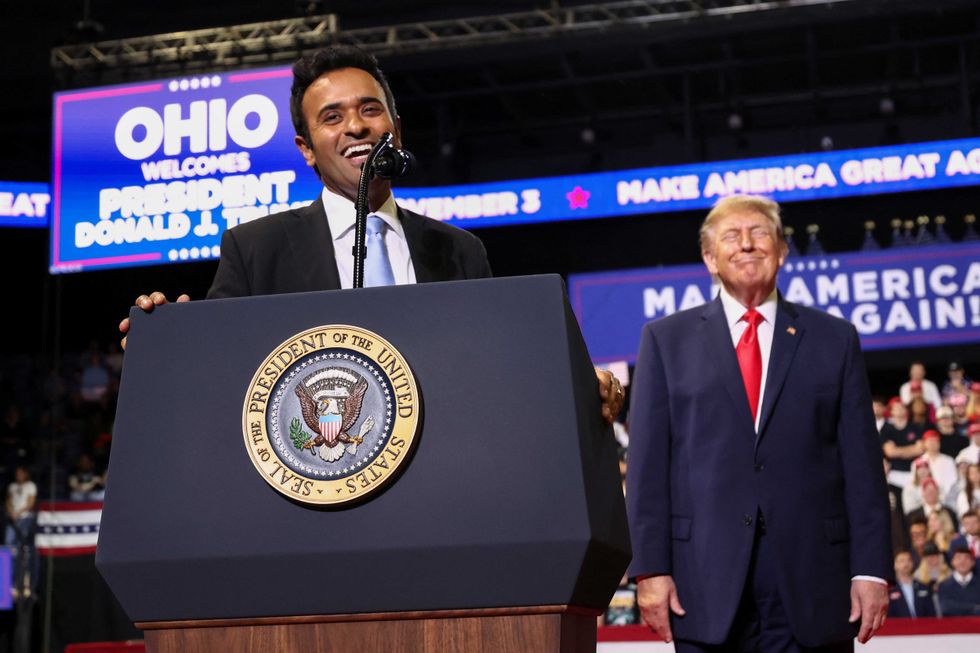
Gubernatorial candidate Vivek Ramaswamy, alongside US President Donald Trump, speaks during a campaign rally for Ramaswamy and US Senator Jon Husted (R-OH) in Youngstown, Ohio, US, October 12, 2026. REUTERS/Kevin Lamarque

If you were physically and/or sexually abused as a child, as I was, then you understand the horror and extreme discomfort of having the person who assaulted you rear their ugly head in your life.
It could be a dream, a momentary thought, or even worse, a picture or their physical presence. Their effect on you is life-altering, and not in a good way.
That’s why what happened to Dr. Amy Acton, the Democratic candidate for governor of Ohio, is so haunting, utterly offensive, and, more pointedly, disgusting. When her opponent released an ad featuring her estranged mother, including the picture and physical presence of the woman responsible for Acton’s childhood abuse, it sent a shiver up the spine of all of us who live with the trauma of another person’s actions.
The 2026 midterm election cycle was widely predicted to be the moment artificial intelligence broke American political ads and social media content with AI slop. It was going to rain hell on elections, unleashing metaphorical blood-and-guts ads that would create a maelstrom of malevolence.
As trackers reported more than $137 million pouring into AI-fueled political ads, we braced for a digital landscape corrupted by deepfakes and atrocious algorithmic deceit.
And wow, so far there have been some real doozies, and you guessed it, the vast majority have come from desperate GOP candidates resorting to distortion in bonkers ways. In Texas, for example, Ken Paxton’s allies unleashed bizarre AI-generated imagery of Democratic candidate James Talarico rewriting the Bible in crayons.
The Paxton campaign’s attacks on Talarico are a lesson in fiendish futility.
In Michigan, groups manufactured deceptive videos of Democratic candidate Dr. Abdul El-Sayed to insinuate extremist ties. The Mike Rogers campaign’s efforts to paint El-Sayed as some kind of terrorist just never end.
And in Pennsylvania, someone used deepfake technology to mimic Pennsylvania Gov. Josh Shapiro making references to a sexual harassment complaint against one of his aides, not Shapiro himself.
It begs the question: Is the GOP so hopeless that it relies on AI as its go-to campaign strategy?
Personally, since I follow AI obsessively, I think the tricks and schemes we’ve seen thus far in 2026 are merely a warm-up for the overwhelming onslaught that will be deployed in 2028. In other words, we ain’t seen nothing yet. And I can’t imagine the GOP won’t go full throttle next time.
But in 2026, as the campaign reaches its final stretch, the most devastatingly cruel political ad in modern history, in my humble opinion, didn’t come from an AI landfill. It came from a warped, demonic human mind.
Ohio Republican gubernatorial candidate Vivek Ramaswamy bypassed the digital chew-'em-up-and-spit-'em-out machine and manufactured his own bludgeon, weaponizing family trauma in a $4 million statewide ad campaign targeting Acton in a way that also bypassed human decency.
If you haven’t heard by now, the ad features Acton’s estranged mother, Donna Arthur, who explicitly calls her daughter a “liar” and disputes her account of childhood homelessness.
It should surprise no one that on Thursday, the king of filth and AI slop-sharing, Donald Trump, said Ramaswamy should keep the ad up to “let everyone listen to the mother of a defective, dishonest, and incapable candidate.”
What the ad deviously and deliberately omits is a mental-health-shattering reality documented in explosive court files. When Acton was just 12 years old — the same age I was when my abuse started — her stepfather was indicted for raping her. The crime led to Acton and her brother being permanently removed from Arthur’s custody.
Acton has not spoken to her mother since that trauma occurred nearly 50 years ago. She escaped that hellscape, and the insipid Ramaswamy has brought all that pain and torture back to her. He should be in jail.
This was more than a strategist’s political calculation for a standard attack ad. It dragged unspeakable psychological and physical violence back into the light of day for Acton and her brother. I can only imagine what they are feeling right now.
The whole sordid idea reveals a profound and chilling truth about the human element in modern campaigning, at least so far: it can outdo AI slop. Yes, AI is smart, it’s devious, and its limits are unknown. But in a dark irony, humans have proven that AI cannot outthink the capacity for cruelty.
When experts talk about having humans oversee AI, one person they need to keep far, far away is Ramaswamy. Translation: If AI is to doom us all, it will be because its human operators took a page from Ramaswamy.
While tech-driven deepfakes rely on cold, mathematical logic to construct a fake reality, the people behind the Ramaswamy campaign looked at a real, breathing survivor of childhood sexual abuse and chose to exploit her estranged, unwell mother to retraumatize her on a mass-media scale.
They took real human suffering, real familial fractures, and real psychological wounds and turned them into a statewide — and now national — sleazy television ad.
From a mental health perspective, the sheer malice required to construct this ad operates on a level of devastation that artificial intelligence simply cannot replicate. At least not yet.
AI lacks Ramaswamy’s outsized ego and brazenness. It has no concept of shame, no capacity for empathy, and no intent to inflict psychological harm. It merely executes code.
And I know I speak for so many survivors when I say that what Ramaswamy did has made us all feel less safe.
Ramaswamy exposed an older, darker threat: the boundless depths of human cruelty. In the end, it wasn’t AI algorithms that degraded the political season to its lowest point. It was his malignity.
Report typos and corrections to corrections@rawstory.com.
For customer support contact support@rawstory.com.