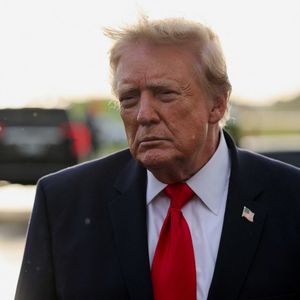
US President Donald Trump speaks to reporters after exiting Air Force One as he returns from Medinah, Illinois, at Joint Base Andrews, Maryland, US, September 27, 2026. REUTERS/Nathan Howard

How do you know that democracy is in trouble? When neither side trusts the outcome of an election.
Let’s say the Republicans somehow kept their House majority after all the midterm smoke clears, in defiance of those blue wave predictions. Would you believe they won fair and square? Of course not. And we already know the Republicans will automatically scream, “Rigged!” if the Dems take back one or both (please God) houses of Congress.
There’s your death of democracy in a nutshell.
This does not, of course, mean that the republic can’t be repaired/restored. But it’s going to take a monumental effort – and no doubt many years – to fully rebuild faith in the system.
My chief worry during the Trump era has been about election hacking at the electronic voting machine level, whether by Russia, the Republicans, or whomever. While there’s been no documented evidence of hacking in real elections to date, that doesn’t mean it isn’t technically possible. I have little doubt that it could happen.
At the very least, you know the bad guys are doing everything in their power to figure out how to pull it off undetected. As if we needed actual proof, it was provided on Monday when ProPublica published an investigation quoting two former Trump administration officials. They reported that a pair of political appointees at the Department of Homeland Security asked the Cybersecurity and Infrastructure Security Agency (CISA) to secretly obtain a voting machine, hack it, and report its findings to the White House.
The report said that CISA personnel were also instructed not to inform the voting-machine manufacturer about any vulnerabilities they discovered.
Huh? The only reasons for the White House to want to do this is either to find out how to do it themselves, or to use the information to provide purported evidence after the fact of how the rigging of machines led to a Republican defeat.
Career employees of CISA thankfully resisted the request, and the DHS appointees eventually stopped pursuing it. But the leaked appeal is itself chilling and raises questions about how far this administration already has gone to make this happen.
It also leaves me wondering: just how vulnerable are America’s voting machines to actual hacking this election cycle?
There are five principal concerns:
1. Direct manipulation of the machines. This can happen only when someone has physical access to the equipment. Older machines and systems with outdated software can be especially susceptible.
2. Compromised election software. Someone with privileged access to election-management systems could potentially introduce malicious software that changes how votes are recorded or counted.
3. Remote hacking. Most voting machines aren’t connected to the internet while voters use them. But some systems have network connections, creating potential avenues for attack.
4. Insider interference. Election employees, contractors or others with authorized access could theoretically manipulate equipment, software or procedures.
5, Manipulation of reported results. Election-night reporting websites can be attacked or altered without changing the underlying official vote totals. It could, however, create confusion.
Given this handful of possibilities, it’s theoretically doable to change the results, but considerably more difficult than simply breaking into a computer. To alter the outcome of a congressional race, an attacker would need to compromise enough votes in a particular district to overcome the actual margin of victory while avoiding detection through audits, recounts and other safeguards.
Probably the most important protection is the existence of a voter-verifiable paper ballot, which is the case for 99 percent of votes, both in-person and/or electronic, in the upcoming election. If electronic totals are manipulated, election officials can independently count the physical ballots to establish the correct result.
Given the above, while the hacking threat is certainly real, a successful large-scale alteration of vote totals remains pretty unlikely given what we know about the current limits of technology. That’s certainly the case when assessing the risk posed by a foreign hacker.
There may be a sizably greater chance that someone with control over government resources could interfere with voting machines/ballot tabulation in Democratic-leaning districts. Particularly given our knowledge of this corrupt administration, the chances of an inside job are more concerning.
Obviously, any attempt by the feds to seize the voting equipment must be fought off vigorously. We already know that the Justice Department would establish a pretext of needing to protect the vote from evidence of fraud when, in fact, it’s that very department that would be instituting the scamming. The wild card here could be the crooked Supreme Court if it came to that.
What should reduce our paranoia surrounding the likelihood of machine-based rigging is the fact that the president has no general constitutional authority to snatch voting machines, and post-election audits can, as far as we’re aware, detect manipulation.
The Dems are also prepared to challenge any unlawful interference via state attorneys general, election administrators and the federal courts (assuming their rulings are still heeded). There are also innumerable pairs of eyes on the process, both directly and indirectly, in the form of journalists, election observers and independent organizations.
The bottom line is that modifying machine totals in any targeted district would require overcoming local security measures, and those properly preserved paper ballots would theoretically expose any discrepancies.
Additionally – and this is not a minor addendum – there’s widespread understanding of what these guys are looking to do. There is hardly a registered voter in the United States who isn’t aware that the Republicans, led by their amoral leader, will stop at nothing to win. That includes lying, cheating, stealing, and absolutely hacking into electronic measuring devices to reverse a certain loss if need be.
What’s galling is this predilection to pretend that the other side has any interest whatsoever in protecting the “integrity” of the election. Who do these people think they’re kidding?
On the other hand, it’s somehow reassuring that they’re pulling out so many stops to halt the impending carnage. It should tell us they haven’t yet mastered the art of electronic interference, or they wouldn’t bother.
(Ray Richmond is a longtime journalist/author and an adjunct professor at Chapman University in Orange, CA.)
Report typos and corrections to corrections@rawstory.com.
For customer support contact support@rawstory.com.