The U.S. Supreme Court will hear emergency arguments in the Trump v. Anderson case on Thursday, after the Colorado state Supreme Court removed Donald Trump from the state ballot.
Other states have since followed suit, citing Section 3 of the 14th Amendment, which declares that no officer of the Constitution can serve if he or she has engaged in insurrection against the United States government. The lower court in Colorado ruled that Trump was guilty of insurrection after attempting to thwart the peaceful transfer of power after losing the 2020 election and encouraging a violent attack on the U.S. Capitol.
The court opens at 10 a.m. E.S.T. but they have some business to navigate in other cases prior to hearing the case. Those will not be live-streamed. An audio feed is available because the U.S. Supreme court has declined to allow cameras in the courtroom.
During a "Morning Joe" segment on how much money the Republican and Democratic parties have raked in as they head towards the November general election, MSNBC Economic Analyst Steve Rattner devoted some time to Donald Trump's bleeding massive amounts cash from his campaign to pay for his legal problems and suggested it needs investigation.
Standing before graphics showing the disparity in cash, with Democrats taking a commanding lead, Rattner then turned to the former president's cash transfers from affiliated PAC's that are paying for his criminal cases in four jurisdictions as well as the civil suits he is facing including the recent $83.3 million defamation trial he lost to writer E. Jean Carroll.
"He's also spending a lot on his legal fees from his fundraising," Rattner told host Mika Brzezinski. "Last year, he took $55 million of money his donors gave him and used it on his legal fees, it may well have been all his legal costs for what we know. In the second half of the year, he took $29 million."
Pointing to the PACs illustrated on his graphics, he continued, "I don't know whether they'd [donors] be surprised to know that 60 percent of all the money they gave to this [MAGA, Inc.] PAC went to Trump's legal fees. It was funneled around here and ended up in legal fees. I don't know people who contributed, even a lot of the small-dollar contributions you saw over there, would know that 10% percent of their money went to pay Trump's legal fees."
"Steve," host Brzezinski interrupted. "I think I'm going to sound really naïve here again, but is that allowed? Is it unprecedented? But these are, what 91 counts federal indictments, civil cases he's been found liable? Is this just not a random court battle or something that has nothing to do with the state of our democracy? Do these people know they are paying his legal fees?"
"If they don't know, hopefully they do now," Rattner replied. "But there has been some notice of it. Look, I assume it's maybe legal, no one has said that it isn't."
Pointing to his graphic, he continued, "This whole thing, by the way of course, is a lot of loopholes and a lot of funny business that goes on in terms of people giving more than they really want you to but being able to funnel it through these PACs and back into the campaign and so forth."
"And it is unprecedented in my experience. I have never heard of anyone taking legal fees of this magnitude to pay what are, in effect, personal fees," he added.
Democratic operatives are telling Semafor that their Republican opponents this week have given them plenty of fodder to use in campaigns later this year with a series of votes that failed on the floor of the House of Representatives.
The operatives say that this week's events, which saw Republicans fail in their own campaign to impeach Homeland Security Secretary Alejandro Mayorkas, will help them portray the GOP as the party of chaos that can't even get its own partisan agenda passed, let alone hammer out negotiations on a bipartisan basis.
“We’ve had a good week because Republicans have shot themselves in the foot,” a Biden campaign aide explained to the publication. “There’s a lot for us to work with, and we’re going to be able to highlight Joe Biden focusing on issues that matter for voters while Republicans are not.”
Democratic operative Kate Berner, meanwhile, told Semafor that this week shows "Donald Trump and congressional Republicans and the MAGA Republican Party can’t govern or deliver results for the American people."
A Trump spokesperson offered a profane response to Democrats and told Semafor that "their record has been s----y at best."
Only a few dozen people, lawyers and court staff included, were on hand in the Denver City and County Building’s Courtroom 209 when a five-day trial in a case known as Anderson v. Griswold began on a cold morning in late October.
Just outside the courtroom, footsteps echoed in the otherwise quiet halls of Denver’s city hall as Jason Miller, a veteran spokesperson for former President Donald Trump, denounced the case as an attempt at “election interference” by a “far-left wacko group.”
A month earlier, six Colorado voters, backed by the nonprofit Citizens for Responsibility and Ethics in Washington, had
sued Trump and Colorado Secretary of State Jena Griswold in state court, alleging that the Republican presidential frontrunner’s actions in relation to the Jan. 6 attack on the U.S. Capitol disqualify him from office under the 14th Amendment to the U.S. Constitution. Section 3 of the Amendment, ratified in 1868 and enforced in only a handful of cases in the last 150 years, prohibits a person who took an oath to support the Constitution and then “engaged in insurrection” from holding office again.
The plaintiffs sought a court order on Trump’s ballot eligibility under a procedure in Colorado election law typically used to adjudicate disputes over candidate residency requirements or irregularities in party nominating assemblies. Griswold, a Democrat and outspoken Trump critic, took no formal position on the matter, inviting the courts to weigh in first. Local news stations called the lawsuit a “
long shot.”
Fielding questions from reporters ahead of the trial, Miller dismissed the plaintiffs, four of whom are registered Republicans, as “Republicans in name only.” He suggested — highly implausibly, based on recent election results in
increasingly blue Colorado — that Democrats had brought the 14th Amendment challenge in the Centennial State out of fear that Trump could put the state in play in the 2024 election.
“Joe Biden and his billionaire Democratic donors … they go to a Democratic jurisdiction, they try to find themselves a Democrat judge, they try to cause chaos,” Miller said. “Democrats don’t actually have an intention of winning this case.”
Within two months, however, Trump’s legal team would suffer a historic defeat in the Colorado case — not at the hands of a district court judge in liberal Denver, but before the justices of the Colorado Supreme Court. A 4-3 majority of the court sent shockwaves through American politics when it
issued a Dec. 19 decision holding that Trump was ineligible for office under Section 3, and ordering Griswold not to certify his candidacy for the state’s March 5 primary ballot.
The lawsuit’s fast-tracked ascent through the American legal system
will reach its apex Thursday, when the U.S. Supreme Court, which promptly granted Trump’s appeal of the Colorado decision last month, hears oral arguments from Trump’s team, the plaintiffs’ attorneys and Colorado’s solicitor general. Within weeks or even days, the nation’s highest court could issue a precedent-setting ruling on the case, now titled Trump v. Anderson.
Despite remaining neutral on Trump’s eligibility during trial proceedings, Griswold has since said that the Colorado Supreme Court “got it right,” and
says the state’s election laws worked exactly as intended.
“The facts of this case are unprecedented, but the legal mechanism is routine,” lawyers for Griswold wrote in a Jan. 31 U.S. Supreme Court brief. “The dispute was capably and constitutionally handled by the procedures directed by Colorado’s legislature to resolve these precise issues. This Court should affirm and uphold Colorado’s right to exclude from its presidential ballots ineligible insurrectionists.”
Legacy of Jan. 6
Over more than
30 hours of evidentiary hearings held beginning Oct. 30, the trial in Denver’s Courtroom 209 at times closely resembled the proceedings of the House of Representatives’ select Jan. 6 committee, complete with dramatic video exhibits of Trump’s election-denying rhetoric and the mob’s Jan. 6 assault on the Capitol. Members of Congress and law enforcement officers assigned to protect the Capitol testified in graphic detail about the day’s events.
Trump was represented in the Colorado case by Scott Gessler, a former Colorado secretary of state who had himself endorsed debunked conspiracy theories alleging widespread fraud in the 2020 election, during an unsuccessful bid for Colorado Republican Party chair the following year. Trump’s defense in the case
relied extensively on close Trump loyalists and election deniers who had organized or attended pro-Trump “Stop the Steal” events on or prior to Jan. 6, and who used their time on the witness stand to reiterate their beliefs that the election had been stolen or that Antifa had been responsible for the violence on Jan. 6.
In her
Nov. 17 ruling, Judge Sarah B. Wallace wrote that many of the witnesses called by the defense lacked credibility and even showed an “inability to discern conspiracy theory from reality.” Although Wallace ruled that Trump had, in fact, “engaged in insurrection,” she rejected the plaintiffs’ case on the grounds of a legal theory, advanced by a handful of conservative law professors, holding that the president is not one of the “officer(s) of the United States” to which Section 3 applies.
But after granting the plaintiffs’ expedited appeal, the Colorado Supreme Court issued a ruling one month later soundly rejecting the theory, while affirming many of Wallace’s other findings. Its seismic majority opinion was the first of its kind in the nation’s history. It was followed just 10 days later by Maine Secretary of State
Shenna Bellows’ order declaring Trump ineligible on the same grounds. Like the Colorado ruling, Bellows’ order is on hold pending the outcome of U.S. Supreme Court proceedings, meaning that Trump will still appear on both states’ primary ballots.
Both rulings have been the subject of intense criticism — not only from Trump allies, but also from centrist and liberal commentators who worry about the consequences of barring a presidential frontrunner from the ballot. The “political and civic logic” of the Section 3 challenges,
wrote New York Magazine’s Jonathan Chait, “strikes me as dangerous and likely to backfire.” Lawrence Lessig, an influential left-leaning legal scholar, has argued the Supreme Court must unanimously reject the Colorado ruling “to preserve its integrity.”
Trump, who faces multiple criminal indictments over his efforts to overturn the results of the 2020 election, has nonetheless remained the overwhelming favorite to win the 2024 Republican nomination since announcing that he would seek the presidency again.
Ilya Somin, a George Mason University law professor who filed an amicus, or friend-of-the-court, brief in support of Trump’s disqualification, spoke during a panel discussion hosted by the conservative Federalist Society on Wednesday and conceded that Section 3 disqualification is a “constraint on democracy, but one that preserves democracy itself.”
“Another way that you can put it is that, if you like to say, as many conservatives do, that we are a republic, not a democracy, Section 3 is one of several aspects of the Constitution that reflects that principle,” Somin said. “(It) reflects some degree of suspicion of unconstrained democracy, which if not limited in certain ways can destroy itself.”
‘The law must stand’
The plaintiffs who brought the case, with help of the liberal nonprofit Citizens for Responsibility and Ethics in Washington, say the concerns about the “undemocratic” nature of Trump’s potential disqualification have it backwards.
“What could possibly be more undemocratic than failing to enforce the Constitution?” Claudine Schneider, one of the six plaintiffs, said in an interview. “It is undemocratic to lie about the outcome of an election, not to mention to mobilize masses to attack the peaceful transfer of power.”
Before moving to Colorado in the 1990s, Schneider served five terms in Congress as a Republican, representing Rhode Island’s 2nd District during the Reagan and George H.W. Bush administrations. A longtime environmentalist who has regularly endorsed Democratic candidates for president beginning with Barack Obama in 2008, Schneider’s disaffection with the GOP began long before Trump’s election.
But that’s hardly the case for other plaintiffs, including Krista Kafer, a Denver Post columnist who remains a registered Republican and voted for Trump in 2020 — in large part, she said in a recent interview, because of her pro-life views. It’s unlikely, she added, that she will vote for Biden this year.
“I don’t vote for politicians that are not pro-life — or at least act pro-life, in the case of Trump,” Kafer said. “But for me, insurrection and refusing to concede an election and trying to (overturn) an election, to me is a line that cannot be passed.”
“I think this is beautiful,” Schneider said. “It’s a melting pot of different perspectives that have … coalesced into a point of view that the law must stand.”
The legal team representing the plaintiffs, too, hardly resembles the pack of “far-left extremists” described by Jason Miller and other Trump allies. Its lead attorneys are largely well-heeled veterans of white-shoe corporate law firms and clerkships with high-ranking conservative judges. And over the last several months and years, the flurry of scholarly research, law-review articles and amicus briefs pertaining to Section 3 has seen plenty of solidly conservative figures in the legal establishment lend their support to the case for Trump’s disqualification, including Somin and
William Baude, a former clerk to Supreme Court Chief Justice John Roberts.
Following the submission of more than 3,000 pages of amicus briefs and trial transcripts to the court over the last month, Roberts and the other justices will be asked to wade into legal territory with little settled precedent or relevant case law from the last century and a half. Key issues
expected to be weighed by the court include whether Section 3’s reference to “officer(s) of the United States” includes the president and whether the clause is “self-executing” or requires congressional action to be enforced.
“From my side of the debate, we do have to prevail on several different issues. That obviously is a disadvantage,” said Somin. “The other side need only prevail on one out of about five or six issues.”
Playing politics
Minutes before the trial in Denver District Court began, Miller made a confident prediction.
“This case is going to fail,” he said. “Whether it fails here, whether Judge Wallace does the right thing, or whether this fails when it goes further up, this is going to fail.”
Thursday’s oral arguments come amid a
cloud of doubt and distrust felt by many Americans towards the Supreme Court, especially in the wake of its decision last year to overturn Roe v. Wade and roll back 49 years of federal protections for abortion rights. Republican-appointed justices hold a 6-3 majority on the court, and three of its conservative justices were appointed by Trump himself.
Critics of the court’s politicization seized on a Fox News appearance last month by Alina Habba, an attorney representing Trump, in which Habba predicted the court would rule in Trump’s favor.
“I think it should be a slam dunk in the Supreme Court,”
Habba said. “You know, people like (Justice Brett) Kavanaugh, who the president fought for, who the president went through hell to get into place, he’ll step up.”
Proponents of Trump’s disqualification have called on Justice Clarence Thomas, the court’s longest-serving justice, to recuse himself from the Colorado case. His wife, Ginni Thomas, is a far-right activist who was
closely linked with organizers of pro-Trump “Stop the Steal” efforts in the weeks leading up to the Jan. 6 attack. No recusal by Thomas or any other justice has been noted in any of the court’s orders in the case to date.
Schneider said the case is an opportunity for the court’s Republican-appointed majority to “adhere to what they claim or their guiding conservative principles of originalism, textualism and federalism.”
“Those justices, at this moment in time, are in the spotlight. And they also know that their credibility, according to many polls, is minuscule,” Schneider said. “So I think they are under an enormous amount of pressure to not play politics, or kowtow to the ex-president, but rather do what is right for the good of the country.”
Newsline’s Quentin Young contributed to this report.
Colorado Newsline is part of States Newsroom, a network of news bureaus supported by grants and a coalition of donors as a 501c(3) public charity. Colorado Newsline maintains editorial independence. Contact Editor Quentin Young for questions: info@coloradonewsline.com. Follow Colorado Newsline on Facebook and Twitter.
Special counsel Jack Smith's office revealed a series of threats made to potential witnesses in the Mar-a-Lago classified documents case.
Federal prosecutors asked U.S. District judge Aileen Cannon in a filing late Wednesday to allow them to file an exhibit under seal, one day after she had ruled against their request to keep some evidence redacted to protect witnesses and investigations, reported ABC News.
"The exhibit describes in some detail threats that have been made over social media to a prospective Government witness and the surrounding circumstances," the filing states, "and the fact that those threats are the subject of an ongoing federal investigation being handled by a United States Attorney's Office."
"Disclosure of the details and circumstances of the threats risks disrupting the investigation," prosecutors added.
Cannon had faulted Smith's team in her order Tuesday for failing to identify the information they wished to redact or explain how public disclosures would jeopardize the integrity of the investigation, but prosecutors responded by saying broader redactions were necessary to keep Donald Trump from learning about some potential witnesses or other key details.
Simply redacting names or other portions of the document could still "provide information to the suspect to which he/she may not otherwise be entitled," prosecutors wrote.
The former president has pleaded not guilty to 37 felony counts related to his handling of classified documents, along with longtime aide Walt Nauta and Mar-a-Lago staffer Carlos De Oliveira, who have pleaded not guilty for taking part in an effort to obstruct the federal investigation.
The threat of political violence hangs over the U.S. Supreme Court case to determine Donald Trump's eligibility for the ballot, and a retired conservative judge warned that was precisely why the justices must disqualify the former president.
Trump has appealed the Colorado Supreme Court ruling that disqualifies him under the U.S. Constitution's insurrection clause, and MSNBC's Mika Brzezinski raised the possibility that his supporters would not peacefully accept a decision that kept him off the 2024 ballot – and retired federal judge Michael Luttig said that underscored the issue the justices must decide.
"The disqualification of the former president is not what is anti-democratic, rather, the Constitution tells us that it is his insurrection against the Constitution, that is anti-democratic," Luttig told "Morning Joe." "Our Constitution could be characterized as anti-democratic in many, many different ways, foremost among which is that the Constitution guarantees us certain rights against the democratic process, so, but in this case, in particular, it's the people through the ratification of Section 3 that decided that one who engages in an insurrection against the Constitution of the United States is ineligible to hold higher office."
Luttig isn't certain that a ruling against Trump would spark violence, but that possibility showed why the former president must never be allowed to hold public office again.
"I don't really believe that if the Supreme Court disqualifies the former president that it will lead to rioting in the streets," Luttig said. "On the other hand, what I would say is this: If the Supreme Court rules that he is qualified, 75 percent of America will accept that decision as the final decision about our Constitution. So I am only concerned about the 20 percent, if that, that would not accept the decision from the Supreme Court, exactly the way they did not accept the results of the last election."
"But the question for America, not just the Supreme Court, is, you know, can we allow ourselves to be held hostage by threats of violence upon a Supreme Court decision?" the retired judge added. "If we are going to do that, we don't have a Constitution anymore."
Now that Donald Trump appears to be headed to appearing on the November presidential ballot against President Joe Biden, the former president who refused to debate any of his Republican Party has suddenly decided debates are not only important but key to his re-election.
According to MSNBC analyst Zeeshan Aleem, Trump's turnabout on standing on the stage with an opponent may not help him and could hurt him because he is "overestimating" the impact.
As the MSNBC columnist wrote, "the real reason Trump is so eager likely has nothing to do with the public good and everything to do with his estimation that he’ll be able to thrash Biden on the debate stage ahead of Election Day. But that playbook isn’t as clear-cut as Trump may think it is."
As he noted, Trump's plans aren't "unreasonable" since he views his appearances through an "entertainment" lens, but, as he noted, the now-former president's debate performances in 2020 didn't move the needle for him and he lost.
"In 2020, instant polls showed that viewers believed Biden outperformed Trump during their two debates; Biden was able to confidently get his message across," he wrote. "Assuming Biden and Trump secure their respective nominations, it’s likely that Biden will benefit from lower expectations if he performs competently. (One of the many irritating aspects of horse race politics is that candidates are judged against narratives as much as they are judged against each other.)"
"Everybody already knows both candidates extremely well," he added. "Everybody already knows both candidates extremely well. Both politicians will have had one recent term as president under their belt. Both politicians are fixtures in the news. Many political scientists are already skeptical that debates change voters’ attitudes and behavior, and the percentage of people who might tune in to these debates and learn something fundamentally new about the candidates or their beliefs is going to be vanishingly small."
The U.S. Supreme Court will undoubtedly look for some way to determine the Colorado ballot case without deciding whether Donald Trump is eligible to hold office, but a retired conservative judge doesn't see an "off-ramp" for them.
The Colorado Supreme Court disqualified the former president from the ballot under the U.S. Constitution's insurrection clause, and former federal judge Michael Luttig told MSNBC's "Morning Joe" the high court has no way to avoid ruling on his eligibility.
"The Supreme Court finds itself in a very precarious position today," Luttig said. "Undoubtedly, it doesn't want to decide this case, and it will be looking for all legitimate off-ramps to decide that the former president is disqualified, but there are no legitimate off-ramps to that decision. What you'll see this morning at the court is the court looking, plumbing all possibilities with counsel, as to how the court can resolve the case without deciding whether the former president was disqualified."
The reason that decision will be unavoidable, Luttig said, is the president clearly engaged in insurrection.
"Section 3 disqualifies any person who engaged in an insurrection or rebellion against the Constitution of the United States, having previously taken an oath to support the Constitution," Luttig said. "There's no question whatsoever that the former president engaged in an insurrection against the Constitution when he attempted to remain in power beyond his constitutional term of four years and denied President Joe Biden the powers of the presidency to which he was entitled, having won the election by a vote of the American people. All of this prevented the peaceful transfer of power for the first time in American history. This is precisely the insurrection that disqualifies one under Section 3 of the 14th Amendment, so, you're right, that is the only legal issue."
"But there's such massive political consequences that, although the Supreme Court ought not consider those, undoubtedly, they will consider them," the retired judge added. "But the Constitution requires the disqualification of the former president."
Specifically, Draper says that court documents still under seal show that "Meadows did in fact receive an immunity order, signed on March 20, 2023, by Chief Judge James E. Boasberg of the District Court in Washington, to testify before a federal grand jury" that had been investigating Trump's efforts to illegally remain in power after losing the 2020 presidential election.
Draper believes that this testimony gives Trump "reason for Trump to be fretful about Meadows" because "Meadows did not simply honor a subpoena request with a single obligatory interview with federal prosecutors; rather, he spoke expansively to them and then, the next day, testified before the grand jury for approximately six hours."
Added to this, writes Draper, Meadows was not named as an unindicted coconspirator in special counsel Jack Smith's election subversion indictment against Trump, which means there's a good chance he gave Smith and his team very useful information against the former president.
While it's not known exactly what Meadows told prosecutors, Draper argues that "a firsthand verification from Trump’s former top aide that the president knew that he lost the election but proceeded with efforts to overturn the results anyway might by itself sway the jury to find Trump guilty and send him to prison."
The U.S. Supreme Court will hear oral arguments to determine whether Donald Trump should be disqualified from the Colorado ballot, and a legal expert identified the strongest argument against the former president remaining eligible.
The Colorado Supreme Court ruled him ineligible in December under the U.S. Constitution's insurrection clause, but Trump has appealed to the high court as other states watch and wait for the final decision, and MSNBC legal analyst Barbara McQuade told "Morning Joe" that the law was fairly clear on this political issue.
"If you look at the language of Section 3 of the 14th Amendment, it says not only that someone 'engaged in insurrection,' it also says, 'or provided aid or comfort' to those who did," said McQuade, a former U.S attorney. "I think there are a number of ways, just as the Colorado Supreme Court did, to find that Donald Trump did, indeed, engage in insurrection, which would bar him under this clause. For example, the speech he gave at the Ellipse and the tweets he sent even after the attack was under way could be a basis for engaging in insurrection."
"However, if there is a worry that that violates any First Amendment rights that he may have, I think a stronger argument is that he provided aid and comfort to the same," McQuade added. "As president, unlike the rest of us, he has affirmative duties to take care that the laws be faithfully executed. His failure to call off that insurrection after 187 minutes, I think, is maybe the strongest argument that he provided aid and comfort to those who were engaged in insurrection. That would bar him, as well."
The case puts the court squarely in the middle of the 2024 presidential election, no matter what the justices decide, but McQuade said they should base their decision on the law and not political considerations.
"Chief justice [John] Roberts has his hands full here," she said. "I think we are at a moment in our nation's history when public confidence in the Supreme Court is very low. I think it has to be at the back of his mind that he doesn't want to do anything that makes that worse. If anything, he wants to bolster confidence. It's difficult to know which way that cuts. Removing Donald Trump from the ballot, I suppose, would be putting the court at the center of American life. Perhaps he would like to avoid being the decision maker that removes a presidential candidate who is leading his party for the nomination."
"On the other hand, [justice] Clarence Thomas himself has said it is not the job of the Supreme Court to render extinct language from the Constitution," McQuade added. "To say that, well, he is popular, so we should just forget about worrying about the 14th Amendment, it is the job of the court to interpret the law. So I think that they're a little damned if they do, damned if they don't here. If they say, you know, no, the voters should decide, that would really abdicate their role as the court to interpret the law."
Now, there’s a legitimate chance Donald Trump could be running for president, or even serving as commander in chief, from behind bars.
Two overriding factors contribute to this bizarre reality.
Firstly, there’s very little — legally speaking — preventing Trump from doing so.
Secondly, Trump himself has offered no indication he’ll step away. To the contrary, he’s as emboldened as ever to run for and win the presidency he lost in 2020.
Thus far, juries have found Trump civilly liable for the sexual abuse and defamation of writer E. Jean Carroll. He’s been ordered to pay more than $88 million combined in damages.
New York Judge Arthur Engoron also found Trump and associates of his business empire liable for fraudulently inflating the value of the Trump Organization’s assets. Determination of damages in the civil fraud trial are expected this month — and could be well into the hundreds of millions of dollars.
And then there's the felony charges: 91 in total across four cases. If convicted, Trump could face significant prison time — totaling more than 700 years combined.
His trials are scheduled in the midst of the Republican presidential primary.
The indictments:
For the first time in U.S. history, a grand jury on June 8, 2023, federally indicted a former president — Trump — on 37 felony counts related to the alleged willful retention of classified documents and conspiracy to conceal them. District Judge Aileen Cannon set trial to begin May 20, but in February, special counsel questioned whether the FBI missed searching some rooms at Trump’s Mar-a-Lago residence, ABC reported.
Then it happened again on Aug. 1 when Trump was indicted on four separate federal counts related to his alleged efforts to overturn the 2020 election. He was set to be tried starting March 4, but U.S. District Judge Tanya Chutkan delayed the trial's start as Trump — unsuccessfully, so far — petitioned a federal appeals court to rule that he enjoys presidential immunity from such prosecution.
Trump also faces a criminal trial in Georgia related to election interference in the state, with trial requested for Aug. 5. Fulton County District Attorney Fani Willis admitted in February to having a romantic relationship with a special prosecutor overseeing the case but denied any tainting of the case, Raw Story reported.
Separately, Trump is charged in New York with 34 felony counts of falsifying business records in relation to payments the Trump Organization made to adult film actress Stormy Daniels. His trial is slated for March 25.
Such a laundry list of legal woes would seemingly sabotage any politician’s campaign efforts. But the cases haven’t slowed Trump down in his pursuit of a second term as president or slashed his chances — now as good as ever — of winning the 2024 Republican nomination.
Trump, who has handily won in the Republican primaries thus far, is almost certain to become the Republican nominee — and has made it clear he has no intention of dropping out of the race no matter how severe his legal battles become.
“I see no case in which I would do that,” Trump said in June during an appearance on a radio show hosted by political strategist Roger Stone, a longtime confidant. “I just wouldn't do it. I wouldn't do it. I had opportunities in 2016 to do it, and I didn't do it.”
But Allan Lichtman, a professor of history at American University, said campaigning for president and defending himself against criminal charges are two very different endeavors.
“He thinks he can win this case in the court of public opinion, but the truth is, Trump can huff, and Trump can puff, but he can't blow the courthouse down,” Lichtman said. “It’s a very, very different game once you enter a federal courthouse or a state courthouse. You can't just bluster. Anything that you present has to be proven, and you're subject to perjury.”
Still, Trump can continue to run his campaign while facing these charges — and he could even do so from prison in the event he were to be tried, convicted and sentenced before the 2024 election.
“Trump’s legal problems shouldn’t affect his campaign. Many of his supporters believe that he is being treated unfairly, and there is no prohibition against a defendant under indictment or even a convicted felon from serving as president,” said Neama Rahmani, a former assistant U.S. attorney and president of West Coast Trial Lawyers. “Theoretically, Trump could even be president while in prison.”
Indeed, the U.S. Constitution stipulates only that a presidential candidate be a natural-born citizen of the United States, be at least 35 years old and a U.S. resident for 14 years. Trump easily checks all those boxes. And congressional Democrats’ strongest efforts to potentially disqualify Trump from ever again seeking the presidency — convicting him following impeachment trials — failed.
So, what would it take for Trump to run a presidential campaign — or govern the nation — from prison?
Raw Story interviewed historians, legal experts, political operatives and former government leaders who pieced together a playbook for how he could do it — and the peril that he’d face along the way as he stands to secure the GOP nomination ahead of a general election rematch with President Joe Biden in November.
Campaigning from a cell
Each of the charges Trump faces in the classified documents federal indictment carries maximum prison sentences between five and 20 years. Across all four indictments, potential prison time could span hundreds of years.
Being behind bars would, of course, prevent Trump from campaigning in his signature fashion: at big, rowdy MAGA rallies.
But Amani Wells-Onyioha, operations director at Democratic political firm Sole Strategies, envisions Trump still figuring out ways to communicate with potential voters.
“There's no doubt in my mind that he would have some recorded press from the little prison phone. There's no doubt in my mind that he would set up press opportunities whenever he's out on the yard getting his recreational use in, that there would be cameras there,” Wells-Onyioha said. “He would be using every opportunity to campaign. I don't see him stopping at all, and I only see him using this as fuel to make him go harder.”
Keeping up his Truth Social posts from prison might not be such a challenge for Trump, Wells-Onyioha said, as some jails and prisons might allow internet access.
“I do see him using the internet because that's all that he has, and he's great at that already,” Wells-Onyioha said. “He's a huge internet, TV personality type of guy, so it really would just force him to be in a position to do something that he's the best at, which is unfortunate for the country, but as far as he's concerned, I think he thinks that this is political gold for himself.”
Plus, Trump isn’t building a campaign from scratch. His 2024 presidential campaign is flush with staffers. He enjoys the support of super PACs, which may raise and spend unlimited amounts of money on his behalf to promote the former president and attack his opponents.
He also has a roster of high-profile MAGA acolytes — from Reps. Marjorie Taylor Greene (R-GA) and Elise Stefanik (R-NY) to Sen. J.D. Vance (R-OH) and South Dakota Gov. Kristi Noem — who gladly serve as Trump surrogates.
And save for former South Carolina Gov. Nikki Haley, who remains in the race despite losses in the Iowa caucuses and New Hampshire primary, with dim prospects going forward, Trump has already vanquished his other main GOP challengers, including Florida Gov. Ron DeSantis, Sen. Tim Scott (R-SC), former New Jersey Gov. Chris Christie, former Vice President Mike Pence and businessman Vivek Ramaswamy.
Meanwhile, few politicians are as good as Trump at presenting himself as a victim — he’s single-handedly vaulted the terms “witch hunt,” “deep state,” “hoax” and “fake news” into the contemporary political lexicon. As an inmate, Trump could become a martyr to the MAGA cause.
“You’re obviously handicapped to campaign, but in this electronic age, you can certainly campaign virtually, plus Trump's pretty well known. It’s not like he has to introduce himself to the American people,” Lichtman said.
If not prison, maybe jail
Former President Donald Trump arrives for his arraignment at Manhattan Criminal Court on April 04 in New York City. Michael M. Santiago/Getty Images
Although it seems unlikely Trump will be serving an active prison sentence before the November election, it’s conceivable he could wind up in pretrial confinement of some sort while campaigning.
This, several legal experts said, will depend on Trump himself.
“He has to behave himself during a trial, and that's not beyond the realm of possibility that he'll act up, thinking that somehow he can win over the jury, but that would be a mistake,” said Kevin O’Brien, a former assistant U.S. attorney and partner at Ford O’Brien Landy LLP who specializes in white-collar criminal defense.
His social media antics stand to put him in potential violation of pretrial instructions and release terms, raising the question of whether a judge would dare throw the former president in jail. So far, he’s been fined thousands for violating gag orders.
Brazenly defying a judge’s order or attempting to intimidate witnesses are among the more common ways a defendant can get himself thrown in jail or home confinement before or during his trial.
This isn’t merely conceptual, said Mike Lawlor, a criminal justice professor at the University of New Haven and former member of the Connecticut House of Representatives, who helped lead impeachment hearings against then-Gov. John Rowland, who ultimately pleaded guilty in federal court to political corruption.
Knowing Trump’s penchant for cutting outbursts, Lawlor can envision a judge sanctioning Trump for defying directives. Trump not only has one judge with whom to contend, but several, given the multiple legal actions against him.
“The opportunity to engage in contempt of court or witness tampering or obstruction of justice is fraught at this point. I’m not sure he has the self-control to keep himself from doing something that would get him confined pre-trial,” Lawlor said.
The U.S. House Jan. 6 select committee accused Trump of potential witness tampering, and Lawlor says he’s monitoring similar allegations here, especially because so many of the witnesses are GOP staffers of the former president.
“It’s so easy to imagine a situation where someone could be contacted and intimidated,” Lawlor said. “I think the temptation to do that for a guy like Trump is probably irresistible. I’m not sure his attorneys or the advisors he listens to can stop him from doing so. I don’t rule it out. As I said, it’s unlikely, but I can definitely see it happening.”
Using legal danger to fuel fundraising
The Trump campaign wasted no time in exploiting the indictments to raise money, leaning into a familiar claim that the candidate is a victim of a Democratic witch hunt.
Only one day after news broke about Trump’s first federal indictment, a fundraising appeal built around the charges appeared on the campaign website prominently displayed in a column on the left-hand side of the page, suggesting contribution amounts ranging from $24 to $3,300. The message lays out a bill of particulars with the former president at the center of the persecution narrative, beginning with the apocalyptic opener: “We are watching our Republic DIE before our very eyes.”
Trump Save America, the beneficiary, is a joint fundraising committee for Donald J. Trump for President 2024 and the Save America PAC, which supports Trump.
The fundraising appeal contends that a “witch hunt began when the FBI RAIDED my home and then staged it to look like a made-for-TV crime scene with police sirens and flashing red and blue lights.”
Alluding to his previous indictment in New York state, the appeals continued: “So, after a state prosecutor failed to break us, the Deep State sharpened their attacks and unleashed a FEDERAL prosecutor to TRY and take us down.”
Notwithstanding Trump’s claim, the charges in New York state remain pending, and Jack Smith, the special prosecutor appointed by U.S. Attorney General Merrick Garland, was investigating Trump for allegedly mishandling classified documents four months before a grand jury in New Manhattan returned an indictment on the state charges related to the Stormy Daniels affair.
Minutes after the Aug. 1 indictment dropped, Trump started fundraising again, selling "I Stand With Trump" T-shirts featuring the indictment date, and Trump's mugshot from his booking at the Fulton County Jail helped him bring in more than $7 million after the Georgia indictment as he quickly took to selling mugs, shirts and other merchandise with the photo.
At least one prominent surrogate helped retail the fundraising push.
Kari Lake, a fellow election denier who lost her race for governor of Arizona in 2022, joined a Twitter Spaces co-hosted by Dustin Stockton and Jennifer Lynn Lawrence on the night news broke about Trump’s indictment on charges of mishandling classified documents.
Stockton and Lawrence helped organize the rally that provided the springboard for the Jan. 6 insurrection. During her appearance on Stockton and Lawrence’s Twitter Space, Lake, who is now running for U.S. Senate, told more than 1,300 listeners she had just gotten off the phone with Trump shortly after news broke about the indictment on June 8. Lake said it wasn’t enough for Republican voters to just say they stand with Trump or condemn the indictment.
“And if we really stand with him, we need to go to DonaldTrump.com and make a donation tonight,” said Lake, who is herselfpreparing a 2024 U.S. Senate run in Arizona. “Everybody, whether it’s $5, $10, $500 — whatever you can afford. Because if we’re gonna stand with him, we need to put our money where our mouth is tonight.”
The political monetization of Trump’s legal woes grows deeper by the month. Go to Trump’s campaign website and you’ll find several items on sale — a black-and-white ceramic coffee mug is $24 — featuring a fake mugshot of Trump above the words “NOT GUILTY”. Of late, Trump hassuggested that he would “end” his campaign in a deceptive bid to squeeze money from supporters.
The Federal Election Commission, which enforces federal campaign finance laws, would have no grounds to intervene in Trump’s fundraising efforts while facing criminal charges or even time in jail or prison, said Ann Ravel, who served as an FEC commissioner from 2013 to 2017, including one year as the commission’s chairwoman.
Trump's campaign is selling these black-and-white ceramic coffee mugs for $24. (Screen grab)
Trump’s campaign could easily continue sending supporters incessant fundraising emails and text messages in Trump’s name.
“The only problems for him would be if there's failure to disclose, or if people are giving more than the limits, all of the things that are traditional FEC issues, but they don't have the authority to do anything with regard to a person who's been indicted and is still fundraising,” Ravel said. “That in and of itself is not sufficient for the FEC to take any action.”
Lessons of Eugene Debs, incarcerated presidential candidate
Trump wouldn’t be the first candidate to run for president from prison if he were convicted.
In the weeks before the 1920 election, Eugene V. Debs, the Socialist Party candidate for president of the United States and an inmate in federal prison, touched on the significance of the moment.
“Has there ever been anything like it in American history before?” Debs said, as reported by the socialist newspaper Appeal to Reason. “Will there ever be anything like it in American history again? We must impress it upon the people that this scene is symbolic of what has befallen this country.”
There has been one other. Lyndon LaRouche, whom The New Republiccalled “The Godfather of Political Paranoia,” ran from prison in 1992 after being convicted of tax evasion and mail fraud.
His vice presidential running mate, the Rev. James Bevel, did most of the campaigning. This suggests that a jailed Trump could lean heavily on the presence of a charismatic vice presidential candidate — be it someone such as Lake of Arizona, Rep. Marjorie Taylor Greene of Georgia or even banished Fox News host Tucker Carlson.
LaRouche received .02% of the popular vote — 26,334.
Debs, who was serving a 10-year sentence for decrying the United States’ involvement in World War I, received 3.4% of the popular vote — 919,799.
He received 6% of the vote as a candidate eight years earlier, in 1912.
While emphasizing that she’s speaking as an individual, Allison Duerk, director of the Eugene V. Debs Museum, located in Debs’ home in Terre Haute, Ind., said she cringes at comparisons between Debs and Trump. In material ways, the two men are polar opposites.
“I bristle at recent casual references to the 1920 campaign — not because they are inaccurate on the surface, but because these two men and their respective projects are diametrically opposed,” she told Raw Story.
Duerk does believe Debs predicted the emergence of American political leaders such as Trump.
Illustration of Eugene Debs while running for president in prison. Indiana State University archives
“Take this quote from the speech that got him locked up,” she said, quoting Debs: “‘In every age it has been the tyrant, the oppressor and the exploiter who has wrapped himself in the cloak of patriotism, or religion, or both to deceive and overawe the people.’"
In an Appeal to Reason article, Debs said he believed in change “but by perfectly peaceful and orderly means.” He added, “Never in my life have I broken a law or advised others to do so.”
Unlike Trump, who nurses grievances daily, the article said of Debs, “Nothing embitters him. Injustice, oppression, persecution, savagery do not embitter him. It is a stirring, an uplifting thing to find a man who has suffered so much and remains so ardent and so pure.”
The U.S. government and the prison warden made small accommodations to Debs’ candidacy. He was, for one, allowed a single written message per week to voters.
“Where Debs had once stormed the country in a verbal torrent,” wrote Ernest Freeberg, author of Democracy’s Prisoner, “he would now have five hundred words a week.”
Debs still had some of the trappings of a political campaign, including a button that had his photo from prison with the words, “For President - Convict No. 9653.” He had printed material that said, “From Atlanta to the White House, 1920,” a reference to his residency inside the Atlanta Federal Penitentiary.
On election night, Debs received the results in the warden’s office and soon conceded the election to President-elect Warren Harding.
In his book Walls and Bars, Debs wrote that the question came up in the room about his potential ability to pardon himself as president — an action over which Trump has reportedly mused.
“We all found some mirth in debating it,” Debs wrote.
Serving as president from prison
If Trump ran a successful campaign from jail or prison, is there anything stopping him from assuming the Oval Office if he were elected president?
“There is nothing in our traditions or the Constitution that prevents someone who is indicted or convicted or, in fact, serving in jail, from also serving as the president,” said Harold Krent, law professor at the Chicago-Kent College of Law, who formerly worked for the Department of Justice. “Does it make any sense? No. But there is no Constitutional disablement from that happening. So, you could think of a scenario in which the case goes to trial, maybe after the primary and results in a prison time with President Trump and then he is inaugurated, and he gets to serve as president from some prison farm somewhere.”
Lichtman said “of course” Trump would just pardon himself of any federal crimes were he reelected president. There’s also the possibility of Trump attempting to preemptively pardon himself, with then-President Gerald Ford’s pardoning of Richard Nixon serving as an imperfect template.
But if Trump is convicted on any state-level charges, where federal pardons do not apply, that’s a different story.
“That's unprecedented, but the pardon power is pretty absolute,” Lichtman. “He can’t pardon himself for the New York case because that’s a state case. If he's convicted in New York, he's stuck. If ... he's convicted in Georgia, he can’t pardon himself from that either, because that's also a state case.”
Trump’s ability to pardon himself is widely debated in the academic community, Krent said.Federal document listing indictment counts against former President Donald Trump. U.S. District Court, Southern District of Florida
“There's no law on the books that says you can't. You just have to reason from the idea of separation of powers and the Constitution or to think that it doesn't make any sense to have one person aggregate or accumulate so much power,” Krent said. “As a constitutional matter, I think that that would be too much of a conflict of interest to be able to pardon yourself.”
Interestingly, the classified documents federal indictment didn’t include counts related to 18 U.S.Code 2071, which deals with the concealment, removal or destruction of government documents. This would disqualify anyone found in violation of the code from running for office, Rahmani said.
“That particular provision was passed after Nixon as a disqualification provision that prevents anyone convicted of it from holding public office,” Rahmani said. “Trump's lawyers would have said that it's unconstitutional because only the Constitution can place limits on who could be president. You can be a felon. You can be in prison and still theoretically be president of the United States.”
The Constitution could be interpreted — ostensibly by the U.S. Supreme Court — that an imprisoned president wouldn’t qualify as capable of carrying out his duties, preventing him from taking the office, Ravel said.
“There's nothing to stop him from becoming president either because the provisions in the Constitution about the presidency and the requirements for presidency don't reflect any concern if a president has been indicted or is in jail,” Ravel said. “Although if he goes to jail, it would create a problem for him because the Constitution does have concerns about the inability to carry out the obligations of the office, which he certainly wouldn't be able to do in jail.”
Specifically, Section 4 of the Constitution’s 25th Amendment potentially empowers Congress to determine — via a two-thirds vote of both chambers — that a president is “unable to discharge the powers and duties of his office” and thereby transfer presidential powers to the vice president.
But if Trump is elected in November, and trials end up taking place after the general election, some of his legal peril could subside — at least at the federal level.
“There's clear Department of Justice memos and policies. It's pretty clear that a sitting president cannot be prosecuted,” Rahmani said.
If Trump won and was convicted but on appeal, he would “probably” still be able to get inaugurated, Krent said.
“The question is whether they would stop the appeal and let him serve out the presidency before it would continue,” Krent said. “Uncharted waters in terms of how this would go. It's gonna affect the primary. It would affect the general election, and it certainly would affect his ability to conduct a presidency.”
Editor’s note: A version of this article was originally published on June 13, 2023, and has been updated to reflect numerous legal and political developments involving Trump.
Six Supreme Court justices will be contorting their arguments like Olympic gymnasts when they convene on Thursday, The Nation's legal correspondent Elie Mystal predicted this week during an appearance on CNN's "Newsnight" with Abby Phillip.
"What we'll see tomorrow... is a level of intellectual gymnastics from the Conservatives that I swear, Simone Biles will copy in Paris this summer," he explained. 'That's how much twisting and turning they're going to have to do to keep Trump on the ballot."
Tomorrow's special session will have the Supreme Court hear oral arguments in order to determine if former President Donald Trump should be disqualified to appear on the GOP presidential primary ballot.
The case against Trump is based on Section 3 of the 14th Amendment that bars officeholders who “engaged in insurrection” from pursuing elected office.
The Colorado Supreme Court ruled that Trump should be booted from the GOP primary ballot, where he remains the frontrunner ahead of former UN Ambassador Nikki Haley, because of his efforts to flip his 2020 election loss to then candidate Joe Biden and fomenting a massive crowd of supporters descending in D.C. on
Jan. 6, 2021, to attend the "Stop the Steal" rally that exploded into an attack on the U.S. Capitol.
Mystal believes that the Court should be true to the "original meaning" of the 14th Amendment "when it was written". And he believes if they do, then Trump is deemed an insurrectionist and "ineligible for the ballot."
"If the Republicans were honest with their own philosophy, they will kick Trump off the ballot," he said.
Instead, Mystal suspects while there may be some circus legal knots that are displayed, nobody will likely break from their respective political tribes.
"What I think will happen, what I think should happen, are two different things," he explained. "What I think will happen is the Republican justices, all six of them, will defend their boy and keep Trump on the ballot. But that's going to require them to abandon their own principles."
Sign up for The Brief, The Texas Tribune’s daily newsletter that keeps readers up to speed on the most essential Texas news.
FBI agents disrupted a plot by three men – two of whom said they were part of a militia – to travel to the Texas-Mexico border to kill Border Patrol agents and immigrants crossing illegally because they believed the country was being invaded, according to court documents filed in federal courts.
One of the men also called and left a phone message to Texas Gov. Greg Abbott’s office to alert him about their plans, saying: “If y'all cannot take care of this border and shut it down then we will be forced to come in and do it ourselves,” according to a criminal complaint. The complaint does not say when he left this message but that he summarized his message to a confidential FBI source on a recorded phone conversation on Oct. 3, 2022.
The men — Bryan C. Perry, 38; Jonathan S. O’Dell, 33; and Paul Faye, 55 — were arrested by FBI agents and face various federal charges in connection to their alleged plot, which authorities say they started organizing in 2022 and planned to carry out in October 2023.
The most recent arrest was of Faye of Tennessee on Monday. He faces a single charge of being in possession of an unregistered firearm silencer.
In the criminal complaint, the FBI said that Perry had “extensive contact “ with Faye before Faye was arrested. Faye “expressed a desire to travel with Perry and another individual” to the border and “commit acts of violence,” the complaint says.
Perry and O’Dell are also accused of attempting to kill seven federal agents. According to the criminal complaint, as the FBI attempted to serve a search warrant at O’Dell’s home in Missouri, Perry fired approximately 11 shots from a multicaliber rifle at FBI agents.
Perry of Tennessee and O’Dell of Missouri were arrested in late 2022 and were indicted last year by a grand jury on several charges including conspiracy to murder a federal officer, conspiracy to assault a federal officer, attempted murder of a federal officer and assault of a federal officer, according to superseding indictments filed last year in the U.S. District Court for the Western District of Missouri. After their arrests, authorities found six firearms, over 20 magazines, roughly 1,770 rounds of ammunition and other equipment at O’Dell’s residence.
According to the criminal complaint, Perry and O’Dell began talking as early as November 2021 about grievances they had with the federal government. The following year they attempted to recruit other members to their militia group to travel to Washington, D.C., “to stop the madness going on,” the complaint says. It also says that they shared maps of the Capitol and other governmental buildings.
“Basically start a war”
In August of 2022, Perry and O’Dell agreed to go “to war with the border patrol,” according to the superseding indictment. Perry later told a woman he attempted to recruit on TikTok and Instagram that his “intentions are to go down there and basically start a war,” the complaint says.
“I mean, you know I know a lot of people are like, well, we don’t want violence. Well, that’s what it’s gonna take for people to open up their eyes,” Perry told an undercover federal agent over the phone, the complaint says. “I’m goin down there to hold up a rifle. You come across, you’re gonna lose your life.”
According to the criminal complaint, Perry uploaded a TikTok video announcing the group’s plan to travel to the southern border with the intent of “shoot[ing] to kill.” O’Dell indicated in the comment section that they planned to go to Texas on Oct. 2, 2022. In the video, O’Dell appears holding the buttstock of a rifle. In other TikTok videos, Perry blames U.S. Border Patrol agents and said he viewed them as treasonous for allowing migrants to cross the border.
The complaints do not say where on the Texas-Mexico border the men intended to travel. But in Faye’s criminal complaint filed Feb. 2, the FBI said he was in communication with a person from North Carolina who had previously been to Eagle Pass with a militia group called NC Patriot Party and planned to travel back to the border on Jan. 20.
Lawyers representing the three men didn’t respond to an after-business-hours email from The Texas Tribune seeking comment. Both Perry and O’Dell have pleaded not guilty.
Authorities first learned of Perry’s threats to attack the federal government after receiving an anonymous tip in September 2022, according to the complaint.
Perry and O’Dell were members of the self-styled 2nd American Militia, according to an October indictment and made plans to travel to the border to shoot federal agents who opposed them and then take the ammunition and night vision goggles from murdered agents.
At one point, prior to Perry’s arrest, he told an FBI source that he called Abbott.
“I basically told him, I said look, we’ve uh – I am a cofounder of a militia out here in Tennessee and Missouri. Um, you know we’ve-we’ve been watching the news. We know that ya’lls (sic) watched people come across the border that are trafficking drugs,” Perry said, according to the criminal complaint. “You know, it’s not acceptable anymore. If ya’ll cannot take care of this border and shut it down then we will be forced to come in and do it ourselves.”
Abbott’s office did not immediately return a request for comment.
“We are being invaded”
Faye’s arrest came one day after Abbott hosted Republican governors from across the country in Eagle Pass to double down on his border security tactics, which he has claimed are necessary to defend the state from an “invasion” of migrants. On Thursday, Abbott plans to host another press conference in Eagle Pass, this time with Republican lawmakers from Texas.
In an eight-page criminal complaint, the Justice Department outlined a months-long relationship between an undercover FBI agent and Faye, which began in March 2023 on the social media platform TikTok.
In December, just over a year after Perry and O’Dell were arrested, the FBI agent and Faye discussed a plan to travel south with unregistered firearms and explosive devices to carry out a plan with militia groups from Kentucky, Georgia, North Carolina, and Tennessee “to stir up the hornet’s nest” at the U.S.-Mexico border.
“Faye discussed his belief that the government was training to take on its citizens, and more specifically, that the federal government was allowing illegal immigrants to enter the United States to help the government ,” the complaint read.
The complaint alleges that Faye told the undercover agent that he could gather necessary gear for their plan, like bullet-proof vests, from deceased individuals “as we go.” Additionally, Faye told undercover agents that he was already in possession of explosive targets and that he had boobytrapped his property in the event law enforcement came to his home, the complaint alleges.
In January, Faye transferred the unregistered silencer to the federal agent as they prepared to travel to the southern border, according to a statement from the U.S. Attorney’s Office for the Middle District of Tennessee. After Faye’s arrest, law enforcement searched his property in Cunningham, Tennessee and recovered several firearms, a silencer, explosive targets and hundreds of rounds of ammunition, the release stated.
Last year, according to the complaint, Faye asked the undercover agents to train together in person before traveling to the border, saying that the “patriots are going to rise up because we are being invaded. We are being invaded.”
Abbott has repeatedly characterized the high numbers of migrants — many of whom are seeking political asylum — arriving at the Texas-Mexico border as an invasion. His campaign used the term as recently as Wednesday morning in a fundraising email. And lawyers for Attorney General Ken Paxton’s office recently tried to make a legal argument saying Texas is being invaded by “transnational cartels.” However, District Judge David Ezra dismissed Texas' argument and wrote: "Such a claim is breathtaking."
Still, Abbott and other Republican leaders in Texas and across the country have doubled down on the use of the phrase, despite demands from immigrant rights advocates and Democratic lawmakers to stop using rhetoric that could inspire someone to commit violence against immigrants.
In August 2019, a gunman — who railed about an “Hispanic invasion” in a document published online — drove about 700 miles from Allen to El Paso and fatally killed 23 people and injured 22 others at a Walmart. According to the DOJ, the gunman has described himself as “a white nationalist, motivated to kill Hispanics because they were immigrating to the United States.”
Last month, Lt. Gov. Dan Patrick told reporters in Eagle Pass that Texas is being invaded by “murders, molesters, terrorists, rapists, gang members, drug dealers, car jackers, kidnappers” in describing the people crossing the Texas-Mexico border. When asked by a reporter if using such language could inspire another violent attack such as the August 2019 mass shooting in El Paso, Patrick responded saying that is “a silly question.”
“Every time an elected official publicly embraces the rhetoric of the replacement and invasion conspiracy, they are contributing to a climate where someone with hate in their heart and a gun in their hand believes they should take matters into their own hands,” said Zachary Mueller, political director at America’s Voice, a progressive pro-immigration group.
Earlier in January, Abbott was heavily criticized for saying that Texas has used every tool to control the border short of ordering officers to shoot migrants.
“The only thing that we're not doing is we're not shooting people who come across the border, because of course, the Biden administration would charge us with murder,” Abbott said during the Jan. 5 radio interview with Dana Loesch, a former editor at Breitbart News and spokesperson for the National Rifle Association.
U.S. Rep. Veronica Escobar, D-El Paso, responded on social media to Abbott’s comments: “I can't believe I have to say 'murdering people is unacceptable.' @GregAbbott_TX. It’s language like yours that left 23 people dead and 22 others injured in El Paso.”




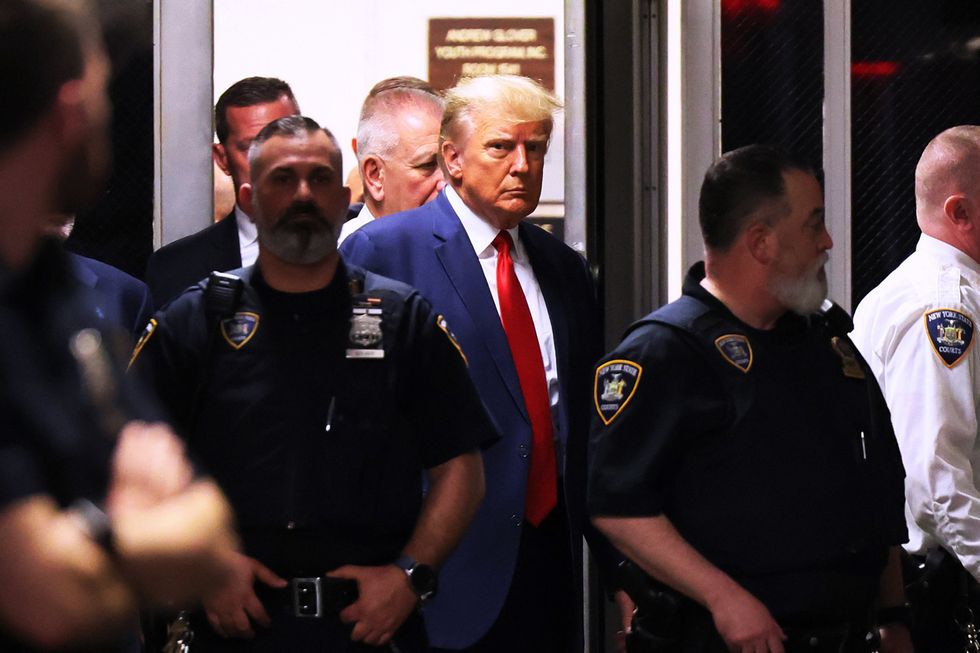 Former President Donald Trump arrives for his arraignment at Manhattan Criminal Court on April 04 in New York City. Michael M. Santiago/Getty Images
 Trump's campaign is selling these black-and-white ceramic coffee mugs for $24. (Screen grab)
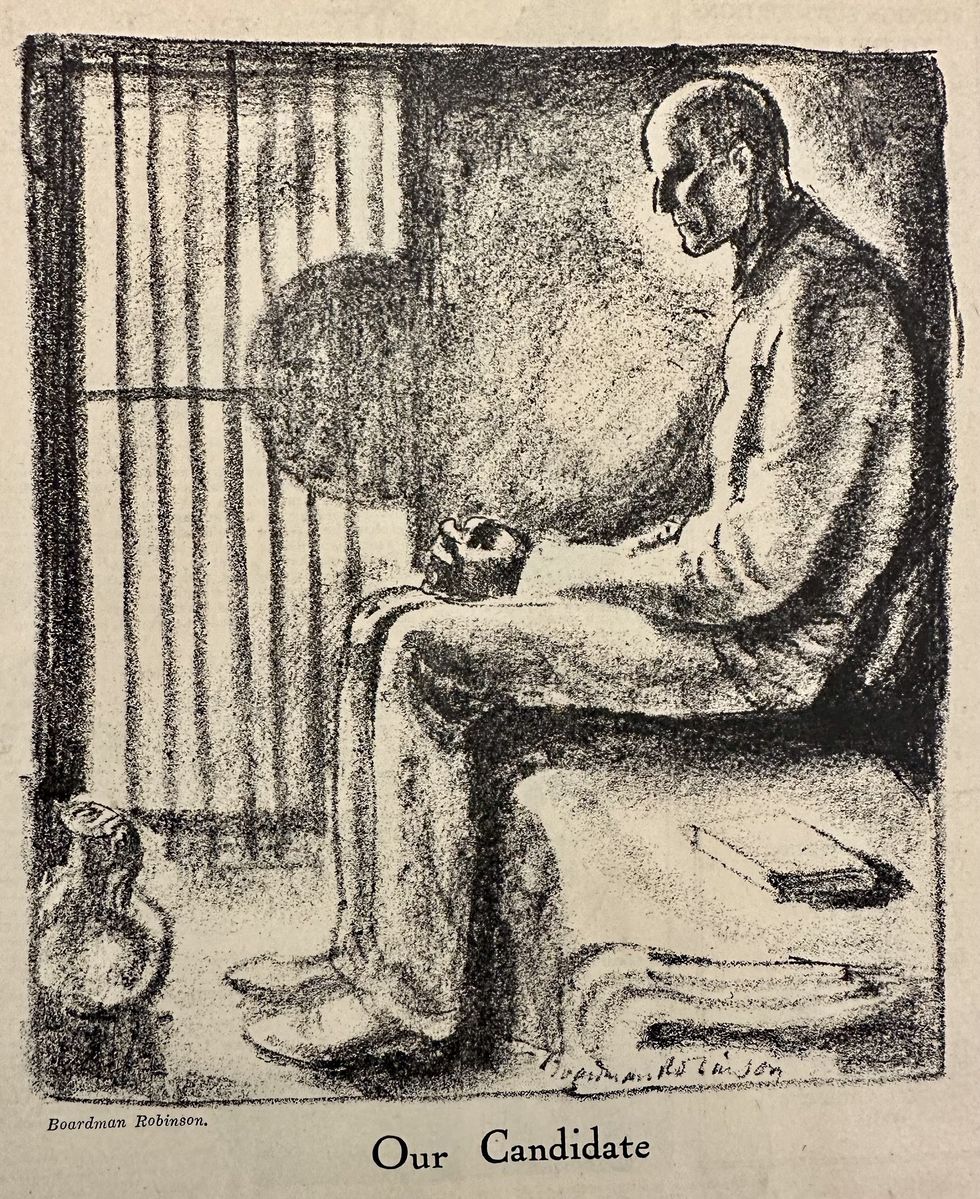 Illustration of Eugene Debs while running for president in prison. Indiana State University archives
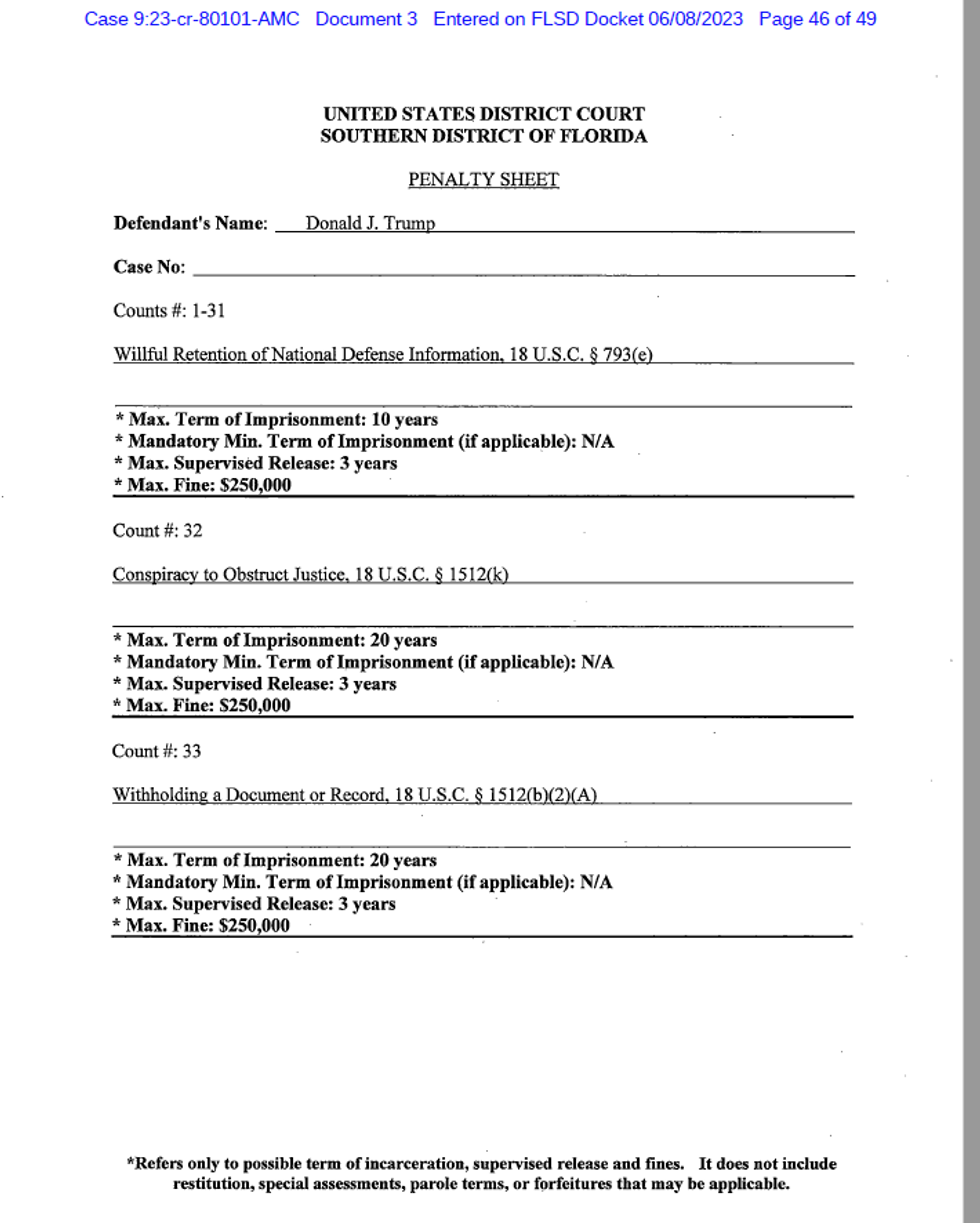 Federal document listing indictment counts against former President Donald Trump. U.S. District Court, Southern District of Florida