A Vietnamese woman who stood trial for the assassination of the North Korean leader's half-brother was freed from prison Friday, bringing down the final curtain on a dramatic and often bizarre two-year murder mystery.
Kim Jong Nam, the estranged relative of Kim Jong Un and once seen as heir apparent to the North's leadership, died in agony after having his face smeared with a banned nerve agent as he waited at Kuala Lumpur airport in February, 2017.
The sensational killing made headlines around the world, and sparked a furious diplomatic row as Seoul accused Pyongyang of an elaborate plot to murder a figure who had spent years in exile and been critical of his family's rule.
Doan Thi Huong from Vietnam and Indonesian Siti Aisyah were arrested after being spotted on CCTV approaching Kim, but they always denied murder. The women insisted they were tricked into carrying out the hit by North Korean agents who said it was a reality TV show prank and fled Malaysia after the killing.
They went on trial, but in March prosecutors dropped the murder charge against Aisyah after diplomatic pressure and she flew home.
Then last month they withdrew murder charges against Huong, who pleaded guilty to a reduced count of "causing injury" and was told she would be released in May at the end of her sentence.
AFP / Gal ROMA The 2017 assassination of Kim Jong Nam
More than two years after her arrest, the 30-year-old former hair salon worker was freed from prison outside the Malaysian capital in the early morning, racing past journalists in a van with heavily tinted windows.
"I'm very happy, thank you all a lot," said Huong, in a message read by her lawyers to media after her release.
She went to an immigration office in the afternoon and was due to fly later Friday to Vietnam, where she will be reunited with her family.
- 'True killers escaped justice' -
While there is relief for the women, no one else is in custody over the murder and those behind the plot are unlikely to ever be punished.
"The assassins have not been brought to justice," said her lawyer Hisyam Teh Poh Teik, adding the women's legal teams consistently argued that four North Koreans who fled Malaysia after the killing, and were charged in absentia, were the real murderers.
The women were arrested after they were captured on airport CCTV cameras walking up behind Kim as he waited for a flight, and one was seen clasping her hands over his face.
Kim, who fell from grace in the North after a bizarre attempt to visit Tokyo Disneyland, died shortly afterwards, his face smeared with poison.
AFP / Mohd RASFAN Lawyer Hisyam Teh Poh Teik read a letter from Huong expressing her happiness at being released
The women, who faced death by hanging if convicted of murder, went on trial in October 2017 but the case was slow-moving due to the large number of witnesses and appeals from the defence teams.
The defence stage of the trial had been due to get underway in March before prosecutors suddenly dropped charges against Aisyah, 27, following intense diplomatic pressure from the Indonesian government.
Vietnam then stepped up pressure for Huong's murder charge to be dropped and at the start of April prosecutors offered her the lesser charge, paving the way for her release.
Pyongyang has never admitted to killing Kim Jong Nam -- it claims the dead man was a North Korean citizen named Kim Chol -- and that the accusations were a smear campaign.
The assassination sparked a furious row between North Korea and Malaysia, previously one of nuclear-armed Pyongyang's few allies, and prompted both countries to expel each other's ambassadors.
Ties have improved in recent times, however, with Malaysia saying it plans to reopen its embassy in Pyongyang, which was closed shortly after the murder.
Jimmy Carter was a dark horse Democratic presidential candidate with little national recognition when he beat Republican incumbent Gerald Ford in 1976.
The introspective former peanut farmer pledged a new era of honesty and forthrightness at home and abroad, a promise that resonated with voters eager for change following the Watergate scandal and the Vietnam War.
His presidency, however, lasted only one term before Ronald Reagan defeated him. Since then, scholars have debated – and often maligned – Carter’s legacy, especially his foreign policy efforts that revolved around human rights.
The criticism of Carter’s foreign policies seems particularly mistaken when it comes to the Cold War, a period defined by decades of hostility, mutual distrust and arms buildup after World War II between the U.S. and Russia, then known as the Soviet Union or Union of Soviet Socialist Republics (USSR).
By the late 1970s, the Soviet Union’s economy and global influence were weakening. With the counsel of National Security Advisor Zbigniew Brzezinski, a Soviet expert, Carter exploited these weaknesses.
During his presidency, Carter insisted nations provide basic freedoms for their people – a moral weapon against which repressive leaders could not defend.
Carter’s team underscored these violations in arms control talks. The CIA flooded the USSR with books and articles to incite human rights activism. And Carter publicly supported Russian dissidents – including pro-democracy activist Andrei Sakharov – who were fighting an ideological war against socialist leaders.
Human rights were a cornerstone of President Jimmy Carter’s foreign policy. Here, a billboard with his picture on it in Liberia.
Carter adviser Stuart Eizenstat argues that the administration attacked the Soviets “in their most vulnerable spot – mistreatment of their own citizens.”
This proved effective in sparking Soviet leader Mikhail Gorbachev’s social and political reforms of the late 1980s, best known by the Russian word “glasnost,” or “openness.”
The Afghan invasion
In December 1979, the Soviets invaded Afghanistan in response to the assassination of the Soviet-backed Afghan leader, Nur Mohammad Taraki. The invasion effectively ended an existing détente between the U.S. and USSR.
Beginning in July 1979, the U.S. was providing advice and nonlethal supplies to the mujahideen rebelling against the Soviet-backed regime. After the invasion, National Security Advisor Brzezinski advised Carter to respond aggressively to it. So the CIA and U.S. allies delivered weapons to the mujahideen, a program later expanded under Reagan.
Afghan rebels examine a Soviet-built armored personnel carrier and scores of other military vehicles left behind when the Mujahedeen fighters overran a Soviet-Afghan garrison.
Economist Elizabeth Clayton concluded in 1985 that Carter’s embargo was effective in exacerbating this weakness.
Census data compiled between 1959 and 1979 show that 54 million people were added to the Soviet population. Clayton estimates that 2 to 3 million more people were added in each subsequent year. The Soviets were overwhelmed by the population boom and struggled to feed their people.
At the same time, Clayton found that monthly wages increased, which led to an increased demand for meat. But by 1985, there was a meat shortage in the USSR. Why? Carter’s grain embargo, although ended by Reagan in 1981, had a lasting impact on livestock feed that resulted in Russian farmers decreasing livestock production.
For years, Soviet leaders promised better diets and health, but now their people had less food. The embargo battered a weak socialist economy and created another layer of instability for the growing population.
The Olympic boycott
In 1980, Carter pushed further to punish the Soviets. He convinced the U.S. Olympic Committee to refrain from competing in the upcoming Moscow Olympics while the Soviets repressed their people and occupied Afghanistan.
Historian Allen Guttmann said, “The USSR lost a significant amount of international legitimacy on the Olympic question.” Dissidents relayed to Carter that the boycott was another jab at Soviet leadership. And in America, public opinion supported Carter’s bold move – 73% of Americans favored the boycott.
The Carter doctrine
In his 1980 State of the Union address, Carter revealed an aggressive Cold War military plan. He declared a “Carter doctrine,” which said that the Soviets’ attempt to gain control of Afghanistan, and possibly the region, was regarded as a threat to U.S. interests. And Carter was prepared to meet the threat with “military force.”
Carter also announced in his speech a five-year spending initiative to modernize and strengthen the military because he recognized the post-Vietnam military cuts weakened the U.S. against the USSR.
Ronald Reagan argued during the 1980 presidential campaign that, “Jimmy Carter risks our national security – our credibility – and damages American purposes by sending timid and even contradictory signals to the Soviet Union.” Carter’s policy was based on “weakness and illusion” and should be replaced “with one founded on improved military strength,” Reagan criticized.
In 1985, however, President Reagan publicly acknowledged that his predecessor demonstrated great timing in modernizing and strengthening the nation’s forces, which further increased economic and diplomatic pressure on the Soviets.
Reagan admitted that he felt “very bad” for misstating Carter’s policies and record on defense.
Carter is most lauded today for his post-presidency activism, public service and defending human rights. He was awarded the Nobel Peace Prize in 2002 for such efforts.
But that praise leaves out a significant portion of Carter’s presidential accomplishments. His foreign policy, emphasizing human rights, was a key instrument in dismantling the power of the Soviet Union.
Facebook on Thursday banned controversial black activist leader Louis Farrakhan, far-right icon Alex Jones and several others in a heightened crackdown on hate content at the leading social network.
"We've always banned individuals or organizations that promote or engage in violence and hate, regardless of ideology," Facebook said in a statement.
The most prominent to be banned were Farrakhan, head of the Nation of Islam, accused of being anti-Semitic and black supremacist; and Jones, the far-right conspiracy theorist best known for calling the 9/11 attacks an inside job and describing the Sandy Hook school massacre as a hoax. Jones's organization Infowars was also banned by Facebook.
Others banned Thursday from Facebook and Instagram were Paul Nehlen, a political candidate espousing white supremacist views; Milo Yiannopoulos, know for neo-Nazi rhetoric; and conspiracy theorists Paul Joseph Watson and Laura Loomer.
Facebook announced the bans on the grounds they violated policies against dangerous individuals and organizations.
"Individuals and organizations who spread hate, or attack or call for the exclusion of others on the basis of who they are, have no place on Facebook," a spokeswoman for Facebook said.
Such bans typically include prohibiting others at the social network from using the platform to post praise or support from those no longer welcomed.
"Today's announcement from Facebook is a step in the right direction," said Cristina Lopez G., deputy director for extremism at nonprofit watchdog group Media Matters for America.
"The majority of the newly banned figures -- Yiannopoulos, Loomer, Watson, Jones, and Nehlen -- owed their influence to the massive reach they were allowed to cultivate through Facebook and Instagram."
Banning the accounts should help limit the spread of radical and often violent far-right ideology, according to Lopez.
Facebook last month banned various far-right British groups including the English Defense League from its network for promoting hate and violence.
Other groups kicked off both Facebook or Instagram last month included Knights Templar International, Britain First, the British National Party (BNP) and the National Front.
The tech titan banned the groups for contravening its policy forbidding "terrorist activity, organized hate, mass or serial murder, human trafficking or organized violence or criminal activity".
Former BNP leader Nick Griffin and Britain First leaders Paul Golding and Jayda Fransen were also been banned in the crackdown.
A senior Republican congressman urged fellow lawmakers to continue supporting the Saudi Arabia-led war in Yemen, by reading a Saudi lobbyist's talking points verbatim.
Rep. Ed Royce (R-CA), who chaired the House Foreign Relations Committee from 2013 until earlier this year, made speech in November 2017 warning that Iran could gain a foothold in the Arabian Gulf nation through Houthi rebels, reported The Intercept.
“Part of the problem here is the leaders of the Houthi militia were indoctrinated in Qom, in Iran, as part of an Iranian attempt to construct a Hezbollah-like proxy in Yemen,” Royce said.
That controversial line, like most of his speech, had been written by a lobbyist for Saudi Arabia.
The Intercept obtained talking points that Royce had gotten that day from the Hogan Lovells lobbyist hired by the Saudi Kingdom, according to federal disclosure forms.
Saudi Arabia and the United Arab Emirates, its chief ally in the war, have spent tens of millions of dollars to keep U.S. support, which may be weakening.
President Donald Trump has vetoed the War Powers Act resolution calling for an end to U.S. support of the war, and the Senate will vote Thursday on whether to override that veto.
May Day clashes between opposition supporters and Venezuela's armed forces in Caracas left a woman dead and 46 people injured on Wednesday, with opposition leader Juan Guaido attempting to rally demonstrators against President Nicolas Maduro.
Jurubith Rausseo, 27, died at a clinic after being hit by a "bullet in the head during (a) demonstration," the non-governmental Venezuelan Observatory of Social Conflict said on Twitter, condemning her "murder."
Human rights organizations and health services reported 46 people injured in Wednesday's clashes, including one person with a gunshot wound.
Tensions in Venezuela have soared since Guaido, who heads the National Assembly legislature, invoked the constitution to declare himself acting president on January 23, claiming Maduro's re-election last year was illegitimate.
National Guard troops fired tear gas at stone-throwing protesters attempting to block a highway close to the air base in eastern Caracas where Guaido had tried on Tuesday to spark a military uprising.
A second day of confrontations between opposition supporters and Maduro's security services came as the United States said it was prepared to take military action, if necessary, to stem the crisis in the South American nation.
At least one journalist was injured when National Guard soldiers fired rubber bullets at a group of reporters covering the clashes.
Miguel Ramirez, 17, told AFP at one medical center that he had been shot in the foot while protesting on the highway near the La Carlota air base.
"I didn't manage to run and hide," he said.
Guaido rallied his supporters in Caracas in the Labor Day demonstrations, urging them to stay in the streets.
AFP / Juan BARRETO Venezuelan President Nicolas Maduro, who said there was "joy" in the streets, gestures during a May Day rally in Caracas
His appeal came despite the apparent failure the day before of a revolt by some soldiers and members of the Bolivarian National Guard who joined his side.
In Tuesday's clashes, one person was killed and dozens injured, according to human rights monitors. More than 150 people were arrested, the government and human rights organizations said.
UN Secretary General Antonio Guterres warned Venezuela's authorities not to use deadly force against demonstrators, while the US and Russia accused each other of making the crisis worse, evoking Cold War confrontations of the past.
In a phone call with Russian Foreign Minister Sergei Lavrov, US Secretary of State Mike Pompeo accused Moscow of "destabilizing" Venezuela.
- 'Nothing to celebrate' -
Lavrov, in turn, charged that US interference was "destructive" and "in flagrant violation of international law."
AFP / Federico PARRA Anti-government demonstrators rally in Caracas ahead of what opposition leader Juan Guaido said would be staggered industrial action leading to a general strike
"There is nothing for workers to celebrate," Guaido told supporters in the oil-rich country suffering from hyperinflation and food and medicine shortages that have driven millions to flee.
"We're going to remain in the streets until we achieve freedom for the Venezuelan people.
"The regime will try to increase the repression. It will try to persecute me, to stage a coup d'etat," said Guaido, recognized by more than 50 countries as the country's interim president.
He said staggered industrial action would begin on Thursday, leading to a general strike.
AFP / Juan BARRETO A member of Venezuela's Bolivarian Militia displays pictures of late leader Hugo Chavez during a pro-government rally on May Day in Caracas
Before thousands of his own supporters in front of Miraflores palace on May Day, Maduro declared he will have "no hesitation" to lock up those responsible for this "criminal coup d'etat," threats recalling those he made the previous day.
In his Wednesday address, Maduro alleged that the "so-called coup d'etat" had been organized "from the White House" by US National Security Advisor John Bolton.
- 'Serious crimes' -
AFP / Alice LEFEBVRE Venezuela
Hours after the revolt by military members appeared to have fizzled out, Pompeo told CNN he believed Maduro was ready to flee to ally Cuba before he was dissuaded by Russia -- a claim Maduro later refuted as "a joke."
A senior Brazilian official said at least 25 Venezuelan troops had sought asylum at its Caracas embassy.
Venezuela's security forces number around 365,000 including military and police, as well as 1.6 million civilian reservists.
Pompeo said on Wednesday that Washington wants a peaceful transfer of power but warned that US President Donald Trump is prepared to take military action if necessary.
"The president has been crystal clear and incredibly consistent. Military action is possible. If that's what's required, that's what the United States will do," Pompeo told Fox Business Network.
- 'Living through hell' -
AFP / YURI CORTEZ An anti-government protester is assisted during May Day clashes with security forces in Caracas, as UN Secretary General Antonio Guterres warned Venezuela's authorities not to use deadly force against demonstrators
Venezuela has suffered five years of recession marked by shortages of basic necessities as well as failing public services, including water, electricity and transport.
"We're living through hell," a resident of western Caracas, Evelinda Villalobos, 58, told AFP.
"I believe the people in the streets will be the straw that breaks the camel's back."
Another demonstrator, Patricia Requena, 40, said that "yesterday we saw soldiers recognizing our interim president. We have to stay in the streets."
She vowed: "I'll keep demonstrating as long as God allows me to."
Michael Shifter, an analyst with the Inter-American Dialogue, told AFP the US approach to Venezuela was "unhelpful and often counterproductive."
"The US is right to back Guaido in his battle against Maduro," said Shifter.
"But beyond being on the right side, the administration is making it harder, not easier, to achieve a democratic transition in Venezuela."
The Loire Valley town of Amboise will kick off festivities marking the 500th anniversary of Leonardo da Vinci's death in style on Thursday, with the French and Italian presidents topping the bill.
The Florentine master who personified the Italian Renaissance was the guest of France's King Francis I for the final three years of his life before his death in Amboise in 1519.
France's Emmanuel Macron and Italian President Sergio Mattarella will mark the anniversary with visits to his grave at the royal chateau and the Clos Luce, the sumptuous manor house nearby where Leonardo lived and died.
Among glitterati attending the events will be Italian star architect Renzo Piano and French astronaut Thomas Pesquet.
The joint celebrations come after months of mounting diplomatic tensions between Paris and Rome over the hardline policies of Italy's populist government and its support for France's anti-government "yellow vest" protesters.
In the worst diplomatic crisis between the two countries since World War II, Paris briefly recalled its ambassador from Rome.
Mattarella, staunchly pro-EU like Macron, played an "essential role" in lowering tensions, Macron's office said.
After some 200 "yellow vests" staged protests in Amboise on Saturday, the town of some 13,000 people was already in virtual lockdown early Wednesday ahead of the presidential visit.
Parking was banned along the riverside motorcade route, with anyone flouting the ban having their vehicle towed away.
AFP/File / GABRIEL BOUYS Leonardo da Vinci personified the Italian Renaissance and was the guest of France's King Francis I for the final three years of his life before his death in Amboise in 1519
Shops, bars and restaurants below the chateau will be shuttered on Thursday.
Emmanuel Honnet, who runs the Cafe des Arts snack bar by the chateau, said the precautions were "understandable... given the terrible social climate and the real terrorist risk".
But the 51-year-old vented "frustration" that the townspeople would be largely sidelined. "It should be the memory of a lifetime," he said.
Macron will be the first French president to visit the town since Charles de Gaulle came in 1959.
- 'Architect of the king' -
Francis I, known as the "Sun King of the 16th century", is widely credited with bringing the Renaissance to France, even if his predecessor Louis XII had begun the process by bringing in architects and artisans from Florence, Milan and Rome.
Leonardo was 64 when he accepted the young Francis I's invitation, at a time when rivals Michelangelo and Raphael were rising stars.
With Leonardo's commissions drying up, it came as a great relief and no small vindication for the Tuscan artist, who received a handsome stipend as the "first painter, engineer and architect of the king".
AFP / Marco Bertorello With fewer than 20 Leonardo paintings still in existence, many Italians are resentful that the Louvre possesses five of them, as well as 22 drawings
At the time, Francis I was barely 23, and his ambitious mother Louise of Savoy "knew that Leonardo would be the man who would allow her son to flourish", Catherine Simon Marion, managing director of the Clos Luce, told AFP.
Leonardo brought with him three of his favourite paintings: the Mona Lisa, the Virgin and Child with Saint Anne, and Saint John the Baptist -- all of which today hang in the Louvre museum in Paris.
Italy and France have also sparred over an accord under which Italy will lend several Leonardos to the Louvre in October.
With fewer than 20 Leonardo paintings still in existence, many Italians are resentful that the Louvre possesses five of them, as well as 22 drawings.
During his three years in Amboise, Leonardo organised lavish parties for the court and worked to design an ideal city for Francis at nearby Romorantin -- one of the polymath's many unrealised projects -- all while continuing his research.
On Thursday, Macron and Mattarella will also travel to the sprawling chateau of Chambord, whose central double-helix staircase is attributed to Leonardo -- though the first stone was not laid until four months after his death.
Nearly 800,000 people in eastern India have been evacuated from the expected path of a major cyclone packing winds up to 200 kilometres (125 miles) per hour and torrential rains, officials said Thursday.
The Indian weather service said Extremely Severe Cyclonic Storm Fani was expected to make landfall on Friday afternoon in Odisha state and barrel northeastwards on a pathway close to the homes of more than 100 million people.
A state relief department official told AFP that 780,000 people were moved to safer places overnight from at least 13 districts of Odisha, home to some 46 million people, which will bear the brunt of the weather system.
"We are expecting more than a million people to move out of the danger zone in next 12 hours," Bishnupada Sethi, Odisha Special Relief Commissioner, told AFP.
Some 3,000 shelters in schools and government buildings have been set up to accommodate more than a million people. More than 100,000 dry food packets are ready to be dropped if needed, reports said.
On Thursday the storm, which reports said was the biggest to hit eastern India in nearly two decades, was brewing in the Bay of Bengal some 250 kilometres (155 miles) offshore and moving slowly but ominously westwards.
AFP / AFP Cyclone Fani
The cyclone was expected to pack sustained wind speeds of 180-190 kph, bringing gusts of up to 200 kph, equivalent in strength to a Category 3 to 4 hurricane.
It was expected to make landfall near the Hindu holy town of Puri, a major tourist hotspot attracting millions of Indian and foreign visitors every year.
More than 100 trains have been cancelled in past 48 hours, according to a statement by Indian Railways. Three special trains were running from Puri to evacuate pilgrims and tourists.
Authorities have asked tourists to leave coastal areas and avoid unnecessary travel. Special buses have been deployed in Puri and other towns.
Dozens of officials were making announcements on hand-held megaphones across the coastal belt asking residents to leave their homes for safety.
The Indian Navy has also been put on alert.
The Airports Authority of India issued an advisory to all the coastal airports to take adequate precautions.
"Our men are urging people to move to safer places and government has set up sufficient shelters to take in those evacuating their homes," said Sethi.
"Heavy rains are expected in all the coastal districts amid fears of flash floods. We are all geared up for the challenge."
- Deluge -
Forecasters have predicted "heavy to very heavy" rain on Friday in some places and "extremely heavy" rain the next day, with some areas inundated by up to 20 centimetres (8 inches) of water.
Tides could also surge up to 1.5 metres (five feet).
India's weather office has warned that the high speed winds can uproot trees, flatten crops and damage homes, power and communication infrastructure.
The neighbouring coastal states of Andhra Pradesh, home to 50 million people, and Tamil Nadu, population some 70 million, have also been put on high alert.
Fani will be the fourth such storm to hit India's east coast in three decades. Major weather systems regularly affect eastern and southeastern India between April and December.
In 2017, Cyclone Ockhi left nearly 250 people dead and more than 600 missing in Tamil Nadu and Kerala states.
The worst cyclone on record in Odisha in 1999, killed almost 10,000 people and caused an estimated $4.5 billion worth of devastation.
Odisha had to evacuate some 300,000 people last October when its coastal districts were battered by Cyclone Titli, with winds up to 150 kph and heavy rains. At least two people died.
Washington has signed more than $1 billion in new missile contracts in the three months since it announced plans to withdraw from a key Cold War-era arms treaty, campaigners said Thursday.
"The withdrawal from the INF Treaty has fired the starting pistol on a new Cold War," warned Beatrice Fihn, who heads the Nobel Peace Prize-winning International Campaign to Abolish Nuclear Weapons (ICAN).
US President Donald Trump announced last October that his country would leave the Intermediate-Range Nuclear Forces (INF) agreement concluded between the US and the former Soviet Union in 1987.
Washington, which accused Russia of violating the treaty through a new missile system, began the official process of withdrawing from the pact in February.
Russian President Vladimir Putin responded by saying Moscow would also leave the INF treaty, which is considered the cornerstone of global arms control.
In the three months following the October announcement, the US government "proceeded to arrange no less than $1 billion in new missile contracts", according to a report by ICAN and another anti-nuclear campaign group, PAX.
The report detailed over $1.1 billion in new contracts with six mainly US companies.
US defence contractor Raytheon saw the biggest windfall, tallying 44 new contracts worth some $537 million.
Lockheed Martin meanwhile scooped up 36 new contracts, worth $268 million, while Boeing grabbed four new contracts totalling $245 million, the report found.
- 'Congress should investigate' -
"Congress should investigate the lobbying roles of Boeing, Lockheed Martin and Raytheon who took the lion's share of these contracts," Fihn said in a statement.
The report authors acknowledged that it was unclear if all of the new contracts awarded between October 22, 2018 and January 21, 2019 were for new nuclear weapon production.
"What is clear is that there is a new rush towards building more missiles that benefit a handful of US companies and intend to flood the market with missiles regardless of their range," they said.
At a global level, the report found that governments are currently contracting at least $116 billion (102 billion euros) to private companies in France, India, Italy, the Netherlands, Britain and the US for the production, development and stockpiling of nuclear weapons.
At the same time, it stressed that the private sector involvement in the arsenals of China, Israel, North Korea, Pakistan and Russia remain largely hidden, with little insight into how much is being contracted and which companies are getting the deals.
Many of the outstanding contracts identified in the report were granted around 2015 and are set to expire in 2020, but some of the contracts have far longer time frames.
For example, one contract for a key component necessary to launch US Intercontinental Ballistic Missiles runs until at least 2075, the report showed.
"President Trump is heralding the need for global denuclearisation, but US deeds, and those of nuclear-armed allies do not match those words," said Susi Snyder, PAX nuclear disarmament programme manager and the lead author of the report.
"We see the US and other states planning for a nuclear-armed century, with contracts to maintain weapons through at least 2075, despite growing domestic and global calls to reverse course," she lamented.
US Secretary of State Mike Pompeo said on Wednesday the administration of President Donald Trump was prepared to take military action to stem the crisis in Venezuela.
"The president has been crystal clear and incredibly consistent. Military action is possible. If that's what's required, that's what the United States will do," Pompeo said on Fox Business Network.
Pompeo said the US would prefer a peaceful transition of power, with President Nicolas Maduro leaving and new elections held to choose new leaders.
"But the president has made clear in the event that there comes a moment -- and we will all have to make decisions about when that moment is and the president will ultimately have to make that decision -- he's prepared to do that if that's what's required."
In a separate interview with CNN, National Security Advisor John Bolton said Pompeo would be speaking later today with Russian Foreign Minister Sergei Lavrov to discuss the situation.
Bolton and Pompeo have accused Russia and Cuba of standing in the way of a change in the regime in Caracas.
Pompeo said Tuesday that Maduro was set to leave the country for Cuba but apparently was talked out of it by the Russians.
"The Russians like nothing better than putting a thumb in our eye," Bolton said. "They're using the Cubans as surrogates. They'd love to get effective control of a country in this hemisphere."
"It's not ideological, it's just good old fashioned power politics. That's why we have the Monroe doctrine which we're dusting off in this administration, why the president indicated last night that the Cubans better think long and hard about what their role is," he added.
The Monroe doctrine is a 19th century US policy opposing interference in the western hemisphere by European powers, which later was invoked to justify US intervention in Latin America.
The fossilised remains of an early human cousin found in the mountains of Tibet proves mankind adapted to live at high altitude far earlier than previously thought, scientists said Wednesday.
A jawbone dating from at least 160,000 years ago of a Denisovan -- a now-extinct branch of humanity -- is the first of its kind discovered outside of southern Siberia, and experts believe it holds the key to understanding how some modern-day humans have evolved to tolerate low-oxygen conditions.
Contemporaries of the Neanderthals -- and like them, possibly wiped out by anatomically modern man, Homo sapiens -- the Denisovans first came to light a decade ago.
Their existence was determined through a piece of finger bone and two molars unearthed at the Denisova Cave in southern Siberia's Altai Mountains and dated to some 80,000 years ago.
But the new remains -- discovered in passing by a local monk nearly thirty years ago -- has led researchers to conclude that Denisovans were far more numerous, and far older, than previously thought.
"To have beings, even if a little archaic, living at 3,300 metres (11,000 feet) on the Tibetan plateau 160,000 years ago.... That's something that no one could have imagined until today," said Jean-Jacques Hublin, director of the Max Planck Institute's Department of Human Evolution.
The bone, found in the Baishiya Karst Cave in Xiahe, China, was donated by the monk to a local museum, before scientists set about analysing its composition. It was so old no DNA could be extracted.
But Hublin and his team used the latest protein analysis to date one of its teeth and to link it genetically to Denisovan specimens found in Siberia.
The Max Planck Institute for Evolutionary Anthropology/AFP / Jean-Jacques HUBLIN The bone, found in the Baishiya Karst Cave in Xiahe, China, was donated by the monk to a local museum, before scientists set about analysing its composition
"From my point of view it's confirmation of a working hypothesis I've had for a while: Nearly all Chinese and east Asian (hominim) fossils between 350,000-50,000 years ago are probably Denisovan," said Hublin, lead author of the study published in Nature.
- 'Extraordinary' -
A recent research paper suggested that humans only reached the Tibetan plateau -- a vast area of mountainous terrain north of the Himalayas -- around 40,000 years ago.
"Here we have something that's four times older," said Hublin. "It's absolutely extraordinary."
The jawbone discovery also solves a riddle that has troubled anthropologists for years.
In 2015 researchers found that ethnic Tibetans and Han Chinese living at altitude had buried in their genetic code an unusual variant of a gene, EPAS1, which regulates haemoglobin, the molecule that hauls oxygen around the blood.
At high altitude, common variants of the gene overproduce haemoglobin and red blood cells, causing the blood to become thick and sludgy -- a cause of hypertension, low birthweight and infant mortality.
But the variant found in Tibetans increases production by much less, thus averting hypoxia problems experienced by many people who relocate to places above 4,000 metres in altitude.
The mutation is nearly identical to that found in the DNA of Denisovans discovered in Siberia -- at an altitude of less than 700 metres.
"That was something that no one really understood, because the Denisovans weren't known to live at altitude, so they didn't really need that gene to survive," said Hublin.
"Now we know why. It's not the DNA from Denisovans from (Siberia), it's the DNA from the Denisovans of Tibet."
That’s not the end of Assange’s legal problems: On May 2, Assange, the co-founder of WikiLeaks, will appear at a London court in relation to his requested extradition to the U.S.
The publication of classified information violates a number of federal laws, including the Espionage Act. The act imposes up to 10 years of imprisonment for every violation of its various provisions.
But at least for now, the U.S. has not charged Assange with any such violations.
Why has Assange not been charged with the more serious crimes of publishing American secrets?
Constitutional protections for publication
One reason is the questionable constitutionality of such charges. They may violate the First Amendment to the U.S. Constitution, which prohibits the government from “abridging the freedom of speech, or of the press.”
Accordingly, the American government has traditionally abstained from charging publishers of classified information for the crime of publication. The one near-exception occurred in 1942, in the middle of World War II, after the Chicago Tribune published a front-page story titled “Navy Had Word of Jap Plan to Strike at Sea.” The story implied that the U.S. military had cracked Japan’s secret naval code – which in fact it had.
Chicago Tribune of June 7, 1942, featuring story, ‘Navy Had Word of Jap Plan to Strike at Sea.’
An incensed President Franklin Roosevelt demanded that Espionage Act charges be brought against the reporter, the managing editor and the Tribune itself. But a grand jury refused to issue indictments.
The Pentagon Papers
In 1972 the U.S. government tried to stop The New York Times and The Washington Post from publishing the Pentagon Papers, a top-secret Department of Defense study on the Vietnam War.
In its well-known decision, the Supreme Court held that preventing the publication violated the First Amendment. Less known is the fact that a majority of the justices also thought that the newspapers could be prosecuted and possibly punished for the publication, even if stopping the publication was unconstitutional.
The Pentagon Papers decision was about the ability of government to stop the publication of information – in other words, its ability to impose a “prior restraint.” It left open the possibility of punishing publishers after the publication.
On the other hand, a number of later Supreme Court decisions did protect publishers who had published truthful information in violation of the law.
These publications were all protected by the freedoms of speech and the press.
National security vs. free speech
However, none of these later cases dealt with publication of national security information, and the outcome may be different when it comes to such materials. That would depend on the specific dangers or harms posed by the publication: for example, on whether lives were endangered, or whether the government was simply trying to prevent embarrassment to itself.
Some judges, however, would likely simply defer to the government’s assessment of these dangers.
“In my judgment the judiciary may not … redetermine for itself the probable impact of disclosure on the national security,” wrote Justice John Marshall Harlan for himself and Justices Harry Blackmun and Warren Burger in the Pentagon Papers decision. Some of today’s Supreme Court justices – Justice Clarence Thomas, for example – are likely to agree with Harlan’s position.
Still, as of today, Assange’s indictment does not include charges of criminal publication. Assuming that the indictment is left unchanged, the question remains: Is the current charge – a conspiracy to hack into a government computer – a danger to the freedom of the press?
Threat to legitimate journalism?
Nothing in Assange’s indictment turns on any distinction between WikiLeaks and the mainstream press. The current charge would be equally applicable to “real” journalists if they engaged in similar conduct.
And yet, Assange is not charged with helping Manning hack into a computer.
He is charged with agreeing to help Manning hack into a computer – whether there was or wasn’t any hacking attempt. The essence of the crime of conspiracy is agreement to commit a crime, irrespective of whether that crime was in fact attempted.
Federal conspiracy charges also require that some action be taken toward committing the crime. But that action can be utterly minor, fall far short of an actual attempt, need not be itself criminal, and may be undertaken by any of the co-conspirators with or without anyone’s knowledge.
Moreover, conspiracy can exist even without explicit words of agreement: It can be inferred. For example, from the fact that a passenger exited a car, robbed a pedestrian, then returned to the car and was driven away, it was permissible to infer that the driver conspired to commit robbery (a criminal offense wholly independent of the robbery itself).
Do legitimate journalists sometimes engage in criminal conspiracies with their sources? Of course: Every time a journalist receives and publishes classified national security information, she can be said to conspire with her source to disclose classified information, which is a crime.
In fact, the federal government had already advanced such a conspiracy claim in regard to a journalist.
In 2009 Fox News reporter James Rosen wrote an article that contained leaked classified information about North Korea. In 2010 the Obama administration filed a search warrant application where it argued that Rosen was a criminal co-conspirator of his State Department source in the criminal disclosure of classified information.
The warrant was granted, although Rosen was never indicted for the alleged conspiracy. Indeed such an indictment would have raised similar constitutional difficulties to those implicated in the criminal publication of classified information.
Line of illegality
Julian Assange is charged with a conspiracy to criminally obtain classified information through computer hacking — not with a conspiracy to disclose or publish classified information (which legitimate journalists might also be accused of).
Nevertheless, Assange’s indictment can be a dangerous precedent if the government views it through a broad lens: namely, as a charge about a criminal conspiracy to obtain classified information. In that case, legitimate journalists may also be on the hook.
In fact, it is rather clear that the government takes a broad view of Assange’s indictment. After all, clearly Assange is prosecuted because of WikiLeaks’ publication of classified information, even if the government is still reluctant to indict him for that.
And the broad view is also implied in the statements of Jeff Sessions, who as attorney general made prosecuting Assange a priority.
When testifying before the Senate Judiciary Committee in 2017, Sessions was asked whether he can “commit to not jailing reporters for doing their jobs.”
Oceans cover more than 70% of the Earth’s surface, and scientists argue that the planet’s interior also contains a lot of water. But where did all this water come from?
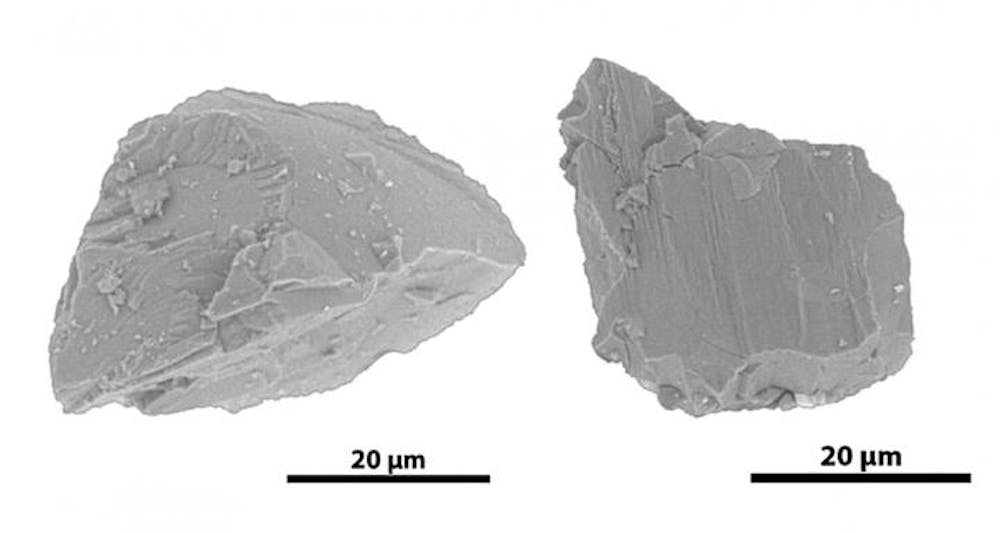
I and my postdoc Ziliang Jin analyzed grains of the mineral pyroxene from an asteroid called Itokawa, which is the first asteroid that humankind ever sampled. The Japanese probe Hayabusa brought back about 1,500 particles from the asteroid’s surface in 2010, and our recent measurements show that this asteroid is wetter than we imagined.
Samples of meteorites that came from Itokawa-like asteroids that have been analyzed for water revealed barely detectable quantities. This led scientists to speculate that rubble-pile asteroids like Itokawa would be bone dry. But we found lots of water in these particles. To be clear, the specific amount of water that Itokawa particles contain is still low with respect to anything in our human experience. But the discovery of even these amounts of water with the correct isotope signature means that asteroids like it that struck the Earth could have provided more than half of Earth’s oceans.
I am a cosmochemist at Arizona State University who is interested in the small bodies in our solar system like asteroids and comets, which are the building blocks of the planets. Studying the chemistry of these types of seed materials can tell us a lot about how the planets formed and the conditions in the early stages of planet growth.
We were interested in studying samples from the asteroid Itokawa because we had speculated that Itokawa particles should have some water, based on some back-of-the-envelope calculations Ziliang had done. Then I wrote a proposal to the Japanese Space Agency and received the samples that we ended up studying.
Asteroid Itokawa is a battered remnant of a larger parent body. ASU scientists have discovered that this rubble-pile asteroid still contains significant amounts of water in its minerals.
The source of water on Earth and other planets like Mars is hotly debated in the planetary science community. It is thought that our oceans were delivered by water-rich asteroids from the outer solar system. This happened during different periods of planetary formation – early, when proto-Earth was not as big as it is now, or late, after the Earth had completely formed.
The planetary science community argues that asteroids were the first objects to form in our solar system and that terrestrial planets – Mercury, Venus, Earth and Mars – grew bigger with the accretion of small asteroids and comets.
The two Itokawa particles studied by Jin and Bose are tiny: For comparison, a human hair is 100 to 500 microns in diameter.
Itokawa is 1,800 feet long and 700 to 1,000 feet wide – roughly 10 times the size of a football field. It is largely made up of minerals like olivine and pyroxene and follows an orbital path that crosses Earth’s orbit and then swings out beyond it past the orbit of Mars. However, we don’t have any idea about how often it revolves around the sun. The original parent body of Itokawa is thought to be larger than 20 kilometers in diameter. It went through multiple collisions, one of which generated Itokawa. In 2005, Hayabusa (Japanese for falcon) collected a small amount of dust from the Itokawa surface and delivered it to Earth five years later on June 13, 2010.
To figure out if asteroids like Itokawa were the source of water on Earth, we looked at the ratio of two forms – or isotopes – of hydrogen: hydrogen and deuterium. The planetary science community uses hydrogen as a proxy for water – which is made from two hydrogen atoms and one oxygen atom. It uses the ratio of deuterium to hydrogen (D/H) as a type of fingerprint to make connections between planetary bodies and question how the different objects received their water.
We used a device called a mass spectrometer, specifically the NanoSIMS, to measure water and D/H ratios in the Itokawa samples.
Ziliang and I found that Itokawa and Earth have the same D/H ratio, which suggests that they share a common source of water. Some objects, comets and asteroids, from the outer solar system have high D/H ratios, and if they collided with Earth and provided water, then our planet’s D/H ratio would be much higher. But we don’t see that. This led us to conclude that Earth got its water from Itokawa-like asteroids.
Maitrayee Bose (left) and Ziliang Jin (right) as they prepare to measure Itokawa samples. Bose is building a clean-lab facility at ASU, the first at a public university capable of analyzing dust grains from solar system bodies.
Our results support the idea that several Itokawa-like bodies may have collided with the proto-Earth and provided water. These small bodies may be considered the fundamental building blocks of planets, bringing water and other materials like organics to the planets.
Two spacecrafts are currently orbiting asteroids, Ryugu and Bennu, and will bring back samples, in 2020 and in 2023 respectively, providing another exciting opportunity to study the materials that make up these asteroids and to determine the amount of water they harbor.
It's clear just how terrified, scared, alone, and abandoned President Trump is feeling.
He started at 5:56 AM.
58 tweets, in rapid-fire blind-rage succession, all but the first one retweets from far right Fox News contributor, former NRA TV host and conspiracy theorist Dan Bongino, an ardent Trump supporter.
Bongino had tweeted a "Fox & Friends" segment, saying, "NONE of the Firemen I know are supporting Joe Biden for President," in response to the endorsement the former vice president picked up from the nation's largest fire fighters union.
President Trump launched a massive retweet storm, blindly including this one – note the user's name:
But it's clear what this shows is just how terrified, scared, alone, and abandoned President Trump is feeling. He's so desperate to find supporters to reinforce his ego and sense of self that he's literally retweeting an anonymous Twitter account with the name "Fuck Donald Trump," that has a Bernie Sanders 2020 logo for an avatar.
Going after a powerful union to attack a Democrat who may or may not become the nominee is an interesting strategy too, as veteran journalist Jim Roberts noted:
And NBC News reporter Mike Memoli notes that – contrary to Bongino's anecdotal experience, the Fire Fighters union that endorsed Biden asked its members who they supported. It was Biden.
Biden is way ahead in the polls. He's beating all the other Democratic candidates out of the gate, by double digits in the latest polls.




 AFP / Gal ROMA The 2017 assassination of Kim Jong Nam
 AFP / Mohd RASFAN Lawyer Hisyam Teh Poh Teik read a letter from Huong expressing her happiness at being released


 AFP / Juan BARRETO
  AFP / Federico PARRA
  AFP / Juan BARRETO
  AFP / Alice LEFEBVRE
  AFP / YURI CORTEZ
  AFP/File / GABRIEL BOUYS
  AFP / Marco Bertorello
  AFP / AFP
  The Max Planck Institute for Evolutionary Anthropology/AFP / Jean-Jacques HUBLIN