President Donald Trump's favorite lender, Deutsche Bank, might be in trouble after years of sketchy business practices.
A recent Bloomberg report explained that after Deutsche Bank AG decided not to take over Commerzbank AG, both companies are searching for alternatives to solve their "pathetic returns."
Benefits of the merger would not offset “additional execution risks, restructuring costs and capital requirements,” the company decided, according to two Bloomberg opinion columnists. They noted that from the beginning the merger looked like a risky and expensive idea that wouldn't fix the "structural inefficiencies in German banking." At the same time, it revealed the trading activities of the bank and sub-par profits from lending.
It's unclear if most loans were as problematic as Trump's, but the president was caught using grossly inflated appraisals for his properties to put up as collateral. In one case, Trump claimed his building was ten stories taller than it actually was, something the bank's assessor could have verified by looking up at the building. In another, Trump grossly embellished the size of his winery.
In most cases, bank employees would be sent to verify the claims, but if that happened in this case, it wasn't reflected in Trump's financial documents. If other major customers got the same treatment, it could explain the company's problem with anemic profits.
"After multiple attempts at a reboot in recent years, Deutsche Bank will probably need to do the next stage of the restructuring on its own," Bloomberg reported.
Huge job cuts (as high as 30,000 employees) added to the fears chief regulators had about the merger.
"While Germany may have full employment, and job losses in finance may attract less sympathy than other industries, the deal couldn’t work without unions on board and they were vigorously opposed at both banks," the report explained.
For biologists everywhere, April 25 is auspicious. It is DNA Day and commemorates the date in 1953 when scientists Francis Crick, Rosalind Franklin, James Watson and Maurice Wilkins published seminal scientific papers describing the helical structure of the DNA molecule. In 2003, April 25 was used to announce the completion of the Human Genome Project. Now annual festivities on this day celebrate the molecule of life with new discoveries. What better time to provide a new picture of DNA.
I am DNA DAVE (or at least my license plate since 1984 says so), and one of the things my lab likes to do is to “see” DNA. We take images of DNA so that we can directly measure things that are difficult to quantify using indirect methods that usually involve sequencing the four chemical units of DNA, called bases.
For example, I would like to know where on each chromosome the process of DNA replication begins. Error-free duplication of DNA is essential for producing healthy cells. When this process is incomplete or disrupted, the result can cause cancer and other diseases.
In our image that familiar double helix staircase is not visible because this perspective is zoomed out – like looking at the map of a country versus a city. Also each of these molecules is equivalent to 50,000 turns of the helical staircase – a substantial segment of a human chromosome.
Making a map of DNA
Single strands of DNA are colored blue. Green marks the location of specific landmarks. Red highlights the locations where DNA replication is beginning.
This image, taken with a device called the Bionano Genomics Saphyr imager, features individual DNA molecules – colored in blue, green and red. These strands of DNA have been aligned by threading them through narrow tubes – called nanochannels – that fit only one piece of DNA. As the DNA slips into the tube, the strands straighten.
The whole DNA molecule is colored blue and the green tick marks are landmarks – or specific sequences of DNA that occur on average every 4,500 base pairs. The pattern of landmarks provide a unique fingerprint which tells us where we are along the length of a chromosome. The red fluorescent blips tag the locations where the DNA has begun to replicate. These sites are called “origins of replication” and are where the DNA first unwinds so that the duplication process can start.
Researchers at Bionano Genomics in San Diego developed this nanochannel technology to chart regions of chromosomes that were otherwise unmappable, due to tricky genetic sequences that make it difficult to determine the order of the four bases. This device solved the problem by “looking” at the arrangement of sequences on one molecule at a time and is able to read 30 billion base pairs in one hour – the equivalent of 10 human genomes.
My team and that of Nick Rhind at the University of Massachusetts recognized that this nanochannel technology would allow us to conduct an experiment never attempted before: map all the locations where DNA replication begins simultaneously on millions of single DNA fibers.
Before a cell can divide into two independent cells, the DNA must make a copy of itself so that each one receives a complete set of chromosomes. To understand how the genetic material is duplicated it is essential to know where along the chromosome the process begins. That has been the greatest challenge to studying how the replication of our own chromosomes takes place and consequently what is going wrong in so many diseases, like cancer, in which replication goes awry.
DNA replication and cancer
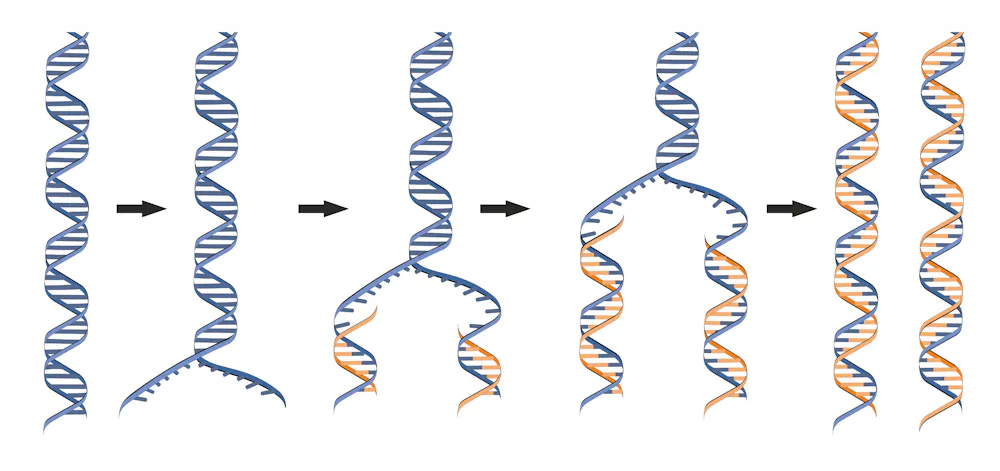
Every time a cell divides the DNA double helix must duplicate itself to provide a copy of the genetic instructions to both cells.
Origins of replication have been elusive because they occur at many sites on different molecules so we need to look at single DNA molecules to detect them. Although scientists have been able to see single DNA molecules since the early 1960s, we could not tell where in the chromosomes any molecule came from so we could not map anything.
Kyle Klein, a Ph.D. student in my lab, labeled living human stem cells with red fluorescent molecules that marked locations where DNA replication was taking place, which were mapped with the Bionano device. These images were then superimposed onto the blue and green DNA maps of the same DNA molecules.
We expect this method to completely transform our understanding of how human chromosomes replicate. Moreover, since most chemotherapy drugs for cancer treatment and most carcinogens – or cancer-causing chemicals – in our environment work by attacking DNA when it replicates, we expect this method to provide a rapid and comprehensive test for how these chemicals disrupt DNA replication. We also hope it reveals how we might alleviate these negative consequences, and how we might develop better and less toxic chemotherapy treatments.
Last year humanity destroyed an expanse of tropical forest nearly the size of England, the fourth largest decline since global satellite data become available in 2001, researchers reported Thursday.
The pace of the loss is staggering -- the equivalent of 30 football fields disappearing every minute of every day in 2018, or a total of 120,000 square kilometers (46,000 square miles).
Almost a third of that area, some 36,000 km2, was pristine primary rainforest, according to the annual assessment from scientists at Global Forest Watch, based at the University of Maryland.
"For the first time, we can distinguish tree cover loss within undisturbed natural rainforests, which contain trees that can be hundreds, even thousands, of years old," team manager Mikaela Weisse told AFP.
Rainforests are the planet's richest repository of wildlife and a critical sponge for soaking up planet-heating CO2.
Despite a slew of counter-measures at both the national and international level, deforestation has continued largely unabated since the beginning of the century.
Global forest loss peaked in 2016, fueled in part by El Nino weather conditions and uncontrolled fires in Brazil and Indonesia.
The main drivers are the livestock industry and large-scale commodity agriculture -- palm oil in Asia and Africa, soy beans and biofuel crops in South America.
Small-scale commercial farming -- of cocoa, for example -- can also lead to the clearing of forests.
A quarter of tropical tree cover loss in 2018 occurred in Brazil, with the Democratic Republic of Congo and Indonesia each accounting for about 10 percent.
Malaysia and Madagascar also saw high levels of deforestation last year.
Nearly a third of primary forest destruction took place in Brazil (13,500 km2), with the Democratic Republic of Congo (4,800 km2), Indonesia (3,400 km2), Colombia (1,800 km2) and Bolivia (1,500 km2) rounding out the top five.
Madagascar lost two percent of its entire rainforest in 2018.
- Indonesia a bright spot -
"The world's forests are now in the emergency room," said Frances Seymour, a distinguished senior fellow at the World Resources Institute, an environmental policy think tank based in Washington DC.
"The health of the planet is at stake, and band aid responses are not enough," she added.
AFP/File / YASUYOSHI CHIBA Logs in the forest in Xapuri, Acre State, in northwestern Brazil.
"With every hectare lost, we are that much closer to the scary scenario of runaway climate change."
Globally, forests absorb about 30 percent of manmade greenhouse gas emissions, just over 11 billion tonnes of C02 a year.
Oceans are also a major "sink", soaking up another 23 percent.
Burning or clear-cutting vast tracts of tropical forest not only releases carbon into the atmosphere, it reduces the size of the sponge that can absorb CO2.
One bright spot in the report was Indonesia, which lost 3,400 km2 of primary forest in 2018 -- a 63 percent drop compared to 2016.
In 2015, massive forest fires on Sumatra, Borneo and other Indonesian islands levelled 20,000 km2 and generated health-wrecking pollution over a large swathe of Southeast Asia.
AFP/File / María SCARPINELLI Progression of deforestation in the Brazilian Amazon, with total area by state
In Brazil, however, trend lines are moving in the wrong direction.
"Our data shows a big spike in forest loss in 2016 and 2017 related to manmade fires," Weisse said of Brazil.
"Shockingly, we are also seeing invasions into indigenous lands that have been immune to deforestation for years."
Brazil's President Jair Bolsonaro, who come into office in January, has vowed to curtail environmental regulations and allow commercial farming and mining on indigenous reserves, which comprise more than 10 percent of Brazil's territory.
The researchers emphasised that Bolsonaro has not been in office long enough to assess the impacts of his policies on deforestation.
In West Africa, meanwhile, 70 percent of primary forest loss in Ghana and Ivory Coast occurred in protected areas, pointing up the need for stricter enforcement.
The second largest Emperor penguin colony on Earth has suffered a "catastrophic" breeding failure after nearly all chicks born over three years died as their icy Antarctic habitat shrinks, researchers said Thursday.
The British Antarctic Survey (BAS) used satellite imagery to study the behaviour of the Halley Bay colony in the Weddell Sea due south of Cape Hope, which normally sees up to 25,000 penguin pairs mate each year.
They found that in 2016, when abnormally warm and stormy weather broke up the sea-ice on which the penguins normally raise their young, almost all the chicks died.
This pattern was repeated in 2017 and 2018.
The BAS said the colony at Halley Bay has "all but disappeared".
"We have been tracking the population of this, and other colonies in the region, for the last decade using very high resolution satellite imagery," said BAS remote sensing specialist Peter Fretwell.
"We can estimate the population based on the known density of the groups to give reliable estimate of colony size.
"These images have clearly shown the catastrophic breeding failure at this site over the last three years," Fretwell added.
The team noted however that a nearby penguin colony at Dawson Lambton had "markedly increased in size", indicating that many of the Halley Bay birds had migrated to safer breeding conditions.
BAS penguin expert Phil Trathan said it was impossible to know for sure if the break up of sea-ice at Halley Bay was caused by climate change.
"But such a complete failure to breed successfully is unprecedented at this site," he said.
Emperors, the world's largest penguin species, came to global fame with a 2005 documentary, "March of the Penguins", portraying their annual trek across the icy wastes, and the 2006 cartoon movie "Happy Feet".
But their population, centred around Earth's extreme south, is set to decline up to 70 percent by the end of the century as the planet continues to warm.
A study in 2015 recommended the birds be added to an international "Red List" of endangered species.
Russia's Vladimir Putin and North Korea's Kim Jong Un met face-to-face for the first time on Thursday, vowing to seek closer ties as they look to counter US influence.
The summit in Russia's Far Eastern city of Vladivostok came with Kim locked in a nuclear stand-off with Washington and Putin keen to put Moscow forward as a player in another global flashpoint.
The two leaders shook hands and shared smiles before heading into one-on-one talks that lasted nearly two hours, longer than expected, on an island off the Pacific coast city.
In brief statements before their meeting, both men said they were looking to strengthen ties that date back to the Soviet Union's support for the founder of North Korea, Kim's grandfather Kim Il Sung.
Kim said he hoped to turn the modern relationship with Moscow into a "more stable and sound one" while Putin said the visit would give a boost to diplomatic and economic ties.
As the talks expanded to include other officials, Kim thanked Putin for "a very good" meeting.
"We have just had a very meaningful exchange of views on issues of mutual interest," he said.
Putin said the talks had been "rather detailed" but neither leader said much about their substance.
The meeting was Kim's first one-on-one talks with another head of state since returning from his Hanoi summit with US President Donald Trump, which broke down without a deal on North Korea's nuclear arsenal in February.
- North Korean labourers -
Among the issues likely to be on the table was the fate of some 10,000 North Korean labourers working in Russia and due to leave by the end of this year under sanctions.
AFP / Janis LATVELS Putin-Kim Summit
Labour is one of North Korea's key exports and sources of cash. Pyongyang has reportedly asked Russia to continue to employ its workers after the deadline.
Kim, whose government has told the United Nations it is facing food shortfalls this year, will also be keen to see Moscow continue or boost its aid.
Russia has provided some $25 million in food aid to North Korea in recent years, according to the Kremlin. One delivery in March saw more than 2,000 tonnes of wheat supplied to the port of Chongjin, news agency TASS reported.
For Putin, the summit is a chance to push Russia's agenda of opposing US international influence.
In an interview with China's official People's Daily published on Thursday, Putin lashed out at "countries claiming sole global leadership".
"They carelessly trample on the norms and principles of international law, resort to blackmail, sanctions and pressure, and try to force their values and dubious ideals on entire countries and populations," said Putin, who is heading to China after the talks for another summit.
AFP / Kirill KUDRYAVTSEV The Vladivostok meeting follows repeated invitations from Putin since Kim embarked on a series of diplomatic overtures last year
The Vladivostok meeting follows repeated invitations from Putin after Kim embarked on a series of diplomatic overtures last year.
Since March 2018, the formerly reclusive North Korean leader has held four meetings with Chinese President Xi Jinping, three with South Korea's Moon Jae-in, two with Trump and one with Vietnam's president.
At the meeting with Trump in Hanoi, the cash-strapped North demanded immediate relief from sanctions, but the talks broke up in disagreement over what Pyongyang was prepared to give up in return.
POOL/AFP / SERGEI ILNITSKY Russia has called for sanctions to be eased against North Korea
North Korea last week launched a blistering attack on US Secretary of State Mike Pompeo, insisting he be removed from the negotiations just hours after announcing it had carried out a new weapons test.
Pompeo said on Wednesday he expected "bumpy" talks ahead with Pyongyang but that he still hoped to reach a potentially landmark denuclearisation deal.
- Soviet-era allies -
Russia has already called for the sanctions to be eased, while the US has accused it of trying to help Pyongyang evade some of the measures -- accusations Russia denies.
KCNA VIA KNS/AFP / KCNA VIA KNS Kim will be looking for Putin's support in easing the sanctions imposed on Pyongyang over its nuclear programme
Moscow was a crucial backer of Pyongyang for decades and their ties go back to the founding of North Korea, when the Soviet Union installed Kim Il Sung as leader.
The USSR reduced funding to the North as it began to seek reconciliation with Seoul in the 1980s, but Pyongyang was hit hard by its demise in 1991.
Soon after his first election as Russian president, Putin sought to normalise relations and met Kim Jong Il -- the current leader's father and predecessor -- three times, including a 2002 meeting also held in Vladivostok.
China has since cemented its role as the isolated North's most important ally, its largest trading partner and crucial fuel supplier, and analysts say Kim could be looking to balance Beijing's influence.
While ties between Moscow and Pyongyang have remained cordial, the last meeting between their leaders came in 2011, when Kim Jong Il told then-president Dmitry Medvedev that he was prepared to renounce nuclear testing.
His son has since overseen by far the country's most powerful blast to date, and launch of missiles which Pyongyang says are capable of reaching the entire US mainland.
Thousands of indigenous people decorated with traditional feathers and body paint converged on Brazil's capital Wednesday to defend hard-won land rights many fear could be eroded by far-right President Jair Bolsonaro.
Heavy security, including riot police, has been deployed for the annual three-day lobbying effort in the heart of Brasilia, where representatives from various tribes have set up camp along the broad avenue leading to Congress.
Next to tents pitched on the grass, demonstrators displayed posters declaring "Our land is sacred," "No mining on indigenous lands" and "We demand the demarcation of our lands" as others sang and danced during the first such protest under Bolsonaro, a champion of farm businesses, mining and logging who took power on January 1.
"We do not just fight for constitutional rights, we fight for the right to exist," indigenous leader Sonia Guajajara told reporters.
Around 2,000 indigenous people have arrived so far, according to AFP journalists.
Organizers of the tribal camp said nearly 4,000 had turned up to the event that was given little coverage by major local media outlets.
AFP / CARL DE SOUZA An indigenous woman pictured at the protest is among more than 800,000 indigenous people and more than 300 tribes in Brazil, according to the country's FUNAI indigenous affairs agency
"We came here for an important cause -- it was very difficult for us, our ancestors, to win these rights and little by little they are decreasing," said Camila Silveiro, 22, from the southern state of Parana.
"We came here to ask for more respect."
Luana Kumaruara, an anthropology student from the northern state of Para, accused Bolsonaro's government of attacking "all" the rights of indigenous people, including education and health.
- A long fight -
AFP / CARL DE SOUZA Indigenous people perform a ceremonial ritual
There are more than 800,000 indigenous people and more than 300 different tribes in the country of 209 million people, according to Brazil's FUNAI indigenous affairs agency.
They have long fought to preserve a way of life imperiled since European colonialists arrived in South America more than 500 years ago.
But the situation has deteriorated dramatically under Bolsonaro, an indigenous alliance has warned.
"We are experiencing the first stages of an apocalypse, of which indigenous peoples are the first victims," 13 signatories said in a piece published in French daily Le Monde earlier this month.
Bolsonaro has vowed to "integrate" Brazil's indigenous people, in part with new roads and rail lines through the Amazon and clearing more areas for agriculture.
"The Indian cannot continue to be trapped within a demarcated area as if he were a zoo animal," the populist leader once said.
Guajajara on Wednesday rejected his comments, telling reporters: "We don't want the society that Bolsonaro wants to introduce us to."
AFP / CARL DE SOUZA Indigenous people have long fought to preserve a way of life imperiled since European colonialists arrived in South America more than 500 years ago
Bolsonaro has been less than welcoming to the protesters in Brasilia.
In a Facebook Live broadcast last week, he suggested Brazilian taxpayers would foot the bill for the "10,000 indigenous people" who take part -- a claim rejected by organizers who said they were using their own funds to pay for the event.
"This government that is in power today is trying to exterminate the indigenous people, but our people are warriors," indigenous leader Cacique Dara told reporters.
"We don't care about wealth, what's important is nature."
Protesters at the "Acampamento Terra Livre", or "Free Land Camp", hope to meet with members of Congress and the Supreme Court in the coming days as they push for greater protection of their lands.
Bolsonaro has already stripped FUNAI of the power to define native land, giving that authority instead to the agriculture ministry.
There are more than 400 demarcated territories across the vast country, established in the 1980s for the exclusive use of their indigenous inhabitants. Access by outsiders is strictly regulated.
Bolsonaro vowed during last year's election campaign that he would not give up "one centimeter more" of land to indigenous communities in Brazil, home to around 60 percent of the Amazon rainforest.
According to conservation group Imazon deforestation increased 54 percent to 108 square kilometers (42 square miles) in January -- the first month Bolsonaro was in office -- compared with 70 kilometers a year earlier.
Arara indigenous people in Para state told AFP recently that illegal logging on their lands had intensified in the opening months of Bolsonaro's presidency.
President Donald Trump and the First Lady traveled to Atlanta Wednesday to speak at the Rx Drug Abuse and Heroin Summit. Following the First Lady's remarks, President Trump also delivered a speech, but it was far different from what many attendees may have expected.
Throughout his speech, the President interrupted his prepared remarks to do what he does best: embellish.
"We will not solve this epidemic overnight," the President told attendees, mostly experts and stakeholders in battling prescription drug and opioid abuse. "But we will stop..." the President said, literally stopping.
Trump paused, his hand still in the air.
"There's just nothing going to stop us," he clearly ad-libbed. "No matter how you cut it. I know some of the people in this room. Nothing stops you," he said, pointing to the room.
"Nothing stops you, I can tell you," he said, pointing to a different section of attendees.
"We will never stop, until our job is done," Trump told the audience, apparently in a live update to his written speech. "And then maybe we'll have to find something new. And I hope that's going to be soon, but we will succeed. We have results that are unbelievable," he added.
Despite claiming "unbelievable" results, Trump embellished again, claiming the opioid crisis is even worse than the numbers say it is:
He then touted the unemployment numbers, saying that all his results are the "best everything" – embellishing yet again. Seconds later, speaking about former inmates getting jobs, he said they're doing great. "Not all, but there's nothing all about any of us."
Trump later touted his wall, which he promised Mexico would pay for, but apparently forgot. He also insisted he will build almost 400 miles of wall, despite Congress refusing to fund it. According to the President, the wall is being built right now, and it's "probably ahead of schedule," which is false.
Vox's Aaron Rupar, who posted these clips and watched the President's speech, offered this response:
A Fox News host apparently blurted out what many people already believe to be true: Russia's attacks on the 2016 presidential election were so effective they were able to effectively install Donald Trump as president, according to video posted by Media Matters for America's Lis Power.
On Fox News' "Outnumbered" Wednesday, Melissa Francis told her co-hosts that Democrats "care about Russia now because it cost them an election,"
Sri Lanka's government on Wednesday acknowledged "major" lapses over its failure to prevent the horrific Easter attacks that killed more than 350 people, despite prior intelligence warnings.
Recriminations have flown since Islamist suicide bombers blew themselves up in packed churches and luxury hotels on Sunday, in attacks claimed by the Islamic State group.
Overnight, security forces using newly granted powers under the country's state of emergency arrested 18 more suspects in connection with the attack, as the toll rose to 359.
Police have so far arrested 58 people, all Sri Lankans, and security remains heavy, with bomb squads carrying out several controlled explosions of suspect packages on Wednesday.
But the government faces anger over revelations that specific warnings about an attack went ignored.
AFP / Jewel SAMAD Children sit next to flowers left by mourners near St. Anthony's Shrine in Colombo, two days after a series of bomb blasts killed more than 350 people
Sri Lanka's police chief issued a warning on April 11 that suicide bombings against "prominent churches" by the local Islamist group National Thowheeth Jama'ath (NTJ) were possible, citing information from a foreign intelligence agency.
CNN reported that Indian intelligence services had passed on "unusually specific" information in the weeks before the attacks, some of it from an IS suspect in their custody.
But that information was not shared with the prime minister or other top ministers, the government says.
"It was a major lapse in the sharing of information," deputy defence minister Ruwan Wijewardene conceded at a press conference on Wednesday.
"The government has to take responsibility."
- Chilling footage -
President Maithripala Sirisena, who is also defense and law and order minister, pledged Tuesday to make "major changes in the leadership of the security forces in the next 24 hours".
CCTV Sri Lanka/AFP / Handout Chilling CCTV footage has emerged showing one of the attackers (C) calmly walking into the packed St Sebastian's church before detonating his bomb
"The restructuring of the security forces and the police will be completed within a week," he said.
He also called an "all party conference" with the country's political parties for Thursday, and will meet with religious leaders too.
New details emerged about some of the bombers on Wednesday, with Wijewardene saying one had studied in Britain and then did post-graduate studies in Australia before returning to Sri Lanka.
"Most of them are well-educated and come from middle, upper-middle class families, so they are financially quite independent and their families are quite stable financially, that is a worrying factor in this," the minister added.
And chilling CCTV footage emerged showing one of the attackers calmly patting a child on the head and shoulder moments before he walked into the packed St Sebastian's church and detonated his bomb.
A US FBI team is now in Sri Lanka, Wijewardene said, and Britain, Australia and the United Arab Emirates have all offered intelligence help.
AFP / Jewel SAMAD The United Nations said at least 45 children, Sri Lankans and foreigners, were among the dead
Experts say the bombings bear many of the hallmarks of IS attacks, and the government has suggested local militants could not have acted alone.
But it has not yet officially confirmed any IS role in the blasts against three churches packed with Easter worshippers and three high-end hotels.
A desperate search was under way for other suspects linked to the blasts, including the head of the local Islamist group believed to have played a key role in the attacks.
The government has said the NTJ group was behind the attack, perhaps with international help, and its leader Zahran Hashim remains unaccounted for.
He appears to be among eight people seen in a video released by IS on Tuesday, leading seven others in a pledge of allegiance to IS chief Abu Bakr al-Baghdadi.
It was not yet clear whether Hashim was among the suicide attackers or had escaped after the blasts.
- Multiple attackers -
Government officials have said they cannot rule out further attacks while suspects remain at large.
In all, nine people are believed to have blown themselves up in Sunday, either during attacks or when police attempted to arrest them.
AFP / Jewel SAMAD Security remained tight at the churches targeted in Sri Lanka
Sri Lankan police sources have told AFP that two Muslim brothers, sons of a wealthy Colombo spice trader, blew themselves up at the Shangri-La and the Cinnamon Grand hotels.
Their father is now one of the 58 in custody.
The Kingsbury hotel in the capital was the last one hit. A fourth planned attack on a hotel failed, authorities said. The would-be attacker was followed back to a Colombo lodge, where he blew himself up, killing two people.
Sources close to the investigation said two more people -- a man and a woman -- blew themselves up at another location as security forces launched a raid. Those blasts killed three police.
Work was continuing to identify foreign victims in the blasts.
A Danish billionaire lost three of his children in the attacks, a spokesman for his company said.
Eight Britons, 10 Indians, four Americans and nationals from Turkey, Australia, Japan and Portugal were also reported killed.
The United Nations said at least 45 children, Sri Lankans and foreigners, were among the dead.
A journalist killed by a dissident republican paramilitary in Northern Ireland is to be laid to rest on Wednesday at a ceremony celebrating her life to be attended by British Prime Minister Theresa May.
Lyra McKee, 29, who chronicled the troubled history of Northern Ireland, was shot in the head on Thursday as rioters clashed with police in Londonderry, the second city of the British province.
Dissident republican faction the New IRA claimed responsibility on Tuesday but apologized, saying the shots had been aimed at the police.
The killing evoked memories of the three decades of violent strife in Northern Ireland and sparked condemnation across the political spectrum also in the neighboring Republic of Ireland.
Downing Street announced on Wednesday that May would attend the funeral, missing her weekly Prime Minister's Questions in parliament.
McKee's partner Sara Canning said her funeral at St Anne's Cathedral in Belfast would be a "celebration of her life".
McKee established her career writing about so-called "ceasefire babies" -- the generation which came of age after the 1998 Good Friday Agreement which ended the conflict known as "The Troubles".
She was also a passionate advocate for LGBT issues, and featured in the prestigious Forbes "30 under 30" list of rising stars in the media across Europe in 2016.
AFP/File / Paul FAITH Floral tributes have been laid at the scene of Lyra McKee's killing
"Such a warm and innocent heart, she was the greatest listener, someone who had time for everyone," her family said in a statement.
"She was a smart, strong-minded woman who believed in passionately in inclusivity, justice and truth."
Fellow writer Susan McKay told BBC radio she was "the antithesis of everything the New IRA stand for".
Canning asked that those attending the funeral ceremony wear Harry Potter and Marvel superhero clothing in tribute to McKee's love of the franchises.
The funeral is expected to begin at around 1200 GMT, with the cathedral ceremony live streamed on television, before a private burial.
- 'Pointless and futile act' -
Irish Foreign Minister Simon Coveney is to attend the ceremony alongside President Michael D. Higgins.
Representatives from Northern Ireland's six main political parties are also expected to attend, having issued a rare joint statement in condemnation of the killing.
AFP/File / BEN STANSALL fFears are growing that a fragile and hard-won peace in Northern Ireland is increasingly at risk
"It was a pointless and futile act to destroy the progress made over the last 20 years, which has the overwhelming support of people everywhere," the statement said.
Britain's minister for Northern Ireland Karen Bradley called McKee a "young, vibrant woman who symbolised the new Northern Ireland".
"Our lasting tribute to Lyra will be to ensure that we continue to work for peace for the whole of Northern Ireland," she told MPs on Tuesday.
McKee's family said it understood the anger over her murder, but urged people to respond with "positivity and hope".
"Lyra's answer would have been simple -- the only way to overcome hatred and intolerance is with love, understanding and kindness," they said.
- 'No appetite for violence' -
The New IRA offered its "full and sincere apologies" for McKee's death, saying she was unintentionally shot as their forces targeted police.
The splinter group seeks the integration of the British province of Northern Ireland with the Republic of Ireland -- rejecting mainstream non-violent political campaigns to achieve that end.
AFP / Paul Faith Sara Canning, partner of Lyra McKee, has asked those attending Wednesday's funeral to come dressed as Harry Potter characters or Marvel superheroes
The group has been condemned by republican leaders, with Sinn Fein head Mary Lou McDonald saying it was "tiny, unrepresentative group" that was "essentially at war now with their own community".
"There's no appetite whatsoever in Creggan (the area where McKee was killed), in Derry, anywhere across nationalist Ireland for a return to conflict," she told BBC radio.
Police in Northern Ireland said Tuesday that a 57-year-old woman had been arrested under the Terrorism Act in connection with the killing.
AFP/File / THOMPSON The death of Lyra McKee has stirred memories of the bad old days of 'The Troubles' in Northern Ireland
Two men aged 18 and 19 who were arrested earlier in the investigation have now been released without charge.
McKee's killing follows a spate of letter bombings and a car bombing, also claimed by the New IRA.
It has fuelled fears that the political turbulence over Brexit, which threatens new border checkpoints between Northern Ireland and the Republic of Ireland, may increase paramilitary activity.
Afghan civilians are for the first time being killed in greater numbers by US and pro-government forces than by the Taliban and other insurgent groups, a UN report released Wednesday revealed.
The bloody milestone comes as the US steps up its air campaign in Afghanistan while pushing for a peace deal with the Taliban, who now control or influence more parts of the country than at any time since they were ousted in 2001.
During the first three months of 2019, international and pro-government forces were responsible for the deaths of 305 civilians, whereas insurgent groups killed 227 people, the United Nations Assistance Mission in Afghanistan (UNAMA) said in a quarterly report.
The majority of the deaths resulted from US air strikes or from search operations on the ground, primarily conducted by US-backed Afghan forces, some of which UNAMA said "appear to act with impunity".
"UNAMA urges both the Afghan national security forces and international military forces to conduct investigations into allegations of civilian casualties, to publish the results of their findings, and to provide compensation to victims as appropriate," the report states.
AFP / Gal ROMA Afghanistan civilian deaths
UNAMA started compiling civilian casualty data in 2009 amid deteriorating security conditions in Afghanistan.
It is the first tally since records began that shows pro-government forces have killed more civilians than insurgents have, though insurgents were responsible for more than twice as many injuries as were pro-government forces.
Colonel Dave Butler, spokesman for US Forces-Afghanistan, said the US military holds itself "to the highest standards of accuracy and accountability" and that it strives for precision in all its operations.
"We reserve the right of self-defence of our forces as well as the Afghan Security Forces," Butler said in a statement.
"The best way to end the suffering of non-combatants is to end the fighting through an agreed-upon reduction in violence on all sides."
- 'Shocking number' -
In 2017, the US military started quickening its operational tempo after President Donald Trump loosened restrictions and made it easier for American forces to bomb Taliban positions.
According to US Air Force Central Command, the US dropped 7,362 bombs in Afghanistan in 2018, the highest number since at least 2010, and up from 4,361 in 2017.
AFP/File / NOORULLAH SHIRZADA In 2017, the US military started quickening its operational tempo after President Donald Trump loosened restrictions
While other nations may contribute logistical or technical support, it is US aircraft that conduct most strikes. Afghanistan's fledgeling air force is also flying more sorties.
The US has sent huge B-52 bombers on runs over the country and benefited from an increase in aerial hardware as operations against the Islamic State group in Iraq and Syria tapered off.
UNAMA's report did, however, also find that civilian casualties dropped 23 percent compared with the first three months of 2018.
In all, UNAMA documented 1,773 casualties in the last quarter: 581 deaths and 1,192 injured -- the lowest first-quarter toll since 2013.
The drop was driven by a decrease in the use of suicide bomb attacks, but UNAMA did not know if this trend came as a result of a harsh winter or if the Taliban were trying to kill fewer civilians during peace talks.
In contrast, the first three months of 2018 saw a spike in horrific attacks that skewed numbers higher for that part of the year compared to 2019. For instance, more than 100 people were killed in Kabul in January 2018 when an explosives-packed ambulance blew up.
AFP/File / SHAH MARAI The US has stepped up its air campaign in Afghanistan while pushing for a peace deal with the Taliban
UNAMA chief Tadamichi Yamamoto, who also serves as the UN secretary general's special representative for Afghanistan, said a "shocking number" of civilians are still being killed or maimed.
"All parties must do more to safeguard civilians," Yamamoto said in a statement.
"Anti-government elements need to stop deliberately targeting civilians ... pro-government forces are called upon to take immediate measures to mitigate the rising death toll and suffering caused by air strikes and search operations," he added.
Last year was the deadliest yet for Afghan civilians, with 3,804 killed, according to UNAMA.
North Korean leader Kim Jong Un arrived in Russia's Pacific port city of Vladivostok on Wednesday for a first summit with Vladimir Putin, as Pyongyang seeks support in its nuclear deadlock with the United States.
The talks, organised in secret and announced at the last minute, will be Kim's first face-to-face meeting with another head of state since negotiations with US President Donald Trump in Hanoi collapsed in February.
Kim's armoured train arrived in the afternoon at the Tsarist-era train station in Vladivostok and he stepped out onto a red carpet before making his way outside to be received by an honour guard.
"I hope that this visit will be successful and useful," Kim told Russian television in the Russian town of Khasan where his train crossed the border.
"I hope that during the talks... I will be able to have concrete discussions on resolving situations on the Korean Peninsula and on the development of our bilateral relationship," Kim said.
Putin was due to arrive in Vladivostok on Thursday, then fly on after the talks for another summit in Beijing.
The North's official Korean Central News Agency (KCNA) earlier reported Kim's departure by train, naming among his entourage foreign minister Ri Yong Ho.
The train crossed the Tumen river Wednesday and arrived in Khasan, where women in folk costumes welcomed Kim with bread and salt in a traditional greeting.
AFP / Janis LATVELS Talks between North Korean leader Kim Jong Un and Russia's President Vladimir Putin are to take place in Vladivostok on April 25
Kim's predecessors as leader, his father and grandfather, also stopped there on their trips to neighbouring Russia.
At Khasan station a small wooden building known as the House of Kim Il Sung commemorates Russian-Korean friendship.
- North Korean flags flying -
Russian and North Korean flags were already flying on lamp posts Tuesday on Vladivostok's Russky island, where the summit is expected to take place at a university campus.
Kim plans to stay on in Vladivostok on Friday for a series of cultural events, including a ballet and a visit to the city's aquarium, Russian media reported.
The talks follow repeated invitations from Putin since Kim embarked on his diplomatic overtures last year.
Since March 2018, the formerly reclusive North Korean leader has held four meetings with Chinese President Xi Jinping, three with the South's Moon Jae-in, two with Trump and one with Vietnam's president.
Analysts say he is now looking for wider international support in his standoff with Washington, while Moscow is keen to inject itself into another global flashpoint.
In Hanoi, the cash-strapped North demanded immediate relief from the sanctions imposed on it over its banned nuclear weapons and ballistic missile programmes, but the talks broke down in disagreement over what Pyongyang was prepared to give up in return.
North Korea last week launched a blistering attack on US Secretary of State Mike Pompeo, insisting he be removed from the negotiations just hours after announcing it had carried out a new weapons test.
POOL/AFP/File / Alexander Zemlianichenko, Handout Russian President Vladimir Putin and North Korea's leader Kim Jong Un are due to hold talks in Vladivostok
Moscow has already called for the sanctions to be eased, while the US has accused it of trying to help Pyongyang evade some of the measures -- accusations Russia denies.
Kremlin foreign policy aide Yuri Ushakov told a briefing on Tuesday: "The focus will be on a political and diplomatic solution to the nuclear problem on the Korean Peninsula."
"Russia intends to help consolidate positive trends in every way," he said, but added that no joint statement or signing of agreements was planned.
KCNA did not mention whether Kim's wife Ri Sol Ju or his sister and close aide Kim Yo Jong were accompanying him.
- Cold War ties -
Moscow was a crucial backer of Pyongyang for decades and their ties go back to the founding of North Korea, when the Soviet Union installed Kim's grandfather Kim Il Sung as leader.
Press Service of Administration of Primorsky Krai/AFP / Alexander SAFRONOV Kim received a traditional greeting from women in folk costumes on arriving in the Russian border town of Khasan
The Soviet Union reduced funding to the North as it began to seek reconciliation with Seoul in the 1980s, but Pyongyang was hit hard by its demise in 1991.
Soon after his first election as Russian president, Putin sought to normalise relations and met Kim Jong Il -- the current leader's father and predecessor -- three times.
The first of those meetings was in Pyongyang in 2000, when Putin became the first Russian leader to visit the North.
China has since cemented its role as the isolated North's most important ally, its largest trading partner and crucial fuel supplier, and analysts say Kim could be looking to balance Beijing's influence.
While ties between Russia and the North have remained cordial, the last meeting between their leaders came in 2011, when Kim Jong Il told then-president Dmitry Medvedev that he was prepared to renounce nuclear testing.
His son has since overseen by far the country's most powerful blast to date, and the launch of missiles capable of reaching the entire US mainland.
For the first time in 217 years, a Japanese emperor will cede his place on the imperial throne.
On April 30, Japan’s ailing 85-year-old Emperor Akihito will abdicate and be replaced the following day by his 59-year-old son, Crown Prince Naruhito.
Naruhito and his wife, Crown Princess Masako, are a modern couple. Both have studied overseas – he at Oxford University, she in Russia, England and the United States. Born after World War II, Naruhito will be the first Japanese emperor not shaped by the upheaval that war brought to his country.
Many Japanese are hopeful that these younger royals can update Japan’s ancient “Chrysanthemum Throne.” But changing a 14-century-old monarchy to reflect the times will not be easy.
A democracy with an emperor
Japan has the oldest continuous monarchy in the world.
The current emperor, Akihito, is the 125th in a royal line of succession officially founded in the 7th century. According to Japanese legend, however, the Chrysanthemum Throne dates back 2,600 years – to the country’s founding in 660 B.C. by Emperor Jimmu, a descendant of the Shinto sun goddess, Amaterasu.
Emperor Jimmu, of Shinto legend.
Despite their sacred status, Japanese emperors have traditionally reigned but not run the country. For most of its long history, military governments or oligarchs governed Japan in a day-to-day sense.
Emperor Hirohito – father of Japan’s current emperor, Akihito – renounced “the false conception that the emperor is divine” in 1946 under pressure from Allied forces. The largely American-written 1947 constitution that followed officially reduced the emperor to a figurehead.
Still, the monarchy continued. And Hirohito remained on the throne until his death at age 88 in 1989.
The people’s emperor
Hirohito’s son, Emperor Akihito has, by most accounts, been a hugely popular monarch – one who put his personal stamp on this institution.
As a young crown prince in U.S.-occupied Japan, Akihito studied the English language and western culture, and his American tutor sought to encourage independence in her young student. Akihito later broke with the Japanese royal tradition of arranged marriages by wedding a commoner, Michiko Shoda, whom he met playing tennis.
Akihito has brought the monarchy closer to the people of Japan in other ways over the last 30 years, too.
He spent more time outside the confines of his palace, interacting with ordinary Japanese, than his aloof father. He and the empress also made official visits to some 35 countries.
In a 2016 speech, Akihito indirectly signaled his intention to abdicate, saying that his advanced age and declining health made it difficult for him to carry out his duties.
Resigning on April 30 will be the last modernizing act of Akhito’s 30-year reign.
The last Japanese monarch to step down, Emperor Kokaku, did so in 1817 for unknown reasons, and before Japan became a democracy. There is simply no modern precedent for Akihito’s decision.
Conservative forces in legislature, however, blocked calls to change Japan’s male succession tradition. Rather than amend the imperial law, they simply passed a special law allowing Akihito to step down.
That means Aiko, the daughter of Japan’s soon-to-be emperor and empress cannot succeed her father. Next in line, instead, is Naruhito’s younger brother, 53-year-old Prince Fumihito. Fumihito will be followed by his son, Hisahito.
Emperor Naruhito, the environmentalist
I had occasion to meet Prince Naruhito, Japan’s next emperor in 1990, at an academic conference in Japan.
Naruhito’s global civic engagement shows how the crown prince has sought to steer his own course in life.
His wife, Masako, will also be unlike any empress in Japanese history.
The daughter of a diplomat and fluent in several languages, Masako graduated from Harvard in 1985 with a degree in economics, and later studied law at the University of Tokyo. In 1987, she was one of only three women – in a pool of 800 applicants – to pass the entrance exam for the Japanese Ministry of Foreign Affairs.
Nahurito proposed three times before Masako agreed to marry him, in 1993. That decision forced her, reluctantly, to give up her diplomatic career.
The lifestyle change appears to have been difficult for Masako.
As crown princess, she came under intense pressure to produce a male heir. Royal household officials also limited her overseas travel and closely monitored her movements.
In 2001, eight years after their marriage, Masako gave birth – but to a girl, Aiko. Shortly afterward, she vanished from public life. According to her doctors, Masako suffered an “adjustment disorder” – what outside observers might identify as depression.
Prince Naruhito has broken with a royal tradition of discretion in 2004 and spoken publicly about his wife’s struggle to adapt to her constrained new existence.
“There were moves to negate Masako’s career and her personality, which was influenced by that career,” he told reporters in 2004.






 AFP/File / YASUYOSHI CHIBA
  AFP/File / María SCARPINELLI
  AFP / Janis LATVELS
  AFP / Kirill KUDRYAVTSEV
  POOL/AFP / SERGEI ILNITSKY
  KCNA VIA KNS/AFP / KCNA VIA KNS
  AFP / CARL DE SOUZA
  AFP / CARL DE SOUZA
  AFP / CARL DE SOUZA
  AFP / Jewel SAMAD
  CCTV Sri Lanka/AFP / Handout
  AFP / Jewel SAMAD
  AFP / Jewel SAMAD
  AFP/File / Paul FAITH
  AFP/File / BEN STANSALL f
 AFP / Paul Faith
  AFP/File / THOMPSON
  AFP / Gal ROMA
  AFP/File / NOORULLAH SHIRZADA
  AFP/File / SHAH MARAI
  AFP / Janis LATVELS
  POOL/AFP/File / Alexander Zemlianichenko, Handout
  Press Service of Administration of Primorsky Krai/AFP / Alexander SAFRONOV