Two civil liberties groups on Tuesday sued three U.S. intelligence chiefs and the acting defense secretary seeking to have declared unconstitutional their agencies’ pre-publication reviews of former officials’ writings and speeches.
The American Civil Liberties Union and Columbia University’s Knight First Amendment Institute brought the lawsuit on behalf of five former intelligence and military officials. They argued the reviews as currently practiced breach the Constitution’s First Amendment prohibition on government abridgement of freedom of speech.
The plaintiffs contended that reviews also violate the Constitution’s Fifth Amendment, because the procedures can involve arbitrary and discriminatory enforcement and fail to define what can or cannot be said.
The action was brought in the U.S. district court in Greenbelt, Maryland, against Director of National Intelligence Dan Coats, CIA Director Gina Haspel, National Security Agency Director Paul Nakasone and Acting Defense Secretary Patrick Shanahan.
“This is a challenge to a far-reaching system of prior restraints that suppresses a broad swath of constitutionally protected speech, including core political speech, by former government employees,” said the lawsuit.
“Under this system, government officials review and censor tens of thousands of submissions every year,” it said.
Current and former U.S. intelligence and military officials are required to submit writings or speeches to prepublication reviews to insure that they are not disclosing classified information.
The plaintiffs said that review standards differ between agencies and former officials are subjected to the procedures “without regard to their level of access to sensitive information.”
Reviews frequently take weeks or months and result in the censorship decisions that “are often arbitrary, unexplained and influenced by authors’ viewpoints,” said the lawsuit, adding that “favored officials” can receive “special treatment” that “fast-tracks” their speeches or manuscripts.
As a result of this “dysfunction,” many would-be authors self-censor, denying the public access to information that would inform debate on national security issues, it said.
The former officials on whose behalf the lawsuit was filed included Richard Immerman, a historian who worked for the Office of the Director of National Intelligence, Timothy Edgar, a cyber security expect who also worked at ODNI, and Mark Fallon, a former Naval Criminal Investigative Service official who served as the chief investigator at the Guantanamo Bay detention center.
They also included former senior CIA analyst Melvin Goodman and Anuradha Bhagwati, a Marine Corps veteran.
Reporting by Jonathan Landay; Editing by Steve Orlofsky
As measles outbreaks spread across the U.S., our new look at how information about vaccine safety and reliability spreads online suggests that the tide may be turning against the anti-vaccination movement.
Many states allow parents not to vaccinate their children if they have religious or philosophical beliefs against immunizations. Online disinformation campaigns are spreading false claims about vaccine dangers, boosting the numbers of people seeking those exemptions – and inviting disease into their homes and communities.
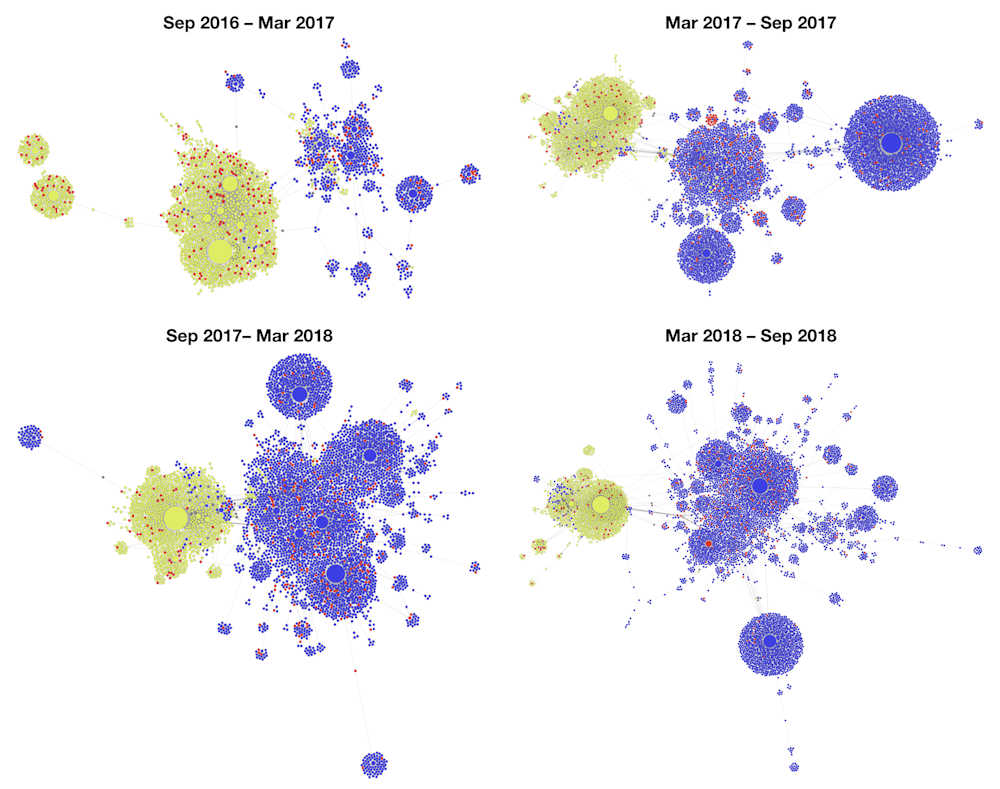
We recently updated this work, looking at vaccine-related Twitter hashtags between September 2016 and September 2018, to see how the vaccine debate continues to play out.
We took a random sampling of 10 percent of the public tweets during that time period. We identified 41,998 posts containing the most popular pro- and anti-vax hashtags. We then classified the 27,590 accounts that generated those tweets as pro-vax (blue) or anti-vax (green) based on whether each one used more hashtags from one side or the other.
We used retweets to visualize the diffusion of vaccine information. A node represents a Twitter account; a link from @alice to @bob indicates one or more vaccine-related retweets of @alice by @bob. We then mapped the largest network of connected accounts for each of four six-month intervals. The two communities of pro- and anti-vax information are quite segregated in the network, indicating that the accounts in one group do not generally retweet messages from the other. In the last year, however, we observe some blue nodes connected to the green clusters, suggesting that pro-vax information is beginning to penetrate the anti-vax community.
Accounts likely controlled by bots are depicted as red nodes in the network. They are prominent on both sides of the online discussion: Consistent with prior research findings, bots share both pro- and anti-vax content.
In late 2016, the anti-vax movement (in green) was much larger than the pro-vax movement (in blue). Over time, the pro-vax movement expanded and now dwarfs the anti-vaxxers.
Filippo Menczer and Pik-Mai Hui, Indiana University, CC BY-ND
Our analysis reveals the most influential accounts on each side – the accounts whose tweets are retweeted the most. On the pro-vax side are organizations like @WHO, @UNICEF and @gavi, the Vaccine Alliance, as well as celebrity advocate @ChelseaClinton and pediatrician @luciapediatra.
On the anti-vax side, one account dominates all the others: @LotusOak, which gave as its full name “Vira Burnayeva.” That account was suspended by Twitter in late 2018 or early 2019. Interestingly, another account @ViraBurnayeva (full name “LotusOak”) that posts similar anti-vax misinformation and propaganda is currently among the most influential anti-vax nodes. The names suggest this account is controlled by the same source, illustrating how easy it can be to circumvent social media companies’ efforts to curb vaccine misinformation.
We have found some possible signs of good news: Initially most of the information on Twitter was dominated by people who opposed vaccinations. But in 2017, the scenario appears to have reversed: Anti-vaccine content is now shared only by a minority of users.
If that preliminary finding is confirmed by other research, it could provide evidence that the combined efforts of social media platforms, health organizations, public policy campaigns and grassroots advocacy may eventually overcome anti-vax junk science.
His U.K. medical license was revoked in 2010 for unethical behavior, misconduct and dishonesty. But he continues to oppose state bills against vaccine exemptions and profit from promoting anti-vax disinformation, including through his propaganda film “Vaxxed,” which is available on popular streaming platforms.
When enough parents in a specific local community are misled into forgoing vaccination of their children, that area’s vaccination rate falls below the level necessary to confer what is called “herd immunity” on the entire population. For measles, 96 percent or more of a population need to be vaccinated to protect everyone.
Some of the parents may be making their decisions based on what they learn online about vaccination.
On the legislative agenda
Much of this online activity appears to relate to debate in the real world. For instance, many of the tweets refer to legislation or other policy discussions. And there is a fair amount of disagreement in the political world.
This may be a legislative reflection of the same trend our research has observed online – where pro-vax information is beginning to push back effectively against the anti-vax movement. Children’s lives are at risk.
More than 113 million people across 53 countries experienced "acute hunger" last year because of wars and climate disasters, with Africa the worst-hit region, the UN said Tuesday.
Yemen, the Democratic Republic of Congo, Afghanistan and Syria were among the eight nations accounting for two-thirds of the total number of people worldwide exposed to the risk of famine, the Food and Agriculture Organization (FAO) said in its 2019 global report on food crises.
Launched three years ago, the annual study takes stock of the countries facing the greatest difficulties.
African states were "disproportionally" affected as close to 72 million people on the continent suffered acute hunger, the FAO's emergencies director Dominique Bourgeon told AFP on Tuesday.
Conflict and insecurity remained key factors, along with economic turbulence and climate-related shocks like drought and floods, the report found.
In countries on the verge of famine, "up to 80 percent of the population depend on agriculture. They need both emergency humanitarian aid for food and measures to help boost agriculture," Bourgeon said.
The report highlighted the strain put on countries hosting large numbers of refugees, including neighbouring nations of war-torn Syria as well as Bangladesh, which has received more than a million Rohingya Muslims from Myanmar.
- Venezuela food crisis -
The FAO said it also expected the number of displaced people to increase "if the political and economic crisis persists in Venezuela" which is likely to declare a food emergency this year.
Bourgeon said he was concerned by the "important and significative rise" in poverty in Venezuela, as it grapples with dire economic and living conditions worsened by an ongoing political crisis.
Globally, the study noted that the overall situation slightly improved in 2018 compared to 2017 when 124 million people suffered acute hunger.
The drop can partially be attributed to the fact that some countries in Latin America and the Asia Pacific region for instance were less affected by weather disasters that had struck in previous years.
However, the FAO warned that the year-on-year trend of more than 100 million people facing famine was unlikely to change in the face of continued crises.
Afghanistan, Iraq and Syria all suffered bad droughts in 2018, which severely impacted agricultural output.
The FAO also stressed that "high levels of acute and chronic malnutrition in children living in emergency conditions remained of grave concern".
Venezuela's Supreme Court called Monday for Juan Guaido to be stripped of his legislative immunity, tightening the noose on the opposition chief just days after authorities announced a ban on him holding public office.
Guaido -- recognized as Venezuela's interim president by some 50 countries -- is locked in a power struggle with President Nicolas Maduro that has drawn in neighboring states as well as superpowers such as the US and Russia.
As the political battle plays out, the country has been hit by a series of devastating blackouts that have left millions without water, prompting the government to replace the country's energy minister and institute power rationing in a bid to address the outages.
The decision by the Supreme Court -- which is controlled by Maduro loyalists -- to call on the ruling Constituent Assembly legislature to strip Guaido of his immunity could open the way for the opposition chief to be prosecuted.
Venezuelan Presidency/AFP / HO Venezuelan President Nicolas Maduro has replaced his energy minister in the wake of repeated power outages
The court ruling cited Guaido's violation of a ban on his travel outside Venezuela when he visited Argentina, Brazil, Colombia, Ecuador and Paraguay from late February to early March.
The move came after Venezuela's auditor general's office announced Thursday that it had stripped Guaido of the right to hold public office for 15 years, a decision he rejected as invalid.
Three major blackouts hit Venezuela in March, worsening already dire living and economic conditions in the country, and prompting authorities to take steps aimed at curbing the outages.
Maduro -- whose government has blamed "terrorists" for alleged attacks that have damaged the country's main hydroelectric power plant -- announced that he was Igor Gavidia Leon to replace retired general Luis Motta Dominguez as energy minister.
The new minister "is an electrical industry worker with 25 years of experience, an engineer who had many responsibilities," Maduro said.
- Electricity rationing -
AFP / Federico Parra People draw water from a spring water tank to be used in their toilets in Caracas
On Sunday, Maduro announced 30 days of electricity rationing, after his government said it was shortening the workday and keeping schools closed due to blackouts.
The measures are a stark admission by the government that there is not enough electricity to go around, and that the power crisis is here to stay.
With no electricity, pumping stations can't work, so water service is limited.
Street lights and traffic lights go dark, pumps at fuel stations stand idle, and cell phone and internet service is non-existent.
But people try to find water wherever they can: from springs, leaky pipes, gutters, government-provided tankers and the little that flows through the Guiare River in Caracas.
"We fill up from a well near here but we don't know if its drinkable. But we're using it," said Erimar Vale, who lives in the capital.
Angel Velazquez said he bathed at work because he did not have water at home.
- 'Brain drain' -
AFP/File / CRISTIAN HERNANDEZ People walk along a dark street during a power outage in Caracas, on March 30, 2019
Crippled infrastructure, little investment in the power grid and poor maintenance have all contributed to the country's electricity woes.
A "brain drain" of qualified personnel has also hit the industry, with about 25,000 people in the electricity sector among the 2.7 million Venezuelans who have emigrated since 2015.
Guaido has asked his supporters to protest each time there is a blackout.
"This is going to continue. The situation is very serious, there will be more blackouts and rationing," said Winton Cabas, president of the Venezuelan Association of Electrical and Mechanical Engineering.
Jose Aguilar, a Venezuelan consultant living in the United States, said the problems with the power grid run deep.
"Over the past 20 years, the infrastructure has been abused due to a lack of maintenance and the postponing of upgrade plans," he told AFP.
Another problem was the "de-professionalization" of the sector when Chavez nationalized the power company in 2007 -- a move that led to pro-government loyalists taking positions as managers and engineers.
Rolling Stones frontman Mick Jagger will undergo heart surgery this week following the postponement of the band’s North American tour for medical reasons, according to a published report.
The U.S. website Drudge Report, citing unidentified sources, said Jagger, 75, would undergo surgery this week in New York to replace a heart valve. New York Post’s Page Six website, citing unidentified sources, said the surgery would involve placing a stent in the singer’s heart.
Representatives for Jagger in the United States did not return requests for comment. A spokesman for the British band in London declined to comment on the Drudge Report article.
The band on Saturday announced it was postponing all dates on its tour of the United States and Canada to give Jagger time to receive medical treatment. It did not specify what treatment Jagger needed but said he is expected to make a full recovery.
The North American tour had been scheduled to run from April 20 until June 29.
Jagger was photographed on Sunday in Miami Beach, Florida on the beach with his current girlfriend, ballet dancer Melanie Hamrick, their young son, and daughter Georgia May, one of his seven adult children.
The British singer has not explained his medical issue but told fans in a tweet on Saturday that he would be “working very hard to be back on stage as soon as I can.”
After a storied sex, drugs and rock-‘n-roll lifestyle in his earlier days, Jagger now follows a healthy diet, runs, and works out frequently.
Stents are typically used to prop open arteries that have been cleared of a blockage.
Reporting by Costas Pitas; editing by Guy Faulconbridge and Bill Berkrot
U.S. Vice President Mike Pence on Tuesday will meet at the White House with family members of six executives from Citgo Petroleum jailed in Venezuela since 2017 and will call on Venezuelan President Nicolas Maduro to free them, a White House official said on Monday.
The executives were arrested in Caracas during corporate meetings of Citgo, a U.S. energy refiner owned by state-run PDVSA and accused of embezzlement and money laundering.
“The vice president will reiterate the administration’s deep concern for the welfare and safety of all wrongfully detained American citizens and he will call on Maduro to release all political prisoners immediately and unconditionally,” the White House official said.
The family members will also meet with U.S. Secretary of State Mike Pompeo, the White House said.
The United States and most other Western countries have backed Venezuelan opposition leader Juan Guaido, who declared himself interim president in January, arguing that Maduro’s 2018 reelection was illegitimate.
The United States slapped stiff sanctions on PDVSA in January aimed at cutting Maduro’s government off from oil revenues. Maduro has called Guaido a puppet of the United States.
President Donald Trump is considering extending the measures to impose sanctions on foreign companies that do business with Venezuela, his national security adviser John Bolton said on Friday.
Pence’s meeting with the Citgo families comes days before he travels to Houston to meet with Venezuelan exiles and community leaders. Pence is slated to give a speech about the Venezuela crisis on Friday at Rice University’s Baker Institute for Public Policy.
Reporting by Roberta Rampton; editing by Lisa Shumaker and G Crosse
Several months ago an unknown international company was outed for refusing to comply with requests for documents from special counsel Robert Mueller. The judge, in that case, decided that each day the company doesn't comply they're fined $50,000. Last week, a First Amendment group called the Reporters Committee for Freedom of the Press, sued for information on the company itself. This week the judge found that the press did not have a right to the company's name because the Mueller grand jury is "ongoing."
"The grand jury investigation to which the underlying subpoena relates, however, is ongoing ... Redactions must thus be applied to maintain the secrecy of all matters occurring before a grand jury," the judge decided.
MSNBC host Rachel Maddow read the exchange aloud where prosecutors admitted that the grand jury and the Mueller investigation is still continuing. They called it "robustly" continuing.
In the decision, the judge "goes on at length about all the reasons why it's so important that the secrecy of information before the grand jury is preserved as long as the grand jury investigation is ongoing."
It's still unclear what the company is, what they do and what their relationship is to President Donald Trump, members of his campaign or the Russian government.
In court, the company attempted to argue they didn't have to comply with the subpoena because they were a company that was owned by a foreign country. They claimed that being owned by a country means they're immune from the U.S. legal system. They've lost all appeals in trying to hide their identity.
Watch Maddow's opener explaining the details in the case below:
The United States has halted delivery of equipment related to the stealthy F-35 fighter aircraft to Turkey, marking the first concrete U.S. step to block delivery of the jet to the NATO ally in light of Ankara’s planned purchase of a Russian missile defense system.
U.S. officials told their Turkish counterparts they will not receive further shipments of F-35 related equipment needed to prepare for the arrival of the stealthy jet, two sources familiar with the situation told Reuters on Monday.
The Pentagon confirmed the Reuters report that the equipment delivery had been stopped.
RELATED COVERAGE
Pentagon halts deliveries, activities linked to Turkey's F-35 capability
“Pending an unequivocal Turkish decision to forgo delivery of the S-400, deliveries and activities associated with the stand-up of Turkey’s F-35 operational capability have been suspended,” Air Force Lieutenant Colonel Mike Andrews, a Defense Department spokesman, said in a statement.
Turkish President Tayyip Erdogan has refused to back down from Ankara’s planned purchase of a Russian S-400 missile defense system that the United States has said would compromise the security of F-35 aircraft.
The disagreement over the F-35 is the latest of a series of diplomatic disputes between the United States and Turkey including Turkish demands that the United States extradite Islamic cleric Fethullah Gulen, differences over Middle East policy and the war in Syria, and sanctions on Iran.
The sources, who spoke on condition of anonymity, told Reuters the next shipment of training equipment, and all subsequent shipments of F-35 related material, had been canceled. The aircraft is built by Lockheed Martin Corp.
A Pentagon official had told Reuters in March that the United States had a number of items it could withhold in order to send Turkey a signal that the United States was serious about Ankara dropping its ambition to own the S-400.
Turkish officials in Ankara were not immediately available for comment. Turkey has said it will take delivery of the S-400s in July.
NATO SUMMIT
The U.S. decision on the F-35s was expected to complicate Turkish Foreign Minister Mevlut Cavusoglu’s visit to Washington this week for a NATO summit. On Sunday, Erdogan suffered one of his biggest electoral losses in decades in local elections.
“Certain Russian weapon systems are seen as inherently threatening to the United States regardless of who is operating them and for what purpose,” Andrew Hunter, a fellow at the Center for Strategic and International Studies, said.
“Because Turkey is not just an F-35 purchaser, but an industrial partner, blocking delivery of these systems represents a major escalation by the United States as it threatens to impose serious costs on both sides,” Hunter said.
Reuters reported last week that Washington was exploring whether it could remove Turkey from production of the F-35. Turkey makes parts of the fuselage, landing gear and cockpit displays. Sources familiar with the F-35’s intricate worldwide production process and U.S. thinking on the issue last week said Turkey’s role can be replaced.
The United States and other NATO allies that own F-35s fear the radar on the Russian S-400 missile system will learn how to spot and track the jet, making it less able to evade Russian weapons.
In an attempt to persuade Turkey to drop its plans to buy the S-400, the United States offered the pricier American-made Patriot anti-missile system in a discounted deal that expired at the end of March. Turkey has shown interest in the Patriot system, but not at the expense of abandoning the S-400.
Turkey has engaged with U.S. negotiators in recent days about buying the Patriot system, a person familiar with the matter said on condition of anonymity. The system is made by Raytheon Co.
Turkish Defense Minister Hulusi Akar in March said that despite some issues, Turkish pilots were continuing their training at an air base in Arizona on the F-35, each of which costs $90 million, and that Ankara was expecting the aircraft to arrive in Turkey in November.
By halting jet deliveries, the Pentagon could subsequently delay training of Turkish pilots. Two additional jets are scheduled to arrive in Arizona in April and a significant delay could impact Turkey’s November target date for operations.
U.S. lawmakers also have expressed alarm over Turkey’s planned purchase of the Russian system. Four U.S. senators last week introduced a bipartisan bill that would prohibit the transfer of F-35s to Turkey until the U.S. government certifies that Ankara will not take delivery of the S-400 system.
Following news of the halt, U.S. Senator Jeanne Shaheen, one of the bill sponsors, said she was glad to hear the administration was “to delay the transfer of F-35 equipment to Turkey to help ensure U.S. military technology and capabilities cannot fall into the hands of the Kremlin.”
Reporting by Mike Stone and Humeyra Pamuk in Washington; editing by Will Dunham, Howard Goller and Lisa Shumaker
The mystery of methane on Mars may finally be solved as scientists Monday confirmed the presence of the life-indicating gas on the Red Planet as well as where it might have come from.
In the 15 years since a European probe reported traces of the gas in the Martian atmosphere, debate has raged over the accuracy of the readings showing methane, which on Earth is produced by simple lifeforms.
Because methane gas dissipates relatively quickly -- within around 12 years on Earth -- and due to the difficulty of observing Mars' atmosphere, many scientists questioned previous studies that relied on a single data set.
Now an international team of experts have compared observations from two separate spacecraft, taken just one day apart in 2013, to find independent proof of methane on our neighbouring planet.
Furthermore, they conducted two parallel experiments to determine the most likely source of methane on Mars to be an ice sheet east of Gale Crater -- itself long assumed to be a dried up lake.
"This is very exciting and largely unexpected," Marco Giuranna, from Rome's National Astrophysics Institute, told AFP.
"Two completely independent lines of investigation pointed to the same general area of the most likely source for the methane."
Europe's Mars Express probe measured 15.5 parts per billion in the atmosphere above the Gale Crater on June 16, 2013. The presence of methane in the vicinity was confirmed by readings taken 24 hours earlier by NASA's Curiosity rover.
Using the data, Giuranna and the team divided the region around the crater into grids of 250 by 250 square kilometres.
One study then ran a million computer-modelled emissions scenarios for each section while another team studied images of the planet surface for features associated on Earth with the release of methane.
- 'Indicator of life' -
The most likely source was a sheet of frozen methane beneath a rock formation, which the team believes periodically ejects the gas into the atmosphere.
Giuranna said that while methane is a sign of life on Earth, its presence on Mars doesn't necessarily constitute evidence of something similar on the Red Planet.
"Methane is important because it could be an indicator of microbial life," he said. "But life is not required to explain these detections because methane can be produced by abiotic processes."
"Though not a direct biosignature of life, methane can add to the habitability of martian settings, as certain types of microbes can use methane as a source of carbon and energy," he added.
Though there is no liquid water on Mars, the European Space Agency said in February its imaging equipment had shown further evidence of dried up river beds, suggesting the Red Planet may once have been home to simple organisms.
Giuranna said that further research was needed to determine the extent of the methane ice sheet near Gale Crater.
If founded to be extensive, the methane it contains "could support a sustained human presence" on Mars as a possible source of fuel for industrial processes and a propellant for returning manned missions to Earth, he said.
The Trump administration is intensifying measures to curb the flow of Central American asylum seekers crossing into the United States from Mexico, officials said on Monday, including sending more people back to Mexico to wait for their asylum claims to be heard by U.S. courts.
Department of Homeland Security Secretary Kirstjen Nielsen said the U.S. Customs and Border Protection agency will speed up the reassignment of 750 officers to parts of the border dealing with the largest numbers of immigrants, a shift the administration first announced last week.
U.S. President Donald Trump has threatened to close the border if Mexico does not stop a surge of people, often traveling as families from Honduras, El Salvador and Guatemala. Closing the border would potentially disrupt millions of legal border crossings and billions of dollars in trade.
One policy put in place earlier this year to return asylum seekers to Mexico, dubbed the Migrant Protection Protocols (MPP), will be “immediately” expanded by “hundreds of additional migrants per day above current rates,” Nielsen said in a statement on Monday.
The policy is already being challenged in court by civil rights groups. As of March 26, approximately 370 migrants had been returned to Mexico since the program began in late January, a Mexican official said last week.
Asked about the numbers, a DHS spokeswoman declined to confirm them and said the policy “is still in the early stages of implementation.”
Critics of the administration say the policy hampers asylum cases, by making it far more difficult for those immigrants to obtain legal assistance. People who have been returned to Mexico to wait are struggling to find attorneys and receive notice of their proceedings in U.S. courts, rights advocates said.
Trump administration officials say the MPP is a way to address the failings of the current system, which they claim encourages illegal immigration. Families that claim asylum are often released into the United States because of limits on how long children can be held in detention, allowing them to stay for years while their cases move through a backlogged immigration court system even though many claims are ultimately denied.
The administration is hoping policies of deterrence will reduce the number of people who turn themselves in to U.S. border agents, overwhelming the capacity of processing centers along the southern border.
Mexican President Andres Manuel Lopez Obrador said on Monday that Mexico will help to regulate the flow of Central Americans passing through its territory to the United States. He said the root causes behind the phenomenon, which include violence and poverty in Honduras, Guatemala and El Salvador, must be tackled.
In a move Democrats and Republicans in Congress have said would be counterproductive, the U.S. State Department cut aid to the three countries after Trump accused them of having “set up” migrant caravans and sending them north.
COURT HEARINGS
Last week, a San Diego immigration judge heard from the first Central American families that were returned to Mexico under the MPP policy. The judge, Scott Simpson, had the previous week heard claims from single adults who had been returned, and both times expressed concerns over how the protocol is working.
Of four families in court on Wednesday, just one had an attorney.
But Yanira Esmeralda Chavez, a Salvadoran fruit seller, accompanied by her three boys did not have a lawyer as she made her case to Simpson. The family had been staying at a shelter in the Mexican border city of Tijuana, and asked to remain in the United States because they feared being sent back to Mexico.
“I called the numbers on the attorney list that they provided me, but they said they cannot take my case because I am in Tijuana,” Chavez said in the hearing. “It would be better if I stay in the U.S., where I have family members.”
Because she expressed fear of return, Simpson said Chavez and her children would be referred to a U.S. asylum officer, who would assess their claims. The outcome of that request was not known, but in prior cases, two people who had expressed similar fears were nevertheless returned to Mexico.
Asylum seekers typically undergo what is known as an interview to assess their “credible fear” of returning to their home country. But the standard of proof for a “reasonable fear” of being returned to Mexico under the MPP is much stiffer.
Simpson gave Chavez two more months to obtain an attorney, and said that her family in the United States could perhaps help her find a lawyer.
Throughout the day, Simpson expressed his concerns about the policy, saying he was “skeptical” about migrants getting their notices to appear in court, given the court does not have proper addresses for those returned to Mexico.
The American Civil Liberties Union and other groups sued the Trump administration over the policy, claiming it violates U.S. law.
But following a March 22 hearing on whether to halt the program, U.S. District Judge Richard Seeborg in San Francisco ordered both sides to submit further briefing on the question of whether or not the California court has jurisdiction over the case, likely prolonging any decision on the policy.
Reporting by Yeganeh Torbati and Jose Gallego Espina; additional reporting by Dave Graham and Sharay Angulo in Mexico City; Editing by Mica Rosenberg and Grant McCool
U.S. President Donald Trump on Monday injected himself into one of the most consequential cases of the current Supreme Court term, saying the nation’s 2020 census would be “meaningless” without adding a citizenship question to the questionnaire.
The comment on Twitter came ahead of an expected Supreme Court ruling by the end of June on whether Commerce Secretary Wilbur Ross’ decision to add the citizenship question violated federal law.
“Can you believe that the Radical Left Democrats want to do our new and very important Census Report without the all important Citizenship Question,” Trump tweeted. “Report would be meaningless and a waste of the $Billions (ridiculous) that it costs to put together!”
Trump’s critics have accused the White House of encouraging an undercount by dissuading Hispanics and other immigrants from participating in the census, disproportionately affecting Democratic-leaning states and municipalities.
Many states, cities and civil rights groups have gone to court over the citizenship question, which is among a series of White House policies signaling tighter control over immigration.
These include Trump’s declaration in February of a national emergency to obtain funds for a wall on the U.S.-Mexico border, and his threat to close the border as soon as this week, disrupting legal crossings as well as trade.
The U.S. Constitution requires a census counting the number of residents every 10 years.
Results are used to draw political boundaries, allocate seats in Congress and at the state and local level, and distribute roughly $800 billion of federal funds.
“The census is the administration’s new front on its war on immigration and, sadly, the president’s tweet today bears out that concern,” said Terri Ann Lowenthal, a former staff director on the House census oversight committee who now advises groups seeking an accurate 2020 count.
‘VERITABLE SMORGASBORD’
When Ross announced the addition of a citizenship question in March 2018, he said it was in response to a Department of Justice request for data to help enforce the Voting Rights Act, which protects eligible voters from discrimination.
Only U.S. citizens can vote in federal elections. Non-citizens comprise about 7 percent of the 328.7 million people living in the United States. Census questionnaires have not included a citizenship question since 1950.
The Supreme Court is reviewing a Jan. 15 ruling by U.S. District Judge Jesse Furman in Manhattan that Ross broke a “veritable smorgasbord” of federal rules by adding the question, a decision he called “arbitrary and capricious.”
Furman also said the Voting Rights Act was as a “pretextual” rationale for adding the question, a decision that Ross had “already made for other reasons.”
The judge said the change would cause many states to lose federal funding, while Arizona, California, Florida, Illinois, New York and Texas would lose congressional seats.
Furman, an appointee of Democratic President Barack Obama, stopped short of a finding that Ross intended to discriminate against immigrants.
Oral arguments at the Supreme Court are scheduled for April 23.
Steven Dillingham, who became director of the U.S. Census Bureau in January, declined to discuss Trump’s tweet but said the bureau was focused on obtaining a full, complete count.
He spoke to reporters at a press briefing on Monday, one year before National Census Day marking the 2020 count.
‘LONG PEDIGREE’
Furman’s decision came in a lawsuit brought by 18 U.S. states, 15 cities and a variety of civil rights groups.
In urging the Supreme Court to overturn Furman’s ruling, Solicitor General Noel Francisco, representing the Justice Department, said Ross had discretion to add the citizenship question, and that there was a “long pedigree” in the census for asking about citizenship or country of birth.
He also said other democracies including Australia, Canada, France, Germany, Indonesia, Ireland, Mexico, Spain and the United Kingdom ask about citizenship on their censuses.
Another federal judge, Richard Seeborg in San Francisco, on March 6 also declared the citizenship question illegal.
Following that ruling, the Supreme Court said it will also decide whether Ross’ actions violated the Constitution’s Enumeration Clause, which sets out terms for counting people.
Adding the citizenship question could lead to an undercount of 4.2 million Hispanics alone, the Harvard Kennedy School’s Shorenstein Center on Media, Politics and Public Policy estimated last month.
Reporting by Susan Heavey and Lauren Tara LaCapra in Washington, and Nick Brown and Jonathan Stempel in New York; Editing by Susan Thomas and Bill Trott
The Trump administration will speed up the deployment of hundreds of officers on the southern border of the United States and will dramatically expand a policy of returning migrants seeking asylum to Mexico, Department of Homeland Security Secretary Kirstjen Nielsen said on Monday.
The U.S. Customs and Border Protection agency first announced the redeployment of 750 officers to process a surge of migrant families entering the United States last week.
In a written statement, Nielsen said she had ordered CBP Commissioner Kevin McAleenan to undertake “emergency surge operations” and immediately speed up the reassignment.
CBP also has the authority to raise the number of redeployed personnel past 750, and will notify Nielsen if they plan to reassign more than 2,000 officers.
The agency will also “immediately expand” a policy to return Central American migrants to Mexico as they wait for their asylum claims to be heard by “hundreds of additional migrants per day above current rates,” Nielsen said.
That would be a dramatic expansion of the policy, dubbed the Migrant Protection Protocols, put in place in January. As of March 26, approximately 370 migrants had been returned to Mexico, a Mexican official told Reuters last week.
Asked about the numbers, a DHS spokeswoman declined to confirm them and said the policy “is still in the early stages of implementation.”
The policy is aimed at curbing the flow of mostly Central American migrants trying to enter the United States. Trump administration officials say a system that allows asylum seekers to remain in the country for years while waiting for their cases to move through a backlogged immigration court system encourages illegal immigration.
The American Civil Liberties Union and other groups sued the Trump administration over the policy, claiming it violates U.S. law.
But following a March 22 hearing on whether the program should be halted, U.S. District Judge Richard Seeborg in San Francisco ordered both sides to submit further briefing on the question of whether or not the California court has jurisdiction to preside over the case, likely prolonging any decision on the policy.
Reporting by Yeganeh Torbati; Editing by Grant McCool and Meredith Mazzilli
Catholic priests in Poland burned books they say are sacrilegious this weekend, including tomes from British author J.K. Rowling's Harry Potter series of fantasy novels.
"We obey the Word," priests said in a Facebook post showing photographs of the public book burning and quoting Biblical passages from the book of Deuteronomy in the Old Testament.
One passage exhorting believers to destroy the enemies of God includes the command to "burn their idols in the fire".
The post, on a page run by the Catholic "SMS from Heaven" evangelical group, stirred controversy and has gone viral.
Photographs show three priests carrying a basket of books and other items, including an African-styled face mask through a church to an outside fire pit.
Priests are seen saying prayers over the fire pit where other items, including a 'Hello Kitty' umbrella and a Hindu religious figurine, are also burning.
Contacted by AFP on Monday, the Polish Episcopate and local bishop acknowledged the incident but declined to comment. The local parish did not answer calls.
The book burning took place "after the 10:00 am mass on Sunday, at 11:00 am," an unnamed parishioner at the church in the northern Polish city of Gdansk told the TVN24 commercial news channel.
"And these offerings, which were brought (to the church) during the week, were taken in front of the church and there was a bonfire."
Parishioners were asked to bring items linked to "negative energy" and superstitious beliefs, including good luck charms, the parishioner added.
- Child abuse scandal -
"I'd like to believe this is a joke... Seriously? Are people burning fantasy literature in the 21st century in some kind of sick ritual?!" one Facebook user said in a comment underneath the post.
"It's hard for me to believe that we're so backward!" the user added.
Other Facebook users, however, backed the book burning. "Get rid of everything that does not please God and see how your life will change," one person posted.
Launched in 1997, the Harry Potter series of books spins an epic tale of good and evil focused on the adventures of the eponymous bespectacled young wizard as he struggles against the dark wizard Lord Voldemort.
It has sometimes drawn criticism from religious and conservative circles for what they say is its focus on witchcraft.
This latest incident comes as Poland's influential Roman Catholic church struggles to deal with the fallout of revelations about paedophilia among priests that are unprecedented in this overwhelmingly Catholic country.
Last month, the Polish episcopate admitted for the first time that nearly 400 of its clergy had sexually abused children and minors over the last three decades.
That reflected the findings published in February by a charity focused on sex abuse in the church.
A survey published in the liberal daily Gazeta Wyborcza Monday suggested that 64 percent of Poles want a secular state, with 29 percent opposed and seven percent without an opinion.
The poll was carried out March 5-11 by Kantor Millward Brown on a random representative sample of 1,500 adult Poles.





 Venezuelan Presidency/AFP / HO
  AFP / Federico Parra
  AFP/File / CRISTIAN HERNANDEZ