A top Russian official says the Kremlin is willing to declassify and release its correspondence with the United States on Russia's attack on the 2016 election.
Nikolai Murashov, a deputy head of the Russian National Coordinating Center for Computer Incidents, said Russia would release the documents if Washington agrees, the Associated Press reports.
"We are ready to make public all correspondence if the US side gives its consent to it,” Murashov said, according to RT, the Kremlin's propaganda arm.
U.S. Intelligence agencies agree Russia's initial goal was to destabilize and sow distrust among Americans in the U.S. electoral system. Putin later decided he wanted to help Trump win.
Also, guilty pleas from former Trump deputy campaign chairman Rick Gates, former Trump national security adviser Michael Flynn, former Trump lawyer Michael Cohen, former Trump campaign junior foreign policy adviser George Papadopoulos. Also, guilty pleas from W. Samuel Patten, Alex van der Zwann, and Richardo Pinedo.
The Mueller investigation has also produced charges against former Manafort associate Konstantin Kilimnik, 12 Russian intelligence officers, 13 Russians, and three Russian entities.
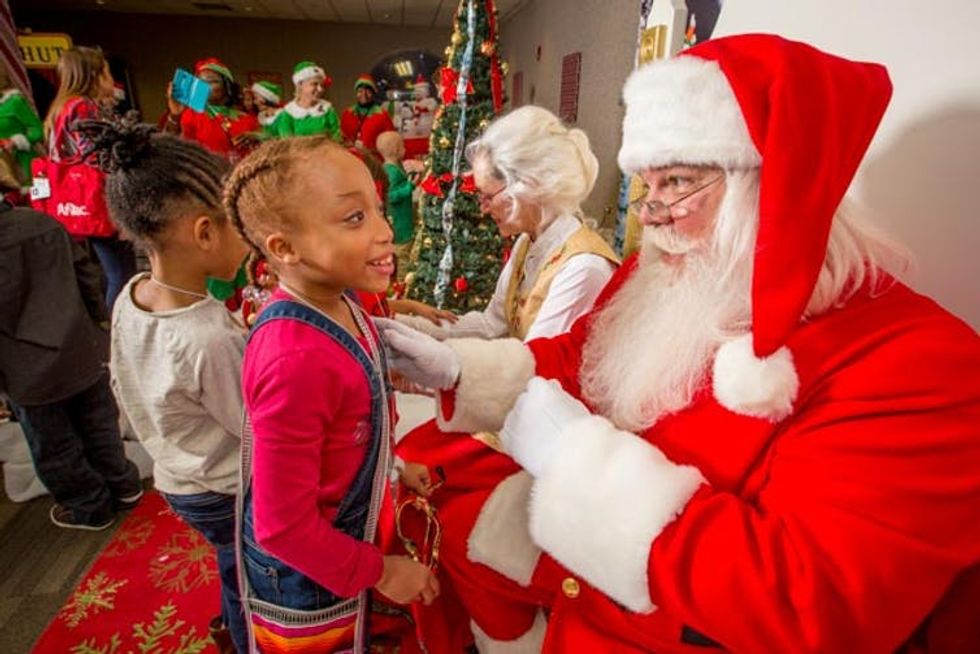
Santa Claus will soon be coming to town, bringing gifts to children.
Santa has several aliases, depending on the part of the world you live in. The English call him Father Christmas, the French know him as Père Noël, and Kris Kringle seems be a version of the Christkind, or Christ Child, who leaves treats for good German Lutherans.
In the Netherlands, he arrives in town on a steamboat or horse from Spain. On the night of Dec. 5, Dutch children put their shoes on the hearth – these days near the central heating duct – hoping that he will fill them with sweet rewards rather than a reprimand for poor behavior. The Dutch call him Sinterklaas – which has come into American English as ‘Santa Claus’ – short for Sint Nicolaas or St. Nicholas.
St. Nicholas and Santa Claus are historically the same man. But unlike the jolly figure who purportedly flies on a sleigh from the North Pole, the saint came originally from the balmy Mediterranean coast.
Who was St. Nicholas really?
As a historian of religions who has written books about ancient saints, I caution against reading accounts of saints’ lives as factual history. However, the earliest stories of St. Nicholas seem to correlate with histories and church documents of the period.
According to these early medieval texts, Nicholas was born around 260 A.D. into a Christian family. His birthplace was near the town of Myra, now called Demre, on the southwest coast of modern Turkey. At the time, Christianity was illegal under the Roman empire.
He studied to be a priest and spent time in prison for his beliefs. However, after Emperor Constantine legalized Christianity, Nicholas was elected Bishop of Myra.
During his lifetime, he became famous for defending his people against imperial taxes and other forms of oppression. According to the earliest document about Nicholas, from the fifth century, he prevented three loyal generals from unjust execution for treason.
A ninth-century Greek legend claims he revived three scholars who had been murdered and stashed in a pickling tub. He also saved three girls whose poverty-stricken father wanted to sell them into prostitution.
After his death, people believed that Nicholas continued to work miracles. His burial place, below the floor of his church, became a popular destination for pilgrims who begged Nicholas to relay their petitions to God.
Proof that Nicholas was listening, they believed, was in the “manna” – holy oil or water – that dripped from the tomb. Pilgrims took this manna home in little bottles or used rags to sop up the moisture that dripped from the saint’s tomb in its subterranean crypt. This was a common pilgrimage practice at Christian shrines.
Visitors to the coastal town of Myra spread Nicholas’ fame along sea routes across the Mediterranean. From there, word passed to the Latin West, and upriver to Russia. Soon, pilgrims from all over Christendom were journeying to Myra to seek the gifts of protection and healing from the saint, who was said to be especially attentive to children.
Italians steal the body
This pilgrimage was disrupted in the 11th century when Seljuk Turks invaded Anatolia. Christians feared that the Muslims who now governed Demre would disregard the saint’s tomb. So, one crew of pious Italian Christians decided to take action.
In 1087, three ships laden with grain set out from Bari, on Italy’s southeast coast, bound for Antioch. However, according to a monk named Nicephorus who wrote immediately after the event, their real mission was to steal St. Nicholas’ body.
In Antioch they heard a rumor that the Venetians too were planning a similar heist. The Barian sailors hastily sold off their grain and headed for Myra in search of St. Nicholas’ church. Priestly custodians there became suspicious when the sailors asked to see the saint’s body.
The Barians claimed that the pope had a vision directing him to fetch Nicholas to Italy. When the priests refused, they offered gold for the relics, but the offer “was tossed aside like dung.” Done with arguing, the Barians caught and bound the priests. Suddenly, a phial of manna fell to the pavement and broke. It seemed that St. Nicholas spoke to them: “It is my will that I leave here with you.”
So, the Barians broke through marble floor with picks and hammers. A delicious aroma filled the church as they opened the tomb. They found the bones swimming in a small sea of manna. They carefully wrapped the relics in a silk case brought for the purpose.
Nicephorus describes how they fled to their ship, pursued by outraged priests and a howling crowd of citizens demanding that they “give back the father who has by his protection kept us safe from visible foes.”
Yet the crew made it back to the harbor at Bari, where the townsfolk and clergy processed, singing joyous hymns, to greet the saint.
St. Nicholas gets a reputation
A new church was built for Nicholas in the court of the governor of Bari. A few years later, Pope Urban II — the one who would preach the First Crusade – formally enshrined the relics of the saint.
A view of the interior of the church of St. Nicholas, built in the 11th century, at Bari.
The Barians believed that manna continued to ooze from Nicholas’ coffin. And going by the claim on the basilica’s website, the belief persists to this day.
Within a decade of the saint’s arrival in 1087, the Basilica di San Nicola was one of Europe’s most popular pilgrimage destinations. May 9 is still celebrated as the day that Nicholas moved shrines or was “translated.”
For at least five centuries, the region, which includes Bari and its saint, was caught in constant wars for possession of southern Italy. In 1500, Bari fell into the hands of King Ferdinand of Aragon, whose marriage to Queen Isabella of Spain created a global naval power.
Because Nicholas was a patron saint of sailors, Spanish sailors and explorers carried stories of the saint wherever they went: Mexico, the Caribbean, Florida and other ports around the world.
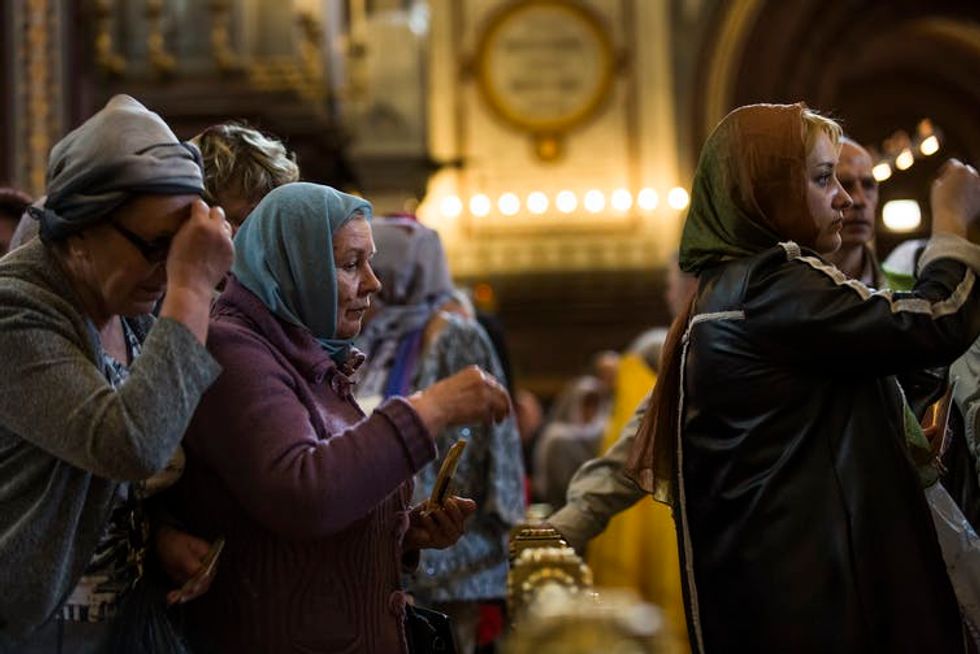
St. Nicholas around the world: Russian Orthodox believers line up to kiss the relics of St. Nicholas that were brought from an Italian church where they have lain for 930 years.
Even the Dutch, who rebelled against Catholic Spain and formed a Calvinist republic in 1581, somehow maintained their devotion to Sinterklass. In other parts of Europe, St. Nicholas lost his feast day but his concern for children helped link him to the gift-giving tradition of another December feast day: Christmas.
How true is this story?
In the 1950s, Italian scientists examined the bones enshrined in the Basilica di San Nicola, seeking evidence of authenticity.
They found the skull and incomplete skeleton of a man, dating to around the fourth century. More recent technology has allowed experts to use the bones to reconstruct Nicholas’ face – he looks like an old Greek man with a broad, worn face. He lacks the rosy cheeks and Anglo-Germanic features of modern Christmas decorations, but like the Santa Claus of greeting cards, he was probably bald.
Turkish archaeologists now claim that the Italians stole the wrong body and that Nicholas’ remains never left Demre. They have discovered another sarcophagus dating to the fourth century in the same church, which they claim contains the saint.
Meanwhile, historians have suggested that the story of Nicholas’ translation is a fiction purposely created to advertise a new pilgrimage center in the 11th century. Although relic theft was common in the Middle Ages, grave-robbers often made mistakes or lied about the authenticity and source of their bones. Nothing in the shrine at Bari proves that the bones inside belong to the fourth-century Bishop Nicholas.
Which Santa story will you tell this holiday season?
Still, this holiday season, when you tell your children about Santa Claus, why not include the tale of Santa’s well-traveled bones? And don’t forget the manna, which is believed to still flow in Bari.
Finally, after two tortuous years of negotiations, it looked like the UK’s elected representatives were about to vote on Prime Minister Theresa May’s Brexit deal. Then, despite vowing to go ahead, May decided to postpone the vote the day before. She had faced almost certain defeat and now says she will speak to EU leaders to find a new way forward.
Technically and legally May was within her rights to back out of the vote. However, the political optics are another thing altogether. This is a government, remember, found in contempt of parliament for withholding information from MPs. Pulling such an important vote out of self-interest does not look good. Doing so a day before the vote is not politic, as Speaker John Bercow pointed out after her statement. Just how much of the normal running order of UK politics is the prime minister ready to jettison?
It seems that May now intends to go back to Brussels and seek concessions around the Irish backstop – a sticking point that riled Brexiteers and Remainers MPs alike – in order to make the vote winnable at a later date. But the question here must be: what concessions? Is she going to ask that the UK as whole to stay in the customs union and maybe even the single market, which is the only real way the Irish border (and the backstop) problem disappears?
Not a chance: this would anger the Brexiteers in her party even more (if that is possible). Rather, the concession she is after is to somehow make the backstop more palatable to the people she has been appealing to from the beginning: the hard Brexiteers. That might be something like agreeing that the backstop becomes a temporary arrangement, somehow.
Corbyn’s alternative?
How will opposition leader Jeremy Corbyn react to this delay? Is he going to try and stick to the line that he wants a general election, promising that if – and it is a big “if” – he won that election he would go back and renegotiate with the EU?
If so, then his fate looks as bleak as May’s. What is it that he imagines he can offer that will provide enough fuel to power the EU27 to reopen the negotiations they have just taken so long to close? And remember, they are not just reopening negotiations with the UK, but among themselves too: they have to reach a unified position before they can agree a position with the UK. The idea that they will be able to reopen talks and get negotiations finished before the end of March is quite frankly ludicrous.
Apart, maybe, from one scenario: that a Labour government would offer to stay in the customs union, in the single market, accept freedom of movement and the jurisdiction of the European Court of Justice. That may be motivation enough for the EU – but it is essentially staying in the EU in anything else but name (and decision-making power).
Parliamentary power
Whatever happens next, one thing is clear: the heads of the UK’s two main parties are no closer to solving this problem from their positions of leadership. It is to other MPs, then, that voters should turn. Only the House of Commons, acting as a collective body, can steer the nation through this political mess.
We should remember that despite all the cries of betrayal from the Brexiteers, this House of Commons as a collective entity was constituted by the people in a vote that superseded the referendum: the snap election of 2017. The MPs that sit in this parliament are the representatives the people chose to enact Brexit in 2017.
And key here is that this house of Commons is hung – there is no outright majority. A clearer display of where the country is at you could not find. As a reflection of that very vote, this house has found it very difficult to agree on anything as the negotiations on Brexit have progressed.
This, then, is the state of the House of Commons as we head into Christmas. And the reality is, everything the government and the opposition have tried so far in terms of Brexit has so far failed. MPs need to find away to coalesce around a different way forward. There needs to be a a proposal, plan or motion that will attract the magic number of 314 MPs needed for a majority in order that a way out can be enacted.
Crucially, we know that if such a plan were to emerge, it would not be a hard Brexit or May’s deal – that much has been proven in the run up to the originally planned vote. Whatever the proposal would be, we should remind ourselves and others that this will be the will of the people expressed via British constitutional means.
Whatever the focus on the role of the PM and other individual politicians in another crazy week, let’s try to remember that the collective sense of the country’s elective representatives is the key player here. Let’s hope it shows up.
If you have a smartphone, it probably is a significant part of your life, storing appointments and destinations as well as being central to your communications with friends, loved ones and co-workers. Research and investigative reporting continue to reveal the degree to which your smartphone is aware of what you’re up to and where you are – and how much of that information is shared with companies that want to track your every move, hoping to better target you with advertising.
Several scholars at U.S. universities have written for The Conversation about how these technologies work, and the privacy problems they raise.
1. Most apps give away personal data
A study based at the University of California, Berkeley found that 7 in 10 apps shared personal data, like location and what apps a person uses, with companies that exist to track users online and in the physical world, digital privacy scholars Narseo Vallina-Rodriguez and Srikanth Sundaresan write. Fifteen percent of the apps the study examined sent that data to five or more tracking websites.
In addition, 1 in 4 trackers received “at least one unique device identifier, such as the phone number … [which] are crucial for online tracking services because they can connect different types of personal data provided by different apps to a single person or device.”
2. Turning off tracking doesn’t always work
Even people who tell their phones and apps not to track their activity are vulnerable. Northeastern University computer scientist Guevara Noubir found that “a phone can listen in on a user’s finger typing to discover a secret password – and […] simply carrying a phone in your pocket can tell data companies where you are and where you’re going.”
3. Your profile is worth money
All of this information on who you are, where you are and what you’re doing gets assembled into enormously detailed digital profiles, which get turned into money, Wayne State University law professor Jonathan Weinberg explains: “By combining online and offline data, Facebook can charge premium rates to an advertiser who wants to target, say, people in Idaho who are in long-distance relationships and are thinking about buying a minivan. (There are 3,100 of them in Facebook’s database.)”
4. Rules and laws don’t exist – in the US
Right now in the U.S., there’s not much regulatory oversight making sure digital apps and services protect people’s privacy and the privacy of their data. “Federal laws protect medical information, financial data and education-related records,” writes University of Michigan privacy scholar Florian Schaub, before noting that “Online services and apps are barely regulated, though they must protect children, limit unsolicited email marketing and tell the public what they do with data they collect.”
European rules are more comprehensive, but the problem remains that people’s digital companions collect and share large amounts of information about their real-world lives.
Corals on Australia's Great Barrier Reef that survived bleaching from rising sea temperatures were more resistant to another bout of hot conditions the following year, scientists said Tuesday, a "silver lining" for the embattled ecosystem.
The 2,300-kilometre (1,400-mile) long UNESCO World Heritage-listed reef off Australia's northeastern coast was hit by back-to-back bleaching in 2016 and 2017.
Bleaching occurs when abnormal environmental conditions, such as warmer sea temperatures, cause corals to expel tiny photosynthetic algae, draining them of their colour.
Corals can recover if the water temperature drops and the algae are able to recolonise them.
AFP / Gal ROMAGreat Barrier Reef
Swathes of coral died or were damaged in the unprecedented successive events, particularly the more heat-susceptible branching corals that are shaped like tables.
But Professor Terry Hughes of James Cook University, who has been leading the surveys of bleached corals, found in the latest study, published in Nature Climate Change, that the response of the reef was different between the two years.
"We were astonished to find less bleaching in 2017, because the temperatures were even more extreme than the year before," Hughes said.
The northern part of the reef, which was worst-affected in 2016, bleached "much less" in 2017 even though some of the reefs underwent similar levels of heat stress in both summers.
JAMES COOK UNIVERSITY/AFP/File / Tane Sinclair-TaylorCorals on Australia's Great Barrier Reef that survived bleaching from rising sea temperatures were more resistant to another bout of hot conditions the following year, study shows
In the central regions, the levels of bleaching for both years were observed to be the same, even though the heat exposure was higher in 2017, the researchers said.
Meanwhile, in the southern region -- the least-affected -- corals that suffered minor bleaching in the first year showed no bleaching in the second.
"That surprised us, because if the southern corals had behaved the same way in year two as in year one, we should have seen 20 or 30 percent of them bleach, and they didn't," Hughes told AFP.
"So it looks like the history of their experience in year one has toughened them up so that they've acclimatised to moderate levels in year two of heat exposure... It's something of a silver lining."
Hughes said it was too early to say whether the reef -- the world's largest living structure -- could be hit by another bleaching event in early 2019, after a spring heatwave in adjacent Queensland state.
Global coral reefs risk catastrophic die-offs if Earth's average surface temperature increases two degrees Celsius (36 degrees Fahrenheit) above pre-industrial levels, earlier research has shown.
Coral reefs make up less than one percent of Earth's marine environment, but are home to an estimated 25 percent of ocean life, acting as nurseries for many species of fish.
A California auction house on Monday withdrew from sale a lightsaber described as having been used by Luke Skywalker in the first “Star Wars” movie after fans raised concerns about its authenticity.
The lightsaber was due to be sold by Profiles in History at a Los Angeles auction on Thursday with an estimated sale price of up to $200,000.
It was described as having been one of five designed by Oscar-winning “Star Wars” set decorator Roger Christian and used by actor Mark Hamill’s young Skywalker character in the 1977 film “Star Wars: A New Hope.” Christian had supplied a letter of authenticity to accompany the sale.
“In light of conflicting information regarding the origin of Roger Christian’s Lightsaber, Profiles in History has decided to withdraw the piece from this auction until Mr. Christian can clear up the inconsistencies that have been brought to our attention,” Profiles in History chief executive Joe Maddalena said in a statement.
Christian did not immediately respond to a request for comment, and Profiles in History declined to comment further.
Some Hollywood memorabilia and “Star Wars” fans had raised questions about whether the lightsaber was used by Hamill in the film, or might be a replica or prototype.
California-based Jason DeBord, the editor-in-chief of the originalprop.com blog, examined postings by Christian on social media websites in 2015 and 2016 in which the artist wrote about making recent exact prototypes of the 1977 Skywalker lightsaber.
“Star Wars” movies have made billions of dollars at the box office worldwide, and props and costumes from the sci-fi saga can fetch sky-high prices at auction.
A different lightsaber used by Skywalker fetched $450,000 at auction last year.
Reporting by Jill Serjeant; editing by Bill Tarrantand Leslie Adler
Formed in the shadow of Mount Everest, the turquoise depths of Nepal's Imja glacial lake would be a breathtaking miracle of nature to behold -- were they not a portent of catastrophic floods.
Scientists warn that as climate change causes Himalayan glaciers to melt at an alarming rate, lakes like Imja could swell further and eventually collapse, triggering a terrifying deluge in Nepal, an impoverished nation at the mercy of a warming planet.
Those tasked with staving off disaster fear a 'glacial lake outburst flood' -- sending torrents of water, mud and rock hurtling downstream -- could reach as far as Nepal's densely populated southern plains, wiping out roads, vital energy projects and entire villages in its path.
"The risk is getting bigger," said Arun Bhakta Shrestha, a climate scientist from the Kathmandu-based International Centre for Integrated Mountain Development.
"These valleys are getting more populated, and infrastructure is developing rapidly."
AFP / AFPHimalayan lake
Hundreds of these lakes have appeared out of nowhere in the Himalayas in recent decades. A 2014 survey found one quarter of Nepal's glaciers shrunk between 1977 and 2010, leaving behind 1,466 lakes.
Twenty-one have been identified as potentially dangerous and Nepal is racing to stay a step ahead of disaster, as global warming reshapes its mountain geography.
"As a small country, there is little we can do to stop what is happening to our glaciers," said Rishi Ram Sharma, the director general at Nepal's department of hydrology and meteorology.
"But we have to do what we can do to adapt and protect our people."
- Living in fear -
Nepal's fastest-growing lake, Imja once posed little threat to the villagers of Surke, a picturesque hamlet perched high in the Everest region.
AFP / Prakash MATHEMAA 2014 survey found one quarter of Nepal's glaciers shrunk between 1977 and 2010
In the early 1980s, the small lake at the foot of the Imja glacier at 5,010 metres (16,437 feet) was unremarkable.
But by 2014, it had more than tripled in size, contained only by a natural wall of debris, known as a moraine, which experts warned might not hold back the waters much longer.
A year later, when a massive earthquake struck Nepal, villagers in Surke assumed Imja had collapsed and would soon bury them all.
"We were terrified the quake would trigger a flood from the lake. All of us ran for safety," villager Phudoma Sherpa told AFP.
The lake miraculously held -- sparing the 12,000 people directly in its path.
But the quake served as a wake-up call for policymakers.
AFP / Prakash MATHEMABy 2014, Imja had more than tripled in size
Experts told the government that the gigantic glacial lakes were effectively a ticking time bomb.
With thousands of lives at stake, a massive undertaking began in late 2016 to drain Imja, which then measured 150 metres deep and two kilometres (1.2 miles) long.
Only the second operation of its kind in Nepal's history, the project was a testament to the monumental challenge posed by glacial lakes, which are often remote and very difficult to access.
Yaks and helicopters transported materials and teams of workers to the high-altitude region, where they toiled in thin air for six months until a drainage canal and early-warning system were installed.
The lake was lowered by 3.5 metres, draining more than five million cubic metres of water.
"Now, you have a channel. So any water that accumulates is drained out. That is how the risk is lowered," said Deepak KC, a climate change analyst from the United Nations Development Programme that backed the project.
- Climate victims -
The project cost $7.4 million, an expensive commitment for a nation heavily reliant on its wealthier neighbours and on international aid that contributed 12 percent to its GDP in the last fiscal year.
AFP / Prakash MATHEMAWith thousands of lives at stake, a massive undertaking began in late 2016 to drain Imja
In this case, over 80 percent of the money came from the Global Environment Facility, an international fund that provides green financing to developing countries. The rest was covered by UNDP.
With a paltry economy and 26 million people, Nepal has a tiny carbon footprint compared to its giant patrons China and India, major polluters that are home to a third of humanity.
Melting glaciers from climate change pose a huge threat to Nepal -- as well as an undeserved extortionate burden, authorities say.
"We feel as if we have been penalised for the mistakes we never made," President Bidya Devi Bhandari told world leaders at a climate summit in Poland this month.
"We are compelled to spend (a) significant amount of our national income in addressing disasters-induced problems."
Nepal is asking the global community for further assistance to fight climate change.
For those no longer living under Imja's shadow, the cost is well worth it.
"There was a sense of fear before, but we feel a lot safer now," said Sherpa.
They said it would never sell, with its six-minute playing time, operatic passages and lyrics about Galileo and Scaramouche, but the Queen song “Bohemian Rhapsody” on Monday became the most streamed song from the 20th century.
Boosted by the new movie “Bohemian Rhapsody,” the 1975 single and music video surpassed 1.6 billion streams globally, record company Universal Music Group said in a statement.
The song overtook the likes of Nirvana’s “Smells Like Teen Spirit,” and Guns N’ Roses’ “Sweet Child O’Mine,” and is now also the most streamed classic rock song of all time, Universal added.
The “Bohemian Rhapsody” film, starring Rami Malek as late Queen frontman Freddie Mercury, has brought the music of the British rock band to a new generation. Five weeks after its release, it has also become the highest grossing musical biography movie ever, with a global box office take of $600 million.
Malek was nominated for a Golden Globe last week for his performance and is widely expected to get an Oscar nomination in January.
Universal said it had been promoting the single across streaming platforms in recent weeks. It used all registered streams on global on-demand services including Spotify, Apple Music and Deezer as well as streams from official song/video streams on YouTube to determine that “Bohemian Rhapsody” was the most streamed song from the 20th century.
Reporting by Jill Serjeant in Los Angeles; Editing by Peter Cooney
Kneeling in front of riot police, 32 religious leaders and activists were arrested at the U.S. border fence in San Diego on Monday during a protest to support the Central American migrant caravan.
More than 400 demonstrators, many leaders of churches, mosques, synagogues and indigenous communities, sought a halt to detention and deportation of migrants and for the United States to welcome the caravan that arrived in Tijuana, Mexico in November.
Singing and praying, religious leaders moved forward in lines of four to six, some wearing T-shirts reading, “Love Knows No Borders.” They were handcuffed and led away by federal agents upon entering a restricted area in front of the fence.
“As a Quaker who believes in our shared humanity...We’re calling on the U.S. to respect the rights of migrants,” said Joyce Ajlouny, general secretary of the American Friends Service Committee, which has run a week of actions to back migrants.
U.S. Border Patrol spokesman Theron Francisco said 31 people were arrested by Federal Protective Services for trespassing and one was arrested by Border Patrol for assaulting an agent.
The arrests marked the second confrontation with U.S. authorities since the caravan reached Tijuana. U.S. Border Patrol agents fired tear gas at migrants on Nov. 25 after they said they had stones thrown at them.
Thousands of migrants are living in crowded shelters and encampments in Tijuana after traveling from Central America to escape poverty and violence. They may have to wait weeks or months to claim asylum at the U.S. border.
Data released on Monday by U.S. Customs and Border Protection (CBP) showed asylum claims at the U.S.-Mexico border rose 67 percent in the 2018 fiscal year from a year earlier.
U.S. immigration officials say these claims, most of which are accepted, exploit a legal loophole allowing migrants to enter the United States while they await a court hearing on their asylum case.
“As the majority of these claims will not be successful when they are adjudicated by an immigration court, we need Congress to act to address these vulnerabilities,” CBP Commissioner Kevin McAleenan said in a statement.
Protest leaders said President Donald Trump had portrayed the caravan as a security threat to advance his “anti-immigrant” agenda and further restrict migrants’ ability to seek asylum.
A U.S. judge in November blocked Trump’s proclamation to bar migrants who cross the U.S.-Mexico border illegally from seeking asylum.
Reporting by Marty Graham; Additional reporting by Andrew Hay in New Mexico; Editing Lisa Shumaker and Clarence Fernandez
The corruption surrounding President Donald Trump includes close allies lobbying the administration for foreign governments targeted by US sanctions, The New York Timesreported Monday.
Two leaders of Trump's legal defense were featured in an article. Rudy Giuliani as Trump's defense attorney and Alan Dershowitz, who frequently defends the administration on cable news.
The story noted Giuliani attending an event atop Hay-Adams Hotel featuring a presentation by the Democratic Republic of Congo’s special envoy.
"The Congolese officials at the reception posed for photos with Mr. Giuliani, and afterward there was some confusion about his connection to the lobbying effort," The Times noted. "Giuliani said he was not serving as an intermediary between the Democratic Republic of Congo and the administration."
On Sunday, in text messages, Giuliani admitted negotiating a consulting deal in the Democratic Republican of Congo.
Giuliani said, “if I do it, it would only be security consulting” and not lobbying.
"Dershowitz also has a long history of representing clients in transnational legal matters, including sanctions," The Times noted. "Dershowitz is advising Dan Gertler, an Israeli billionaire who was the target of sanctions by Washington last year for using his connections to [Joseph] Kabila, the Congolese president, to facilitate what the Treasury Department called opaque and corrupt mining and oil deals.'"
The two weren't alone.
Former Trump campaign aide Bryan Lanza has lobbied to delay sanctions against Russian oligarch Oleg Deripaska.
And former Trump campaign fundraiser Brian Ballard the Turkish-state-owned bank Halkbank.
A Canadian provincial court weighing whether to grant bail to a top executive of Chinese telecoms giant Huawei Technologies [HWT.UL], who is facing possible extradition to the United States, adjourned on Monday without deciding her fate.
U.S. prosecutors want Chief Financial Officer Meng Wanzhou to be extradited to face accusations she misled multinational banks about Huawei’s control of a company operating in Iran, putting the banks at risk of violating U.S. sanctions which would incur severe penalties, court documents said.
Meng, the 46-year-old daughter of Huawei’s founder, was arrested on Dec. 1 as she was changing planes in Vancouver. In a sworn affidavit, she said she is innocent and will contest the allegations against her at trial if she is surrendered to the United States.
The judge in Monday’s bail hearing said he rolled the proceedings over to Tuesday at 10 a.m. PST (1 p.m. EDT/1800 GMT) because he wants to hear more about the issue of surety - who will take responsibility for Meng’s actions if she is released.
Meng’s lawyer David Martin, who told the court high-tech surveillance devices and a 24-hour security detail would ensure his client does not flee and proposed a C$15 million ($11.3 million) bail guarantee, had offered her husband as surety.
But the judge and the public prosecutor called into question whether Meng’s husband could perform this duty as he is not a resident of British Columbia, where Vancouver is located, and would not suffer if she were to breach her bail conditions.
Meng’s arrest has roiled markets over fears it would exacerbate tensions between the United States and China, already at a high over tariffs. The two sides have agreed to trade negotiations that must be concluded by March 1.
Beijing has demanded Meng’s immediate release and threatened “consequences” for Canada. But both Chinese and U.S. officials appear to be avoiding linking her arrest to the trade dispute.
Meng’s lawyer offered C$14 million in property equity and C$1 million in cash as a guarantee. The public prosecutor said he wanted half in cash and half in property.
At one point the judge asked why Meng had avoided travel to the United States since 2017 if not to avoid arrest. Martin cited a “hostile” climate toward Huawei in the United States.
“I ask the court to ask itself, what motive could she possibly have to flee?” Martin said, arguing the evidence against her was not overwhelming.
“If she were to flee, or breach order in any way ... it doesn’t overstate things to say she would embarrass China itself.”
Meng appeared confident in court early on Monday, smiling and taking her lawyer’s arm. But by mid-afternoon she appeared more tense, gesturing rapidly as she conferred with members of her legal team.
She has argued she needs to be released because she has severe hypertension and fears for her health.
Huawei is the world’s largest supplier of telecommunications network equipment and second-biggest maker of smartphones, with revenue of about $92 billion last year. Unlike other big Chinese technology firms, it does much of its business overseas.
U.S. officials allege Huawei was trying to use the banks to move money out of Iran. Companies are barred from using the U.S. financial system to funnel goods and services to sanctioned entities.
Huawei and its lawyers have said the company operates in strict compliance with applicable laws, regulations and sanctions of the United States and other parties.
“We will continue to follow the bail hearing tomorrow. We have every confidence that the Canadian and U.S. legal systems will reach a just conclusion,” the company said on Monday.
Reporting by Anna Mehler Paperny; Additional reporting by Ben Blanchard in Beijing, David Ljunggren in Ottawa and Karen Freifeld in Washington; Writing by Anna Mehler Paperny and Nick Zieminski; Editing by Bill Rigby and Sonya Hepinstall
U.S. immigration authorities arrested 170 people between early July and late November who came forward to claim migrant children in government custody, according to official data released on Monday, a crackdown advocates say is discouraging relatives from volunteering to take in some of the 14,000 detained children.
Of those arrested, 61 were classified as criminal while the other 109 had only committed immigration violations, said U.S. Immigration and Customs Enforcement spokesman Matthew Bourke.
President Donald Trump won the White House on a promise to crack down on illegal immigrants and he has ordered more aggressive enforcement to dissuade migrants from crossing the U.S. southern border.
U.S. laws and legal precedent limit the time migrant juveniles can be detained, so those caught crossing the border alone are often released to their parents or other close relatives.
About 80 percent of potential sponsors that ICE conducted checks on in that five-month period were in the United States unlawfully, said Bourke.
The Department of Health and Human Services (HHS) cares for the migrant children, while the Department of Homeland Security (DHS) enforces immigration law and oversees ICE.
HHS officials did not immediately respond to a request for comment.
In April, HHS and DHS agreed they would share more information about children and their potential sponsors. That information was not previously routinely shared. HHS now provides immigration authorities with names, dates of birth, and fingerprints of potential sponsors. All adult members of the potential sponsor’s household must also be fingerprinted, something not required in the past.
The government says it wants to ensure that potential sponsors are suitable and properly vetted. But immigrant advocates have criticized the policy change, saying it is scaring parents and other relatives from claiming their children.
On Nov. 28, 112 organizations wrote a letter to DHS Secretary Kirstjen Nielsen and HHS Secretary Alex Azar urging them to reverse the policy.
“Your agencies have taken a process designed to protect children and made it into a tool that uses them to find and deport their families,” they wrote.
In September, senior ICE official Matthew Albence testified to Congress that ICE had arrested 41 people who came forward to sponsor immigrant children. The figures provided by ICE on Monday include the 41 people mentioned by Albence, Bourke said.
Reporting by Yeganeh Torbati and Kristina Cooke; Editing by Lisa Shumaker
President Emmanuel Macron on Monday announced wage rises for the poorest workers and tax cuts for pensioners, offering concessions after weeks of often violent protests that have challenged his authority.
In his first national address following two weekends of the worst unrest in France in years, Macron sought to restore calm after accusations that his political methods and economic policies were fracturing the country.
“We want a France where one can live in dignity through one’s work and on this we have gone too slowly,” Macron said on primetime television.
“I ask the government and parliament to do what is necessary.”
The president’s address came 48 hours after protesters fought street battles with riot police in Paris, hurling missiles, torching cars and looting shops.
Macron faces a delicate task: he needs to persuade the middle class and blue-collar workers that he hears their anger over a squeeze on household spending, without being exposed to charges of caving in to street politics.
He said people on the minimum wage would see their salaries increase by 100 euros a month from 2019 without extra costs to employers. Pensioners earning less than 2,000 euros would see recent increase in social security taxes scrapped.
But he also said he would stick to his reform agenda and refused to reinstate a wealth tax.
“We will respond to the economic and social urgency with strong measures, by cutting taxes more rapidly, by keeping our spending under control, but not with U-turns,” Macron said.
Additional reporting by Richard lough, Leigh Thomas, Pascale Denis, Jean-Bapttiste Vey, Marine Pennetier in Paris and Dhara Ranasinghe in London, Editing by David Stamp and John Stonestreet







 AFP / Gal ROMA
 JAMES COOK UNIVERSITY/AFP/File / Tane Sinclair-Taylor
 AFP / AFP
 AFP / Prakash MATHEMA
 AFP / Prakash MATHEMA
 AFP / Prakash MATHEMA