The historic and ornate U.S. Capitol Rotunda was hosting mourners on Tuesday paying respects to the 41st U.S. president, George H.W. Bush, who died last week at the age of 94 and will be buried on Thursday in his home state of Texas.
A casket bearing Bush’s body arrived on the Capitol grounds at sunset on Monday for a ceremony led by congressional leaders who celebrated the life of the Republican president and father of the 43rd president, George W. Bush.
The public was given 36 hours to file past the elder Bush’s flag-draped coffin. Early on Wednesday, it will be transported to the Washington National Cathedral for a memorial service.
Senate Majority Leader Mitch McConnell opened a session of the Senate on Monday heralding the “daring” World War Two aviator, former head of the Central Intelligence Agency and wartime president. “Year after year, post after post, George Bush stayed the course,” McConnell said.
Bush was elected president in 1988 after serving two terms as President Ronald Reagan’s vice president.
During his four years as president, Bush used U.S. military power to end Iraq’s occupation of Kuwait, steered the United States through the end of the Cold War and condemned China’s violent reaction to pro-democracy demonstrators in Beijing.
He was dogged by domestic problems, including a sluggish economy. When he ran for re-election in 1992, he was pilloried by Democrats and many Republicans for violating his famous 1988 campaign promise: “Read my lips, no new taxes.”
Democrat Bill Clinton coasted to victory, ending Bush’s presidency.
Early in his political career, Bush served in the U.S. House of Representatives from 1967-1971. He lost bids in 1964 and 1970 for a U.S. Senate seat from Texas.
Bush is the 12th U.S. president to lie in state in the Capitol Rotunda. The first was Abraham Lincoln following his assassination in 1865.
On Monday, mourners lined up to enter the Capitol for the public viewing starting later that evening, including Theresa Murphy, 64, a retired New York high school history teacher.
“His character speaks most, because of his character, how he handled so many important points in our history. The Iraq war, the falling of the Berlin Wall, he wasn’t (saying) that’s all about me,” Murphy said, adding: “Can you imagine what it would look like if our president today did that?”
The federal government and some financial exchanges will be closed on Wednesday for a day of mourning.
Reporting by Richard Cowan; Additional reporting by Susan Cornwell; Editing by Kevin Drawbaugh and Peter Cooney
Tania Bruguera and several other Cuban artists were detained in Havana on Monday after trying to stage a protest against a new decree that they fear will hamper creativity and increase censorship of Cuban culture.
Bruguera, the most high-profile of the detainees, was arrested shortly after leaving her home in the morning and before reaching the ministry of culture where the artists intended to hold their protest, her mother, Argelia Fernandez, told Reuters.
The performance artist, who has been arrested before for publicly protesting against the Communist government, was released in the evening, Fernandez said, but immediately went to the ministry to demonstrate against the arrests of other artists.
“All I can do is show solidarity,” Bruguera wrote on her Facebook page early on Monday evening, posting a photo of herself wearing a T-shirt with the words “No to the Decree 349”. “If they detain me, I will be on hunger and thirst strike.”
Bruguera was reportedly detained again on Monday evening, according to Iris Ruiz, an actress and the coordinator of what has been a rare campaign in recent months against Decree 349, one of the first pieces of legislation to be signed by Miguel Diaz-Canel since he succeeded Raul Castro as president in April.
Fernandez told Reuters she had no means of locating her daughter because her cellphone appeared to have been blocked by state security.
Brief detentions are the standard response to opposition street protests in a country that frowns on public dissent and views dissidents as mercenaries in the pay of the United States to subvert the government.
Cuban officials do not typically comment on such police activity.
With Decree 349 due to come into force on Friday, protesters decided to step up their campaign with a demonstration all week on the steps of the culture ministry that would include poetry readings and performances.
Ruiz said her husband, the poet Amaury Pacheco, and another artist were detained after arriving together at the culture ministry on Monday morning.
Three other artists who also headed there, including campaign leader Luis Manuel Otero Alcantara, could not be located, suggesting they had also been detained, Ruiz said. Otero Alcantara’s phone appeared to be turned off.
Few Cuban artists have chosen to protest against the decree publicly but unease is widespread in the island’s creative community and among Western diplomats in Havana. Amnesty International has called it a “dystopian prospect”.
Cuban authorities, however, have insisted it merely aims to prevent tax evasion and the spread of bad, pseudo-culture, and say that the issue is being manipulated by counter-revolutionaries.
CIA Director Gina Haspel will give a closed briefing to leaders of several U.S. Senate committees on Tuesday on the killing of Saudi journalist Jamal Khashoggi, according to a source familiar with the planned meeting.
Some lawmakers were angry Haspel did not participate in a Senate briefing by Trump administration officials last week on Khashoggi’s death at the Saudi consulate in Istanbul.
The CIA has assessed that Saudi Crown Prince Mohammed bin Salman ordered the killing of Khashoggi, a critic of the Saudi government.
The Wall Street Journal first reported that Haspel would conduct a briefing.
At last week’s briefing, Secretary of State Mike Pompeo and Defense Secretary Jim Mattis said there was no hard evidence the crown prince was behind the killing and urged senators not to downgrade ties with Saudi Arabia over the incident.
Haspel will brief the Republican and Democratic leaders of the Senate Foreign Relations, Armed Services and Appropriations committees, the source said, adding that the Senate Intelligence Committee already had been briefed by the CIA chief.
The CIA had no immediate comment.
Reporting by Mark Hosenball; Writing by Eric Beech; Editing by Sonya Hepinstall and Howard Goller
A Soyuz spacecraft carrying Russian, American and Canadian astronauts arrived at the International Space Station on Monday, following the first manned launch since a failed launch in October.
Russian cosmonaut Oleg Kononenko, Anne McClain of NASA and David Saint-Jacques of the Canadian Space Agency blasted off from Kazakhstan's Baikonur Cosmodrome earlier in the day.
They successfully docked at the ISS on schedule at 1736 GMT to begin an expected six and a half months aboard the ISS, the Russian Roscosmos space agency said via Twitter.
It was the first manned voyage for the Soviet-era Soyuz since October 11, when a rocket carrying Russia's Aleksey Ovchinin and US astronaut Nick Hague failed just minutes after blast-off, forcing the pair to make a harrowing emergency landing.
They escaped unharmed but the failed launch -- the first such incident in Russia's post-Soviet history -- raised concerns about the state of the Soyuz programme.
AFP / Kirill KUDRYAVTSEVAnne McClain, Oleg Kononenko, and David Saint-Jacques say risk is just part of their job
The Soyuz is the only means of reaching the ISS since the United States retired the space shuttle in 2011.
Kononenko, McClain and Saint-Jacques smiled and gave thumbs up to the cheering crowd including relatives as they ascended into the Soyuz capsule on Monday morning.
Minutes after take off, Roscosmos said the capsule was in orbit. NASA administrator Jim Bridenstine meanwhile thanked the US and Russian teams "for their dedication to making this launch a success".
- Risk 'part of our profession' -
(NASA/Bill Ingalls)/AFP/File / Bill INGALLSA Soyuz rocket failed just minutes after blast-off in October
In a successful rehearsal for Monday's flight, a Soyuz cargo vessel took off on November 16 from Baikonur and delivered several tonnes of food, fuel and supplies to the ISS.
Russia said last month the October launch had failed because of a sensor damaged during assembly at the Baikonur cosmodrome, but insisted the spacecraft remained reliable.
While flight commander Kononenko is beginning his fourth mission to add to an impressive 533 days in space, both Saint-Jacques and McClain are making their maiden trip.
Crew commander Kononenko, 54, said during a press conference on the eve of the launch that "risk is part of our profession".
But he added that his team "absolutely" trusted those who had prepared for the flight.
European Space Agency astronaut Alexander Gerst, NASA's Serena Aunon-Chancellor and Sergei Prokopyev of Roscosmos were set to greet the trio on arrival at the ISS.
NASA/Roscosmos/AFP/File / HOThe astronauts are heading for a six-and-a-half month mission on the International Space Station
Veteran Kononenko said the crew would conduct a spacewalk on December 11 as part of an investigation into a mysterious hole that has caused an air leak on the ISS.
While on board, Saint-Jacques will be involved in an experiment called "At Home in Space" which "takes a closer look at how crew members adapt to living with each other by creating a shared culture," according to the Canadian Space Agency.
Among the dozens of other experiments the new crew members will take part in is one that will use worms to examine muscle loss in space, led by British scientists.
The experiment could pave the way to new treatments for muscular conditions for people on Earth, according to the UK Space Agency.
- 'Spacewalking like rugby' -
AFP / STRThe launch comes after a failed mission on October 11
McClain, 39, served in Iraq and has represented the United States in women's rugby.
She has said that training to spacewalk resembled the sport since it demands "grit, toughness, mental focus, and more".
Russia-US cooperation in space has remained one of the few areas not affected by a crisis in ties between the former Cold War enemies.
But comments by the combative chief of the Russian space agency, Dmitry Rogozin, have raised eyebrows.
He recently joked Russia would send a mission to the Moon to "verify" whether or not NASA lunar landings ever took place.
In recent years Russia's debt-laden space industry has suffered a number of mishaps including the loss of cargo spacecraft and satellites.
At a press conference following the successful docking, Rogozin announced March 1, 2019, as the date for the next manned launch to the ISS.
He said Ovchinin and Hague would be on board, along with NASA's Christina Koch.
China has made more than $1.2 trillion in additional trade commitments as part of a deal reached by U.S. President Donald Trump and China’s Xi Jinping and Beijing has vowed to take immediate steps on those promises.
Trump and Chinese President Xi Jinping agreed to hold off on new tariffs during talks in Argentina on Saturday, declaring a truce following months of escalating tensions on trade and other issues.
Treasury Secretary Steve Mnuchin said on Monday there was a clear shift in tone at Buenos Aires from past discussions with Chinese officials, as Xi offered a clear commitment to open China’s markets to U.S. companies.
“They put on the table an offer of over $1.2 trillion in additional commitments. But the details of that still need to be negotiated,” Mnuchin told CNBC. “This is the first time that we have a commitment from them that this will be a real agreement.”
National Economic Council Director Larry Kudlow said he, Mnuchin and U.S. Trade Representative Robert Lighthizer had lunch with China’s vice premier in Argentina and he told them that Beijing would move immediately on the new commitments.
“The history here with China promises is not very good. And we know that,” Kudlow said. “However, I will say this: President Xi has never been this involved.
“They cannot slow walk this, stall this, meander this. Their word: ‘immediately.’”
Kudlow told reporters at the White House that Washington would like to see progress quickly on structural issues, including intellectual property theft and technology transfers. Americans will get majority ownership in companies in China for the first time, which should help address those issues, he said on CNBC.
The United States agreed not to raise tariffs further on Jan. 1, while China agreed to buy more agricultural products from U.S. farmers immediately.
The two sides also agreed to negotiate over the next 90 days to resolve issues of concern raised by the United States including intellectual property protection, non-tariff trade barriers and cyber theft.
The truce boosted global markets on Monday with world stocks up nearly 1 percent. On Wall Street, the Dow Jones Industrial Average rose 0.94 percent at the open and the S&P 500 by 1.10 percent.
U.S. officials will monitor Chinese progress on enforcing the commitments very closely, Kudlow said.
Trump has appointed Lighthizer, one of the administration’s most vocal China critics, to oversee the new round of trade talks with China, a White House official and a U.S. official told Reuters on Monday.
The appointment of Lighthizer may signify a harder line in talks with Beijing and marks a shift from past practices where Mnuchin had a lead role.
Lighthizer is an experienced trade negotiator who just completed a new agreement with Canada and Mexico.
“He’s the toughest negotiator we’ve ever at the USTR and he’s going to go chapter and verse and get tariffs down, non-tariff barriers down and end all these structural practices that prevent market access,” White House trade adviser Peter Navarro told National Public Radio earlier on Monday.
The White House is stepping up efforts to prod other countries to build more vehicles in the United States. Lighthizer and other officials including National Economic Council director Larry Kudlow are set to meet with German automakers on Tuesday, including the chief executives at Volkswagen AG and Daimler AG, people briefed on the matter said.
On Sunday, Trump tweeted that China had agreed to cut import levies on American-made cars.
Chinese regulators did not respond to requests for comment on Trump’s tweet on autos tariffs. Neither country had mentioned auto tariffs in their official read-outs of the Trump-Xi meeting.
Reporting by David Lawder and Jeff Mason; Additional reporting by David Lawder and David Shepardson in Washington, Meng Meng and Stella Qiu in Beijing, Andrew Galbraith and David Stanway in Shanghai, and Noah Sin and Anne Marie Roantree in Hong Kong; Writing by Ben Blanchard; Editing by Kim Coghill and Susan Thomas
U.S. Trade Representative Robert Lighthizer will lead negotiations with China over tariffs, market access and structural changes to intellectual property practices over the next 90 days, the White House has confirmed, potentially signaling a harder U.S. line.
On Saturday, U.S. President Donald Trump and Chinese President Xi Jinping declared a trade truce, agreeing to hold off on new tariffs following months of escalating tension. The two sides also agreed to negotiate over the next 90 days.
Lighthizer leading the talks marks a shift from the administration’s previous approach to China trade talks that had been largely led by U.S. Treasury Secretary Steven Mnuchin. Lighthizer, an experienced trade negotiator and having just completed a new agreement with Canada and Mexico, is one of the administration’s most vocal China critics.
“Robert Lighthizer, the ambassador, USTR, is in charge of these negotiations,” White House trade adviser Peter Navarro told National Public Radio. “He’s the toughest negotiator we’ve ever had at the USTR and he’s going to go chapter and verse and get tariffs down, non-tariff barriers down and end all these structural practices that prevent market access.”
A White House official also confirmed the decision to have Lighthizer lead the negotiations.
Mnuchin had said the negotiations with China would be led by Trump, with an “inclusive team” of administration officials, including himself and other cabinet officials.
Mnuchin led some past rounds of talks due to his relationship as the counterpart to Chinese Vice Premier Liu He, the top economic adviser to Chinese President Xi Jinping. U.S. Commerce Secretary Wilbur Ross also led a failed round of talks in Beijing in June, while mid-level Treasury officials hosted a round of discussions in August.
The White House said on Saturday that the talks would cover structural changes in China on forced technology transfer, intellectual property protection, non-tariff barriers, cyber intrusions and cyber theft, services and agriculture.
Most of these issues were identified in USTR’s “Section 301” investigation of China’s intellectual property practices, which formed the basis of the U.S. tariffs imposed on Chinese goods.
Lighthizer said last week that China had failed to alter the “unfair, unreasonable” practices at the heart of the trade dispute.
Reporting by David Lawder, Editing by Franklin Paul and Susan Thomas
Canada takes U.S. President Donald Trump’s comments about pulling out of NAFTA seriously and has no indication when the White House might act, Finance Minister Bill Morneau said on Monday.
Morneau, speaking to a New York event arranged by Politico, also said it was clear that a negotiating process was starting in the United States which he hoped would lead to Congressional ratification of a new pact designed to replace the North American Free Trade Agreement.
Trump said on Saturday he would give formal notice of his intention to terminate NAFTA, giving six months for lawmakers to approve the new U.S.-Mexico-Canada Agreement (USMCA).
Asked whether Canada took Trump’s comments seriously, Morneau replied: “We take everything seriously.”
The Democrats, who say the USMCA has some shortcomings, take control of the U.S. House of Representatives next month. If Trump pulls out of NAFTA and the House rejects the new pact, it could deal a major blow to North American free trade.
“We are starting to see the beginnings of the negotiation process in the United States that will - we hope - get to a ratification of the deal,” said Morneau, saying Canadian officials would be talking to all those involved.
Asked about Trump’s comments, a spokesman for Canadian Foreign Minister Chrystia Freeland said “this is part of the U.S. ratification process” but declined to comment further.
Reporting by David Ljunggren; Editing by Chizu Nomiyama and Susan Thomas
The U.S. Supreme Court on Monday rebuffed a challenge by three conservation groups to the authority of President Donald Trump’s administration to build a wall along the U.S.-Mexico border, a victory for Trump who has made the wall a centerpiece of his hardline immigration policies.
The justices’ declined to hear the groups’ appeal of a ruling by a federal judge in California rejecting their claims that the administration had pursued border wall projects without complying with applicable environmental laws. The groups are the Center for Biological Diversity, the Animal Legal Defense Fund and Defenders of Wildlife.
Their lawsuits said construction operations would harm plants, rare wildlife habitats, threatened coastal birds like the snowy plover and California gnatcatcher, and other species such as fairy shrimp and the Quino checkerspot butterfly.
Trump has clashed with U.S. lawmakers, particularly Democrats, over his plans for an extensive and costly border wall that he has called necessary to combat illegal immigration and drug smuggling. Congress, controlled by the president’s fellow Republicans, has not yet provided him the amount of money he wants.
The president has threatened a government shutdown unless lawmakers provide $5 billion in funding.
On Saturday, Trump said congressional leaders sought a two-week extension of funding ahead of a Dec. 7 deadline to fully fund the U.S. government and that he would probably agree to it.
Mexico has rejected Trump’s demand that it pay for the wall.
Illegal immigration was a central theme of Trump’s presidential bid, and he repeatedly invoked the issue ahead of the Nov. 6 congressional elections as a caravan of migrants from Central America made their way toward the United States. Trump deployed 5,800 U.S. troops to the border.
The three conservation groups sued last year in San Diego after the Department of Homeland Security authorized projects to replace existing border fencing at two sites in southern California, as well as the construction of prototype border walls.
The dispute centers on a 1996 law aimed at countering illegal immigration that gave the federal government the authority to build border barriers and preempt legal requirements such as environmental rules. That law also limited the kinds of legal challenges that could be mounted.
The groups argued that Trump’s wall projects did not fall under that law, and that the measure was unconstitutional because it gave too much power to unelected Cabinet officials to avoid laws such as the Endangered Species Act and the National Environmental Policy Act.
U.S. District Judge Gonzalo Curiel in February ruled that the administration had not exceeded its powers. The groups appealed the judge’s decision to the Supreme Court.
The groups have said that giving the federal government unfettered power to waive applicable laws and limit judicial oversight is ripe for abuse. With such power, the plaintiffs argued, officials could theoretically give contracts to political cronies to build walls with no safety standards using child migrant labor, and “kill bald eagles in the process.”
The Trump administration urged the justices not to take up the appeal.
Trump criticized Curiel in 2016 in a different case, a lawsuit accusing his now-defunct Trump University of fraud. Trump, while running for president, accused Curiel of being biased against him because of the Indiana-born judge’s Mexican heritage.
Reporting by Andrew Chung; editing by Grant McCool
British broadcaster and environmentalist David Attenborough on Monday urged world leaders, meeting in Poland to agree ways to limit global warming, to get on and tackle “our greatest threat in thousands of years”.
Known for countless nature films, Attenborough has gained prominence recently with his “Blue Planet II” series, which highlighted the devastating effect of pollution on the oceans.
“Leaders of the world, you must lead,” said the naturalist, given a “People’s seat” at the two-week U.N. climate conference in the Polish coal city of Katowice alongside two dozen heads of state and government.
“The continuation of our civilisations and the natural world upon which we depend, is in your hands,” he said.
The world is currently on course to overshoot by far the limits for global warming agreed in the landmark 2015 Paris accord on climate change, which were intended to prevent more extreme weather, rising sea levels and the loss of plant and animal species.
The Katowice talks are billed as the most important U.N. conference since Paris, coming ahead of an end-of-year deadline to agree a “rule book” on enforcing action.
Yet political and U.N. leaders have been struggling to inject urgency into two weeks of haggling on how to move on from fossil fuels to give practical effect to the Paris accord.
Representatives of some of the most powerful countries and biggest polluters were conspicuous by their absence, and the United States is quitting the U.N. climate process.
To maximise the chances of success in Poland, technical talks began on Sunday, a day early, with delegates from nearly 200 nations debating how to meet the Paris target of limiting global warming to between 1.5 and 2.0 degrees Celsius (2.7 and 3.6 Fahrenheit).
“WAVE OF OPTIMISM HAS BROKEN”
Michal Kurtyka, Poland’s deputy environment minister and president of the talks, said that without success in Katowice, Paris would not be a success, as it had only decided what was needed, not how it could be done.
Moreover, the wider political environment had changed.
“The wave of optimism and global cooperation that carried us to and through Paris has now crested, broken and is now tumbling,” he told delegates.
He nevertheless took heart from a G20 statement at the weekend when the leading industrialised nations - except the United States - reaffirmed their commitment to implementing the Paris deal.
A series of reports in the run-up to the Katowice conference have made clear the widening gap between high-level rhetoric and actual work to cut emissions, which have continued to rise.
“It is hard to overstate the urgency of our situation,” U.N. Secretary General Antonio Guterres said.
“Climate change is running faster than we are and we must catch up sooner rather than later before it is too late.”
Attenborough told the delegates: “Right now, we are facing a man-made disaster of global scale. Our greatest threat in thousands of years. Climate Change.”
Yet expectations for Katowice are low.
The host nation Poland is committed to coal, the most polluting of fossil fuels. It is calling for a “just transition” to provide help for communities dependent on fossil fuels.
Riots in Paris at the weekend, partly in protest at fuel taxes, also illustrate the conundrum: how do politicians introduce long-term environmental policies without inflicting costs on voters that may damage their chances of re-election?
To contain warming at 1.5C, man-made global net carbon dioxide (CO2) emissions will need to fall by about 45 percent by 2030 from 2010 levels and reach “net zero” by mid-century, according to the U.N. Intergovernmental Panel on Climate Change (IPCC).
Delegates at the talks said sticking points were likely to include finance and the level of scrutiny associated with monitoring individual nations’ emissions.
The U.N. has a goal of raising $100 billion every year from 2020 for climate action. To inject momentum, the World Bank Group on Monday said it would provide a further $200 billion over five years from the start of the next decade.
Additional reporting by Agnieszka Barteczko in Warsaw and Wojciech Zurawski in Katowice; Editing by Toby Chopra
On Sunday, Nov. 25, the scientist He Jiankui claimed the birth of the world’s first genetically engineered children: twins, created by IVF, their DNA altered at fertilization. Changes like these, because they’re inheritable – “editing the germline” – are widely prohibited by law and avoided by scientific consensus. If He really did this, it’s a very big step across a very bright line.
The strangeness of this choice cannot be overstated. Groundbreaking achievements normally appear in prestigious journals, with extensive data, after rigorous peer review. Announcing the accomplishment on YouTube is the social media equivalent of walking out the front door and yelling, “Guess what, everybody? I’m the first to engineer a human being! And the kids are already here – they’re twins!” The timing of the video’s release – on the eve of a major international conference on genome editing, where He was scheduled to speak – clearly had more to do with publicity than science.
Others have written on the science and ethics involved. I’m a writer, so what interests me is persuasion: the way literary tools, like story and metaphor, help pave the way for cutting-edge biotechnology. Researching a forthcoming book on this topic, I came to see that human-focused biotech and persuasion form a single system: for the biotech to be adopted, the public has to accept it first. He’s video is a textbook bid for acceptance, an argument for germline editing aimed at the general public.
But the video is a low-rent production. It’s just He, standing in a lab, talking to the camera in English (it’s subtitled). As such, the video doesn’t hold a candle to the polished emanations of established research institutes or multimillion dollar corporations. The writing isn’t great either. Effective persuasion guides us lightly from one place to another: the lightest touch on your shoulder, redirecting your path. Listening to He is more like being yanked down a slippery slope.
And yet for precisely that reason, the video deserves a closer look: Seeing the pitch in its most obvious form, we can learn to recognize the patterns.
The family success story
The video begins with He beaming at the camera, describing “two beautiful little Chinese girls named Lulu and Nana,” a few weeks old, “as healthy as any other babies.” According to He, their parents, Mark and Grace, had always wanted to have a family. But Mark is HIV-positive, and stigma had deterred them. Now, because of He’s experiment – which was intended to make the twins permanently immune to HIV infection – a happy family exists. “The babies are home now with their mom Grace and their dad Mark,” He says.
“Mark” and “Grace,” their real names changed for privacy, may be real. Rhetorically, though, their function is to humanize a new technology. Ironically, that technology is changing what it means to be human in the first place.
Portrait of a scientist
Persuasion means crafting a persona, and He is clearly going for approachable scientist and family man. Identifying himself as “a father of two girls,” He also suggests his own humility, by saying, “Mark’s words taught me something I didn’t fully appreciate.” That lesson? “Gene surgery” helps more than a child: “We heal a whole family.”
That feigned humility doesn’t square with what He actually did: rushing to be first across the germline, thereby putting his experimental human subjects, and any of their descendants, at risk. Given all this, He’s assertion that he’s willing to brave controversy on behalf of the parents – “I’m willing to take the criticism for them” – rings just a tad hollow.
Zhou Xiaoqin, left, and Qin Jinzhou, embryologists working with He Jiankui, view a time lapse image of embryos on a computer screen.
Obviously, selling a new technology means putting it in the best possible light. Trying to do this, He makes an odd choice. Instead of “CRISPR-Cas9,” the common name, he insists on the phrase “gene surgery.” It’s a naked attempt to make CRISPR sound precise, like a molecular scalpel. That metaphor is misleading. CRISPR is improving in accuracy, but as geneticist Eric Topol wrote in The New York Times, unintended edits still occur – “We don’t have the assurance yet that Crispr provides laserlike precision in editing” – and we might not always detect them. “Our ability to discern these changes is still rudimentary, and it is entirely likely that we will miss something,” Topol added.
But the surgery metaphor has another function: It likens the radically new to the comfortably familiar. He continues this theme with a second (mixed) metaphor: “The surgery removed the doorway through which HIV enters to infect people.”
A doorway is easy to imagine – and who could oppose slamming the door on AIDS? And yet the metaphor glosses over the complications of actual biology. It is true that people with a variation in the CCR5 gene have natural resistance to HIV. But other strains can infect the body via a different protein, which He left untouched. There is, in other words, more than one doorway. Complicating things further, having a variant CCR5 gene may protect you from HIV, but it also makes you more vulnerable to dying from West Nile virus or the flu.
Also omitted from He’s video: the number of failed attempts required to get one successfully engineered baby. He’s team began with 22 embryos, but in the end only one pregnancy succeeded. Of the implanted twins, one, at best, is protected against HIV. (Our genes come in pairs; in one twin, only one gene was modified, not both.)
So when He asserts that “the surgery worked safely, as intended,” you have to remember that “safe,” like “health” and “choice,” is a useful weasel word: positive but vague, its meaning dependent on context. “Safe” could simply mean that the babies were born and appear to be okay. It does not mean they will be free from unanticipated effects, or protected from HIV.
Reason, emotion and the dismissal of critics
In arguments for new biotechnologies, it’s common to deride critics as fearful or irrational. He’s video is no exception. In it, he asserts that “the media hyped panic about Louise Brown’s birth as the first IVF baby.” Building on this theme in a second video (there are five in all), He inveighs against the phrase “designer baby,” contrasting “vocal critics” with silently suffering families. By implication, you’re either pro-technology or pro-suffering. That’s a false binary, of course: Untested treatments can lead to suffering.
But He’s pitch also illuminates a common problem. In arguments like these, the categories of reason and emotion are invoked in contradictory ways. If people disagree with you, they’re dismissed as panicky and irrational. If they’re sympathetic parents who bolster your case, though, then their emotions are authoritative. In the second video, He contrasts parents and an unnamed naysayer: “[The parents] may not be the director of an ethics center quoted by the New York Times, but they are no less authorities on what’s right and wrong, because it’s their lives on the line.”
Actually, it’s their children’s lives on the line. Also, invoking sympathetic parents is itself an emotional appeal.
Because independent verification is still lacking, reports about Lulu and Nana tend to use the phrase “if true.” It’s appropriate, somehow, that the possibility of human germline enhancement – insistently discussed and envisioned, from bioethics conferences to movies with genetically upgraded superheroes – still seems half-imaginary, a projection, an event with deep roots in the digital and shallow roots in the real.
At the end of the video, He invites you to email his lab and share your thoughts. But weirdly – and, by the end of the video, the bar for weird is very high — you can email Lulu and Nana themselves at DearLuluandNana@gmail.com. Perhaps they’ll have Twitter and Instagram accounts soon? Perhaps, one day, there’ll be a LuluAndNana.com, with an online fan club and emailed testimonials? In the meantime, the twins, engineered or not, expand into the world of information, where persuasion tries to reproduce itself. To go, in our biology-based metaphor, viral.
The twins’ email address is, of course, a PR gimmick. Emailing two Chinese infants (and why don’t they have their own addresses? They’re two people, after all) is about as meaningful as texting in a vote for this year’s “American Idol.” But we can learn something from the ploy: that inheritable human modification is too serious a matter for fake participation, and that a more substantive engagement is called for. If our species is to be engineered, then we all ought to have a say.
Climate change often conjures up images of heat, drought and hurricanes. But according to the latest U.S. National Climate Assessment, released on Nov. 23, 2018, winters have warmed three times faster than summers in the Northeast in recent years. These changes are also producing significant effects.
Historically, over 50 percent of the northern hemisphere has had snow cover in winter. Now warmer temperatures are reducing the depth and duration of winter snow cover. Many people assume that winter is a dormant time for organisms in cold climates, but decades of research now show that winter climate conditions – particularly snowpack – are important regulators of the health of forest ecosystems and organisms that live in them.
In particular, ourwork over the last decade shows that declining snow cover may impair tree health and reduce forests’ ability to filter air and water. Our latest study finds that continued winter warming could greatly reduce snow cover across the northeastern United States, causing large declines in tree growth and forest carbon storage.
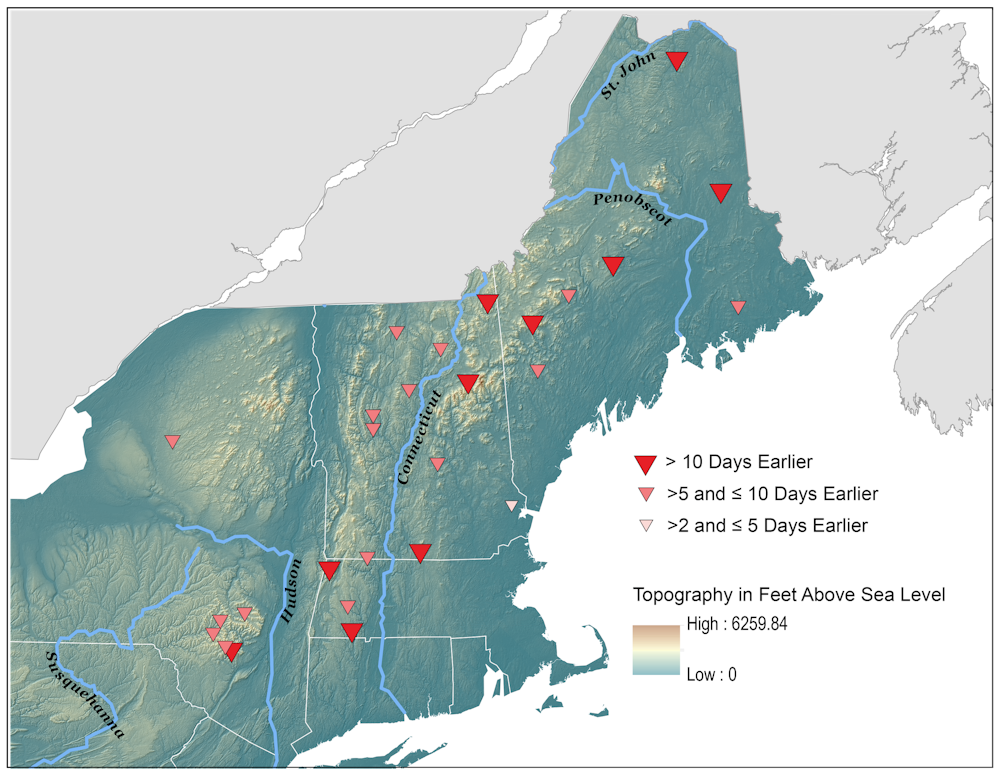
Changes in snowmelt-related streamflow timing for rivers, 1960-2014, show that snow is melting earlier in the year in the Northeast.
We study northern hardwood forests, which are dominated by sugar maple, yellow birch and American beech trees and span 85,000 square miles, from Minnesota and south-central Canada east to the Canadian Maritime Provinces and the northeastern United States. These forests are famed for their vibrant fall colors. They generate revenue by drawing tourists, hikers, hunters and campers, and support timber and maple syrup industries. They also provide important ecological services, such as storing carbon and maintaining water and air quality.
When winter encroaches on this region, with temperatures often dipping well below freezing, every species needs insulation to cope. Tree roots and soil organisms like insects rely on deep snowpack for protection from cold – a literal blanket of snow. Even in sub-zero temperatures, if snow is sufficiently deep, soils can remain unfrozen.
Scientists have used the Hubbard Brook Experimental Forest as a living laboratory to study environmental problems since 1963.
Why northern forests need snow
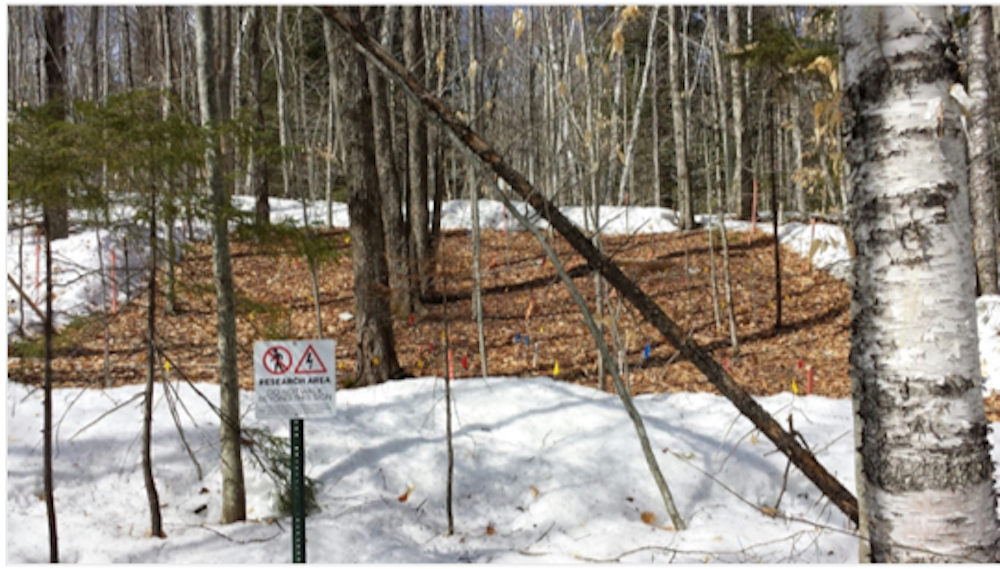
For more than 10 years we have manipulated winter snowpack at Hubbard Brook to study the effects of projected climate change on northern hardwood forests. In early winter, we head outdoors after each snowfall to remove snow from our experimental plots. Then we analyze how losing this insulating layer affects trees and soil.
We have found that in plots where we remove snow, frost penetrates a foot or more down into the soil, while it rarely extends more than two inches deep in nearby reference plots with unaltered snowpack. And just as freeze-thaw cycles create potholes in city streets, soil freezing abrades and kills tree roots and damages those that survive.
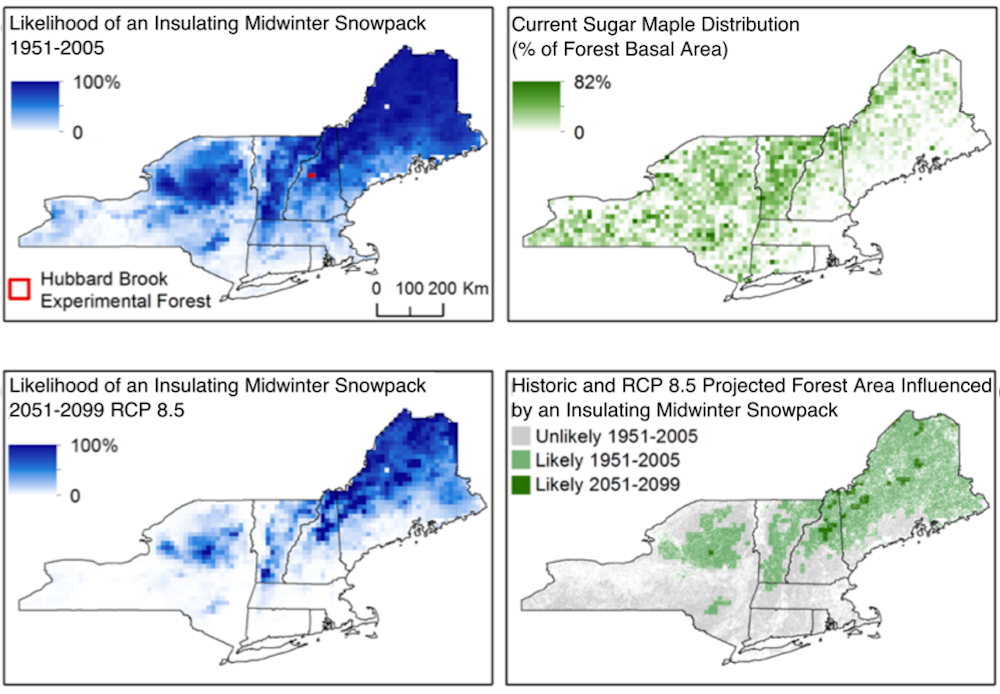
In our most recent paper, our climate and hydrological models show that the area of forests across the northeastern United States that receives insulating midwinter snowpack could decline by 95 percent by the year 2100. Today, 33,000 square miles of forests across northern New York and New England typically have snowpack for several months in winter. By the year 2100, this area could shrink to a patch smaller than 2,000 square miles – about one-fifth the size of Vermont.
This decline will undoubtedly harm the skiing and snowmobiling industries and expose Northeast roads to more freeze-thaw cycles. It also will significantly affect tree growth.
Historical and projected changes in spatial extent of insulating winter snowpack in the northeastern U.S. (left panels) and the distribution of sugar maple trees and forest area influenced by insulating winter snowpack (right panels).
To assess the relationship between snowpack and tree growth, we used a specialized hollow drill bit called an increment borer to remove straw-sized wood cores from multiple sugar maple stems. Each of these trees experienced either natural winter snowpack or five consecutive years in which we removed early winter snowpack. When we sanded the cores and viewed them under a microscope, they revealed annual growth rings that we could use to understand how each tree responded to its environment.
Within just the first two years, our analyses showed a 40 percent decline in sugar maple growth from plots without snowpack. Growth rates remained depressed by 40 to 55 percent over the next three years. By contrast, there was no growth decline in the sugar maple trees in our reference plots where snow covered trees’ roots in midwinter. These results are comparable to root mortality that other researchers observed in an earlier snow removal experiment at Hubbard Brook.
At Hubbard Brook, sugar maples can account for more than half of annual forest biomass accumulation. Consequently, changes in climate that reduce winter snowpack and increase soil freezing could reduce forest growth rates in the northern hardwood forest region by 20 percent just through their impacts on these trees. But we know that yellow birch also suffers root damage in response to soil freezing, so our estimate for changes in whole forest growth is likely to be low.
Could warmer growing season temperatures compensate at least partially for this damage by stimulating rates of tree growth, as some research suggests? Very little work has been done to understand how forests in seasonally snow-covered regions will respond to interactive effects of climate change across seasons. To help fill this gap, we established the Climate Change Across Seasons Experiment at Hubbard Brook in 2013.
In this project we use buried heating cables to warm forest soils by 9 degrees Fahrenheit (5 degrees Celsius) during the snow-free season from April through November. In winter we use a combination of warming with buried heating cables and snow shoveling to induce soil freeze-thaw cycles. Our results so far show that root damage and reduced tree growth caused by winter soil freeze-thaw cycles are not offset by soil warming during the growing season.
Our work shows how often-overlooked changes in winter climate can impact forest ecosystems. Losing snowpack can reduce forest growth, carbon sequestration and nutrient retention, which will have important implications for climate change and air and water quality all year-round.
Men with deep-rooted homosexual tendencies should not be admitted to the Catholic clergy, and it would be better for priests who are actively gay to leave rather than lead a double life, Pope Francis says in a new book.
While he has previously spoken of the need for better screening of candidates for the religious life, his comments suggesting that priests who cannot keep their vows of celibacy should leave are some of his clearest to date.
Francis made the comments in a book-length interview with Spanish priest Fernando Prado called “The Strength of Vocation”, in which he discusses the challenges of being a priest or nun today.
Francis said in the book that homosexuality in the Church “is something that worries me”. It is due to be published this week in several languages. An advance copy of the Italian version was made available to Reuters.
“The question of homosexuality is a very serious one,” he said, adding that those entrusted with training men to be priests must be certain that candidates are “humanly and emotionally mature” before they can be ordained.
This also applied to women who wanted to enter female religious communities to become nuns. In the Catholic Church, priests, nuns and monks all take vows of celibacy.
The Church teaches that homosexual tendencies are not sinful in themselves, but homosexual acts are.
Francis said there was “no room for this” in the lives of priests and nuns, adding that the Church had to be “demanding” in choosing candidates for what is known as the consecrated life.
“For this reason, the Church urges that persons with this rooted tendency not be accepted into (priestly) ministry or consecrated life,” he said.
“BETTER TO LEAVE”
He urged homosexuals who are already priests or nuns to be celibate and responsible to avoid creating scandal. “It is better that they leave the priesthood or the consecrated life rather than live a double life,” he said.
The interview was conducted in mid-August. Less than two weeks later, on Aug. 26, Archbishop Carlo Maria Vigano, the Vatican’s former ambassador to the Vatican, threw the Church into turmoil with a bombshell statement against the pope and Vatican officials.
Vigano said a “homosexual network” existed in the Vatican, whose members helped promote each other’s careers in the Church.
He also accused the pope of having ignored alleged sexual misconduct with adult male seminarians by former American cardinal Theodore McCarrick, 88.
The Vatican said Vigano’s accusations were riddled with “calumny and defamation”.
The Catholic Church has been haunted for more than two decades by evidence of thousands of cases of sexual abuse of minors by clergy around the world, in countries ranging from the United States to Australia, Ireland, Belgium, Germany and Chile.
In July, McCarrick became the first cardinal to resign in nearly 100 years after U.S. Church officials said allegations made in a separate investigation that he had sexually abused a 16-year-old boy almost 50 years ago were credible and substantiated.
McCarrick has said he had no recollection of the alleged abuse of the minor, but has not commented on the allegations of misconduct with the seminarians, which allegedly took place decades ago.
Reporting By Philip Pullella; Editing by Kevin Liffey
Philippine President Rodrigo Duterte, whose controversial war on drugs has killed nearly 5,000 suspected drug dealers and users since taking office in 2016, said on Monday he used marijuana to stay awake - and then said he was just joking.
The comment is bound to upset families of the victims of his crackdown on narcotics. Marijuana is illegal in the Southeast Asian nation and is not a stimulant.
“I use marijuana to keep me awake,” Duterte said in a speech, complaining about the Association of Southeast Asian Nations (ASEAN) summit in Singapore last month.
In Singapore, he skipped some meetings and took “power naps” to catch up on sleep, according to his spokesman.
“The more that the crescendo becomes faster, the more you cannot sleep because you are catching up on readings,” Duterte said.
Duterte, after his speech, told reporters he had been joking but a human rights activist criticized the attempt at humor.
“This will definitely anger the families even more. There is a disconnect between what the president admitted to do and what the president said he will do to those who use drugs,” Carlos Conde, Philippines researcher with the New York-based Human Rights Watch, told Reuters.
“Now, if the president admitted probably in jest ... then that demolishes the credibility of this whole thing.”
Reporting by Neil Jerome Morales and Manuel Mogato; Editing by Nick Macfie




 AFP / Kirill KUDRYAVTSEV
 (NASA/Bill Ingalls)/AFP/File / Bill INGALLS
 NASA/Roscosmos/AFP/File / HO
 AFP / STR