Twitter has published an archive of 10 million tweets and media it says are from accounts it believes are potentially the product of Russian and Iranian state-backed information operations on the microblogging site.
“Our initial disclosures cover two previously disclosed campaigns, and include information from 3,841 accounts believed to be connected to the Russian Internet Research Agency, and 770 accounts believed to originate in Iran,” Twitter said in a statement on its “elections integrity” site.
“We are making this data available with the goal of encouraging open research and investigation of these behaviors from researchers and academics around the world.”
When artificial intelligence has been used to create works of art, a human artist has always exerted a significant element of control over the creative process.
But what if a machine were programmed to create art on its own, with little to no human involvement? What if it were the primary creative force in the process? And if it were to create something novel, engaging and moving, who should get credit for this work?
At Rutgers’ Art & AI Lab, we created AICAN, a program that could be thought of as a nearly autonomous artist that has learned existing styles and aesthetics and can generate innovate images of its own.
People genuinely like AICAN’s work, and can’t distinguish it from that of human artists. Its pieces have been exhibited worldwide, and one even recently sold for $16,000 at an auction.
An emphasis on novelty
When designing the algorithm, we adhered to a theory proposed by psychologist Colin Martindale.
He hypothesized that many artists will seek to make their works appealing by rejecting existing forms, subjects and styles that the public has become accustomed to. Artists seem to intuitively understand that they’re more likely to arouse viewers and capture their attention by doing something new.
In other words, novelty reigns.
So when programming AICAN, we used an algorithm called the “creative adversarial network,” which compels AICAN to contend with two opposing forces. On one end, it tries to learn the aesthetics of existing works of art. On the other, it will be penalized if, when creating a work of its own, it too closely emulates an established style.
At the same time, AICAN adheres to what Martindale calls the “least effort” principle, in which he argues that too much novelty will turn off viewers.
This ensures that the art generated will be novel but won’t depart too much from what’s considered acceptable. Ideally, it will create something new that builds off what already exists.
Instead, we’ve fed the algorithm 80,000 images that represent the Western art canon over the previous five centuries. It’s somewhat like an artist taking an art history survey course, with no particular focus on a style or genre.
At the click of a button, the machine can create an image that can then be printed. The works will often surprise us in their range, sophistication and variation.
‘The Birth of Venus’ by AICAN.
Ahmed Elgammal, Author provided
Using our prior work on quantifying creativity, AICAN can judge how creative its individual pieces are. Since it has also learned the titles used by artists and art historians in the past, the algorithm can even give names to the works it generates. It named one “Orgy”; it called another “The Beach at Pourville.”
‘The Beach at Pourville’ by AICAN.
Ahmed Elgammal, Author provided
The algorithm favors generating more abstract works than figurative ones. Our research on how the machine is able to understand the evolution of art history could offer an explanation. Because it’s tasked with creating something new, AICAN is likely building off more recent trends in art history, like abstract art, which came into vogue in the 20th century.
Can humans tell the difference?
There was still the question of how people would respond to AICAN’s work.
To test this, we showed subjects AICAN images and works created by human artists that were showcased at Art Basel, an annual fair that features cutting-edge contemporary art. We asked the participants whether each was made by a machine or an artist.
They didn’t simply have a tough time distinguishing between the two. They genuinely enjoyed the computer-generated art, using words like “having visual structure,” “inspiring” and “communicative” when describing AICAN’s work.
Beginning in October 2017, we started exhibiting AICAN’s work at venues in Frankfurt, Los Angles, New York City and San Francisco, with a different set of images for each show.
At the exhibitions, we heard one question, time and again: Who’s the artist?
As a scientist, I created the algorithm, but I have no control over what the machine will generate.
The machine chooses the style, the subject, the composition, the colors and the texture. Yes, I set the framework, but the algorithm is fully at the helm when it comes to the elements and the principles of the art it generates.
For this reason, in the all exhibitions where the art was shown, I gave credit solely to the algorithm – “AICAN” – for each artwork. At Miami’s Art Basel this December, eight pieces, also credited to AICAN, will be shown.
Samples of artworks generated by AICAN that will be shown in the SCOPE Art Fair in conjunction with Art Basel Miami in December 2018.
Ahmed Elgammal
The first artwork that was offered for sale from the AICAN collection, which AICAN titled “St. George Killing the Dragon,” was sold for $16,000 at an auction in New York in November 2017. (Most of the proceeds went to fund research at Rutgers and the Institut des Hautes Etudes Scientifiques in France.)
‘St. George Killing the Dragon’ was sold for $16,000.
Ahmed Elgammal
What the computer can’t do
Still, there’s something missing in AICAN’s artistic process.
The algorithm might create appealing images. But it lives in an isolated creative space that lacks social context.
Human artists, on the other hand, are inspired by people, places and politics. They make art to tell stories and make sense of the world.
AICAN lacks any of that. It can, however, generate artwork that human curators can then ground in our society and connect to what’s happening around us. That’s just what we did with “Alternative Facts: The Multi Faces of Untruth,” a title we gave to a series of portraits generated by AICAN that struck us with its timely serendipity.
‘Alternative Facts: The Multi Faces of Untruth’ by AICAN was exhibited at the 2018 Frankfurt Book Fair.
Ahmed Elgammal
Of course, just because machines can almost autonomously produce art, it doesn’t mean they will replace artists. It simply means that artists will have an additional creative tool at their disposal, one they could even collaborate with.
I often compare AI art to photography. When photography was first invented in the early 19th century, it wasn’t considered art – after all, a machine was doing much of the work.
The tastemakers resisted, but eventually relented: A century later, photography became an established fine art genre. Today, photographs are exhibited in museums and auctioned off at astronomical prices.
I have no doubt that art produced by artificial intelligence will go down the same path.
To read “When the Line Between Machine and Artist Becomes Blurred,” the first part of this two-part series on AI art, click here.
The rules-based world order, which has been the scaffolding supporting the global economy since World War II, appears to be in serious jeopardy. And, judging by the number of eulogiespublished in recent months, it would be easy to conclude that this system of international cooperation on trade and other issues is already dead.
Concern for the fate of cooperation among nations is understandable. In his attacks on the United Nations, NATO and the World Trade Organization, President Donald Trump has shown his disdain for American commitments to peace, security and trade.
Notwithstanding Trump’s bluster, I believe it’s too soon to mourn the end of international cooperation. While there are some very real challenges facing the global system, when we look at international economic law – one of my areas of expertise – there are several reasons to believe that it can, and will, endure.
Trade cooperation under threat
Trump has been attacking free trade since his 2016 campaign.
He singled out multilateral trade agreements such as the Trans-Pacific Partnership as harmful to U.S. interests. He also claimed the North American Free Trade Agreement was responsible for accelerating the decline in American manufacturing.
Once in office, this anti-trade rhetoric turned into policy. Trump withdrew from the TPP, demanded a renegotiation of NAFTA and has repeatedly threatened to leave the WTO. And earlier this year, he began trade wars with allies such as the European Union and rivals like China.
In addition to concerns that these actions will harm Americans’ pocketbooks, there is fear that Trump’s strategy is eroding faith in the very rules that promote economic cooperation, including those intended to limit trade protection and constrain retaliation.
Look beyond Trump’s tough talk on trade, however, and you’ll see reasons to be hopeful.
Trump’s main problem with WTO is its formal system for dispute settlement, which the White Houseargues treats the U.S. unfairly. Indeed, the United States is sued more often than any other country.
In response, Trump has threatened to ignore WTO rulings and U.S. authorities have blocked the appointment of new appellate judges to the organization.
These moves are certainly disconcerting given that U.S. withdrawal would be a serious blow to a system it once helped build. However, ongoing activity in the WTO’s dispute system indicates that other members still see value in the system.
Instead of relying solely on unilateral trade retaliation, countries have filed 17 new filings against the U.S. this year to combat its tariffs and other protectionist measures. That is the highest number of cases against the U.S. since steel tariffs brought on a wave of disputes in 2002.
But rather than supporting Trump’s contention that the WTO is biased against the U.S., these filings are a statement that economies around the world want the system to work. And for good reason. There are benefits to seeking settlements at the WTO over punitive tariffs.
For example, research shows that WTO dispute settlement works pretty well as a way to combat discriminatory trade policies. Countries comply with the WTO’s rulings about 60 percent of the time. While that may not seem like a lot, given the WTO isn’t strictly able to enforce its rulings, 60 percent compliance is actually pretty good.
By bringing these complaints to the WTO, countries also draw the world’s attention to violations, naming and shaming violators of the rules, effectively damaging the reputations of leaders who erect discriminatory barriers.
While it’s true that there has been a spate of new one-on-one agreements among U.S. trading partners in the last few years, this isn’t evidence that other countries are buying into Trump’s rhetoric.
Notably, the TPP didn’t die with Trump’s withdrawal. Partly on the insistence of Japan, the rebranded Comprehensive and Progressive Agreement for Trans-Pacific Partnership was signed in March.
Bilateral deals may be seen as messy and even inefficient compared with the multilateral trading system. But that reading is too simple.
It’s important to recognize that the WTO hasn’t undergone comprehensive revisions in many years, and this has led countries to prefer regional and bilateral alternatives.
But these alternatives don’t necessarily signal a turn away from cooperation. Nor are they representative of a global wave of Trump-inspired economic nationalism. Just the opposite. In an effort to maintain open trade routes, countries are seeking alternatives to U.S. leadership.
Don’t mourn yet
Certainly, it is difficult to overstate the damage that Trump’s strategy is doing to American diplomatic relations.
By manyaccounts, his main “victory” on trade – the conclusion of negotiations over a new NAFTA – came at the expense of any lingering goodwill between Trump and Canadian Prime Minister Justin Trudeau.
Yet one significant result of Trump’s tirades against trade law is a growing push for much-needed reform at the WTO, particularly by Canada and the EU. If successful, this could result in actually boosting international economic cooperation.
Whether those efforts will be successful is uncertain. But at the very least, countries seem interested in salvaging the system. As long as that’s true, it’s too soon to mourn the end of trade cooperation.
There are diseases and health conditions that are essentially invisible to us until it is too late.
When those problems are life-threatening, such as cancer, and if there is a period when something could be done, then those are instances where an effective screening strategy could prevent illness and save lives.
Once an individual tests positive for one of the “breast cancer” genes, called BRCA1 and BRCA2, then screening – mammograms and MRI – and prevention – surgery and medicines – can be used to reduce risk of disease and improve outcomes. In this case the risk is not just for breast cancer; these genes also raise the risk for ovarian, prostate and pancreatic cancer.
Perhaps just as important as the actions to encourage screening and prevention in the person who gets the news, is the opportunity to alert family members. Parents, siblings and adult children all have a 50-50 risk for the carrying the same gene change and might benefit from knowing of the positive screening results. That’s because when one family member tests positive all close relatives should also consider testing. With BRCA1 and BRCA2 women have higher personal cancer risk, but all have increased cancer risks.
A mammogram is an x-ray that allows a qualified specialist to examine the breast tissue for any suspicious areas.
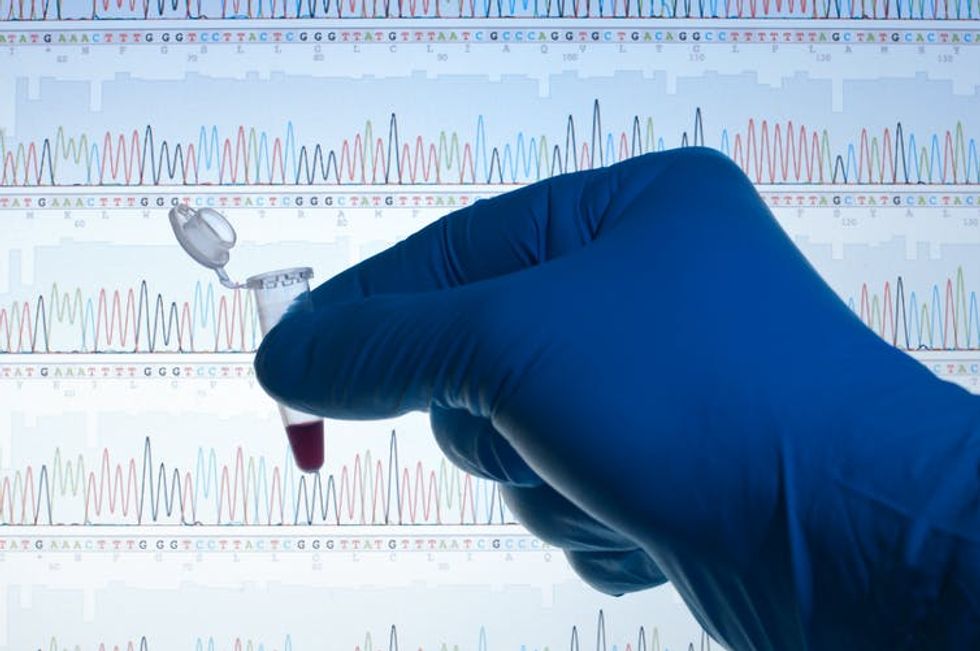
I helped lead a recent study of 50,000 people in Pennsylvania whose DNA had been collected and tested for disease-causing versions of the breast cancer genes BRCA1/2. We discovered that some 267 people carried such genes. But what surprised us was that only 18 percent of these people were already aware of this.
This study highlights the fact that our current approaches to finding individuals with the cancer risk associated with BRCA1 and BRCA2 miss the majority of individuals who carry those genes, and further research into the use of DNA-based screening is needed if we are to address the missed opportunities to intervene.
The value of genetic testing
There are lots of ways to screen. As part of standard primary care, physicians check blood pressure and recommend carrying out colonoscopies on nearly everyone over 50 years old. High blood pressure is invisible, but if not addressed can lead to increased strokes and heart attacks. Polyps in the colon are not visible without a colonoscopy or similar study, and if not removed early some will progress to colon cancer.
In 2013 I left Harvard Medical School to join Geisinger Health System in Pennsylvania, where we saw a unique opportunity to explore ways to use genetic testing in standard primary care to improve the health of the average person. In early 2014, Geisinger announced a research collaboration with Regeneron Pharmaceuticals to work together on discovering disease-causing genes and new targets for drug therapies. This project relied on tens of thousands of patient volunteers choosing to link their electronic health records to their DNA code for research. This allowed researchers to carefully study the combined DNA code and health care records to identify harmful genetic changes that raised the risk of particular disorders, and as well as protective genetic changes that lowered them.
The BRCA gene test is a blood test that uses analysis of DNA to identify harmful mutations in either one of the two breast cancer susceptibility genes – BRCA1 and BRCA2.
Among the Geisinger leadership team, a group of us recognized the opportunity to give something back to these volunteers by using DNA code as the basis for a screening program. The screening was designed to identify genetic variations in the volunteer’s DNA that might increase their risk of disease and that health care providers could do something about, and then deliver a report to the patient and their physician. In May of 2015 we delivered our first result, and there is now a well-structured system set up to deliver care based on this kind of result to thousands of Geisinger patients who volunteered for the project. Now at Yale, I co-authored the recent paper that reported results from one of the most important projects from my time at Geisinger and is a template for some the work we will do here in Connecticut.
Over the last 20 years, screening strategies to identify risk related to disease-associated changes in the breast cancer genes BRCA1 and BRCA2 have been developed. Those strategies have focused on the predictive value of family history of cancer.
A lot of careful research has proven that a strong family history of cancer greatly increases the likelihood of a related person having disease causing variations in one of their genes, and the brave public stories of affected people has helped us all to appreciate that connection.
We also know that family histories don’t always get discussed in enough detail to alert someone that they need to get tested. Then there are those who have DNA changes that increase their risk of disease but are unaware because they fortunately don’t have the family history.
New findings with BRCA1/BRCA2 screening
Our study showed that of 50,000 people in Pennsylvania whose DNA had been tested as part of the MyCode project for BRCA1/2 genes, 267 people carried such genes but only 18 percent were already aware of this. The other 82 percent were learning it for the first time through the DNA-based screening strategy that we applied.
Breast cancer survivor Alicia Cook holds a letter from the University of Chicago informing her that test results showed she had the BRCA genetic defect linked to breast cancer.
It’s important to note that not all of these 267 individuals will develop cancer. However, among the volunteers who had died prior to the completion of the study, almost half had developed a BRCA-associated cancer.
In contrast, far fewer of those alive at the end of the study had developed a BRCA1- or BRCA2-associated cancer, suggesting that we have opportunities to intervene with those we have identified.
Early warning provides the chance to apply proven cancer prevention and early detection strategies for those who are now aware of their risk. While long-term follow-up is needed to document how successful this is, we have already detected a number of early cancers that we hope will result in better outcomes for those individuals.
In the decades ahead, medical researchers will work out the details of using DNA-based screening to understand risk, not only for cancer, but for all kinds of health risks. That information can be used to improve people’s lives by prevention of cancer, heart disease and other diseases. Although we are in the early days still, there are several prominent organizations, including the U.S National Academy of Medicine, which are gathering expert groups figure out what it will take to apply what we know now to DNA-based screening programs for large groups of people, perhaps even the entire U.S. population some day.
Large demonstration projects are needed to get a clearer picture of what works best. We need to determine what is the ideal age to do the screening, which set of genes to screen, what are the costs of such large programs and what are the long-term risks and benefits.
Ultimately however, there should be little doubt that preventive health care management in the decades ahead will routinely use DNA-based screening to detect otherwise invisible risks that can be addressed to improve individual and populations health.
Michael Murray, Professor of Genetics and Director for Clinical Operations in the Center for Genomic Health, Yale University
Eighteen people were killed and dozens injured at a college in the Black Sea region of Crimea on Wednesday when at least one attacker set off a bomb in the cafeteria and went through the building shooting at random, officials said.
Law enforcement officials said they were treating the incident, in which many of the victims were teenage pupils, as a terrorist attack.
Sergei Aksyonov, the head of the Russian-backed administration in Crimea, a region Moscow annexed from Ukraine four years ago, said the main suspect was a male student a the college and that he had killed himself.
Video footage from the scene showed armored personnel carriers and military trucks lined up on the approach to the college, in the Crimean city of Kerch. Russia’s Defence Minister Sergei Shoigu said the military was sending forces and supplies to help the victims.
Russia annexed Crimea from Ukraine in 2014, prompting international condemnation and Western sanctions. Since the operation to annex the peninsula, there have been no outbreaks of violence there.
Aksyonov, the regional head, told Russian state television the death toll from the attack now stood at 18, up from a previous estimate of 13.
Olga Grebennikova, the college’s director, described a scene of bloodshed at the college, which provides vocational training. Its pupils are mostly teenagers.
“CHILDREN’S BODIES EVERYWHERE”
“There are bodies everywhere, children’s bodies everywhere. It was a real act of terrorism. They burst in five or 10 minutes after I’d left. They blew up everything in the hall, glass was flying,” Grebennikova told Crimean media outlets.
“They then ran about throwing some kind of explosives around, and then ran around the second floor with guns, opened the office doors, and killed anyone they could find.”
The Investigative Committee, the law enforcement body that investigates major crimes, said initial information was that an explosive device packed with metal objects had gone off in the cafeteria of the college.
It said in a statement that there were around 50 people wounded in the attack.
Russian news agencies quoted a senior official with Russia’s National Guard, a law enforcement agency, as saying that the attack was being treated as terrorism. There was no immediate claim of responsibility.
An employee at a hospital in Kerch was quoted as saying that 18 people had already been admitted with injuries from the explosion, and that doctors were expecting around 50 more wounded people to be brought in.
“There are already lots of people in the emergency room, and in the operating theater,” the TASS news agency quoted the employee as saying.
Anastasia Yenshina, a 15-year-old student at the college, said she was in a toilet on the ground floor of the building with some friends when she heard the sound of an explosion.
“I came out and there was dust and smoke, I couldn’t understand, I’d been deafened,” she told Reuters. “Everyone started running. I did not know what to do. Then they told us to leave the building through the gymnasium.”
“Everyone ran there... I saw a girl lying there. There was a child who was being helped to walk because he could not move on his own. The wall was covered in blood. Then everyone started to climb over the fence, and we could still hear explosions. Everyone was scared. People were crying.”
Photographs from the scene of the blast posted by local media outlet Kerch.FM showed that the ground floor windows of the two-story building had been blown out, and that debris was lying on the floor outside.
Emergency services teams could be seen in the photographs carrying wounded people from the building on makeshift stretchers and loading them on to buses and ambulances.
Reporting by Moscow newsroom; Writing by Christian Lowe; Editing by Gareth Jones
Liliana Barrios was working in a California bakery in July and facing possible deportation when she got a call from her immigration attorney with some good news.
The notice to appear in court that Barrios had received in her deportation case hadn’t specified a time or date for her first hearing, noting that they would be determined later. Her lawyer was calling to say that the U.S. Supreme Court had just issued a ruling that might open the door for her case, along with thousands of others, to be dismissed.
The Supreme Court case involved Wescley Fonseca Pereira, a Brazilian immigrant who overstayed his visa and was put into deportation proceedings in 2006. The initial paperwork he was sent did not state a date and time of appearance, however, and Pereira said he did not receive a subsequent notice telling him where and when to appear. When he failed to show up in court, he was ordered deported.
The Supreme Court ruled that paperwork failing to designate a time and place didn’t constitute a legal notice to appear in court.
The ruling sparked a frenzy of immigration court filings. Over ten weeks this summer, a record 9,000 deportation cases, including Barrios’, were terminated as immigration attorneys raced to court with challenges to the paperwork their clients had received, a Reuters analysis of data from the Executive Office for Immigration Review shows. The number represents a 160 percent increase from the same time period a year earlier and the highest number of terminations per month ever.
Then, just as suddenly as they began, the wave of case terminations stopped. On August 31, in a different case, the Board of Immigration Appeals (BIA) ruled that charging documents issued without a date and time were valid so long as the immigrant received a subsequent hearing notice filling in the details, as is the usual procedure.
A Department of Justice official said that as a result of the BIA decision, the issues “have been solved.”
The Department of Homeland Security (DHS) did not respond to requests for comment, but the agency laid out its thoughts on the terminations in court documents opposing the motions to terminate. In a San Diego case, DHS wrote that the motions were based on a “misreading” of the Supreme Court decision. “If read in a manner most favorable to the respondent, the practical impact would be to terminate virtually all immigration proceedings.” The Supreme Court decision “nowhere purports to invalidate the underlying removal proceedings,” DHS wrote.
The dueling interpretations will now be weighed by a federal appeals court, which could uphold or overturn the BIA decision in coming months. The case could ultimately end up before the Supreme Court.
“ONE GASP”
Having a removal case terminated, as Liliana Barrios and many others did over the summer, does not confer legal status, but it does remove the threat of imminent deportation and provide an immigrant time to pursue legal ways of staying in the country, such as asylum or by accruing enough time in the country to be eligible to stay through a process known as cancellation of removal.
The Supreme Court ruling provided a “brief glimmer of hope”, said immigration lawyer Aaron Chenault, “like when you are almost drowning and you get one gasp.”
The Department of Homeland Security can appeal the case dismissals or it can restart deportation proceedings by issuing a new notice to appear. By the end of August, the most recent date for which records are available, government attorneys had appealed only 2,100 of the cases terminated in the wake of the decision, according to a Reuters analysis.
Roxie Rawls-de Santiago, an immigration attorney in New Mexico, said that for some of her clients, even a few months of not being in active deportation proceedings could make a difference. One woman whose case was terminated, for example, has a U.S. citizen daughter who turns 21 next year, the age at which she can sponsor her mother for permanent residency, and the woman is now hopeful she can stave off deportation proceedings until then.
CHAOS IN THE COURTS
At the Department of Justice, which administers the immigration courts, chaos reigned in the weeks following the June decision. Immigration judges and officials struggled to agree on an interpretation of the Supreme Court ruling, according to internal emails obtained through a Freedom of Information Act request by immigration attorney Matthew Hoppock and shared with Reuters.
“The issue has VERY large implications, in that DHS has put the actual “time and date” on VERY, VERY few NTA’s, if any. Any guidance would be helpful,” wrote Memphis immigration judge Richard Averwater in an email to an assistant chief immigration judge days after the ruling. Averwater declined to discuss the email further.
In San Francisco alone, immigration judges terminated 2,000 cases between June 21 and August 31, sometimes more than 100 a day, according to a Reuters analysis. In San Antonio, more than 1,200 cases were terminated.
“The court was getting dozens and dozens and dozens of those a day,” said Ashley Tabaddor, president of the immigration judges’ union. “The large number of terminations that happened were directly a result of Pereira.”
The door to mass dismissals for such cases could be reopened or remain closed depending on how the 9th U.S. Circuit Court of Appeals rules on the Board of Immigration Appeals decision that stopped them.
For Barrios, 20, who was caught crossing the Southern border illegally with her toddler two years ago, her dismissal has meant more time to file for a special visa for immigrants under the age of 21 who have been abandoned or neglected. Barrios said she was abandoned by her mother.
Having her case terminated “lifted the pressure a bit,” said Barrios, who makes cream for cookies at a wholesale bakery in California during the day and studies English at night. The Department of Homeland Security has appealed her case termination.
Reporting by Kristina Cooke and Reade Levinson; Editing by Sue Horton and Paul Thomasch
Five years ago, a group of university students in Spain's Basque Country decided they wanted to shake up a sector -- any sector -- but preferably one to do with food or drink.
So Imanol, Inigo, Gorka, Aritz and Taig picked the most traditional of them all -- and created blue wine, one of several innovations in a deeply conservative industry.
After two years of research at the University of the Basque Country with the help of in-house, professional chemical engineers and an outside centre for food innovation, they launched their company Gik Live! in 2015.
It sold 30,000 bottles in its first year and close to 500,000 in 2017.
The young company now exports to 21 countries, the United States being its main market... and wine-loving France its second.
From five rookie entrepreneurs, the company has grown to 12 employees.
AFP/File / GABRIEL BOUYS Electric blue in colour, the wine is made of mainly white wine with a small amount of red and a tiny bit of freshly-crushed grape juice, with the colour coming from two pigments The blue colour is obtained via a mix of "nature and technology" using two pigments -- anthocyanin, found in the skin of red grapes, and indigo carmine.
"We understand that for many people... wine is something sacred that mustn't be changed," says Irish-Basque co-founder Taig Mac Carthy, standing at a bar in the company office in Portugalete, a northern town near Bilbao.
"But we like to change things and we're not afraid to try," he adds, as employees type at their computers in the room next door where a drum kit and guitars stand ready for use in true hipster startup tradition.
- Blue recipe -
One look at a glass of blue wine can be enough to send sommeliers scurrying.
AFP/File / GABRIEL BOUYS "We knew Gik Blue would polarize opinion," says Aritz Lopez, a co-founder of Gik Live! which produces blue wine
Electric blue in colour, Gik Blue is made in several wineries in Spain following the traditional winemaking process.
As well as being sold online, some bars, restaurants and shops in Spain sell it.
The recipe?
Mix a lot of white wine with a smaller amount of red wine, and a tiny bit of must, or freshly-crushed grape juice.
The blue colour is obtained via a mix of "nature and technology" using two pigments -- anthocyanin, found in the skin of red grapes, and indigo carmine.
The company won't divulge any more of what they say is their "industrial secret."
Gik Live used to use sugar substitutes but now adds dessert wine instead to get a sweet taste.
Other brands have followed suit in Spain including a blue sparkling cava, and the company has created other types.
AFP/File / ANDER GILLENEA As well as making blue wine, Gik Live! also makes wine infused with Earl Grey tea and a spicy red number called "Bastarde"
There is red wine infused with Earl Grey tea, white wine infused with Japanese Sencha tea, or spicy red wine named "Bastarde."
Prices online range roughly from 11 to 13 euros ($13 to $15) a bottle and clients are usually aged 25 to 45, men and women alike, says the company.
- Chinese counterfeit -
The reaction to blue wine has been decidedly mixed.
Jean-Michel Deluc, former head sommelier at the Ritz in Paris, labelled it "surprising."
"It's not what I'd drink but still, it's not bad, it's quite well done," he said in a video posted on the blog of wine-ordering business Le Petit Ballon, which comments on news in the sector.
In an August review, Britain's The Daily Telegraph newspaper decided it was "sweet. Very sweet. Too sweet," calling it a "gimmick."
AFP/File / ANDER GILLENEA Reaction to the blue wine has been mixed: "Not bad" was the verdict of the former head sommelier at the Paris Ritz, while Britain's Daily Telegraph scoffed at it as a "gimmick" which was far too sweet
For Rafael del Rey, director of the Spanish Observatory of the Wine Market, blue wine is one of several innovations in a "conservative" sector that has been losing consumers, including among the young, women and city dwellers.
Factors such as people having less time for meals, needing lighter products and a trend for slightly sweeter flavours have also had an impact.
"Many of them haven't found a wine they find attractive," he says.
That demand, he adds, is generating innovative products like blue wine, or wine with low alcohol content.
In Europe, the company has had to label Gik Blue an "alcoholic drink" as authorities have ruled it isn't wine due to its blue colour.
But other countries, including the United States, allow it to be sold as wine.
"We knew from the start that Gik Blue would be a product that would polarise opinion a lot," says 25-year-old Aritz Lopez, another co-founder of Gik Live, speaking as he walks through the rolling vineyards of a winery that makes the blue wine in Zaragoza province.
But he's asked not to reveal the name of the winery, nor the village it's in, to protect it from criticism in the sector.
The company says it is on track to make 1.5 million euros in turnover this year.
And in a surefire gauge of popularity, Mac Carthy says he even found counterfeit replicas of Gik Live's blue wine in Spain... that had been made in China.
Despite progress in reducing extreme poverty, nearly half the world's population lives on less than $5.50 a day, with a rising share of the poor in wealthier economies, the World Bank said Wednesday.
In a twice-yearly report, the bank took a broader look at poverty to see where countries were lagging, even though the share of those living in extreme poverty -- defined as earning less than $1.90 a day -- has continued to come down in recent years.
Under the expanded criteria for poverty, the report found the number of poor worldwide was still "unacceptably high," while the fruits of economic growth were "shared unevenly across regions and countries."
Even though global growth of recent years had been sluggish, the total count of people in poverty declined by more than 68 million people between 2013 and 2015 -- "a number roughly equivalent to the population of Thailand or the United Kingdom."
Despite the improvement, the report said current trends indicated the World Bank's goal of reducing extreme poverty to less than three percent of the world's population by 2030 may be unattainable.
"Particularly distressing findings are that extreme poverty is becoming entrenched in a handful of countries and that the pace of poverty reduction will soon decelerate significantly," the report said.
At the $5.50-a-day threshold, global poverty fell to 46 percent from 67 percent between 1990 and 2015. The bank reported last month that extreme poverty had fallen to 10 percent in 2015.
With China's rise, East Asia and the Pacific saw a 60 point drop in the poverty rate to 35 percent, but the region is unlikely to continue to achieve that pace going forward as growth has moderated.
And poverty is becoming entrenched in Sub-Saharan Africa, where 84.5 percent of the population still live on less than $5.50 a day, the report said.
And while two decades ago, 60 percent of the global population lived in low-income countries, by 2015, that had fallen to nine percent.
The World Bank also cautioned that in many of those countries, the poor were not sharing equally in economic growth.
State-of-the-art sensors that can measure stress levels, mood, posture, performance and even smell took centre stage at Asia's top high-tech fair in Tokyo.
The big-screen TVs and entertainment systems that were all the rage 10 years ago at the CEATEC fair have gradually been replaced by tiny sensors that accurately measure the minutest facet of the human body -- a Japanese speciality.
Electronics giant Panasonic showcased a prototype of an armchair that measures how much the user's hands sweat along with the seating position and facial expressions via a camera, all to determine stress levels.
This could be useful for an airline pilot or long-distance truck driver for example but could also one day find its way into the workplace.
"You could imagine such a chair in the office and by combining the results with air conditioning and lighting levels, you could adjust the ambiance of the office to enable people to relax if necessary," a Panasonic demonstrator said.
Components manufacturer Murata Manufacturing has pioneered a small device that is held for a minute between the thumb and forefinger to measure pulse rates and the nervous system.
"We are going to start selling this very soon to companies, so they can measure how stressed their employees are. Transport and taxi companies are especially interested," said Takashi Hayashida, a spokesman for the firm.
Staff equipped with sensors could be under permanent surveillance to "improve their posture and productivity," according to Japanese electronics firm TDK.
This also extends to the field of play, with Fujitsu demonstrating a 3D analytical system based on sensors to improve the performance of gymnasts.
- Stress smells like onions -
Sensors are also being put to work to improve healthcare -- especially for the elderly, with nearly 28 percent of the Japanese population over 65.
Using a device created by hygiene firm Lion, patients worried about their teeth can flash a smile at a smartphone and send it to a specialised server that returns data on oral hygiene.
Housing equipment firm Lixil has developed a sensor for the bathtub that measures water temperature and key vital signs like pulse and body temperature in an attempt to reduce sudden bath deaths, which afflict more than 5,000 people annually in the country, 90 percent of them over 65.
At the other end of the age scale, sensors are being deployed in a bid to ease labour shortages in kindergartens and creches.
Japan's public New Energy and Industrial Technology Development Organization has developed a super-fine and sensitive film that can perform a host of functions related to childcare.
For example, placed in a cot, it can upload data to a computer showing whether a baby rolls onto its stomach or its temperature spikes -- alerting an adult if necessary.
"There is a staff shortage in creches. We need solutions to ease their task and enable them to watch over more children at a time," said a demonstrator.
The same film can be used to determine how much and at what speed a meal is eaten -- in a hospital or retirement home for example -- by measuring the pressure applied on a table by a bowl or plate.
Of course, much effort is also devoted to matters that are less life and death, especially body odour, to which the Japanese are especially sensitive.
Cosmetics giant Shiseido recently commissioned a study to demonstrate that the odour given off by a person under stress smells like... onions.
And the sensors are not just for humans. Sharp has developed a cat litter tray equipped with monitors to measure kitty's urine volume and frequency.
Nearly a century of marijuana prohibition came to an end Wednesday as Canada became the first major Western nation to legalize and regulate its sale and recreational use.
The change was praised by pot enthusiasts and investors in a budding industry that has seen pot stocks soar on the Toronto and New York stock exchanges, but sharply questioned by some health professionals and opposition politicians.
"We're not legalizing cannabis because we think it's good for our health. We're doing it because we know it's not good for our children," Prime Minister Justin Trudeau said on the eve of the reform.
"We know we need to do a better job to protect our children and to eliminate or massively reduce the profits that go to organized crime."
AFP/File / Lars HagbergIt's unclear as yet if Canada's new framework of legal cannabis will succeed in undercutting the black market, as prices for illicit pot have plunged in the last year to an average of Can$6.79 per gram, and most sellers had planned to charge more
The Cannabis Act, which fulfills a promise Trudeau made in the 2015 election campaign, makes Canada only the second nation after Uruguay to legalize the drug.
Its implementation will be scrutinized and dissected by Canadians ahead of the next election in 2019, as well as other nations that the prime minister has said may follow suit if the measure proves a success.
Trudeau himself admitted in 2013 to having smoked pot five or six times in his life, including at a dinner party with friends after being elected to parliament.
He has also said that his late brother Michel was facing marijuana possession charges for a "tiny amount" of pot before his death in an avalanche in 1998, and that this influenced his decision to propose legalizing cannabis.
But Trudeau's office told AFP he "does not plan on purchasing or consuming cannabis once it is legalized."
AFP/File / Lars HagbergSmoke lingers over Parliament Hill in Ottawa as people smoke marijuana during Canada's annual 4/20 rally in April 2018, six months before the country became just the second in the world to legalize its sale and recreational use
In total, Statistics Canada says 5.4 million Canadians will buy cannabis from legal dispensaries in 2018 -- about 15 percent of the population. Around 4.9 million already smoke.
Stores in St. John's in the Atlantic island province of Newfoundland were due to open their doors to pot enthusiasts as of 12:01 am local time (0231 GMT) on Wednesday.
"I'm going to have a lot more variety than the black market dealers, so you have a lot more choice at our store. The prices are very comparable," Thomas Clarke, owner of THC Distribution store, told public broadcaster CBC just prior to the big event.
- A new industry is born -
Under the new regulations, Canadians at least 18 or 19 years old (soon to be 21 in Quebec) will be allowed to buy up to 30 grams of cannabis, and grow up to four plants at home.
A patchwork of private and public cannabis retail stores and online sales have been set up across the 13 provinces and territories, ramping up to 300 storefronts by year's end, the government predicts.
AFP/File / John SAEKI, Laurence CHUCannabis use worldwide
Sales of derivatives like edibles will be legalized next year.
To meet demand, hundreds of growers have been licensed, some taking over horticulture and floriculture greenhouses.
This new industry has attracted billions in funding, as well as interest from alcohol and soft drink makers such as Constellation Brands and Coca-Cola, respectively, which have expressed an interest in developing cannabis infused drinks.
Cannabis sales are forecast to boost economic growth by up to Can$1.1 billion and provide a Can$400 million tax revenue windfall for the government, according to Statistics Canada.
Public health officials contend that smoking cannabis is as harmful as tobacco, but welcome what they call the opportunity that legalization affords for open dialogue.
Some doctors, however, remain wary. Diane Kelsall, editor in chief of the Canadian Medical Association Journal, called legalization "a national, uncontrolled experiment in which the profits of cannabis producers and tax revenues are squarely pitched against the health of Canadians."
Police, meanwhile, are scrambling to prepare for a predicted uptick in drug-impaired driving.
It's unclear as yet if the new framework will succeed in undercutting the black market, as prices for illicit pot have plunged in the last year to an average of Can$6.79 per gram, and most sellers had planned to charge more.
Bill Blair, a former police chief in Toronto who is Trudeau's pointman for pot legalization, remains optimistic.
"For almost a century, criminal enterprises had complete control of this market, 100 percent of its production and distribution and they profited in the billions of dollars each year. I suspect they're not going to go gently into the night," he told AFP.
"But the fact that some individuals want to cling to a prohibition model that has led to the highest rates of cannabis use of any country in the world is a little shocking to me," he said.
According to a recent Abacus Data poll published on Monday, 70 percent of Canadians accept or support legalization.
Wildlife officials in the southern Australia on Wednesday announced an investigation into the mass death of 58 penguins they believe were killed in a dog attack.
The carcasses of the fairy penguins -- the world's smallest penguin species -- were found strewn across a beach in Tasmania, a island-state off the mainland.
"We would like to remind dog owners of the need to take responsibility for their animals at all times as dogs have the capacity to do a lot of damage to penguin colonies in a short period of time," Tasmania's department of parks, water and environment said in a statement.
The latest grisly find comes just months after a dozen birds were found dead on a nearby beach, they too are believed to have been killed in a dog attack.
"All reports of alleged unlawful harming of wildlife are regarded extremely seriously by the department," the government department said.
Fairy penguins -- who grow to around just over a foot (30 centimetres) and can live for up to 24 years -- are only found in southern Australia and New Zealand, with Tasmania supporting around half of the global population.
Fairy penguin colonies remain under threat from increasing urbanisation, traffic and domestic animals.
Turkey hopes to enter the Saudi consul’s residence in Istanbul on Wednesday in connection with the disappearance of Saudi journalist Jamal Khashoggi, Turkey’s foreign minister said after meeting with U.S. Secretary of State Mike Pompeo.
Speaking from the airport in Ankara, Mevlut Cavusoglu said talks with Pompeo were “beneficial and fruitful”. Pompeo was on a brief visit to Turkey after having met with the Saudi king, crown prince and foreign minister in Riyadh on Tuesday.
Turkish police did not search the Saudi consul’s Istanbul residence on Tuesday, officers at the scene said, because Saudi officials were not able to join.
Reporting by Tulay Karadeniz; Writing by Sarah Dadouch; Editing by David Dolan
Statements by the United States that it would reduce Iran’s oil exports to zero are a “political bluff”, the head of state-run National Iranian Oil Company (NIOC) said, according to a report published by Tasnim news agency on Wednesday.
U.S. officials have said they aim to cut Iran’s oil exports to zero to force its leaders to change their behavior in the region. U.S. sanctions on Iran’s oil exports are scheduled to kick in on Nov. 4.
NIOC head Ali Kardor said U.S. President Donald Trump had been trying to reduce Iran’s oil exports for months.
“The president of America has done whatever he can and he knows very well that getting Iran’s oil exports to zero was a political bluff,” Kardor said.
The U.S. administration has been pushing its allies to cut Iranian oil imports and encouraging Saudi Arabia, other OPEC states and Russia to pump more oil to meet any shortfall.
Kardor said Iran did not have any difficulties receiving payments for oil exports and said the Islamic Republic could accept payments in euros instead of dollars if necessary.
“There is no problem on this issue,” Kardor said, Iran’s ISNA news agency reported. “With European support there will not be a problem.”
European powers have been trying to salvage a nuclear accord with Iran after the United States withdrew in May.
The European Union said last month it was considering setting up a Special Purpose Vehicle (SPV) to facilitate trade with Iran and said it could be in place before November.
European diplomats have said the SPV would create a barter system, similar to one used by the Soviet Union during the Cold War, to exchange Iranian oil for European goods without money changing hands.
Kardor said Iran was scheduled to sign a new oil contract with a foreign company within two weeks, ISNA reported. He did not provide any additional information.
Reporting by Babak Dehghanpisheh; Editing by Louise Heavens and Edmund Blair













 AFP/File / GABRIEL BOUYS
  AFP/File / GABRIEL BOUYS
  AFP/File / ANDER GILLENEA
  AFP/File / ANDER GILLENEA
  AFP/File / Lars Hagberg
 AFP/File / Lars Hagberg
 AFP/File / John SAEKI, Laurence CHU