Former USA Gymnastics president Steve Penny, who resigned from his post last year, was arrested Wednesday in connection with the Larry Nassar molestation scandal, US media reported.
The arrest came after Penny was indicted three weeks ago by a grand jury on felony charges of allegedly tampering with evidence in the sexual assault investigation of former gymnastics doctor Nassar, the Huntsville Item newspaper reported.
Penny was arrested by a police task force in Gatlinburg, Tennessee and is awaiting extradition to Texas, prosecutors said in a press release Wednesday night.
According to the indictment, Penny is alleged to have tampered with evidence during the investigation of Nassar by ordering the removal of documents from the Karolyi Ranch in Walker County, Texas that were related to the activities of Nassar at the ranch. The indictment alleges the removal of the documents was done to destroy or hide the documents and impair the investigation.
"During the investigation by the Texas Rangers and the Walker County Sheriff?s Office, several sources reported that Penny ordered the removal of the documents from the ranch after learning that an investigation was underway," the Item quoted Walker County district attorney David Weeks saying.
The documents in question were from the Korolyi Ranch, the base for the gold-medal winning US Olympic teams. It is also the location where several athletes say Nassar molested them.
In February, Nassar was sentenced to 40 to 175 years in prison after he pled guilty to molesting 10 girls.
Penny could be facing between two to 10 years in jail on a third degree felony charge.
"Deputy U.S. Marshals and task force officers from the Southern District of Texas and the Eastern District Tennessee worked tirelessly to locate Penny," US Marshal for the Eastern District of Tennessee David Jolley said in a news release. "Good police work ensured that Penny was swiftly and safely apprehended. He will now face the charges against him."
Penny's arrest also comes a day after the newly appointed interim president and chief executive of USA Gymnastics, Mary Bono, resigned just days after being named to the job following stinging criticism by Olympic stars Simone Biles and Aly Raisman.
The 56-year-old Bono drew the ire of Olympic superstar Biles over a tweet posted by Bono last month in which she was critical of apparel maker Nike following the company's ad campaign featuring ex-NFL star Colin Kaepernick.
Penny's arrest and Bono's resignation are further blows to USA Gymnastics, which has lurched from one self-inflicted crisis to the next as it struggles to rebuild in the aftermath of the Nassar sex abuse scandal.
French Economy Minister Bruno Le Maire said Thursday he was pulling out of a major investment conference in Saudi Arabia over the disappearance of Saudi journalist Jamal Khashoggi.
"I won't go to Riyadh next week," Le Maire told France's Public Senat TV channel, adding that "the current circumstances do not allow me to go to Riyadh".
The minister echoed President Emmanuel Macron's remarks last week on Khashoggi's disappearance, calling it a "very serious" matter.
"The important thing now is that the full truth of this affair be known," said Le Maire, who said he informed his Saudi counterpart on Wednesday of his decision.
Khashoggi, who was living in self-imposed exile in the United States where he contributed to the Washington Post, vanished after entering the Saudi consulate in Istanbul on October 2.
He was critical of some of Saudi Arabia's policies.
Turkish officials claim he was killed and dismembered in the consulate by a hit squad which arrived from Riyadh -- claims denied by the Saudi government.
Le Maire's decision to pull out of the October 23-25 Future Investment Initiative in Riyadh -- dubbed the "Davos in the Desert" -- follows that of International Monetary Fund (IMF) chief Christine Lagarde.
The IMF said Wednesday that Lagarde had "deferred" her trip to the Middle East, without giving an explanation.
US Treasury Secretary Steven Mnuchin has said he will decide on Thursday whether to attend.
Several Western business titans and media groups have already pulled out of the conference organized by Saudi Arabia's sovereign wealth fund.
Like other Western allies of the world's biggest oil exporter, France had embraced Saudi Arabia's powerful new de facto ruler, Crown Prince Mohammed bin Salman, as a reformer.
Macron hosted the 33-year-old prince for a private dinner at the Louvre museum when he visited Paris in April.
Saudi Arabia was the second-biggest purchaser of French weapons between 2008 and 2017, after India, signing deals for some 12 billion euros ($13.8 billion) in French weaponry.
China’s soybean imports are set to drop by a quarter in the last three months of 2018, their biggest fall in at least 12 years as buyers curb purchases amid the Sino-U.S. trade war and high domestic stockpiles.
Soybeans, crushed to make protein-rich animal feed ingredients and vegetable oils, have been at the heart of the tit-for-tat trade dispute between the world’s top two economies.
China in July imposed a retaliatory 25-percent import duty on U.S. soybeans as part of the conflict, a saga that has gathered steam since then with the introduction of fresh tariffs on other products.
Soybean imports by China, which buys 60 percent of the oilseed traded worldwide, will likely decline to around 18-20 million tonnes in the fourth quarter, compared with 24.1 million tonnes in the same period last year, traders said.
“Imports will average around 6 million tonnes per month in the fourth quarter,” said a Singapore-based trader at an international company that owns oilseed processing plants in China.
“Purchases are going to be mainly from Brazil and some from Argentina and Canada. Buyers are not willing to take chances by bringing in U.S. beans,” the trader added, declining to be identified as he was not authorized to speak with media.
The benchmark Chicago soybean contract dropped to a 10-year low of $8.12-1/4 last month, although prices have since recovered on fears of crop-damage following rains ahead of the harvest in parts of the U.S. Midwest. It was trading down 0.8 percent at $8.78-1/2 on Thursday.
The landed cost of U.S. beans in China is currently similar to Brazilian soybeans even with the 25-percent tariff, but Chinese crushers are reluctant to take U.S. supply as they fear authorities may not approve cargoes and that tariffs could climb further.
“Right now China’s import duty on U.S. wheat is 25 percent, who knows, the duty might go up to 50 percent by the time your boat arrives,” said Ole Houe, director of advisory services at brokerage IKON Commodities in Sydney.
China’s soybean purchases of around 24 million tonnes in the fourth quarter of last year were more than triple 2006 levels, climbing for 10 out of 12 years, according to the country’s customs data.
The estimated decline of 4 to 6 million tonnes in October-December this year would be the biggest fall since at least 2006.
LAND OF PLENTY?
China, which largely uses soy in feed for the world’s biggest pig herd, is unlikely to face a shortfall in supplies despite the drop in imports as it has abundant domestic reserves after a strong pace of imports.
“We will be fine until the end of February. For March, April, it’s a bit tight, but if demand is not so good, then we can probably even survive until then,” said a Beijing-based soybean trader who forecast imports in the fourth quarter at 20 million tonnes.
Soybean stocks at China’s ports stood at 8.57 million tonnes this week, down marginally from a record of around 9 million tonnes at the end of last week.
Crush margins in Shandong, the hub of China’s soybean processing industry, have been in positive territory since early August, reaping strong profits for companies making feed ingredients such as soymeal.
Processors are making 305 yuan ($44.04) a ton, not far from last month’s two-year high of 315 yuan.
“Soymeal demand from the feed millers has been pretty strong as they build stocks,” said the first Singapore-based source.
($1 = 6.9263 Chinese yuan renminbi)
Reporting by Naveen Thukral and Dominique Patton; Editing by Joseph Radford
There is a long tradition in American politics of presidents copying from the speeches of others, stealing their ideas, recycling their rhetoric. Think of Kennedy’s famed cri de coeur in his inaugural address: “Ask not what your country can do for you; ask what you can do for your country,” taken from Khalil Gibran’s book “The New Frontier,” published 36 years before Kennedy took office. Gibran wrote, “Are you a politician asking what your country can do for you, or a zealous one asking what you can do for your country?”
Ronald Reagan’s “shining city on a hill,” was taken from John Winthrop’s address in 1630 just before the first group of Massachusetts Bay colonists set sail from Southampton, England to establish a colony in the new world that became the city of Boston. He charged his fellow Puritans "that we shall be as a city upon a hill — the eyes of all people are upon us." In future campaigns, Barack Obama, Mitt Romney and even Ted Cruz would take up John Winthrop’s challenge as a way of inspiring their followers.
Candidates and presidents have traditionally celebrated the greatness of America and its people, while at the same time reaching out a hand to the rest of the world, pledging loyalty to our allies and issuing a warning to our adversaries. The rhetoric could be soaring and lyrical. “Now the trumpet summons us again,” said Kennedy at his inauguration, “a call to bear the burden of a long twilight struggle, year in and year out, ‘rejoicing in hope, patient in tribulation’ — a struggle against the common enemies of man: tyranny, poverty, disease and war itself.”
But Donald Trump listens to a different trumpet. He set the authoritarian tone for his administration right from the start. Rather than celebrating the greatness of American democracy in his inaugural address, he listed the country’s failings.
“We’ve enriched foreign industry at the expense of American industry; subsidized the armies of other countries while allowing for the very sad depletion of our military; we’ve defended other nation’s borders while refusing to defend our own; we’ve made other countries rich while the wealth, strength, and confidence of our country has disappeared over the horizon.”
“This American carnage stops right here and stops right now,” he cried. “From this moment on, it’s going to be America first.”
Trump shamelessly stole this gem from the notorious “America First Committee,” which was founded in 1940 to oppose American involvement in World War II. The committee was riddled with anti-Semites like Henry Ford, Charles Lindbergh and Avery Brundage, the former chairman of the U.S. Olympic Committee, who in 1936 had barred two Jewish runners from competing in the finals of the 4x100 relay race. The 1936 Olympics were held in Nazi Berlin, with Adolf Hitler frequently in attendance. The America First Committee disbanded three days after the Japanese attack on Pearl Harbor, its dark place in American history nearly forgotten until its resurrection by Donald Trump.
He didn’t stop his authoritarian march there. Only weeks after taking office, Trump began his trumpet call of the media as the so-called “enemy of the people.” He tweeted:
A few days later, at the Conservative Political Action Conference, he said, “A few days ago I called the fake news the enemy of the people and they are. They are the enemy of the people.” He has repeated the charge over and over again in tweets and at rallies, where he frequently points to reporters, fenced in within the arenas, as “the enemy of the people.”
It’s another phrase fraught with an ugly history. Vladimir Lenin first used it in his famous decree of November 28, 1917, telling his victorious revolutionaries, “all leaders of the Constitutional Democratic Party, a party filled with enemies of the people, are hereby to be considered outlaws, and are to be arrested immediately and brought before the revolutionary court.” The phrase was then written into the Soviet criminal code to describe various crimes against the state.
In Nazi Germany, the party tabloid “Der Sturmer” wrote that “Jews are pests and disseminators of diseases. In whatever country they settle and spread themselves out, they produce the same effects as are produced in the human body by germs. . . . In former times sane people and sane leaders made short shrift of enemies of the people. They had them either expelled or killed.”
To be an enemy of the people isn’t good for your health in Vladimir Putin’s Russia, either. Numerous critics of Putin’s regime, including journalists, have been murdered during his rule. Most recently, Putin ordered the poisoning of Sergie and Yulia Skirpal at their home in Salisbury, England, earlier this year. They survived and are now in hiding. Putin denied that Russia had anything to do with the attempted murder, despite the fact that a known Russian nerve agent, Novichok A-234 was used in the attack.
British surveillance cameras caught the two Russian assassins as they entered the country and during their time in Salisbury. Putin put the two on display on the Russian television network RT, denying they were intelligence agents and claiming that their trip was merely to visit the famed Salisbury Cathedral. Smirking at the camera, the two explained that they weren’t able to visit the cathedral because they didn’t bring the right footwear for the snow in Salisbury during their visit. Surveillance footage showed them walking down streets free of snow or precipitation of any kind.
Deny, deny, deny. That’s what dictators do, and Trump copies them right down the line. He was caught on tape by Access Hollywood admitting sexually assaulting women by giving them unwanted kisses and claiming that, “When you’re a star, they let you do it. You can do anything. Grab’em by the pussy. You can do anything.” Later, he denied that he said it. Charged by at least 15 different women with sexual harassment, Trump has flatly denied their claims.
Alabama Senate candidate Roy Moore was charged with sexually harassing multiple underage girls when he was an assistant district attorney in his hometown. "Well, he denies it," Trump said, endorsing Moore in his campaign. “Look, he denies it. If you look at what's really going on, he totally denies it. He says it didn't happen.”
According to Bob Woodward’s book, “Fear,” Trump told a friend facing a claim of sexual harassment, “You’ve got to deny, deny, deny and push back on these women. If you admit to anything and any culpability, then you’re dead.”
Trump has denied climate change, calling it a Chinese conspiracy and a “hoax.” And he loves it when dictators make denials. Told by every American intelligence agency that Russia interfered in the election of 2016, Trump stood next to Russian president Putin last summer in Helsinki and accepted his denials. “I have president Putin, he just said it's not Russia. I will say this. I don't see any reason why it would be,” President Trump said. “I will tell you that President Putin was extremely strong and powerful in his denial today.”
Same with Saudi denials that they had anything to do with the death of Washington Post journalist Jamal Khashoggi, who was seen entering the Saudi embassy in Istanbul and has not been seen since. Trump spoke with Saudi King Salman on Monday and told reporters that the King “firmly denied any knowledge” of what happened to Khashoggi. “It wasn’t like there was a question in his mind. The denial was very strong.”
Jamal Khashoggi was an “enemy of the people” in Saudi Arabia. Russian journalist Anna Politkovskaya was an enemy of the people for Vladimir Putin when she was poisoned aboard an Aeroflot flight in 2004. She survived but was shot in her apartment building two years later.
“A California man was charged Thursday with threatening to shoot and kill Boston Globe journalists, calling them ‘the enemy of the people,’” the Boston Globe reported on August 30, just a month and a half ago.
“Robert Darrell Chain, 68, was arrested at dawn in his home in Encino, Calif., by an FBI SWAT team armed with military-style weapons and what neighbors believe were flash-bang grenades. Authorities said they found 20 firearms in the home, including a semiautomatic rifle purchased in May.” He made his threats in response to the nationwide editorial campaign organized by the Globe denouncing Trump’s attacks on the press, according to the Globe.
Trump loves these guys, these dictators whose denials are always “very strong” or “extremely strong and powerful.” Their denials are just like his denials. Their enemies of the people are just like his enemies of the people.
You know what else is extremely strong and powerful? The poison they use to kill enemies of the people. The bullets they fire into the chests of enemies of the people.
Former president Barack Obama had vowed to close the US military-run prison at Guantanamo Bay, Cuba, but now it will stay open for at least 25 years, the officer in charge of the facility said Tuesday.
Rear Admiral John Ring said the prison, which holds several alleged plotters of the 9/11 attacks, is focused on readiness to make "sure that the facilities are going to last for 25 years."
In January, President Donald Trump signed an executive order, reversing his predecessor Obama's ultimately fruitless 2009 directive to shutter the facility that has drawn global scorn.
Following Trump's move, "they told us we are going to be here for 25 years or more," said Ring, Commander of Joint Task Force Guantanamo.
The Pentagon "sent us a memo saying plan to be open" for at least 25 years, Ring said during a visit regularly organized by the US military for journalists, with the aim of showing that prisoners are treated humanely at the American enclave in communist Cuba's southeast.
In December, the top torture expert at the United Nations said reports from sources indicated at least one inmate was still being tortured at Guantanamo Bay.
Nils Melzer, the UN special rapporteur on torture, said he had received information that torture through noise and vibrations was taking place against Ammar al-Baluchi, a suspected 9/11 plotter.
Melzer voiced particular concern about detainees who had been held for long periods of time in almost complete isolation.
Under president George W. Bush, the military hastily built the prison camp following the US-led invasion of Afghanistan in late 2001.
Over the years, roughly 780 people have been detained at Guantanamo, mostly for their alleged ties to Al-Qaeda and the Taliban.
First under Bush and then under Obama, the US released hundreds of detainees from the prison.
The most notorious inmates, including accused 9/11 mastermind Khalid Sheikh Mohammed, are still awaiting trial but their cases have been beset by legal woes.
Guantanamo has not received any new inmates since 2008, and 40 remain.
Some have never been charged yet have been deemed too dangerous to release.
On the campaign trail, Trump vowed to load Guantanamo with "bad dudes," and later in office he said Islamic State fighters would be sent there.
Ring said that so far there is "no indication" that such new detainees would be transferred soon to Guantanamo.
Four major U.S. public funds that hold shares in Facebook Inc on Wednesday proposed removing Chief Executive Officer Mark Zuckerberg as chairman following several high-profile scandals and said they hoped to gain backing from larger asset managers.
State treasurers from Illinois, Rhode Island and Pennsylvania, and New York City Comptroller Scott Stringer, co-filed the proposal. They oversee money including pension funds and joined activist and original filer Trillium Asset Management.
A similar shareholder proposal seeking an independent chair was defeated in 2017 at Facebook, where Zuckerberg’s majority control makes outsider resolutions effectively symbolic.
Rhode Island State Treasurer Seth Magaziner said that the latest proposal was still worth filing as a way of drawing attention to Facebook’s problems and how to solve them.
“This will allow us to force a conversation at the annual meeting, and from now until then in the court of public opinion,” Magaziner said in a telephone interview.
A Facebook spokeswoman declined to comment.
At least three of the four public funds supported the 2017 resolution as well. The current proposal, meant for Facebook’s annual shareholder meeting in May 2019, asks the board to create an independent board chair to improve oversight, a common practice at other companies.
It cites controversies that have hurt the reputation of the world’s largest social media network, including the unauthorized sharing of user information, the proliferation of fake news, and foreign meddling in U.S. elections.
Illinois State Treasurer Michael Frerichs said in an interview that, while an independent chair might not have prevented all the issues, “there might have been fewer of these problems and less of a drop in share price” at the company.
Shares of Facebook have had a rocky year, under pressure from revelations about the privacy and operational issues as well as concerns over slowing revenue growth. They closed Wednesday at $159.42, 10 percent lower than at the start of the year and well off a closing high of $217.50 reached on July 25.
The 2017 resolution received the support of a slim majority of outside investors, according to the public fund leaders’ calculations. Magaziner and Frerichs said they planned to talk with larger Facebook investors in coming months to seek their support.
Among funds that are Facebook’s largest investors, the Vanguard Total Stock Market Index Fund and Fidelity Contrafund voted against the 2017 proposal, securities filings show, while the American Funds Growth Fund of America supported it.
American Funds representatives did not reply to requests for comment on Wednesday. Spokespeople for Fidelity and Vanguard declined to comment. Contrafund manager Will Danoff was supportive of Facebook’s response to problems in an investor note in August.
In opposing the 2017 proposal, Facebook said an independent chair could “cause uncertainty, confusion, and inefficiency in board and management function and relations.”
Zuckerberg has about 60 percent voting rights, according to a company filing in April.
The New York City Pension Funds owned about 4.5 million Facebook shares as of July 31, while Trillium held 53,000 shares.
The Pennsylvania Treasury held 38,737 shares and the Illinois Treasury owned 190,712 shares as of August. Rhode Island funds hold 168,230 Facebook shares, a spokesman said.
Reporting by Arjun Panchadar and Munsif Vengattil in Bengaluru and Ross Kerber; Editing by Sriraj Kalluvila and Rosalba O'Brien
More Honduran migrants tried to join a caravan of several thousand trekking through Guatemala on Wednesday, defying calls by authorities not to make the journey after U.S. President Donald Trump threatened to cut off regional aid in reprisal.
The caravan has been growing steadily since it left the violent Honduran city of San Pedro Sula on Saturday. The migrants hope to reach Mexico and then cross its northern border with the United States, to seek refuge from endemic violence and poverty in Central America.
Several thousand people are now part of the caravan, according to a Reuters witness traveling with the group in Guatemala, where men women and children on foot and riding in trucks filled a road on their long journey to Mexico.
Later on Wednesday, Guatemalan President Jimmy Morales said his government rejects constraints placed on foreign aid.
“No help can be conditioned and no help can be demanded,” Morales told reporters following an event in the Guatemalan capital.
He said he had spoken with his Honduran counterpart, President Juan Orlando Hernandez, about ensuring that those migrants who want to return home can do so safely, and cited reports indicating that “many people” from the migrant caravan are returning to Honduras.
U.S. President Donald Trump decried “horrendous weak and outdated immigration laws,” in a series of Twitter messages starting on Tuesday. He threatened to cut off aid to Honduras, Guatemala and El Salvador if they fail to prevent undocumented immigrants from heading to the United States.
“Hard to believe that with thousands of people from South of the Border, walking unimpeded toward our country in the form of large Caravans, that the Democrats won’t approve legislation that will allow laws for the protection of our country,” Trump said on Twitter on Wednesday.
The Honduran government has urged citizens not to join the caravan, calling it politically motivated. On Wednesday morning near the Guatemalan border, authorities could be seen stopping Hondurans still hoping to join, with police in riot gear at one checkpoint halting buses carrying at least a hundred people.
The men, women and children carried on toward the border on foot, Reuters photographs showed, with some later fording a jungle river near the frontier after unconfirmed reports that Guatemalan authorities had stopped letting Hondurans enter the country.
Guatemalan authorities did not provide an estimate of the size of the caravan, which aims to pass through Guatemala City before heading to Mexico.
Adult citizens of Honduras, Guatemala, El Salvador and Nicaragua need only present national identity cards to cross each others’ borders. That regional immigration agreement does not apply when they reach Mexico.
Mexico said anyone who enters the country with a Mexican visa can move freely, while those without proper documents would be subject to review and could be deported.
“This measure responds not only to compliance with national legislation, but particularly to the interest of the Mexican Government to avoid that such people become victims of human trafficking networks,” the foreign ministry said in a statement.
Reporting by Edgard Garrido, Jorge Cabrera and Sofia Menchu in Guatemala; Writing by Daina Beth Solomon; Editing by Frank Jack Daniel, Tom Brown and David Gregorio
Russian President Vladimir Putin is reportedly building up military might in a strategically critical area, CNN reported Wednesday.
"Tonight, exclusive new pictures of what appears to be an alarming new challenge to the United States and NATO from Russia's Vladimir Putin," CNN's Wolf Blitzer reported.
"The satellite pictures show a Russian military buildup in an important city on the Baltic Sea," he continued.
"Well, there may be some additional investigation going on," Hoffman replied.
"Given the fact that Khashoggi was a lawful U.S. permanent resident and three of his four children are U.S. citizens," the ex-CIA official added, "there's obviously great interest on top of human rights concerns."
The host interrupted, noting that he hadn't seen any "obvious great interest."
"You really see obvious great interest when the secretary of state goes over and thanks the king for his transparency in a case where he's been anything but transparent?" Smith asked before listing off the other startling facts about Khashoggi's disappearance.
"It doesn't seem like enormous attention," the host added before sparring more with Hoffman over his claim that there is more to the case than meets the eye.
Several public funds with holdings in Facebook Inc on Wednesday backed a proposal to remove Chief Executive Officer Mark Zuckerberg as chairman.
The proposal, originally bought to the table by hedge fund Trillium Asset Management, is now backed by state treasurers from Illinois, Rhode Island and Pennsylvania. New York City Comptroller Scott Stringer also joined the shareholder proposal.
The proposal is asking Facebook’s board to make the role of board chair an independent position.
Reporting by Arjun Panchadar in Bengaluru; Editing by Bernard Orr
Twitter has published an archive of 10 million tweets and media it says are from accounts it believes are potentially the product of Russian and Iranian state-backed information operations on the microblogging site.
“Our initial disclosures cover two previously disclosed campaigns, and include information from 3,841 accounts believed to be connected to the Russian Internet Research Agency, and 770 accounts believed to originate in Iran,” Twitter said in a statement on its “elections integrity” site.
“We are making this data available with the goal of encouraging open research and investigation of these behaviors from researchers and academics around the world.”
When artificial intelligence has been used to create works of art, a human artist has always exerted a significant element of control over the creative process.
But what if a machine were programmed to create art on its own, with little to no human involvement? What if it were the primary creative force in the process? And if it were to create something novel, engaging and moving, who should get credit for this work?
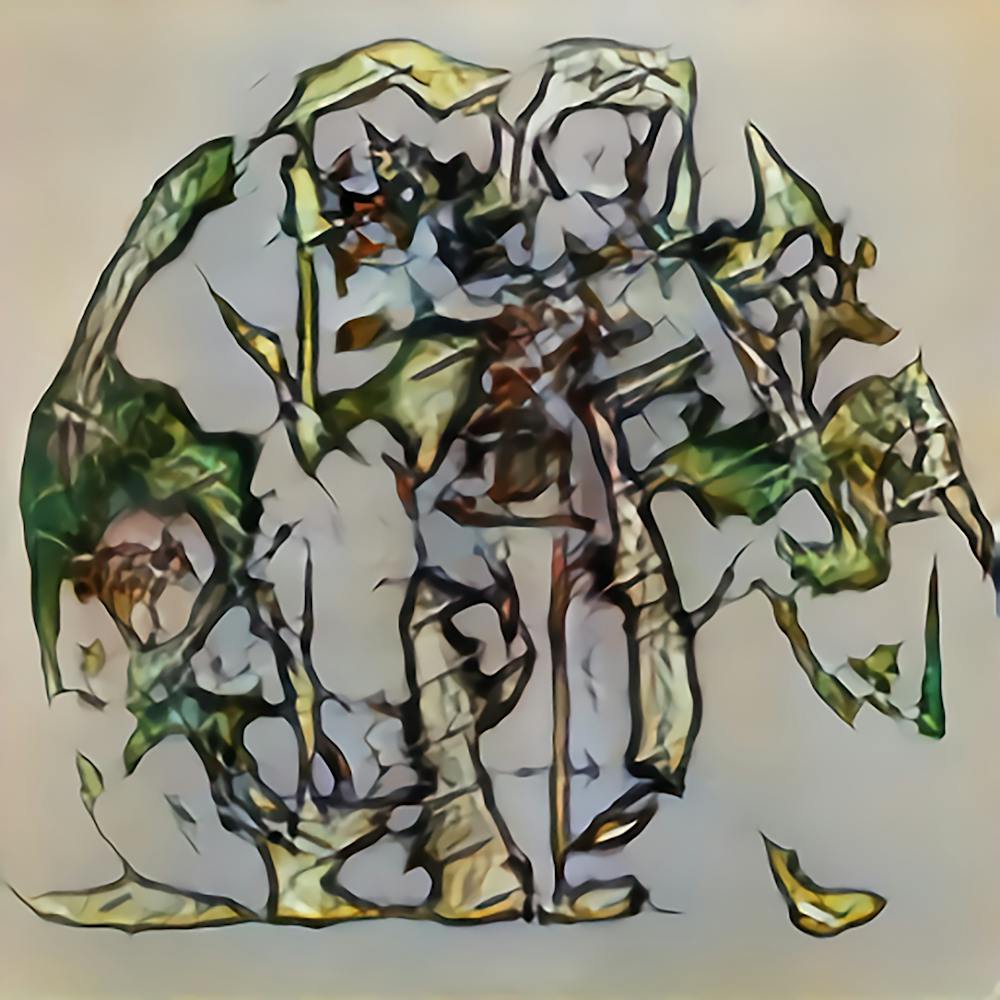
At Rutgers’ Art & AI Lab, we created AICAN, a program that could be thought of as a nearly autonomous artist that has learned existing styles and aesthetics and can generate innovate images of its own.
People genuinely like AICAN’s work, and can’t distinguish it from that of human artists. Its pieces have been exhibited worldwide, and one even recently sold for $16,000 at an auction.
An emphasis on novelty
When designing the algorithm, we adhered to a theory proposed by psychologist Colin Martindale.
He hypothesized that many artists will seek to make their works appealing by rejecting existing forms, subjects and styles that the public has become accustomed to. Artists seem to intuitively understand that they’re more likely to arouse viewers and capture their attention by doing something new.
In other words, novelty reigns.
So when programming AICAN, we used an algorithm called the “creative adversarial network,” which compels AICAN to contend with two opposing forces. On one end, it tries to learn the aesthetics of existing works of art. On the other, it will be penalized if, when creating a work of its own, it too closely emulates an established style.
At the same time, AICAN adheres to what Martindale calls the “least effort” principle, in which he argues that too much novelty will turn off viewers.
This ensures that the art generated will be novel but won’t depart too much from what’s considered acceptable. Ideally, it will create something new that builds off what already exists.
Instead, we’ve fed the algorithm 80,000 images that represent the Western art canon over the previous five centuries. It’s somewhat like an artist taking an art history survey course, with no particular focus on a style or genre.
At the click of a button, the machine can create an image that can then be printed. The works will often surprise us in their range, sophistication and variation.
‘The Birth of Venus’ by AICAN.
Ahmed Elgammal, Author provided
Using our prior work on quantifying creativity, AICAN can judge how creative its individual pieces are. Since it has also learned the titles used by artists and art historians in the past, the algorithm can even give names to the works it generates. It named one “Orgy”; it called another “The Beach at Pourville.”
‘The Beach at Pourville’ by AICAN.
Ahmed Elgammal, Author provided
The algorithm favors generating more abstract works than figurative ones. Our research on how the machine is able to understand the evolution of art history could offer an explanation. Because it’s tasked with creating something new, AICAN is likely building off more recent trends in art history, like abstract art, which came into vogue in the 20th century.
Can humans tell the difference?
There was still the question of how people would respond to AICAN’s work.
To test this, we showed subjects AICAN images and works created by human artists that were showcased at Art Basel, an annual fair that features cutting-edge contemporary art. We asked the participants whether each was made by a machine or an artist.
They didn’t simply have a tough time distinguishing between the two. They genuinely enjoyed the computer-generated art, using words like “having visual structure,” “inspiring” and “communicative” when describing AICAN’s work.
Beginning in October 2017, we started exhibiting AICAN’s work at venues in Frankfurt, Los Angles, New York City and San Francisco, with a different set of images for each show.
At the exhibitions, we heard one question, time and again: Who’s the artist?
As a scientist, I created the algorithm, but I have no control over what the machine will generate.
The machine chooses the style, the subject, the composition, the colors and the texture. Yes, I set the framework, but the algorithm is fully at the helm when it comes to the elements and the principles of the art it generates.
For this reason, in the all exhibitions where the art was shown, I gave credit solely to the algorithm – “AICAN” – for each artwork. At Miami’s Art Basel this December, eight pieces, also credited to AICAN, will be shown.
Samples of artworks generated by AICAN that will be shown in the SCOPE Art Fair in conjunction with Art Basel Miami in December 2018.
Ahmed Elgammal
The first artwork that was offered for sale from the AICAN collection, which AICAN titled “St. George Killing the Dragon,” was sold for $16,000 at an auction in New York in November 2017. (Most of the proceeds went to fund research at Rutgers and the Institut des Hautes Etudes Scientifiques in France.)
‘St. George Killing the Dragon’ was sold for $16,000.
Ahmed Elgammal
What the computer can’t do
Still, there’s something missing in AICAN’s artistic process.
The algorithm might create appealing images. But it lives in an isolated creative space that lacks social context.
Human artists, on the other hand, are inspired by people, places and politics. They make art to tell stories and make sense of the world.
AICAN lacks any of that. It can, however, generate artwork that human curators can then ground in our society and connect to what’s happening around us. That’s just what we did with “Alternative Facts: The Multi Faces of Untruth,” a title we gave to a series of portraits generated by AICAN that struck us with its timely serendipity.
‘Alternative Facts: The Multi Faces of Untruth’ by AICAN was exhibited at the 2018 Frankfurt Book Fair.
Ahmed Elgammal
Of course, just because machines can almost autonomously produce art, it doesn’t mean they will replace artists. It simply means that artists will have an additional creative tool at their disposal, one they could even collaborate with.
I often compare AI art to photography. When photography was first invented in the early 19th century, it wasn’t considered art – after all, a machine was doing much of the work.
The tastemakers resisted, but eventually relented: A century later, photography became an established fine art genre. Today, photographs are exhibited in museums and auctioned off at astronomical prices.
I have no doubt that art produced by artificial intelligence will go down the same path.
To read “When the Line Between Machine and Artist Becomes Blurred,” the first part of this two-part series on AI art, click here.
The rules-based world order, which has been the scaffolding supporting the global economy since World War II, appears to be in serious jeopardy. And, judging by the number of eulogiespublished in recent months, it would be easy to conclude that this system of international cooperation on trade and other issues is already dead.
Concern for the fate of cooperation among nations is understandable. In his attacks on the United Nations, NATO and the World Trade Organization, President Donald Trump has shown his disdain for American commitments to peace, security and trade.
Notwithstanding Trump’s bluster, I believe it’s too soon to mourn the end of international cooperation. While there are some very real challenges facing the global system, when we look at international economic law – one of my areas of expertise – there are several reasons to believe that it can, and will, endure.
Trade cooperation under threat
Trump has been attacking free trade since his 2016 campaign.
He singled out multilateral trade agreements such as the Trans-Pacific Partnership as harmful to U.S. interests. He also claimed the North American Free Trade Agreement was responsible for accelerating the decline in American manufacturing.
Once in office, this anti-trade rhetoric turned into policy. Trump withdrew from the TPP, demanded a renegotiation of NAFTA and has repeatedly threatened to leave the WTO. And earlier this year, he began trade wars with allies such as the European Union and rivals like China.
In addition to concerns that these actions will harm Americans’ pocketbooks, there is fear that Trump’s strategy is eroding faith in the very rules that promote economic cooperation, including those intended to limit trade protection and constrain retaliation.
Look beyond Trump’s tough talk on trade, however, and you’ll see reasons to be hopeful.
Trump’s main problem with WTO is its formal system for dispute settlement, which the White Houseargues treats the U.S. unfairly. Indeed, the United States is sued more often than any other country.
In response, Trump has threatened to ignore WTO rulings and U.S. authorities have blocked the appointment of new appellate judges to the organization.
These moves are certainly disconcerting given that U.S. withdrawal would be a serious blow to a system it once helped build. However, ongoing activity in the WTO’s dispute system indicates that other members still see value in the system.
Instead of relying solely on unilateral trade retaliation, countries have filed 17 new filings against the U.S. this year to combat its tariffs and other protectionist measures. That is the highest number of cases against the U.S. since steel tariffs brought on a wave of disputes in 2002.
But rather than supporting Trump’s contention that the WTO is biased against the U.S., these filings are a statement that economies around the world want the system to work. And for good reason. There are benefits to seeking settlements at the WTO over punitive tariffs.
For example, research shows that WTO dispute settlement works pretty well as a way to combat discriminatory trade policies. Countries comply with the WTO’s rulings about 60 percent of the time. While that may not seem like a lot, given the WTO isn’t strictly able to enforce its rulings, 60 percent compliance is actually pretty good.
By bringing these complaints to the WTO, countries also draw the world’s attention to violations, naming and shaming violators of the rules, effectively damaging the reputations of leaders who erect discriminatory barriers.
While it’s true that there has been a spate of new one-on-one agreements among U.S. trading partners in the last few years, this isn’t evidence that other countries are buying into Trump’s rhetoric.
Notably, the TPP didn’t die with Trump’s withdrawal. Partly on the insistence of Japan, the rebranded Comprehensive and Progressive Agreement for Trans-Pacific Partnership was signed in March.
Bilateral deals may be seen as messy and even inefficient compared with the multilateral trading system. But that reading is too simple.
It’s important to recognize that the WTO hasn’t undergone comprehensive revisions in many years, and this has led countries to prefer regional and bilateral alternatives.
But these alternatives don’t necessarily signal a turn away from cooperation. Nor are they representative of a global wave of Trump-inspired economic nationalism. Just the opposite. In an effort to maintain open trade routes, countries are seeking alternatives to U.S. leadership.
Don’t mourn yet
Certainly, it is difficult to overstate the damage that Trump’s strategy is doing to American diplomatic relations.
By manyaccounts, his main “victory” on trade – the conclusion of negotiations over a new NAFTA – came at the expense of any lingering goodwill between Trump and Canadian Prime Minister Justin Trudeau.
Yet one significant result of Trump’s tirades against trade law is a growing push for much-needed reform at the WTO, particularly by Canada and the EU. If successful, this could result in actually boosting international economic cooperation.
Whether those efforts will be successful is uncertain. But at the very least, countries seem interested in salvaging the system. As long as that’s true, it’s too soon to mourn the end of trade cooperation.