U.S. President Donald Trump has told aides he wants to move ahead on a plan to impose tariffs on Chinese imports worth $200 billion next week, Bloomberg News reported, further ratcheting up trade tensions between the world’s two largest economies.
Both countries have levied tariffs on $50 billion on the other’s goods and threatened more duties. U.S. and Chinese officials ended talks last week without major breakthroughs on alleviating trade issues.
U.S. President Donald Trump sought to backtrack on comments last year in which he tied his decision to fire FBI Director James Comey to a probe into Russian election meddling, accusing NBC News on Thursday of “fudging” their interview, but offering no supporting evidence.
Trump made his accusation as the man who took over the federal Russiainvestigation from Comey, Special Counsel Robert Mueller, digs deeper into a probe that has already led to a series of indictments of former Trump aides.
Trump fired Comey on May 9, 2017, a move that Comey said later was aimed at undercutting the probe.
The Trump administration said at the time of Comey’s dismissal that the president had acted on the recommendation of Attorney General Jeff Sessions and No. 2 Justice Department official Rod Rosenstein.
In an interview with NBC Nightly News anchor Lester Holt that aired two days after the firing, Trump accused Comey of being incompetent and noted the recommendation, but also raised the issue of the Russia investigation, saying he was thinking of “this Russia thing” when he fired him.
In a Twitter post on Thursday, Trump accused the news outlet and Holt, of “fudging my tape on Russia,” but gave no evidence to back up his claim.
In addition to looking into Russia’s alleged interference in the 2016 presidential election, which Moscow denies, Mueller is investigating any collusion with Russia by Trump’s campaign and any attempt by the president to impede the probe.
The Comey firing could be central to a potential obstruction of justice case. Legal experts have said Mueller’s team must weigh whether the president acted with an improper, or “corrupt,” intent when he took actions such as firing Comey.
Trump has denied any collusion with Russia, or any obstruction of justice. He has said since the interview with Holt that he did not fire Comey over the federal probe.
Trump said in the Holt interview, “regardless of recommendation, I was going to fire Comey knowing there was no good time to do it And in fact, when I decided to just do it, I said to myself — I said, you know, this Russia thing with Trump and Russia is a made-up story. It’s an excuse by the Democrats for having lost an election that they should’ve won.”
Representatives for NBC News, part of Comcast Corp (CMCSA.O), declined to comment on Trump’s tweets on Thursday.
Representatives for the White House did not respond to a question about Trump’s accusation.
ATTACKS ON NEWS MEDIA
In the most dramatic day yet in the Russia investigation, federal prosecutors last week secured the conviction of Trump’s former campaign manager for financial crimes and a plea agreement from the president’s longtime attorney that included pleading guilty to campaign finance violations.
Trump, in a string of tweets last week, said he had nothing to hide from Mueller’s probe.
Trump’s tweets on Thursday were his latest attack on the news media. He has repeatedly called critical reports about him “fake news” and on Thursday he also called for the firing of CNN’s president, Jeff Zucker.
Representatives for CNN, owned by AT&T, declined to comment.
U.S. news organizations have pushed back against the stream of criticism from Trump.
Federal authorities on Thursday charged a California man with threatening to kill Boston Globe employees for the newspaper’s role leading a defense this month of press freedoms by hundreds of news organizations.
Shares of AT&T and Comcast did not move on the president’s tweets.
Reporting by Susan Heavey in Washington and Ken Li in New York; Editing by Susan Thomas and Frances Kerry
Officials in Germany’s eastern state of Saxony sought to avert further unrest in the city of Chemnitz before the far right gathers for another anti-immigration protest later on Thursday after several violent confrontations this week.
Thousands of people took part in two days of protests against asylum seekers in Chemnitz this week after police arrested a Syrian and an Iraqi on suspicion of fatally stabbing a German man on Sunday.
Germany is deeply divided over Chancellor Angela Merkel’s 2015 decision to take in more than one million migrants, many of whom fled conflicts in Syria, Iraq and Afghanistan.
“We will see to it that those who have committed this homicidal crime are condemned, and swiftly,” Michael Kretschmer, Saxony’s premier told reporters in Chemnitz.
“We will see to it that those who ran through the city with Hitler salutes are also convicted,” he said.
The authorities said federal police and police from other states including Hessen and Bavaria would be drafted in to support local forces during the far right protest at Chemnitz’s football stadium later on Thursday.
Kretschmer plans to meet with local residents to discuss immigration inside the stadium at around the same time, he said.
Chemnitz lies Germany’s formerly Communist east which has become the heartland of anti-immigrant groups including PEGIDA and the Alternative for Germany (AfD) political party which won 13 percent of the vote in a 2017 federal election, its strongest showing yet.
In Wismar, another eastern town, police called for witnesses to come forward over an attack late on Wednesday on a 20-year-old migrant who was beaten with an iron chain by three assailants.
At around noon in a rainy and cold Chemnitz on Thursday there was still no sign of the extra police which the local authorities said would be present at the protest due to start at 6 p.m. local time (1700 GMT).
The Chemnitz stabbing has raised concerns of possible links between police and the far right in Saxony after prosecutors in the northern city of Bremen opened an investigation into a lawmaker, a former police officer, who is accused of leaking information of the arrest warrant against the Iraqi suspect.
Chemnitz mayor Barbara Ludwig vowed to clean up her city’s image, telling reporters: “This city is something completely different to what you had to see and what has been shown in the media in the past few days.
The AfD and PEGIDA, which is under observation by intelligence agencies, say they will march again in Chemnitz on Saturday to “mourn Daniel H. (the stabbing victim) and the others killed by Germany’s forced multiculturalisation.”
Writing by Paul Carrel; Editing by Raissa Kasolowsky
China on Thursday derided the "irresponsible and absurd logic" of the United States after President Donald Trump accused Beijing of making Washington's relationship with North Korea more difficult.
Trump doubled down on his suggestion that China was not helping to rein in its Cold War-era ally -- a charge he first levelled when he cancelled a trip to North Korea by Secretary of State Mike Pompeo that was due to take place this week.
"A lot of people, like me, feel that the US is first in the world when it comes to twisting the truth, and irresponsible and absurd logic," Chinese foreign ministry spokeswoman Hua Chunying told a regular press briefing.
"This logic is not easily understood by all," Hua said.
Trump's refusal to direct criticism at North Korean leader Kim Jong Un and instead blame other parties for a lack of progress comes despite reports the US received a belligerent letter from Pyongyang, which prompted Pompeo to cancel a planned trip to North Korea last weekend.
"We hope the US can play a positive and constructive role in settling the issue just like the Chinese. To solve the problem, it should look at itself instead of shifting blame," Hua added.
- Trade war -
Speaking at the White House on Wednesday, Trump said: "China makes it much more difficult in terms of our relationship with North Korea".
"Part of the North Korea problem is caused by the trade disputes with China," Trump said.
But he insisted his ties with Chinese President Xi Jinping were "great" and that he had a "fantastic relationship" with North Korean leader Kim Jong Un, whom he met in Singapore in June.
The US president said he was not considering resuming joint military exercises on the Korean Peninsula that Pyongyang considers "provocative."
Beijing is Pyongyang's sole major ally, and the main transit country for any goods entering the North. Trump said that China -- angered by US moves on trade -- is no longer being as tough as it could be on North Korea.
"We know that China is providing North Korea with considerable aid, including money, fuel, fertilizer and various other commodities. This is not helpful!" he tweeted on Wednesday evening.
On the subject of military exercises, which the US suspended as a "good faith" measure following Trump's summit with Kim, the president said "there is no reason at this time to be spending large amounts of money on joint US-South Korea war games" though added these could resume if the need arose.
It came a day after Defense Secretary Jim Mattis said the Pentagon was not planning to suspend any more military drills, before appearing to backtrack on Wednesday by insisting "no decisions" had been made on the matter.
Trump also reiterated his wish to fundamentally alter the trade status quo between the United States and China, the world's top two economies.
He said he needed to take a tough stance with Beijing on trade "because it was really not fair to our country," criticising his predecessors who "closed their eyes" to the issue.
- Belligerent letter -
In June, Trump and Kim pledged to work toward the "complete denuclearisation of the Korean Peninsula" although their joint statement was short on details for how that might be achieved.
Efforts stalled several weeks ago, and last week, Trump ordered Secretary of State Mike Pompeo to cancel a planned trip to Pyongyang. At the time, Trump said that he did not believe China was helping in the denuclearisation process due to Washington's tougher stance on trade.
Pompeo said Tuesday that Washington remains ready to engage "when it is clear that Chairman Kim stands ready to deliver on the commitments that he made at the Singapore summit to President Trump to completely denuclearise North Korea".
According to the Washington Post, Pyongyang sent Pompeo a belligerent letter that prompted him to cancel the visit, though its precise contents were not known.
US news site Vox meanwhile reported that Trump at June's summit pledged to sign a declaration ending the Korean War, and now the two countries remain deadlocked over who will follow through on their commitment first.
On Wednesday, State Department spokeswoman Heather Nauert told reporters that Washington believes "denuclearisation has to take place before we get to other parts," confirming that included such a declaration.
As O'Rourke's yard signs are popping up in neighborhoods around the state, frustrated Cruz supporters are having trouble finding ones promoting the current U.S. senator's re-election bid. Until recently, that was by design, according to Cruz's camp.
The conversation unfolding before a campaign event for U.S. Sen. Ted Cruz here last week echoed similar ones popping up among Republican groups around Texas. With a mixture of frustration and bewilderment, attendees were discussing the proliferation of black-and-white yard signs in their neighborhoods brandishing a single four-letter word: BETO.
The signs have become a signature calling card of Democrat Beto O'Rourke's bid to unseat Cruz. While Democrats posting yard signs for candidates is nothing new, even when it happens in some of Texas' most conservative enclaves, what's been different this summer is the extent to which O'Rourke's signs have seemingly dominated the landscape in some neighborhoods.
Meanwhile, Cruz signs are far tougher to spot, and many Cruz supporters have become increasingly agitated by their inability to obtain signs to counter what they see on their daily drives.
Once the event in Georgetown got started, one of the earlier speakers — a candidate for county office — jokingly pleaded with the crowd to quit asking him for Cruz signs because he could not provide them.
Cruz later fielded a question about signs from the local member of the State Republican Executive Committee, Mike McCloskey.
"The one question I get asked universally, everywhere is, 'We’re seeing signs that say 'Robert Francis' in our neighbors’ yards, and we want to claim our territory and have your signs in our yards,'" McCloskey told Cruz, using O'Rourke's birth name. "I think people here are wanting those. What can we do to get those in the hands of the folks that want to have them in their yard?"
"That’s a question we hear a lot," Cruz said. "Yes, there are a lot of signs for my opponent, Beto O’Rourke. They invested a ton of money and they put that money, part of it, into having signs everywhere."
The sign disparity is not necessarily indicative of an enthusiasm gap, but of differences in campaign spending priorities. But more broadly, Cruz campaign manager Jeff Roe has an aversion to yard signs — he said he views them as a far-less-effective use of campaign money than door knocking, television and radio advertising, phone banking or direct mail. That's not a new strategy in Cruz world. Roe said the Cruz 2016 presidential campaign spent no money on yard signs.
"It would be an easier campaign to win if we just used yard signs, and whoever wins is who puts up the most yard signs," Roe told The Texas Tribune.
Even so, the Cruz campaign has distributed 10,000 signs so far, and ordered another 25,000 for these anxious supporters.
On Tuesday afternoon, the Cruz campaign sent out an email to supporters with the subject line, "Yard Signs are Here – Get Yours!" The signs are available on its website for $10 – the same price O'Rourke is selling signs on his own site. Both campaigns also offer sets of 100 or more at discounted rates.
"We respect and admire the contributions of our volunteers and the people coming to the rallies for the senator and admire their participation in the process," Roe said. "They said loud and clear they would like those signs, and we are happy to oblige while maintaining the efficient and effective voter campaign while being outspent."
So how many O'Rourke yard signs are there actually around Texas? An O'Rourke spokesman said the campaign has not tracked the number of signs they've sold or given away.
Texas hasn't elected a Democrat statewide in over 20 years. But recent polls show the race between Cruz and O'Rourke within single digits. O'Rourke has also taken the lead in fundraising.
While the paucity of Cruz signs does not appear to reflect a lack of enthusiasm on the Republican side of the race, the decision has nonetheless begun to have a psychological impact in some communities, energizing O'Rourke backers and, at the very least, unnerving some Cruz voters.
The topic has come up repeatedly at Republican gatherings in recent weeks. On a telephone town hall Cruz held with supporters earlier this month, one caller introduced himself as an Uber driver from Keller who said he travels "all over the Mid-Cities and Tarrant County and whatnot, and Beto signs are everywhere." The man told Cruz he has "not seen one sign for you other than the one that's on my back patio." He asked whether the lack of signs was due to the Cruz campaign taking Republican-leaning Tarrant County for granted, or whether the campaign simply lacked the money to offer its supporters signs.
"I hear that all across the state, and there are a lot of Beto O'Rourke signs that are out there," Cruz replied. "And the reason is they invested big, big dollars early on."
Cruz went on to recall his "famously cheap" campaign for U.S. Senate in 2012 – one in which he defeated Lt. Gov. David Dewhurst, who put millions of dollars of his own money into the race and was widely viewed as the frontrunner until Cruz's upstart bid gained traction. "We watch our pennies very, very closely," Cruz told the man, saying supporters were similarly frustrated six years ago with the availability of yard signs, but that was "because we were saving our money to use it when it has the greatest effect.”
Last week, at a GOP gathering in Salado, a small, community halfway between Waco and Austin, attendees distributed a bulletin that highlighted all the O'Rourke signs popping up in conservative neighborhoods. A speaker urged patience among local Republicans on the lack of Cruz signs, telling the relieved crowd that she was working with a local printer on getting legal clearance to print their own local Cruz campaign signs and that the campaign would purchase more signs in the coming weeks.
It was a very different scene at an O'Rourke rally in Fort Worth over the weekend, in which staffers and volunteers put together signs with assembly-line speed and happily distributed them. When asked how many signs they had given out that evening, the O’Rourke staffers shrugged, a nod to how difficult it was to keep track.
O'Rourke told the Tribune Tuesday that the signs have helped boost his campaign's reach — particularly in more conservative communities.
“We go to a town hall in Waco, or we were in Huntsville the day before yesterday, and folks are hopeful — and I’m in turn hopeful — they say, ‘Hey, there are yard signs all over the place in neighborhoods that I never would’ve expected to see one. That gave me some courage to come out to this town hall or to get a yard sign myself,'" O'Rourke said. "'Now I know it’s OK in this suburb of Houston or this stretch of West Texas to be for you or to be with other people who think the way that I do.’ It’s been a real surprise for us, but a positive one."
The congressman echoed Cruz's campaign manager in asserting that door knocking and candidate appearances are a more effective means of campaigning, but he insisted signs matter as personal endorsements.
"The more human, the more powerful it is," he said. "But literally planting that sign ... you’re personally and powerfully saying, 'Look, I’m part of this amazing thing that’s going on in Texas right now.' That’s really powerful.'"
The difference in tactics goes back to a 2006 political science experiment. At the time, former Gov. Rick Perry was running for his second full term and allowed for researchers to try different tactics in some communities to test which were most effective at motivating voters. Daron Shaw, a government professor at the University of Texas at Austin and co-director of the Texas Tribune/University of Texas Poll, worked on experiments involving yard signs in Perry’s race and saw little evidence that they moved Perry's numbers.
Four years later, Perry’s team essentially abandoned the entire practice of distributing yard signs during his third re-election campaign. He soundly defeated now-former U.S. Sen. Kay Bailey Hutchison in the Republican primary and Democrat Bill White in the general election.
Since then, more academic research backed up Shaw's findings, and yard signs have largely fallen out of vogue within the Texas GOP consultant class, at least among statewide candidates.
But that 2006 campaign marked Perry’s fifth statewide race — when he already had near-universal name identification in Texas, much like Cruz does now. As such, Shaw cautions not every campaign should follow Perry’s lead.
“It varies race by race and year by year," he said. "So I wouldn’t claim that that study should be used as evidence that you ought not to be doing it this time around."
For a candidate like O’Rourke, who began the race as a relative unknown, there is anecdotal evidence that the signs have helped him build his name identification.
Jo Johns is a retired physical education teacher who recently attended an organizing rally for O’Rourke in Weatherford.
She told the Tribune she first learned about O'Rourke by seeing his signs while driving to yoga class.
“I didn’t know who he was, and I wanted to know about him,” she added. “I saw Beto, Beto, Beto. I thought he must be a Republican because they’re everywhere.”
Shaw pointed back to the 2014 governor's race, when Democrat Wendy Davis' signs outnumbered her opponent, now-Gov. Greg Abbott, in some communities. Davis still lost by 20 points. But this time around, the political scientist suggests O'Rourke's yard signs are possibly signaling momentum to voters, priming some who may have otherwise assumed Cruz was unbeatable that O'Rourke has a shot.
“In this race, it probably is more of a positive because it reinforces information you’re getting in public polls, stories you’re getting in the media and fundraising," said Shaw.
Roe and the Cruz campaign intend to continue to prioritize other ways of getting out the vote.
"At the end of the day," Roe said, "our campaign will be measured by one thing and one thing only: Whether we win the race."
Disclosure: The University of Texas has been a financial supporter of The Texas Tribune, a nonprofit, nonpartisan news organization that is funded in part by donations from members, foundations and corporate sponsors. Financial supporters play no role in the Tribune's journalism. Find a complete list of them here.
The 10-year anniversary of the 2008 financial crisis is upon us.
A decade ago, former U.S. president George W. Bush signed into law the money-printing scheme called the Troubled Asset Relief Program (TARP), aimed at purchasing toxic assets and equity from financial institutions to strengthen the country’s shell-shocked financial sector amid the sub-prime mortgage crisis.
In this 2014 photo, vines cover the front of a boarded-up home in East Cleveland, Ohio. Ohio was one of the Midwest states hardest hit by the sub-prime mortgage crisis that began in 2007.
(AP Photo/Mark Duncan)
How do banks, treasury departments and central banks create money anyway? And does it work to buoy economies teetering on the brink of collapse?
In the U.S., banks are required to set aside, depending on the total amount, up to 10 per cent of their deposits to be held at the Federal Reserve.
Here’s how the reserve system works. Let’s say you deposit $10,000 at Bank A. The bank sets aside $1,000 as reserve. It will loan out the remaining $9,000 and charge interest, enabling it to make interest payments to depositors and earn interest income. So Bank A becomes a financial intermediary between savers and borrowers, and money keeps getting created.
How? Because there are many banks in the financial system, and they are required to hold only a fraction (10 per cent) of their deposits. Loans end up deposited in other banks, which increases reserves, deposits — and the money supply.
Money multiplies
In the U.S., the Treasury Department can sell IOU papersvia the Fed to the open market in order to finance government deficits instead of raising taxes. The Fed itself, domestic and foreign banks and investors, and foreign governments will buy and pay for them with American dollars. When the government spends these dollars, they get channelled into the commercial banking system as deposits.
When the Fed buys financial assets from financial institutions, it pays for them by making bookkeeping entries into their reserve accounts. Banks can create up to $10 in new loans for every one dollar increase in the commercial banks’ reserves.
During the financial crisis of 2007-2008, the Fed engineered what’s called quantitative easing, or QE, by buying many billions of bad assets from endangered banks.
The banks’ damaged assets became safe because the Fed had bought them. And it also allowed banks to extend more credits to, supposedly, stimulate the economy.
This financial injection multiplied, and money flooded the system.
Here’s how and why.
Bank assets versus liabilities
Mortgage loans are bank assets because banks can call in the loans and the borrower must pay. Deposits, on the other hand, are bank liabilities because customers can withdraw their money at any time, so banks owe that money to them.
If people start defaulting on their mortgage payments and house prices plummet, it can create fears among depositors; they will rush to take their money out of the bank before it collapses and they lose their savings. So in 2008, the Fed stepped in to nip this fear in the bud to prevent a possible system-wide bank run leading to the collapse of banks.
When house prices fall and people are worried the economy is on the brink of collapse, they tend to withdraw their money from the bank.
(Shutterstock)
Today, the cumulative balance of the Fed’s financial assets over a 10-year period from 2008 to 2018 has risen to $4.3 trillion from $872 billion, an increase of about 400 per cent. Money keeps multiplying.
Why? Recall that each time the Fed buys financial assets from banks, it pays for them by making bookkeeping entries to banks’ reserve accounts, and for every one dollar increase in their reserve accounts, banks can lend out up to $10.
Where has all the money gone?
The financial system is therefore awash with money. That’s why interest rates have been so low for so long. Interest rates, essentially, are the price of money. When the Fed makes it easy for banks to create money, banks must lower the price of money in order to move it into the hands of borrowers. Banks, after all, are in the business of making money by selling money.
And this does not even include Eurodollars. These are U.S. dollar-denominated deposits at foreign banks or at American bank branches abroad, the amounts of which are hard to estimate. And they are not subject to the Fed’s regulations on required reserves. The world is simply flooded with American dollars, with the Euro, the yen, the yuan and pound sterling all operating under similar QE policy.
Traders work on the floor of the New York Stock Exchange in July 2018.
(AP Photo/Richard Drew)
Within the U.S. and major developed and developing economies, part of this flood of cheap money has created significant increases in the world’s selectedreal estate markets and in stock markets. By 2017, 16 of the 20 largest stock exchanges in the world have a market capitalization ranging from US$1.2 trillion to $19 trillion.
Key lesson: The Fed can create money, but it’s hard to predict where that money will go.
Why scant inflation?
Over the period of 2008 to 2018, the U.S. economy has not experienced noticeable inflation, despite the flood of money into the system. The broadest measure of inflation shows it’s increasing at about 1.55 per cent a year. America does not have a problem of too much money chasing too few goods, because there is plenty of money around for imports. That’s where trade deficits came from.
Meantime, while American after-tax corporate profits have grown at a compounded rate of 6.44 per cent per year, workers’ average hourly earnings before tax and before inflation is 2.29 per cent per year, which is practically zero in real terms.
The gigantic money-printing scheme, therefore, appears to have benefited banks, corporations and those who can afford to play in real estate markets, in stock markets and in the broader financial world. Broad-based personal consumption, however, remains unimpressive compared to pre-2008 periods.
The Fed is trapped
The Fed has increased its own federal funds rate over the past couple of years from zero to 1.91 per cent to spur rate hikes in the financial sector. This is the rate that short-term commercial interest rates are pegged to. And it has also started to sell off some of its assets back to the market. When it sells assets, the multiplier works in reverse, resulting in less money available and higher interest rates.
The rationale for this strategy is that the real economy seems to have picked up some momentum as unemployment rates are down and inflation is ticking up. The QE money that has been circulating on and on within the financial and real estate sectors may finally be going somewhere in real sectors.
But facing a total government debt of $21 trillion and climbing, the Fed is trapped — higher interest rates means bigger interest payments on government debt.
The Congressional Budget Office (CBO) has projected that the government’s net interest costs alone will triple over the next 10 years, rising to be the third largest expenditure item after Social Security and Medicare.
U.S. President Donald Trump’s tax cuts may produce some short-term economic growth, but at the expense of even bigger budget deficits, rising to exceed $1 trillion annually by 2020. That’s two years ahead of CBO’s previous projection.
Ending easy money is not easy
While the Fed has pushed interest rates up, rates in the Eurozone and in Japan remain at or below zero, and QE is still ongoing there. More money will flow into the U.S. to earn higher rates. Adding to the ongoing trade wars, this global uncertainty will, paradoxically, result in higher demand for the dollar. The higher dollar will make American exports more expensive and reduce the effects of tariffs on imports.
A silver bullet has yet to be found to break through this vicious circle of debt, the dollar and trade deficit. But interest rates will have to rise to their normal level soon or pension funds will come under enormous stress to hit the eight per cent required returns in order to meet their obligations.
This is going to be a test case of the Fed’s independence.
When you think of sugar, you probably think of the sweet, white, crystalline table sugar that you use to make cookies or sweeten your coffee. But did you know that within our body, simple sugar molecules can be connected together to create powerful structures that have recently been found to be linked to health problems, including cancer, aging and autoimmune diseases.
These long sugar chains that cover each of our cells are called glycans, and according to the National Academy of Sciences, creating a map of their location and structure will usher us into a new era of modern medicine. This is because the human glycome – the entire collection of sugars within our body – houses yet-to-be-discovered glycans with the potential to aid physicians in diagnosing and treating their patients.
Thanks to the worldwide attention garnered by the 2003 completion of the Human Genome Project, most people have heard about DNA, genomics and even proteomics – the study of proteins. But the study of glycans, also known as glycomics, is about 20 years behind that of other fields. One reason for this lag is that scientists have not developed the tools to rapidly identify glycan structures and their attachment sites on people’s cells. The “sugar coat” has been somewhat of a mystery.
Until now, that is.
While most laboratories focus on cellular or molecular research, our lab is dedicated to developing technology to rapidly characterize glycan structures and their attachment sites. Our ultimate goal is to catalog the hundreds of thousands of sugars and their locations on various cell types, and then to use this information to tailor medical therapies to each individual.
Why do we care about glycans?
In the future, it is likely that analysis of an individual’s glycans will be used to predict our risk for developing diseases like rheumatoid arthritis, cancer or even food allergies. This is because glycome alterations can be specifically tied to particular disease states. Also, biological processes like aging are linked to inflammation in our glycome. It remains to be tested if reversing these changes can help prevent disease, or even slow aging – an intriguing possibility.
Along with DNA, proteins, and fats, glycans are one of the four major macromolecules essential for life. Of these four, glycans are the final arbiters of how our cells behave.
DNA orchestrates what we look like, our capacity to think and behave, and even determines the diseases to which we are most susceptible. Within our DNA are short segments, genes, which often contain instructions for how to synthesize proteins. Proteins in turn are the “workhorses” of the cell, carrying out many of the functions necessary for life.
However, how a protein behaves often depends on what glycans are attached to it. In other words, these sugar molecules can greatly influence how our proteins do their work, and even how our cells will respond to stimuli. For example, if you change a few glycans on the outside of a cell, it might trigger that cell to migrate to a different location in our body.
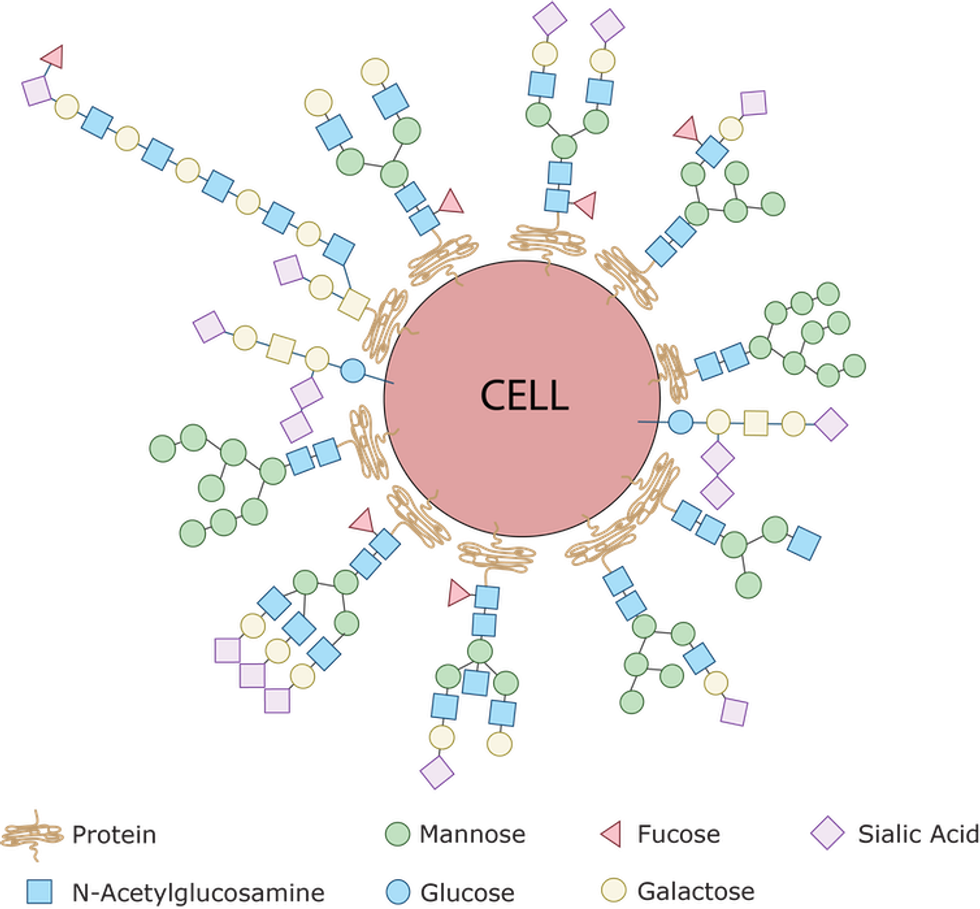
The main job of glycans is to modify the proteins and fats that sit on the surface of our cells. Together, they create a thick sugar coat around the cell. If we consider the surface of the cell to be soil, then glycans would be the wonderfully diverse plant-life and foliage that sprout up and bring color and identity to the cell. In fact, if you were able to see a cell with your naked eye, it would look very fuzzy. Picture a peach with 10 times more fuzz.
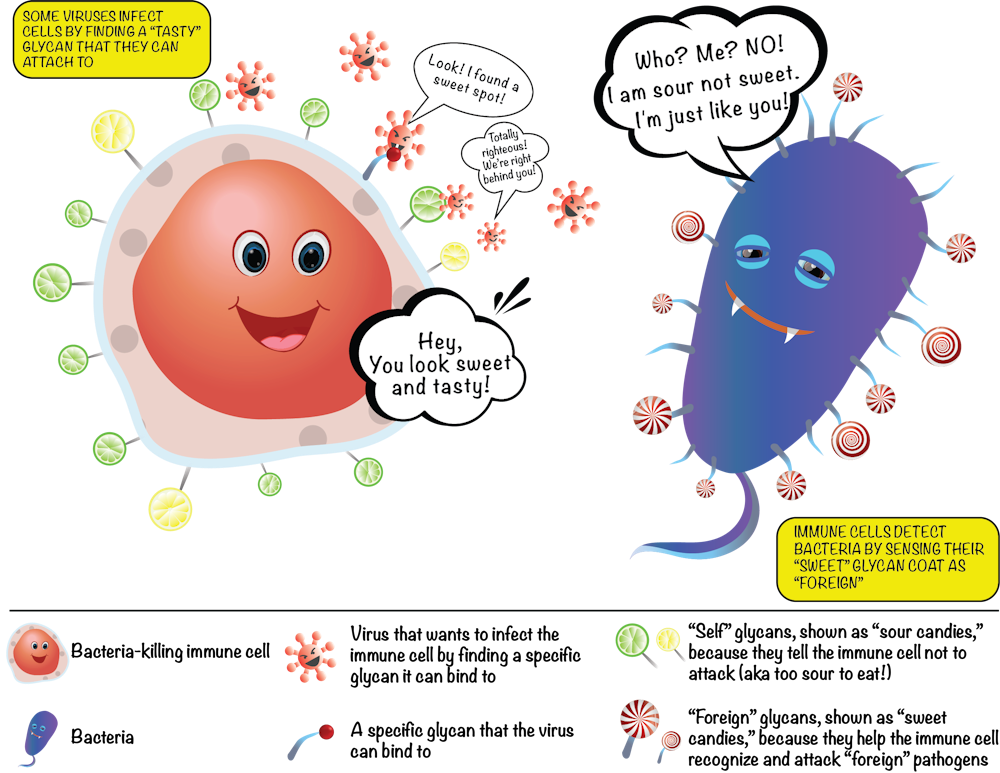
Every single cell in the human body is covered with a collection of glycans which are assembled using various simple sugars like glucose, mannose, galactose, sialic acid, glucosamine and frucose as building blocks. By sensing the type of sugar coat present, our immune cells can identify other cells as friend or foe. This is because bacteria have sugars on their surfaces that are never seen on human cells – the pathogen’s sugars are sensed by the immune system and that identifies the bacteria as ‘foreign.’
Glycans label our own cells and identify them as ‘self’
The fuzz around a cell is its glycan coat. Being on the outside of our cells, glycans are the first point of contact for most cellular interactions and thus influence how our cells communicate with one another. You can also think of the glycans as a unique cellular “barcode.” Thus, a kidney cell’s fuzz will look different from an immune cell’s fuzz. But there are also similarities. In fact, the immune cells that survey our body searching for pathogens know not to attack our own “self” cells because of common features in the glycan “barcode” which are shared by all cells of our body.
In contrast, bacteria and parasites like malaria have different “sugar coats” that are not seen on human cells. When bacterial sugars are tagged as “foreign,” a person’s immune system targets the bacterium for destruction. However, some harmful bacterial pathogens like group B streptococcus, which commonly cause severe infections in babies, can avoid immune detection by impersonating human cells by carrying similar glycans as a disguise – like the wolf dressed in sheepskin.
Unfortunately some pathogens are also able to use our glycans to help them cause disease. Deadly viruses like HIV and Ebola have evolved to grab hold of specific glycans which they then “lock” onto as they infect our human cells. Therapies that either block these viruses from interacting with our glycans, or that attack virus-specific glycans may be a new avenue to treating these infections.
The sugars on our cells and on bacterial cells label them as friend or foe.
New research has also shown that glycans play a huge role in the development of autoimmune diseases like rheumatoid arthritis and autoimmune pancreatitis. This is not surprising since glycans directly influence the function of immune cells.
Normally, our immune cells act as our body’s “defense system,” and identify and destroy foreign invaders like harmful bacteria or viruses. But when the body mistakenly labels our own cells as the enemy and launches an internal attack on itself, autoimmunity is born. Interestingly, in such instances, it is the glycans present on the misbehaving self-attacking antibodies that will dictate the strength of the attack on the body. This abnormal immune response can even be directed against glycans. For example, the immune system can mistake “self” glycans as if they were “foreign” molecules. Our research team recently published an article that introduced the glycan theory of autoimmunity, which explains some of these relationships.
Glycans in our food can trigger immune responses
There have been many studies linking consumption of red meat with diseases like atherosclerosis and diabetes, but they have not been able to show why or how this occurs until recently. One intriguing study suggests that the culprit was a sugar with the unwieldy name, nonhuman sialic N-glycolylneuraminic acid, or Neu5Gc for short. Neu5Gc is found in all mammals except humans, because the early humans that could make Neu5Gc died from an ancient malarial parasite.
However, although we now lack the ability to produce Neu5Gc, our bodies still have the ability to incorporate it into the glycans on our cells if we obtain it by eating red meat. Once it becomes part of our cells’ glycan coat, our cells then have a “foreign” substance – Neu5Gc – surrounding them. This can trigger inflammation throughout the body because our immune system recognize Neu5Gc as “foreign” and attacks it. The chronic inflammation caused by these internal attacks can lead to heart attack, stroke and even cancer.
Our bodies synthesize tens of thousands of unique glycans, often with branching structures formed from simple sugar building blocks. Proteins or fats can also be modified by dozens of unique glycans. These countless combinations make mapping glycans a difficult task because we need a practical and efficient way to analyze hundreds of thousands of glycan patterns.
Our research team has now developed methods to rapidly and robustly monitor the human glycome. By capitalizing on engineering advancements and improvements in sample processing, our technique can monitor thousands of glycans at once, which allows us to characterize the glycans in cells from healthy controls and patients with a variety of different diseases. Our goal is to use this data to develop predictive models to help clinicians diagnose and treat all human diseases. We believe that a new wave of medical advancements will arrive as we unlock the “sugar code.”
Jenny Wang was the co-lead author of this article.
The spectre of the Civil War continues to haunt Spain in many different ways. It manifests itself overtly in conflicts over Catalan independence but also more subtly through art, literature and film. Many will remember Guillermo del Toro’s haunting Mexican-Spanish co-productions The Devil’s Backbone (2001) and Pan’s Labyrinth (2006). But it is especially prevalent in the works of writer Carlos Ruiz Zafón. His novel The Labyrinth of the Spirits, the last in the international best-selling quartet The Cemetery of Forgotten Books, is being published in English in September.
Those who can read Spanish had access to El Laberinto de los Espíritus as early as 2016. But as it is just shy of 1,000 pages, it is not surprising it has taken nearly two years for this mammoth conclusion to see the light of day in translation. Its epic proportions, as well as Ruiz Zafón’s usual concoction of suspense, melodrama and humour – all set against a heavily Gothic Barcelona – is sure to delight his readers.
The introduction of a new character, the detective Alicia Gris, also provides some much needed new blood to a series of books that has been steeped in an exploration of the horrors and silences of the Spanish Civil War.
The Cemetery of Forgotten Books
The other volumes in Ruiz Zafón’s quartet, namely The Shadow of the Wind (2001), The Angel’s Game (2008) and The Prisoner of Heaven (2011), are also variously set during the Civil War and its direct aftermath. They each interweave the classic formulae of Gothic literature with a revisionist social realism strongly imbued with the war and Spain’s recovery from it as traumatic event – the perception of which has been affected by recent historical and social changes.
As I have argued in my book on the Spanish Gothic, the fear in these novels is not strictly spectral. It is derived from the war, the subsequent fascist regime and its followers. The Gothic anti-hero in The Shadow of the Wind, Julián Carax, turns out not to be the villain of the novel, but the man who saves the protagonist from the real monster: police officer Fumero.
The Civil War is imagined in all its cruelty and visceral brutality in Ruiz Zafón’s novels. The war is Gothicised as much as its setting, a fallen, rainy and depressed Barcelona which contrasts strongly with images of the city in the contemporary tourist industry.
Even the library that becomes the catalyst of all events – appropriately named the Cemetery of Forgotten Books – stands as a poetic image for those killed in the war. It is described in The Shadow of the Wind as an “endless necropolis” where volumes “remain unexplored, forgotten forever” until rescued by a daring reader who may become their protector. These daring readers are naturally modern day Spaniards, some of whom have been quite literally digging up the dead since the first exhumation of a war mass grave in 2000.
‘One doesn’t talk about the war’
This casual injunction, a phrase I heard often when growing up in Spain in the 1980s and 1990s, may be read as a distillation of the country’s attitude towards a conflict that took place 80 years ago, but which is still very much present in the lives of the Spanish. It is a bit like a ghost, but more like a cursed legacy. It is an echo of “the sins of fathers (being) visited on their children to the third and fourth generation” that Horace Walpole suggested was the main moral of his The Castle of Otranto (1764) – broadly seen as the first Gothic novel.
It has been suggested that the repression of trauma (a typical Gothic trope) may not be appropriate for the case of the Spanish Civil War. The reason for the relative lateness of the “memory boom” (1990s and 2000s) could be due to a reluctance on the part of those who lived through the conflict to tell their stories. The decision to break with the past after Franco’s death, the argument continues, may have more to do with not wanting to let the past affect the future than with deliberately attempting to silence it.
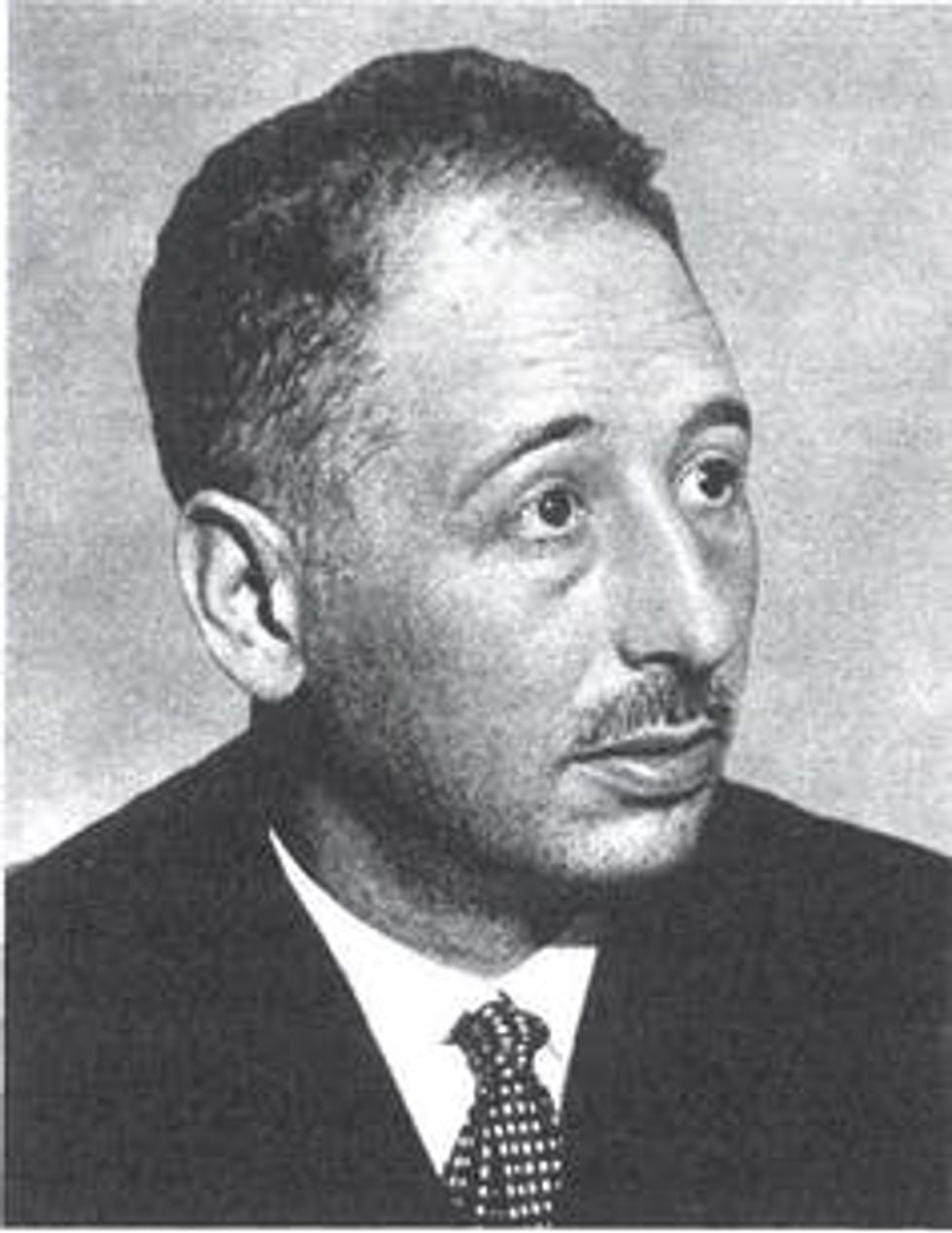
Lluís Companys, the president of Catalonia from 1934 and during the Spanish Civil War.
However, the conflicts over the Catalan independence vote in 2017 demonstrate that the very idea that the past may not affect the future is not only untenable, but reactionary. This position may inadvertently mask a desire to let the status quo go unchallenged. On this note, it is interesting that Ruiz Zafón’s books are set in Catalonia, a part of Spain with a history of resistance to centralist policies and whose president during the War, Lluís Companys, was eventually executed by the regime.
Spain’s modern Gothic tale
The Civil War remains Spain’s favourite modern Gothic tale. This is because Spain, as a country, is only beginning to deal with the war’s legacy openly, with its impact on the lives of those directly affected by it. It could not have begun to do so any sooner given that the crimes committed during Francoism have not even been legally recognised, let alone sanctioned.
Whether the past can ever be truly laid to rest is a contentious issue, but it seems to me that only the recognition of its effects – and the way that current discourses around nationalism have been coloured by them – can lead to the end of the type of alienation, fear and anger that Ruiz Zafón and other artists have been working through in their work. We should continue to read and talk about the Civil War and to condemn the brutal acts of murder and repression that have affected Spain for at least three generations. As philosopher George Santayana once warned, “those who cannot remember the past are condemned to repeat it”.
The Green, a gathering place in New Haven, Connecticut, near Yale University looked like a mass casualty zone, with 70 serious drug overdoses over a period spanning Aug. 15-16, 2018.
The cause: synthetic cannabinoids, also known as K2, Spice, or AK47, which induced retching, vomiting, loss of consciousness and trouble breathing. On July 19, 2018, the Food and Drug Administration warned consumers that another batch of synthetic marijuana had been laced with rat poison. In 10 states and the District of Columbia, hundreds of people were hospitalized with severe bleeding, and four people died.
Many parts of the country have seen episodic crises due to synthetic marijuana, the largest occurring in Mississippi, where 721 adverse events were logged between April 2-3, 2015.
As an intensive care pharmacist and clinical pharmacologist, I have been researching street drugs for over a decade to help emergency room, critical care and poison control clinicians treat overdosing patients.
Why is using synthetic marijuana risky?
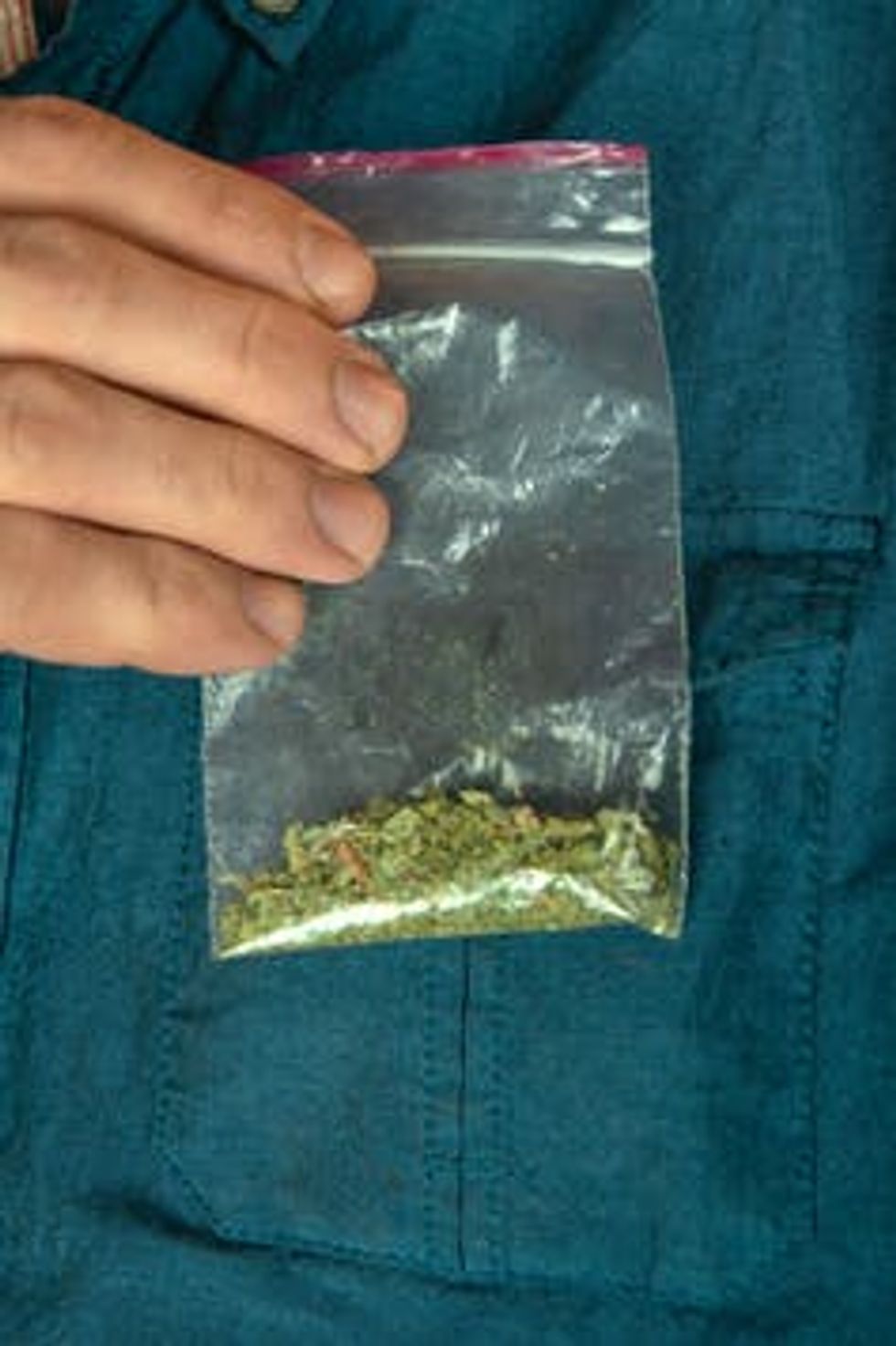
When you open a packet of a synthetic cannabinoid like K2 or Spice and pour the dried vegetation into your hand, it looks like marijuana. These dried leaves and stems can be inert or come from psychoactive plants like Wild Dagga. Some of these plants are contaminated with heavy metals, pesticides, mold or salmonella.
However, synthetic cannabinoids are anything but natural. They are mass-produced overseas and then shipped in bulk to the U.S., where they are dissolved and then mixed with dried vegetation, which absorbs the liquid. This process is very imprecise, so the dose in one packet can differ greatly within or between batches.
There are several hundred synthetic cannabinoids in existence, and they all stimulate cannabinoid type 1 receptors (CB1), just like the active component in natural marijuana, THC, that provides the high. But they do so with different intensities and for differing periods of time. Some incorporate the central ring structure of the THC molecule before laboratory modification, but many others do not. More problems arise because some of the synthetic cannabinoids stimulate non-cannabinoid receptors and can cause unanticipated effects as well. There is no way to know which synthetic cannabinoids are actually in the product you purchased.
The molecular structure of THC, the active component of marijuana. Many chemists producing synthetic cannabinoids in the lab use the three hexagonal rings as the scaffold to generate new molecules that produce a similar high.
Natural marijuana does not comprise only THC. The other constituents in natural marijuana such as cannabidiol actually help to temper the negative impact of THC but are absent in synthetic cannabinoids. In addition to these myriad risks, there is also a risk that synthetic cannabinoids can be adulterated with other chemicals, ranging from opioids to rat poison.
Synthetic cannabinoids were initially designed by legitimate researchers in the U.S. and around the world who were looking to explore the function and structure of cannabinoid receptors. They did not intend for illegal drug labs to use their recipe to mass-produce these synthetic cannabinoids.
What are the consequences of using these drugs?
In addition to giving the user a high, the primary psychological and neurological effects of synthetic cannabinoid use include anxiety, agitation and paranoia, although psychosis and seizures have also occurred. The anxiety and psychosis can cause the heart to beat fast and even trigger heart attacks or strokes when the body’s adrenaline gets flowing. Many people suffer upset stomach with synthetic cannabinoids, and vomiting is also common (which is paradoxical, since medical marijuana is used to prevent vomiting). Finally, there is a risk that synthetic cannabinoids can damage both the muscles and kidneys.
Rarely, people reported having trouble breathing, but in some cases this is due to adrenaline release. In other cases, the butane that was used to extract THC from marijuana before laboratory alteration was not removed. The butane ignites during smoking and damages the lungs. Early detection and aggressive treatment for all of these adverse events can help to prevent severe adverse events or death.
What can we do to protect ourselves?
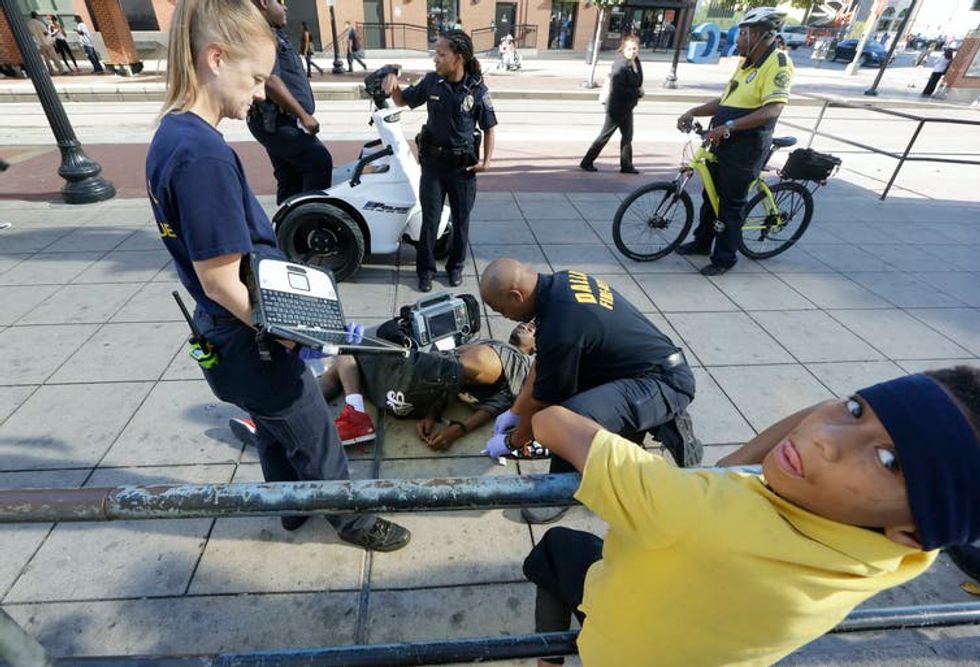
A man lays handcuffed and unresponsive as first responders attend to him at a Dallas Area Rapid Transit rail stop during rush hour. According to police, the man had smoked K2, also known as ‘spice,’ a synthetic marijuana known to cause hallucinations and violent behavior.
Many of the risks of synthetic cannabinoids and other illegal drugs of abuse arise because of contamination, adulteration, substitution and inconsistent dosages. As long as people are able to manufacture, transport and sell these drugs secretly, there is no way to assure buyers of a consistent quality product. Public health personnel, teachers and parents need to educate adults and students alike about the inherent risks of the drugs in their pure form but should also include the risks associated with poor manufacturing practices.
People generally prefer natural marijuana to synthetic forms, but as long as natural marijuana remains illegal, highly desired, easily detected and periodically unavailable, the desire to purchase synthetic forms will persist.
Finally, synthetic cannabinoids are primarily manufactured overseas. Foreign governments, especially in Asia, need to crack down on illegal drug factories and better scan freight for illegal drugs. In addition, all shipping companies need to do more to detect the illegal transport of drugs into the United States. There are hand-held detectors that can help identify some but not most synthetic cannabinoids. However, detection will still be painstakingly slow.
A solid white mass found in a broken jar in an Ancient Egyptian tomb has turned out to be the world’s oldest example of solid cheese.
Probably made mostly from sheep or goats milk, the cheese was found several years ago by archaeologists in the ancient tomb of Ptahmes, who was a high-ranking Egyptian official. The substance was identified after the archaeology team carried out biomolecular identification of its proteins.
This 3,200-year-old find is exciting because it shows that the Ancient Egyptian’s shared our love of cheese – to the extent it was given as a funerary offering. But not only that, it also fits into archaeology’s growing understanding of the importance of dairy to the development of the human diet in Europe.
Dairy in diets
About two-thirds of the world’s population is lactose intolerant. So although dairy products are a daily part of the diet for many living in Europe, Northern India and North America, drinking milk in adulthood was only possible from the Bronze Age, over the last 4,500 years.
For most of human history, adults lost the ability to consume milk after infancy – and the same is true of people who are lactose intolerant today. After weaning, people with lactose intolerance can no longer produce the enzyme lactase. This is necessary to break down the lactose sugars in fresh milk into compounds that can be easily digested. People with lactose intolerance experience unpleasant symptoms if they consume dairy products such as bloating, flatulence and diarrhoea.
Ancient DNA analysis on human skeletons from prehistoric Europe places the earliest appearance of the gene lactase gene (LCT) – which keeps adults producing lactase – to 2,500BC. But there is plenty of evidence from the Neolithic period (around 6,000-2,500BC in Europe) that milk was being consumed.
This is not totally surprising though, as the Neolithic marks the start of farming in most regions of Europe – and the first time humans lived closely alongside animals. And although they were unable to digest milk, we know that Neolithic populations were processing milk into substances they could consume.
Archaeological evidence
Using a technique called “lipid analysis”, sherds of ancient pottery can be analysed and fats absorbed into the clay identified. This then allows archaeologists to find out what was cooked or processed inside them.
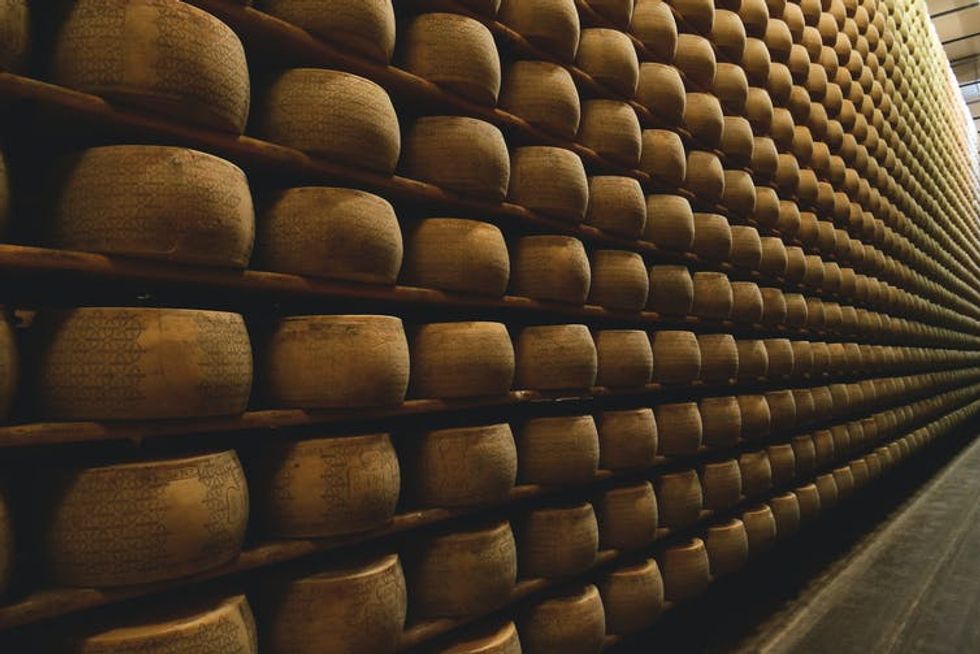
We have ancient ancestors to thank for the cheese we eat today.
Shutterstock
Although it is not yet possible to identify the species of animal, dairy fats can be distinguished. It is also challenging to determine what techniques were being used to make dairy products safe to consume, with many potential options. Fermenting milk, for example, breaks down the lactose sugar into lactic acid. Cheese is low in lactose because it involves separating curd (from which cheese is made) from whey, in which the majority of the lactose sugars remain.
Clay sieves from Poland, similar to modern cheese sieves, have been found to have dairy lipids preserved in the pores of clay, suggesting that they were being used to separate curds from the whey. Whether the curds were then consumed or attempts made to preserve them by pressing into a harder cheese is unknown. Fermentation of milk was also possible to our ancestors, but harder to explore with the techniques currently available to archaeology.
Early cheese making
While the techniques from bioarchaeology have provided this fantastic detail on Neolithic diets, where the science stops, experimental archaeology can explore what was possible.
We have been making cheese using the utensils, plants and techniques available to Neolithic farmers. The aim of the experiments is not to faithfully recreate early cheeses, but to begin to capture some of the decisions available to early cheese makers – and the experiments have thrown up some interesting results.
By using these ancient techniques, we have discovered that a wealth of different means of curdling the milk would have been possible, each producing different forms, tastes and amounts of cheese.
And such specialist knowledge may have been akin to the spread of bronze smelting at the end of the Neolithic. Dairy may have had a special status among foodstuffs. For example, at the major late Neolithic feasting site of Durrington Walls, not far from and contemporary with Stonehenge, dairy residues were found in a particular kind of pottery vessel and concentrated in the area around a timber circle – a form of Late Neolithic monument.
From the Bronze Age, however, lactase persistence offered an advantage to some people who were able to pass this on to their offspring. It also seems that this advantage was not solely because of increased calorie and nutrient intake alone – but because of the special status dairy foods may have had. The development of this biological adaption to fresh milk took place after humans had already found ways to safely include dairy products in the diet.
This shows that humans are not only able to manipulate their food to make it edible, but that what we consume can also lead to new adaptations in our biology.
As creator of The Simpsons, Matt Groening is the man behind one of the most popular television shows of all time. So there was always going to be plenty of interest in his latest offering, Disenchantment.
When I visited the San Diego Comic Con in July 2018, buildings in city were “wrapped” in promotional graphics to advertise the series which was about to launch on Netflix. There was a panel event at the conference, featuring Groening himself, most of the creative team and some of the voice talent. Anticipation and hype were high. So does it live up to expectations?
The ten episode series kicks off with a two-parter, which sets the tone for the rest of the run. Interestingly, there is much more of a story arc running across the series than in Groening’s previous shows (The Simpsons and Futurama), so even though there are stand alone episodes, there is a bigger story running through the entire season (which is even slyly referred to in one of the latter episodes).
The setting for the show is Dreamland, a medieval kingdom ruled over by King Zøg, a character brilliantly performed by John DiMaggio. But the main focus is on the king’s wayward daughter, Princess Tiabeanie or “Bean”, Luci her demonic (or is it catlike?) sidekick, and Elfo, a rather literally named elf from the sickly sweet Elfwood. The kingdom of Dreamland is littered with visual gags and inside jokes (known as Easter eggs) which require your attention (particularly in the “ye olde” signage).
The characters are set up very quickly in the season opener, and the three main protagonists quickly bond, making you feel like you have been already been watching them for a few seasons. Bean is a privileged tearaway drifter, who likes a drink – but as with most of Groening’s lead characters, you just can’t help siding with her.
Luci’s wisecracking one-liners make him feel more like a Seth Macfarlane (creator of Family Guy) character, in voice and actions – but this is no bad thing. Meanwhile, Elfo is the heart of the show – cute, but also the comedy relief. He ends up on the receiving end of some questionable experiments to harness his magical “elf blood” as King Zøg strives to find the elixir of life, one of the overriding plot points of the first season. The gags are not as quickfire as in The Simpsons or Futurama, but this actually gives the plot room to breathe.
As with Groening’s other work, there is a strong support cast. There is Bunty, the loyal but dim maid, Sorcerio (played by Futurama’s Billy West) the rather useless wizard, and Odval, the sinister (and Game of Thrones-inspired) three-eyed prime minister of Dreamland. The show also makes use of stellar British character actors and voice talent such as Matt Berry, Noel Fielding and Sharon Horgan.
The surprisingly dark and adult themes show a marked departure from Groening’s other mainstream work – there is some very graphic violence and even the occasional swearing. It is possible that a lack of interference from a TV network has freed up the creators in this respect.
Cartoons for grown ups
The more adult style is carried through to the visuals. The distinctive Groening look is still in evidence, but the colour pallets and the backgrounds are much more muted. The backdrops in particular, have a much more brush-like feel to them, and do not utilise the linear line weight and flat colours of The Simpsons. These elements give the show a much more traditional feel, even though the production is obviously aided by computer generated graphics, which are as seamlessly integrated as they can be, particularly in the establishing shots of Dreamland itself.
So is it any good? For me, the series benefits from the shorter season run associated with Netflix shows. This means the quality of the show stays high across the full run – there is no filler. It also helps that this series is more episodic than Groening’s other shows, rewarding the viewer who sticks with the entire run.
The use of cliffhangers (literally, in episode one) and run-ons from previous episodes give a greater sense of continuity, even if it sometimes means the loss of the quickfire gags. Despite this, Disenchantment is still at times laugh-out-loud funny and the writers know how to pull off a twist or two. Special note should be made of the great stylised title sequences, which give you a flavour of the forthcoming episode.
This is a series which is well worth watching and sticking with. And there is more to come. Netflix commissioned a 20-episode run, so hopefully it won’t be too long before the next ten episodes become available, picking up from where it left off. And on the evidence of the first half, three decades after he created America’s best known family, Groening has not lost his magic touch.
After more than 500 days of stalemate, Northern Ireland has surpassed the record previously set by Belgium for the longest run in peacetime without a working government. The trigger for the collapse of Stormont’s power-sharing institutions concerned a relative anodyne issue – the implication of the DUP leader Arlene Foster in a seriously flawed renewable energy scheme. However, there were a range of other factors which created a breakdown in trust between Foster’s party and Sinn Féin. Among these were the DUP’s opposition to Sinn Féin’s proposal of an act to help preserve and promote the Irish language and its refusal to countenance gay marriage. On top of these, there were issues relating to Northern Ireland’s past conflict.
Arguably, though, the key factor that continues to prevent an agreement to restore power-sharing in Northern Ireland is the same issue that has destabilised politics right across the UK: Brexit. The day after the vote to leave the EU in 2016, Sinn Féin called for a vote on Irish unity. This was linked to the threat that Brexit could re-establish a hard border in Ireland, with serious economic implications for both parts of the island. Sinn Féin argues that this might change the attitudes even of many unionists in Northern Ireland, creating a momentum towards republicans’ long-standing goal of reunification.
The DUP naturally opposed such suggestions. And, indeed, it had backed the Leave campaign in the referendum. So, after the surprising loss of the Westminster majority for the Conservatives in 2017’s election, it was much less surprising that the DUP came to their aid with a confidence-and-supply accord.
Having a say in the governance of the UK as a whole, and helping to deliver the claimed “will of the British people” on Brexit, has helped burnish the DUP’s unionist credentials. Also, the Tory-DUP deal involved a commitment to increase public spending in Northern Ireland. This sold well with the DUP’s supporters, who, for many years, have chafed at the changes of the peace process, interpreted as rewarding republicans. Conversely, republicans now chafe at the DUP’s enhanced political influence. They note that a majority in Northern Ireland voted Remain, while support for the EU in the Irish Republic remains high.
Brexit has thus revived the ideologies of Irish nationalism and Ulster unionism, and reignited their most central dispute – continued union with Britain or unification with Ireland. Brexit has simply created a new arena for an age-old contest.
Over to you, Brussels
This underlying tension is arguably the real reason for the continued failure of efforts to resolve other disagreements between the DUP and Sinn Féin and restore power-sharing. Indeed, these other issues are far less challenging than those previously resolved through the peace process. This is not to downplay the importance of Irish speakers in Northern Ireland having the same protections enjoyed by those using other indigenous languages across the UK and Ireland, or the rights of the gay community to marriage equality as in any other part of these islands. However, issues like the decommissioning of IRA weapons, policing reform, or the release of paramilitary prisoners under the terms of the Good Friday Agreement proved far more controversial. Yet they were all delivered, and so established the basis for Sinn Féin and the DUP to work together in government for nearly a decade.
However, the peace process did not reconcile Sinn Féin and the DUP. It forced them to be friends. Specifically, the British and Irish governments made clear that they could only have power if they shared power. The unity of political purpose between London and Dublin, so evident and successful in the early years of the peace process, has been seriously damaged by Brexit. Though there are very particular implications for Northern Ireland and the Irish border, Brexit has created wider challenges for London and Dublin. Given the highly important all-Ireland and UK dimensions of Irish trade, and nearly half a century of British integration with Europe, the outcome of Brexit could have massively disruptive effects on either or both national economies.
This has often left London and Dublin at odds in the course of the Brexit negotiations. The DUP’s role in supporting the Westminster government has only complicated matters further. While London and Dublin remain divided over the direction of Brexit, however, they cannot lead a co-ordinated effort to force the Northern Ireland parties to resolve their differences and restore power-sharing at Stormont.
This creates a Catch-22. Just as the issue of the Irish border remains the chief obstacle to an agreement on Brexit, so Brexit remains the chief obstacle to an agreement at Stormont. It seems then that a political deal in Belfast will only emerge as we near a political deal in Brussels. Northern Ireland may have taken the Belgian title for the longest period without governance, but ironically it is in the Belgian capital that any move to end that run will likely develop.
President Donald Trump said on Wednesday the U.S. Supreme Court chief justice should tell the head of a national security court to question FBI and Justice Department officials about their use of a so-called Russia dossier as part of a collusion probe.
Trump singled out Justice Department official Bruce Ohr in a message on Twitter apparently quoting a Fox News analyst. Ohr is linked to the dossier of allegations of possible collusion between Trump’s campaign and Russia.
The dossier was compiled by former British spy Christopher Steele in work partly financed by the Democratic National Committee (DNC). Republican critics of the dossier have focused heavily on its DNC ties and U.S. surveillance of Trump associates.
“Ohr told the FBI it (the Fake Dossier) wasn’t true, it was a lie and the FBI was determined to use it anyway to damage Trump and to perpetrate a fraud on the court to spy on the Trump campaign,” Trump said in a series of Twitter messages.
“This is a fraud on the court. The Chief Justice of the U.S. Supreme Court is in charge of the FISA court. He should direct the Presiding Judge, Rosemary Collier, to hold a hearing, haul all of these people from the DOJ & FBI in there, & if she finds there were crimes committed, and there were, there should be a criminal referral by her,” Trump said in the Twitter post that misspelled the judge’s name.
Rosemary Collyer is the presiding judge for the Foreign Intelligence Surveillance Court, which oversees electronic surveillance requests and search warrants sought by federal authorities.
Some Republicans charge that Steele’s Russia dossier, which contains a number of inflammatory and salacious allegations about Trump, was used improperly by Justice and FBI officials to convince the FISA court to extend an eavesdropping warrant against a Trump campaign adviser.
Special Counsel Robert Mueller is currently investigating Russian efforts to influence the outcome of the 2016 presidential election and whether there was collusion with the Trump campaign.
U.S. intelligence agencies have concluded that Russia tried to help Trump win the 2016 election but the Kremlin denies meddling. Trump denies any collusion and has said Steele’s Russia dossier is “bogus.”
Reporting by David Alexander; Editing by Paul Tait