The European Union has accused Ireland of giving Apple Inc. illegal state aid through tax arrangements that had "no scientific basis" but which helped the iPhone maker shelter tens of billions of dollars in international revenues from tax.
In a letter written in June but published only on Tuesday, European Competition Commissioner Joaquin Almunia told the Dublin government that tax deals agreed in 1991 and 2007 appeared, in his preliminary view, to amount to state aid that broke EU laws and could be clawed back from the U.S. company.
"The Commission is of the opinion that through those rulings the Irish authorities confer an advantage on Apple," Almunia wrote to Ireland in the letter, which was dated June 11.
Publication of the letter had been expected this week.
Analysts said the Irish tax arrangements saved Apple, the world's most valuable corporation, billions of dollars in tax.
The Irish government and Apple have long denied any sweetheart deals were agreed. There was no immediate comment on Tuesday on from either Dublin or Apple.
The EU's competition watchdog announced in June that it was looking at whether a number of countries' benign tax regimes for multinational companies, which help to attract investment and jobs, represent unfair state aid.
Under EU competition law, if a government is found to have unfairly helped a company with state aid, it must then recover that money from the company.
(Reporting by Julia Fioretti; Editing by Alastair Macdonald)
A captain with the Fire Department of New York has been charged with sex crimes against children and is awaiting extradition to California, authorities said on Monday.
Wilbert Riera is accused in incidents in Los Angeles on Sept. 12 that involved two juveniles, said Officer Liliana Preciado of the Los Angeles Police Department.
He has been arrested on charges of sex crimes against children and is awaiting extradition to California, she said.
The 21-year veteran, who works in the Fire Department's Emergency Medical Service, was arrested on Friday, according to New York's Daily News.
A warrant charges Riera, 51, with six counts of oral sex with children, the News said.
ST. PETERSBURG Fla. (Reuters) - Freshmen at Florida's Lakewood High School lined up against gold and black gymnasium mats on Friday to have their height and weight measured, an assessment to launch a novel study on fighting teenage obesity with trendy new technology.
Researchers affiliated with Johns Hopkins Medicine, whose network includes a Florida children's hospital near the school, plan to use results of the screening to select about 50 overweight students and track their activity levels using the Fitbit, a connected wristband.
Wearable technology, expected to take off next year when Apple Inc introduces its health-oriented Apple Watch, has shown mixed promise in research. Yet medical literature has little to say about the effectiveness in adolescents, whose obesity rates have quadrupled in the last 30 years, with nearly one in five now being obese, according the U.S. Centers for Disease Control and Prevention.
"It's cool. You can wear it and it measures your activity," said Dr. Raquel Hernandez, lead researcher and an assistant professor of pediatrics at John Hopkins Medical School, who works at All Children's Hospital in St. Petersburg, Florida.
"It also can help the student know what they really are doing," she added.
Students will synch their wristbands to MyFitnessPal, an app that can also track their daily diet. Researchers are using Fitbit tracking to examine sleep patterns as well.
When a youngster's activity level drops, researchers can send a cell phone text or Twitter message, with real-time tips on a healthy excursion or snack.
Funded by a $100,000 grant from the philanthropic arm of insurer Florida Blue, the school-based program eliminates the need to talk teenagers into trekking to the doctor's office.
"We are coming right to where they are," said program coordinator Janelle Garcia, a health educator who hopes to expand nationally if successful. "The goal is to test the feasibility."
The focus is not on weight loss, but teaching healthy habits at a critical age. Obese adolescents are much more likely to become obese adults, and run the health risks of developing diabetes, hypertension and cardiovascular disease.
Students will meet with nutrition counselors and fitness experts twice a week, as well as attend after-school sessions with a psychologist focused on behavioral change.
Such counseling is key, said Corby Martin, an associate professor at Louisiana State University’s Pennington Biomedical Research Center. Simply wearing a fitness wristband doesn't guarantee that adults will shed pounds, research has shown.
"The proliferation and availability of these devices and apps doesn't necessarily mean that it's going to miraculously help you lose body weight, increase your activity and be healthier. That takes a lot of work," said Martin, a spokesman for the Obesity Society, a scientific organization.
Teenagers and their parents may be reluctant to talk about weight problems, the Florida researchers acknowledge.
"We are fully aware that this may make some families uncomfortable," said Hernandez, who hopes an accompanying schoolwide health initiative will destigmatize the topic.
On Friday morning, 14-year-old Sierra Mieczkowski saw little downside as she arrived for a height and weight check and slipped off her black sneakers, revealing mismatched socks.
The ninth-grader, who does not know whether she will be selected for the study, said she tries to eat well and takes frequent walks with her father.
But with a wearable fitness tracker, "I could see how much I'm doing," she said, adding "and know how much I can improve."
(Reporting by Letitia Stein; Editing by Frank McGurty and Gunna Dickson)
In a matter of days, the new social network Ello, described as the "anti-Facebook (NasdaqGS: FB - news) " for its stand on privacy and advertising, has become perhaps the hottest ticket on the Internet.
Created last year as a "private" social network, Ello (www.ello.co) recently opened its doors on an invitation-only basis.
Because of the limited supply and strong demand, the invitations have been selling on eBay at prices up to $500. Some reports said Ello is getting up to 35,000 requests per hour as a result of a viral surge in the past week.
Ello appears to have caught on with its simple message which seems to take aim at frustrations of Facebook users.
"Ello doesn't sell ads. Nor do we sell data about you to third parties," the company says.
Its "manifesto" states: "We believe a social network can be a tool for empowerment. Not a tool to deceive, coerce, and manipulate -- but a place to connect, create, and celebrate life. You are not a product."
Ello's policy states that the practice of collecting and selling personal data and mapping your social connections for profit "is both creepy and unethical."
"Under the guise of offering a 'free' service, users pay a high price in intrusive advertising and lack of privacy."
Based in Vermont, Ello was launched by a group of artists and programmers led by Paul Budnitz, whose previous experience include designing bicycles and robots.
Budnitz says on his page that Ello was designed to be "simple, beautiful and ad-free."
- 'Different politics' -
Nathan Jurgenson, a social media researcher at the University of Maryland, welcomed Ello's fresh approach.
"I love these moments of new social media when conversation explodes, moved to imagine how social media can be different, questioning core assumptions instead of just fretting and complaining -- all before this paint even dries," he said on his Ello page.
"Ello is getting so much attention precisely because it promises social media of a different politics. We?ve collectively come to the realization that the rise of social media has been accompanied by handing far too much power to far too few people, and there?s energy to shake things up, even if just a bit."
Ello's rise also comes amid complaints against Facebook from the gay community that the world's biggest social network began disabling accounts using stage names instead of real names.
A San Francisco protest is planned against Facebook supporting "drag queens" who lost their Facebook accounts. Ello does not require real names.
- Business plan? -
It remains unclear if Ello will end up being a flash in the pan, or if it will develop a profitable business plan.
Ello states it plans to remain "completely free to use," but that it could start offering some premium features for a fee.
Some question if Ello can succeed on this kind of model and keep its principles.
But former Ello collaborator Aral Balkan said Ello has already been compromised by taking $435,000 in venture capital funding.
A designer and founder of ind.ie, a privacy advocacy group, Balkan said he worked briefly for Ello but left when he learned of the venture investments.
"When you take venture capital, it is not a matter of if you're going to sell your users, you already have," says a blog post from Balkan.
"It's called an exit plan. And no investor will give you venture capital without one. In the myopic and upside-down world of venture capital, exits precede the building of the actual thing itself. It would be a comedy if the repercussions of this toxic system were not so tragic."
The British inventor of the World Wide Web warned on Saturday that the freedom of the internet is under threat by governments and corporations interested in controlling the web.
Tim Berners-Lee, a computer scientist who invented the web 25 years ago, called for a bill of rights that would guarantee the independence of the internet and ensure users' privacy.
"If a company can control your access to the internet, if they can control which websites they go to, then they have tremendous control over your life," Berners-Lee said at the London "Web We Want" festival on the future of the internet.
"If a Government can block you going to, for example, the opposition's political pages, then they can give you a blinkered view of reality to keep themselves in power."
"Suddenly the power to abuse the open internet has become so tempting both for government and big companies."
Berners-Lee, 59, is director of the World Wide Web Consortium, a body which develops guidelines for the development of the internet.
He called for an internet version of the "Magna Carta", the 13th century English charter credited with guaranteeing basic rights and freedoms.
Concerns over privacy and freedom on the internet have increased in the wake of the revelation of mass government monitoring of online activity following leaks by former US intelligence contractor Edward Snowden.
A ruling by the European Union to allow individuals to ask search engines such as Google to remove links to information about them, called the "right to be forgotten", has also raised concerns over the potential for censorship.
"There have been lots of times that it has been abused, so now the Magna Carta is about saying...I want a web where I'm not spied on, where there's no censorship," Berners-Lee said.
The scientist added that in order to be a "neutral medium", the internet had to reflect all of humanity, including "some ghastly stuff".
"Now some things are of course just illegal, child pornography, fraud, telling someone how to rob a bank, that's illegal before the web and it's illegal after the web," Berners-Lee added.
Sierra Nevada Corp (SNC) said it had filed a legal challenge to NASA's award of contracts totaling $6.8 billion to Boeing and SpaceX to build commercially owned and operated "space taxis" to fly astronauts to the International Space Station.
NASA had considered a bid by privately owned Sierra Nevada, but U.S. officials said on Tuesday the U.S. space agency had opted to award long-time aerospace contractor Boeing and SpaceX with contracts to develop, certify and fly their seven-person capsules.
SNC said its bid could have saved up to $900 million and that NASA's statements "indicate that there are serious questions and inconsistencies in the source selection process."
"SNC, therefore, feels that there is no alternative but to institute a legal challenge," it added in a statement on Friday.
Boeing was awarded $4.2 billion and SpaceX $2.6 billion. SpaceX is run by technology entrepreneur Elon Musk, also chief executive of electric car manufacturer Tesla Motors Inc.
"With the current awards, the U.S. government would spend up to $900 million more at the publicly announced contracted level for a space program equivalent to the program that SNC proposed," Sierra Nevada said.
It said a "thorough review must be conducted of the award decision."
The space taxis would end U.S. dependence on Russia for rides to the space station. The contract has taken on new urgency given rising tensions over Russia's annexation of the Crimea region of Ukraine and support for rebels in eastern Ukraine.
(Reporting by Andrea Shalal and Mohammad Zargham; Editing by David Holmes)
A first and quite reasonable thought readers may have will be to wonder: what is bash?
When you use a computer you probably interact with it through a point-and-click, visual interface such as Windows or Mac OS. More advanced users or specific tasks might require a text-only interface, using typed commands. This command line program is known as a shell, and bash is the acronym for Bourne Again SHell (a successor to the Bourne shell, written by Stephen Bourne – that’s geek humour right there), known to everyone as bash.
So what you need to know is that a shell is essential, and that bash as the most common shell in use is installed on pretty much every machine that runs a flavour of Linux or Unix. That includes Mac OS X – which behind its shiny desktop is a Unix-based operating system too.
What has systems administrators hot under the collar right now is the discovery by Red Hat, a firm that produces one of the long-established distributions of Linux favoured by enterprise, of a vulnerability in bash. This bug, which is being called “shellshock”, allows under specific conditions a hacker to remotely access and take control of a system running a vulnerable version of bash.
Potentially vulnerable computers running Linux/Unix account for around two-thirds of web servers on the internet. That will include a huge number of online services you use – shops, banks, social networking sites, government services. The police and military, too.
Huge scope online
Now you can see why everyone is panicking and claiming that this is bigger than the Heartbleed bug, a problem that only affected one specific technology (secure socket layers) which is not near-universal like bash. It has been classed as a maximum risk factor 10 of 10.
Red Hat has released a patch to close the loophole and solve the problem, but it’s not perfect and still allows an attacker other vectors to exploit. Other Linux and Unix vendors will be on the case as a matter of urgency and no doubt there will be an update from Apple for its Mac OS systems very soon. It isn’t the fault of one organisation – while tempting, there is no cause to bash Apple this time.
This vulnerability, dating back to version 1.13 of the program, has existed for 22 years and it has taken detailed analysis by security experts to find it. Now it has been made public, vendors and system administrators are scrabbling to close the hole while hackers and cybercriminals are trying to exploit it.
In fact within 24 hours of being announced, exploits are already being reported in the wild. The issue is exacerbated by the problem that shell programs such as bash are designed to be connected to remotely, through programs such as SSH or telnet. It isn’t too difficult to send commands to a remote device or to encourage users to download an application that uses the same commands.
But that assumes the attacker is able to bypass your perimeter protection such as a firewall and other network security policies. As a network engineer, I know that while there is a weakness on my system that must be resolved, there are other defence mechanisms already surrounding that weakness that still provide protection.
However, those running a web server – whose entire function is to respond to those remote calls (in this case, your web browser’s requests for pages on the site you’re browsing) – have much more of a problem. This provides a route into the system that can’t be blocked with a firewall as it would also block legitimate requests for the web server. Systems administrators are probably very busy at the moment trying to ensure that their bash environments cannot be exploited.
Also of concern are the tens of millions of pieces of networking hardware such as router and switches that connect the internet’s computers together. Almost all run stripped-down versions of Linux-like operating systems optimised for networking, but they also include bash for network engineers to connect and control them. These will need to be patched too.
Desktop users are safe(r)
The rest of us can probably breathe easier. Attackers are more interested in compromising systems that may return financial advantage, which is unlikely to be our desktop computers.
My advice to Apple Mac users is to check firewall settings and take care when downloading any third-party application not available via the App Store. For Linux users the same applies – Ubuntu has a software centre, for example, where the community have checked all available applications to date. In any case, a patch will be available soon. Windows users are unaffected (and it’s not often you can say that).
Some are suggesting this bug is a larger problem for Apple desktop devices than it really is. Unless your machine has been set up to allow others remote access to it (it wouldn’t do so by default), has also switched off the firewall and is not using a protected network (home broadband routers provide their own protection, for example), then I wouldn’t worry – but install whatever recommended updates appear in the days to come.
How do you rate your chances of completing a transcontinental road trip? What if you can’t drive and don’t have car? What if you can’t even move unaided? In fact, what about if you’re not even human?
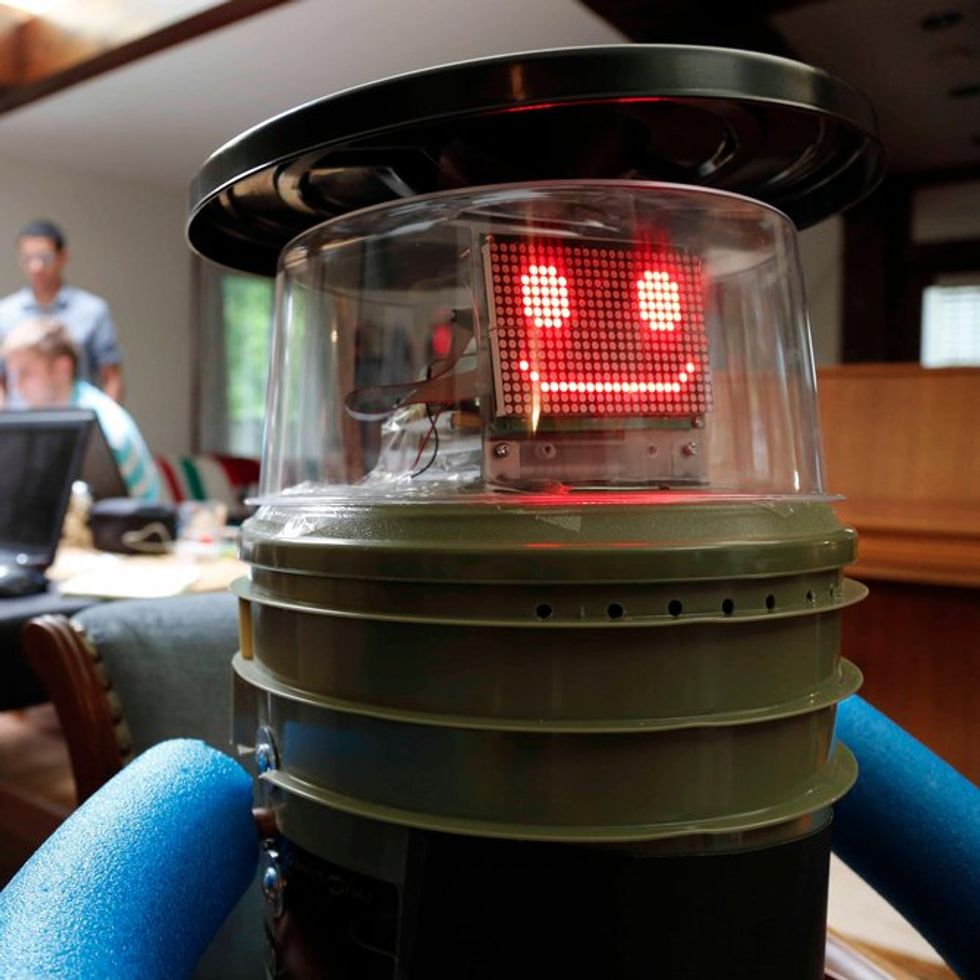
Tweeting, GPS-equipped robot Hitchbot managed it, hitchhiking across Canada this summer from Halifax, Nova Scotia to Victoria, British Columbia. The cylindrical robot, sporting a digital LCD smile and a fetching line in matching yellow rubber gloves and boots, completed the 6,000km journey in around 20 days.
Unlike the robots of the big screen, which tend to come equipped with advanced intelligence and search-and-destroy capabilities, Hitchbot is social, friendly, and entirely human-dependent. It relied only on the kindness of strangers it met along the way to pick it up, put it in their vehicles, and take it as far as they could toward its final destination.
David Harris Smith and I conceived the idea for Hitchbot as an opportunity to set an experimental, technological art project free in the wild. Combining arts and science knowledge (and David’s years of experience as a hitchhiker), we thought a hitchhiking robot would provide a fascinating experience for the public, and would offer some insight on how humans interact with robots. We’re delighted to be receiving a Top 30 Innovation Award at this year’s Silicon Valley Innovation & Entrepreneurship Forum, so it seems others see the same appeal.
It may look like a cake lid for a head, indeed it is a cake lid. But it’s MY cake lid.
Hitchbot
We put the robot down on the side of the highway on July 27, 2014 in Halifax and watched it get picked up by its first travel companions, Anne and Brian Saulnier. Heading to Kouchibouguac National Park in New Brunswick, this was the first of 19 hitches that allowed Hitchbot to traverse the country.
Arriving in Victoria on August 17, the trip was faster and more eventful than we could have imagined. Highlights of the trip included attending a Pow Wow with the Wikwemikong First Nation on Manitoulin Island, doing the Harlem Shake with three travel companions in Saskatchewan, and attending the wedding of Kyle Shepherd and Julie Branch on Kicking Horse Mountain in Golden, BC.
Hitchbot, happy to land a ride.
Hitchbot/Instagram
As Hitchbot’s family we were overwhelmed by the kindness of those who helped the robot cross the country. The willingness to see the project succeed affirmed what people often say about Canadians – that they are warm, polite, and hospitable. Monitoring the journey unfold from Toronto our team never caught wind of anyone attempting to harm Hitchbot. Instead, each participant was charmed by the robot, showed it love, and genuinely wanted to help it reach Victoria.
Of course, the positive media coverage helped. Tens of thousands of people followed the robot’s trip on Facebook, Twitter, and Instagram, sharing hitchhiking advice, personal anecdotes, and suggestions for tourist visits.
The initial question we posed was whether robots can trust human beings – inverting the more common worry of artificial intelligence’s trustworthiness towards humans. While the result shows that the answer seems to be “Yes”, it also demonstrated that by setting the project up as an engaging art and science project, people were eager to get involved. It developed into a participatory event, proving how much interest art and sciences can evoke among the public.
From a scientific point of view, Hitchbot’s progress showed not only the relevance of social media but also that the field of human-robot interaction goes beyond just physical interaction: it is also the personality, communication abilities and ability to actively shape the interaction that seems to invite people to trust a robot and to be willing to engage with it.
This also applies to the design. Whereas Hitchbot’s communication features were more rudimentary compared to high-tech artificial intelligence robots that come at high costs, Hitchbot’s design actually made people want to engage and connect. The design was chosen and intended to instill trust, and also to encourage people to help Hitchbot – so the decision to have it the height of a six-year-old child. The overall design, with matching yellow gloves and boots was meant to be quirky and fun, which turned out to be rather appealing to people.
Many people from around the world have enquired whether Hitchbot will be making trips through the US or Europe – an encouraging sign that a project like this could succeed in places other than Canada. For now, we’re still deciding what trips may come next.
This article was co-authored with Hitchbot family member Alanna Mager.
Frauke Zeller received funding from the European Commission Research Framework (6+7), German Academic Exchange Service, Social Sciences and Humanities Research Council, Canada. She works for Ryerson University, Canada.
David Harris Smith receives funding from GRAND NCE, McMaster University, SSHRC. He is Assistant Professor in the Department of Communication Studies and Multimedia at McMaster University.
Activist investor Starboard Value LP said on Friday it has acquired a "significant" stake in Yahoo Inc YHOO.O and urged the Internet company to explore a merger with AOL Inc AOL.N.
Starboard, the second activist investor to target Yahoo in the last three years, also said the company should quickly "monetize" its Asian assets which exceed the enterprise value of its actual business.
Shares of Yahoo rose 4.4 percent to close at $40.60, while AOL jumped 3.7 percent to $44.55, both on Nasdaq.
Starboard's call marks the latest chapter in Yahoo's protracted effort to revamp the Internet pioneer whose revenue growth has lagged those of competitors such as Google Inc GOOGL.O, Facebook Inc FB.O and Twitter Inc TWTR.N.
In a letter to Yahoo Chief Executive Marissa Mayer, Starboard said it was looking forward to "engaging directly" with Yahoo to discuss how its plan could be implemented in a timely manner.
Yahoo would review the letter, Mayer said in a statement late on Friday.
The company said it would provide an update on its capital allocation initiatives during its third-quarter earnings call.
Starboard, a former activist investor in AOL, said a Yahoo-AOL merger could create up to $1 billion in "synergies" by reducing overlaps in online display advertising and other overhead costs.
"I don't think it will happen but I do think Yahoo is now in play. It puts more pressure on Mayer," Ironfire Capital founder Eric Jackson said.
"Between now and four months from now someone will want to submit a short board slate and they will have a strong case," said Jackson who owns a stake in Yahoo. "Mayer is really under the gun to create value for shareholders and prove she is doing a better job than anyone else can do."
Mayer, a former Google executive, was hired in mid-2012 with the backing of Dan Loeb, the head of activist hedge fund Third Point LLC, which had waged a bitter proxy battle with Yahoo and eventually won several board seats at Yahoo.
In suggesting a tie-up with AOL, Starboard is revisiting a theme that pops up every few quarters as the former 1990s Internet powerhouses try to regain their footing. Both AOL and Yahoo have seen their online ad market share shrink in recent years.
AOL's $3.5 billion market valuation makes the merger viable for Yahoo, which has $9 billion in cash, said BGC Partners analyst Colin Gillis.
AOL declined to comment.
More than 2 years ago Starboard bought a stake in AOL, pushed for a patent sale and tried unsuccessfully to gain board seats. It no longer holds shares in AOL.
Starboard is also pursuing a high visibility proxy battle with Olive Garden owner Darden Restaurants Inc DRI.N.
Starboard did not specify the size of its stake in Yahoo. Investors which own 5 percent or more are required to publicly disclose their holdings.
TAX MATTERS
Shares of Yahoo have surged by more than 150 percent since Mayer took the helm in 2012, but investors attribute most of the gains to the fast-rising value of Yahoo's stakes in Chinese e-commerce company Alibaba Group Holding Ltd BABA.N and in Yahoo Japan, a joint venture with Japan's Softbank Corp 9984.T.
Yahoo sold 140 million Alibaba shares in the Chinese company’s blockbuster initial public offering earlier this month, adding billions of dollars to Yahoo's balance sheet. While Yahoo has said it plans to return at least half to shareholders, some investors worry that Mayer will spend the rest of the cash on poorly chosen acquisitions.
Starboard faulted Yahoo for not doing enough to reduce taxes associated with selling its Alibaba shares.
Figuring out a tax-efficient way to "monetize" the Asian stakes should be the top priority for Yahoo's management and board, Starboard said, noting that $16 billion in additional value could be generated by more tax efficient deal structures.
Starboard has explored several "alternative structures" that could deliver directly to shareholders with "minimal tax leakage," it said, without providing specifics.
Yahoo has a one-year lockup with Alibaba, so Starboard's proposal would require the cooperation of the Chinese company and Yahoo Japan.
(Reporting by Alexei Oreskovic and Jennifer Saba; Additional reporting by Nadia Damouni in New York and Anya George Tharakan in Bangalore; Editing by David Gregorio and Richard Chang)
A group of top U.S. financial regulators urged banks to quickly fix their software to protect it against the "Shellshock" computer bug, saying it could expose them to fraud.
Shellshock is a newly emerged major Internet threat that affects a common software tool found in many operating systems known as Bash, or Bourne-again Shell.
"The pervasive use of Bash and the potential for this vulnerability to be automated presents a material risk," the Federal Financial Institutions Examinations Council said.
The FFIEC is an interagency body that can prescribe common standards for banks that includes the Federal Reserve, the Federal Deposit Insurance Corporation, the Office of the Comptroller of the Currency, and others.
The banks should identify all their systems that use Bash and update them, and should also check third-party software, the group of regulators said.
(Reporting by Douwe Miedema; Editing by David Gregorio)
Authorities in San Francisco and Los Angeles have threatened to put a brake on the popular ride-sharing services that are roiling the traditional taxi industry, accusing them of violating California state and local laws.
In a letter to Sidecar Inc, a copy of which was seen by Reuters, the district attorneys said the company's carpooling feature violated a state law restricting service providers from charging multiple people for the same ride.
The letter, which threatened an injunction on Sidecar's services, also said an investigation had found that the startup had been misleading users on how extensively it conducted background checks on its drivers' criminal and driving records.
Sidecar said it strongly disagreed with the assertion that its Sidecar Shared Rides service was illegal.
"The district attorneys are trying to enforce laws written for limousines, in an era before smartphones," a Sidecar spokeswoman said in a statement. "Sidecar will continue to operate and expand Shared Rides."
The Wall Street Journal, quoting a spokeswoman for the San Francisco district attorney's office, said Sidecar rivals Uber Technologies Inc and Lyft Inc were issued similar letters.
Uber and Lyft could not be reached for comment.
Ride-sharing companies, which allow customers order and pay for a taxi using a smartphone application, have faced protests from taxi unions worldwide.
Taxi drivers across Europe staged protests in June against Uber, saying it breaks local taxi rules, violates licensing and safety regulations and that its drivers fail to comply with local insurance rules.
The attorneys want the company to remove the "Shared Ride" payment feature from its platform and remove from its website, mobile app, and receipts all statements that imply Sidecar's criminal background checks reveal a driver's criminal history older than seven years.
The attorneys have asked Sidecar Chief Executive Sunil Paul to meet with them before Oct. 8.
(Reporting by Ankush Sharma in Bangalore; Editing by Gopakumar Warrier and Ted Kerr)
Two Massachusetts teens have been arrested and a third is being sought in the brutal rape of a teenage girl that was recorded and posted on Snapchat.
The 16-year-old girl said she has no memory of what happened Sept. 3 when she was allegedly drugged and sexually assaulted by three teens behind a Saugus elementary school, reported WHDH-TV.
“What they did was disgusting, it was sick, (and) I almost lost my daughter,” her mother said. “She was barely breathing she was found with nothing on.”
Police said the assault was videotaped and shared on Snapchat, a social networking service that shows images or videos for a short time before they disappear.
“She had fingerprints -- at least two hands held down by her throat, her breasts were bruised, her whole body was ripped, (and) shredded, (with) broken toes,” her mother said.
A friend recognized the victim in the Snapchat video and notified the police, authorities said.
The video evidence led police to the girl, who was found unconscious in some bushes and had to be carried from the scene.
The girl was hospitalized and had to be revived after losing consciousness, reported WFXT-TV.
Police have arrested a 17-year-boy and 18-year-old woman in connection with the attack.
A third suspect, 19-year-old Rashad Deihim, remains at large.
Deihim was charged with assault with intent to rape, kidnapping, indecent assault and battery on a person 14 or older, and posing or exhibiting a child in a sexual act.
Human thumbs are just too stumpy to navigate bigger-than-ever smartphone screens, but a Japanese gadget maker has a solution: a thumb extender.
Enter Japan-based Thanko that is hawking a silicone-based device called the "Yubi Nobiiru," or "stretched finger," for 1,480 yen ($13.55) apiece.
The thumb extension lets users master large-screen devices such as the iPhone 6 Plus and Samsung's oversized Galaxy Note with just one hand.
The fake digit slips over user's real thumb to produce a life-like appendage boasting an extra 15 millimetres (0.6 inch) of length.
That means users can reach any spot on the bigger iPhone's 5.5 inch screen, perfect for urban commuters clutching a briefcase or a subway strap on packed trains.
A conductor at the hollow gadget's tip ensures the screen registers its touch.
"Do you think new smartphones are too big and it's difficult to touch the far corners of the display?" Thanko says on its website.
"Wear this stylus that looks exactly like your thumb, only longer!"
A Thanko spokesman told AFP that the firm wanted to make something unique to the pen-shaped stylus models already on the market.
"We've seen steady Internet sales and some customers abroad are buying it," he said of the thumb extender, which went on sale in May.
This week, Apple said it broke its sales record for the opening weekend of a new iPhone model, delivering 10 million in the first three days and boasting it could have sold more if it had them.