A far-reaching lawsuit filed Friday by the attorneys general of more than 40 states accused some of the nation's largest generic drug manufacturers of conspiring to inflate prices, in some cases by over 1,000 percent.
"We have hard evidence that shows the generic drug industry perpetrated a multi-billion dollar fraud on the American people," Connecticut Attorney General William Tong, whose state led the probe into the companies' practices, said in a statement.
"We have emails, text messages, telephone records, and former company insiders that we believe will prove a multi-year conspiracy to fix prices and divide market share for huge numbers of generic drugs," said Tong.
The suit names 20 major drug manufacturers—including Pfizer, Teva, Novartis, and Mylan—as well as more than a dozen senior executives, who the complaint accuses of deleting evidence after the states began their investigation in 2014.
"The industrywide scheme affected the prices of more than 100 generic drugs," the New York Times reported Saturday, "including lamivudine-zidovudine, which treats H.I.V.; budesonide, an asthma medication; fenofibrate, which treats high cholesterol; amphetamine-dextroamphetamine for ADHD.; oral antibiotics; blood thinners; cancer drugs; contraceptives; and antidepressants."
Americans pay far more for prescription drugs than the people of any other industrialized nation. Alluding to this fact, Colorado Attorney General Phil Weiser—who joined the multi-state lawsuit—tweeted on Saturday: "If you are angry about rising drug prices, you should be. Particularly because a major cause of price increases is illegal collusion by generic drug companies."
As the Washington Post reported, the 465-page lawsuit accuses drug company executives of "coordinating consistently to obstruct" government investigations into drug prices, including after Rep. Elijah Cummings (D-Md.) and Sen. Bernie Sanders (I-Vt.) launched a probe into generic drug pricing in 2014.
"Apparently unsatisfied with the status quo of 'fair share' and the mere avoidance of price erosion, Teva and its co-conspirators embarked on one of the most egregious and damaging price-fixing conspiracies in the history of the United States," states the complaint.
Uber shares skidded Friday in a disappointing Wall Street debut following a massive public offering from the global ride-hailing giant.
After pricing at $45 for the initial public offering (IPO) -- translating to a market value of $82 billion -- Uber shares began the trading day lower, and closed with a loss of 7.6 percent at $41.57.
The decline, in a volatile session for Wall Street, came amid doubts over Uber's path to profitability despite one of the biggest tech IPOs ever.
The drop was a "big disappointment" and suggested lower demand than expected for a major name like Uber, said Matt Kennedy, senior IPO market strategist at Renaissance Capital.
Kennedy said that both Uber and US rival Lyft were lower on concerns about hefty losses at the ride-hailing services.
"Silicon Valley may not care about losses, but Wall Street does," he said.
Ross Gerber of the investment firm Gerber Kawasaki said Uber had been overhyped, despite concerns about its business model, and estimated Uber's value at no more than $60 billion.
"I don't buy ride sharing and the current economics," Gerber tweeted. "Questionable employment practices. And an unsustainable pricing structure. We're passing on $uber and $lyft for now."
Despite the staggering valuation, Uber dialed back some of its earlier ambitions for a value exceeding $100 billion after a rocky start for Lyft earlier this year.
Lyft, meanwhile, slumped more than seven percent, bringing its shares down about 29 percent since its March debut.
- NYSE fanfare -
AFP / Riwan MARHIC Top stock exchange listings by market value
Chief executive Dara Khosrowshahi and an Uber team rang the opening bell on the New York Stock Exchange after the firm raised about $8.1 billion in the IPO.
While Uber has lost billions since launching its first rides in 2011 in San Francisco, the company is aiming to develop a global brand that helps transform local transportation.
Whether Uber can drive to profitability using this model as it disrupts traditional taxi and transport services is a key question.
Daniel Ives at Wedbush Securities was upbeat on Uber despite the weaker-than-anticipated valuation.
Ives said in a research note that Uber has "established itself as the clear number one player in the ridesharing industry and is paving a similar road to what Amazon did to transform retail/ecommerce and Facebook did for social media."
- Risks to business model -
AFP / Johannes EISELE The "Fearless Girl" statue, by sculptor Kristen Visbal, stands outside the New York Stock Exchange (NYSE) ahead of the market debut for ride-hailing firm Uber
Some of the risks surrounding Uber and its rivals were highlighted Wednesday as thousands of drivers turned off their apps in a US-wide strike over pay and working conditions.
The strikes targeting Uber and Lyft highlighted a dilemma for rideshare firms, which have faced challenges from regulators and traditional taxi operators for using a business model relying on independent contractors.
One group protested outside the New York Stock Exchange, some holding signs that read "Invest in our lives -- Not their stocks."
"While we aim to provide an earnings opportunity comparable to that available in retail, wholesale, or restaurant services or other similar work, we continue to experience dissatisfaction with our platform from a significant number of drivers," Uber said in a filing with securities regulators.
AFP / Don Emmert Drivers hold up a protest sign in front of the New York Stock Exchange to express displeasure over ride-hailing working conditions as Uber made its market debut
In a securities filing on Thursday, Uber said it had reached an agreement with a large majority of the roughly 60,000 drivers contesting their status as independent contractors and who had instituted arbitration proceedings against the firm.
The company anticipates the total cost of the individual settlements, combined with attorneys' fees, will fall between $146 million and $170 million.
Uber maintained it was sticking to its plans on how it classifies drivers.
"Our business would be adversely affected if drivers were classified as employees instead of independent contractors," the company said.
Uber's IPO was underwritten by Goldman Sachs, Morgan Stanley, Bank of America Merrill Lynch and other large banks.
- Sharing the future -
Uber envisions becoming the "Amazon of transportation" in a future where people share instead of owning vehicles.
If all goes to plan, commuters could ride an e-scooter to a transit station, take a train, then grab an e-bike or e-scooter to complete a journey using the Uber smartphone app.
Uber is also taking to the sky with an Elevate project to have electric aircraft carry people between "skyports," taking off and landing vertically.
Facebook is unwittingly auto-generating content for terror-linked groups that its artificial intelligence systems do not recognize as extremist, according to a complaint made public on Thursday.
The National Whistleblowers Center in Washington carried out a five-month study of the pages of 3,000 members who liked or connected to organizations proscribed as terrorist by the US government.
Researchers found that the Islamic State group and al-Qaeda were "openly" active on the social network.
More worryingly, the Facebook's own software was automatically creating "celebration" and "memories" videos for extremist pages that had amassed sufficient views or "likes."
The Whistleblower's Center said it filed a complaint with the US Securities and Exchange Commission on behalf of a source that preferred to remain anonymous.
"Facebook's efforts to stamp out terror content have been weak and ineffectual," read an executive summary of the 48-page document shared by the center.
"Of even greater concern, Facebook itself has been creating and promoting terror content with its auto-generate technology."
Survey results shared in the complaint indicated that Facebook was not delivering on its claims about eliminating extremist posts or accounts.
The company told AFP it had been removing terror-linked content "at a far higher success rate than even two years go" since making heavy investments in technology.
"We don't claim to find everything and we remain vigilant in our efforts against terrorist groups around the world," the company said.
Facebook and other social media platforms have been under fire for not doing enough to curb messages of hate and violence, while at the same time criticized for failing to offer equal time for all viewpoints, no matter how unpleasant.
Facebook in March announced bans at the social network and Instagram on praise or support for white nationalism and white separatism.
One of the co-founders of Facebook called on Thursday for the social media behemoth to be broken up, warning that the company's head, Mark Zuckerberg, had become far too powerful.
"It's time to break up Facebook," said Chris Hughes, who along with Zuckerberg founded the online network in their dorm room while both were students at Harvard University in 2004.
In an editorial published in The New York Times, Hughes said that Zuckerberg's "focus on growth led him to sacrifice security and civility for clicks," and warned that his global influence had become "staggering."
Zuckerberg not only controls Facebook but also the widely used Instagram and WhatsApp platforms, and Hughes said that Facebook's board works more like an advisory committee than a check on the chief executive's power.
"Facebook accepts that with success comes accountability," said vice president of global affairs and communications Nick Clegg.
"But you don’t enforce accountability by calling for the breakup of a successful American company."
Clegg, a British former deputy prime minister, reasoned that carefully crafted regulation of the internet is the way to hold technology companies accountable, and noted that Zuckerberg has been advocating for just that.
Facebook and its family of services have many competitors, and can find corporate efficiencies when it comes to data centers, talent and other resources that can work on its various offerings, Clegg said.
Hughes, who quit Facebook more than a decade ago, was pictured in the newspaper together with Zuckerberg when both were fresh-faced students launching Facebook as a campus networking tool.
He accused Facebook of acquiring or copying all of its competitors to achieve dominance in the social media field, meaning that investors were reluctant to back any rivals because they know they cannot compete for long.
Zuckerberg "has created a leviathan that crowds out entrepreneurship and restricts consumer choice," wrote Hughes, who is now a member of the Economic Security Project, which is pushing for a universal basic income in the United States.
After buying up its main competitors Instagram, where people can publish photos, and WhatsApp, a secure messaging service, Facebook now has 2.7 billion monthly users across its platforms and made a first quarter profit of $2.43 billion this year.
- 'Break up Facebook's monopoly' -
"The most problematic aspect of Facebook's power is Mark's unilateral control over speech. There is no precedent for his ability to monitor, organize and even censor the conversations of two billion people," said Hughes.
The company has been rocked by a series of scandals recently, including allowing its users' data to be harvested by research companies and its slow response to Russia using Facebook as a means to spread disinformation during the 2016 US election campaign.
The company is reportedly expecting to face a fine of $5 billion. It has also been investing heavily in staff and artificial intelligence to fight misinformation and other abuses at its platform.
"The American government needs to do two things: break up Facebook's monopoly and regulate the company to make it more accountable to the American people," Hughes said, urging the government to break away Instagram and WhatsApp and prevent new acquisitions for several years.
"Even after a breakup, Facebook would be a hugely profitable business with billions to invest in new technologies -- and a more competitive market would only encourage those investments," he said.
Hughes said the break-up, under existing anti-trust laws, would allow better privacy protections for social media users and would cost US authorities almost nothing.
Hughes said that he remained friends with Zuckerberg, noting that "he's human. But it's his very humanity that makes his unchecked power so problematic."
The ride-hailing era ushered in by Uber and Lyft once promised to complement public transit, reduce car ownership and alleviate congestion.
But a new study on San Francisco has found the opposite may in fact be true: far from reducing traffic, the companies increased delays by 40 percent as commuters ditched buses or walking for mobile-app summoned rides.
Published Wednesday in Science Advances, the study went back to 2010, before the advent of so-called transportation network companies (TNCs), and compared journey times and road conditions with 2016, by which time they had become a common sighting.
San Francisco, where Lyft and Uber are headquartered, grew from 805,000 inhabitants to 876,000 during that period, as 150,000 jobs were added and the road network updated.
The authors, from the University of Kentucky and the San Francisco County Transportation Authority (SFCTA), accounted for these changes via a computer model that asked: what would things look like if ride-hailing companies had not come on the scene?
Greg Erhardt, an assistant professor of engineering at the university, told AFP his team had found "some substitution" from private cars to TNCs as well as a slight increase in carpooling.
"But the net effect is that two-thirds of TNCs are new cars added to the roadway, that would otherwise not be present," he said.
GETTY IMAGES NORTH AMERICA/AFP/File / JUSTIN SULLIVAN Morning commute traffic moves westbound on the western span of the San Francisco Bay Bridge September 8, 2009 in San Francisco, California
They also found that weekday vehicle hours of delay -- defined as the difference in travel time in congested versus free-flow conditions –- increased by 62 percent between 2010 and 2016.
By contrast, in the simulated model without ride-hailing companies, delays went up by only 22 percent -- meaning that the TNCs were responsible for 40 percent of the increase.
- Deadheading and disruption -
The findings were challenged by Lyft, which said the study had failed to account for increased freight and commercial deliveries -- an area in which Amazon and others have aggressively expanded in recent years, as well as tourism growth.
"Lyft is actively working with cities on solutions backed by years of economic and engineering research, such as comprehensive congestion pricing and proven infrastructure investment," the company said in a statement noting its investments in shared rides and bikes.
Uber called for more widespread congestion charging, arguing that "while studies disagree on causes for congestion, almost everyone agrees on the solution."
The study came as thousands of rideshare drivers in major US cities staged a series strikes against pay and working conditions. It also came ahead of Uber's keenly anticipated Wall Street debut. Lyft went public in March.
Proponents of ridesharing often use the argument that the majority of journeys take place at non-peak times, such as when people have gone for a night out and are returning home from bars.
But the study found peaks occurring at 7.00 am and 8.00 am and then again around 5.00 pm and 6.00 pm.
Among the cars' most disruptive activities on traffic flow were curbside pickups and drop-offs, especially on major arterial roads, it found.
Another notable effect was so-called "deadheading," which Erhardt explained as driving around in search of the next customer. "It doesn't serve a purpose in terms of transporting a person. So that's purely an addition to traffic."
- Data scraping -
GETTY IMAGES NORTH AMERICA/AFP/File / SCOTT OLSON The study comes as rideshare drivers in major US cities were set to stage a series of strikes ahead of Uber's keenly anticipated Wall Street debut
The study relied on background traffic speed from GPS data obtained from a commercial vendor, but when the researchers approached the companies to share their own trip data, they were denied access.
They were forced then to rely on a method of data scraping developed by Northeastern University that uses the companies' public apps to learn about vehicle movements.
Elliot Martin, a research engineer at the University of California Berkeley's Transportation Sustainability Research Center, who was not connected to the study, said its methodology was rigorous.
"I think that they did a good job of trying to draw comparisons, to look at what would have happened in a world where TNCs didn't exist versus where they did exist," he said, adding the methodology was the "best available" given the amount of information.
Despite the findings, ride-hailing isn't all bad, said co-author Joe Castiglione of the SFCTA.
"They are providing services like helping people move around in the evening when transit isn't great, or assisting the visually impaired," he told AFP.
The trick, he said, was to determine "how (to) manage the positive benefits without the negative externalities" through new policies like congestion pricing or curbside regulation. Stephen Goldsmith, director of Data-Smart city solutions at Harvard, and the former mayor of Indianapolis, agreed.
"There's no love lost today between most cities and Uber, but there's a lot of customer loyalty, which makes it difficult for cities to cut back too much."
Boeing is falling under increased scrutiny after it was uncovered that the company knew that there were problems with the 737 Max 8 prior to the Lion Air and Ethiopian Airlines crashes. But Boeing's problems just got worse.
Reports are surfacing of recurring errors on the assembly line for the 787 Dreamliner plane. According to The The Post and Courier, the problems likely came from a manufacturing process that has mechanics to "self regulate" the work. The errors are believed to have stemmed from a manufacturing process that allows mechanics to self-inspect their work, The Post and Courier reported, citing Boeing workers.
Debris was discovered in airspeed sensors, rags and bolts were also found in planes, and loose cabin seats, the paper reported. There were tires for the plane that had cuts in them, untested gears and "malfunctioning hydraulics systems" that workers spotted.
According to the report, 90 percent of the aircraft's production fell under the "self-inspect" program but most of the mistakes were discovered before the plane was turned over to airlines.
President Donald Trump has argued over the last two years of his presidency that regulations are the enemy of business. In the pork industry specifically, inspectors are now allowing "self-regulation" or "self-inspection." Trump now wants to let nuclear plants do the same self-regulation.
Got a crush on another Facebook user? The social network will help you connect, as part of a revamp unveiled Tuesday that aims to foster real-world relationships and make the platform a more intimate place for small groups of friends.
Changes coming to the mobile application and eventually the website are part of the vision of co-founder and chief executive Mark Zuckerberg to have Facebook be a place for cozy online gatherings as well as more open public forums.
"As the world gets bigger and more connected, we need that sense of intimacy more than ever," Zuckerberg said as he opened the F8 developer conference for the social networking giant.
"That's why I believe the future is private."
The new design is in line with Facebook's aim to shift its focus to small-scale communication in response to criticism over failing to curb misinformation and manipulation of the platform used by 2.3 billion people.
Changes announced Tuesday put groups at the center of the experience and add dating, friend-making and events features intended to promote people getting together in real life, Facebook's new app head Fidji Simo told AFP.
The redesign is meant to make it easier for users to take part in communities, whether based on friendships, family ties or common interests, according to Simo.
"It's definitely part of Mark's bigger vision," she said.
The new design, released as Facebook opened its annual developers conference, will give users more options for private and group connections.
- Dogs and politics -
While counterintuitive, Facebook sees the change as potentially bringing people with opposing political viewpoints together rather than separating them in "filter bubbles."
"We are seeing that groups can bridge people across dividing lines," Simo said.
"If you are a dog lover, you will find people who are dog lovers across all divides; political or otherwise," she added as an example.
Facebook is adding tools intended to make engaging with groups easier, including improved recommendations of online communities that might be of interest.
A "Meet New Friends" feature being gradually rolled out will let users opt in to getting acquainted with others interested in fresh connections in shared communities.
An "Events" tab will expedite making real world, local plans with online friends.
The changes are in line with Zuckerberg's vision outlined earlier this year to make Facebook more like "a digital equivalent of the living room" than a digital "town square."
This shift, according to Zuckerberg, will mean simple, intimate spaces online where "you have complete confidence that what you say is private."
- Hidden crushes -
Facebook also announced it is expanding its dating feature to 14 more countries including the Philippines, Singapore, Brazil and Chile.
A new feature called "Secret Crush" will let people signal which friends they are interested in romantically, but only letting the object of their fancy know it if that person makes similar interest known on a private crush list.
"We think there is a lot of potential in developing these relationships," Simo said.
"It's all built with privacy in mind, and with the goal of building meaningfully long-term relationships and not just hookups."
The ability for people in small groups to be able to communicate securely and privately is seen as essential to making the social network more intimate.
There are tens of millions of active groups on Facebook, and more than 400 million people belong to groups at the social network.
- Leaner, faster Messenger -
Separately, Facebook unveiled a Messenger app overhaul that makes the mobile software leaner, faster and more of an energy miser.
"We rewrote practically all of the code from scratch," Facebook head of messaging product Stan Chudnovsky told AFP.
"We made Messenger the fastest private communication hub on the planet."
Features built into the new Messenger app build on the social network's broader vision of small-group-sharing in "virtual living rooms," according to Chudnovsky.
New features included friends being able to text one another on smartphones while using them to take part in group video chats.
Some 1.3 billion people use Messenger monthly, according to Facebook.
A bill before the Texas Senate seeks to prevent social media platforms like Facebook and Twitter from censoring users based on their viewpoints. Supporters say it would protect the free exchange of ideas but critics say the bill contradicts a federal law that allows social media platforms to regulate their own content.
The measure — Senate Bill 2373 by state Sen. Bryan Hughes R-Mineola — would hold social media platforms accountable for restricting users’ speech based on personal opinions. Hughes said the bill applies to social media platforms that advertise as unbiased but still censor users. The bill was unanimously approved by the Senate State Affairs Committee last week.
“Senate Bill 2373 tries to prevent those companies that control these new public spaces, this new public square, from picking winners and losers based on content,” Hughes said in the committee hearing. “Basically if the company represents, ‘we’re an open forum and we don’t discriminate based on content,’ then they shouldn’t be able to discriminate based on content.”
During the hearing, Hughes pointed to a recent ad on Facebook by the Texas Senate Republican Caucus in support of an anti-abortion bill that the platform flagged because it could be a “negative experience.” Facebook objected to the ad because it asked users to share it, Hughes said Facebook told him. However, the Republican Caucus posted an ad about the Senate’s property tax bill that also asked users to share, and it was promoted with no issue, Hughes said.
Facebook spokeswoman Monique Hall told The Texas Tribune that the platform is trying to reduce clickbait and that the company considers a post that asks users to like or share it if they agree with it as meeting its definition of that term.
"The first ad was not penalized because of the views it expresses but because we have increased our efforts to reduce language in ads asking people to 'share' or 'like if you agree,'" said Ana Martinez, a public policy manager for Facebook. "The ad was edited and was then able to run without issue. The second ad, however, should have also been flagged but enforcement is not always perfect. ”
Opponents to the bill raised concerns about the conflict with a federal law that protects social media platforms. In the federal law, social media platforms are protected under a “Good Samaritan” policy that allows them to moderate content on the platform however they want, or on a subjective basis. Kendra Albert, a lecturer at Harvard Law School, said the federal law would likely preempt SB 2373 because the bill is more restrictive.
“The federal law contains what we would call a ‘subjective standard,’” said Albert, who specializes in technology law. “It's based on whether the provider thinks that this causes problems, whereas the Texas bill attempts to move it to an objective standard.”
Albert said it would be difficult to determine what is “objectively” offensive, that’s why the federal law leaves it up to social media platforms and its users to determine what is offensive. Users can block what content they see on their own feed in addition to monitoring by the platforms. Sometimes there’s not a particular reason why content is removed; it’s flagged by an algorithm, Albert said.
States are allowed to create their own laws about social media platforms removing content if it fits within the federal law. Hughes, a lawyer, told The Texas Tribune that he and several other lawyers looked over the bill and agreed that the bill wouldn’t contradict the federal law.
The bill would apply the Texas Deceptive Trade Practices Consumer Protection Act, which protects consumers from bad or misleading actions in the trade industry. Users on social media platforms who feel like they are censored for their views would be able to file a consumer complaint with the Texas attorney general. The attorney general could then decide whether to bring a public case against the platform.
Some raised concerns that the bill’s language could leave room for private cases against social media companies under the state’s trade act. Hughes told The Tribune that he’s willing to amend the bill on the Senate floor to make sure it is “abundantly clear” that the bill will only allow lawsuits from the attorney general.
Another concern from opponents is that the measure could change how social media platforms determine harmful content. David Edmondson, Texas director for TechNet, a coalition of tech companies committed to inclusivity, said the bill could unintentionally lead to social media platforms removing content policies altogether, leaving them open to increased liability. TechNet's members include Facebook and Google, which owns the video-sharing platform YouTube. A spokeswoman for Twitter said the company had no comment on the bill.
Many social media platforms have their own guidelines for regulating content. Facebook released its community standards policy to the public in 2018, which defined the platform’s voice as “embracing diverse views.” It also outlined the types of content Facebook doesn’t allow, such as posts that are considered to be bullying, harassment or hate speech.
CJ Grisham, the founder of Open Carry Texas, spoke at the hearing in support of the bill. He said Facebook has shut down 16 of the organization’s local groups and did not explain why. Grisham said the group is a conservative gun rights platform and is "routinely targeted" for pushing gun rights on Facebook.
U.S. Sen. Ted Cruz raised similar concerns about social media censorship at a Senate Judiciary committee hearing on April 10. Cruz, a Republican, threatened federal regulation of social media sites in response to allegations that they censor conservative content and users. Representatives from both Facebook and Twitter testified at the hearing. Google was invited to testify, but Cruz rejected the company's witness.
Other states have also filled legislation seeking to curbsocial media censorship. Lawmakers in California filed a bill that would prohibit anyone who operates a social media site located in the state from removing content from the site based on the political affiliation or viewpoint.
Disclosure: Facebook and Google have been financial supporters of The Texas Tribune, a nonprofit, nonpartisan news organization that is funded in part by donations from members, foundations and corporate sponsors. Financial supporters play no role in the Tribune's journalism. Find a complete list of them here.
A Denver-based advertising company is already getting involved in 2020 U.S. Senate races, after its political ads came under scrutiny in the midterm cycle last year.
MotiveAI, which has backing from billionaire LinkedIn chairman Reid Hoffman, has set up a new social media-based news agency called Versa that will create videos analyzing news stories for Facebook and Instagram and paid ads that promote progressive reporting by other outlets, reported The Daily Beast.
Versa has already set up three Facebook pages focused on Arizona, Colorado and Kentucky, with plans aimed at five or six other states.
“I don’t think we’re positioning Versa as the vehicle to deliver Democratic wins,” said MotiveAI chief executive Dan Fletcher. “But I do think there’s going to be a lot of media misinformation that happens within these states because of this cycle, and standing up a trusted, transparent media property in the two years before the cycle, and before all that activity starts to happen, is a good defensive mechanism.”
Fletcher said the company is raising money "internally," and some senior staff members have come on board from Upworthy.
Four limited liability companies associated with MotiveAI set up nearly 50 Facebook pages, with names sounding like news organizations, to purchase ads last year, targeting specific demographics with paid ads that promoted progressive and Democratic messages, while others targeted specific groups such as veterans, Christians and gun owners.
Some of the ads, such as one page called Drain The Swamp, promoted conspiracy theories claiming that Brett Kavanaugh, who was then facing a poisonous Supreme Court confirmation battle, had helped Bill and Hillary Clinton cover up the murder of a White House aide.
Another page, called The Keg Bros, made sexist comments about Rep. Tulsi Gabbard (D-HI) and GOP megadonor Rebekah Mercer.
MotiveAI claimed credit after the 2018 election for Democratic gains in the House, saying the company had produced more than 260 videos and at least 5,000 individual ads, and promised to do more in the 2020 cycle. But this time around, they will be changing their approach.
The company has faced criticism and investigation over their allegedly misleading ad campaigns, and Fletcher promises that a "strict firewall" will separate Versa from MotiveAI.
“What I learned from the experience in the fall was that people on Facebook have an expectation of more transparency from where their political info or news is coming from,” Fletcher said. “We’re not trying to hide who’s behind it, and the positioning of it is we’re going to put out all the information about what we believe and what we want to see happen and you’ll either trust us or you won’t.”
A report by Bloomberg illustrates in hard cold numbers the devastating effect the trade policies of President Donald Trump have had on the national economy-- stretching from the soybean fields of the midwest to Silicon Valley.
According to the report, Trump's tariffs and threats of economic retribution against America's trade partners have crippled the economy as prices have increased -- ultimately hitting consumers in the pocketbook.
While noting that China has also felt the economic pinch from Trump's trade war, the report states that the U.S. is feeling an even larger impact.
"The U.S. was also sideswiped by the trade war. Taxing Chinese-made products raised prices for American consumers and factories alike. A pair of studies by trade economists put the losses to the U.S. economy in the tens of billions of dollars annually," the report states, "And that doesn’t count the impact of Chinese retaliation."
"Chinese tariffs hit American farmers hard, as the country halted most imports of soybeans from the U.S, "Bloomberg adds, noting, "Inventories piled up. U.S. agricultural exports, which had been growing exponentially, started to fall, and farm incomes declined. Desperate farmers appealed to Trump for help, and he responded with a wave of direct payments to farmers. But going on the government dole isn't a sustainable business model, and a wave of farm bankruptcies has begun."
According to the report, investors are is also seeing a dangerous trend linked to Trump in an industry where the U.S. is a world leader: technology.
"The struggle to control the future of high technology is arguably even more important to the balance of economic power between the U.S. and China. And the U.S. may also be losing on this front as well," the report states before making an ominous prediction.
"Export controls will hurt Chinese tech in the short term, but in the long term it could merely push China to accelerate its efforts to replicate and surpass U.S. technology," the analysis concludes. "If China becomes a technological peer, its companies will begin to compete more directly with American ones, as Japanese companies did in the 1970s and 1980s."
Australian politicians, including Prime Minister Scott Morrison, have raised the question of electric vehicles’ capacity for “grunt”.
Now I’m by no means a “grunt” expert, but when it comes to performance, electric cars are far from lacking. In fact, Australian electric car owners have ranked performance as the top reason for their purchase choice.
The V8, fuel-guzzling, rev-heads, who are supposedly worried that electric cars mean they will be left driving around golf buggies, should first check out this drag race between a Tesla and a Holden V8 Supercar.
SPOILER ALERT: The Tesla wins, and by a fair amount.
CarAdvice.com: Tesla Model S v Holden V8 Supercar v Walkinshaw HSV GTS Drag Race.
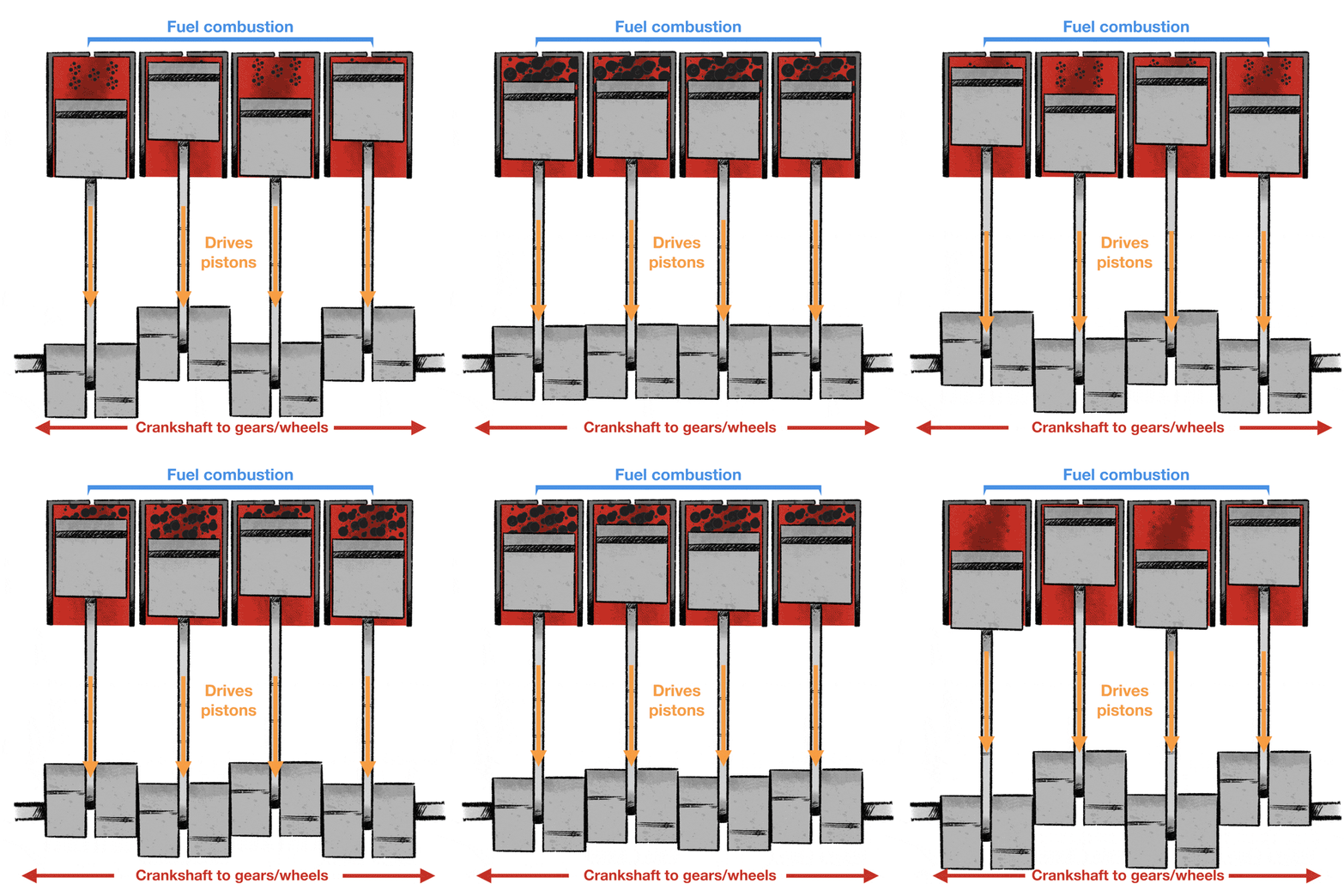
Internal combustion engines and electric motors are very different. In an internal combustion engine, as the name suggests, small amounts of fuel are mixed with air, and are exploded to drive a series of pistons. These pistons drive a crankshaft, which is then connected to a gearbox, and eventually the wheels.
This is a rather simplified overview, but there are literally hundreds of moving parts in a combustion engine. The engine must be “revved-up” to a high number of revolutions in order to reach peak efficiency. The gearbox attempts to keep the engine running close to this peak efficiency across a wide range of speeds.
All of this complexity leads to a significant amount of energy being lost, mostly through friction (heat). This is why combustion engine cars are very energy inefficient.
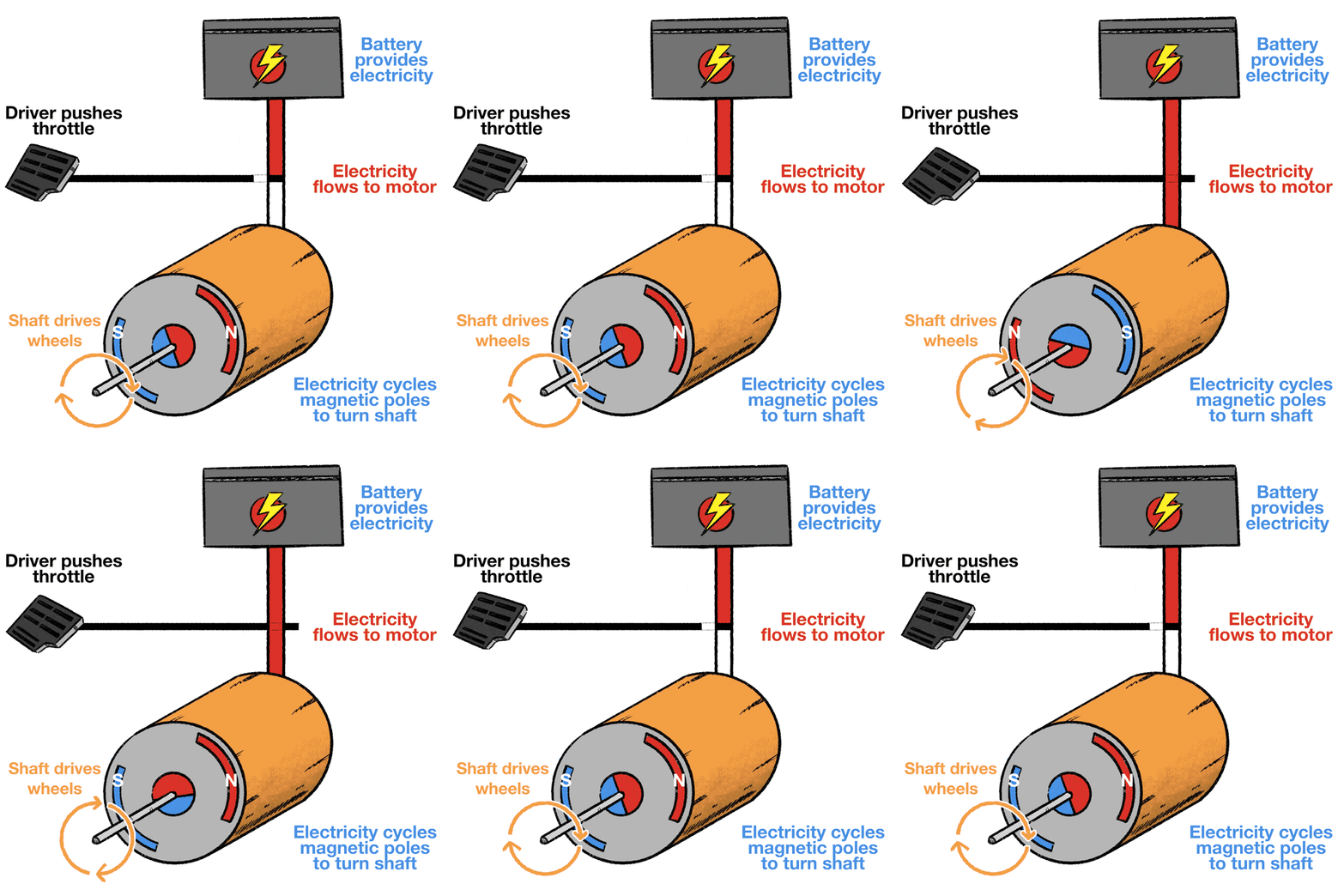
So how are electric motors different? Electric motors are actually pretty simple, consisting of a central rotor, typically connected to a single gear. The rotor is turned by a surrounding magnetic field, which is generated using electricity. The added benefit of this design is that it can operate in reverse, acting as a generator to charge the batteries while slowing down the vehicle (this is called regenerative braking).
On the other hand, the electric motor reacts instantly as soon as the accelerator is pushed. Given the minimal moving parts, electric motors are also highly reliable and require little to no maintenance. Their simplicity also means that almost no energy is lost in friction between moving parts, making them far more efficient than internal combustion engines.
Does simplicity translate to more or less grunt?
Combustion engines need to be “revved-up” to reach peak power and torque. Torque is a measure of how much rotational force can be produced, whereas power is a measure of how hard an engine has to work to produce the rotational force.
As shown below, the power and torque characteristics of a combustion engine means that although a conventional car might have a top capacity of 120 kW of power and 250 Newton metres of torque, this is only when the engine is running at high speeds.
Power and torque characteristics of a typical internal combustion engine. Victor Barreto
In contrast, an electric motor provides full torque from zero kilometres an hour, with a linear relationship between how fast the motor is spinning and the power required. These characteristics translate to a vehicle that is extremely fast at accelerating, with the ability to push you back into your seat.
Power and torque characteristics of a typical electric motor. Victor Barreto
What about pulling power?
For over a decade electric motors have been used in mining trucks, sometimes with a capacity greater than 100 tonnes, due to their powerful, instant torque and ability to pull large loads at slow speeds.
While most of these vehicles have been diesel-hybrids, fully electric mining trucks are now being introduced due to their high power-to-weight ratio, low operating costs, and ability to use regenerative braking to - in some cases - fully recharge their batteries on each mine descent.
Electric motors are also increasingly being used in shipping, again because of their ability to push large loads. In Europe, a number of short-haul electric ships are currently in use. One example is the Tycho Brahe, a 111 metre-long, 8,414 tonne electric passenger and vehicle ferry that operates between Helsingborg, Sweden and Helsingør, Denmark.
The future of grunt
The global transition to electric vehicles is underway. Australians must decide whether we want to capture the enormous benefits this technology can bring, or remain a global laggard, literally being killed by our current vehicle emissions.
While long-distance towing in fully electric vehicles is currently a challenge, in the near future this will no longer be the case with the introduction of long-range electric utes like the Rivian R1T and Tesla Pickup.
In the interim, alternatives also exist, like my own plug-in hybrid electric vehicle. It can tow, drive on the beach, and drive up to 50 kilometres on electricity alone. Charged using my home solar system or The University of Queensland’s fast-charger, it means that more than 90% of my trips are zero-emission.
It is clear that electric cars can provide plenty of grunt for Australians, so let’s make sure we are ready for an electric performance future.
An earlier version of this article stated the electric passenger and vehicle ferry Tycho Brahe was 238 metres long. The article has been updated with the correct length of 111 metres.
While the retail giant did not say which jobs, if any, might be lost as a result, the announcement – and the many more surely to follow at other big box retailers – begs the question: How can workers prepare for a future of increasingly automated work?
Millions of today’s jobs are expected to be affected by artificial intelligence and automation as part of the “fourth industrial revolution.” But just which occupations are most at risk has been a guessing game among economists, futurists and scholars trying to predict winners and losers.
While these broad groupings may grab headlines, they offer little guidance to individual workers at a time when, more than ever, individuals are expected to take responsibility for managing and driving their own careers.
Rather than focus on efficiency or cost, our research offers a more nuanced and sustainable tool for examining the fate of one’s profession: value.
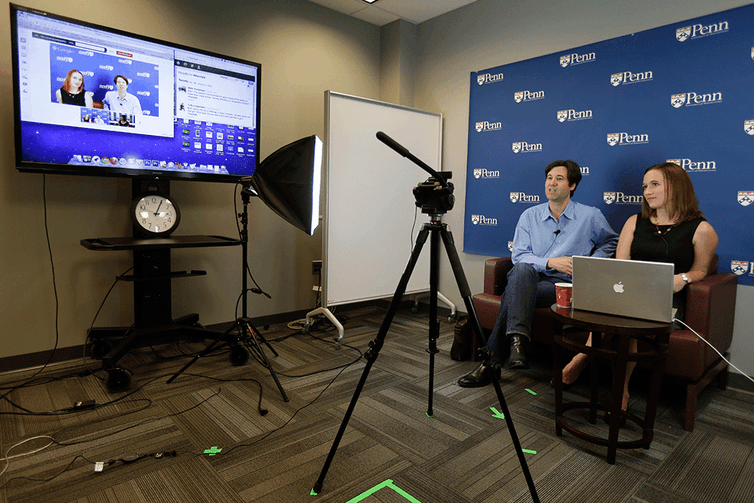
While humans will still value the skills of a college professor in the future, AI and online learning tools are threatening the way those abilities are delivered.
AP Photo/Matt Rourke
Worker value
Our research is based on the idea that every individual’s work creates value in his or her day-to-day job.
That value may be something a customer pays for, may enable co-workers to do their own jobs or may help the company to function internally. In any case, every job provides some degree of worth or usefulness to another party. The value is constant, but the way it is created and delivered to the end user can be threatened by automation and AI. Only after we’ve evaluated that can we determine how the coming wave of technological change will affect a job’s future prospects. To assess these threats, we need to break value down into two key components.
First, value is created by the skills required to complete a job, such as a programmer’s ability to code or a painter’s knack at prepping a wall and applying paint cleanly. In general, we’ve found that when skills are standardized, they are more likely to be threatened by automation or AI.
The second component of value, though, is separate from skills. It’s the method of delivering a job’s value to someone else, which can also be threatened by new technology. We call this “value form.”
For example, while a college professor’s skills and expertise in a particular domain may not be under immediate threat, the form in which their value is delivered is certainly threatened by online learning platforms and the increased use of AI education tools.
By considering these two threats together, workers can better assess if their jobs are at risk.
Displaced or durable
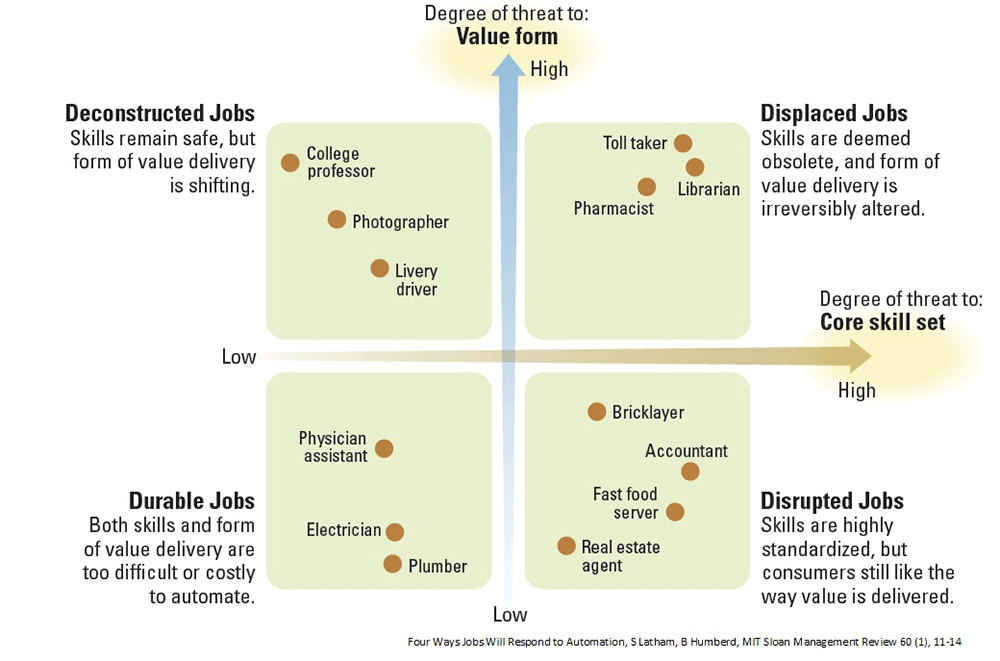
Our framework has four categories: A job could be displaced, disrupted, deconstructed or durable depending on the level of threat facing its skills and value form.
This value matrix helps workers assess the threat their occupations face based on the two components of value.
Displaced signifies the jobs that are most in danger. Our analysis shows pharmacists, radiologists and librarians all belong in the displaced category.
Disrupted means the skills are highly threatened, but people desire the recognized or current method of delivery, which often involves a human interaction. Examples include fast food servers, accountants and real estate agents.
Deconstructed flips those two around: The skills are hardly standardized but automation poses a serious threat to how the job’s value is delivered. Photographers, college professors and livery drivers are in this category.
Durable jobs are the safest ones because both the skills and the value form are difficult or costly to automate. Lucky workers in this category include electricians, plumbers and physician assistants.
What we learn from value
In some ways, the value framework confirms what others have found.
For example, no one would have argued that shelf stockers at big box retailers like Walmart would be a safe job for years to come – as the retailer’s announcement confirms. Putting them in our framework, their primary skills of keeping inventory stocked and shelves clean are severely threatened because they are standardized and routine.
Furthermore, robots can deliver more value through automated transmission of inventory information. Thus, our model shows these workers will most likely be displaced.
However, our focus on value suggests that other predictions based merely on categories of at-risk jobs may be missing the mark. For example, some people predict many jobs are threatened simply because they are routine, non-college-educated or blue-collar, like plumbers, electricians and hospice workers. Yet, rewiring an electrical system in a historic home or caring for a hospice patient are nonstandard jobs that require a human to create and deliver value, which is why these jobs can be quite durable.
What workers can do
Once workers understand the value they create and the threat automation poses to their skills and value form, what actions can they take?
The common answer they’ve been given thus far involves encouraging them to engage in lifelong learning. But a focus on value the way our model does provides much more nuanced guidance.
Workers in deconstructed jobs, for example, don’t need new skills. They just need to learn to adapt existing skills to new forms of delivery. Conversely, workers in disrupted jobs need training to work alongside robots and AI systems during periods of transition.
And even if displaced workers – a fate that is likely to be on the horizon for Walmart’s shelf stockers – need to consider retraining, the traditional higher education system is not well suited for the future of work. Universities focus on the longer-term bachelor’s-to-master’s pathway. Rather, individuals need access to quick, modular and adaptable pathways to new jobs.
The 48-year-old parent who just lost his job as an accountant is not able to begin a new four-year degree program. But a three-month program to earn a cybersecurity certificate would be doable and all he needs.
The future of work is already here. Days after Walmart’s announcement, workers at Stop & Shop, a large regional grocery chain in the Boston area, are striking over increased automation. But we have time. Let’s worry less about robots and AI itself and more about the value workers can create in different jobs in a landscape that will continue to change for years to come. Value is the only constant.
The world's largest airplane -- a Stratolaunch behemoth with two fuselages and six Boeing 747 engines -- made its first test flight on Saturday in California.
The mega jet carried out its maiden voyage over the Mojave desert.
It is designed to carry into space, and drop, a rocket that would in turn ignite to deploy satellites.
It is supposed to provide a more flexible way to deploy satellites than vertical takeoff rockets because this way all you need is a long runway for takeoff.
It was built by an engineering company called Scaled Composites.
The aircraft is so big its wing span is longer than a football field, or about 1.5 times that of an Airbus A380.
Specifically, the wing span is 117 meters; that of an Airbus A380 is just under 80.
The plane flew Saturday for about two and a half hours, Stratolaunch said. Until now, it had just carried out tests on the ground.
It hit a top speed of 304 kilometers per hour (189 mph) and reached an altitude of 17,000 feet, or 5,182 meters.
"What a fantastic first flight," said Jean Floyd, CEO of Stratolaunch.
"Today's flight furthers our mission to provide a flexible alternative to ground launched systems," he added.
Stratolaunch was financed by Paul Allen, a co-founder of Microsoft as a way to get into the market for launching small satellites.
But Allen died in October of last year so the future of the company is uncertain.




 AFP / Riwan MARHIC
  AFP / Johannes EISELE
  AFP / Don Emmert
  GETTY IMAGES NORTH AMERICA/AFP/File / JUSTIN SULLIVAN
  GETTY IMAGES NORTH AMERICA/AFP/File / SCOTT OLSON