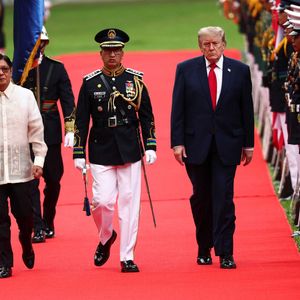
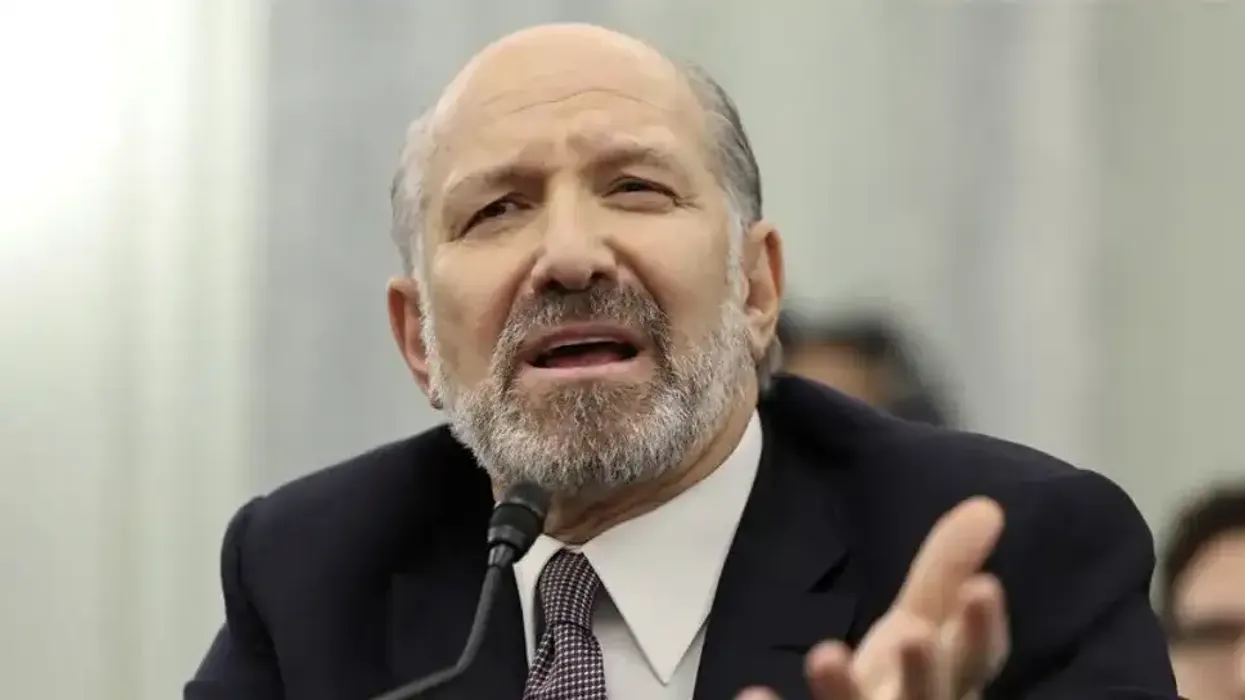
FILE PHOTO: U.S. President Donald Trump speaks next to U.S. Supreme Court Associate Justice Brett Kavanaugh as they participate in a ceremonial public swearing-in in the East Room of the White House in Washington, U.S., October 8, 2018. REUTERS/Jim Bourg/File Photo
Sarah Burris is a long-time veteran of political campaigns, having worked as a fundraiser and media director across the United States. She transitioned into reporting while working for Rock the Vote, Future Majority and Wiretap Magazine, covering the Millennial Generation's perspective during the presidential elections. As a political writer, Burris has had bylines at CNN, Salon.com, BNR, and AlterNet and serves as a senior digital editor for RawStory.com.
Law professor and former Justice Department official Andrew Weissmann took issue with two Supreme Court justices while listening to oral arguments on Thursday.
Before the court was a nationwide injunction from a lower court that paused President Donald Trump's executive order, which redefined who qualifies for birthright citizenship in the United States.
Legal analysts Melissa Murray and Weissmann appeared at the top of Nicolle Wallace's "Deadline: White House," where the panel discussed the case and speculated on how the high court might rule.
Murray said she thought Justice Amy Coney Barrett might find in favor of the migrants because she has two children from another country who had to be naturalized after adoption.
But it was Weissmann who told the MSNBC host that he found Justices Brett Kavanaugh and Samuel Alito's line of comments to be troubling.
"One of the more shocking things were Justice Kavanaugh and Justice Alito. Justice Kavanaugh spent a lot of time trying to normalize what is happening today in this country," said Weissmann.
"Why?" Wallace asked.
"He said, 'Oh, isn't it fair?' And tried to get concessions from the people challenging birthright citizenship, which, as [Justice] Sonia Sotomayor said, seems to violate four — four — not one, not two, not three, four Supreme Court precedents," Weissmann explained. "And he said, 'Oh, this is just a president who wants to act quickly. That's normal. That's good faith. I mean, it was so apologetic."
From Alito, Weissmann said that he made it sound as if no one could trust the judicial system.
"We can't trust district courts, we can't trust courts of appeals. It was a redux of the presidential immunity decision, which is we can't trust the Department of Justice and grand juries and trial juries," he continued. "So, the reason we have to get rid of this is because you can only trust me, but not any of these lower courts, because they're really, you know, doing this sort of crazy stuff. It was — I mean, it was a continuation of the don't trust institutions, trust me [argument]. I found those two justices deeply disturbing in their questioning."