

This is the fuel of MAGA's blind devotion
If only Trump's devoted MAGA could use this to fuel their trucks.
Nick Anderson is a Pulitzer Prize-winning editorial cartoonist.


If only Trump's devoted MAGA could use this to fuel their trucks.
Nick Anderson is a Pulitzer Prize-winning editorial cartoonist.
Two very different demos have recently risen to social media prominence: GenX women and our polar opposites, the MAGA Trad Wives. The starkly opposed messaging is making a real case for the “nurture” part of the “nature vs. nurture” argument during a time when women’s rights are constantly in flux.
GenX Women — aka the “Forgotten Generation”— have emerged as a hugely influential group thanks to being the (better) half of the last fully analog generation on the planet. Too many GenX men are MAGA, which is why liberal GenX women have found our collectively loud social media voice amid our current AI garbage fire of MAGA fakery. We are rightfully raging as we refuse to remain silent during our menopause, from the peri- to the post-menopausal years. Black women in particular are leading the female GenX trends, and rightly so.
It took us forever to get here, and we’re going to make sure everybody knows it.
Call it Middle Rage instead of Middle Age. Our mothers and grandmothers may have suffered through the “change of life” in silence, but we’re absolutely not going gently into our golden years. Several celebs in their 50s now have menopause wellness lines and are very vocal about how it’s changed literally everything. The Portland-based Menopunks podcast/documentary project has grown exponentially over the last year.
We have plenty of wisdom to impart on the younger generations, because we’re made of the toughest stuff. Raised on hose water, Twinkies, and frozen pizza we made in the toaster oven in our empty house after walking home from school by ourselves, the latchkey GenX kids are better prepared to take over this country than you might think. We stood on kitchen chairs to cook our own breakfasts on the stove by the age of 5 or 6. None of used a bike helmet or a seat belt until the government mandated them. Our parents had no idea where we were most of the time during the summers, and we all had jobs by the time we were 15.
Plus, with all of our tattoos and other body modifications, we’re also poised to be the coolest old people ever! We’ve already made going naturally gray both hot and cool, and we’re also using fewer facial fillers than our moms.
But it’s our collective political voice that’s emerged as our strongest asset, because we’ve lived through decades of sexism and misogynist microaggressions, and we aren’t having any of what the MAGA Mean Girls and the Trumpy Trad Wives are putting out there.
If you’re not familiar (and oh, how I envy you!), the Trad Wife is young, Christian, white, and obedient to her husband, who’s often much older. Not at all Epstein-y. Anyway, they embrace a “Little House on the Prairie” lifestyle of doing all of the housework and child-rearing while the menfolk make — and therefore, control — the money. They call it “spousal submission.” I call it domestic abuse.
I’m oddly fascinated by women who vote for Republicans. There are multiple memes for it, but the best one is probably any that shows someone punching themselves in the face. Or just pointing out that it will never make sense.
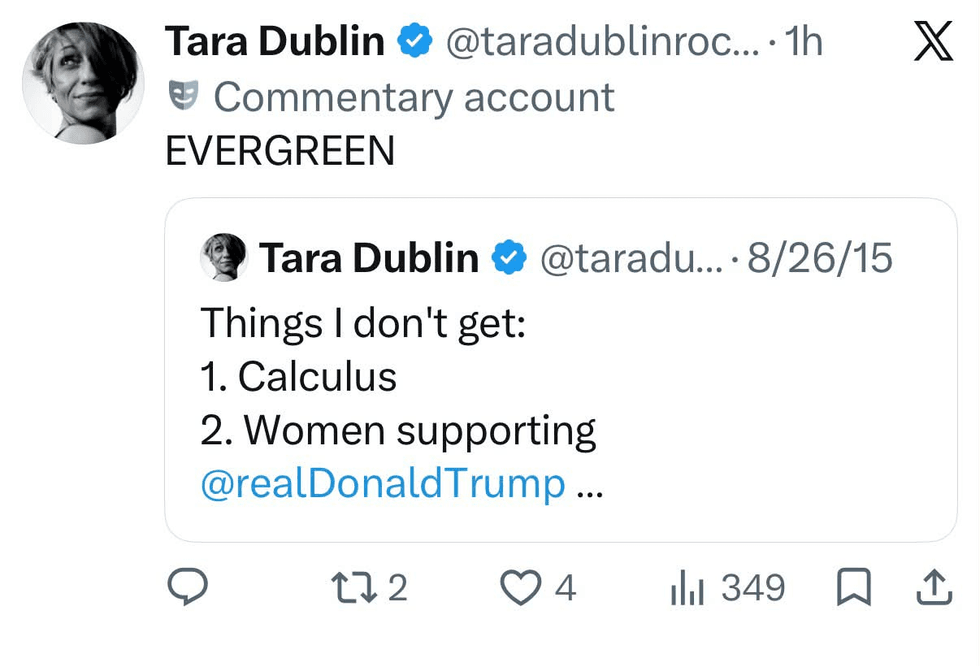
There really isn’t enough internet space to delve into the subjugation of women since the dawn of time, so we’ll just fast-forward to the last few decades of watching Republican women hand over their bodily autonomy to men for *checks notes* reasons I don’t get.
But they’ve been immersed in a groupthink cult experiment for their whole lives, mostly due to the patriarchy of Christianity. Religion is a choice, and once you’re an adult, you have a duty to yourself to question everything you’ve been told when you’ve never been given any proof.
Thinking for yourself isn’t hard and should always be encouraged. However, the cult-like atmosphere in which most conservatives are raised clearly doesn’t lend itself to individuality. No one is born hating anyone or believing anything; our parents are our first teachers, and whether or not they’re aware of it, they’re imprinting us with their belief systems instead of letting us create our own.
But MAGA women are still women, and I’m not letting them distract me with that stupid “what is a woman” question they use as a distraction from the cult stuff they’re doing.
I want to know why they’re okay with giving up their bodies, brains, and basic human rights to men. They’ll say they’d be fine with the abolishment of the 19th Amendment. They believe that getting married young and having a huge family is all they’re meant for. They don’t question any of the GOP’s tactics or the evils of Project 2025/2026, they just repeat whatever they’ve been told.
A recent viral example of this is the helium-voiced, non-blinking Julia Kate, who doesn’t use her last name and speaks in the overly cheerful cadence of a cult member, even when she’s defending Donald Trump’s horrific track record. She just got a whole bunch of negative attention thanks to a debate on Jubliee Media, which seems to exist solely to create ragebait videos. Julia Kate claims that all women need to marry young and get into their Birthing Vessel Era by having no less than 10 children as fast as possible.
GenX women would like a few moments with Julia Kate and her ilk to set them straight. MAGA women will also go through childbirth, menopause, and other things that their men won’t like. We can see how ill-equipped they are to handle real life and wonder how they manage to even dress themselves (which is mostly like a human version of a Holly Hobbie doll, yet another GenX reference).
But it’s so much more than just making viral videos. It’s making sure women achieve full equality. It’s electing more Democratic women to be louder than the weak Republican men who fear our power. And it’s setting the example for those coming up behind us.
Is it just me, or has anyone else also noticed that our president has been melting down even more than usual lately?
That whole “no guardrails” thing, combined with being surrounded by sycophants who are only too eager to do all of his bidding without questioning it and Congressional Republicans who almost without exception remain scared to death of him – plus immunity – has produced a monster who believes no court order applies to him and no law can stop him from doing whatever the hell he wants.
Given the above, I don’t think it qualifies as catastrophizing to conclude that all bets are off when it comes to this guy’s wholly unpredictable behavior and what he’s prone to do when faced with what’s looking like an increasingly likely blue wave washing over the midterms to deliver a Democratic majority in both the House and Senate.
The question becomes less how Trump is likely to act and more what the rest of us will do to stop him if a worst-case scenario comes to pass. Because unlike what some believe, stopping him is not only possible but essential to ultimately restoring the health of the republic.
But let’s try to look at this logically, if anything resembling reason can even matter when it comes to the least stable leader this country has ever been forced to endure by a very wide margin.
Trump has done nothing to indicate he’ll play by any rules other than his own; ergo, I have precisely zero confidence that he will, for instance, heed the original injunction put in place by Federal District Judge Indira Talwani that the U.S. Postal Service cannot refuse to send-out mail-in ballots because a state hasn’t complied with Trump’s onerous new requirements that were essentially rubber-stamped by the Supreme Court.
You know that sense of relief you got on September 14 when the Supremes uncharacteristically declined to overturn Judge Talwani’s order? Well, forget about that.
It would be entirely on brand at this stage for Trump to disregard what the courts said and order the USPS to, for instance, withhold the sending out of mail-in ballots to blue states – in other words, go utterly rogue. He could just say, “I overrule the order because I believe it’s unfair, and as president I have the power to correct this grave error.”
He doesn’t, of course. But who is going to tell Trump he doesn’t? You? Me? Certainly not the lily-livered House and Senate.
Let’s remember that he still has a loyalist presiding in USPS Postmaster General David Steiner. Steiner already announced that he’d abide by the courts’ determination of the post office’s legal authority, but a lot of people have said a lot of things lately that wind up not being worth squat.
So let’s say USPS decides to do the president’s bidding, anyway. Trump would laugh at threats of additional injunctions and civil contempt sanctions. The only thing he seems to understand and heed is brute force, and the courts ain’t got it. However, he personally has it in the form of his very own ICE militia/goon squad.
The Supreme Court doesn’t command an army or police force of its own. Federal courts in general have limited independent means of physically ensuring compliance with their decisions. Before Trump, this was simply not an issue, since we were not an authoritarian state ruled by a would-be dictator. (Actually, I think we should erase the words “would-be” at this point.)
The constitutional system has historically depended entirely on executive officials accepting judicial judgments as binding. I wouldn’t be so sure that’s going to continue.
Imagine this: the president orders defiance on mail-in ballots. USPS leadership complies. Subordinate officials comply. The Justice Department refuses to assist the court (thanks Todd Blanche). Executive officials refuse to implement contempt orders, and even if they do, there’s no one to enforce them.
Even if Congressional Republicans were suddenly to locate their long-lost spines, the whole process of conducting investigations and hearings, subpoenaing officials and even invoking the impeachment process would likely take far too long to save the midterms.
Bottom line: there is no automatic mechanism in place to stop such illegality should Trump and his group of enablers choose to go that route.
Should a rogue Trump fly completely off the rails of legal and ethical comportment surrounding the midterms, the mail-in ballot system would be only one of the alarming concerns (and perhaps not even the primary one).
He could direct federal agents to seize ballots or voting equipment at polling locations, throwing the whole process into chaos.
He could deploy federal law-enforcement troops around polling places, as has already been regularly threatened, to intimidate voters and potentially transform numerous locations into immigration roundup zones.
He could call up the National Guard or other armed military to crack down and toss the election into further turmoil by invoking a sham emergency.
He could use federal investigations to obtain voter registration databases, demanding voter files from states and invoking voting-rights or election-integrity laws.
He could attempt to dictate which voting machines states may use.
He could attempt to impose new nationwide voting requirements and ID laws by executive order, essentially instituting elements of the SAVE Act unilaterally in the purported interest of preventing fraud and keeping election integrity intact.
He could try to disrupt the counting of ballots after Election Day, claiming that suspected federal crimes justify obtaining ballots, records or equipment while tallying or canvassing are underway.
He could attempt to use the DOJ (thanks again, Mr. Blanche) to stop or alter counts, filing lawsuits and requesting emergency injunctions.
Mind you, all of this could be accomplished no matter how any federal court rules if Trump simply decides the judiciary doesn’t matter. That’s more than a mere constitutional crisis, boys and girls. That’s democracy in its death throes.
I would be shocked if at least some of this isn’t on the White House drawing board and/or being prepped for implementation, and so would you. If the rulings of judges are ignored, this thing stands to get very ugly very quickly.
I pray that it doesn’t come to that.
(Ray Richmond is a longtime journalist/author and an adjunct professor at Chapman University in Orange, CA.)
I was reading a story about how Donald Trump had so thoroughly destroyed the Kennedy Center, a once-great arts institution reduced to a pathetic shell by one man’s seemingly deep-seated enmity at John F. Kennedy’s ongoing, and entirely justified, veneration. It was clear that Trump’s goal all along has been to raze the venue and rebuild it as the Trump Center, so egomaniacal is he.
The thing is, this sort of pitiful move is entirely on brand for this president. He is at war with America’s history, the goal being to erase it and install himself as at once the demolisher and self-appointed savior of everything that has been and will be. He is all about marking his territory with toxic urine. If it doesn’t bear his name and/or likeness, he believes it carries no value and must be wiped from the face of the earth.
Indeed, to catalog the institutions, ideals, norms and shared assumptions of American life that Trump has sought to destroy during both his first and (especially) second administrations is to perceive an impossibly voluminous obliteration of things and standards that once seemed permanent and invulnerable.
What follows here, in no particular order, is a list of what Trump has ruined through either his hideous taste, inept decision-making or purposeful hostility. It is by no means a complete list, as that would require a multi-book encyclopedia.
The deeper argument here is not simply that Trump is singlehandedly destroying American democracy, science, education, journalism and the rule of law. They remain essentially intact despite the enormous and continuing pressures placed on them to completely implode.
What seems the larger point is how his two presidencies have exposed how much of our lives depends on voluntary restraint, institutional independence, public trust and a willingness to accept limits on power, the kind of limits that Trump will never believe apply to him.
As we sit less than six weeks from the midterms, it’s instructive to remember that a constitution cannot enforce itself and a democracy can’t survive indefinitely without a vigorous defense. We must start to reverse his purposeful destruction of everything we hold dear.
November can’t come soon enough.
(Ray Richmond is a longtime journalist/author and an adjunct professor at Chapman University in Orange, CA.)
I feel optimistic about the midterm elections, just over five weeks away. But my stomach aches when I think of what’s at stake.
Call me nauseously optimistic.
I suspect you’re in a similar place.
If it were only the polls, I’d feel reasonably good. Here’s one that stuck out for me: The share of Republicans who say the economy is better than a year ago has collapsed from over 70 percent in January to 29 percent in September, according to last week’s New York Times/Siena poll.
Here’s another: According to a Wall Street Journal poll, just 37 percent of Americans approve of the job that Trump is doing — the lowest approval rating of any president heading into a midterm election in Journal polls dating to 1990.
Another good sign: Because of Trump’s unpopular war, his dreaded tariffs, and their effect on prices, Republicans in tight races are starting to tiptoe away from Trump. In recent days, Maine Senator Susan Collins and Kansas Senator Roger Marshall have distanced themselves from Trump on tariff policies that they say hurt small businesses and rural communities in Maine and aircraft production in Kansas. Nebraska Senator Pete Ricketts has questioned whether consumers would see lower prices from Trump’s decision to temporarily allow more foreign beef imports into the U.S., a move that’s opposed by ranchers. All three senators are seeking reelection this year.
In the House, seven Republicans, including a group facing tough reelection races, joined Democrats this past week in passing a measure directing Trump to remove U.S. forces from hostilities against Iran unless Congress authorizes the war.
Republicans are also uneasy with Trump’s refusal to regulate AI, data centers, or even Flock Safety cameras — which most Americans now oppose.
And I think this is fascinating: Mentions of Trump’s name per hour on conservative podcasts have fallen nearly 70 percent from their peak in the run-up to the 2024 election. Monthly mentions of his name have fallen 30 percent since the U.S. launched the war in late February.
All encouraging.
But what makes my stomach churn is the vast amounts of money from some of the worst right-wing billionaires in America (cue Elon Musk) now being poured into key races to finance a barrage of ads favoring Republican candidates and making stuff up about Democrats and progressives.
My stomach also aches when I think about what Trump and his regime may try (and have already tried) to do to interfere with our elections and further erode public trust in them. On Friday, for example, the Supreme Court lifted restrictions on a federal voter database pushed by Trump. Even worse, his regime refuses to rule out sending ICE agents to polling places.
So our work over the next five weeks is essential — phoning, writing, canvassing, getting out the vote, and, to the extent we can, funding candidates who will help average working Americans.
Yes, money talks, and Trump is a vicious dictator. But there are far more of us than there are Trump’s billionaires — more of us to do the talking and the organizing and the mobilizing. And far more of us to guard our electoral system than there are Trump lapdogs and agents.
And always remember this: We’re on the right side — the side of the people seeking the common good rather than the corporate and techno-billionaires seeking additional wealth and power for themselves.
Which is why I’m nauseously optimistic that we will prevail in just over five weeks. And you? How do you feel?
Donald Trump made history this week when he achieved something none of his predecessors ever could: the lowest approval ratings since approval ratings began. He’s languishing at -26, according to YouGov polling. Nowhere near the winning MAGA was promised.
It’s almost as if he’s deliberately trying to look as bad as possible so he can keep embarrassing our country on the global stage. Witness his welcome for Chinese President Dictator Xi Jinping, which was an exercise in full cringe. Oddly bundled into a winter coat with black leather gloves covering his badly bruised hands, Trump tried to show off for Xi during a military flyover, but ended up wincing in fear while saluting absolutely no one.
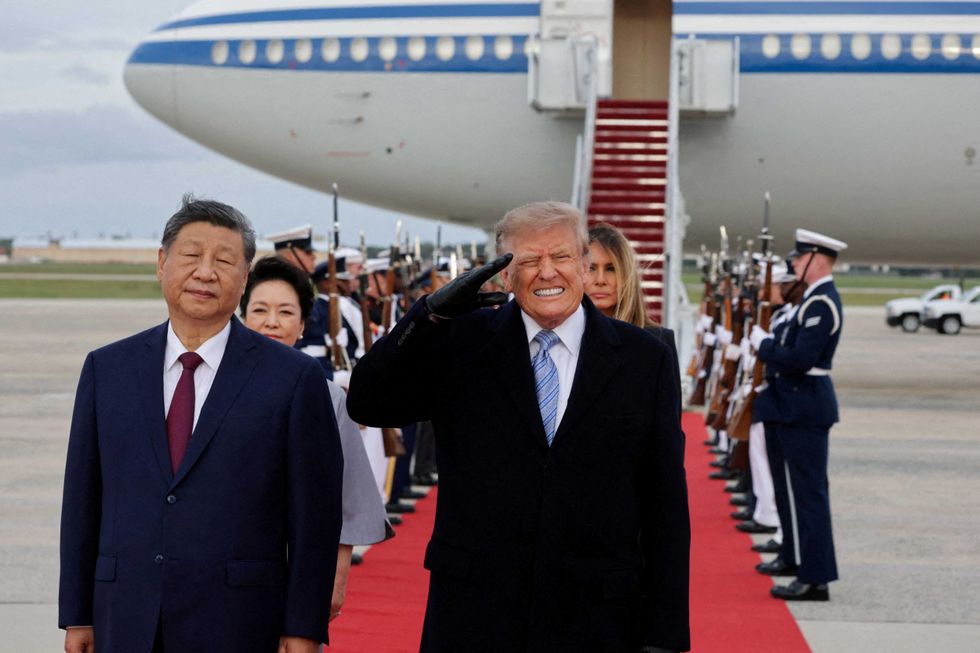 US President Donald Trump reacts to the roar of B-1 bomber flyover during the U.S. national anthem as Trump salutes next to Chinese President Xi Jinping during an arrival ceremony ahead of a state visit at Joint Base Andrews, Maryland, US, September 23, 2026. REUTERS/Jonathan Ernst
Then Trump led Xi on a tour of what used to be our White House, but has now been decorated with leftover stock from a Hobby Lobby in Moscow. Trump’s Wall of Hate is especially infuriating to see hanging in the People’s House, serving only to boost King Baby’s weak ego. Imagine thinking it’s a flex of any kind to bully Joe Biden and Barack Obama in front of the Chinese dictator, who openly laughed at the “Autopen” display. Trump is so feckless, he thought Xi was laughing with him, instead of at him.
I miss dignity from the White House. Also, I just miss our White House, which isn’t his house, and he never should’ve been allowed to change any part of the structure. It was the first step in his intentional vandalization of DC to make America look as weak as possible on the global stage, a display for his Daddy Vladdy, Xi, and other dictators that the U.S. is that easily bought.
Also on display for Xi: the least effective First Lady ever, Melania “I don't care” Trump, who couldn’t have made it clearer that she hates her husband.
While she’s always enjoyed the material spoils of being the third Mrs. Trump, she’s also looked the other way at his philandering, probably because she doesn’t want him touching her. It’s no secret that Melania never had any interest in being the First Lady in the first place, which was painfully obvious when Trump ran in 2016. She took no joy in the scrutiny of public attention, and any speeches she made on behalf of her husband came across as joyless chores. If he lost, it was rumored Melania would finally divorce him.
That rumor took hold even tighter after Melania famously remained behind in Manhattan with Barron instead of moving to the White House, claiming he needed to finish school in New York. Once she finally made the move, she made it clear she was doing it under protest.
Melania allegedly demanded a new toilet in her en suite bathroom because Michelle Obama had used it before her, according to a book written by her former aide, Stephanie Winston Wolkoff. “Melania took one look at her bedroom off the West Sitting Hall and said, ‘I’m not moving to D.C. until the Residence has been renovated and redecorated, starting with a new shower and toilet,’” the book says.
“Melania did not conduct business on a previously-used john."
Published in 2020, Melania and Me: The Rise and Fall of My Friendship with the First Lady details the strained relationship between Melania and her elder stepdaughter, Ivanka. Before Trump’s first inauguration, Melania and Winston Wolkoff plotted to keep Ivanka from drawing attention during the 2017 swearing-in ceremony in what they called “Operation Block Ivanka.”
Imagine if Jill Biden had tried the same thing with Hunter.
Like her husband, Melania has a habit of taking out her personal misery on everyone else, which is why she paved over Jackie Kennedy’s Rose Garden and turned the White House into a Handmaid’s Tale Christmas Horror Show.
Melania has never taken to the role of First Lady. She doesn’t visit sick kids in hospitals or read to them in libraries. She doesn’t go on “Goodwill Ambassador” tours or promote initiatives to make anything better. Instead, she promoted the biased documentary about her that aired on Amazon Prime and has made her full lack of interest in other people her entire aesthetic.
The former model knows how to turn on a smile for the cameras, but the Unhappy First Couple’s unhappiness was on full display during Xi’s visit this week when they thought no one was looking, probably because Trump still won’t lift the press ban a federal judge ordered him to lift. Check the unguarded body language in this image. Who’s the most miserable? They don’t even try to hide it. Could this be any less presidential?
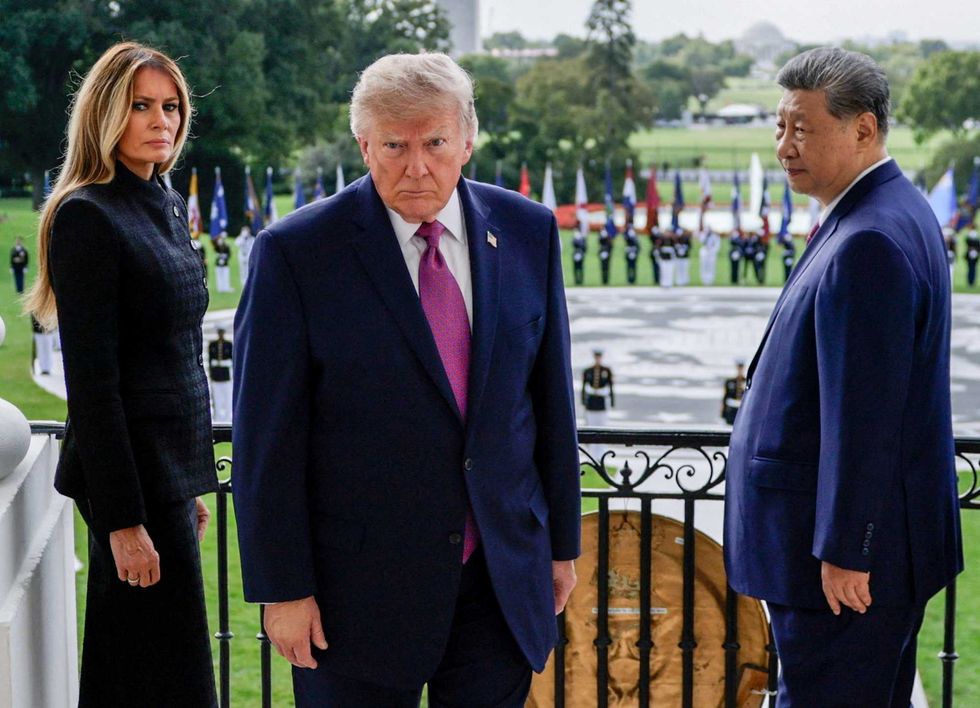 US President Donald Trump, first lady Melania Trump and Chinese President Xi Jinping after watching a military demonstration from a balcony of the White House in Washington, D.C., US, September 24, 2026. REUTERS/Evan Vucci
Like, they have no desire to interact with each other at all. That’s some extreme body language on display.
I share two important things with Melania: a birthday (April 26th; I’m one year older than she is) and a white-hot hatred for her husband. But she’s not a prisoner of her own making — she’s a willing co-conspirator, happy to live off his grifted billions until she can finally get away from him.
So when you see Melania looking miserable, never feel bad for her.
Sabrina Haake is a political analyst and 25+ year federal trial attorney specializing in 1st and 14th A defense. Subscribe to her free Substack, The Haake Take.
Thursday’s ruling from U.S. District Judge Timothy Kelly putting an end to Trump’s White House media ban was lamentable for the speed with which it was issued. An exhausted nation was enjoying a break from Trump’s vitriol dominating every channel but, alas, the reprieve was short-lived.
On September 24, only three days after banned outlets CNN, MSN, and Politico sued, Kelly ordered the White House to ‘immediately return, reinstate, and restore’ their access to the White House. The judge said the banned media outlets had met the legal thresholds for a temporary restraining order, which he put into effect for 14 days. “This is a high bar,” Kelly wrote, “but Plaintiffs have met it.”
At argument, Trump’s DOJ made a laughable attempt to call his press ban a “matter of national security.” The DOJ argued that the three banned news organizations engaged in a “non-exhaustive list of reporting incidents” that “threatened national security and spread falsehoods.” Those incidents included publishing construction details about the East Wing bunker, reporting on who is really funding the White House ballroom, and reports detailing how U.S. munitions stockpiles were affected by the administration’s mistakes in Iran.
Kelly rejected the DOJ’s “national security” explanation as an after-the-fact justification. The judge noted that Trump had not used a national security argument when he announced the ban, but instead focused solely on what Trump called negative coverage of his administration.
Trump TV: when a man gasps for attention like a fish out of water
On the day of the hearing Wednesday, after Kelly had failed to immediately rule, even though the ban was a textbook example of government censorship, I was hopeful the judge would drag his decision out, because other major news networks had suspended their shared pooled television coverage of Trump in solidarity with the banned networks. The media boycott left Trump with comically reduced media exposure as even The New York Times and The Washington Post stopped publishing new Trump images.
The media blackout was so effective, it seemed perhaps Kelly, a Trump appointee, might have a partisan motive in prolonging it: to help Republican candidates in competitive races by reducing Trump’s face time. A delayed ruling meant continued diminished Trump coverage, also a welcome balm for our collective mental health.
But taking airtime from a creature formed by Reality TV and media attention was like taking a fish out of water. Deprived of 24/7 media attention, Trump’s pitiful wet flopping on the deck prompted his staff to create a quick and embarrassing replacement: Trump TV, a 24-hour YouTube livestream of White House coverage — curated, of course, by the White House.
Trump calls himself the “King of Ratings,” but Trump TV debuted to hilariously small numbers, peaking at around 8,000 viewers and frequently dropping down to a few thousand. As of Thursday morning, under 500 live viewers were watching. The internet blew up over the fact that a YouTube stream of a black screen and box fan had more viewers than Trump. One of the funniest sentences ever written, thank you Roxanne Cooper of Alternet, said it all: “Trump TV was similarly crushed by random ambient streams of people getting pedicures.”
And now, a blatantly illegal campaign ad
Trump’s lesson in humility would be funny, but Trump has taken State TV to the next illegal level. Fox News is now airing a new partisan ad promoting Trump, “paid for by the U.S. government.” The 30-second video combines rapid cuts of Trump, American flags, and military aircraft, alongside claims about tax cuts, manufacturing, and policing. Images of Trump are accompanied by a choir singing, “Love me,” repeatedly. It ends with Dana White saying, “He is the toughest, most resilient person I’ve ever met, and nothing was going to stop him from fighting so hard for the country he loves.”
Spending tax dollars on political campaign ads has long been illegal under federal law. The Hatch Act prohibits federal employees, as well as local government employees under federally funded programs, from engaging in political activities of any kind while they are on the clock. The General Government Appropriations Act also prohibits the expenditure of any tax dollars to produce partisan content. Ads that glorify an official or an administration, like singing “Love me” against a backdrop of militaristic Trump images and brags, blatantly violate both laws.
Internet reaction was swift and correct. Occupy Democrats' Grant Stern tweeted, “Dear Leader is using YOUR tax dollars to make this insane propaganda with a musical track that says 'Love Me' on repeat.” Author Brendan Noble asked, “Why is the U.S. Government paying for cult-level media like this? 'Love me' over images of Trump feels like some weird psychological play. Regardless, it's propaganda with our tax dollars.”
The cost of the absence of truth
The ad is an obviously illegal use of taxpayer dollars, and a legal reckoning will come at some point, IF the 90 million voters who stayed home in 2024 care more about the price of gas than they cared about Trump’s J6 coup attempt. But more dangerous than Trump’s continued abuse of power is the fact that Trump appears to believe his own falsehoods.
Much noise has been made about Trump’s assistant Natalie Harp, who follows him around with a portable printer. It’s widely reported that Harp shows Trump only favorable news stories, positive polling, and praise. Trump inhales that disinformation and regurgitates it back to a press pool allergic to hard questions because they are owned by Trump’s corporate backers.
Steady flattery may make the job more palatable to a man getting tired of politics, but it’s dangerous. Trump can’t make informed decisions if he only hears information he wants to hear; advisors with nefarious intentions can also shape information to manipulate him. But that’s what seems to be happening: Trump believes we are winning the war in Iran because Hegseth tells him we are; he believes the economy is strong; he thinks world leaders respect him, even as they mock him and move toward alliances excluding the U.S.
Unfavored media outlets’ crucial role is correcting Trump’s misinformation on everything — the war in Iran, the economy, even foreign trade. They may have returned to the White House, but the extreme danger of a president so insulated from the truth that he believes his own propaganda remains.
As President Xi heads back to China, one imagines him, like any other tourist returning home after a long trip, meeting with old friends who are sure to ask how his trip went — and to have him recount the highlights.
This is what I imagine Xi would say, translated into English, of course:
When we landed, they made me stand in the doorway of the plane for like forever while they unfurled a little red carpet. You know, here in China we can lay down a mile-long red carpet at lightning speed and watch a million soldiers walk on it in perfect formation in under a minute, but the Americans took forever smoothing it out. I think they spent so much time on it because Donald has trouble walking in a straight line on carpets.
Then Donald was waiting at the bottom of the stairs for me, and I was like, “What?” It apparently was the first time in decades an American president had greeted a visiting leader planeside. I mean, I didn’t go to the airport to meet Donald when he came to China because, as a dictator, I’m too busy with crushing freedom. I just don’t have time for such trivial matters.
When I reached the bottom of the stairs, I said to Donald that he didn’t need to come all this way since I’ve been to D.C. before, and I knew the way to the White House.
The weather was pleasant enough, but Donald was bundled in a heavy coat and gloves, like there was a blizzard coming, but I think he was wearing those things to hide the bruises on his hands and the contraption he seems to carry around on his backside.
Within the first five minutes, he started with his incessant attempts to impress me, starting with a flyover of America’s bombers roaring overhead. Again, it looked puny. You know the way we do things in China, we have 200 planes roaring overhead during our National Day Military Parades in Tiananmen Square.
Now, let me show you a picture. As the planes were flying over, look at the expression on Donald’s face. I said to Peng Liyuan that Donald clearly has a very low threshold for pain or discomfort, and she reminded me that he didn’t serve in the military because he had a little bone spur in his foot. So the expression made sense.
While we were there, there was a big controversy going on because Donald banned three news outlets from the White House. And yes, Peng Liyuan and I had a good laugh about that too. I can’t remember the exact number, but I have imprisoned between 50 and 113 media professionals. I don’t just ban them. Donald is such a wimp.
When we pulled into the White House, the media was standing outside the gate like groupies at a TFBOYS concert.
Oh, and the altruistic rest of the media allowed on the premises decided not to send cameras to my White House welcome ceremony in solidarity with the three outlets that were banned. Boy oh boy, you should have seen how angry Donald was that there were no American news cameras there.
Of course, China was well represented. I mean, if they didn’t show up, or decided to support free press, you know very well what would have happened to them once we crossed into Chinese airspace on the way home.
Donald showed me this little helipad he put in the backyard of the White House. He kept bragging about how he liked granite and kept fussing over this silly little circle. I wanted to say that I have got 109 acres of granite at Tiananmen Square to land a plane on if I wanted, so you want me to be impressed with your little granite sandbox?
It was just another example of how this friendship is so one-sided. He has all these things that he boasts about, but does he realize who he’s talking to? Who I am? And all the infinite material possessions I possess as a result of my dictatorship?
For example, he took me for a walk along what’s called the West Wing colonnade, showing me how he put up all of his predecessors’ “portraits,” which are just little 8-by-10s in fake gold frames. I kept biting my tongue, trying not to laugh, because again, does he realize who he’s talking to?
I have an enormous hand-painted oil portrait of Chairman Mao over the Tiananmen Gate that measures 20 feet by 15 feet and weighs 1.5 metric tons.
But then, I just couldn’t hold my mirth anymore when he paused at Joe Biden’s photo and jokingly said, “This is the autopen — it’s Biden.” I broke out laughing, which is something I don’t normally do, and not because what he said was funny. It was because it all seemed so immature and childish. This man is the most powerful person in the world, and this is how he spends his time?
We are going to kick America’s a-- once we declare war on them, economic or otherwise, because their leader has the mentality of an incorrigible six-year-old.
Then we had what’s called a State Dinner in the quaint dining room of the White House. It’s about the size of Peng Liyuan’s bathroom. Donald gave us this sculpture of a bird, an eagle, I think, although it looked like a prehistoric bird, and I’m not sure why he gave me something that represents freedom, since that’s the last thing in the world I care about.
Then there’s his silly ballroom. He talked about it all day, and then wanted us to go behind some magic curtain to see what he said was a “nice and clean and sparkling” construction site. What a disappointment.
Again, Donald is not my friend, because if he were, he’d know that our State Banquet Hall alone spans 75,000 square feet and easily seats 5,000 guests for dinner simultaneously, which makes his 22,000-square-foot ballroom look pathetic.
I mean, I could keep going, if you want, but I’d rather talk about my plans to have AI supremacy for China so that we can destroy humanity, or at the very least, do more to destroy China’s freedoms.
Sabrina Haake is a political analyst and 25+ year federal trial attorney specializing in 1st and 14th A defense. You can subscribe to her free Substack, The Haake Take.
Veterans are standing in the middle of D.C.’s Memorial Circle at rush hour with banners denouncing plans for Trump’s arch. Their continuing protest, which started on Memorial Day, features a replica arch and an urgent plea to “protect and defend the solemnity and honor of this hallowed ground.”
The veterans have a point the rest of us need to hear, including 'unitary executive’ nonsense-spouting Supreme Court justices who think the madman at the helm is free to take a wrecking ball to our nation’s historical monuments. At 25 stories tall, Trump’s arch would deliberately diminish the stature of monuments around it, and would forever obscure historical sightlines, laid after the Civil War to symbolize national healing.
At the protests, Retired Army Colonel Ann Wright, a 29-year Special Operations officer, carries an “over our dead bodies” banner for “Mr. Bonespurs, with five deferments from the military.” The veterans’ spokesperson explained that, “To place a memorial that would obstruct the unbroken viewshed from the Lincoln Memorial to Arlington Cemetery would totally destroy all that this space represents.”
Trump’s sacrilege
The targeted sightline, unbroken across the Potomac River via the Arlington Memorial Bridge, was rendered two generations after the Civil War as a symbol of national reconciliation. The memorial to Abraham Lincoln, preserver of the Union, deliberately overlooks Arlington, the estate of Confederate Robert E. Lee and the hallowed burial grounds for both sides, to symbolize the enduring triumph of national unity over the tragedy of division.
Alignment of those monuments was key. Lincoln’s memorial (‘A house divided against itself cannot stand’) solemnly overlooks the shared blood and soil of Arlington’s dead. Veterans are concerned that a giant arch dominating Arlington, now the final resting place of more than 400,000 war veterans, many of whom died in battle, would overpower the significance of their sacrifice.
Retired Army Major General Paul Eaton called the arch “entirely inappropriate, (bordering) on sacrilege to the men and women buried” there. A Gold Star mother whose son is buried at Arlington lamented grievously that the arch’s planned observation deck means tourists will be able to take selfies while burials are happening.
“We don’t need tourists overlooking funerals. I’m just appalled,” she said. “We need everybody to speak out about this.”
The legal battle
In May, a federal panel packed with Trump appointees approved plans for the arch, then in August, the National Park Service found the monument would have “adverse effects” on several historic sites. Although aviation experts noted the hazards of a 250-foot arch near the runway of one of the nation’s busiest airports, last week Trump’s FAA approved the plans.
Meanwhile, Vietnam War veterans have sued to stop the project, challenging the arch for both lacking congressional authority and blocking historically significant monument sightlines. Earlier this month, a federal judge ordered the administration to provide at least 48 hours’ notice before conducting any activities on the planned arch while the case is pending.
After that order, over a year after revealing plans for the arch, and after the Supreme Court let Trump get away with his ballroom on manufactured national security grounds, Trump then raised a national security rationale for the arch. Last Sunday, Trump claimed that he’d “agreed” to convert the proposed arch, at the “strong request” of the military, “into a top grade Military Complex/ Triumphal Arch,” alleging that:
"(F)or National Security purposes, I have agreed to convert the magnificent Triumphal Arch, planned since the Civil War Era many years ago, (laughably false)… into a top grade Military Complex/Triumphal Arch…”
Trump said his arch would “house, store, and have the rapid ability to use large numbers of drones, plus Snipers, on both the roof and plaza areas, and additionally have and hold large quantities of sniper ammunition in storage.” Arlington’s historic message of national healing — and the devastation of its opposite — is sadly lost on the most divisive president in our nation’s history. He also seems to miss how a Hitler-inspired monument would discourage tourists who may not want snipers aimed at their heads.
Ye old national security ruse
Courts have long given deference to the executive on matters of national security. In 1936, the Supreme Court said presidents must have ‘wide latitude in security affairs,’ reiterating the same in 1988, and again in 2018. Small wonder Trump is now claiming that his decorative arch is “necessary to protect US national security.”
Never mind that it took Trump over a year to manufacture a “national security” rationale for his obviously ornamental arch.
Trump’s security claim is just another well-worn litigation ruse. He also cited national security to defend both unconstitutional immigration tactics and his ban of several media outlets from the White House. He even claimed that trade relations posed an “unusual and extraordinary threat to national security” to defend his tariffs, an argument the Supreme Court rejected.
The ballroom decision illustrates the flaw of the “unitary executive” theory
After the Supreme Court cleared the way for Trump’s sprawling ballroom, however, the same flawed analysis could protect Trump’s arch. Even after Chief Justice Roberts wrote that Trump’s ballroom was “likely unlawful,” the other conservative justices determined that the National Trust for Historic Preservation couldn’t block it, because “mere offense, disagreement, or distaste” wasn’t enough to constitute an injury for purposes of standing, trashing decades of legal precedent whereby historic preservationists successfully sued to protect historic landmarks.
The question now dangling before a nation dreading a Hitlerian arch in D.C. is this: If a National Trust created by Congress to act as guardians of historic monuments doesn’t have standing to sue to protect those monuments, who the hell does?
If SCOTUS approves this arch, under its misguided ‘unitary executive’ theory that contradicts the founders’ intentions of never having a king again, wait for Trump to sandblast his name into all four sides of the Washington Monument, install a statue of himself sitting in the Lincoln Memorial, and carve his own face on Mount Rushmore.
The only silver lining of such a ruling would be that the next president would then possess the legal authority to build another monument on the basis of national security: a permanent prison cell around Trump, open for public viewing at feeding times. Only then, the security justification will be real.
Nick Anderson is a Pulitzer Prize-winning editorial cartoonist.
While there is no doubt that Trump lives primarily in his own world of unicorns and devotion from nearly all, he apparently keeps at least one foot grounded in reality — a reality even he understands to be on the brink of breaking him.
Given that, Trump is reacting in predictable ways. After all, he has far more on the line than a simple election loss.
The result is a workplace environment that would get one sued in any other situation. And he has different rats, jumping the same ship.
The New York Times' Maggie Haberman has twice emphasized that White House staffers now understand they're walking on eggshells, with fear of flung china. Not just because the boss is mad; it is just as likely the boss is mad at them. According to Haberman, Trump is "not in a great place with his staff."
Most, or at least many, people want to move on.
Such a dynamic presents a major danger to any administration. To Trump, it might literally break the presidency beneath him.
There is the presumption that the people leaving carry a ton of secrets — stuff that hasn't yet leaked due to fear of lie detector tests. The concern about secrets spilling at the same time an inchoate Democratic Congress spelling change should be enough to chase a ton of people away, even if they could put up with the temper tantrums.
To Trump, there's another level of danger. Susie Wiles has run a tight ship with the most committed MAGA talent available. That competence now sees that working in the White House past this point may be weighing down resumes instead of the ultimate rocket it was once considered. Now note that the next level of possible hires understands the same thing. Wiles may be left literally having to hire the third string, and third stringers don't keep secrets as well, make mistakes the public sees immediately, and much, much more.
“Most people have decided that they want to go do something else.” On CNN, Haberman described the White House as “not a happy environment,” connecting some of Trump's frustration to the prolonged Iran war, leaks, and other problems confronting the administration. Haberman did add an important qualification: turnover has actually been lower than during Trump's first term, and the approach of a midterm election is traditionally a time when White House officials begin considering their exits.
So who is leaving? Just an assortment of folks one needs hanging around to get things done and protect that ship. For example, legislative-affairs director James Braid jumped the railing as the orchestra played. That's the main guy coordinating the White House and Congress communication and direction. The departure could prove deadly, since no one — and wow, meaning no one — needs Congress on the same page as much as Trump.
Struggling to believe Braid is that big a loss? Trump called him "critical" just recently. Well, now one will note how the White House responds to the loss of "critical" personnel; it could easily lead to a critical situation.
Joining Braid is Patrick Adams — deputy assistant to the president and White House press adviser, leaving in the last week. Wiles promoted Adams in the last year for his talent in preparing White House officials facing the press and their questions. Kinda weird, but Trump praised Adams on the way out, maybe, just maybe, as a sign to others that they're respected and needed.
The trouble for Trump is that his ratings and respect are in such a nosedive that that very same appreciation and respect may actually weigh down future prospects. Tough to tell: "He still liked you? You didn't protest inside?"
Another bail comes from an unexpected source and makes very little sense unless one is trying to protect a law license. Joseph diGenova, DOJ special prosecutor, resigned Sept. 10. Now, this isn't the highest White House position, but he may have had the most devastating anti-Democratic agenda. DiGenova combed the crumbs, trying to find enough "evidence" to prosecute those who sought to prosecute Trump. And he left with a vague: “It was an honor and privilege to serve the president and the department.”
Dude was five months into his job and perhaps worried about a five-year layoff from a law license. There is another, perhaps underreported, reason he may have left. Trump charged this man with the duty to prosecute his political enemies. It is not hard to envision diGenova thinking in the back of his mind, "If I come up with nothin' but bull spit and prosecute anyway, the next administration puts me first on the prosecution list.
Last, there's Paige Willey, deputy director of the National Economic Council/deputy assistant to the president, leaving at the end of the month. The White House called her a "loss for the entire team," but she's getting out while she still can to be a principal at Invariant. Willey represents the exact type of staffer who may have been looking at White House work, especially economic work, beginning to become an anchor on a resume, even among and amidst MAGA private sector.
So that's that, at least with accumulating rats. If you look at the folks packing their boxes, there's a striking correlation between job description and Trump fury. A guy who couldn't get Congress to play along with everything Trump demanded, someone who prepared others to play the press (must be a real, real issue with Trump booting MS NOW, CNN, and Politico), a guy who was supposed to play Trump enemies, and a woman involved in playing numbers within economic policy.
If you had to make a list of issues currently not playing for Trump, making the White House a particularly ugly environment, it would be awfully tough to find a better evidentiary sample platter. A buffet perhaps, served as the U.S.S. Titrumptic takes on water.
Speaking of which. If Trump ever had reason to toss plates into walls, it'd be today or tomorrow, over understanding what his ratings mean going into the midterms. Given that the man is not known for patience, calm, or discernment, he is surely acting out as he always has.
As has been said here repeatedly, Trump's only true north is that things always get more extreme. Surely his staff knows better than anyone. If the White House is ugly, terrifying, loud, and smelly now, wait until after the midterms. Maybe this time it's a ketchup bottle, banging off two gold eagles on the way to the wall.
It seems staffers sure know it. Given the context, there soon may be more ship than rats.
Jason Miciak is a Raw Story Columnist, a former editor at Occupy Democrats, author, consultant, attorney, and single parent girldad. Please follow on Bluesky, and he can be reached at jasonmiciak@gmail.com
Anyone with a late-teen daughter needs only to say the name "Finn Wolfhard," one of the actors on Stranger Things, to see a human lose all higher function: linear thought, discernment, self-respect. It's all out the window as she contemplates being the center of a boy god's attention.
Though it's likely that everyone has seen a similar reaction from somebody in their life, it isn't that often that one can flip on a screen and see the vapors flowing from Donald Trump, entirely overwhelmed in the presence of someone with even more of an "it-factor" than him (at least in Trump's mind), someone who makes Trump's breath shorten, sounding like a fanboy.
It is also extremely unseemly given who it is that elicits such Trumpian mindless flirtation. Trump gave what the Associated Press calls an unusually elaborate gesture by meeting Xi's plane on the red carpet; something Trump emphasized when he wrote: “I met President Xi at the plane (Airport!) yesterday, and he looks strong, vibrant, and fit - Better than ever. Madam Xi, of course, BEAUTIFUL! President DJT."
There is no higher compliment in Trump World than "looking" better than ever.
Try to imagine Trump saying the same about any world leader from a democratic and respected country: Canada, France, Australia, South Korea, Germany... Can't do it, can you? In order to envision a similar reaction, we would have to imagine a mogul with so much money it glazes Trump's eyes, and yet a mogul who needs absolutely nothing that Trump has to give, and that's tough to envision. The Trump-Musk, Trump-Bezos, Trump-Ellison world: the relationship is too symbiotic, with each side switching between host and parasite; no puppy love there.
Given just how "weird" it is for Trump to treat anyone with respect, it's worth looking into what drives the type of attraction that appears, from the look on Xi's face, to either bore or even annoy the Chinese leader. It must also be pointed out that we see Trump extend the same fanaticism toward Putin, Mohammed Bin-Salman (The Saudi Butcher) and, to a lesser degree, Kim Jong Un.
Since we know that Trump doesn't feel true kinship or true respect, it must be that these people have something he desperately admires and deeply wants for himself. This is where the attraction becomes self-evident.
In the same way that a dad can watch interviews of Finn Wolfhard and say, "Okay, I get it, he's awfully charming," one need only look at the one thing common among each member of Trump's boy band: they all embody unfiltered power, feeding Trump's original sins — lust for hurting those who question or embarrass him, gluttony in that nothing is ever enough, jealousy, greed, and the greatest of all, pride, pride, pride.
Every member of Trump's quartet has ordered opponents killed, often their own citizens who are merely personally critical. Trump's answer? At a minimum, Trump has killed purported drug runners by missile, finishing off some swimming beside a busted boat (by proxy, possibly a war crime near the top). But just as powerful in this country, Trump "killed" access to him by networks he deemed too critical, suffocating one of this country's most cherished values: freedom of the press and freedom of speech. A political murder on Pennsylvania Avenue.
He also destroys the lives of immigrant families with an iron fist, sending moms and dads away, many after living here for decades. He kills funding for institutions that demand a diversified student body or workforce. Not technically "murder," but perhaps actions just as devastating. He uses what he can, including pardoning friends.
But it doesn't end there, of course. Does anyone think there is a committee or a court to review a Putin, MBS, or Jong-Un plan to build a new wing and ballroom? Pffft. And given that Trump sees himself as the fifth Beatle, he orders a ballroom to be put up, a triumphal arch in his honor — all those things the countries he admires have.
* Momentary pause. The United States eschews over-the-top old-world/kingdom buildings. The United States is supposed to be a young country in comparison to the great traditional European and Far Eastern nations. An understated office in an understated home office, no needless gilded gold, with tents for big supper parties, is the best of America. Trump's envy doesn't just show up in power.
But power is where his kowtowing really takes a toll. We know that Russia provided satellite data that helped Iranians target Americans. We get an anti-Ukraine message from the White House and not a peep about blowing Russia's doors off if done again.
Through a highly suspicious "error" in the shipping of F-35 parts from Australia intended for repair in the United States, the package somehow got routed through South Korea and, from there, Hong Kong. Once the parts arrived in Hong Kong, the Chinese government took control of these highly, highly sensitive parts of the plane (canopy and bomb door, critical to stealth), and China has not given them back... for nearly four months. Moreover, that decision to keep the parts could only come from the very top, the guy who looks "better than ever!" on the red carpet.
It is bad enough that corporate/national espionage may have taken place, benefiting China — that has yet to be proven. What is established is that any self-respecting American president would have been apoplectic over the bold move to simply keep the parts, which are the property of the Australian government but critical to Lockheed Martin and the United States military.
Try to imagine Trump's reaction if Canada kept the parts? Germany? Ukraine? Trump would be venomous in such a situation. But President Xi "is [his] friend," who treats Trump so well, and so Trump has to be much more careful to not shake that friendship. Trump's fan status leaves him needing that friendship, that stage; he wants to be the American Xi Jinping, leader for life.
The irony, of course, is that these other leaders once pandered to the American president's favor, thinking that personal relationships would cover over some animosity. It didn't work with any other president, with the possible exception of W. Bush's old "friendship" with the House of Saud and the Kingdom. The United States' president held the most powerful position; even if temporarily, one could count on the next one carrying out long-held U.S. policies.
Not with Trump, and that's where his fanboy status really hurts. Russia can give Iran satellite data of our troops; China can, for all intents and purposes, steal some of the most closely held American secrets. MBS can say that Saudi Arabia may immediately start building nuclear weapons. And North Korea has total freedom to send troops to Russia and can continue refining its nuclear weapons.
More irony, and this is just sad. Trump accused China of helping the Democrats "steal" the election from him. He accused China of ripping us off in trade, and it used to be his boogeyman for anything people believed involved Russia.
The U.S. relationship with China was always, always complicated by mutual needs and mutual animosity. But it is stunning to see Trump placating a man whom he accused of stealing the 2020 election (NO bigger sin in Trump's world) and really stealing our biggest secrets. Yet it's our guy who rolls out the red carpet with sea bass on the menu for a state dinner. He wants Dr. Fauci in prison.
This is what happens when fanboys lose their breath over their heroes, get giddy wanting a picture taken alongside them, attention. The difference with teens is that none would immediately toss their family and values away for lunch with Finn Wolfhard. Trump only values power, and he is a family of one, ever willing to throw his self-respect aside in pursuit of more.
The American family never factored into the equation.
Jason Miciak is a Raw Story columnist, past editor of Occupy Democrats, an author, attorney, consultant, and single parent girldad. Please follow on Bluesky, and he can be reached at jasonmiciak@gmail.com
A man is dead in western Kansas.
Erlin Y. Lagos-Gonzales, a Honduran citizen living in Garden City, has been charged with voluntary manslaughter in the Aug. 31 death of Adonis Edgardo Aguilar-Juarez at a livestock facility in Kearny County. A federal immigration judge had issued Lagos-Gonzales a final order of removal in July 2025. He remains presumed innocent unless the state proves the charge.
Those facts are serious enough on their own. Kansas Attorney General Kris Kobach immediately gave them a broader political meaning.
“This killing never should have happened,” he said, before arguing that law-enforcement agencies should collaborate with U.S. Immigration and Customs Enforcement to locate and remove people with final removal orders.
The policy connection was not inferred by critics. Kobach himself made it. One charged homicide became the evidentiary vehicle for a general claim about immigration enforcement.
That is where the hypocrisy begins. When a native-born American commits a murder, we generally understand the concept of individuality perfectly well. We ask about motive, rage, domestic conflict, ideology, drugs, mental illness, opportunity or the peculiar facts of that person’s life. Citizenship is rarely offered as the explanation. We do not normally treat a citizen’s violence as evidence that citizens, or white Americans, or white men, are collectively dangerous.
But when the accused is an undocumented immigrant, the individual’s immigration status can suddenly become the headline, the explanation and the policy prescription all at once.
The aggregate evidence does not justify that asymmetry. A peer-reviewed study using unusually detailed Texas arrest data found that undocumented immigrants had substantially lower crime rates than native-born citizens across violent, property and drug offenses.
A later National Institute of Justice-funded report cautioned policymakers against linking crime increases to unauthorized immigrant populations without robust evidence and found no significant association between estimated unauthorized immigrant population size and arrest rates after accounting for known correlates of crime and robustness checks.
One horrific case does not erase those denominators.
Chapter seven of my book makes the double standard concrete by naming native-born white offenders whose crimes are seared into American memory: Ted Bundy, Jeffrey Dahmer, John Wayne Gacy, Dennis Rader, Adam Lanza, Dylann Roof, James Holmes, Scott Peterson, Chris Watts, Timothy McVeigh, Patrick Crusius, Robert Bowers and Stephen Paddock. Beyond that numbered list: Dylan Klebold, Eric Harris, James Alex Fields Jr. and John T. Earnest.
Their crimes were monstrous. Yet their whiteness and citizenship did not routinely become a generalized policy category called “white male crime.” The individual remained the individual. That privilege of individuality is exactly what disappears when the defendant is an immigrant or another racialized outsider.
Another reality makes the criminal-immigrant stereotype especially simplistic. Undocumented people often have powerful reasons to fear contact with law enforcement.
Research on Latino communities has found that greater fear of deportation is associated with a lower likelihood of reporting crimes and lower confidence in police and courts. Other scholarship about migrants with irregular status likewise documents fear that contact with police can expose them to immigration consequences.
This does not mean undocumented people never commit crimes. It means the common picture of undocumented immigrants casually embracing conduct likely to attract police attention ignores a basic feature of undocumented life: Official attention can carry consequences that most citizens never have to contemplate.
That fear also creates a public safety complication that slogans erase. If immigrants are afraid that reporting a crime, appearing as a witness or cooperating with police may expose them or someone in their family to immigration enforcement, crimes can go unreported and investigations can become harder. The research is not perfectly uniform, and undocumented communities are not monolithic. But the existence of this documented fear is relevant to any serious claim that more entanglement between local policing and immigration enforcement automatically makes communities safer.
This is where the cognitive science matters. Human beings are not spreadsheets. We process vivid stories more easily than denominators. We form in-groups and out-groups. We give familiar people more benefit of the doubt, and we are more likely to treat a frightening act by an outsider as information about the outsider’s group.
System-justification research adds another layer: When people perceive the social order as threatened, they become more inclined to defend familiar hierarchies and explanations. My book calls the related process “meh relegation”: inconvenient information gets pushed into the cognitive background because the emotionally satisfying story feels more real.
That mechanism is politically universal.
Republican voters are not uniquely susceptible to it, and neither are Democratic voters. But political identity matters because messages from trusted in-group leaders can arrive with built-in credibility. Here, a Republican attorney general deliberately connected a homicide committed by a Honduran national to a broader immigration-enforcement argument.
We cannot establish Kobach’s private mental state or whether he consciously intended to exploit racialized fear or cognitive bias from the statement alone. But the rhetorical structure is inescapable: a vivid death, an outsider, a threat narrative and a policy demand — without the comparative crime-rate evidence that would allow citizens to evaluate the generalization.
That deserves scrutiny because Kobach is not merely a campaign surrogate or television commentator.
The Kansas Attorney General Office’s own website describes Kobach as the state’s “chief legal officer and top law enforcement official.” The office includes the Kansas Bureau of Investigation. When the state’s highest law enforcement official makes an empirical public safety claim, the evidentiary standard ought to be higher than the emotional force of a single case. The more powerful the office, the higher the ethical responsibility to distinguish a tragedy from a trend.
None of this minimizes Aguilar-Juarez’s death. If the state proves Lagos-Gonzales committed voluntary manslaughter, he should be held accountable under the law.
If federal authorities failed to execute a valid removal order, that failure can be investigated on its own terms. If Kansas wants to evaluate whether a particular form of ICE cooperation improves public safety, it can examine actual outcomes. Those are legitimate questions. What is not sound reasoning is using an alleged act as though it proves a proposition about millions of people while comparable crimes committed by native-born white Americans remain resolutely individual.
There is also an ethical question here that cannot be answered by crime statistics alone. At what point does using a person’s death as the emotionally potent substitute for aggregate evidence become more than ordinary political rhetoric?
When a public official knows or has ready access to the denominator, the comparison group and the contrary research, but presents the anecdote without them, constituents are entitled to ask whether grief is being used to do persuasive work that the evidence itself cannot do. That question is especially serious when the speaker is the state’s top law-enforcement official.
Look again at what is easiest to lose.
The best comparative evidence does not show undocumented immigrants to be more violent than native-born citizens. Undocumented people often have reasons to avoid law enforcement contact and can be reluctant to report crimes because of deportation fears. The long list of spectacular native-born white violence has never produced an equivalent presumption that one white offender represents white Americans generally. This particular Kansas case, however tragic, cannot supply a denominator it does not contain.
Do you see how powerful these impulses are? Even when you now know the evidence, can you feel how easy it is to just “meh” away the truth because the original story — foreign criminal, dangerous immigrants, more enforcement — is simpler and more emotionally satisfying?
The frightening anecdote still feels more real than the denominator. The outsider still feels more representative of his group than the insider. That is precisely the cognitive vulnerability my book describes. The first defense against it is to recognize the move when it happens.
Rory Bahadur is the author of “A Critical Race Approach to Systemic Inequity” and the James R. Ahrens Professor of Law at Washburn University School of Law but his views are his own and do not represent those of Washburn University. Through its opinion section, Kansas Reflector works to amplify the voices of people who are affected by public policies or excluded from public debate. Find information, including how to submit your own commentary, here.
Kansas Reflector is part of States Newsroom, a nonprofit news network supported by grants and a coalition of donors as a 501c(3) public charity. Kansas Reflector maintains editorial independence. Contact Editor Sherman Smith for questions: info@kansasreflector.com.
Copyright © 2026 Raw Story Media, Inc. PO Box 21050, Washington, D.C. 20009 |
Masthead
|
Privacy Policy
|
Manage Preferences
|
Debug Logs
For corrections contact
corrections@rawstory.com
, for support contact
support@rawstory.com
.