Canadian officials have studied switching to electronic vote-counting systems, focusing on reliability, cost and confidence in the results.
Ballot-marking devices produce ballots that do not necessarily record the vote expressed by the voter when they enter their selections on the touchscreen.
In 2016, a House of Commons Special Committee on Election Reform reviewed online voting for Canada's federal elections. In 2017, the committee recommended against electronic voting machines. In subsequent reviews of technology, Elections Canada definitively stated their intent to continue using paper ballots, marked and counted by hand:
"Elections Canada has no plans to introduce electronic casting or counting of votes. Polling places will continue using paper ballots, marked and counted by hand."
Canada is not alone in establishing a coordinated national approach free of electronic technology. According to ACE Electoral Knowledge Network 209 of the 227 countries they studied cast their votes by manually marking ballots.
Australia, Belgium, Finland, Germany, Ireland, Netherlands, Norway, Spain and the United Kingdom, among others, all use paper ballots and hand counting.
Nor was Canada alone in conducting extensive research into vote casting and counting technologies. Most of the other countries also conducted reviews before deciding to continue with paper. Compared to its allies, the United States is an outlier.
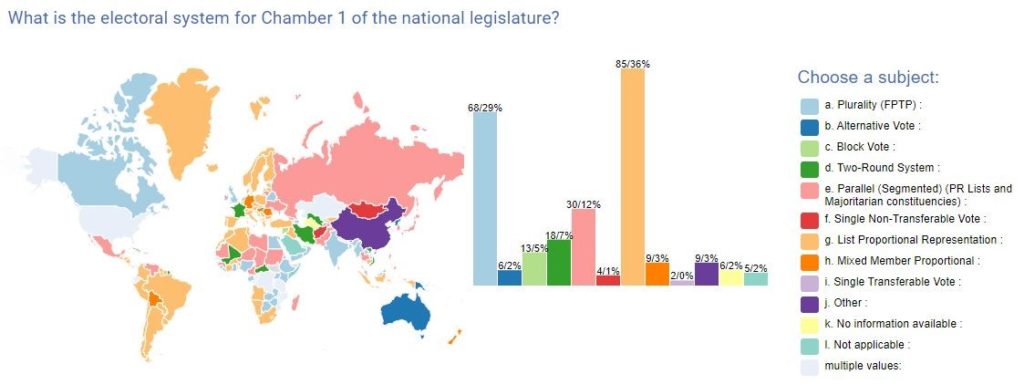
Source: ACE Electoral Knowledge Network
A Trusted System
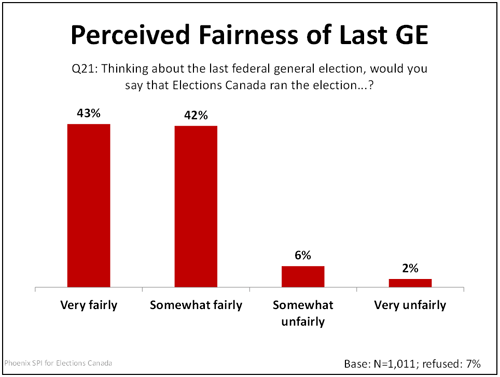
Canada's system is straightforward, safe and passes a critical test – there are no reports of vote flipping, disappearing votes, confusing ballots, illogical outcomes or outcries of fraud.
Some local elections have adopted technology into their voting process. For example, Ontario recently introduced technology, but for local elections such as picking a school board or a local representative. For federal elections Canadian officials recently studied switching to electronic vote-counting systems, focusing on reliability, cost and confidence in the results, but chose to keep paper ballots.
Like America, Canada has voter suppression, but there are no issues with the paper ballot process. Canada's hand-marked and hand-counted paper system instills confidence that elections are free and fair.
"Having an agency that is independent from the elected government, with a chief electoral officer who is appointed by Parliament as a whole, we are nonpartisan in everything that we do," said Natasha Gauthier, a spokesperson for Elections Canada. "We are removed from that politicization of the voting system that we see in the U.S."

Canada's different system of national government lends itself to a much simpler ballot and much simpler vote counting. Their parliamentary system requires them to cast a vote for only one candidate, instead of our country with pages of different candidates at multiple levels of government, bond issues and referendums. Canadians only have one bubble to mark on their ballot in their federal election.
In a growing number of American jurisdictions, so-called paper ballots are being adopted. But in no way does the American approach resemble Canada's hand-marked and hand-counted paper ballot voting. Indeed, it doesn't truly rely on paper. The American trend is to rely on ballot marking devices (BMDs), a hybrid technology-paper approach.
Machine and Paper
The hybrid approach uses a paper ballot that is generated, scanned and counted by machines.
Verified Voting, a bipartisan and nonprofit group organized by ballot experts found that almost 70% of the U.S. jurisdictions rely primarily on hand-marked paper ballots.
However, there's an asterisk. That 70% figure included paper ballots created through a BMD. Many BMDs generate paper ballots which are then hand-marked using technology. Vote machinery vendors push what they describe as voter-verified paper ballot products in which voters use a touch screen to create their paper ballots. The majority of states now rely on BMDs.
After making their selection on a touch screen, voters receive for verification a paper ballot showing their selection. The concept is that voters self-verify their vote by examining the paper ballot the machine generates before it is counted by another machine. This complicated process creates opportunities for error, mistakenly or intentionally, especially if voters do not scrutinize the paper ballot for accuracy. And it assumes the vote-counting software will accurately capture the choice on the paper ballot, a process that will not be observed by the voter.
In Pennsylvania's Northampton County, near Allentown and 75 minutes north of Philadelphia, officials selected equipment from ES&S, the nation's largest manufacturer of voting machines. It's a secretive company founded by Republicans, which we examined here and here.
Problems with ES&S Machines
After the 2016 election, Green Party presidential candidate Jill Stein and four others sued in Pennsylvania alleging that the ES&S machinery was vulnerable to hacking and difficult to audit. The case was settled in late 2018 with an agreement that all 67 Pennsylvania counties would buy new voting machines on which votes are recorded on paper and a voter-verifiable record of each vote was produced.
Northampton County chose to purchase $2.8 million worth of new voting equipment from ES&S, the largest vendor, including its ExpressVote XL BMD. However, on rollout in 2019 elections, the county ran into major problems with their new ES&S ExpressVote machines.
Abe Kassis, a Democratic Party judicial candidate, complained that he knew people who voted for him in one precinct where ES&S showed he got no votes. That prompted an inquiry into the integrity of the vote-counting process. The discrepancy between votes cast and counted was not trivial, but huge.
In December 2019, ES&S held a Facebook live press conference taking full responsibility for the issues in Northampton. The company acknowledged problems and blamed human error by ES&S employees, but insisted the machines worked just fine when properly operated.
Adam Carbullido, ES&S senior vice president of product development, said. "First and foremost, on behalf of my company, I apologize to Northampton County. If not for mistakes made by ES&S staff these issues all could have been avoided."
Wrong Machine Votes
ES&S said it found that the candidates shown on the voter-verified paper ballot did not match with the records of the vote-counting equipment.
Voters saw their vote on the touch screen and confirmed it. Then the machine generates a paper ballot to confirm and assure voters of the official record of their ballot. However, despite double-checking and verifying, the system did not then count their vote for the candidate chosen on the voter-verifiable paper record.
So, the ES&S system instilled confidence that people cast their ballots as intended, and then the vote-counting software disregarded their votes, which voters would have no way of detecting except for anomalies like the one reported by Kassis, the judicial candidate.
ES&S's Carbullido confirmed this, saying: "The ballot showed correctly on the screen and printed correctly on the paper ballots, but the votes were not attributed to the proper candidates."
'Human Error'
Carbullido acknowledged that the issues hadn't been caught during pre-election testing. "I want to make clear that this was human error, and ES&S takes full accountability.
"The issue should have been identified by ES&S staff prior to the election and during pre-election testing.
"Had we scrutinized the results during that process better, had ES&S staff advised the county better on how to do that, it would have been caught."
In the end, ballots were hand-counted. Kassis, the Democratic candidate for judge, appeared to lose with only 164 votes when ES&S machines did the counting. The hand count revealed he had actually received 26,142 votes, winning the election.
Righting this wrong was possible only because paper ballots existed and could be checked with a hand count. The Northampton debacle establishes the fears of many election integrity advocates are legitimate and illustrates the value of audits.
Experts Issue Warnings
In December 2019, computer scientists Andrew Appel of Princeton University and Richard DeMillo of Georgia Tech along with statistics theorist Philip B. Stark of the University of California, Berkley, produced a paper titled "Ballot-Marking Devices (BMD's) Cannot Assure the Will of the Voters." It reviewed BMDs including ES&S's ExpressVote and ExpressVote XL. The professors concluded: "Ballot-Marking Devices produce ballots that do not necessarily record the vote expressed by the voter when they enter their selections on the touchscreen."
This followed a similar observation after an examination of ES&S ExpressVote equipment done as part of Texas's certification procedures. Of BMD generated paper ballots, James Sneeringer, Ph.D., as a designee of the attorney general, wrote in a 2018 report: "I want to express my opinion that the paper ballot does not actually increase the accuracy or security of a voting system, although I acknowledge that many voters feel more secure when there is a paper record, and voter confidence is very important."
He was more specific about his concerns in a 2019 report produced for the Texas secretary of state writing: "I cannot think of a circumstance where I would advise a Texas jurisdiction to buy ExpressVote XLs, yet I am loath to deny certification or to try to write a complex condition to attach to certification."
This contrasts with Sneeringer's 2017 Texas report which found a "bridge" between ES&S systems was "acceptable."
Despite these statements by experts, in March 2019 the secretary of state of Texas certified both ExpressVote and ExpressVoteXL.
Texas and Pennsylvania both used either the ES&S ExpressVote or ExpressVote XL in the 2020 elections in some of their counties.
Kentucky Uses ExpressVote
DCReport analyzed the election results in Mitch McConnell's Kentucky. Our analysis was based on information from the Kentucky State Board of Elections website. They listed the ES&S voting machines used in Kentucky as a model called the iVotronic.
At some point after our Dec. 19 article, the list of ES&S equipment that had been used in the 2020 election was changed on the Kentucky government website. Kentucky now listed the equipment they used as made by ES&S but switched the specific product listed to ExpressVote.
DCReport verified with Jared Dearing, executive director of Kentucky Board of Elections, that the website had been updated, and that ES&S ExpressVote models were used in the 2020 General Election. Dearing stressed, "We recently updated our equipment to provide a voter-verified paper ballot system."
Given expert concerns about the ability to hack the ES&S ExpressVote, Kentucky's recent purchase of this equipment seems curious.
Dearing told a Kentucky House budget subcommittee that a U.S. Department of Homeland Security official meets with the Kentucky elections board every week to go over every attempt to break into Kentucky's system, which gives him "sleepless nights."
"We are routinely scanned by Venezuela, by North Korea, by Russia on a regular basis," Dearing said. "This is not something that is in the past, that happened in 2016. It happens on a weekly basis."
Dearing told this to the subcommittee in February 2020, months after the false results produced by ES&S equipment in Pennsylvania's Northampton County.
Foreign Snooping
Given that bad actors worldwide are scanning Kentucky's electronic elections systems, the choice of upgrading approximately 20% of Kentucky's voting machines to the ES&S ExpressVote seems ill-suited at best. DCReport's recent article about Texas and the bug they reported in their ES&S equipment adds to the concerns about their choice.
As part of their report, professors Appel, DeMillo and Stark warned that "hacking, bugs, and configuration errors can cause the BMDs to print votes that differ from what the voter entered and verified electronically."
They explained further, "When computers are used to record votes, the original transaction (the voter's expression of the votes) is not documented in a verifiable way. When pen-and-paper is used to record the vote, the original expression of the vote is documented in a verifiable way (if a demonstrably secure chain of custody of the paper ballots is maintained)."
Assurances by the Kentucky State Board of Elections that they use voter-verified paper ballots are intended to instill confidence. Instead, they may provide a false sense of security. On top of that, consider Kentucky has provided very little in the way of verifying the voting machines accurately counted ballots in the 2020 election.
The results that DCReport broke down in Breathitt, Elliott and Wolfe counties in Kentucky are still supported only by anecdotal evidence. But the experience in Northampton and the findings by the professors, among others, argue strongly for universal hand counts and an independent inquiry into the integrity of the voting machines used in Kentucky and other states.
'Gold Standard'
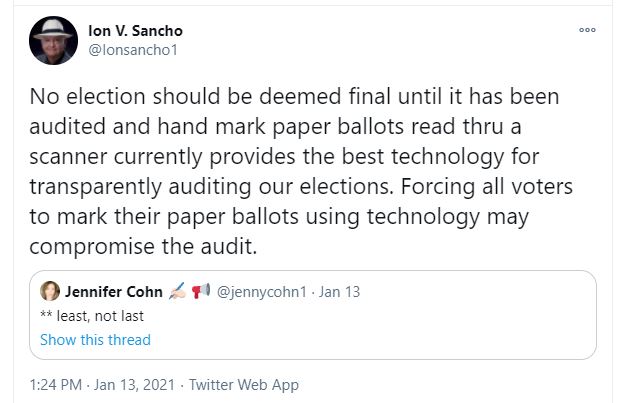
Ion Sancho, an internationally recognized elections expert who was featured prominently in HBO documentaries on cyber-attacks on American elections in both 2006 and 2020, said, "Hand-marked paper ballots are the gold standard' of election security — provided there's an audit system to verify, afterward, that the machine totals match what the voters actually marked on ballots."
Kentucky did not use hand-marked ballots and only did limited audits in 2020. Out of Kentucky's 120 counties, only six were randomly audited. None of the three counties DCReport focused on was audited.
As Sancho points out, mandated audits are a critical step. While Kentucky updated their machines to have an auditable paper trail, that does nothing to ensure election integrity without actual audits of every voting precinct.
Vendors over Voters?
The concept that more costly sophisticated technological solutions will provide safer and more secure elections than human counted hand-marked ballots is a myth if we don't apply the technology effectively.
Sancho further notes, "We need to look at the outcomes we need to achieve. You want to safeguard the process, not the product, to ensure safe and secure elections." In our eagerness to embrace technology are we paying enough attention to securing the voters' fundamental Constitutional right to have their ballots counted as cast?"
Looking at other countries, if we shift our approach from technology to paper, we won't be alone. Secure Our Vote found that 15 countries had either tried electronic voting and switched back to paper by 2018, or like Canada explored electronic voting but decided to stick with paper.
Hand-marked paper ballots are distinct from BMD paper ballots. But also, the overall approach and the process differ.
The crucial distinction is this: Canada puts trust in people who are trained, paid, vetted and locked in a room together to count the votes with ballots that can be recounted if necessary.
America puts trust in technology vendors whose self-interests are served by assuring election officials that the election went well, all the while maximizing their profits, and providing very little transparency for Americans to be able to audit fully audit elections.