


I know this radical pragmatist — she's too smart for Trump but Rubio's Vulture may swoop
Oh no, she didn’t.
After the U.S. seizure of Former President Nicolás Maduro, Rodriguez still attacks Trump as an outlaw kidnapper and imperialist invader. But at the same time, she says she’s seeking the restoration of diplomatic relations and offers tens of millions of barrels of oil.
I’ve known Rodriguez for years. Is she a militant leftist or a moderate pragmatist? The answer is, “Yes.” I’d call Rodriguez a “radical pragmatist.”
Trump is wise to keep Rodriguez in office. Did I just associate “Trump” and “wise”? Yes, but it seems such wisdom may be accidental. Trump is reported to be furious at the leader of the Venezuelan opposition, Maria Corina Machado, for accepting the Nobel Peace Prize instead of leaving it to him. The result is that he has vetoed installing her in power.
Notably, oil and finance interests want the “Leftist” Rodriguez to stay — even the CIA wants her to stay. But Secretary of State Marco Rubio and an outlaw US billionaire want her out. Who wins? I’ll handicap the race here.
Trump wants Venezuelan oil — that we already had
Rodriguez and Trump desire the same thing: to send Venezuelan oil to the US.
But Donald, we already had Venezuelan oil … until YOU embargoed imports of their crude.
Venezuela’s former socialist president, Hugo Chavez, used to enjoy taunting George W. Bush. I remember 2006, when Chavez spoke at the UN General Assembly, right after Bush left the podium. Chavez began, “There is a distinct smell of sulphur here.” Bush had gone after Chavez, backing his kidnapping in 2002. Unlike Trump, Bush face-planted. Chavez was returned by his kidnappers, more popular than ever.
Despite it all, Bush, with Chavez’s encouragement, kept Venezuelan oil flowing to the US, more than a million barrels a day.
Now Trump crows, “We're going to be taking oil” from Venezuela.
Mr. President, we were taking Venezuela’s oil until you stopped the flow with an embargo.
It will be nearly impossible, and prohibitively expensive, to crank up Venezuela’s production, to get back to the flow before the embargo. Because when the extraction of super-heavy oil of Venezuela stopped, it congealed into tar and then into asphalt. Refineries and pipes are choked and destroyed, a destruction Trump engineered through blocking Venezuela from paying for equipment to maintain the lines. Now, Trump is trying to bully US oil companies to invest as much as $100 billion to restore the oil infrastructure he himself destroyed.
Trump wants praise for expensively rebuilding what he demolished. He’s like an arsonist who wants praise for calling the fire department.
Chavez’s offer
US voters have decided that price inflation is a real bummer. So, Trump has decided, correctly, that unleashing Venezuela’s oil is the way to go. Trump states bluntly that he wants to open Venezuela’s spigots to bring down the price of crude to $50 a barrel. Today, crude sells for just under $60/bbl.
But Venezuela already offered, years ago, to cap the price of its oil at $50/bbl. In one of my interviews with Chavez for the BBC, he said he would cap oil at $50 if the US would guarantee it would not slip below $30/bbl. Venezuela, unlike Saudi Arabia, could not afford another crash to $10 a barrel, as happened in 1998, bankrupting South American OPEC members. So Chavez enthusiastically endorsed this idea of a “band” — you give us a bottom and we’ll give you a top — which was first suggested, notably, by industry consultant Henry Kissinger.
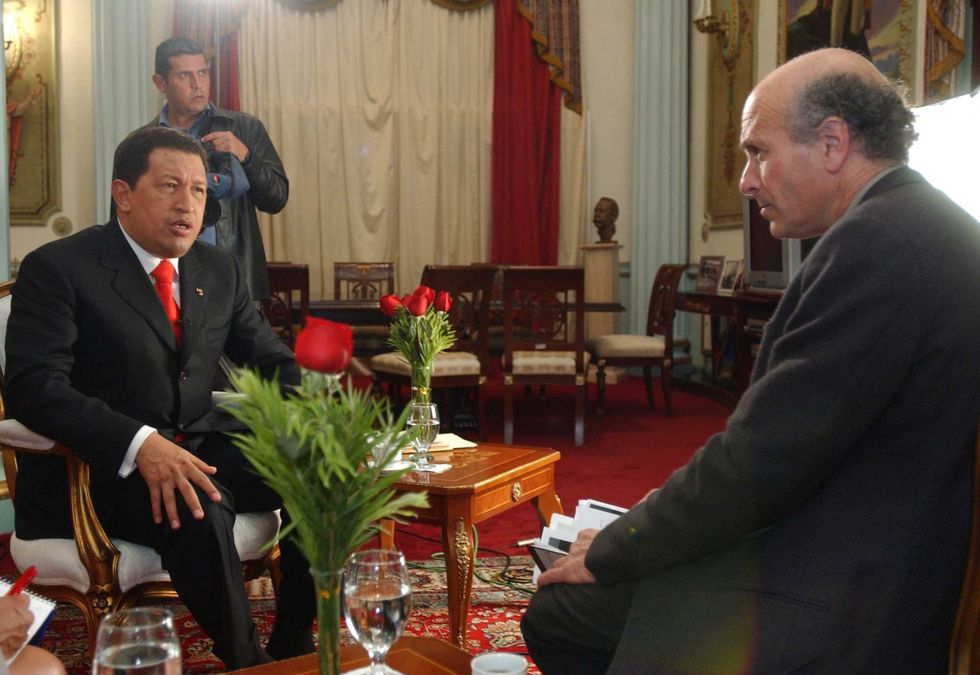 Greg Palast interviews Hugo Chavez. Picture: Richard Rowley for BBC-TV (c)2004 the Palast Investigative Fund.
Chavez told me he got along well with Kissinger and George Bush Sr., a fellow oil man. Chavez was “a good chess player,” a pro at realpolitik, a skill he passed to his protégé Rodriguez.
In other words, Trump killed a hundred people in his coup (and thousands may yet die) to get something by force that he could have gotten by contract.
OPEC: ‘no brainer’ or ‘no brains’?
The first strike against right-wing fave Machado is her avowed desire to sell off Venezuela’s state oil company, Petroleos de Venezuela, S.A. (PdVSA, pronounced, “Pay-day-VAY-sah). What Machado, a neophyte to petroleum economics, does not understand is that full privatization is a direct threat to the oil majors and OPEC.
I’ve seen this movie before. Leading up to the invasion of Iraq, neo-cons in the Bush administration wanted to privatize Iraq’s state oil companies, selling the fields to American and European majors who would then, the plan went, compete to maximize output, crash the price of crude and bring OPEC to its knees.
Ari Cohen of the Heritage Foundation told me this scheme was a “no-brainer.” But then I spoke with Philip Carrol, past president of Royal Dutch Shell USA. He said: “Anyone who thinks pulling out of OPEC is a ‘no brainer’ has no brains.”
Oil companies are not in the business of getting oil. They are in the business of making money. A crash in the price of crude could indeed end OPEC’s price-setting power and no US oil company wants to see their revenues collapse.
There’s also a legal issue. There is no way for Venezuela to stay in OPEC if its state oil company is sold to US interests because US law makes it a crime to participate in a price-fixing cartel. But our government has carved out a convenient exception for state-owned oil companies, allowing Exxon and Chevron and their buds to surf on the high prices set by the OPEC monopoly.
Rodriguez is not only Acting President — she remains the Minister of Petroleum and Hydrocarbons. She has a detailed knowledge of the hard realities of oil production. But she’s a patriot, too. She will not allow the theft or seizure of Venezuela’s oil, but she sure as hell wants to sell us oil again.
Chevron, which has worked closely with Rodriguez, couldn’t be happier. Oil companies don’t want to own oil fields. That’s not how the industry operates. They don’t want the real estate. They want profit. They work with OPEC nations through Profit Sharing Agreements. The issue is always the split of the revenues, not ownership, with the state’s share paid as a “royalty” for US tax purposes.
The last thing the oil companies need is Machado, a free-market fanatic, creating a civil war over ownership of fields that the majors want to drill, not own.
And there’s a practical problem. At $50/bbl, no one is going to drill in the Orinoco Basin, where most of the oil is, because it’s just not profitable to try and pull up the sulphurous gunk there. As Beck would sing, “It’s a loser, baby.” That’s why Trump was so frustrated with the oil big wigs who just met him at the White House. He’s telling them to dump tens of billions into a money pit, rebuilding what he destroyed.
Rodriguez well understands the practical limits of control. Chavez was known for hiking oil royalties on Exxon, Chevron and France’s Total but his then-minister for oil told me, quietly, “If they invest in our country, then we forgive the new royalty.”
‘The Vulture’ swoops in
So who would want to privatize PdVSA? The Vulture, that’s who. I’ve been tracking this bird, Paul Elliott Singer, for nearly two decades, first for the BBC. Bloomberg low-balls his net worth at $6.7 billion. (He’s been known as The Vulture since I gave him the name. You could say he’s no fan and tried to get the BBC to fire me.)
Singer is an international repo man, buying up the debts of nations busted by wars, famines and cholera. An Obama official called him an “extortionist,” after Singer got away with ripping off the US taxpayer for billions.
Singer’s trick is to buy up defaulted debts of desperate nations and distressed companies. Then he’ll sue for ten times, even a hundred times, what he paid — a brutal business outlawed in several nations. You may remember the signs from Argentinian fans at the 2014 World Cup: “IFuera Buitres!” — “Vultures Out!” — referring to a Singer-led repo attack that brought Argentina to its knees.
Late last year, a U.S. court approved Singer’s Elliott Management’s purchase of PdVSA’s US subsidiary, CITGO. Singer plans to pay peanuts — just $5.9 billion for US property valued at $11 billion to $18 billion. As you can imagine, Venezuela objects.
The low price for CITGO is based on its devaluation because of the Trump embargo. But since Maduro’s kidnapping, it’s all but certain the embargo will end. If Singer can close the sale, he could cash in and quickly flip these assets for a $6+ billion profit.
But Rodriguez wants CITGO back. Her nation paid for those refineries and gas stations and it’s hard to see how she’d let Singer waltz off with her people’s property.
The judge understands that CITGO’s valuation is changing, probably tripling in value because the US is negotiating the restoration of diplomatic ties. So, the judge asked the US State Department to file a statement with the court on how the change of government in Venezuela changes the commercial value of CITGO. The comment was due from the State Department on Jan. 8. But the court got nothing — nada, zero.
How come the State Department didn’t respond to the court, leaving Singer’s windfall uncontested? How could Singer get away with this? It should be “who” is letting Singer get away with this?
Singer was the overwhelming number one donor to the 2016 presidential campaign of Marco Rubio, now Secretary of State and National Security Advisor. Trump used to attack the “Never-Trump” Singer — until Singer made a million-dollar donation to Trump’s first inaugural committee. Now, Singer is funding a primary against Rep. Thomas Massie (R-KY), the congressman who demanded the release of the Epstein files.
Rubio was huffing-and-puffing to get Trump to install Machado, whose affection for privatization would have helped Singer to cash in. Whether Singer’s creepy greed, Rubio’s silence and Machado’s willingness to give up her nation’s crown jewels are related, ¿Quién sabe?" Unlike Defense Secretary Pete Hegseth, Rubio doesn’t invite journalists on his conference calls.
But while the State Department did not respond to the judge, Trump went over Rubio’s head and issued an executive order this past weekend, using his power under the Constitution to stop any court action that impedes the executive branch’s authority to conduct foreign affairs. In a stunning move, Trump barred US oil majors and other creditors from grabbing Venezuela’s cash reserves still held in US banks.
Trump’s order is a bit of a mess (no news there), but it is a clear and present danger to The Vulture’s smash and grab of CITGO.
Trump told oil companies to stick it. In last week’s confab with Trump, ConocoPhillips bitched it was owed $12 billion and Trump blamed the company for its loss: "We're not going to look at what people lost in the past because that was their fault.” (Which it was.)
Trump’s even suggesting he’ll bar ExxonMobil from returning to Venezuela because they are demanding compensation for properties they abandoned. (Exxon left Venezuela as an attempt to pressure Chavez into dropping his royalty demands. That failed. Now, I suspect, Exxon is miffed that Chevron will cash in big-time under Rodriguez. Exxon is like the guy who gives up girlfriend then gets jealous when she cuddles up to a rival.)
‘Call of Duty,’ the CIA and ‘good’ vultures
A week after the attack on Venezuela, Pope Leo XIV went full Pontiff-for-Peace on Trump, decrying “diplomacy based on force.” Take that, Stephen Miller!
Singer is not normal. Not every financier wants to chew on Venezuela’s corpse. Hans Humes of Greylock Capital Management, whom one of my colleagues calls “the ‘good’ vulture,” likes to cut deals with foreign governments that won’t bankrupt their nations or cart off their resources. I know Humes. He fears civil war in Venezuela or “any kind of breakdown of social order,” which would make his bonds worthless.
Both sides in Venezuela are armed to the teeth. If Rubio succeeds in getting Trump to reverse his position and shove Machado down Venezuelans’ throat, it will be Iraq 2.0. Then no one gets the oil, no debts get paid.
The Wall Street Journal quotes Eric Fine, whose firm also owns Venezuelan bonds: “The last thing you want to see is a ‘Call of Duty’ scenario with a bunch of soldiers in the streets.”
Trump has been down this dark alley before. In 2019, he went along with then-Senator Rubio’s hair-brained scheme to declare Juan Guaido President of Venezuela. Guaido is a white guy who lived in Washington, not Venezuela, and never even ran for President. Trump has made clear he was burned with Guaidó, and dismissed him as a loser. Trump has said he thinks of Machado as another Guiado. He said, “She doesn’t have the support within, or the respect within, the country. She’s a very nice woman, but she doesn’t have the respect.” Ouch!
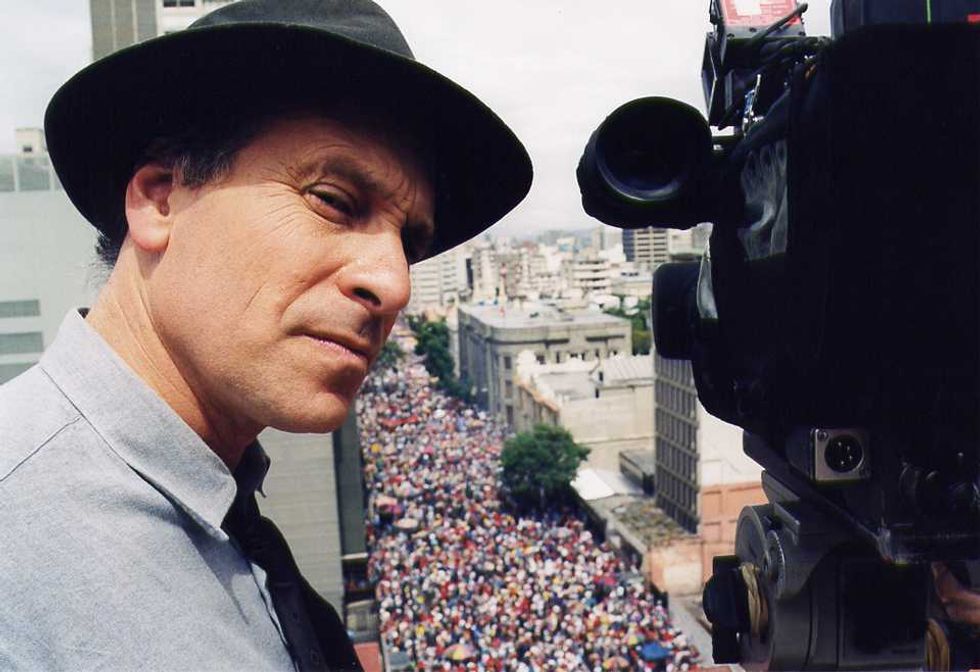 Greg Palast films in Venezuela in 2004. Picture: Richard Rowley for BBC-TV (c)2004 the Palast Investigative Fund.
That’s also the position of the CIA. In a leaked memo, it said Rodriguez was more likely to hold the country together during a transition. Also, while she gave a thundering speech against Trump’s gunboat diplomacy — “Never again will we be slaves, never again will we be a colony of any empire” — she also said, “We are open to energy relationships where all parties benefit, where cooperation is clearly defined in a commercial agreement.”
That had to be music to Trump’s ears, if not Rubio’s. Rodriguez, the 56-year-old Sorbonne-trained lawyer and former diplomat in London, is expert in the Art of the Deal. And, unlike the former bus-driver Maduro, she can make her case convincingly in flawless English and French and erudite Castilian.
Acting President Rodriguez knows, it’s about the oil. Always the oil. She said, “All the lies about ‘drug trafficking’, ‘democracy’, ‘human rights’. They were the excuses. It was always about the oil.” And Minister for Petroleum Rodriguez, the radical pragmatist, knows that is how she will artfully cut her deal.
Because she knows that Venezuelans can’t drink their oil; that her nation needs American majors to buy her nation’s output and for the industry to rebuild production lines. Darren Woods, the cranky CEO of ExxonMobil, told Trump that Venezuela would be “uninvestible” unless there is political stability. Rodriguez can provide that.
But while the oil boys were talking about the need for stability in Venezuela, there was a sly message directed at Trump. Given our president’s quixotic policies — from tariffs to taxes to military adventures — the majors don’t want to gamble billions unless there is a stable government in the USA.
- Greg Palast covered Venezuela and the oil industry for The Guardian, BBC Newsnight, Democracy Now! and Vice. His reports on Venezuela and short documentary, The Assassination of Hugo Chavez, can be viewed with no charge at GregPalast.com
 Micki Witthoeft, mother of Ashli Babbitt, speaks in Washington, D.C., last week. REUTERS/Leah Millis
 Roy Cohn advises Sen. Joseph McCarthy in 1953. Picture: Los Angeles Times/Wiki Commons.
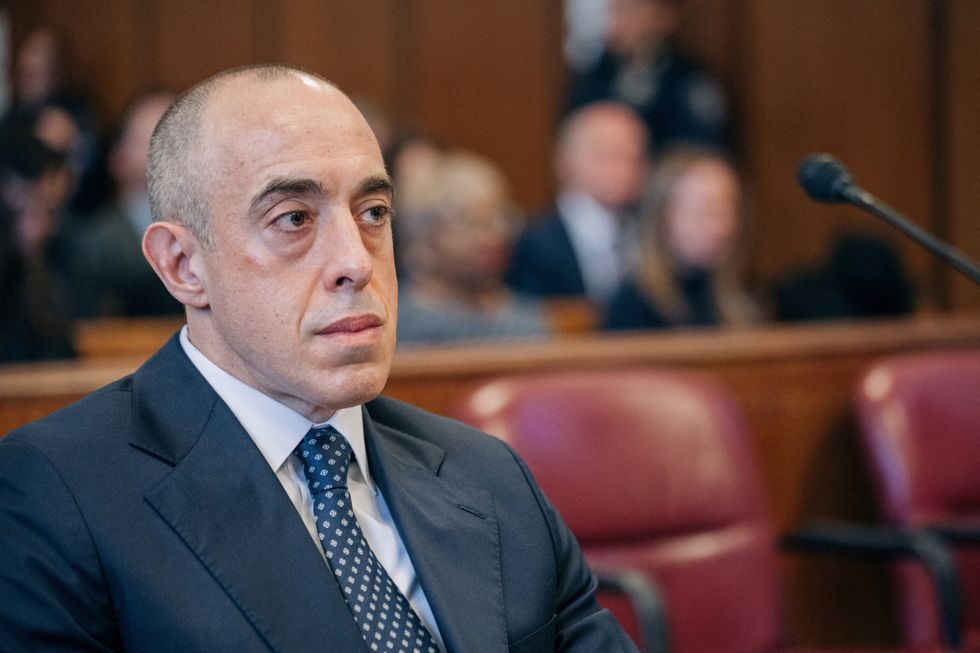 Emil Bove attends Manhattan criminal court in New York. JEENAH MOON/Pool via REUTERS