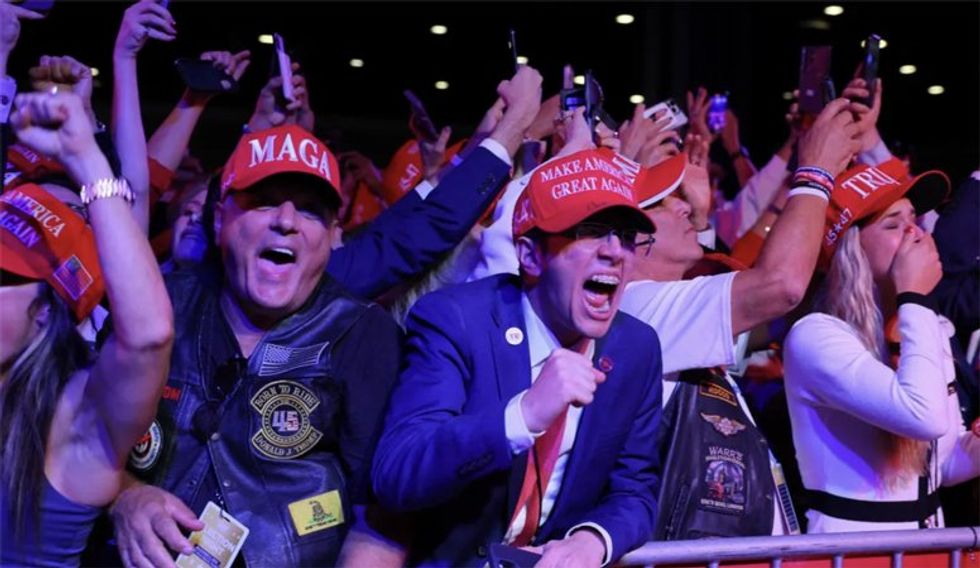
Donald Trump supporters (Photo via Reuters)

Vice President JD Vance was subjected to a scathing rebuke Wednesday over his furious response after a Michigan Senate candidate called him a hypocrite.
The vice president lashed out at Democratic Senate candidate Abdul El-Sayed on the campaign trail, warning him to "keep my wife's name the hell out of your mouth" and calling him "very, very evil," but The New Republic's Greg Sargent dismissed Vance's seething defense of his wife Usha as "fake fury."
"The vice president’s pose as an enforcer of chivalry and rectitude in our politics is ludicrous on its face, given his apologetics for Donald Trump’s nonstop vicious personal smears," Sargent wrote. "But this episode is of interest for another reason: El-Sayed’s stance articulates a bigger point about Vance’s craven compromises with the MAGA coalition’s racist and white nationalist elements that is 100 percent correct."
The outburst came after El-Sayed referenced Usha Vance in response to remarks the vice president made days earlier falsely claiming El-Sayed had called criticism of Sharia law "rooted in white supremacy."
Sargent noted the sequence undercuts Vance's posture as an aggrieved defender of his family. It was Vance, not El-Sayed, who first invoked family lineage, telling audiences his Kentucky-born grandfather would have viewed El-Sayed's past comments on race in America as hostile to "working people" — rhetoric widely read as signaling that a Muslim candidate poses an inherent threat.
"The key point is that El-Sayed is making an argument about JD Vance himself, not about his wife," Sargent wrote. "He’s urging JD Vance to be a bit more reluctant to play such sordid racist games given his own marriage to a brown person — with whom he’s had four children — who herself has faced much bigotry."
When MAGA-aligned figures attacked Vance's marriage to Usha, who was born in the U.S. to Indian immigrant parents, in explicitly racist terms, the vice president initially declined to condemn them, doing so only after the silence became politically untenable.
"El-Sayed’s invocations of Usha, then, effectively ask Vance to reflect on his willingness to push anti-Muslim smears in the context of his own life experiences," Sargent wrote. "This is an absolutely legitimate line of criticism. Because what El-Sayed is saying here is broadly correct: Vance’s successful rise in politics absolutely has required sordid compromises with factions in the MAGA coalition who are viciously bigoted, including toward his own wife, and this really should weigh more heavily on him."
The president himself has mocked El-Sayed's wife's hijab and cast the El-Sayed family as outsiders, drawing no public rebuke from Vance despite his outrage over El-Sayed's comments. El-Sayed and his family have also faced a wave of anti-Muslim attacks from MAGA supporters since his primary win.
That contrast — swift anger at a rival, muted response to bigotry within his own ranks — has become a recurring feature of Vance's political identity, one that has drawn renewed criticism as he seeks to position himself publicly as a defender of decency and family in American politics, while remaining largely silent on the attacks coming from within his own political ranks.
"Vance has made vile accommodations with gutter white nationalists of all stripes," Sargent wrote. "Given Vance’s undisguised desire to be seen as a towering moral and intellectual figure, you’d expect him to ruminate just a tad on how he and his movement are treating El-Sayed and his family. But in the end, he almost certainly won’t judge his white nationalist allies harshly for a fairly simple reason: He largely agrees with them."
Report typos and corrections to corrections@rawstory.com.
For customer support contact support@rawstory.com.