US surgeons who transplanted a genetically modified pig kidney into a brain-dead patient announced Thursday they had ended their experiment after a record-breaking 61 days.
The latest experimental procedure is part of a growing field of research aimed at advancing cross-species transplants, mainly testing the technique on bodies that have been donated for science.
There are more than 103,000 people waiting for organ transplants in the United States, 88,000 of whom need kidneys.
"We have learned a great deal throughout these past two months of close observation and analysis, and there is great reason to be hopeful for the future," said Robert Montgomery, director of the New York University Langone Transplant Institute, who led the surgery in July.
It was the the fifth so-called xenotransplant performed by Montgomery, who also carried out the world's first genetically modified pig kidney transplant in September 2021.
Tissue collected during the study indicated a mild rejection process had begun, requiring intensification of immunosuppression medication.
By "knocking out" the gene responsible for a biomolecule called alpha-gal -- a prime target for roving human antibodies -- the NYU Langone team were able to stop immediate rejection.
The donor pig in this experiment came from a herd cultivated by Virginia-based biotech company Revivicor.
The herd has also been approved by the Food and Drug Administration as a source of meat for people with hypersensitivity to the alpha-gal molecule, an allergy caused by some tick bites.
These pigs are bred, not cloned, meaning the process can be more easily scaled.
Early xenotransplantation research focused on harvesting organs from primates -- for example, a baboon heart was transplanted into a newborn known as "Baby Fae" in 1984, but she survived only 20 days.
Current efforts focus on pigs, which are thought to be ideal donors for humans because of their organ size, their rapid growth and large litters, and the fact they are already raised as a food source.
In January 2022, surgeons at the University of Maryland Medical School carried out the world's first pig-to-human transplant on a living patient -- this time involving a heart.
He died two months after the milestone, with the presence of porcine cytomegalovirus in the organ later blamed.
Last week, Chinese scientists published a paper showing they had succeeded in hybrid pig-human kidneys in pig embryos, an alternative approach that also has the potential to one day help address organ donation shortages.
But the development raised ethical issues -- especially since some human cells were also found in the pigs' brains, experts said.
Could the lives of the eight billion people currently on Earth have depended on the resilience of just 1,280 human ancestors who very nearly went extinct 900,000 years ago?
That is the finding of a recent study which used genetic analysis modeling to determine that our ancestors teetered on the brink of annihilation for nearly 120,000 years.
However, scientists not involved in the research have criticized the claim, one telling AFP there was "pretty much unanimous" agreement among population geneticists that it was not convincing.
None denied that the ancestors of humans could have neared extinction at some point, in what is known as a population bottleneck.
But experts expressed doubts that the study could be so precise, given the extraordinarily complicated task of estimating population changes so long ago, and emphasized that similar methods had not spotted this massive population crash.
It is extremely difficult to extract DNA from the few fossils of human relatives dating from more than a couple of hundred thousand years ago, making it hard to know much about them.
But advances in genome sequencing mean that scientists are now able to analyze genetic mutations in modern humans, then use a computer model that works backwards in time to infer how populations changed -- even in the distant past.
The study, published in the journal Science earlier this month, looked at the genomes of more than 3,150 modern-day humans.
The Chinese-led team of researchers developed a model to crunch the numbers, which found that the population of breeding human ancestors shrank to about 1,280 around 930,000 years ago.
- 99 percent of ancestors wiped out? -
"About 98.7 percent of human ancestors were lost" at the start of the bottleneck, said co-author Haipeng Li of the Shanghai Institute of Nutrition and Health, Chinese Academy of Sciences.
"Our ancestors almost went extinct and had to work together to survive," he told AFP.
The bottleneck, potentially caused by a period of global cooling, continued until 813,000 years ago, the study said.
Then there was a population boom, possibly sparked by a warming climate and "control of fire", it added.
The researchers suggested that inbreeding during the bottleneck could explain why humans have a significantly lower level of genetic diversity compared to many other species.
The population squeeze could have even contributed to the separate evolution of Neanderthals, Denisovans and modern humans, all of which are thought to have potentially split from a common ancestor roughly around that time, the study suggested.
It could also explain why so few fossils of human ancestors have been found from the period.
However, archaeologists have pointed out that some fossils dating from the time have been discovered in Kenya, Ethiopia, Europe and China, which may suggest that our ancestors were more widespread than such a bottleneck would allow.
"The hypothesis of a global crash does not fit in with the archaeological and human fossil evidence," the British Museum's Nicholas Ashton told Science.
In response, the study's authors said that hominins then living in Eurasia and East Asia may not have contributed to the ancestry of modern humans.
"The ancient small population is the ancestor of all modern humans. Otherwise we would not carry the traces in our DNA," Li said.
- 'Extremely skeptical' -
Stephan Schiffels, group leader for population genetics at Germany's Max Planck Institute for Evolutionary Anthropology, told AFP he was "extremely sceptical" that the researchers had accounted for the statistical uncertainty involved in this kind of analysis.
Schiffels said it will "never be possible" to use genomic analysis of modern humans to get such a precise number as 1,280 from that long ago, emphasising that there are normally wide ranges of estimations in such research.
Li said their range was between 1,270 and 1,300 individuals -- a difference of just 30.
Schiffels also said the data used for the research had been around for years, and previous methods using it to infer past population sizes had not spotted any such near-extinction event.
The authors of the study simulated the bottleneck using some of these previous models, this time spotting their population crash.
However, since the models should have picked up the bottleneck the first time, "it is hard to be convinced by the conclusion", said Pontus Skoglund of the UK's Francis Crick Institute.
Aylwyn Scally, a researcher in human evolutionary genetics at Cambridge University, told AFP there was "a pretty much unanimous response amongst population geneticists, people who work in this field, that the paper was unconvincing".
Our ancestors may have neared extinction at some point but the ability of modern genomic data to infer such an event was "very weak", he said.
"It's probably one of those questions that we're not going to answer."
The Centers for Disease Control and Prevention recommends new covid-19 booster vaccines for all — but many who need them most won’t get them.
About 75% of people in the United States appear to have skipped last year’s bivalent booster, and nothing suggests uptake will be better this time around.
“Urging people to get boosters has really only worked for Democrats, college graduates, and people making over $90,000 a year,” said Gregg Gonsalves, an epidemiologist at Yale University.
The number of centenarians in Japan surpassed 92,000 for the first time, hitting a record high for the 53rd consecutive year, a government report showed on Friday.
The number of people over 100 rose by 1,613 from a year earlier to 92,139, as the Ministry of Health in Tokyo said. According to the latest survey, around 88% of all centenarians are women.
Life expectancy for women in Japan is around 87 years, for men around 81 years. Japan has seen a rapid increase in the number of centenarians since the government first counted 153 over-100s in 1963.
A massive project to build one of the world’s most powerful particle accelerators at Fermilab has been halted since May 25 while federal authorities investigate an accident that severely injured a northwest Indiana ironworker three months into construction.
James Daniels, 46, fell from the top of a two-story wall during his first day on the job. Hospitalized for several months, he has filed a lawsuit in Cook County Circuit Court against Fermi Research Alliance, which operates the site, as well as the contractor and subcontractors in charge of the construction project.
Scientists behind a new study on the crossing of the Earth's "planetary boundaries" on Wednesday likened the planet to a sick patient, warning that six out of nine barriers that ensure the Earth is a "safe operating space for humanity" have now been breached.
Researchers at the University of Copenhagen, the Potsdam Institute for Climate Impact Research (PIK), and other international institutions analyzed 2,000 studies to update a planetary boundary framework developed in 2009 by the Stockholm Resilience Center, completing the first "complete check-up of all nine processes and systems that determine the stability and resilience of the planet."
The boundaries for climate change and land use have been broken for decades as extractive industries have razed forests and planet-heating fossil fuel emissions have significantly increased since preindustrial times.
The "novel entities" boundary—pertaining to the accumulation of synthetic pollution from substances such as microplastics, pesticides, and nuclear waste—was quantified for the first time in the study, which was published in Science Advances.
Freshwater change—both "green" freshwater in soil and vegetation and "blue" freshwater in bodies of water—has also been breached, along with biogeochemical flows, or the flow of nitrogen and phosphorus into the environment, which can create ocean dead zones and algal blooms.
"We don't know how long we can keep breaching these key boundaries before combined pressures lead to irreversible change and harm."
The study marked the first time researchers quantified a control variable for the "biosphere integrity" boundary, which they found was breached long before the framework was introduced—in the late 19th century as the Industrial Revolution and other factors accelerated the destruction of the natural world.
Co-author Wolfgang Lucht called biosphere integrity "the second pillar of stability for our planet" next to climate change, and warned the pillar is being destabilized by humans "taking out too much biomass, destroying too much habitat, deforesting too much land. Our research shows that mitigating global warming and saving a functional biosphere for the future should go hand in hand."
"This update on planetary boundaries clearly depicts a patient that is unwell, as pressure on the planet increases and vital boundaries are being transgressed," said Johan Rockström, director of PIK. "We don't know how long we can keep breaching these key boundaries before combined pressures lead to irreversible change and harm."
The boundaries for atmospheric aerosol loading, or air pollution, and ocean acidification, are both close to being crossed, while the atmospheric ozone boundary is currently well below the "zone of increasing risk," due to global initiatives within the Montreal Protocol, adopted in 1987.
The fact that the boundary for ozone depletion was once "headed for increasing regional transgressions" and slowly recovered, said co-author Katherine Richardson of the University of Copenhagen, shows that it is possible to bring the planet back from the boundaries that it's close to crossing or that have been breached to a lesser degree, such as freshwater change.
"We can think of Earth as a human body, and the planetary boundaries as blood pressure," said Richardson. "Over 120/80 does not indicate a certain heart attack but it does raise the risk and, therefore, we work to reduce blood pressure."
The boundaries that have reached the highest risk level are biosphere integrity, climate change, novel entities, and biogeochemical flows.
The update to the framework "may serve as a renewed wake-up call to humankind that Earth is in danger of leaving its Holocene-like state," reads the study, referring to relatively stable state the planet was in between the end of the last ice age—10,000 years ago—until the start of the Industrial Revolution.
The study, said global grassroots climate action campaign Extinction Rebellion, offered the latest evidence that policymakers must do everything in their power to "just stop oil"—ending approval for fossil fuel projects, subsidies for oil and gas companies, and policies that slow down a transition to renewable energy.
"We are not separate from the Earth," said the group. "We ignore these warnings at our peril."
NASA held a public hearing on Thursday about research into strange objects in the sky – and revealed they've as yet not found evidence of extraterrestrials.
But officials did share that their researchers aren't being named because publicly known members have been getting threats.
The Congressional hearing that began the research in May ran live on YouTube, and NASA officials said that the chat section was flooded with accusations that the agency was covering up evidence of aliens and lying.
Harassment and threats then followed as the research continued.
Thursday's briefing also told the public that a head of research for the program would be appointed to continue examining the evidence collected. Nasa said it's considering asking for public help in crowdsourcing data.
It's unclear if it would be simply personal reporting or a program similar to the Search for Extraterrestrial Intelligence (SETI) – the first-ever large-scale citizen science project, described by the Irish Times when it ceased operation in 2020.
The hearing continued with the research team handing over its list of suggestions that NASA could implement that would allow them to collect and analyze further data on UAPs (unidentified aerial phenomena.)
As Space.com explained, "The agency is quick to note that the report is "not a review or assessment of previous unidentifiable observations," according to a NASA statement that announced the briefing.
The astronaut Frank Rubio broke the record for the longest in orbit mission by an American, spending more than 355 days aboard the International Space Station.
"In some ways, it's been an incredible challenge. But in other ways, it's been an incredible blessing," Rubio said Wednesday from the ISS during a chat with NASA that was broadcast live.
Having broken the old record Monday, Rubio said he was now looking forward to reaching 365 days. "I think that'll be a really good milestone for our nation to achieve," said Rubio, who is a doctor by training and a helicopter pilot.
The previous US record was set in 2022 by Mark Vande, who spent 355 days in space. The world record is held by Russian cosmonaut Valeri Polyakov at 437 days.
Rubio is scheduled to return to Earth on September 27; at that point he will have spent 371 days in space.
When Rubio traveled to the ISS last year on a Russian Soyuz rocket with two cosmonauts, the plan was for him to stay six months, which is the usual mission length.
As per normal procedure that rocket stayed hooked up to the ISS as an emergency escape vessel if necessary, and was supposed to bring those three travelers home in December. But it suffered a leak, probably due to impact from a tiny meteorite.
So the Russian space agency Roscosmos brought that rocket home and sent up another with no crew aboard.
Rubio and his two colleagues carried out the mission of the crew that was initially due to travel to the ISS on the second rocket and replace them.
Rubio, who is Latino, has seen crews come and go while up in space -- a total of 28 people of various nationalities.
"If I do the math right, that's almost five percent of the humans that have ever been to space, which is pretty incredible," Rubio said Wednesday.
He described living and doing experiments in low Earth orbit.
"Once you're up here for a little bit, you really get focused on the work and sometimes you forget to appreciate the fact that you are floating around and that you have this amazing view down below you," Rubio said.
He said the quarters are somewhat cramped, likening them to a five-bedroom house.
"And so, psychologically for a year, that was a little bit of a challenge," Rubio said.
The US record for most days in space over a lifetime is held by former astronaut Peggy Whitson, with 675 days during several missions.
NASA is set to release on Thursday the findings of a long-awaited study on unexplained flying objects in Earth's skies.
The US space agency announced last year it was reviewing evidence regarding unidentified anomalous phenomena, or UAPs -- which has replaced the term "UFO" in official parlance.
The subject has long fascinated the public but was shunned by mainstream science.
An independent team of 16 researchers shared their preliminary observations in May, finding that existing data and eyewitness reports are insufficient to draw firm conclusions, while calling for more systematic collection of high-quality data.
It's unlikely Thursday's report will change that bottom line -- but it could eventually usher in the start of a new mission for the agency.
While NASA's probes and rovers scour the solar system for any fossils of ancient microbes, and its astronomers look for signs of intelligent civilizations on distant planets, its historic posture has been to "debunk" sightings on our home planet.
There have been more than 800 "events" collected over 27 years, of which two to five percent are thought to be possibly anomalous, the report's authors said during the May meeting.
These are defined as "anything that is not readily understandable by the operator or the sensor," or "something that is doing something weird," said team member Nadia Drake.
The US government has begun taking the issue of UAPs more seriously in recent years, in part due to concerns that they are related to foreign surveillance.
NASA's work, which relies on unclassified material, is separate from a Pentagon investigation, though the two are coordinating on matters of how to apply scientific tools and methods.
In July, a former US intelligence officer made headlines when he told a congressional committee he "absolutely" believes the government is in possession of unidentified anomalous phenomena -- as well as remains of their alien operators.
"My testimony is based on information I've been given by individuals with a longstanding track record of legitimacy and service to this country -- many of whom also shared compelling evidence in the form of photography, official documentation and classified oral testimony," David Grusch told lawmakers.
Earlier this week, the alleged bodies of two "non-human" beings were presented during a congressional hearing in Mexico, generating a mixture of surprise, disbelief and ridicule on social media.
The purported mummified remains, which had a grayish color and a human-like body form, were brought by Jaime Maussan, a controversial Mexican journalist and researcher who reported finding them in Peru in 2017.
WASHINGTON – Who runs Washington, elected officials or the wealthy donor class?
It seems up for debate after Silicon Valley billionaires were given the dais, mics and taxpayer-funded security details, even as upwards of 60 U.S. senators were forbidden from speaking as they sat like pupils in the audience, scribbling notes during the Senate’s first ever Artificial Intelligence [AI] Innovation Forum.
While Senate Majority Leader Chuck Schumer (D-NY) gushed over the “historic” gathering of upwards of 20 tech CEOs, consumer advocates and ethicists, the bipartisan frustration from some of his Senate colleagues was palpable.
“I’m a U.S. senator and I don't get to ask questions,” Sen. Elizabeth Warren (D-MA) complained to Raw Story upon leaving the closed-door forums. “The people of Massachusetts did not send me here not to ask questions.”
It sets a “terrible precedent,” Warren contended. While they’re usually worlds apart, some Republicans agree with the progressive on that.
“The whole idea that we'd have like this big show and invite all these folks and close it to press and throw all these limits around it, I just think it's ridiculous,” Sen. Josh Hawley (R-MO) told Raw Story outside the forum he boycotted. “It also suggests that their opinion is somehow privileged, and we ought to really all be learning from them. What's really going on is they're talking about how to have us help them make money.”
The privilege was unmistakable.
While, say, AFL-CIO labor federation President Liz Shuler was only flanked by a couple staffers, Capitol Police officers shut down three-stories of public hallways in the Russell Senate Office Building – a public building – when Tesla CEO Elon Musk exited.
Senators walk through Senate Office Buildings alone or with a staffer or two. Musk was escorted through the highly secure building flanked by four Capitol Police officers – on top of his three, black suit and tie-donning private security detail – and then upward of 10 stood guard outside as he paused to talk to reporters before taking a Tesla to a meeting he said he had at the FAA.
Raw Story asked Schumer about Musk’s taxpayer-funded escort.
“Did you know Capitol Police were shutting down public hallways for these CEOs?”
“I did not,” Schumer said.
“And is it a good use of taxpayer dollars to have 10 Capitol Police officers escort Elon Musk out?”
“I leave safety issues up to Capitol Police,” Schumer replied.
Schumer quickly moved on to other questions, and requests for comment from the Capitol Police were not returned. But when Raw Story described the scene to Schumer’s fellow New Yorker, Rep. Jamaal Bowman (D-NY), there was no hesitation.
“America is also an oligarchy. We talk about oligarchy from the perspective of Russia — America has an oligarchy,” Bowman told Raw Story. “What you just described is a clear example of that. Citizens United is a clear example of that. And that's why our H.R. 1, getting big money out of politics and dark money out of politics, is such a priority for us.”
Other senators were surprised to learn they wouldn’t be able to question the assembled witnesses – including the likes of Meta’s Mark Zuckerberg, OpenAI founder Sam Altman, former Microsoft CEO Bill Gates – but once informed, they just assumed Schumer gave deference to all the big-name speakers he assembled.
“Oh, well, that might have been a nod to some of the people who are here, so that they would not get challenged,” Sen. Cynthia Lummis (R-WY) told Raw Story.
Still, Lummis was pleasantly surprised by how informative the closed-door AI meeting was, including Musk’s warning to the Senate of the “civilization risk” AI poses.
“Which I was a term that I hadn't heard before,” Lummis said as she flipped through her notebook brimming with her studiously scribbled notes of the private forum. “He said, ‘AI is a double-edged sword and that we have to make sure we nurture the good side of that sword and find ways to address the bad side of that double-edged sword.’”
Lummis, like others, reported being introduced to many new concepts in the forum, like the need for AI audits (“I would have thought, as long as it’s open-source AI, that there's almost a natural audit function”) or that algorithms can reinforce discrimination (“how could an algorithm do that?”).
After missing all three all-Senate AI briefings that Schumer hosted over the summer, Lummis was “really glad” she went.
“I was worried about that, that it wasn’t gonna be worth the time because, you know, there's so many big names and so maybe it was going to be much ado about nothing because people wouldn't say things that were helpful to policymakers. They did,” Lummis said. “It was surprisingly, at least from my perspective, it was surprisingly helpful.”
Many Democratic attendees praised the private forum as well.
“It was pretty cordial. I thought there'd be a lot of sniping, and it really wasn't,” Sen. John Hickenlooper (D-CO) told Raw Story as he left the the forum after listening to more than two hours of three-minute opening speeches from all those assembled on the dais.
While Schumer hosted the event, one of Senate Minority Leader Mitch McConnell’s top lieutenants, Sen. John Cornyn (R-TX), was also pleased with how it went.
“I think rather than what’s said, I think the fact that that meeting’s occurred at all is probably the most significant,” Sen. John Cornyn (R-TX) told Raw Story. “Just because those people don't sit down and talk to each other. They're competitors, and so knowing of the interest of policymakers that, I think, will cause some additional conversations and that hopefully will be helpful.”
“But the problem is Congress is slow as a glacier at actually passing legislation,” Cornyn said. “And I don't think the technology is going to wait.”
AI surely won’t wait, and Senate critics say today they lost precious time in assessing where they agree and disagree with their own colleagues – an essential information gathering tool if a compromise is ever to be forged in these hyper-partisan times.
“There's no feeling in the room. Everything just passed by. There’s no interaction. No bumping against each other on any of these issues,” Warren of Massachusetts complained.
The other thing is, senators – some unwittingly – surrendered one of their biggest powers at the feet of these titans of Silicon Valley, because not a single tech CEO can commit perjury if they’re never sworn in.
“I'd prefer them all being under oath and testifying. That’s how you do it. We have a mechanism to gather information in Congress, we have hearings,” Sen. Hawley of Missouri lamented. “But if we're not going to do that, at least it should be open to the public.”
As people, we are all shaped by the neighborhoods we grew up in, whether it was a bustling urban center or the quiet countryside. Objects in distant outer space are no different.
Like you, every supermassive black hole lives in a home – its host galaxy – and a neighborhood – its local group of other galaxies. A supermassive black hole grows by consuming gas already inside its host galaxy, sometimes reaching a billion times heavier than our Sun.
Theoretical physics predicts that black holes should take billions of years to grow into quasars, which are extra bright and powerful objects powered by black holes. Yet astronomers know that many quasars have formed in only a few hundred million years.
I’m fascinated by this peculiar problem of faster-than-expected black hole growth and am working to solve it by zooming out and examining the space around these black holes. Maybe the most massive quasars are city slickers, forming in hubs of tens or hundreds of other galaxies. Or maybe quasars can grow to huge proportions even in the most desolate regions of the universe.
Galaxy protoclusters
The largest object that can form in the universe is a galaxy cluster, containing hundreds of galaxies pulled by gravity to a common center. Before these grouped galaxies collapse into a single object, astronomers call them protoclusters. In these dense galaxy neighborhoods, astronomers see colliding galaxies, growing black holes and great swarms of gas that will eventually become the next generation of stars.
These protocluster structures grow much faster than we thought, too, so we have a second cosmic problem to solve – how do quasars and protoclusters evolve so quickly? Are they connected?
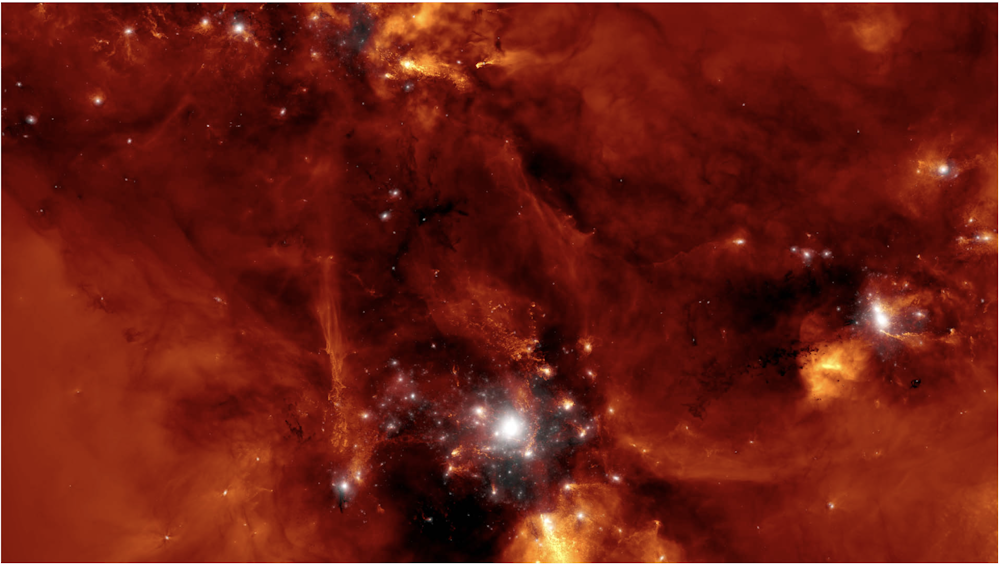
A simulation of a galaxy protocluster forming. In white, clouds of dark matter collapse and merge, while the red shows the motions of gas falling into the gravitational pull of the dark matter halos. TNG Collaboration, CC BY-NC-SA
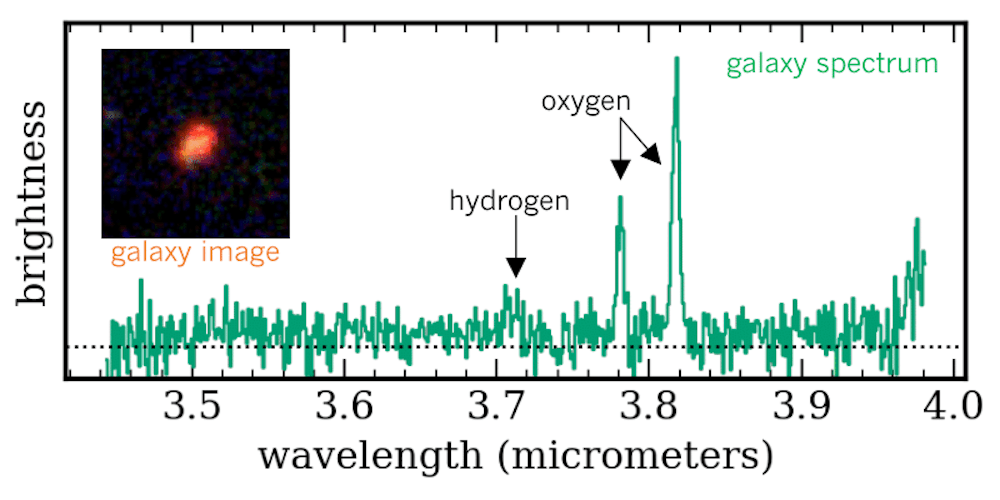
To look at protoclusters, astronomers ideally obtain images, which show the galaxy’s shape, size and color, and a spectrum, which shows the galaxy’s distance from Earth through specific wavelengths of light, for each galaxy in the protocluster.
With telescopes like the James Webb Space Telescope, astronomers can see galaxies and black holes as they were billions of years ago, since the light emitted from distant objects must travel billions of light-years to reach its detectors. We can then look at protoclusters’ and quasars’ baby pictures to see how they evolved at early times.
An example of a galaxy image and spectrum from the ASPIRE program at the University of Arizona. The inset shows the infrared image of a galaxy 800 million years after the Big Bang. The spectrum shows signatures of hydrogen and oxygen emission lines, whose wavelengths translate mathematically to a 3D location in space. J. Champagne/ASPIRE/University of Arizona
It is only after looking at spectra that astronomers determine whether the galaxies and quasars are actually close together in three-dimensional space. But getting spectra for every galaxy one at a time can take many more hours than any astronomer has, and images can show galaxies that look closer together than they actually are.
So, for a long time, it was only a prediction that massive quasars might be evolving at the centers of vast galactic cities.
An unprecedented view of quasar environments
Now, Webb has completely revolutionized the search for galaxy neighborhoods because of an instrument called a wide-field slitless spectrograph.
This instrument takes spectra of every galaxy in its field of view simultaneously so astronomers can map out an entire cosmic city at once. It encodes the critical information about galaxies’ 3D locations by capturing the light emitted from gas at specific wavelengths – and in only a few hours of observing time.
The first Webb projects are hoping to look at quasar environments focused on a period about 800 million years after the Big Bang. This time period is a sweet spot in which astronomers can view these monster quasars and their neighbors using the light emitted by hydrogen and oxygen. The wavelengths of these light features show where the objects emitting them are along our line of sight, allowing astronomers to complete the census of where galaxies live relative to bright quasars.
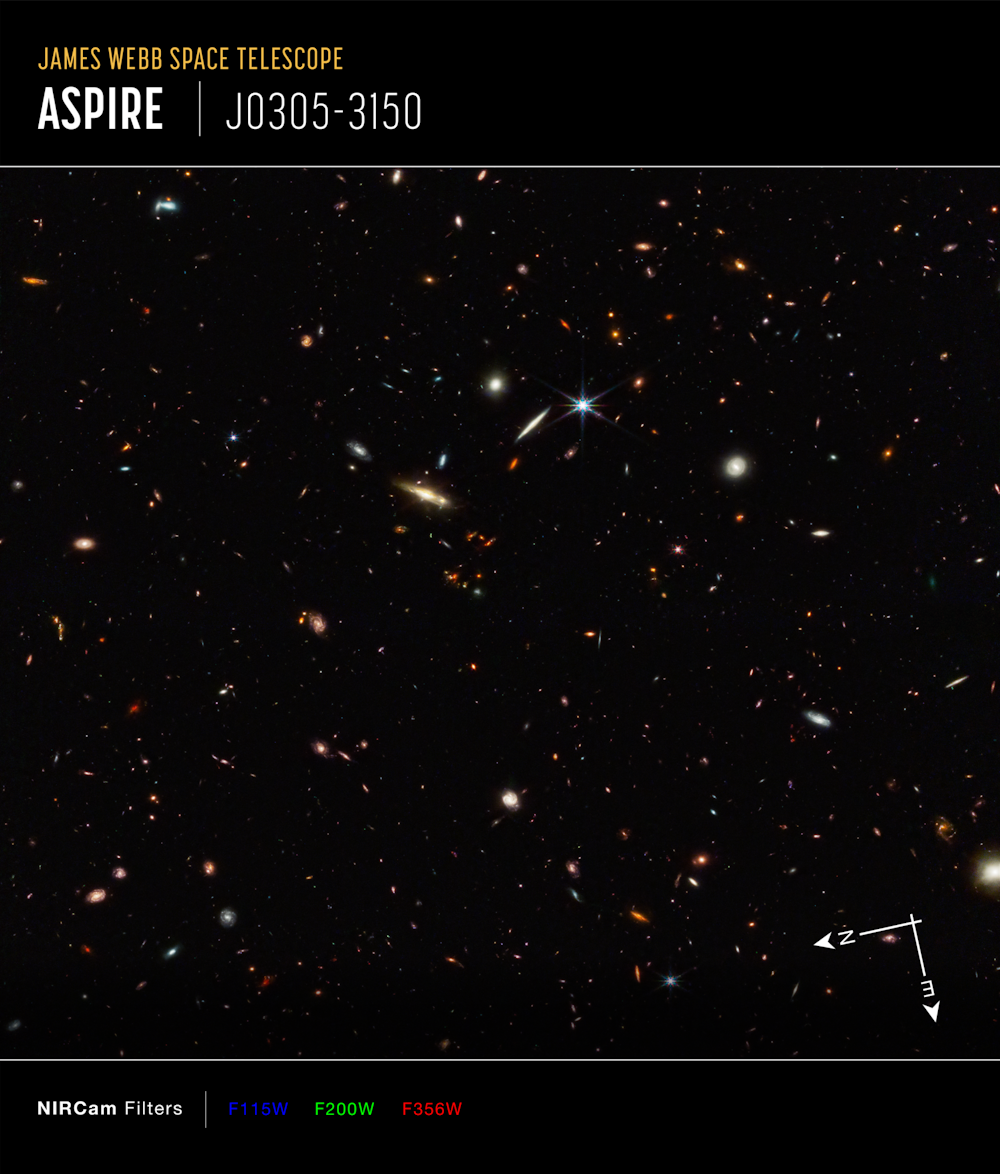
One such ongoing project is led by the ASPIRE team at the University of Arizona’s Steward Observatory. In an early paper, they found a protocluster around an extremely bright quasar and confirmed it with 12 galaxies’ spectra.
Another study detected over a hundred galaxies, looking toward the single most luminous quasar known in the early universe. Twenty-four of those galaxies were close to the quasar or in its neighborhood.
The neighborhood of galaxies around J0305-3150, a quasar identified approximately 800 million years after the Big Bang. STScI/NASA
In ongoing work, my team is learning more details about mini galaxy cities like these. We want to figure out if individual galaxies show high rates of new star formation, if they contain large masses of old stars or if they are merging with one another. All these metrics would indicate that these galaxies are still actively evolving but had already formed millions of years before we observed them.
Once my team has a list of the properties of the galaxies in an area, we’ll compare these properties with a control sample of random galaxies in the universe, far away from any quasar. If these metrics are different enough from the control, we’ll have good evidence that quasars do grow up in special neighborhoods – ones developing much faster than the more sparse regions of the universe.
While astronomers still need more than a handful of quasars to prove this hypothesis on a larger scale, Webb has already opened a window into a bright future of discovery in glorious, high-resolution detail.
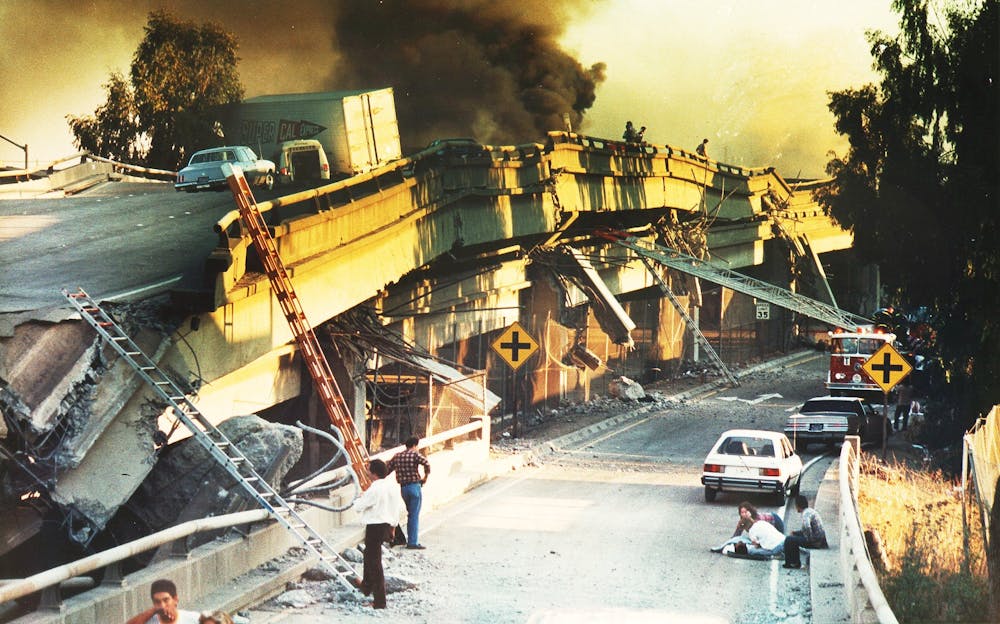
In short, no. Science has not yet found a way to make actionable earthquake predictions. A useful prediction would specify a time, a place and a magnitude – and all of these would need to be fairly specific, with enough advance notice to be worthwhile.
For example, if I predict that California will have an earthquake in 2023, that would certainly come true, but it’s not useful because California has many small earthquakes every day. Or imagine I predict a magnitude 8 or greater earthquake will strike in the Pacific Northwest. That is almost certainly true but doesn’t specify when, so it’s not helpful new information.
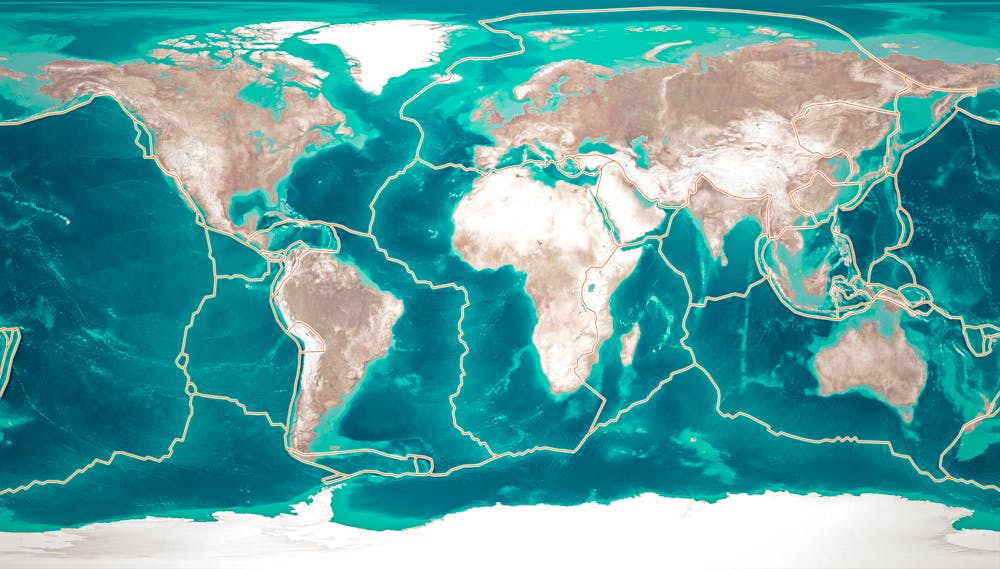
Earthquakes happen because the slow and steady motions of tectonic plates cause stresses to build up along faults in the Earth’s crust. Faults are not really lines, but planes extending down miles into the ground. Friction due to the enormous pressure from the weight of all the overlying rock holds these cracks together.
An earthquake starts in some small spot on the fault where the stress overcomes the friction. The two sides slip past each other, with the rupture spreading out at a mile or two per second. The grinding of the two sides against each other on the fault plane sends out waves of motion of the rock in every direction. Like the ripples in a pond after you drop in a stone, it’s those waves that make the ground shake and cause damage.
Most earthquakes strike without warning because the faults are stuck – locked up and stationary despite the strain of the moving plates around them, and therefore silent until that rupture begins. Seismologists have not yet found any reliable signal to measure before that initial break.
What about the likelihood of a quake in one area?
On the other hand, earthquake science today has come a long way in what I’ll call forecasting as opposed to prediction.
Seismologists can measure the movement of the plates with millimeter-scale precision using GPS technology and other means, and detect the places where stress is building up. Scientists know about the recorded history of past earthquakes and can even infer farther back in time using the methods of paleoseismology: the geologically preserved evidence of past quakes.
Putting all this information together allows us to recognize areas where conditions are ripe for a fault to break. These forecasts are expressed as the likelihood of an earthquake of a given size or greater in a region over a period of decades into the future. For example, the U.S. Geological Survey estimates the odds of a magnitude 6.7 or greater quake in the San Francisco Bay Area over the next 30 years is 72%.
Only about 1 in 20 damaging earthquakes have foreshocks – smaller quakes that precede a larger one in the same place. By definition they aren’t foreshocks, though, until a bigger one follows. The inability to recognize whether an earthquake in isolation is a foreshock is a big part of why useful prediction still eludes us.
These observations suggest perhaps there really are precursory signals for at least some huge quakes. Maybe the sheer size of the ensuing quake made otherwise imperceptible changes in the region of the fault prior to the main event more detectable. We don’t know, because so few of these greater than magnitude 8 earthquakes happen. Scientists don’t have a lot of examples to go on that would let us test hypotheses with statistical methods.
In fact, while earthquake scientists all agree that we can’t predict quakes today, there are now essentially two camps: In one view, earthquakes are the result of complex cascades of tiny effects – a sensitive chain reaction of sorts that starts with the proverbial butterfly wing flapping deep within a fault – so they’re inherently unpredictable and will always remain so. On the other hand, some geophysicists believe we may one day unlock the key to prediction, if we can just find the right signals to measure and gain enough experience.
How do early warning systems work?
One real breakthrough today is that scientists have developed earthquake early warning systems like the USGS ShakeAlert now operating in California, Oregon and Washington state. These systems can send out an alert to residents’ mobile devices and to operators of critical machinery, including utilities, hospitals, trains and so on, providing warning of anywhere from a few seconds to more than a minute before shaking begins.
This sounds like earthquake prediction, but it is not. Earthquake early warning relies on networks of seismometers that detect the very beginning of an earthquake on a fault and automatically calculate its location and magnitude before the damaging waves have spread very far. The sensing, calculating and data transfer all happen near the speed of light, while the seismic waves move more slowly. That time difference is what allows early warning.
For example, if an earthquake begins off the coast of Washington state beneath the ocean, coastal stations can detect it, and cities like Portland and Seattle could get tens of seconds of warning time. People may well get enough time to take a life safety action like “Drop, Cover and Hold On” – as long as they are sufficiently far away from the fault itself.
What complications would predicting bring?
While earthquake prediction has often been referred to as the “holy grail” of seismology, it actually would present some real dilemmas if ever developed.
First of all, earthquakes are so infrequent that any early methods will inevitably be of uncertain accuracy. In the face of that uncertainty, who will make the call to take a major action, such as evacuating an entire city or region? How long should people stay away if a quake doesn’t materialize? How many times before it’s a boy-who-cried-wolf situation and the public stops heeding the orders? How do officials balance the known risks from the chaos of mass evacuation against the risk from the shaking itself? The idea that prediction technology will emerge fully formed and reliable is a mirage.
It is often said in the field of seismology that earthquakes don’t kill people, buildings do. Scientists are already good enough today at forecasting earthquake hazards that the best course of action is to redouble efforts to construct or retrofit buildings, bridges and other infrastructure so they’re safe and resilient in the event of ground shaking in any area known to be at risk from large future quakes. These precautions will pay off in lives and property saved far more than a hoped-for means of earthquake prediction, at least for the foreseeable future.
This is an updated version of an article originally published on Feb. 15, 2023.
Galaxies come in many shapes and sizes, from giant, slowly rotating ovals and fast-whirling spiral disks to faint ball-shaped blobs and dwarf irregulars. Most large, bright galaxies – including our own Milky Way – are orbited by a gang of much smaller dwarf galaxies.
Most of this we know from optical images, whether taken with small backyard telescopes or much bigger dedicated ground- and space-based telescopes that reveal the light from billions of distant suns. However, as we are discovering, what happens beyond the bright disk of stars may be even more interesting.
With radio telescopes, we can map the distinctive glow of free-floating hydrogen atoms throughout the universe, whether they are inside galaxies, around them, or lurking in the lonely spaces between.
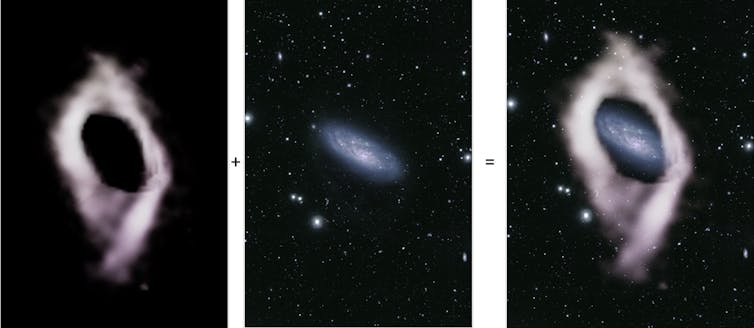
Using CSIRO’s Australian Square Kilometre Array Pathfinder (ASKAP) radio telescope, on Wajarri Yamaji Country in Western Australia, we recently discovered an enormous ribbon of hydrogen encircling a spiral galaxy called NGC 4632. The results are described in a new paper in Monthly Notices of the Royal Astronomical Society.
Galactic leftovers
NGC 4632 appears to be a very rare formation called a “polar ring galaxy”, as the hydrogen ring seems to be rotating over the poles of the galaxy’s disk. The gas in the ring, which makes up about half of the system’s mass, was likely hoovered up from a companion galaxy.
In the words of my colleague Nathan Deg at Queen’s University in Canada, who led the new study:
Polar ring galaxies are some of the most spectacular looking galaxies that we can see. Beyond just being beautiful, they provide important clues about the formation and growth of galaxies over time.
The location and movement of these polar rings can also tell us about the shape of the halo of invisible dark matter astronomers believe surrounds most galaxies.
Left: the hydrogen ring discovered by ASKAP around the spiral galaxy NGC 4632, after removing the bright hydrogen emission detected in the galaxy’s disk. Middle: An optical image of the stellar disk from the Subaru telescope. Right: Composite image showing the stellar disk of NGC 4632 surrounded by the large hydrogen ring. Deg et al. 2023, MNRAS / Jayanne English / Tom Jarrett / Nathan Deg / Wallaby collaborators / CSIRO / ASKAP / NAOJ / Subaru Telescope., CC BY
Spiral galaxies like NGC 4632 are typically rich in cold hydrogen gas. The gas provides the fuel for star formation and typically extends well beyond the bright disk of stars.
In the outskirts of spiral galaxies, we often see that the shape of the gas disk is warped. Why does this happen?
Some warps may be caused by a galaxy wrestling with its neighbors via gravity, stealing gas which collects in the galaxy’s outer disk or forms a polar ring. This is quite a common process by which galaxies grow: our Milky Way galaxy is known to have munched up several small companions.
Hunting hydrogen
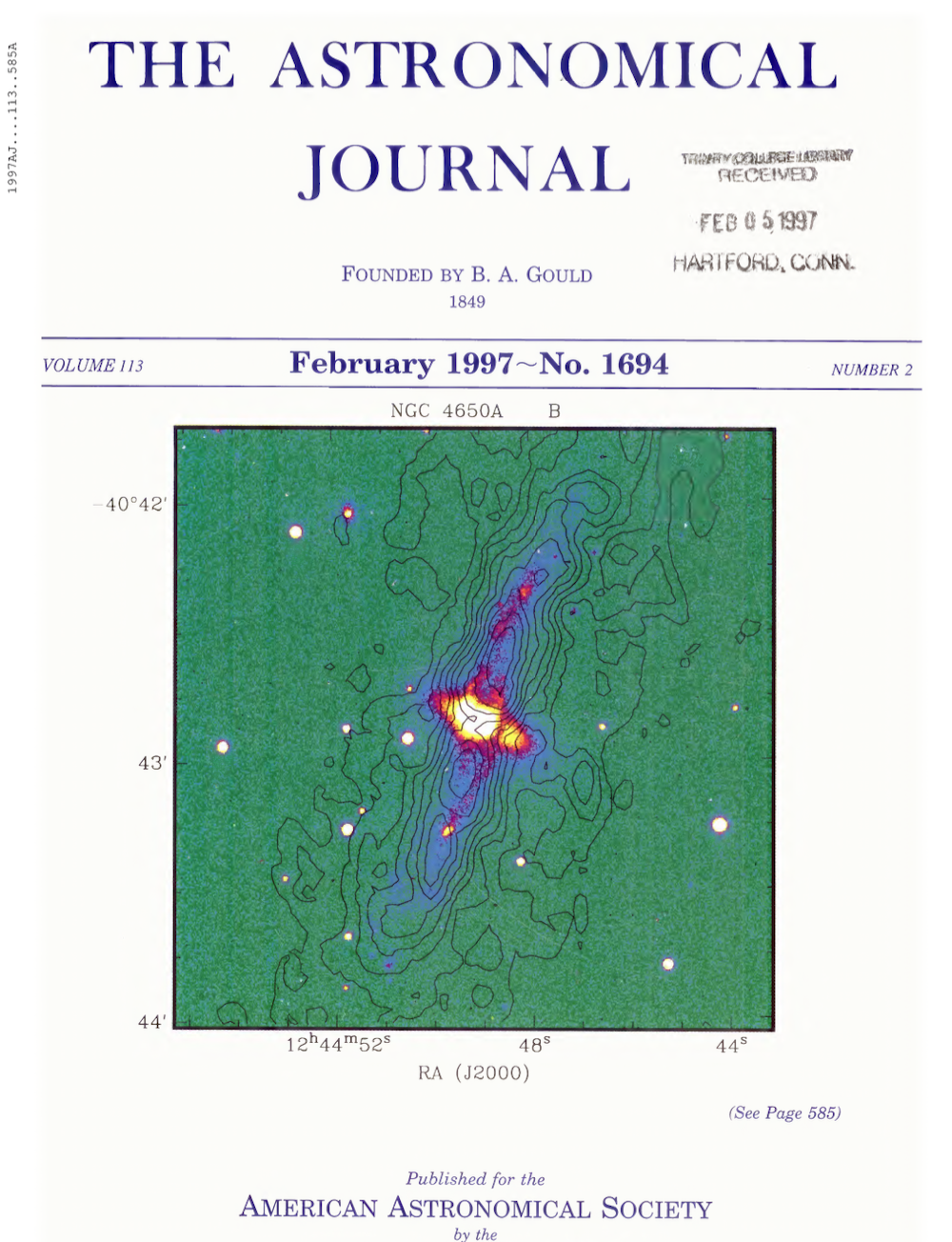
Bärbel Koribalski and Magda Arnaboldi’s early results on hydrogen around the polar ring galaxy NGC 4650A made it to the front cover of The Astronomical Journal in 1997. The Astronomical Journal
Two big projects, the HI Parkes All Sky Survey (HIPASS) and the Local Volume HI Survey (LVHIS), set the scene for much of my current research on galaxies. As plans advanced for the much larger and more powerful ASKAP telescope, I was one of the founders of the Wallaby project, which uses ASKAP’s capabilities to conduct a huge survey of hydrogen in the local universe.
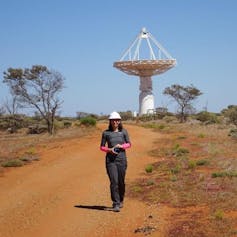
Bärbel Koribalski’s first visit to the ASKAP site in Western Australia. One of ASKAP’s 36 dishes dotted over a 6-km diameter area is seen in the background. Cornelia Brem, CC BY
ASKAP began full operations in late 2022. The telescope is located at Inyarrimanha Ilgari Bundara, CSIRO’s Murchison radio astronomy observatory: the traditional name means ‘sharing sky and stars’ in the Wajarri language.
ASKAP now produces such vast amounts of data that we need dedicated software running on the Setonix supercomputer in Perth, not only to produce wide-field images and cubes, but also to sift through them for signs of hydrogen in distant galaxies. We can then conduct more detailed studies of the most interesting galaxies.
Visualising galaxies
Our latest paper highlights two galaxies (of 600 found in our first pilot study) that contain unusual structures.
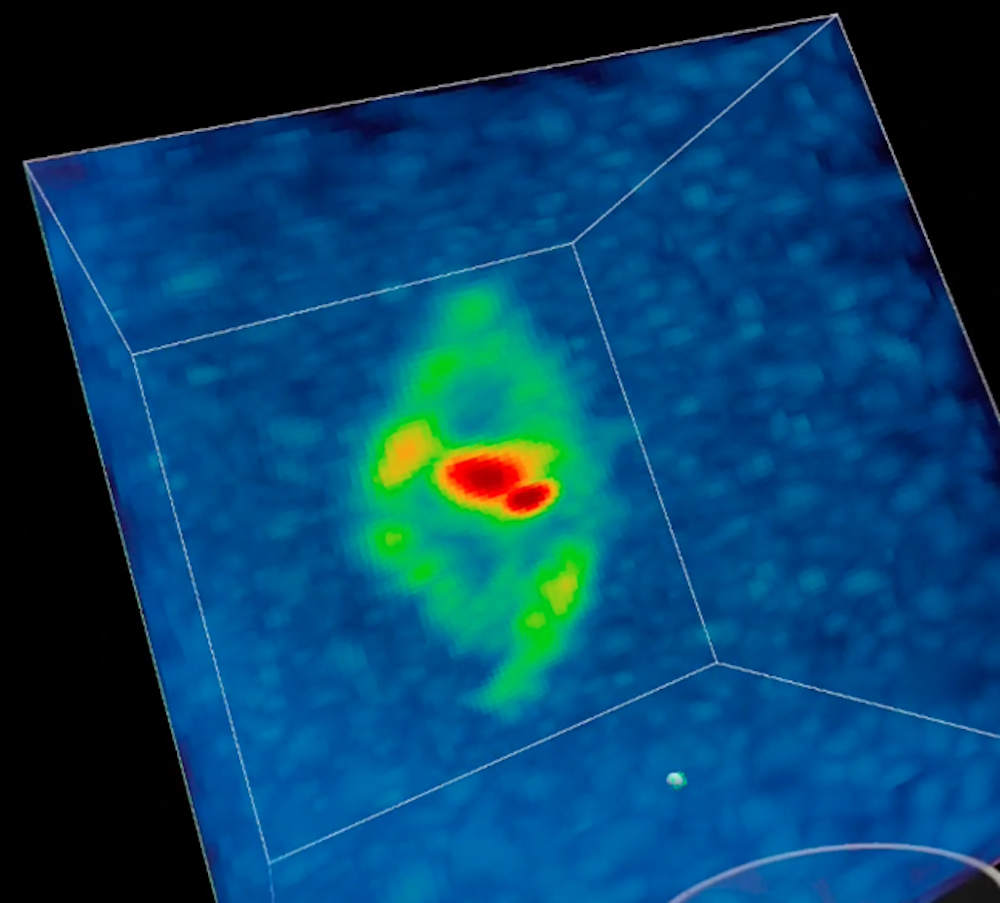
A 3D visualisation of the Wallaby data cube around NGC 4632, created with the iDaVIE virtual reality software. Deg et al. / iDaVIE, CC BY
As Deg puts it, “finding two potential polar ring galaxies in the Wallaby pilot survey is incredibly exciting, as it suggests that these objects may be more common than previously thought”.
To explore the shapes of galaxies we often use 3D visualisation – and even virtual reality software such as iDaVIE.
We expect the full Wallaby survey will reveal more than 200,000 hydrogen-rich galaxies. Among them will be many more unusual objects like the polar ring around NGC 4632, which can then be used to learn more about dark matter.