One of these insects is the honeypot ant Camponotus inflatus, found throughout the central desert region of Australia. We set out to determine whether its honey might be medically useful.
Our results, published in PeerJ, show the honey has powerful anti-microbial effects, particularly against certain heat-tolerant yeasts and moulds which resist most current antifungal drugs.
Pots of gold
Honeypot ants are social ant species that develop large nests in the soil. Within these colonies, certain worker ants known as “repletes” serve as living food stores.
The repletes are fed by other members of the colony, who forage for nectar and honeydew in the environment. The repletes accumulate a golden honey-like substance in their flexible abdomens.
The repletes become so engorged with honey they are rendered almost immobile. They hang together from the ceiling of the nest, forming a sort of ant pantry.
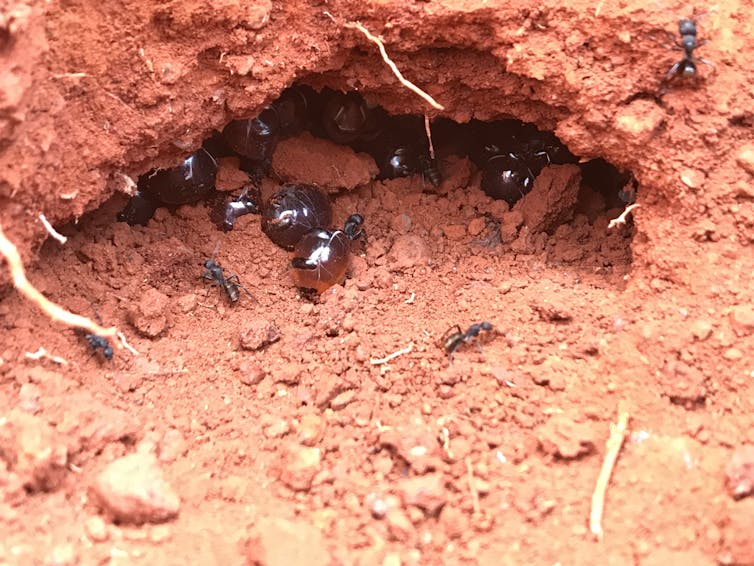
Honeypot ant ‘repletes’ store honey for the nest. Andrew Dong, Author provided
In times of need, other worker ants visit the repletes and stroke their antennae. The repletes cough up some honey in response, and the other workers then distribute it throughout the colony.
Most honeypot ants live in very dry environments. Their unusual lifestyle has been so successful it has evolved multiple times.
Honeypot ants in First Nations culture

Digging for honeypot ants. Danny Ulrich, Author provided
In Australia, Camponotus inflatus is found throughout the central desert region and holds cultural and nutritional significance to local Indigenous people.
Danny Ulrich of the Tjupan language group, operator of Goldfields Honey Ant Tours in Kalgoorlie, Western Australia, says
For our people, honey ants are more than just a food source. Digging for them is a very enjoyable way of life. It’s a way of bringing the family together, to connect with each other and nature.
There are also reports of traditional use of honeypot ant honey for treating ailments like colds and sore throats, and possibly as a topical ointment to help keep infections at bay, suggesting potential antimicrobial properties.
Not your usual honey activity
To investigate further, we obtained honeypot ant repletes from Goldfields Honey Ant Tours, collected and pooled the honey from the ants and tested its ability to inhibit various pathogenic bacteria, yeasts and moulds.
We compared this to two well-studied bee honeys with anti-microbial properties: manuka honey from New Zealand, and jarrah honey from Western Australia.
Our results revealed striking differences between the honeypot ant honey and the bee honeys.
Both bee honeys showed broad activity and were able to inhibit every pathogen tested at similar levels. However, the honeypot ant honey showed remarkable potency against certain microbes, but little against others.
Important factors that contribute to the antimicrobial power of bee honey are its high sugar and low water content, which sucks the water out of microbial invaders.
We found honeypot ant honey to have a much higher moisture content than the bee honeys, however, putting it in a range that could support the growth of some microorganisms.
Most bee honeys also contain enzymes that produce hydrogen peroxide, a known antimicrobial compound. However, honeypot ant honey retained most of its activity even after we removed all the hydrogen peroxide.
Finally, some honeys contain antimicrobial proteins and peptides that are derived from the honey bee. These can be destroyed by heat, and when we heated the honeypot ant honey to 90℃ for 10 minutes it lost most of its antimicrobial activity.
We therefore think this unique antimicrobial activity is likely due to proteins or peptides, and these are probably derived from the honeypot ant.
Evolution of antimicrobial activity in the insect world
In the natural environment, animals, plants, and the products they make are exposed to a huge range of microorganisms looking for their next meal. Sweet, nutritious honey is an enticing food source for these microbial scavengers and must be vigorously protected, both to prevent its spoilage and to stop invasion of the hive or nest by rapidly growing moulds.
Intriguingly, we found honeypot ant honey was particularly effective against some pathogens we consider to be quite “tough”. These pathogens are well adapted to living in soils and dry conditions, and can also cause very serious infections in people with severely weakened immune systems.
In particular, the ant honey was able to inhibit heat-tolerant yeasts and moulds that are likely to be present in the honey ant nest and surrounding environment. Importantly, these can be very difficult to kill with most currently available antifungal drugs.
We suggest the evolutionary pressure imposed by these soil microorganisms has resulted in the potent, selective antimicrobial activity of honeypot ant honey.
Science catches up with Indigenous knowledge
Our results clearly support the medicinal use of honeypot ant honey by Australian Indigenous communities and provide a new understanding of the intricate relationship between honeypot ants, their environment, and the remarkable antimicrobial activity exhibited by their honey.
Due to the cultural significance of the ants, and challenges with rearing them at a commercial scale, it is not feasible to domesticate honeypot ants for honey production.
However, honeypot ant honey may provide valuable insights for the development of useful new antimicrobial peptides. These may help expand our arsenal of effective antibacterial and antifungal treatments, which are increasingly needed to combat emerging challenges in healthcare.
Dee Carter, Professor of Microbiology, University of Sydney; Andrew Dong, Research Affiliate, Microbiology, University of Sydney; Danny Ulrich, Operator, Goldfields Honey Ant Tours, Indigenous Knowledge; Kenya Fernandes, Postdoctoral Researcher, University of Sydney, and Nural Cokcetin, Research scientist, University of Sydney
This article is republished from The Conversation under a Creative Commons license. Read the original article.