Questions about the ultimate origin of the cosmos, or universe, take physics out of its comfort zone. Yet this was exactly where Hawking liked to venture. The prospect — or hope — to crack the riddle of cosmic design drove much of Hawking’s research in cosmology. “To boldly go where Star Trek fears to tread” was his motto – and also his screen saver.
Our shared scientific quest meant that we inevitably grew close. Being around him, one could not fail to be influenced by his determination and optimism that we could tackle mystifying questions. He made me feel as if we were writing our own creation story, which, in a sense, we did.
In the old days, it was thought that the apparent design of the cosmos meant there had to be a designer – a God. Today, scientists instead point to the laws of physics. These laws have a number of striking life-engendering properties. Take the amount of matter and energy in the universe, the delicate ratios of the forces, or the number of spatial dimensions.
Physicists have discovered that if you tweak these properties ever so slightly, it renders the universe lifeless. It almost feels as if the universe is a fix – even a big one.
But where do the laws of physics come from? From Albert Einstein to Hawking in his earlier work, most 20th-century physicists regarded the mathematical relationships that underlie the physical laws as eternal truths. In this view, the apparent design of the cosmos is a matter of mathematical necessity. The universe is the way it is because nature had no choice.
Around the turn of the 21st century, a different explanation emerged. Perhaps we live in a multiverse, an enormous space that spawns a patchwork of universes, each with its own kind of Big Bang and physics. It would make sense, statistically, for a few of these universes to be life-friendly.
However, soon such multiverse musings got caught in a spiral of paradoxes and no verifiable predictions.
Turning cosmology inside out
Can we do better? Yes, Hawking and I found out, but only by relinquishing the idea, inherent in multiverse cosmology, that our physical theories can take a God’s-eye view, as if standing outside the entire cosmos.
It is an obvious and seemingly tautological point: cosmological theory must account for the fact that we exist within the universe. “We are not angels who view the universe from the outside,” Hawking told me. “Our theories are never decoupled from us.”
We set out to rethink cosmology from an observer’s perspective. This required adopting the strange rules of quantum mechanics, which governs the microworld of particles and atoms.
According to quantum mechanics, particles can be in several possible locations at the same time – a property called superposition. It is only when a particle is observed that it (randomly) picks a definite position. Quantum mechanics also involves random jumps and fluctuations, such as particles popping out of empty space and disappearing again.
In a quantum universe, therefore, a tangible past and future emerge out of a haze of possibilities by means of a continual process of observing. Such quantum observations don’t need to be carried out by humans. The environment or even a single particle can “observe”.
Countless such quantum acts of observation constantly transform what might be into what does happen, thereby drawing the universe more firmly into existence. And once something has been observed, all other possibilities become irrelevant.
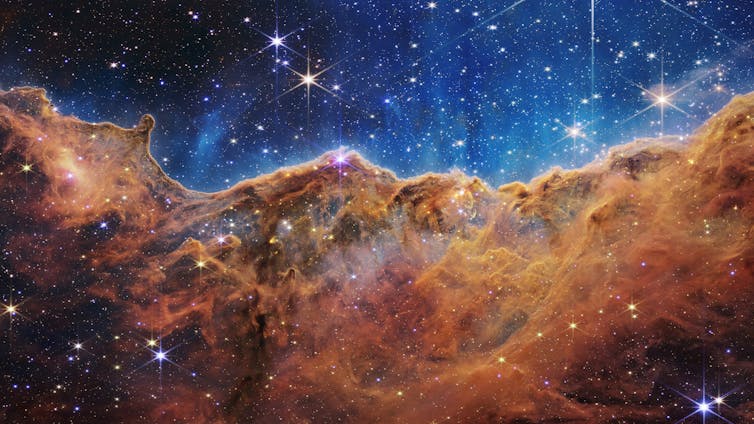
Star-forming region in our galaxy. NASA, ESA, CSA, and STScI
We discovered that when looking back at the earliest stages of the universe through a quantum lens, there’s a deeper level of evolution in which even the laws of physics change and evolve, in sync with the universe that is taking shape. What’s more, this meta-evolution has a Darwinian flavor.
Variation enters because random quantum jumps cause frequent excursions from what’s most probable. Selection enters because some of these excursions can be amplified and frozen, thanks to quantum observation. The interplay between these two competing forces – variation and selection – in the primeval universe produced a branching tree of physical laws.
The upshot is a profound revision of the fundamentals of cosmology. Cosmologists usually start by assuming laws and initial conditions that existed at the moment of the Big Bang, then consider how today’s universe evolved from them. But we suggest that these laws are themselves the result of evolution.
Dimensions, forces, and particle species transmute and diversify in the furnace of the hot Big Bang – somewhat analogous to how biological species emerge billions of years later – and acquire their effective form over time.
Moreover, the randomness involved means that the outcome of this evolution – the specific set of physical laws that makes our universe what it is – can only be understood in retrospect.
In some sense, the early universe was a superposition of an enormous number of possible worlds. But we are looking at the universe today at a time when humans, galaxies and planets exist. That means we see the history that led to our evolution.
We observe parameters with “lucky values”. But we are wrong to assume they were somehow designed or always like that.
The trouble with time
The crux of our hypothesis is that, reasoning backward in time, evolution towards more simplicity and less structure continues all the way. Ultimately, even time and, with it, the physical laws fade away.
This view is especially borne out of the holographic form of our theory. The “holographic principle” in physics predicts that just as a hologram appears to have three dimensions when it is in fact encoded in only two dimensions, the evolution of the entire universe is similarly encoded on an abstract, timeless surface.
Hawking and I view time and causality as “emergent qualities”, having no prior existence but arising from the interactions between countless quantum particles. It’s a bit like how temperature emerges from many atoms moving collectively, even though no single atom has temperature.
One ventures back in time by zooming out and taking a fuzzier look at the hologram. Eventually, however, one loses all information encoded in the hologram. This would be the origin of time - the Big Bang.
For almost a century, we have studied the origin of the universe against the stable background of immutable laws of nature. But our theory reads the universe’s history from within and as one that includes, in its earliest stages, the genealogy of the physical laws. It isn’t the laws as such but their capacity to transmute that has the final word.
Future cosmological observations may find evidence of this. For instance, precision observations of gravitational waves – ripples in the fabric of spacetime – may reveal signatures of some of the early branches of the universe. If spotted, Hawking’s cosmological finale may well prove to be his greatest scientific legacy.
Thomas Hertog, Professor of physics, KU Leuven
This article is republished from The Conversation under a Creative Commons license. Read the original article.




 Credit: OpenSecrets