British scientists are tracking two enormous icebergs that broke off from Antarctica and could intrude on shipping lanes. The smaller of the icebergs is called A81 and it’s bigger than Greater London, according to the BBC. Its larger travel companion is called A76a. The Royal Research Ship Discovery inspected the latter berg as it entered the southern Atlantic Ocean. “It was directly in our path as we sailed home so we took 24 hours out to go around it,” British oceanographer Geraint Tarlingtold the BBC. It’s slowly approaching the Falkland Islands, which are a British territory. Researchers’ ...
While the COVID-19 pandemic gripped the U.S. in 2020, the nationwide rate of sudden unexplained infant deaths remained steady — except among Black babies, according to a study released Monday. The sudden unexplained infant death (SUID) rates among white, Asian, American Indian and Hispanic babies all remained relatively steady or declined from 2019 to 2020, the study found. However, the rate increased substantially among Black babies. “The significant increased rate of SUID among non-Hispanic Black infants from 2019 to 2020, but not among other single race and Hispanic infants, deserves furthe...
Ants can be found in nearly every location on Earth, with rough estimates suggesting there are over 10 quadrillion individuals – that is a 1 followed by 16 zeroes, or about 1 million ants per person. Ants are among the most biologically successful animals on the planet.
A surprising part of their evolutionary success is the amazing sense of smell that lets them recognize, communicate and cooperate with one another.
Ants live in complex colonies, sometimes referred to as nests, that are home to a wide range of social interactions. Here, one or more queens are responsible for all the reproduction within that colony. The vast majority of colony members are female workers – sisters that never mate or reproduce and live only to serve the group.
Ants need to defend their colony, seek food and take care of offspring. To accomplish these tasks some ant species domesticate other insects, while others create agricultural systems, harvesting leaves from which they grow edible fungal gardens. Successfully coordinating all these intricate tasks requires reliable and secure communication among nestmates.
Weare biologists who study the remarkable sensory abilities of ants. Our recent work shows how their societies depend on the exchange of reliable information which, if disrupted, spells doom for their colonies.
Unique scents
Human communication relies primarily on verbal and visual cues. We usually identify our friends by the sound of their voice, the appearance of their face or the clothes they wear. Ants, however, rely primarily on their acute sense of smell.
An exterior shell, known as an exoskeleton, encases an ant’s body. This greasy coat carries a unique scent that varies from individual to individual and gives each ant a unique odor signature that other ants can detect. This odor signature can communicate important information.
The queen, for example, will smell slightly different from a worker, and thus receive special treatment within the colony. Importantly, ants from different colonies will smell slightly different from one another. The detection and decoding of these differences is vital for colony defense and can trigger aggressive turf wars between colonies when ants catch a whiff of intruders.
Interactions between nestmates are friendly. But when ants sniff out enemy non-nestmates, there is rapid and deadly aggression. Produced by the Zwiebel Lab, Vanderbilt University, filmed by Stephen Ferguson.
For ants and other insects, receiving chemical information begins when an odor enters the small hairs located along their antennae. These hairs are hollow and contain special receptors, called chemosensory neurons, that sort and send the chemical information to the ant’s brain.
Odors, such as those given off from an ant’s greasy coat, act like chemical “keys.” Ants can smell these odor keys only if they are inserted into the correct set of chemosensory neuron “locks.” A neuronal lock remains shut to any odors except its particular key. When the correct key binds to the correct neuronal lock, though, the receptor sends a complex message to the brain. The ant’s brain is able to decode this sensory information to make decisions that ultimately lead to cooperation between nestmates – or battles between non-nestmates.
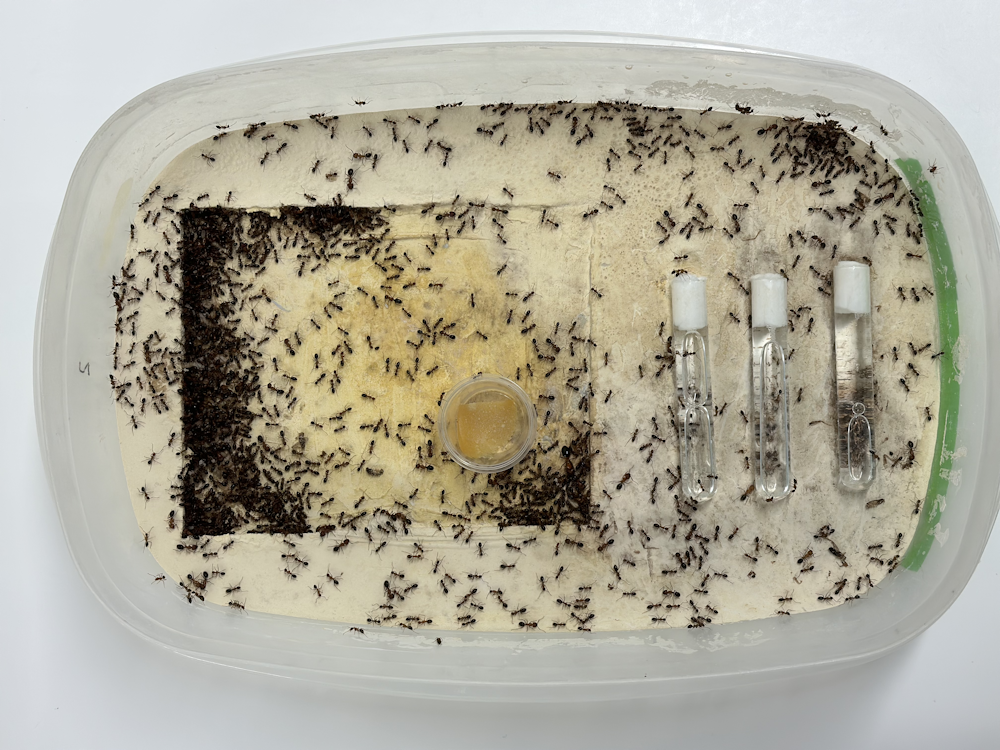
A colony of carpenter ants (Camponotus floridanus) reared in the Zwiebel Lab at Vanderbilt University. LJ Zwiebel, Vanderbilt University, CC BY-ND
Changing the locks
To better understand how ants detect and communicate information, we use laboratory tools such as precisely targeted drugs and geneticengineering to manipulate their sense of smell. We are especially interested in what happens when an ant’s sense of smell goes wrong.
For example, when we prevent an odor “key” from opening a chemosensory “lock,” it prevents the chemical information from reaching the brain. This would be like plugging your nose or standing in a completely dark room – no scents or sights would register. We can also open all the “locks” at the same time, which floods the neurons with too many messages. Both of these scenarios dramatically compromise an ant’s ability to detect and receive accurate information.
When we messed with ants’ sense of smell – whether shutting down or flooding their odor receptors – we found they no longer attacked non-nestmates. Instead, they became less aggressive. In the absence of clear information, ants exercised restraint and opted to accept rather than attack their fellow ant. Put another way, ants ask questions first and shoot later.
We believe this social restraint is hard-wired and gives ants an evolutionary advantage. When you live in a colony with tens of thousands of sisters, a simple case of mistaken identity or miscommunication could lead to deadly infighting and societal chaos, which is potentially very costly.
Not only do they fail to recognize and attack foes, they also stop cooperating with their friends. Without nurses to take care of the young or foragers to collect food, the eggs dry up and the queen goes hungry.
We discovered that without an accurate means of communicating and receiving chemical information, ant societies collapse and the colony quickly dies. Miscommunication or the lack of accurate information affects other highly social animals, including humans, as well. For ants, it all depends on their sense of smell.
The World Health Organization confirmed an outbreak of the deadly Marburg virus disease in the central African country of Equatorial Guinea on Feb. 13, 2023. To date, there have been 11 deaths suspected to be caused by the virus, with one case confirmed. Authorities are currently monitoring 48 contacts, four of whom have developed symptoms and three of whom are hospitalized as of publication. The WHO and the U.S. Centers for Disease Control and Prevention are assisting Equatorial Guinea in its efforts to stop the spread of the outbreak.
We are virologistswhostudy Marburg, Ebola and related viruses. Our laboratory has a long-standing interest in researching the underlying mechanisms of how these viruses cause disease in people. Learning more about how Marburg virus is transmitted from animals to humans and how it spreads between people is essential to preventing and limiting future outbreaks.
Marburg virus disease
Marburg virus spreads between people by close contact only after they show symptoms. It is transmitted through infected body fluids such as blood, and is not airborne. Contact tracing is a potent tool to combat outbreaks. The incubation time, or time between infection and the onset of symptoms, ranges from two to 21 days and typically falls between five and 10 days. This means that contacts must be observed for extended periods for potential symptoms.
Marburg virus cannot be detected before patients are symptomatic. One major cause of the spread of Marbug virus disease is postmortem transmission due to traditional burial procedures, where family and friends typically have direct skin-to-skin contact with people who have died from the disease.
Without effective treatments or vaccines, Marburg virus outbreak control primarily relies on contact tracing, sample testing, patient contact monitoring, quarantines and attempts to limit or modify high-risk activities such as traditional funeral practices.
Identifying the virus took only three months, which, at the time, was incredibly fast considering the available research tools. Despite receiving intensive care, seven of the 32 patients died. This case fatality rate of 22% was relatively low compared to subsequent Marburg virus outbreaks in Africa, which have had a cumulative case fatality rate of 86%. It remains unclear if these differences in lethality are due to variability in patient care options or other factors such as distinct viral strains.
Subsequent Marburg virus disease outbreaks occurred in Uganda and Kenya, as well as the Democratic Republic of the Congo and Angola in Central Africa. In addition to the current outbreak in Equatorial Guinea, recent Marburg virus cases in the West African countries of Guinea in 2021 and Ghana in 2022 highlight that the Marburg virus is not confined to Central Africa.
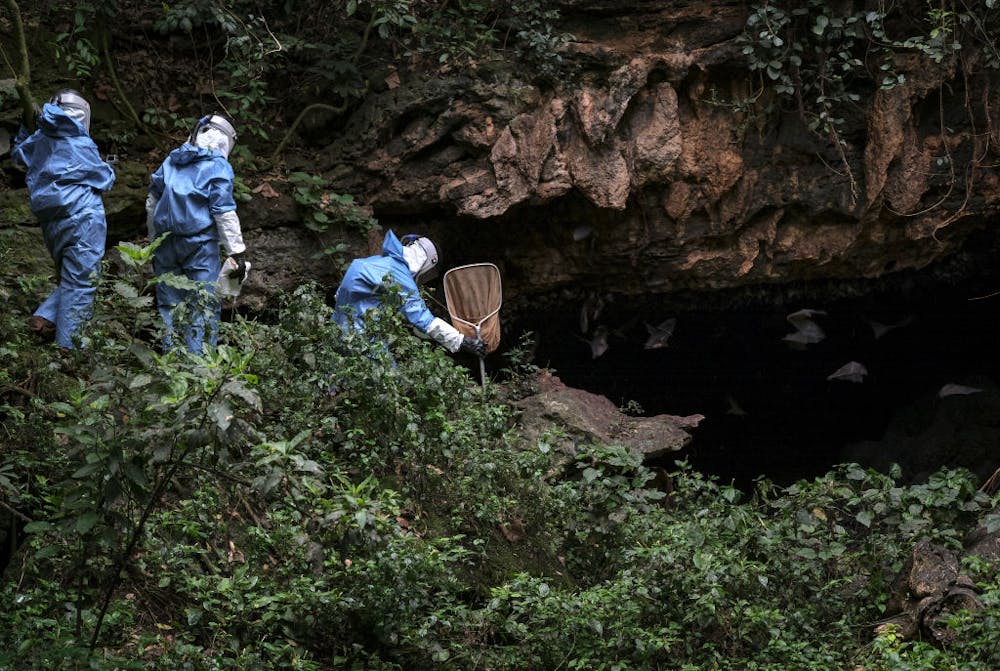
Strong evidence shows that the Egyptian fruit bat, a natural animal reservoir of Marburg virus, might play an important role in spreading the virus to people. The location of all Marburg virus outbreaks coincides with the natural range of these bats. The large area of Marburg virus outbreaks is unsurprising, given the ecology of the virus. However, the mechanisms of zoonotic, or animal-to-human, spread of Marburg virus still remain poorly understood.
The origin of a number of Marburg virus disease outbreaks is closely linked to human activity in caves where Egyptian fruit bats roost. More than half of the cases in a 1998 outbreak in the northeastern Democratic Republic of the Congo were among gold miners who had worked in Goroumbwa Mine. Intriguingly, the end of the nearly two-year outbreak coincided with the flooding of the cave and the disappearance of the bats in the same month.
Although Marburg virus disease outbreaks have historically been sporadic, their frequency has been increasing in recent years.
The increasing emergence and reemergence of zoonotic viruses, including filoviruses (such as Ebola, Sudan and Marburg viruses), coronaviruses (which cause SARS, MERS and COVID-19), henipaviruses (such as Nipah and Hendra viruses) and Mpox appear to be influenced by both human encroachment on previously undisturbed animal habitats and alterations to wildlife habitat ranges due to climate change.
Most Marburg virus outbreaks have occurred in remote areas, which has helped to contain the spread of the disease. However, the large geographic distribution of Egyptian fruit bats that harbor the virus raises concerns that future Marburg virus disease outbreaks could happen in new locations and spread to more densely populated areas, as seen by the devastating Ebola virus outbreak in 2014 in West Africa, where over 11,300 people died.
Based on research in France’s Mandrin cave, in February 2022 we published a study in the journal Science Advances that pushed back the earliest evidence of the arrival of the first Homo sapiens in Europe to 54,000 years ago – 11 millennia earlier than had been previously established.
In the study, we described nine fossil teeth excavated from all the archeological layers in the cave. Eight were determined to be from Neanderthals, but one from one of the middle layers belonged to a paleolithic Homo sapiens. Based on this and other data, we determined that these early Homo sapiens of Europe were later replaced by Neanderthal populations.
The single Homo sapiens tooth was discovered in a remarkable and rich archeological layer that also included approximately 1,500 tiny stone blades or bladelets – some were less than 1 centimeter in length. They were all part of the “Neronian” tradition, named in 2004 by one of us, Ludovic Slimak, after the Néron cave in France’s Ardèche region. Neronian stone tools are distinctive and there were no similar points found in the layers left behind by the Neanderthals who inhabited the rock shelter before and after. They also bear striking parallels with those made by other Homo sapiens along the east Mediterranean coast, as exemplified at the site of Ksar Akil northeast of Beirut.
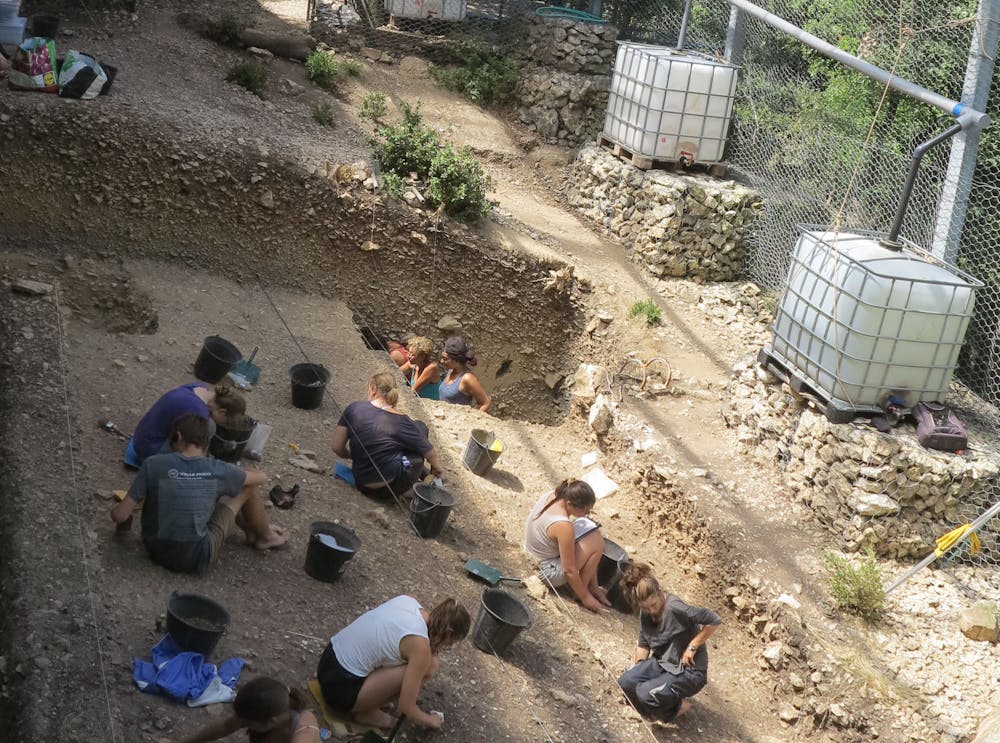
View of archeological excavations at the entrance of France’s Mandrin cave. Ludovic Slimak, CC BY-ND
This month in the journal Science Advances, we published a study announcing that the humans who arrived in Europe some 54,000 years ago had mastered the use of bows and arrows. This discovery pushes back the origin in Eurasia of these remarkable technologies by approximately 40,000 years.
The emergence in prehistory of mechanically propelled weapons – spears or arrows sent on their way by throwing sticks (atlatl) or bows – is commonly perceived as one of the hallmarks of the advance of modern human populations into the European continent. However, the origin of archery has always been archeologically difficult to trace because the materials used tend to disappear from the fossil record.
Archaeological invisibility
Armatures – hard points made of stone, horn or bone – constitute the main evidence of weapon technologies in the European Paleolithic. Materials associated with archery – wood, fibers, leather, resins, and sinew – are perishable, however, and so are rarely preserved. This makes archaeological recognition of these technologies difficult.
Partially preserved archery equipment was found in Eurasia only in more recent times, between 10 and 12 millennia ago, and in frozen ground or peat bogs, as at the Stellmoor site in Germany. Based on the analysis of armatures, archery is now well documented in Africa approximately 70,000 years ago. While some flint or deer-antler armatures suggest the existence of archery from the early phases of the Upper Paleolithic in Europe more than 35,000 years ago, their shape and how they were hafted – attached to a shaft or handle – do not allow confirmation that they were propelled by a bow.
More recent armatures from the European Upper Paleolithic bear similarities to each other, not allowing us to clearly determine whether they were propelled by a bow or an atlatl. This makes the possible existence of archery during the European Upper Paleolithic archeologically plausible, but difficult to establish.
Experimental replicas
The stone points found in the Mandrin cave are both extremely light (30% weigh hardly more than a few grams) and small (almost 40% of these tiny points present a maximum width of 10mm).
To determine how they could have been propelled, the first step was to make experimental replicas. We then hafted the newly made points into shafts and tested how they behaved when shot with bows and spear-throwers, or by simply thrusting them. This allowed us to test their ballistic characteristics, limits and efficiency.
The tiny experimental points were used as arrowheads and shot by bow or atlatl, and the resulting fractures were compared with the scars found on the archeological material. Laure Metz, Slimak Ludovic, CC BY-ND
After our experimental replicas were shot, we examined the fractures that resulted and compared them with those found on the archeological material. The fractures and scars show that they were distally hafted – attached to the split end of a shaft. Their small size and especially narrow width allow us to conclude how they were fired: only high-speed propulsion by a bow was possible, our analysis determined.
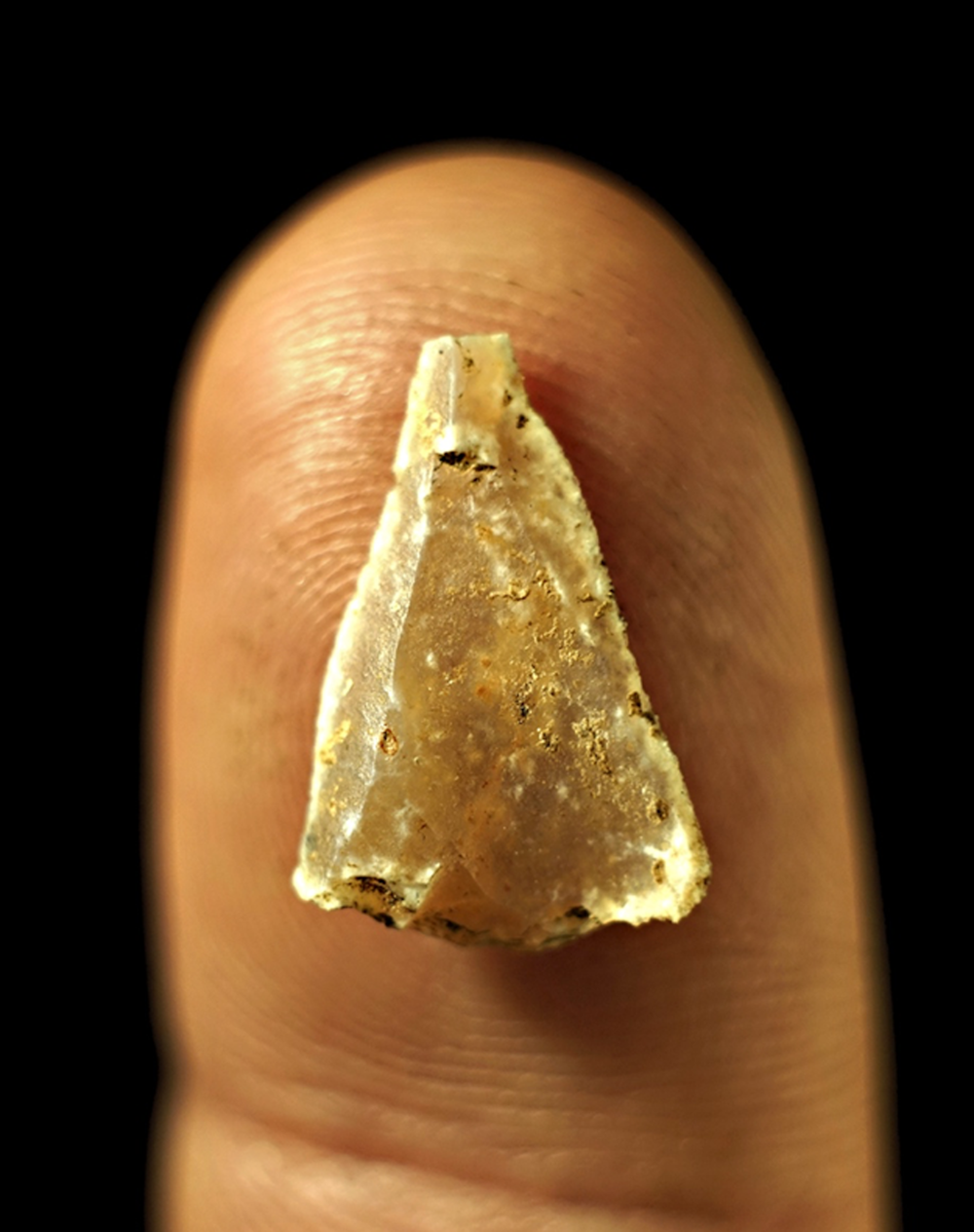
Nanotechnologies of the first Homo sapiens in Europe. More than 1,500 points were found abandoned by these earliest modern humans during their stay in Mandrin cave. This very light point, found in the cave’s Layer E, is dated to 54,000 years old and presents diagnostic microscopic scars of its use as a weapon. Laure Metz, Ludovic Slimak, CC BY-ND
The data from the Mandrin cave and the tests that we performed enrich our knowledge of these technologies in Europe and now allow us to push back the age of archery in Europe by more than 40,000 years.
Our study also sheds light on the weaponry of these Neanderthal populations, who were contemporaries of the Neronian modern humans. Neanderthals did not develop mechanically propelled weapons and continued to use their traditional weapons based on the use of massive stone-tipped spears that were thrust or thrown by hand, and thus requiring close contact with the game they hunted. The traditions and technologies mastered by these two populations were thus distinct, illustrating a remarkable objective technological advantage for modern populations during their expansion into Europe.
Not only do these discoveries profoundly reshape our knowledge of Neanderthals and modern humans in Western Europe, but they also raise many questions about the structure and organization of these different populations on the continent. Technical choices are not solely the result of the cognitive capacities of differing hominin populations, but may also have depended on the weight of traditions within these Neanderthal and modern human populations.
To deepen one’s understanding the complex question of the relationship between Homo sapiens and Neanderthals during the first migration to the European continent, the reader can turn to Ludovic Slimak’s book “Néandertal nu” (Odile Jacob 2022), soon available from Penguin books as “The Naked Neanderthal”.
SACRAMENTO, Calif. Melted chocolate whirred around a melanger in California Cultured’s workshop, destined to be poured, hardened and broken into little squares. A tasty dessert, not yet legal to sell in the U.S. This chocolate didn’t come from cacao pods in South America or Africa. It was grown in laboratory flasks and metal tanks inside a West Sacramento industrial park, part of a growing regional trend. Yolo County has long been an agricultural hub. Now, its food tech companies are shaping what we eat in a different way. From Davis to Woodland and West Sacramento, California, the county has ...
A new effort to tackle climate change in Washington state just got a boost of cash.
On Tuesday, the state announced the results of its first “cap-and-invest” auction. It raised an estimated $300 million from polluting companies to fund projects such as building clean energy, reducing emissions from buildings and transportation, and adapting to the effects of rising global temperatures.
Washington has set a goal to cut its carbon emissions 95 percent below 1990 levels by 2050. In that effort, the state is putting a statewide limit on carbon emissions that gradually lowers over time. Under the cap-and-invest system, businesses buy “allowances” for the greenhouse gases they emit. But these permits will become more expensive over time — both an incentive to cut emissions and a method of raising money to address climate change.
In Washington’s first auction, held last week, the permits sold out, averaging about $49 per ton of carbon dioxide. The price was nearly double that of the most recent cap-and-trade auction held by California and Quebec, where the average was $28 per ton.
“The auction price is potentially higher because Washington’s program requires stronger climate pollution cuts than anywhere else in the country,” said Kelly Hall, the Washington director for the regional nonprofit Climate Solutions. “There is strong competition for these allowances.”
Washington’s auctions, which will take place four times a year, are projected to raise nearly $1 billion annually. At least 35 percent of the revenue is slated to go toward projects that benefit communities historically and disproportionately impacted by pollution. By the end of April, once the budgeting process is ironed out, the state will begin the process of setting up these various climate initiatives, said David Mendoza, the director of public engagement and policy at The Nature Conservancy in Washington.
The state’s cap-and-invest system, which began in January, follows in the footsteps of several state and regional cap-and-trade systems — with a few key changes. It relies less on carbon offsets and is also designed to address some equity concerns around cap-and-trade. In California, for example, studies have shown that pollution in Black and Latino communities actually increased in the years since that state’s cap-and-trade program began.
Washington’s system takes the novel approach of pairing cap-and-trade with a regulatory air quality program intended to crack down on large and small sources of pollution in the hardest-hit areas. While the state is still figuring out the details, last week, its Department of Ecology announced that it had identified 16 communities where it plans to concentrate efforts to improve air quality. South Seattle, Tacoma, and Spokane made the list, as did some rural areas.
Cap-and-trade programs are now up and running in more than a dozen U.S. states, including Oregon and a regional program in the Northeast. Still, the approach remains controversial. Washington’s program has gathered criticism for giving some large emitters, such as petroleum refineries and paper mills, a free pass. While these polluters can buy allowances at little or no cost for the next dozen years, they are still covered under the program’s declining cap on emissions.
The state is currently looking into linking up its cap-and-trade program with California and Quebec, which have already joined markets. In Washington, there’s a requirement that they can only link the markets if the state determines that it won’t result in a “negative impact on overburdened communities in either jurisdiction,” Mendoza said.
After researching the potential benefits — and consequences — of linking the programs, the state is expected to issue a recommendation on whether to join California’s market by the end of summer.
Grist is a nonprofit, independent media organization dedicated to telling stories of climate solutions and a just future. Learn more at Grist.org
The U.S. Food and Drug Administration has approved a nasal spray developed by Pfizer as a means to quickly treat the painful symptoms associated with suffering a migraine.
The drug, Zavzpret, also known as zavegepant, was approved on Thursday for the treatment of acute migraines with or without an aura in adults. It’s expected to launch in July, Reuters reported.
ORLANDO, Fla. — Another four humans are headed back to Earth after spending more than five months in space with the SpaceX Crew-5 mission departing the International Space Station aiming for a Saturday night splashdown off the coast of Florida.
The quartet of mission commander and NASA astronaut Nicole Mann, pilot and NASA astronaut Josh Cassada, Japan Aerospace Exploration Agency astronaut Koichi Wakata and Roscosmos cosmonaut Anna Kikina climbed aboard Crew Dragon Endurance and detached from the forward-facing port of the ISS’s Harmony module at 2:20 a.m.
A Tyrannosaurus-Rex skeleton dating back 67-million years will be auctioned in Switzerland next month, marking the first such sale in Europe, the auction house said Saturday.
The skeleton dubbed Trinity will go under the hammer in Zurich on April 18, the Koller auction house said.
Towering 3.9 metres (12.8 feet) in the air, Trinity has been valued at between six to eight million Swiss francs ($6.5-8.7 million), according to the auction catalogue.
But Christian Link, in charge of natural history memorabilia at Koller, told AFP he believed that was a "very low estimate".
Trinity is "one of the most spectacular T-Rex skeletons in existence, a well-preserved and brilliantly restored fossil," the auction house said.
The sale would mark "the first time in Europe and only the third time worldwide (that) a skeleton of an entire T-Rex dinosaur of exceptional quality will be offered at auction".
Koller pointed to a 2021 study in the scientific journal Nature indicating that only 32 skeletons of adult T-Rex's -- one of the largest terrestrial predators ever to walk the Earth -- had been found worldwide.
'Incredibly well-preserved'
The Trinity skeleton is made up of bone material from three T-Rex specimens.
They were excavated between 2008 and 2013 from the Hell Creek and Lance Creek formations in Montana and Wyoming in the United States, the auction catalogue said.
The two sites are known for the discoveries of two other significant T-Rex skeletons that have gone to auction: Sue went under the hammer in 1997 for $8.4 million, and Stan, which took the world-record hammer price of $31.8 million at Christie's, in 2020.
Last year, Christie's withdrew another T-Rex skeleton -- also excavated from Montana -- days before it went to auction in Hong Kong, after doubts were reportedly raised about parts of the skeleton.
Link said Koller was intent on being open and transparent about the origins of the bones that make up Trinity.
Just over half of the bone material in the skeleton comes from the three Tyrannosaurus specimens, he said.
Trinity's skull meanwhile is "incredibly well-preserved" and comes from a single T-Rex specimen, according to Koller.
The skeleton was provided by a "private individual", and had been flown in nine large crates to Switzerland, for reassembly, Link said.
Auction sales of dinosaur skeletons and other fossils have raked in tens of millions of dollars in recent years, but experts have warned the trade could be harmful to science by putting the specimens in private hands and out of the reach of researchers.
Koller noted "the rare skeletons of adult T-Rex specimens which have been unearthed are almost all now in institutional collections."
"The Zurich auction is therefore an exceptional opportunity to acquire such a fossil of the highest quality," it said in a statement.
Link also said he would like to see a museum snap up Trinity, adding that several had already voiced interest.
The skeleton will be the star of an auction set to feature a number of other rare fossils, as well as a 2.145-kilo rock that is "among the largest Martian meteorites ever found on earth", according to the catalogue.
The Greek historian Herodotus reported over 2,000 years ago on a misguided forbidden experiment in which two children were prevented from hearing human speech so that a king could discover the true, unlearned language of human beings.
There are two common answers to why language should be learned or innate. For one, complex languages can often respond to local conditions as they are learned. A second answer is that complex communication is often difficult to produce even when individuals are born with some knowledge of the correct signals. Given that the ways honeybees communicate are quite elaborate, we decided to study how they learn these behaviors to answer this language question.
What is a waggle dance?
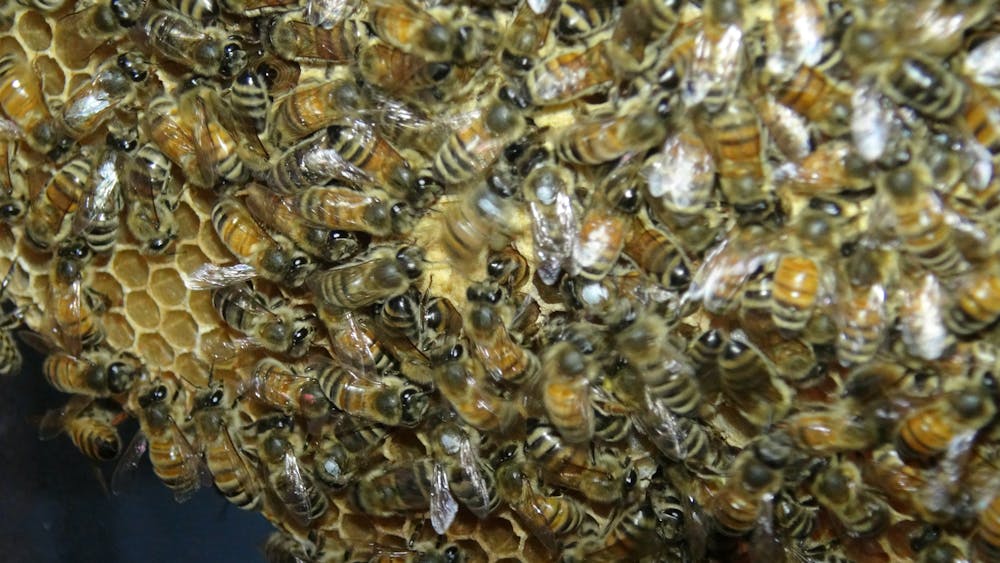
Astonishingly, honeybees possess one of the most complicated examples of nonhuman communication. They can tell each other where to find resources such as food, water, or nest sites with a physical “waggle dance.” This dance conveys the direction, distance and quality of a resource to the bee’s nestmates.
This video, from PBS Nova, shows bees getting their “waggle dance” on.
Essentially, the dancer points recruits in the correct direction and tells them how far to go by repeatedly circling around in a figure eight pattern centered around a waggle run, in which the bee waggles its abdomen as it moves forward. Dancers are pursued by potential recruits, bees that closely follow the dancer, to learn where to go to find the communicated resource.
The waggle dancer gives the instructions, and the followers learn where they can find the indicated resource. Dong Shihao, CC BY-ND
Longer waggle runs communicate greater distances, and the waggle angle communicates direction. For higher-quality resources such as sweeter nectar, dancers repeat the waggle run more times and race back faster after each waggle run.
Making mistakes
This dance is difficult to produce. The dancer is not only running – covering about one body length per second – while trying to maintain the correct waggle angle and duration. It is also usually in total darkness, amid a crowd of jostling bees and on an irregular surface.
Bees therefore can make three different types of mistakes: pointing in the wrong direction, signaling the wrong distance, or making more errors in performing the figure eight dance pattern – what researchers call disorder errors. The first two mistakes make it harder for recruits to find the location being communicated. Disorder error may make it harder for recruits to follow the dancer.
This video, from the Nieh lab, shows the bees’ “waggle run.”
Scientists knew that all bees of the species Apis mellifera begin to forage and dance only as they get older and that they also follow experienced dancers before they first attempt to dance. Could they be learning from practiced teachers?
A ‘forbidden’ bee experiment
My colleagues and I thus created isolated experimental colonies of bees that could not observe other waggle dances before they themselves danced. Like the ancient experiment described by Herodotus, these bees could not observe the dance language because they were all the same age and had no older, experienced bees to follow. In contrast, our control colonies contained bees of all ages, so younger bees could follow the older, experienced dancers.
We recorded the first dances of bees living in colonies with both population age profiles. The bees that could not follow the dances of experienced bees produced dances with significantly more directional, distance and disorder errors than the dances of control novice bees.
We then tested the same bees later, when they were experienced foragers. Bees who had lacked teachers now produced significantly fewer directional and disorder errors, possibly because they had more practice or had learned by eventually following other dancers. The dances of the older control bees from colonies with teachers remained just as good as their first dances.
This finding told us that bees are therefore born with some knowledge of how to dance, but they can learn how to dance even better by following experienced bees. This is the first known example of such complex social learning of communication in insects and is a form of animal culture.
Dance dialects are about distance
A mystery remained with respect to the bees that had lacked dance teachers early on. They could never correct their distance errors. They continued to overshoot, communicating greater distances than normal. So, why is this interesting to scientists? The answer may lie in how distance communication could adapt to local conditions.
There can be significant differences in where food is distributed in different environments. As a result, different honeybee species have evolved different “dance dialects,” described as the relationship between the distance to a food source and the corresponding waggle dance duration.
Interestingly, these dialects vary, even within the same honeybee species. Researchers suspect this variation exists because colonies, even of the same species, can live in very different environments.
If learning language is a way to cope with different environments, then perhaps each colony should have a distance dialect tailored to its locale and passed on from experienced bees to novices. If so, our teacher-deprived individual bees may never have corrected their distance errors because they acquired, on their own, a different distance dialect.
Normally, this dialect would be learned from experienced bees, but could potentially change within a single generation if their environmental conditions changed or if the colony swarmed to a new location.
The complex terrain bees must navigate while doing their dances. Dong Shihao, CC BY-ND
In addition, each colony has a “dance floor,” or the space where bees dance, with complex terrain that the dancers may learn to better navigate over time or by following in the footsteps of older dancers.
These ideas remain to be tested but provide a foundation for future experiments that will explore cultural transmission between older and younger bees. We believe that this study and future studies will expand our understanding of collective knowledge and language learning in animal societies.
A new species of lizard, of the genus Proctoporus, was found in a high Andean area of a national park in Peru, authorities said Friday.
This small species was located in the Otishi National Park, in the jungle area shared by the departments of Cusco and Junin, the Peruvian authority for protected areas announced.
This is a new specimen of the genus Proctoporus that includes species that inhabit yungas forests and high mountain grasslands on the Amazon slope of the Andes," said the National Service of Natural Areas Protected by the State (Sernanp), without specifying the date of discovery in an area located between 3,241 and 3,269 meters above sea level.
Among its characteristics, "its smooth scales on the head, which lack grooves or roughness, and the eyelids with an undivided translucent disc" stand out, the agency reported.
Males have a dark gray to black neck, breast, and belly, while females have a pale gray neck, breast, and belly with a diffused dark gray.
Peruvian authorities say that there are 20 species of Proctoporus, of which 18 are found in Peru. The discovery was made by a team of five researchers.
The world's first 3D printed rocket is scheduled to blast off from Florida on Saturday on the maiden flight of an innovative spacecraft billed as being less costly to produce and fly.
Liftoff of the rocket, Terran 1, had been scheduled for Wednesday at Cape Canaveral but was postponed at the last minute because of propellant temperature issues.
The new launch window for the rocket built by California aerospace startup Relativity Space to put satellites into orbit is from 1:00 pm to 4:00 pm (1800 GMT to 2100 GMT) on Saturday.
Terran 1 is set to reach low Earth orbit eight minutes after blastoff on a voyage intended to gather data and demonstrate that it can withstand the rigors of liftoff and space flight.
If the rocket manages to attain low Earth orbit, it will be the first privately-funded vehicle using methane fuel to do so on its first try, according to Relativity.
Terran 1 is not carrying a payload for its first flight but the rocket will eventually be capable of putting up to 2,755 pounds (1,250 kilograms) into low Earth orbit.
The rocket is 110-feet (33.5 meters) tall with a diameter of 7.5 feet (2.2 meters) and 85 percent of its mass is 3D printed with metal alloys, including the engines.
It is the largest ever 3D printed object according to the Long Beach-based company whose goal is to produce a rocket that is 95 percent 3D printed.
Terran 1 is powered by Aeon engines using liquid oxygen and liquid natural gas -- the "propellants of the future," according to Relativity, capable of eventually fueling a voyage to Mars.
Vulcan rockets being developed by United Launch Alliance and SpaceX's Starship use the same fuel.
Terran 1 has nine 3D printed Aeon 1 engines on its first stage and one 3D printed Aeon Vacuum engine on its second stage.
Built in 60 days
Relativity is also building a larger rocket, Terran R, capable of putting a payload of 44,000 pounds (20,000 kgs) into low Earth orbit.
The first launch of a Terran R, which is designed to be fully reusable, is scheduled for next year from Cape Canaveral.
A satellite operator can wait for years for a spot on an Arianespace or SpaceX rocket, and Relativity Space hopes to accelerate the timeline with its 3D printed rockets.
"Long-term, a major benefit of 3D printing is the ability to more rapidly democratize space due to the incredible cost effectiveness, radical flexibility and customization," the company said.
Relativity said its 3D printed rockets use 100 times fewer parts than a traditional rocket and a Terran 1 and a Terran R can be built from raw materials in just 60 days.
Relativity has already signed commercial launch contracts worth $1.65 billion, mostly for the Terran R, according to CEO Tim Ellis, who cofounded the company in 2015.
"Medium-heavy lift is clearly where the biggest market opportunity is for the remaining decade, with a massive launch shortage in this payload class," Ellis tweeted.