How human team mates got along with Lena, their new robot colleague
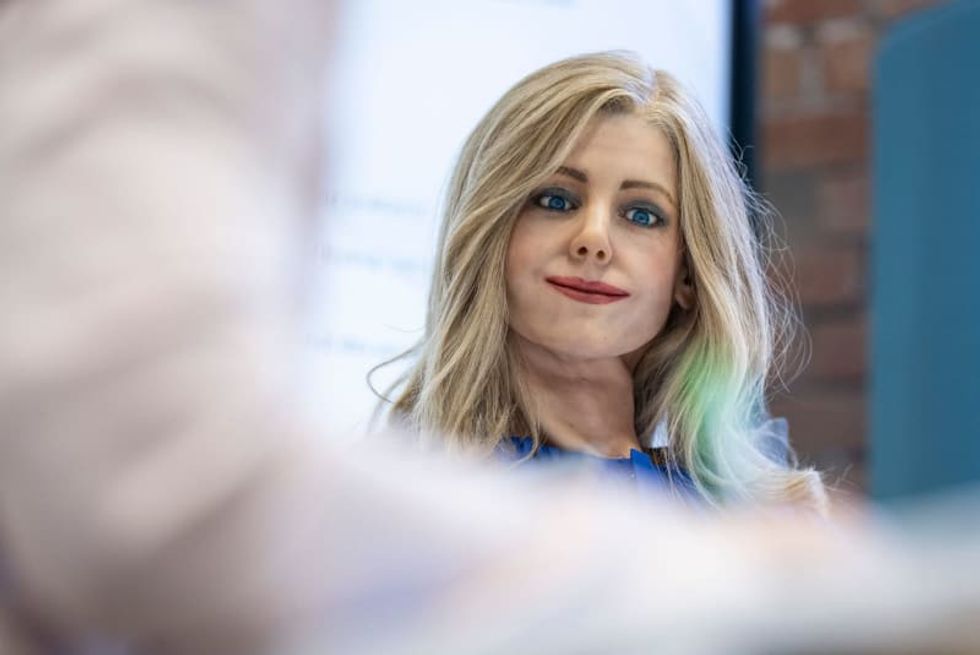
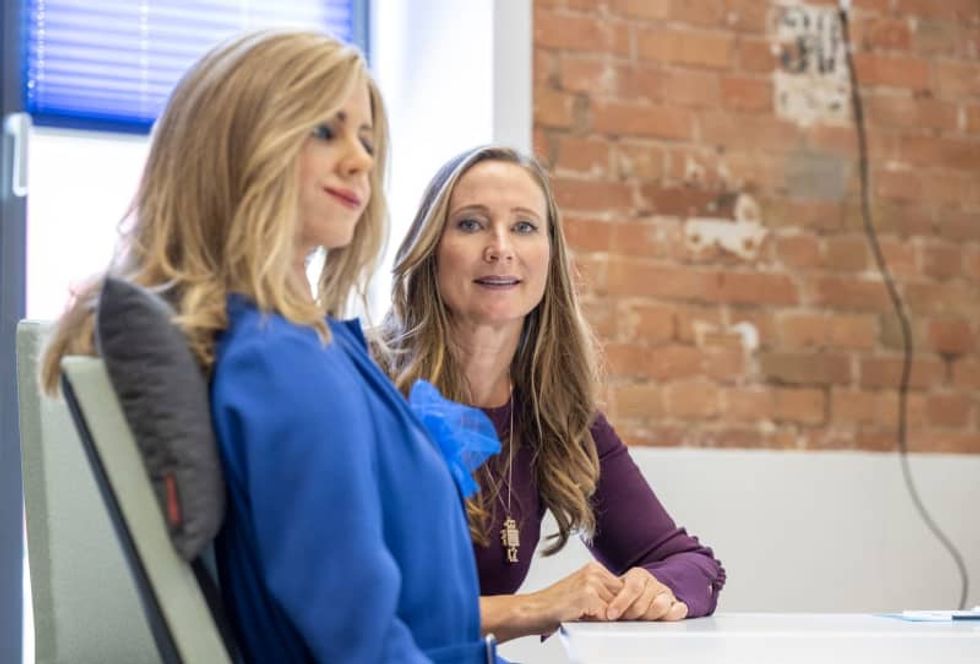
Lena sits relaxed in her office chair, smiles and occasionally blinks as she chats about her projects with other members of the team and comes up with ways to solve problems.
But as an android robot, Lena is not your average co-worker. Kitted out with artificial intelligence (AI), she can be compared with Commander Data from "Starship Enterprise," though she is not yet as smart, articulate and nimble as her TV counterpart.
A blonde robot woman with red lips, she is also not designed for intergalactic travel but to work in an office.
Robots like Lena may soon be at work in many settings. "For service or office work, this is very, very new," says Bettina-Johanna Krings from the Institute for Technology Assessment and Systems Analysis at Germany's Karlsruhe Institute of Technology (KIT).
AI robots have already started working in support roles, such as taking on straightforward tasks at a reception desk, for example.
"In industrial settings, AI already decides autonomously, for example, when to turn off machines," says Krings, whose institute does not work with Lena.
Lena recently passed a test to assess how suitable she is to be a team member. She spent eight weeks working in an office environment with several different groups.
She and the groups were working on finding an innovative product and applying for EU funding, in a project run by the Leap in Time Lab research unit in Darmstadt, Germany, which created Lena together with a company.
Other team members came to appreciate their robo-colleague. "It was a bit difficult at the beginning," says Jil-Amy Leber. But she liked the fact that Lena came up with her own suggestions, interacted like a human and also gave presentations.
Julia Gimbel, another colleague, also came to value the robot. "I found her to be very communicative." Lena also asked questions, she says, and wasn't seen as just a database. Unlike a regular computer, Lena also turns to look at the person she is talking to.
The robot "increased its vocabulary, learned language and understood better and better what people wanted," says Ruth Stock-Homburg, founder of the Leap in Time Lab and professor of business administration at the Technical University of Darmstadt.
The project was set up as a competition, with seven teams addressing the same tasks, under the same conditions and for the same amount of time.
Four teams worked with the android robot, two with an AI box and one without artificial intelligence. An independent jury then assessed the results.
"We found that the teams that worked with AI were ahead," says Stock-Homburg, who founded the lab in 2016. "In two teams, the crucial idea came from the AI."
Meanwhile the people using a regular computer box viewed it as just a tool, while Lena's colleagues saw her as a team member, she says.
The robot "has shown that it can do more than just data-driven tasks," says Dietmar Eidens, global head of human resources at the pharmaceutical and technology group Merck which worked on the project together with the Leap in Time Lab.
What was more surprising was the way the robot commented on team members' ideas or generated its own ideas, says Eidens. What impressed him was the clarity and dominance of the robot's contributions.
Merck is hoping to use the technology in office settings in the medium or long term, he says. As an HR professional, looking at the future, for Eidens, "the question is how we can counter the shortage of skilled workers in the medium and long term with new, different measures than the usual ones."
There are some hurdles to clear first, though, he says. "There is the whole issue of data security. This must be absolutely guaranteed, especially if this technology is integrated into a company's established IT. That has to be the aim," says Eidens.
The main question is not whether the technology is available, he says. "We are way beyond the question, is it feasible?" Now, the key point is how fast production can be ramped up.
But a further area to consider is the robot's future colleagues, says Krings. How do you want your people and robots to work together? "You have to think carefully about how you use them, what role they take on."
Developing Lena has cost between $2 million and $3 million so far, according to Stock-Homburg. "After all, in the beginning the robot was just a doll that moved, we had to integrate all the systems into the robot."
Lena currently only speaks English, but is expected to learn other languages in the future.
Her contribution goes beyond professional support. Team members found that if you ask the right questions, she can chat and make small talk, too.
So far, they learned that Lena doesn't have a favourite song, hasn't had a date yet and doesn't see herself as a workaholic.